1
1. INTRODUCTION
Sedimentation is the tendency for particles in suspension to settle usually at the bottom
of the fluid in which they are entrained and come to rest against a “barrier”. This settling is
mainly caused by their motion through the fluid in response to different forces that acts on
them. These forces can be due to electromagnetism, centrifugal acceleration, and gravity.
The particles are usually solid, but they can be small liquid droplets, and the fluid can be either
a liquid or a gas.
Sedimentation is widely used in the industry making it one of the most important unit
operations. Sedimentation is very often used in the food industry for separating dirt and debris
from incoming raw material, crystals from their mother liquor and dust or product particles
from air streams. It is also used in water treatment. In a plant, successful sedimentation is
crucial for the overall efficiency. Some examples include the removal of:
• Chemical flocks in the chemical step.
• Grit and particulate matter in the primary settling basin (settling tanks that receive raw
wastewater prior to biological treatment are called primary tanks).
• Sludge from the bioreactor (activated sludge process).
2
2. REVIEW OF RELATED LITERATURE
2.1. Sedimentation
Sedimentation is the tendency for particles in suspension to settle usually at the bottom of
the fluid in which they are entrained and come to rest against a “barrier”. This can also be a
separation process of a dilute slurry or suspension by gravity settling into a clear fluid and a
slurry of higher solids content. This settling is mainly caused by their motion through the fluid
in response to different forces that acts on them. Some other forces include:
• Centrifugal Acceleration
• Electromagnetism
In some processes of settling and sedimentation, the purpose is to remove he particles from the
fluid stream so that the fluid is free of particle contaminants. In other processes, the particles
are recovered as the product, as in recovery of the dispersed phase in liquid-liquid extraction.
When a particle is at a sufficient distance from the walls of the container and from other
particles so that its fall is not affected by them, the process is called free settling. Interference
is less than 1% if the ratio of the particle diameter to the container diameter is less than 1:200
or if the particle concentration is 0.2% vol in the solution.
2.2. Basic Principles of particle in a fluid
The three main forces that are involved in a falling object in motion are:
• Gravitational force
• Buoyant
• Drag
In sedimentation these forces are applied because of its mechanism.
3
Considering a particle of mass m kg falling at a velocity v relative to the fluid. The density of
the particle pp kg/m3
and the fluid of p liquid. The drag force by the fluid against the particle is
also present.
The resultant force of on the body is the Fg-Fb-Fd. This resultant force must equal the
force due to acceleration:
m
𝑑𝑣
𝑑𝑡
= 𝐹𝑔 − 𝐹𝑏 − 𝐹𝑑 (1)
This equation becomes
𝑚
𝑑𝑣
𝑑𝑡
= 𝑚𝑔 − 𝑚𝑝g -
𝐶𝐷𝑣2𝑝𝐴
2
(1.2)
In laminar-flow region, called the Stokes’ law region for Nre < 1 and calculating the settling
velocity in terms of viscosity by substituting Reynolds number equation, equation 1.2 becomes
𝑣𝑓 =
𝑔𝐷2(𝑝 𝑝−𝑝)
18𝑢
(1.3)
Sedimentation Mechanism
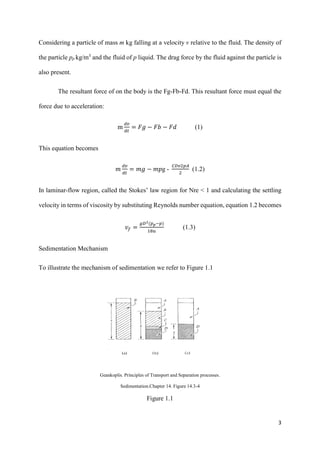
To illustrate the mechanism of sedimentation we refer to Figure 1.1
Geankoplis. Principles of Transport and Separation processes.
Sedimentation.Chapter 14. Figure 14.3-4
Figure 1.1
4
In a, all the particles settle by free settling, that is in zone B. The particles start to settle
at a uniform rate a clear liquid zone A appears. The height which is z drops at constant rate.
Also, zone D starts to appear, which contains the settles particles at the bottom. Zone C is a
transition layer which contains solid content that varies from that of B and D. In further settling,
B and C disappears, as shown in c. Then compression starts, this moment is called the critical
point. During compression, liquid is expelled from zone D thus the height of D decreases.
2.3. Determination of the settling velocity
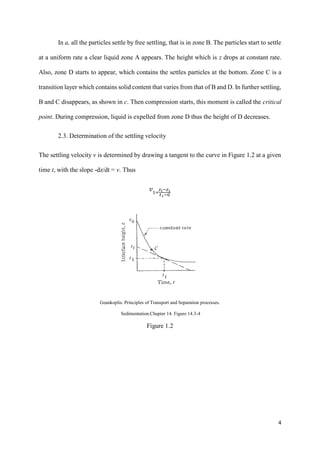
The settling velocity v is determined by drawing a tangent to the curve in Figure 1.2 at a given
time t, with the slope -dz/dt = v. Thus
𝑣1=
𝑧 𝑖−𝑧1
𝑡1−0
Geankoplis. Principles of Transport and Separation processes.
Sedimentation.Chapter 14. Figure 14.3-4
Figure 1.2
5
3. EXPERIMENTAL SECTION: APPARATUS AND PROCEDURE
3.1. Materials
• Sedimentation apparatus
• Mesh
• Stop watch
• Beaker
• Spatula
• Stirring rod
• Powder of calcium carbonate
3.2. Methods
3.2.1. Preparation for part A
1. The powdered calcium carbonate was sieved to achieve a uniform particle size
using the mesh.
2. Five setups were prepare using one liter of solutions containing 2%, 4%, 6%, 8%,
and 10% by weight calcium carbonate suspension in water.
3. Each slurry was placed in the sedimentation tubes at the same height. For better
readings, the light in the sedimentation apparatus was turned on. The interphase
height reading was read every 5 minutes.
4. Readings of the rise of sludge interphase from the base of the cylinder were
recorded.
5. Final compaction reading were read after 24 hours of settling.
3.2.2. Part B
6
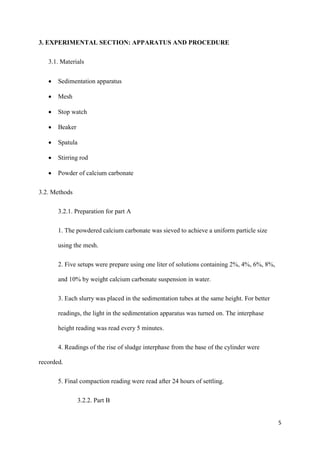
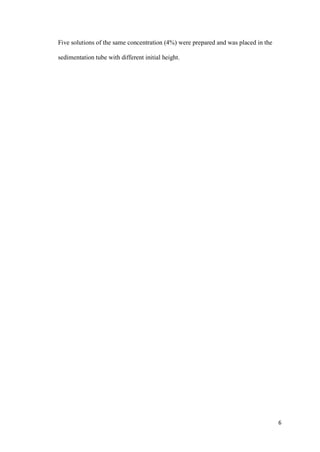
Five solutions of the same concentration (4%) were prepared and was placed in the
sedimentation tube with different initial height.
7
4. RESULTS AND DISCUSSION
4.1. Readings for Part A
Time
Interval(min)
Height of Interphase (cm)
2% 4% 6% 8% 10%
0 0 0 0 0 0
5 19 305 365 390 415
10 29 150 245 303 359
15 23 70 143 227 306
20 21 56 111 181 260.5
25 19.5 46 95 158 228
30 18 40.5 83 142 204.5
35 17.5 38 72 128.5 187
40 17 36.5 64 112 172
Table 4.1
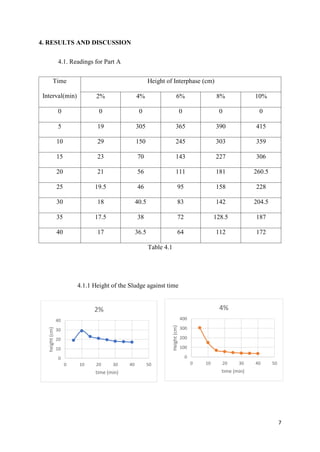
4.1.1 Height of the Sludge against time
0
10
20
30
40
0 10 20 30 40 50
height(cm)
time (min)
2%
0
100
200
300
400
0 10 20 30 40 50
Height(cm)
time (min)
4%
8
Figure 4.1.1-1 Figure 4.1.1-2
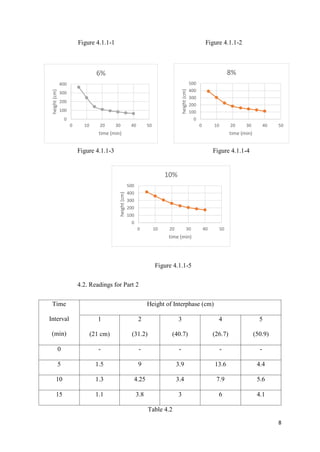
Figure 4.1.1-3 Figure 4.1.1-4
Figure 4.1.1-5
4.2. Readings for Part 2
Time
Interval
(min)
Height of Interphase (cm)
1
(21 cm)
2
(31.2)
3
(40.7)
4
(26.7)
5
(50.9)
0 - - - - -
5 1.5 9 3.9 13.6 4.4
10 1.3 4.25 3.4 7.9 5.6
15 1.1 3.8 3 6 4.1
Table 4.2
0
100
200
300
400
0 10 20 30 40 50
height(cm)
time (min)
6%
0
100
200
300
400
500
0 10 20 30 40 50
height(cm)
time (min)
8%
0
100
200
300
400
500
0 10 20 30 40 50
height(cm)
time (min)
10%
9
4.3. Data obtained from calculation
4.3.1 Concentration-Velocity Table
Time
Interval(min)
Velocity (cm/min)
2% 4% 6% 8% 10%
15-20 0.2 2.8 6.4 9.2 9.1
20-25 0.3 2 3.2 4.6 6.5
25-30 0.3 1.1 1.6 3.2 4.7
30-35 0.3 0.3 2.2 2.7 3.5
35-40 0.1 0.3 1.6 3.3 3
Average v 0.24 1.3 3 4.6 5.4
Table 4.3.1
4.3.2. Height- Velocity Table
Time
Interval
(min)
Height of Interphase (cm)
1
(21 cm)
2
(31.2)
3
(40.7)
4
(26.7)
5
(50.9)
5-10 0.04 0.95 0.1 1.14 0.24
10-15 0.04 0.09 0.08 0.38 0.3
Average v 0.04 0.52 0.09 0.76 0.27
Table 4.3.2
10
4.4. Discussion:
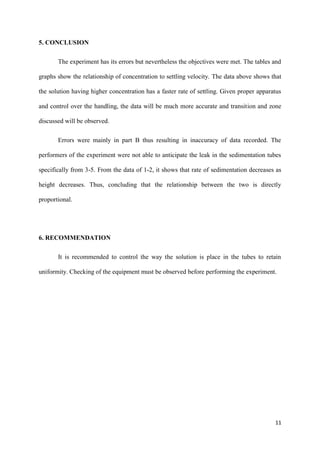
In table 4.1 different concentrations of Calcium Carbonate are place in the
sedimentation tube. The readings are taken upon the interval of 5 minutes. The performers of
the experiment failed to record the initial reading. The graphs (figure 3.1-3.5) furthermore give
information about the relationship of settling distance over time.
In table 4.2 same composition of solution but with different height. The readings are
taken upon the interval of 5 minutes. No graph is available due to lack of time in performing
the experiment.
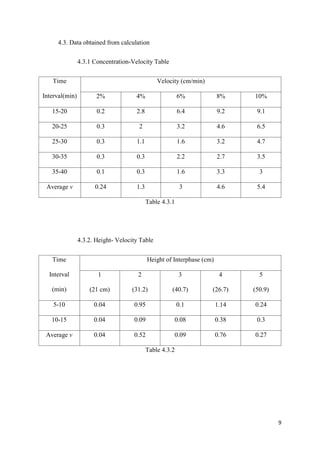
In table 4.3.1 shows the relationship of concentration and velocity. Shown are the
results in the velocity calculations between the interval of 5 minutes starting from 15 minutes
from placement of solution. This is because each tube is subjective to the way the performer
places the solution, if he/she places it with force or not varies thus the calculations are based
on 15 minutes for uniformity.
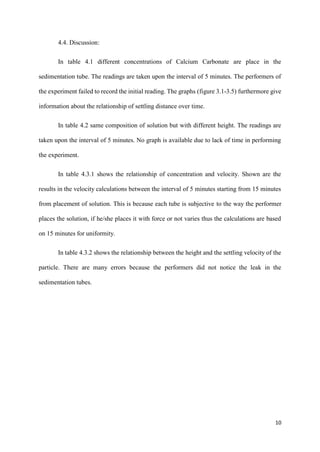
In table 4.3.2 shows the relationship between the height and the settling velocity of the
particle. There are many errors because the performers did not notice the leak in the
sedimentation tubes.
11
5. CONCLUSION
The experiment has its errors but nevertheless the objectives were met. The tables and
graphs show the relationship of concentration to settling velocity. The data above shows that
the solution having higher concentration has a faster rate of settling. Given proper apparatus
and control over the handling, the data will be much more accurate and transition and zone
discussed will be observed.
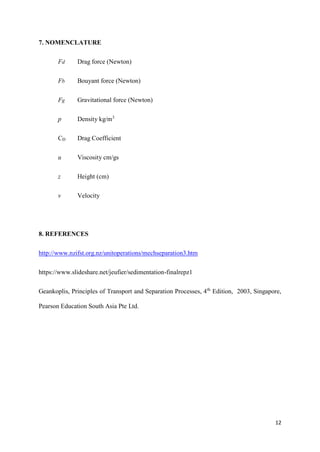
Errors were mainly in part B thus resulting in inaccuracy of data recorded. The
performers of the experiment were not able to anticipate the leak in the sedimentation tubes
specifically from 3-5. From the data of 1-2, it shows that rate of sedimentation decreases as
height decreases. Thus, concluding that the relationship between the two is directly
proportional.
6. RECOMMENDATION
It is recommended to control the way the solution is place in the tubes to retain
uniformity. Checking of the equipment must be observed before performing the experiment.
12
7. NOMENCLATURE
Fd Drag force (Newton)
Fb Bouyant force (Newton)
Fg Gravitational force (Newton)
p Density kg/m3
CD Drag Coefficient
u Viscosity cm/gs
z Height (cm)
v Velocity
8. REFERENCES
http://www.nzifst.org.nz/unitoperations/mechseparation3.htm
https://www.slideshare.net/jeufier/sedimentation-finalrepz1
Geankoplis, Principles of Transport and Separation Processes, 4th
Edition, 2003, Singapore,
Pearson Education South Asia Pte Ltd.
13

Sedimentation Ed Ryan M. Ruales

  • 1.
    1 1. INTRODUCTION Sedimentation isthe tendency for particles in suspension to settle usually at the bottom of the fluid in which they are entrained and come to rest against a “barrier”. This settling is mainly caused by their motion through the fluid in response to different forces that acts on them. These forces can be due to electromagnetism, centrifugal acceleration, and gravity. The particles are usually solid, but they can be small liquid droplets, and the fluid can be either a liquid or a gas. Sedimentation is widely used in the industry making it one of the most important unit operations. Sedimentation is very often used in the food industry for separating dirt and debris from incoming raw material, crystals from their mother liquor and dust or product particles from air streams. It is also used in water treatment. In a plant, successful sedimentation is crucial for the overall efficiency. Some examples include the removal of: • Chemical flocks in the chemical step. • Grit and particulate matter in the primary settling basin (settling tanks that receive raw wastewater prior to biological treatment are called primary tanks). • Sludge from the bioreactor (activated sludge process).
  • 2.
    2 2. REVIEW OFRELATED LITERATURE 2.1. Sedimentation Sedimentation is the tendency for particles in suspension to settle usually at the bottom of the fluid in which they are entrained and come to rest against a “barrier”. This can also be a separation process of a dilute slurry or suspension by gravity settling into a clear fluid and a slurry of higher solids content. This settling is mainly caused by their motion through the fluid in response to different forces that acts on them. Some other forces include: • Centrifugal Acceleration • Electromagnetism In some processes of settling and sedimentation, the purpose is to remove he particles from the fluid stream so that the fluid is free of particle contaminants. In other processes, the particles are recovered as the product, as in recovery of the dispersed phase in liquid-liquid extraction. When a particle is at a sufficient distance from the walls of the container and from other particles so that its fall is not affected by them, the process is called free settling. Interference is less than 1% if the ratio of the particle diameter to the container diameter is less than 1:200 or if the particle concentration is 0.2% vol in the solution. 2.2. Basic Principles of particle in a fluid The three main forces that are involved in a falling object in motion are: • Gravitational force • Buoyant • Drag In sedimentation these forces are applied because of its mechanism.
  • 3.
    3 Considering a particleof mass m kg falling at a velocity v relative to the fluid. The density of the particle pp kg/m3 and the fluid of p liquid. The drag force by the fluid against the particle is also present. The resultant force of on the body is the Fg-Fb-Fd. This resultant force must equal the force due to acceleration: m 𝑑𝑣 𝑑𝑡 = 𝐹𝑔 − 𝐹𝑏 − 𝐹𝑑 (1) This equation becomes 𝑚 𝑑𝑣 𝑑𝑡 = 𝑚𝑔 − 𝑚𝑝g - 𝐶𝐷𝑣2𝑝𝐴 2 (1.2) In laminar-flow region, called the Stokes’ law region for Nre < 1 and calculating the settling velocity in terms of viscosity by substituting Reynolds number equation, equation 1.2 becomes 𝑣𝑓 = 𝑔𝐷2(𝑝 𝑝−𝑝) 18𝑢 (1.3) Sedimentation Mechanism To illustrate the mechanism of sedimentation we refer to Figure 1.1 Geankoplis. Principles of Transport and Separation processes. Sedimentation.Chapter 14. Figure 14.3-4 Figure 1.1
  • 4.
    4 In a, allthe particles settle by free settling, that is in zone B. The particles start to settle at a uniform rate a clear liquid zone A appears. The height which is z drops at constant rate. Also, zone D starts to appear, which contains the settles particles at the bottom. Zone C is a transition layer which contains solid content that varies from that of B and D. In further settling, B and C disappears, as shown in c. Then compression starts, this moment is called the critical point. During compression, liquid is expelled from zone D thus the height of D decreases. 2.3. Determination of the settling velocity The settling velocity v is determined by drawing a tangent to the curve in Figure 1.2 at a given time t, with the slope -dz/dt = v. Thus 𝑣1= 𝑧 𝑖−𝑧1 𝑡1−0 Geankoplis. Principles of Transport and Separation processes. Sedimentation.Chapter 14. Figure 14.3-4 Figure 1.2
  • 5.
    5 3. EXPERIMENTAL SECTION:APPARATUS AND PROCEDURE 3.1. Materials • Sedimentation apparatus • Mesh • Stop watch • Beaker • Spatula • Stirring rod • Powder of calcium carbonate 3.2. Methods 3.2.1. Preparation for part A 1. The powdered calcium carbonate was sieved to achieve a uniform particle size using the mesh. 2. Five setups were prepare using one liter of solutions containing 2%, 4%, 6%, 8%, and 10% by weight calcium carbonate suspension in water. 3. Each slurry was placed in the sedimentation tubes at the same height. For better readings, the light in the sedimentation apparatus was turned on. The interphase height reading was read every 5 minutes. 4. Readings of the rise of sludge interphase from the base of the cylinder were recorded. 5. Final compaction reading were read after 24 hours of settling. 3.2.2. Part B
  • 6.
    6 Five solutions ofthe same concentration (4%) were prepared and was placed in the sedimentation tube with different initial height.
  • 7.
    7 4. RESULTS ANDDISCUSSION 4.1. Readings for Part A Time Interval(min) Height of Interphase (cm) 2% 4% 6% 8% 10% 0 0 0 0 0 0 5 19 305 365 390 415 10 29 150 245 303 359 15 23 70 143 227 306 20 21 56 111 181 260.5 25 19.5 46 95 158 228 30 18 40.5 83 142 204.5 35 17.5 38 72 128.5 187 40 17 36.5 64 112 172 Table 4.1 4.1.1 Height of the Sludge against time 0 10 20 30 40 0 10 20 30 40 50 height(cm) time (min) 2% 0 100 200 300 400 0 10 20 30 40 50 Height(cm) time (min) 4%
  • 8.
    8 Figure 4.1.1-1 Figure4.1.1-2 Figure 4.1.1-3 Figure 4.1.1-4 Figure 4.1.1-5 4.2. Readings for Part 2 Time Interval (min) Height of Interphase (cm) 1 (21 cm) 2 (31.2) 3 (40.7) 4 (26.7) 5 (50.9) 0 - - - - - 5 1.5 9 3.9 13.6 4.4 10 1.3 4.25 3.4 7.9 5.6 15 1.1 3.8 3 6 4.1 Table 4.2 0 100 200 300 400 0 10 20 30 40 50 height(cm) time (min) 6% 0 100 200 300 400 500 0 10 20 30 40 50 height(cm) time (min) 8% 0 100 200 300 400 500 0 10 20 30 40 50 height(cm) time (min) 10%
  • 9.
    9 4.3. Data obtainedfrom calculation 4.3.1 Concentration-Velocity Table Time Interval(min) Velocity (cm/min) 2% 4% 6% 8% 10% 15-20 0.2 2.8 6.4 9.2 9.1 20-25 0.3 2 3.2 4.6 6.5 25-30 0.3 1.1 1.6 3.2 4.7 30-35 0.3 0.3 2.2 2.7 3.5 35-40 0.1 0.3 1.6 3.3 3 Average v 0.24 1.3 3 4.6 5.4 Table 4.3.1 4.3.2. Height- Velocity Table Time Interval (min) Height of Interphase (cm) 1 (21 cm) 2 (31.2) 3 (40.7) 4 (26.7) 5 (50.9) 5-10 0.04 0.95 0.1 1.14 0.24 10-15 0.04 0.09 0.08 0.38 0.3 Average v 0.04 0.52 0.09 0.76 0.27 Table 4.3.2
  • 10.
    10 4.4. Discussion: In table4.1 different concentrations of Calcium Carbonate are place in the sedimentation tube. The readings are taken upon the interval of 5 minutes. The performers of the experiment failed to record the initial reading. The graphs (figure 3.1-3.5) furthermore give information about the relationship of settling distance over time. In table 4.2 same composition of solution but with different height. The readings are taken upon the interval of 5 minutes. No graph is available due to lack of time in performing the experiment. In table 4.3.1 shows the relationship of concentration and velocity. Shown are the results in the velocity calculations between the interval of 5 minutes starting from 15 minutes from placement of solution. This is because each tube is subjective to the way the performer places the solution, if he/she places it with force or not varies thus the calculations are based on 15 minutes for uniformity. In table 4.3.2 shows the relationship between the height and the settling velocity of the particle. There are many errors because the performers did not notice the leak in the sedimentation tubes.
  • 11.
    11 5. CONCLUSION The experimenthas its errors but nevertheless the objectives were met. The tables and graphs show the relationship of concentration to settling velocity. The data above shows that the solution having higher concentration has a faster rate of settling. Given proper apparatus and control over the handling, the data will be much more accurate and transition and zone discussed will be observed. Errors were mainly in part B thus resulting in inaccuracy of data recorded. The performers of the experiment were not able to anticipate the leak in the sedimentation tubes specifically from 3-5. From the data of 1-2, it shows that rate of sedimentation decreases as height decreases. Thus, concluding that the relationship between the two is directly proportional. 6. RECOMMENDATION It is recommended to control the way the solution is place in the tubes to retain uniformity. Checking of the equipment must be observed before performing the experiment.
  • 12.
    12 7. NOMENCLATURE Fd Dragforce (Newton) Fb Bouyant force (Newton) Fg Gravitational force (Newton) p Density kg/m3 CD Drag Coefficient u Viscosity cm/gs z Height (cm) v Velocity 8. REFERENCES http://www.nzifst.org.nz/unitoperations/mechseparation3.htm https://www.slideshare.net/jeufier/sedimentation-finalrepz1 Geankoplis, Principles of Transport and Separation Processes, 4th Edition, 2003, Singapore, Pearson Education South Asia Pte Ltd.
  • 13.