"The love ofa family is life's greatest blessing."
Name: Bushra Fatima
College Name: Malla Reddy College of Education
Course: M.ed Semester 1
Subject: Advanced Educational Psychology
Paper:EDN-02
Topic: Bronfenbrenner’s Ecological Systems Theory
Roll No:2485-24-709-029
Preliminary Details
2.
"The love ofa family
is life's greatest
blessing."
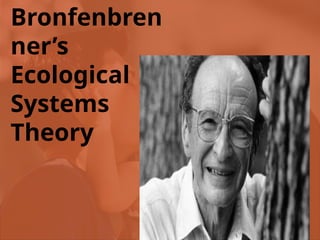
Bronfenbren
ner’s
Ecological
Systems
Theory
Background On Urie
Bronfenbrenner
Urie Bronfenbrenner was born in Moscow,
Russia, in 1917 and experienced turmoil in
his home country as a child before
immigrating to the United States at age 6.
Witnessing the difficulties faced by children
during the unrest and rapid social change in
Russia shaped his ideas about how
environmental factors can influence child
development.
Bronfenbrenner went on to earn a Ph.D. in
developmental psychology from the
University of Michigan in 1942.
6.
Critique of LabStudies
Criticized lab-based research (e.g., Mary Ainsworth’s Strange Situation, 1970)
for lacking ecological validity.
Argued that these studies failed to account for reciprocal influences between
children and their environments.
Highlighted the need to consider broader environmental forces affecting
development.
Influence of Other Theories
Built on concepts from:
• Vygotsky’s Sociocultural Theory – Emphasized the role of social interaction in
learning.
• Bandura’s Social Learning Theory – Focused on learning through observation
and modeling.
7.
The Five Ecological
Systems
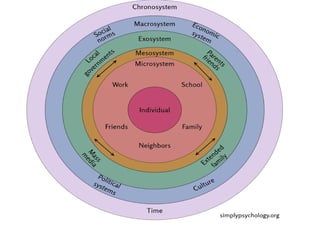
Bronfenbrenner (1977) suggested
that the child’s environment is a
nested arrangement of structures,
each contained within the next. He
organized them in order of how
much of an impact they have on a
child.
He named these structures the
microsystem, mesosystem,
exosystem, macrosystem and the
chronosystem.
Because the five systems are
interrelated, the influence of one
system on a child’s development
depends on its relationship with the
others.
9.
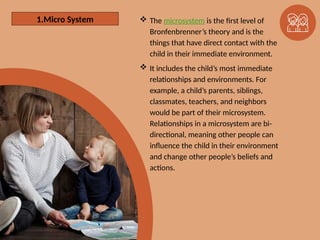
1. The Microsystem The microsystem is the first level of
Bronfenbrenner’s theory and is the
things that have direct contact with the
child in their immediate environment.
It includes the child’s most immediate
relationships and environments. For
example, a child’s parents, siblings,
classmates, teachers, and neighbors
would be part of their microsystem.
Relationships in a microsystem are bi-
directional, meaning other people can
influence the child in their environment
and change other people’s beliefs and
actions.
1.Micro System
10.
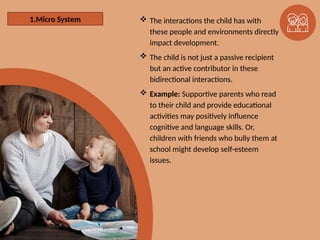
1. The Microsystem The interactions the child has with
these people and environments directly
impact development.
The child is not just a passive recipient
but an active contributor in these
bidirectional interactions.
Example: Supportive parents who read
to their child and provide educational
activities may positively influence
cognitive and language skills. Or,
children with friends who bully them at
school might develop self-esteem
issues.
1.Micro System
11.
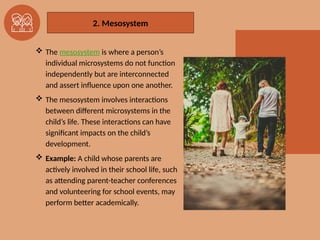
2. The Mesosystem
The mesosystem is where a person’s
individual microsystems do not function
independently but are interconnected
and assert influence upon one another.
The mesosystem involves interactions
between different microsystems in the
child’s life. These interactions can have
significant impacts on the child’s
development.
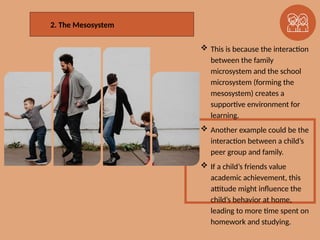
Example: A child whose parents are
actively involved in their school life, such
as attending parent-teacher conferences
and volunteering for school events, may
perform better academically.
2. Mesosystem
12.
This isbecause the interaction
between the family
microsystem and the school
microsystem (forming the
mesosystem) creates a
supportive environment for
learning.
Another example could be the
interaction between a child’s
peer group and family.
If a child’s friends value
academic achievement, this
attitude might influence the
child’s behavior at home,
leading to more time spent on
homework and studying.
2. The Mesosystem
13.
3. The Exosystem
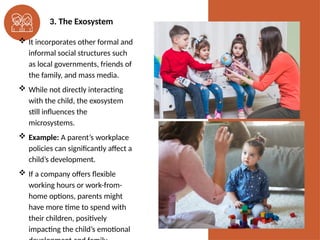
It incorporates other formal and
informal social structures such
as local governments, friends of
the family, and mass media.
While not directly interacting
with the child, the exosystem
still influences the
microsystems.
Example: A parent’s workplace
policies can significantly affect a
child’s development.
If a company offers flexible
working hours or work-from-
home options, parents might
have more time to spend with
their children, positively
impacting the child’s emotional
14.
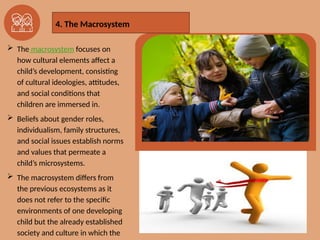
The macrosystemfocuses on
how cultural elements affect a
child’s development, consisting
of cultural ideologies, attitudes,
and social conditions that
children are immersed in.
Beliefs about gender roles,
individualism, family structures,
and social issues establish norms
and values that permeate a
child’s microsystems.
The macrosystem differs from
the previous ecosystems as it
does not refer to the specific
environments of one developing
child but the already established
society and culture in which the
4. The Macrosystem
15.
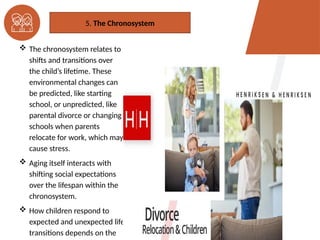
The chronosystemrelates to
shifts and transitions over
the child’s lifetime. These
environmental changes can
be predicted, like starting
school, or unpredicted, like
parental divorce or changing
schools when parents
relocate for work, which may
cause stress.
Aging itself interacts with
shifting social expectations
over the lifespan within the
chronosystem.
How children respond to
expected and unexpected life
transitions depends on the
5. The Chronosystem
16.
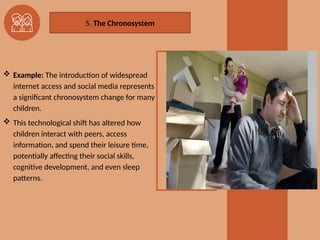
Example: Theintroduction of widespread
internet access and social media represents
a significant chronosystem change for many
children.
This technological shift has altered how
children interact with peers, access
information, and spend their leisure time,
potentially affecting their social skills,
cognitive development, and even sleep
patterns.
5. The Chronosystem
The EcologicalSystems Theory has
been used to link psychological and
educational theory to early
educational curriculums and
practice.
The developing child is at the center
of the theory, and all that occurs
within and between the five
ecological systems is done to benefit
the child in the classroom.
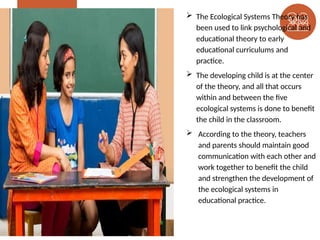
According to the theory, teachers
and parents should maintain good
communication with each other and
work together to benefit the child
and strengthen the development of
the ecological systems in
educational practice.
19.
Teachers shouldalso understand the
situations their students’ families may be
experiencing, including social and economic
factors that are part of the various systems.
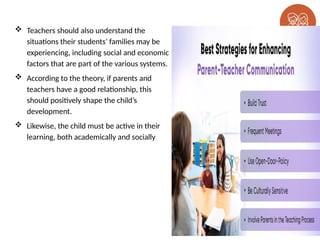
According to the theory, if parents and
teachers have a good relationship, this
should positively shape the child’s
development.
Likewise, the child must be active in their
learning, both academically and socially
20.
Limitations of the
Ecologicalsystem
Theory
Limited Research on Mesosystems:
Difficulty in Empirical Testing:
Risk of Overgeneralization:
Context-Specific Variations:
Need to Avoid Broad Assumptions: