Bronchiectasis
- Dr Rahul Arya
- Assistant Professor
- Department of Medicine
• Bronchiectasis refers to an irreversible airway dilation of lungs.
• It involves the lung in either a focal or a diffuse manner and that
classically has been categorized as cylindrical or tubular (the most
common form), varicose, or cystic.
Etiology
1) Focal bronchiectasis- refers to bronchiectatic changes in a
localized area of the lung.
Causes:-
• Obstruction of the airway-
i. Extrinsic- compression by adjacent lymphadenopathy or
parenchymal tumor mass.
ii. Intrinsic- due to an airway tumor or aspirated foreign body, a
scarred/stenotic airway, or bronchial atresia from congenital
underdevelopment of the airway
2) Diffuse bronchiectasis- It is characterized by widespread
bronchiectatic changes throughout the lung.
Causes:-
a) Infection- bacterial, nontuberculous mycobacterial
b) Immunodeficiency-hypogammaglobulinemia, HIV infection.
c) Genetic causes-Cystic fibrosis,α1 antitrypsin deficiency.
d) Autoimmune or rheumatologic causes- Rheumatoid arthritis, Sjogren’s
syndrome, inflammatory bowel disease
e) Immune mediated disease- Allergic bronchopulmonary aspergillosis
f) Miscellaneous- traction bronchiectasis from postradiation fibrosis
or idiopathic pulmonary fibrosis, recurrent aspiration.
g) Idiopathic
Epidemiology
• Incidence increases with age.
• Women > men
Pathogenesis and Pathology
• Vicious cycle hypothesis
• Susceptibility to infection and poor mucociliary clearance result in
microbial colonization of the bronchial tree.
• The presence of the microbes incites continued chronic
inflammation, with consequent damage to the airway wall,
continued impairment of secretion and microbial clearance, and
ongoing propagation of the infectious/inflammatory cycle.
• Small-airway wall inflammation and larger airway wall destruction
as well as dilation, with loss of elastin, smooth muscle, and
cartilage.
• Inflammatory cells in the small airways release proteases and
other mediators, such as reactive oxygen species and
proinflammatory cytokines, that damage the larger-airway walls.
• The ongoing inflammatory process in the smaller airways results in
airflow obstruction.
• Mechanisms for noninfectious bronchiectasis include immune-
mediated reactions that damage the bronchial wall.
Clinical Manifestations
• Persistent productive cough.
• Sputum- thick, tenacious.
• Physical Examination-
- lung auscultation Crackles and Ronchi.
- Clubbing of the digits.
Diagnosis
• Chest radiographs-lack
sensitivity.
• Presence of “tram tracks”
indicating dilated airways is
consistent with bronchiectasis.
CT- THORAX
• Chest computed tomography-imaging
modality of choice.
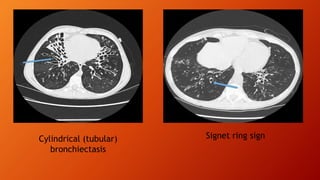
• CT findings include airway dilation
(detected as parallel “tram tracks”
or as the “signet-ring sign”—a cross-
sectional area of the airway with a
diameter at least 1.5 times that of
the adjacent vessel),
• Lack of bronchial tapering (including
the presence of tubular structures
within 1 cm from the pleural
surface),
• Bronchial wall thickening in dilated
airways, inspissated secretions (e.g.,
the “tree-in-bud” pattern),
• Cysts emanating from the bronchial
wall (especially pronounced in cystic
bronchiectasis
Signet ring signCylindrical (tubular)
bronchiectasis
Treatment
• Goals of treatment:-
1. Control of active infection.
2. Improvements in secretion clearance and bronchial hygiene so
as to decrease the microbial load within the airways.
3. Minimize the risk of repeated infections.
ANTIBIOTIC TREATMENT
• Antibiotics targeting the causative or presumptive pathogen
should be administered in acute exacerbations, usually for a
minimum of 7–10 days.
• For NTM (usually MAC)- Macrolide combined with rifampin and
ethambutol.
BRONCHIAL HYGIENE
• Approaches used to enhance secretion clearance in bronchiectasis
include:-
i. Hydration and mucolytic administration
ii. Aerosolization of bronchodilators
iii. Hyperosmolar agents (e.g., hypertonic saline)
iv. Chest physiotherapy.
ANTI-INFLAMMATORY THERAPY
• Oral/systemic glucocorticoids- ABPA
-non infectious bronchiectasis
REFRACTORY CASES
• Resection of a focal area of suppuration.
• In advanced cases, lung transplantation can be considered.
Complications
• Recurrent infections can result in injury to superficial mucosal
vessels, with bleeding and, in severe cases, life-threatening
hemoptysis.
Prevention
(1) Administration of an oral antibiotic (e.g., ciprofloxacin) daily for 1–2
weeks per month.
(2) Use of a rotating schedule of oral antibiotics.
(3) Administration of a macrolide antibiotic daily or three times per week.
(4) Inhalation of aerosolized antibiotics (e.g., tobramycin inhalation
solution) on a rotating schedule (e.g., 30 days on, 30 days off ),
with the goal of decreasing the microbial load without eliciting the
side effects of systemic drug administration.
(5) Intermittent administration of IV antibiotics for patients with
more severe bronchiectasis and/or resistant pathogens.
(6) Bronchial hygiene- promote secretion clearance and decrease
the microbial load in the airways.
Thank You

Bronchiectasis

  • 1.
    Bronchiectasis - Dr RahulArya - Assistant Professor - Department of Medicine
  • 2.
    • Bronchiectasis refersto an irreversible airway dilation of lungs. • It involves the lung in either a focal or a diffuse manner and that classically has been categorized as cylindrical or tubular (the most common form), varicose, or cystic.
  • 3.
    Etiology 1) Focal bronchiectasis-refers to bronchiectatic changes in a localized area of the lung. Causes:- • Obstruction of the airway- i. Extrinsic- compression by adjacent lymphadenopathy or parenchymal tumor mass. ii. Intrinsic- due to an airway tumor or aspirated foreign body, a scarred/stenotic airway, or bronchial atresia from congenital underdevelopment of the airway
  • 4.
    2) Diffuse bronchiectasis-It is characterized by widespread bronchiectatic changes throughout the lung. Causes:- a) Infection- bacterial, nontuberculous mycobacterial b) Immunodeficiency-hypogammaglobulinemia, HIV infection. c) Genetic causes-Cystic fibrosis,α1 antitrypsin deficiency. d) Autoimmune or rheumatologic causes- Rheumatoid arthritis, Sjogren’s syndrome, inflammatory bowel disease e) Immune mediated disease- Allergic bronchopulmonary aspergillosis
  • 5.
    f) Miscellaneous- tractionbronchiectasis from postradiation fibrosis or idiopathic pulmonary fibrosis, recurrent aspiration. g) Idiopathic
  • 6.
    Epidemiology • Incidence increaseswith age. • Women > men
  • 7.
    Pathogenesis and Pathology •Vicious cycle hypothesis • Susceptibility to infection and poor mucociliary clearance result in microbial colonization of the bronchial tree. • The presence of the microbes incites continued chronic inflammation, with consequent damage to the airway wall, continued impairment of secretion and microbial clearance, and ongoing propagation of the infectious/inflammatory cycle.
  • 8.
    • Small-airway wallinflammation and larger airway wall destruction as well as dilation, with loss of elastin, smooth muscle, and cartilage. • Inflammatory cells in the small airways release proteases and other mediators, such as reactive oxygen species and proinflammatory cytokines, that damage the larger-airway walls. • The ongoing inflammatory process in the smaller airways results in airflow obstruction.
  • 9.
    • Mechanisms fornoninfectious bronchiectasis include immune- mediated reactions that damage the bronchial wall.
  • 10.
    Clinical Manifestations • Persistentproductive cough. • Sputum- thick, tenacious. • Physical Examination- - lung auscultation Crackles and Ronchi. - Clubbing of the digits.
  • 11.
    Diagnosis • Chest radiographs-lack sensitivity. •Presence of “tram tracks” indicating dilated airways is consistent with bronchiectasis.
  • 12.
    CT- THORAX • Chestcomputed tomography-imaging modality of choice. • CT findings include airway dilation (detected as parallel “tram tracks” or as the “signet-ring sign”—a cross- sectional area of the airway with a diameter at least 1.5 times that of the adjacent vessel), • Lack of bronchial tapering (including the presence of tubular structures within 1 cm from the pleural surface), • Bronchial wall thickening in dilated airways, inspissated secretions (e.g., the “tree-in-bud” pattern), • Cysts emanating from the bronchial wall (especially pronounced in cystic bronchiectasis
  • 13.
    Signet ring signCylindrical(tubular) bronchiectasis
  • 14.
    Treatment • Goals oftreatment:- 1. Control of active infection. 2. Improvements in secretion clearance and bronchial hygiene so as to decrease the microbial load within the airways. 3. Minimize the risk of repeated infections.
  • 15.
    ANTIBIOTIC TREATMENT • Antibioticstargeting the causative or presumptive pathogen should be administered in acute exacerbations, usually for a minimum of 7–10 days. • For NTM (usually MAC)- Macrolide combined with rifampin and ethambutol.
  • 16.
    BRONCHIAL HYGIENE • Approachesused to enhance secretion clearance in bronchiectasis include:- i. Hydration and mucolytic administration ii. Aerosolization of bronchodilators iii. Hyperosmolar agents (e.g., hypertonic saline) iv. Chest physiotherapy.
  • 17.
    ANTI-INFLAMMATORY THERAPY • Oral/systemicglucocorticoids- ABPA -non infectious bronchiectasis
  • 18.
    REFRACTORY CASES • Resectionof a focal area of suppuration. • In advanced cases, lung transplantation can be considered.
  • 19.
    Complications • Recurrent infectionscan result in injury to superficial mucosal vessels, with bleeding and, in severe cases, life-threatening hemoptysis.
  • 20.
    Prevention (1) Administration ofan oral antibiotic (e.g., ciprofloxacin) daily for 1–2 weeks per month. (2) Use of a rotating schedule of oral antibiotics. (3) Administration of a macrolide antibiotic daily or three times per week.
  • 21.
    (4) Inhalation ofaerosolized antibiotics (e.g., tobramycin inhalation solution) on a rotating schedule (e.g., 30 days on, 30 days off ), with the goal of decreasing the microbial load without eliciting the side effects of systemic drug administration. (5) Intermittent administration of IV antibiotics for patients with more severe bronchiectasis and/or resistant pathogens.
  • 22.
    (6) Bronchial hygiene-promote secretion clearance and decrease the microbial load in the airways.
  • 23.