Beka Aberra [Internal Medicine - R2]
Dermatology Attachment
April 9, 2019
Objectives
Introduction
Classification
Clinical Manifestations
Laboratory
Diagnosis
Management
MOTT
References
 To Explain the Pathogenesis of Cutaneous Tuberculosis
 To Explain the Classifications of Cutaneous Tuberculosis
 To Explain the Clinical manifestations of Cutaneous Tuberculosis
 To Have a diagnostic approach towards Cutaneous Tuberculosis
 To Have a management approach towards Cutaneous Tuberculosis
 Tuberculosis (TB) is a mycobacterial infection that most frequently occurs due to
infection with Mycobacterium tuberculosis, an acid-fast bacillus.
 The high prevalence of TB worldwide, its transmissible nature, & the significant
morbidity & mortality associated with this infection account for the status of TB
as a major public health concern.
Cutaneous TB
 Factors such as the pathway of bacterial entry into the skin, the host's immune
status, & the presence or absence of host sensitization to M. tuberculosis influence
the morphologic presentation of TB in the skin.
 The clinical findings vary; Inflammatory papules, Verrucous plaques, Suppurative
nodules, Chronic ulcers, or other lesions may be seen.
 Cutaneous TB was first documented in 1826, when Laennec reported his own
prosector's wart," a lesion that likely represented tuberculosis verrucosa cutis, a
variant of TB that results from direct entry of the organism into the skin.
 However, the causative organism of TB was unknown until Robert Koch
discovered Mycobacterium tuberculosis in 1882. Later on Detected in cutaneous
lesions.
 Cutaneous lesions are relatively uncommon manifestations of TB, occurring in
only 1 to 2 percent of infected patients.
 Resurgence of cutaneous TB has been noted in parts of the world where human
immunodeficiency virus (HIV) infection & multidrug-resistant TB are prevalent.
 Similar to Extra cutaneous TB, multiple diagnostic studies are utilized for the
evaluation of patients with cutaneous TB.
 The conventional techniques include
 Mycobacterial culture (the gold standard for diagnosis),
 Stained smears,
 Lesional biopsies, &
 Tuberculin skin testing.
 Interferon-gamma release assays [QuantiFeron-TB GOLD]
 PCR [Mycobacterial DNA in Lesional tissue]
 However, in Paucibacillary variants, culture, smears, & histopathology often fail.
 The Tuberculin skin test can be positive in both Multibacillary & Paucibacillary forms
of cutaneous TB; however, a positive test only identifies individuals who have been
sensitized to TB & does not confirm active TB infection.
 A therapeutic trial of anti-TB medications may be used to confirm the diagnosis of TB
in difficult cases; In cutaneous TB, a response to multidrug therapy is usually evident
within six weeks.
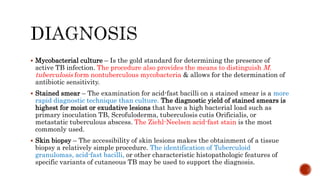
 Mycobacterial culture – Is the gold standard for determining the presence of
active TB infection. The procedure also provides the means to distinguish M.
tuberculosis form nontuberculous mycobacteria & allows for the determination of
antibiotic sensitivity.
 Stained smear – The examination for acid-fast bacilli on a stained smear is a more
rapid diagnostic technique than culture. The diagnostic yield of stained smears is
highest for moist or exudative lesions that have a high bacterial load such as
primary inoculation TB, Scrofuloderma, tuberculosis cutis Orificialis, or
metastatic tuberculous abscess. The Ziehl-Neelsen acid-fast stain is the most
commonly used.
 Skin biopsy – The accessibility of skin lesions makes the obtainment of a tissue
biopsy a relatively simple procedure. The identification of Tuberculoid
granulomas, acid-fast bacilli, or other characteristic histopathologic features of
specific variants of cutaneous TB may be used to support the diagnosis.
 A characteristic histopathologic finding in Cutaneous
TB is the Tuberculoid granuloma [Low Sn/Sp], an
accumulation of epithelioid histiocytes & Langhans-
type giant cells that demonstrates a variable degree of
central caseation necrosis & a peripheral rim
composed of numerous lymphocytes.
 Leprosy, tertiary syphilis, Granulomatous rosacea,
Leishmaniasis, Deep fungal infections, & other
disorders may also present with “Tuberculoid
granulomas”
 Sarcoidal granulomas tend to be more circumscribed,
exhibit fewer peripheral inflammatory cells (so-called
"naked granulomas"), & are less likely to have central
caseation necrosis
 Tuberculin skin test – Identifies individuals sensitized to M. tuberculosis. It has a
[Sp of 63 % & a Sn 33-96 %] for cutaneous TB that becomes higher in
unvaccinated populations. The Mantoux technique, the recommended method for
performing tuberculin skin testing “delayed hypersensitivity reaction involving T
cells”. It Can be impaired in young infants, older adults, & patients with deficient
cellular immunity, “False Negatives”.
 Interferon-gamma release assay – are serologic tests that assess for latent TB
infection via the measurement of interferon-gamma production from peripheral
blood mononuclear cells after exposure to antigens from M. tuberculosis.
[Sn of 92 % & a Sp of 76 %].
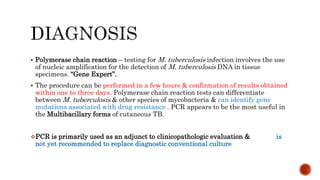
 Polymerase chain reaction – testing for M. tuberculosis infection involves the use
of nucleic amplification for the detection of M. tuberculosis DNA in tissue
specimens. “Gene Expert”.
 The procedure can be performed in a few hours & confirmation of results obtained
within one to three days. Polymerase chain reaction tests can differentiate
between M. tuberculosis & other species of mycobacteria & can identify gene
mutations associated with drug resistance . PCR appears to be the most useful in
the Multibacillary forms of cutaneous TB.
PCR is primarily used as an adjunct to clinicopathologic evaluation & is
not yet recommended to replace diagnostic conventional culture
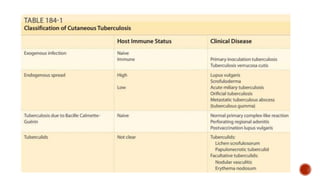
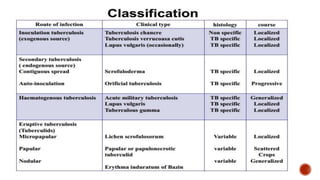
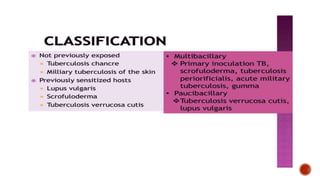
 The clinical variants of cutaneous TB may be divided into
 Infections acquired through exogenous inoculation,
 Infections that result from contiguous spread,
 Infections related to hematogenous dissemination, &
 The tuberculids.
 The tuberculids are thought to be hypersensitivity reactions to M. tuberculosis, &
include
 Papulonecrotic tuberculid,
 Lichen scrofulosorum, &
 Erythema induratum of Bazin.
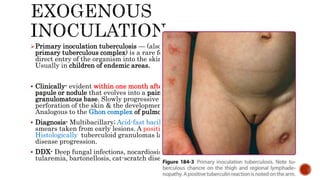
Primary inoculation tuberculosis — (also known as tuberculous chancre &
primary tuberculous complex) is a rare form of cutaneous TB that results from the
direct entry of the organism into the skin or mucosa of a nonsensitized individual.
Usually in children of endemic areas.
 Clinically- evident within one month after inoculation; nondescript red-brown
papule or nodule that evolves into a painless, shallow & undermined ulcer with a
granulomatous base. Slowly progressive & painless regional lymphadenopathy;
perforation of the skin & the development of draining sinuses occasionally.
Analogous to the Ghon complex of pulmonary TB infection.
 Diagnosis- Multibacillary; Acid-fast bacilli (AFB) are usually easily detected in
smears taken from early lesions. A positive culture confirms the diagnosis.
Histologically tuberculoid granulomas late in course; TST –ve at onset, +ve with
disease progression.
 DDX- Deep fungal infections, nocardiosis, syphilis, leishmaniasis, yaws,
tularemia, bartonellosis, cat-scratch disease, & other mycobacterioses.
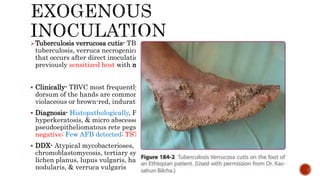
Tuberculosis verrucosa cutis- TBVC, also known as prosector's wart, anatomic
tuberculosis, verruca necrogenica, & warty tuberculosis) is a form of cutaneous TB
that occurs after direct inoculation of the mycobacteria into the skin of a
previously sensitized host with moderate to high immunity against the bacillus.
 Clinically- TBVC most frequently develops on the acral extremities; the fingers &
dorsum of the hands are commonly affected. Solitary lesions, manifest as painless,
violaceous or brown-red, indurated warty plaques, ulceration is uncommon.
 Diagnosis- Histopathologically, Pseudoepitheliomatous hyperplasia, marked
hyperkeratosis, & micro abscesses in the superficial dermis or the
pseudoepitheliomatous rete pegs; Cultures taken from lesions of TBVC are often
negative; Few AFB detected; TST Strongly +ve
 DDX- Atypical mycobacterioses, blastomycosis, Majocchi's granuloma,
chromoblastomycosis, tertiary syphilis, verrucous epidermal nevus, hypertrophic
lichen planus, lupus vulgaris, halogenoderma, benign keratoses, prurigo
nodularis, & verruca vulgaris
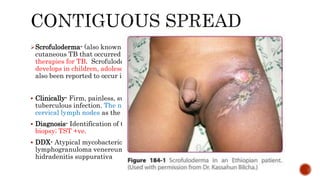
Scrofuloderma- (also known as tuberculosis colliquativa cutis) is a form of
cutaneous TB that occurred much more frequently prior to the advent of effective
therapies for TB. Scrofuloderma may occur at any age, but most commonly
develops in children, adolescents, & older adult individuals Scrofuloderma has
also been reported to occur in association with Hansen's disease & psoriasis.
 Clinically- Firm, painless, subcutaneous, red-brown nodules that overly foci of
tuberculous infection. The neck, axillae, & groin are often involved, with the
cervical lymph nodes as the most common source of infection.
 Diagnosis- Identification of the causative organism by culture, smear, or skin
biopsy; TST +ve.
 DDX- Atypical mycobacterioses, sporotrichosis, actinomycosis, coccidioidomycosis,
lymphogranuloma venereum, syphilis, severe forms of acne conglobata, &
hidradenitis suppurativa
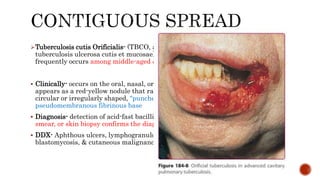
Tuberculosis cutis Orificialis- (TBCO, also known as orificial tuberculosis &
tuberculosis ulcerosa cutis et mucosae) is a rare manifestation of TB that most
frequently occurs among middle-aged & older adults.
 Clinically- occurs on the oral, nasal, or Anogenital skin or mucosa; A typical lesion
appears as a red-yellow nodule that rapidly breaks down to form a painful,
circular or irregularly shaped, "punched-out" & friable 1 to 3 cm ulcer with a
pseudomembranous fibrinous base
 Diagnosis- detection of acid-fast bacilli in affected tissue via culture, stained
smear, or skin biopsy confirms the diagnosis; TST -ve
 DDX- Aphthous ulcers, lymphogranuloma venereum, syphilis, South American
blastomycosis, & cutaneous malignancies
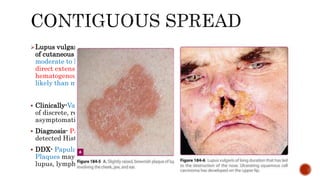
Lupus vulgaris- (also known as tuberculosis lupus) is a chronic & progressive form
of cutaneous TB that represents a reactivation of TB infection in people with
moderate to high immunity against the bacillus. It may occur either as a result of
direct extension from an underlying focus of infection or via lymphatic or
hematogenous spread. For unknown reasons, females are two to three times more
likely than males to be affected.
 Clinically-Variable, The classic plaque type of the disorder begins as a collection
of discrete, red-brown papules that subsequently coalesce to form an indolent,
asymptomatic plaque.
 Diagnosis- Paucibacillary form of cutaneous TB, & mycobacteria often cannot be
detected Histopathologically or by culture; TST +ve;
 DDX- Papular lesions should be distinguished from colloid milia, acne, & rosacea.
Plaques may resemble deep fungal infections, leishmaniasis, late syphilis, discoid
lupus, lymphocytoma cutis, tuberculoid leprosy, & pyodermatitis vegetans.
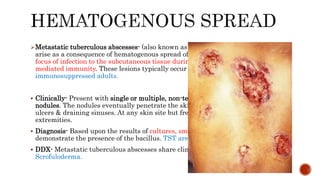
Metastatic tuberculous abscesses- (also known as tuberculous gummas) usually
arise as a consequence of hematogenous spread of the bacillus from a primary
focus of infection to the subcutaneous tissue during a state of reduced cell-
mediated immunity. These lesions typically occur in malnourished children &
immunosuppressed adults.
 Clinically- Present with single or multiple, non-tender, fluctuant, subcutaneous
nodules. The nodules eventually penetrate the skin, resulting in the formation of
ulcers & draining sinuses. At any skin site but frequently develop on the
extremities.
 Diagnosis- Based upon the results of cultures, smears, or skin biopsies that
demonstrate the presence of the bacillus. TST are variable.
 DDX- Metastatic tuberculous abscesses share clinical & histologic features with
Scrofuloderma.
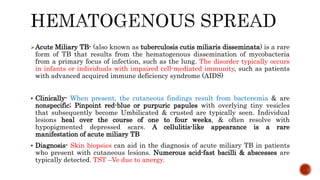
Acute Miliary TB- (also known as tuberculosis cutis miliaris disseminata) is a rare
form of TB that results from the hematogenous dissemination of mycobacteria
from a primary focus of infection, such as the lung. The disorder typically occurs
in infants or individuals with impaired cell-mediated immunity, such as patients
with advanced acquired immune deficiency syndrome (AIDS)
 Clinically- When present, the cutaneous findings result from bacteremia & are
nonspecific; Pinpoint red-blue or purpuric papules with overlying tiny vesicles
that subsequently become Umbilicated & crusted are typically seen. Individual
lesions heal over the course of one to four weeks, & often resolve with
hypopigmented depressed scars. A cellulitis-like appearance is a rare
manifestation of acute miliary TB
 Diagnosis- Skin biopsies can aid in the diagnosis of acute miliary TB in patients
who present with cutaneous lesions. Numerous acid-fast bacilli & abscesses are
typically detected. TST –Ve due to anergy.
 The pathogenesis of the disorders classified as tuberculids is not
fully understood;
 The following findings support the designation of a condition as a
tuberculid:
 Failure to detect M. tuberculosis in stains or cultures of affected tissue
 Presence of detectable extracutaneous M. tuberculosis infection, a strongly
positive tuberculin skin test, or a positive interferon-gamma release assay
(these findings support a history of exposure to the bacillus)
 Histopathologic evidence for granulomatous inflammation in skin lesions
 Frequent resolution of skin lesions with anti-TB therapy
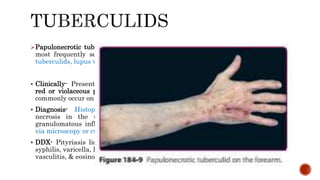
Papulonecrotic tuberculid is the most common of the tuberculid disorders. It is
most frequently seen in children & young adults . It may coexist with other
tuberculids, lupus vulgaris, & Scrofuloderma.
 Clinically- Presents as a symmetric & recurring eruption of 2 to 8 mm, firm, dark
red or violaceous papules that subsequently become pustular or necrotic; most
commonly occur on the face, ears, extensor extremities, & buttocks.
 Diagnosis- Histopathologic examination often demonstrates wedge-shaped
necrosis in the upper dermis & epidermis & nonspecific or tuberculoid
granulomatous inflammation. M. tuberculosis bacilli usually are not detectable
via microscopy or cultures. TST +ve
 DDX- Pityriasis lichenoides et varioliformis acuta (PLEVA), prurigo, secondary
syphilis, varicella, lymphomatoid papulosis, perforating disorders, leukocytoclastic
vasculitis, & eosinophilic granulomatosis with polyangiitis (Churg-Strauss).
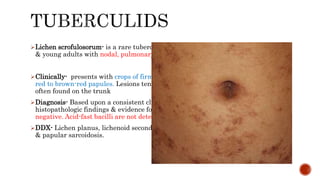
Lichen scrofulosorum- is a rare tuberculid that most frequently occurs in children
& young adults with nodal, pulmonary, skeletal, or intracranial TB
Clinically- presents with crops of firm 1 to 5 mm, asymptomatic, grouped, yellow-
red to brown-red papules. Lesions tend to be follicular or perifollicular, & are most
often found on the trunk
Diagnosis- Based upon a consistent clinical picture in the context of concordant
histopathologic findings & evidence for TB infection. Mycobacterial cultures are
negative. Acid-fast bacilli are not detected ; TST is often strongly +ve.
DDX- Lichen planus, lichenoid secondary syphilis, papular eczema, lichen nitidus,
& papular sarcoidosis.
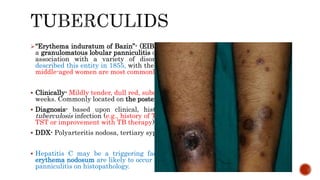
“Erythema induratum of Bazin”- (EIB) & "nodular vasculitis" are used to refer to
a granulomatous lobular panniculitis of the lower extremities that may develop in
association with a variety of disorders, particularly infections. Bazin first
described this entity in 1855, with the belief of TB as the origin.. Young women &
middle-aged women are most commonly affected.
 Clinically- Mildly tender, dull red, subcutaneous nodules over the course of several
weeks. Commonly located on the posterior aspects of the lower legs.
 Diagnosis- based upon clinical, histopathologic findings, & evidence for M.
tuberculosis infection (e.g., history of TB, a detectable focus of infection, a positive
TST or improvement with TB therapy); AFB –Ve.
 DDX- Polyarteritis nodosa, tertiary syphilis, & other panniculitides;
 Hepatitis C may be a triggering factor for nodular vasculitis/EIB; lesions of
erythema nodosum are likely to occur on the anterior legs & demonstrate a septal
panniculitis on histopathology.
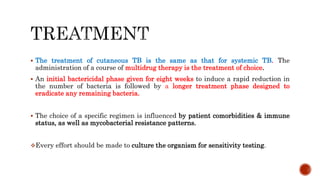
 The treatment of cutaneous TB is the same as that for systemic TB. The
administration of a course of multidrug therapy is the treatment of choice.
 An initial bactericidal phase given for eight weeks to induce a rapid reduction in
the number of bacteria is followed by a longer treatment phase designed to
eradicate any remaining bacteria.
 The choice of a specific regimen is influenced by patient comorbidities & immune
status, as well as mycobacterial resistance patterns.
Every effort should be made to culture the organism for sensitivity testing.
 The so-called atypical Mycobacteria (Mycobacteria other than Mycobacteria
tuberculosis, or MOTT) cause skin disease more frequently than does M.
tuberculosis.
 They exist in various reservoirs in the environment. Among these organisms are
obligate & facultative pathogens as well as non pathogens. In contrast to the
obligate pathogens, the latter do not cause disease by person-to-person spread
 Diagnosis relies on histopathologic analysis and the results of culture.
Incidence is unknown, but endemic areas exist for certain types of MOTT.
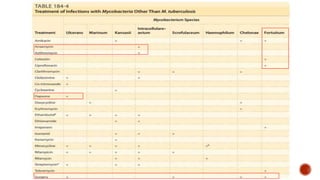
 Treatment is unlike that of tuberculosis, and no strict international guidelines
have been developed.
 Effective antibiotics are know for each mycobacterial species but should be
checked by sensitivity testing.
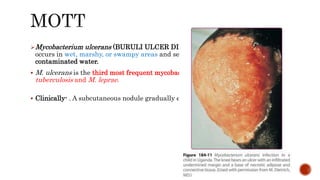
Mycobacterium ulcerans (BURULI ULCER DISEASE)- M. ulcerans infection
occurs in wet, marshy, or swampy areas and seems to have to do with
contaminated water.
 M. ulcerans is the third most frequent mycobacterial pathogen, after M.
tuberculosis and M. leprae.
 Clinically- . A subcutaneous nodule gradually enlarges and eventually ulcerates.
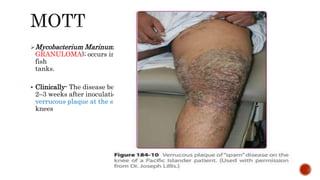
Mycobacterium Marinum (Mycobacterium balnei, FISHTANK/SWIMMING POOL
GRANULOMA); occurs in freshwater & saltwater, including swimming pools &
fish
tanks.
 Clinically- The disease begins as a violaceous papule at the site of a trauma
2–3 weeks after inoculation. Patients may have a nodule or a psoriasiform or
verrucous plaque at the site of inoculation, usually the hands, feet, elbows, or
knees
Mycobacterium Kansasii- most closely related to M. tuberculosis. It is usually
acquired from the environment. Usually occurs in adults, and is more common in
individuals with underlying immunosuppression caused by Hodgkin disease,
treatment for organ transplantation, or AIDS.
 Clinically- Most frequently, there are papules in a sporotrichoid distribution.
Sometimes, subcutaneous nodules extend to deeper structures and may result
in a carpal tunnel syndrome or joint disease.
 The most commonly affected organ is the lung, usually in patients with other
pulmonary conditions (silicosis, emphysema).
Mycobacterium Scrofulaceum- widely distributed in the environment.
 Clinically- Cervical lymphadenitis, frequently unilateral, in children, mainly
between the ages of 1-3 years. Submandibular and submaxillary nodes
are typically involved, rather than the tonsillar & anterior cervical nodes, as is
characteristic for M. tuberculosis infection.
 Lymph nodes enlarge slowly over several weeks, & eventually ulcerate & develop
fistulae
 DDX - bacterial lymphadenitis; viral infections, including mumps &
mononucleosis; & malignancy, including solid tumors, lymphoma, & leukemia
Mycobacterium avium Intracellulare- Encompasses organisms with a
wide variety of microbiologic & pathogenic properties. Well over 20 subtypes can
be separated by immunologic techniques, not necessary for clinical purposes.
 Clinically- Whereas M. scrofulaceum produces only a benign, self-limited
lymphadenopathy with no organ involvement, M. avium-intracellulare infection
usually causes lung disease or, less frequently, osteomyelitis. It presenting as
single or multiple painless, scaly yellowish plaques, sometimes resembling LV, or
as subcutaneous nodules with a tendency to ulceration & a slowly progressive,
chronic course
 M. avium intracellulare infections are an important cause of morbidity in patients
with AIDS. Skin lesions have included generalized cutaneous ulcerations,
granulomas, infiltrated erythematous lesions on the extremities, pustules, and
soft-tissue swelling
M. fortuitum, Mycobacterium chelonae, and Mycobacterium abscessus - three
species of fast-growing, facultative pathogenic Mycobacteria—were previously
grouped in the M. fortuitum complex but are now recognized as distinct species.
 Clinically- Infection usually follows a puncture wound or a surgical procedure.
The disease manifests itself as a painful red infiltrate at the site of inoculation;
The disease course consists of multiple recurrent episodes of abscesses on the
extremities or a generalized macular and papular eruption. Internal organs may
be involved.
 Diagnosis- Histopathology, There is simultaneous occurrence of
polymorphonuclear leukocyte microabscesses & granuloma formation. There is
usually necrosis but no caseation. AFB occasionally found within microabscesses.
 Organisms of the M. fortuitum complex may be identified by special laboratories
to permit a rational treatment.
Mycobacterium szulgai, Mycobacterium haemophilum, and M. genavense are
rarely found to cause human disease in cases of otherwise
 If Present then as; Unexplained cervical lymphadenitis, cellulitis, draining
nodules and plaques, bursitis, pneumonia, and subcutaneous granulomatous
eruptions.
 BCG vaccination reactions — The Bacille Calmette-Guérin (BCG) vaccine is
composed of a living attenuated strain of M. bovis that is used in many parts of
the world to enhance immunity to TB. Rarely, dermatologic complications of BCG
vaccination occur.
 Local tissue reactions, ulceration, abscess formation, Scrofuloderma, lupus
vulgaris, EIB, Papulonecrotic tuberculid, & lichen scrofulosorum-like lesions have
been described
 Fitzpatrick’s Dermatology in General Medicine.
 Up-to-date 2018
 WHO Report 2009 – Global Tuberculosis Control. 2010
 Center for Disease Control- Trends in Tuberculosis, United States on
March 13, 2010
 Harrison’s Principles of Internal Medicine; 20th Edition.
Cutaneous tuberculosis

Cutaneous tuberculosis

  • 1.
    Beka Aberra [InternalMedicine - R2] Dermatology Attachment April 9, 2019
  • 2.
  • 3.
     To Explainthe Pathogenesis of Cutaneous Tuberculosis  To Explain the Classifications of Cutaneous Tuberculosis  To Explain the Clinical manifestations of Cutaneous Tuberculosis  To Have a diagnostic approach towards Cutaneous Tuberculosis  To Have a management approach towards Cutaneous Tuberculosis
  • 5.
     Tuberculosis (TB)is a mycobacterial infection that most frequently occurs due to infection with Mycobacterium tuberculosis, an acid-fast bacillus.  The high prevalence of TB worldwide, its transmissible nature, & the significant morbidity & mortality associated with this infection account for the status of TB as a major public health concern. Cutaneous TB  Factors such as the pathway of bacterial entry into the skin, the host's immune status, & the presence or absence of host sensitization to M. tuberculosis influence the morphologic presentation of TB in the skin.  The clinical findings vary; Inflammatory papules, Verrucous plaques, Suppurative nodules, Chronic ulcers, or other lesions may be seen.
  • 6.
     Cutaneous TBwas first documented in 1826, when Laennec reported his own prosector's wart," a lesion that likely represented tuberculosis verrucosa cutis, a variant of TB that results from direct entry of the organism into the skin.  However, the causative organism of TB was unknown until Robert Koch discovered Mycobacterium tuberculosis in 1882. Later on Detected in cutaneous lesions.  Cutaneous lesions are relatively uncommon manifestations of TB, occurring in only 1 to 2 percent of infected patients.  Resurgence of cutaneous TB has been noted in parts of the world where human immunodeficiency virus (HIV) infection & multidrug-resistant TB are prevalent.
  • 10.
     Similar toExtra cutaneous TB, multiple diagnostic studies are utilized for the evaluation of patients with cutaneous TB.  The conventional techniques include  Mycobacterial culture (the gold standard for diagnosis),  Stained smears,  Lesional biopsies, &  Tuberculin skin testing.  Interferon-gamma release assays [QuantiFeron-TB GOLD]  PCR [Mycobacterial DNA in Lesional tissue]  However, in Paucibacillary variants, culture, smears, & histopathology often fail.  The Tuberculin skin test can be positive in both Multibacillary & Paucibacillary forms of cutaneous TB; however, a positive test only identifies individuals who have been sensitized to TB & does not confirm active TB infection.  A therapeutic trial of anti-TB medications may be used to confirm the diagnosis of TB in difficult cases; In cutaneous TB, a response to multidrug therapy is usually evident within six weeks.
  • 11.
     Mycobacterial culture– Is the gold standard for determining the presence of active TB infection. The procedure also provides the means to distinguish M. tuberculosis form nontuberculous mycobacteria & allows for the determination of antibiotic sensitivity.  Stained smear – The examination for acid-fast bacilli on a stained smear is a more rapid diagnostic technique than culture. The diagnostic yield of stained smears is highest for moist or exudative lesions that have a high bacterial load such as primary inoculation TB, Scrofuloderma, tuberculosis cutis Orificialis, or metastatic tuberculous abscess. The Ziehl-Neelsen acid-fast stain is the most commonly used.  Skin biopsy – The accessibility of skin lesions makes the obtainment of a tissue biopsy a relatively simple procedure. The identification of Tuberculoid granulomas, acid-fast bacilli, or other characteristic histopathologic features of specific variants of cutaneous TB may be used to support the diagnosis.
  • 12.
     A characteristichistopathologic finding in Cutaneous TB is the Tuberculoid granuloma [Low Sn/Sp], an accumulation of epithelioid histiocytes & Langhans- type giant cells that demonstrates a variable degree of central caseation necrosis & a peripheral rim composed of numerous lymphocytes.  Leprosy, tertiary syphilis, Granulomatous rosacea, Leishmaniasis, Deep fungal infections, & other disorders may also present with “Tuberculoid granulomas”  Sarcoidal granulomas tend to be more circumscribed, exhibit fewer peripheral inflammatory cells (so-called "naked granulomas"), & are less likely to have central caseation necrosis
  • 13.
     Tuberculin skintest – Identifies individuals sensitized to M. tuberculosis. It has a [Sp of 63 % & a Sn 33-96 %] for cutaneous TB that becomes higher in unvaccinated populations. The Mantoux technique, the recommended method for performing tuberculin skin testing “delayed hypersensitivity reaction involving T cells”. It Can be impaired in young infants, older adults, & patients with deficient cellular immunity, “False Negatives”.  Interferon-gamma release assay – are serologic tests that assess for latent TB infection via the measurement of interferon-gamma production from peripheral blood mononuclear cells after exposure to antigens from M. tuberculosis. [Sn of 92 % & a Sp of 76 %].
  • 14.
     Polymerase chainreaction – testing for M. tuberculosis infection involves the use of nucleic amplification for the detection of M. tuberculosis DNA in tissue specimens. “Gene Expert”.  The procedure can be performed in a few hours & confirmation of results obtained within one to three days. Polymerase chain reaction tests can differentiate between M. tuberculosis & other species of mycobacteria & can identify gene mutations associated with drug resistance . PCR appears to be the most useful in the Multibacillary forms of cutaneous TB. PCR is primarily used as an adjunct to clinicopathologic evaluation & is not yet recommended to replace diagnostic conventional culture
  • 15.
     The clinicalvariants of cutaneous TB may be divided into  Infections acquired through exogenous inoculation,  Infections that result from contiguous spread,  Infections related to hematogenous dissemination, &  The tuberculids.  The tuberculids are thought to be hypersensitivity reactions to M. tuberculosis, & include  Papulonecrotic tuberculid,  Lichen scrofulosorum, &  Erythema induratum of Bazin.
  • 16.
    Primary inoculation tuberculosis— (also known as tuberculous chancre & primary tuberculous complex) is a rare form of cutaneous TB that results from the direct entry of the organism into the skin or mucosa of a nonsensitized individual. Usually in children of endemic areas.  Clinically- evident within one month after inoculation; nondescript red-brown papule or nodule that evolves into a painless, shallow & undermined ulcer with a granulomatous base. Slowly progressive & painless regional lymphadenopathy; perforation of the skin & the development of draining sinuses occasionally. Analogous to the Ghon complex of pulmonary TB infection.  Diagnosis- Multibacillary; Acid-fast bacilli (AFB) are usually easily detected in smears taken from early lesions. A positive culture confirms the diagnosis. Histologically tuberculoid granulomas late in course; TST –ve at onset, +ve with disease progression.  DDX- Deep fungal infections, nocardiosis, syphilis, leishmaniasis, yaws, tularemia, bartonellosis, cat-scratch disease, & other mycobacterioses.
  • 17.
    Tuberculosis verrucosa cutis-TBVC, also known as prosector's wart, anatomic tuberculosis, verruca necrogenica, & warty tuberculosis) is a form of cutaneous TB that occurs after direct inoculation of the mycobacteria into the skin of a previously sensitized host with moderate to high immunity against the bacillus.  Clinically- TBVC most frequently develops on the acral extremities; the fingers & dorsum of the hands are commonly affected. Solitary lesions, manifest as painless, violaceous or brown-red, indurated warty plaques, ulceration is uncommon.  Diagnosis- Histopathologically, Pseudoepitheliomatous hyperplasia, marked hyperkeratosis, & micro abscesses in the superficial dermis or the pseudoepitheliomatous rete pegs; Cultures taken from lesions of TBVC are often negative; Few AFB detected; TST Strongly +ve  DDX- Atypical mycobacterioses, blastomycosis, Majocchi's granuloma, chromoblastomycosis, tertiary syphilis, verrucous epidermal nevus, hypertrophic lichen planus, lupus vulgaris, halogenoderma, benign keratoses, prurigo nodularis, & verruca vulgaris
  • 18.
    Scrofuloderma- (also knownas tuberculosis colliquativa cutis) is a form of cutaneous TB that occurred much more frequently prior to the advent of effective therapies for TB. Scrofuloderma may occur at any age, but most commonly develops in children, adolescents, & older adult individuals Scrofuloderma has also been reported to occur in association with Hansen's disease & psoriasis.  Clinically- Firm, painless, subcutaneous, red-brown nodules that overly foci of tuberculous infection. The neck, axillae, & groin are often involved, with the cervical lymph nodes as the most common source of infection.  Diagnosis- Identification of the causative organism by culture, smear, or skin biopsy; TST +ve.  DDX- Atypical mycobacterioses, sporotrichosis, actinomycosis, coccidioidomycosis, lymphogranuloma venereum, syphilis, severe forms of acne conglobata, & hidradenitis suppurativa
  • 19.
    Tuberculosis cutis Orificialis-(TBCO, also known as orificial tuberculosis & tuberculosis ulcerosa cutis et mucosae) is a rare manifestation of TB that most frequently occurs among middle-aged & older adults.  Clinically- occurs on the oral, nasal, or Anogenital skin or mucosa; A typical lesion appears as a red-yellow nodule that rapidly breaks down to form a painful, circular or irregularly shaped, "punched-out" & friable 1 to 3 cm ulcer with a pseudomembranous fibrinous base  Diagnosis- detection of acid-fast bacilli in affected tissue via culture, stained smear, or skin biopsy confirms the diagnosis; TST -ve  DDX- Aphthous ulcers, lymphogranuloma venereum, syphilis, South American blastomycosis, & cutaneous malignancies
  • 20.
    Lupus vulgaris- (alsoknown as tuberculosis lupus) is a chronic & progressive form of cutaneous TB that represents a reactivation of TB infection in people with moderate to high immunity against the bacillus. It may occur either as a result of direct extension from an underlying focus of infection or via lymphatic or hematogenous spread. For unknown reasons, females are two to three times more likely than males to be affected.  Clinically-Variable, The classic plaque type of the disorder begins as a collection of discrete, red-brown papules that subsequently coalesce to form an indolent, asymptomatic plaque.  Diagnosis- Paucibacillary form of cutaneous TB, & mycobacteria often cannot be detected Histopathologically or by culture; TST +ve;  DDX- Papular lesions should be distinguished from colloid milia, acne, & rosacea. Plaques may resemble deep fungal infections, leishmaniasis, late syphilis, discoid lupus, lymphocytoma cutis, tuberculoid leprosy, & pyodermatitis vegetans.
  • 21.
    Metastatic tuberculous abscesses-(also known as tuberculous gummas) usually arise as a consequence of hematogenous spread of the bacillus from a primary focus of infection to the subcutaneous tissue during a state of reduced cell- mediated immunity. These lesions typically occur in malnourished children & immunosuppressed adults.  Clinically- Present with single or multiple, non-tender, fluctuant, subcutaneous nodules. The nodules eventually penetrate the skin, resulting in the formation of ulcers & draining sinuses. At any skin site but frequently develop on the extremities.  Diagnosis- Based upon the results of cultures, smears, or skin biopsies that demonstrate the presence of the bacillus. TST are variable.  DDX- Metastatic tuberculous abscesses share clinical & histologic features with Scrofuloderma.
  • 22.
    Acute Miliary TB-(also known as tuberculosis cutis miliaris disseminata) is a rare form of TB that results from the hematogenous dissemination of mycobacteria from a primary focus of infection, such as the lung. The disorder typically occurs in infants or individuals with impaired cell-mediated immunity, such as patients with advanced acquired immune deficiency syndrome (AIDS)  Clinically- When present, the cutaneous findings result from bacteremia & are nonspecific; Pinpoint red-blue or purpuric papules with overlying tiny vesicles that subsequently become Umbilicated & crusted are typically seen. Individual lesions heal over the course of one to four weeks, & often resolve with hypopigmented depressed scars. A cellulitis-like appearance is a rare manifestation of acute miliary TB  Diagnosis- Skin biopsies can aid in the diagnosis of acute miliary TB in patients who present with cutaneous lesions. Numerous acid-fast bacilli & abscesses are typically detected. TST –Ve due to anergy.
  • 23.
     The pathogenesisof the disorders classified as tuberculids is not fully understood;  The following findings support the designation of a condition as a tuberculid:  Failure to detect M. tuberculosis in stains or cultures of affected tissue  Presence of detectable extracutaneous M. tuberculosis infection, a strongly positive tuberculin skin test, or a positive interferon-gamma release assay (these findings support a history of exposure to the bacillus)  Histopathologic evidence for granulomatous inflammation in skin lesions  Frequent resolution of skin lesions with anti-TB therapy
  • 24.
    Papulonecrotic tuberculid isthe most common of the tuberculid disorders. It is most frequently seen in children & young adults . It may coexist with other tuberculids, lupus vulgaris, & Scrofuloderma.  Clinically- Presents as a symmetric & recurring eruption of 2 to 8 mm, firm, dark red or violaceous papules that subsequently become pustular or necrotic; most commonly occur on the face, ears, extensor extremities, & buttocks.  Diagnosis- Histopathologic examination often demonstrates wedge-shaped necrosis in the upper dermis & epidermis & nonspecific or tuberculoid granulomatous inflammation. M. tuberculosis bacilli usually are not detectable via microscopy or cultures. TST +ve  DDX- Pityriasis lichenoides et varioliformis acuta (PLEVA), prurigo, secondary syphilis, varicella, lymphomatoid papulosis, perforating disorders, leukocytoclastic vasculitis, & eosinophilic granulomatosis with polyangiitis (Churg-Strauss).
  • 25.
    Lichen scrofulosorum- isa rare tuberculid that most frequently occurs in children & young adults with nodal, pulmonary, skeletal, or intracranial TB Clinically- presents with crops of firm 1 to 5 mm, asymptomatic, grouped, yellow- red to brown-red papules. Lesions tend to be follicular or perifollicular, & are most often found on the trunk Diagnosis- Based upon a consistent clinical picture in the context of concordant histopathologic findings & evidence for TB infection. Mycobacterial cultures are negative. Acid-fast bacilli are not detected ; TST is often strongly +ve. DDX- Lichen planus, lichenoid secondary syphilis, papular eczema, lichen nitidus, & papular sarcoidosis.
  • 26.
    “Erythema induratum ofBazin”- (EIB) & "nodular vasculitis" are used to refer to a granulomatous lobular panniculitis of the lower extremities that may develop in association with a variety of disorders, particularly infections. Bazin first described this entity in 1855, with the belief of TB as the origin.. Young women & middle-aged women are most commonly affected.  Clinically- Mildly tender, dull red, subcutaneous nodules over the course of several weeks. Commonly located on the posterior aspects of the lower legs.  Diagnosis- based upon clinical, histopathologic findings, & evidence for M. tuberculosis infection (e.g., history of TB, a detectable focus of infection, a positive TST or improvement with TB therapy); AFB –Ve.  DDX- Polyarteritis nodosa, tertiary syphilis, & other panniculitides;  Hepatitis C may be a triggering factor for nodular vasculitis/EIB; lesions of erythema nodosum are likely to occur on the anterior legs & demonstrate a septal panniculitis on histopathology.
  • 27.
     The treatmentof cutaneous TB is the same as that for systemic TB. The administration of a course of multidrug therapy is the treatment of choice.  An initial bactericidal phase given for eight weeks to induce a rapid reduction in the number of bacteria is followed by a longer treatment phase designed to eradicate any remaining bacteria.  The choice of a specific regimen is influenced by patient comorbidities & immune status, as well as mycobacterial resistance patterns. Every effort should be made to culture the organism for sensitivity testing.
  • 33.
     The so-calledatypical Mycobacteria (Mycobacteria other than Mycobacteria tuberculosis, or MOTT) cause skin disease more frequently than does M. tuberculosis.  They exist in various reservoirs in the environment. Among these organisms are obligate & facultative pathogens as well as non pathogens. In contrast to the obligate pathogens, the latter do not cause disease by person-to-person spread  Diagnosis relies on histopathologic analysis and the results of culture. Incidence is unknown, but endemic areas exist for certain types of MOTT.  Treatment is unlike that of tuberculosis, and no strict international guidelines have been developed.  Effective antibiotics are know for each mycobacterial species but should be checked by sensitivity testing.
  • 35.
    Mycobacterium ulcerans (BURULIULCER DISEASE)- M. ulcerans infection occurs in wet, marshy, or swampy areas and seems to have to do with contaminated water.  M. ulcerans is the third most frequent mycobacterial pathogen, after M. tuberculosis and M. leprae.  Clinically- . A subcutaneous nodule gradually enlarges and eventually ulcerates.
  • 36.
    Mycobacterium Marinum (Mycobacteriumbalnei, FISHTANK/SWIMMING POOL GRANULOMA); occurs in freshwater & saltwater, including swimming pools & fish tanks.  Clinically- The disease begins as a violaceous papule at the site of a trauma 2–3 weeks after inoculation. Patients may have a nodule or a psoriasiform or verrucous plaque at the site of inoculation, usually the hands, feet, elbows, or knees
  • 37.
    Mycobacterium Kansasii- mostclosely related to M. tuberculosis. It is usually acquired from the environment. Usually occurs in adults, and is more common in individuals with underlying immunosuppression caused by Hodgkin disease, treatment for organ transplantation, or AIDS.  Clinically- Most frequently, there are papules in a sporotrichoid distribution. Sometimes, subcutaneous nodules extend to deeper structures and may result in a carpal tunnel syndrome or joint disease.  The most commonly affected organ is the lung, usually in patients with other pulmonary conditions (silicosis, emphysema).
  • 38.
    Mycobacterium Scrofulaceum- widelydistributed in the environment.  Clinically- Cervical lymphadenitis, frequently unilateral, in children, mainly between the ages of 1-3 years. Submandibular and submaxillary nodes are typically involved, rather than the tonsillar & anterior cervical nodes, as is characteristic for M. tuberculosis infection.  Lymph nodes enlarge slowly over several weeks, & eventually ulcerate & develop fistulae  DDX - bacterial lymphadenitis; viral infections, including mumps & mononucleosis; & malignancy, including solid tumors, lymphoma, & leukemia
  • 39.
    Mycobacterium avium Intracellulare-Encompasses organisms with a wide variety of microbiologic & pathogenic properties. Well over 20 subtypes can be separated by immunologic techniques, not necessary for clinical purposes.  Clinically- Whereas M. scrofulaceum produces only a benign, self-limited lymphadenopathy with no organ involvement, M. avium-intracellulare infection usually causes lung disease or, less frequently, osteomyelitis. It presenting as single or multiple painless, scaly yellowish plaques, sometimes resembling LV, or as subcutaneous nodules with a tendency to ulceration & a slowly progressive, chronic course  M. avium intracellulare infections are an important cause of morbidity in patients with AIDS. Skin lesions have included generalized cutaneous ulcerations, granulomas, infiltrated erythematous lesions on the extremities, pustules, and soft-tissue swelling
  • 40.
    M. fortuitum, Mycobacteriumchelonae, and Mycobacterium abscessus - three species of fast-growing, facultative pathogenic Mycobacteria—were previously grouped in the M. fortuitum complex but are now recognized as distinct species.  Clinically- Infection usually follows a puncture wound or a surgical procedure. The disease manifests itself as a painful red infiltrate at the site of inoculation; The disease course consists of multiple recurrent episodes of abscesses on the extremities or a generalized macular and papular eruption. Internal organs may be involved.  Diagnosis- Histopathology, There is simultaneous occurrence of polymorphonuclear leukocyte microabscesses & granuloma formation. There is usually necrosis but no caseation. AFB occasionally found within microabscesses.  Organisms of the M. fortuitum complex may be identified by special laboratories to permit a rational treatment.
  • 41.
    Mycobacterium szulgai, Mycobacteriumhaemophilum, and M. genavense are rarely found to cause human disease in cases of otherwise  If Present then as; Unexplained cervical lymphadenitis, cellulitis, draining nodules and plaques, bursitis, pneumonia, and subcutaneous granulomatous eruptions.
  • 43.
     BCG vaccinationreactions — The Bacille Calmette-Guérin (BCG) vaccine is composed of a living attenuated strain of M. bovis that is used in many parts of the world to enhance immunity to TB. Rarely, dermatologic complications of BCG vaccination occur.  Local tissue reactions, ulceration, abscess formation, Scrofuloderma, lupus vulgaris, EIB, Papulonecrotic tuberculid, & lichen scrofulosorum-like lesions have been described
  • 44.
     Fitzpatrick’s Dermatologyin General Medicine.  Up-to-date 2018  WHO Report 2009 – Global Tuberculosis Control. 2010  Center for Disease Control- Trends in Tuberculosis, United States on March 13, 2010  Harrison’s Principles of Internal Medicine; 20th Edition.