Dr. Ashok Kumar, Assistant
Professor,IMCMT,KUK
Email :akkumar@kuk.ac.in
 Write as they speak
 Use the present tense
 Include only one idea per sentence.
 Explain a story live from the scene
 Use sound and pictures effectively.
 Keep stories brief
 Keep it simple :
 Keep use attribution
 Contractions' use
 Abbreviations
 Numbers
 Present tense
 Keep it short : They should explain basics of
the story as it stands at the time of
broadcast and he compelling enough to hold
the listener and the viewer.
 If a story is running for several consecutive
bulletins it should be re written to
incorporate the latest development.
 Cue and story should be matched up :
 Introducing the reporter :
 Read your copy aloud :
 News headline summary : A story round up
of the main news events, each story is
summed in one or two sentences.
 News Bulletin : Usually on the hour, this is
the synopsis of the main news stories. It will
consist of about half a dozen stories, some
containing audio clips, voices etc.
 News Programme : This is longer than a
news bulletin, usually 15 or 30 minutes or
and hour and broadcast at breakfast,
lunchtime or early evening. It includes
extended reports, packages and interviews.
 Copy : A news story with no audio in it. It reads by the presenter
and is usually no more than three or four sentences or 20 second
long.
 Voice Pices/Voicer/ Voice report : A scripted piece of audio read
and written by the reporter usually pre recorded in the studio or on
location. It can be read live. Voice pieces are used to put across
more information than a copy only story. It usually no longer than
40 seconds.
 Clips/Cuts/Inserts : Audio which has been pre recorded from an
interview and one answer or part of an answer has been edited to
form a news clip or sound bite. A clip is used to convey opinion ore
emotion. It is usually 15 to 20 second long.
 Warp : A voice report that contains clips.
 Package Feature : This is a longer report and includes a reporters
script interspersed with clips, actuality and music.
 Vox Pops : A series of short, tightly edited comments form the
public on a current issue. Unlike clips, their names are not given.
 2 –way or Q&A : A presenter interviews a
reporter on air about a story he or she is
covering.
 Interview : Interview someone involved with
news story.
 Round table discussion : This includes several
participants with contrasting views on a subject
chaired by a journalist.
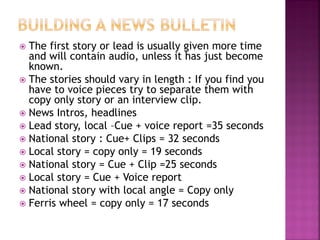
 The first story or lead is usually given more time
and will contain audio, unless it has just become
known.
 The stories should vary in length : If you find you
have to voice pieces try to separate them with
copy only story or an interview clip.
 News Intros, headlines
 Lead story, local –Cue + voice report =35 seconds
 National story : Cue+ Clips = 32 seconds
 Local story = copy only = 19 seconds
 National story = Cue + Clip =25 seconds
 Local story = Cue + Voice report
 National story with local angle = Copy only
 Ferris wheel = copy only = 17 seconds
 You need to be able to read your script
 A catch line or name of the story and the
name of the person who wrote the story.
 The date sometime time should mentioned
on it.
 Whether there is an audio and if so the
details of the person speaking :
 Speak clearly so than every word is
understood.
 Breath without destroying the flow.
 Read a few words ahead.
 Use a full vocal range.
 Vary the speed of reading.
 Understand what they are reading
 Mark up script as a guide.
 Visuals are essentials elements in television
news.
 Visuals + Script makes a effective television
report.
 Television stories are written for Viewers.
 Copy should brief and concise.
 Copy only story : A story with no pictures. It is read by the presenter
and is usually no more than three to four sentences or 20 second long.
These are visually less interesting than other types of report and they
are almost the same as radio copy.
 OOV (Out of vision ) Picture over presenter reads a script but does not
appear in vision. These are often read live. When writing these, it is
important to make sure the words complement the picture.
 Clips/Cuts/Inserts : Audio which has been pre recorded form an
interview and one answer or part of answer has been edited to form a
news clip or sound bite. A clip is used to convey opinion or emotions.
It is usually 15 to 20 second long. Sometime OOV are followed by clip.
 As live : This is pre recorded 2 way between a reporter and a presenter
or presenter and guest and set up as if it were live.
 Graphic captions : Any still photographs, maps, charts, courtroom
sketches, written statement etc. These make a short report for a
bulletin or form part of a package.
 Package/Feature : This is a longer report and includes a reporters
script interspersed with clip, graphics, actuality and some time music.
 Vox Pop : A series of short, tightly edited comments from public on a
current issue. Unlike clips, their names are not given.
 Picture to tell the story
 Information and good script.
 Interviewees.
 Piece to camera
 Graphics :
 Communicate
 Try to arrive location before the crew
 Remember that crews can work on several
stories in a day and yours may not seem that
interesting.
 Once you start filming talk the crew about
what picture you want.
 Always research well before writing the
script.
 Keep the target audience in mind.
 Time the script.
 Always include all element of a script-video,
audio, music, sound and graphics.
 Drama : Singly episode drama,
serials and soap operas.
 Factual : Documentaries, science
and consumer programme,
business, crime, investigation.
 News and current affairs : Daily
news cast and all other
programmes coming up to news
channels.
 Arts : Theatre, music, dance,
cinema, photography and
literature.
 Entertainment : Comedies, game show,
chat shows, variety shows and satire
 Children programme : Show drama,
cartoon and entertainment.
 Religion : Issue of morality, faith and
belief.
 Sports : Magazine and news programmes.
 Demonstration : Demonstrating in the
way something is done or works.
 Documentary :
 Drama :
 Animation
 Illustrated talk
 Puppets
 Graphics
 Write for ears
 Write short sentences, avoid complex words
and phrases.
 If convinced about writing convert the diary
entry into shots and scenes.
 We all aspire to be producer, reporters or news presenter.
 The most important skill expected to us is to write well.
 If you are multilingual that is very good for you to be a
script writer.
 Writing for video means writing for ears. If we have
practiced concise sentence and for the ears, we are well
on the track towards becoming a good TV news writer.
 TV news script should be sound colloquial, be
unambiguous, to the point, compelling and cliché free.
 We should write as we talk, be clear, use forceful
constructions and avoid verbosity.
 Story idea are normally tossed around editorial meeting.
 Story ideas are suggest by the editor or present by the reporters.
 Clarity on the reporters part Is very important to convey the story.
 Ask question why do I want to do this story ?
 What do I want the audience to know ?
 What is the point I am trying to make through the story.
 Television story is not all about visuals only.
 How am I going to tell the story using audio and video ?
 Who will feature in a story ?
 Which place I will shoot at ?
 A reporter normally briefs the cameraperson on the kind of shots he is
looking for camera person who helps tell the story through audio and
video.
 A good camera person shoot a variety of shots as well as sound bite.
 Log our tape : Logging simply means writing down what is on the tape.
 Logging help us to know what shots are available for us to construct the
story .
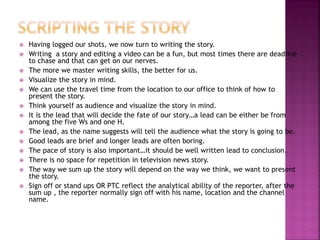
 Having logged our shots, we now turn to writing the story.
 Writing a story and editing a video can be a fun, but most times there are deadline
to chase and that can get on our nerves.
 The more we master writing skills, the better for us.
 Visualize the story in mind.
 We can use the travel time from the location to our office to think of how to
present the story.
 Think yourself as audience and visualize the story in mind.
 It is the lead that will decide the fate of our story…a lead can be either be from
among the five Ws and one H.
 The lead, as the name suggests will tell the audience what the story is going to be.
 Good leads are brief and longer leads are often boring.
 The pace of story is also important…it should be well written lead to conclusion.
 There is no space for repetition in television news story.
 The way we sum up the story will depend on the way we think, we want to present
the story.
 Sign off or stand ups OR PTC reflect the analytical ability of the reporter, after the
sum up , the reporter normally sign off with his name, location and the channel
name.
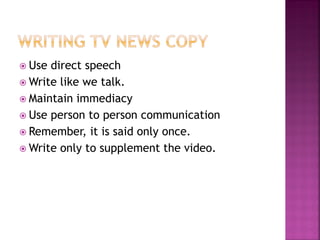
 Use direct speech
 Write like we talk.
 Maintain immediacy
 Use person to person communication
 Remember, it is said only once.
 Write only to supplement the video.
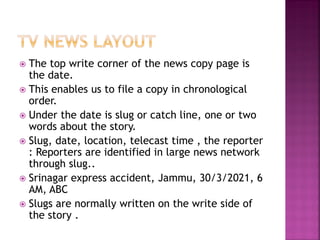
 The top write corner of the news copy page is
the date.
 This enables us to file a copy in chronological
order.
 Under the date is slug or catch line, one or two
words about the story.
 Slug, date, location, telecast time , the reporter
: Reporters are identified in large news network
through slug..
 Srinagar express accident, Jammu, 30/3/2021, 6
AM, ABC
 Slugs are normally written on the write side of
the story .
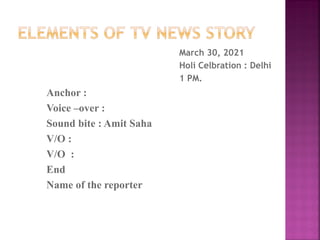
March 30, 2021
Holi Celbration : Delhi
1 PM.
Anchor :
Voice –over :
Sound bite : Amit Saha
V/O :
V/O :
End
Name of the reporter
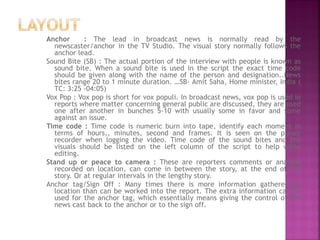
Anchor : The lead in broadcast news is normally read by the
newscaster/anchor in the TV Studio. The visual story normally follows the
anchor lead.
Sound Bite (SB) : The actual portion of the interview with people is known as
sound bite. When a sound bite is used in the script the exact time code
should be given along with the name of the person and designation..News
bites range 20 to 1 minute duration. …SB- Amit Saha, Home minister, India (
TC: 3:25 -04:05)
Vox Pop : Vox pop is short for vox populi. In broadcast news, vox pop is used in
reports where matter concerning general public are discussed, they are used
one after another in bunches 5-10 with usually some in favor and some
against an issue.
Time code : Time code is numeric burn into tape, identify each moment in
terms of hours,, minutes, second and frames. It is seen on the player
recorder when logging the video. Time code of the sound bites and the
visuals should be listed on the left column of the script to help while
editing.
Stand up or peace to camera : These are reporters comments or analysis
recorded on location, can come in between the story, at the end of the
story. Or at regular intervals in the lengthy story.
Anchor tag/Sign Off : Many times there is more information gathered on
location than can be worked into the report. The extra information can be
used for the anchor tag, which essentially means giving the control of the
news cast back to the anchor or to the sign off.
 Every channel has its own standardized style for
writing news scripts.
 There may be some difference in jargon used,
but most time script formats have similar
component.
 Slug
 Anchor-lead in
 Voice over
 Sound bite
 Stand up or piece to camera
 Visuals with location
 Sound music, sound effects
 Sign off or Anchor tag
 Documentaries concern themselves with
people, things, events, phenomena, and
places that exist in fact.
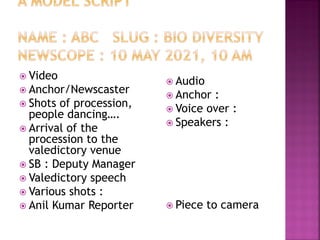
 Video
 Anchor/Newscaster
 Shots of procession,
people dancing….
 Arrival of the
procession to the
valedictory venue
 SB : Deputy Manager
 Valedictory speech
 Various shots :
 Anil Kumar Reporter
 Audio
 Anchor :
 Voice over :
 Speakers :
 Piece to camera
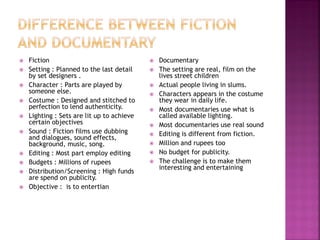
 Fiction
 Setting : Planned to the last detail
by set designers .
 Character : Parts are played by
someone else.
 Costume : Designed and stitched to
perfection to lend authenticity.
 Lighting : Sets are lit up to achieve
certain objectives
 Sound : Fiction films use dubbing
and dialogues, sound effects,
background, music, song.
 Editing : Most part employ editing
 Budgets : Millions of rupees
 Distribution/Screening : High funds
are spend on publicity.
 Objective : is to entertian
 Documentary
 The setting are real, film on the
lives street children
 Actual people living in slums.
 Characters appears in the costume
they wear in daily life.
 Most documentaries use what is
called available lighting.
 Most documentaries use real sound
 Editing is different from fiction.
 Million and rupees too
 No budget for publicity.
 The challenge is to make them
interesting and entertaining
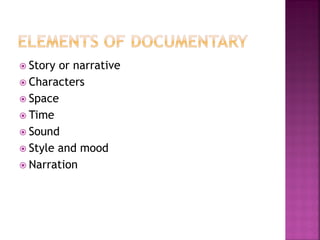
 Story or narrative
 Characters
 Space
 Time
 Sound
 Style and mood
 Narration
 Use active voice
 Use short and simple sentences
 Avoid clichés
 Avoid too many decorative
 Simplify jargon
 Avoid writing what can be seen .
 Type the script in double space
 Make sure each page ends with a complete
sentence.
 Maintain margin space all around the script.
 Ensure that script contains full details of audio
and video
 Film statement : What film is about.
 Background and need : Why the topic is interesting
 Approach, form and style : Idea, Character, where
story set, what is the conflict, what structure the
film adopt.
 Shooting schedule : When project will begin and end
 Budget : Prepare a budget
 Audience, distribution and marketing : must know
audience and marketing
 Film maker resume : Include resume of the director,
chairperson, editor and script writer
 Company brochure : If you have one, do not forget to
attach one.
 Thanks

Writing for broadcast media

  • 1.
    Dr. Ashok Kumar,Assistant Professor,IMCMT,KUK Email :akkumar@kuk.ac.in
  • 2.
     Write asthey speak  Use the present tense  Include only one idea per sentence.  Explain a story live from the scene  Use sound and pictures effectively.
  • 3.
     Keep storiesbrief  Keep it simple :  Keep use attribution  Contractions' use  Abbreviations  Numbers  Present tense
  • 4.
     Keep itshort : They should explain basics of the story as it stands at the time of broadcast and he compelling enough to hold the listener and the viewer.  If a story is running for several consecutive bulletins it should be re written to incorporate the latest development.  Cue and story should be matched up :  Introducing the reporter :  Read your copy aloud :
  • 5.
     News headlinesummary : A story round up of the main news events, each story is summed in one or two sentences.  News Bulletin : Usually on the hour, this is the synopsis of the main news stories. It will consist of about half a dozen stories, some containing audio clips, voices etc.  News Programme : This is longer than a news bulletin, usually 15 or 30 minutes or and hour and broadcast at breakfast, lunchtime or early evening. It includes extended reports, packages and interviews.
  • 6.
     Copy :A news story with no audio in it. It reads by the presenter and is usually no more than three or four sentences or 20 second long.  Voice Pices/Voicer/ Voice report : A scripted piece of audio read and written by the reporter usually pre recorded in the studio or on location. It can be read live. Voice pieces are used to put across more information than a copy only story. It usually no longer than 40 seconds.  Clips/Cuts/Inserts : Audio which has been pre recorded from an interview and one answer or part of an answer has been edited to form a news clip or sound bite. A clip is used to convey opinion ore emotion. It is usually 15 to 20 second long.  Warp : A voice report that contains clips.  Package Feature : This is a longer report and includes a reporters script interspersed with clips, actuality and music.  Vox Pops : A series of short, tightly edited comments form the public on a current issue. Unlike clips, their names are not given.
  • 7.
     2 –wayor Q&A : A presenter interviews a reporter on air about a story he or she is covering.  Interview : Interview someone involved with news story.  Round table discussion : This includes several participants with contrasting views on a subject chaired by a journalist.
  • 8.
     The firststory or lead is usually given more time and will contain audio, unless it has just become known.  The stories should vary in length : If you find you have to voice pieces try to separate them with copy only story or an interview clip.  News Intros, headlines  Lead story, local –Cue + voice report =35 seconds  National story : Cue+ Clips = 32 seconds  Local story = copy only = 19 seconds  National story = Cue + Clip =25 seconds  Local story = Cue + Voice report  National story with local angle = Copy only  Ferris wheel = copy only = 17 seconds
  • 9.
     You needto be able to read your script  A catch line or name of the story and the name of the person who wrote the story.  The date sometime time should mentioned on it.  Whether there is an audio and if so the details of the person speaking :
  • 10.
     Speak clearlyso than every word is understood.  Breath without destroying the flow.  Read a few words ahead.  Use a full vocal range.  Vary the speed of reading.  Understand what they are reading  Mark up script as a guide.
  • 11.
     Visuals areessentials elements in television news.  Visuals + Script makes a effective television report.  Television stories are written for Viewers.  Copy should brief and concise.
  • 12.
     Copy onlystory : A story with no pictures. It is read by the presenter and is usually no more than three to four sentences or 20 second long. These are visually less interesting than other types of report and they are almost the same as radio copy.  OOV (Out of vision ) Picture over presenter reads a script but does not appear in vision. These are often read live. When writing these, it is important to make sure the words complement the picture.  Clips/Cuts/Inserts : Audio which has been pre recorded form an interview and one answer or part of answer has been edited to form a news clip or sound bite. A clip is used to convey opinion or emotions. It is usually 15 to 20 second long. Sometime OOV are followed by clip.  As live : This is pre recorded 2 way between a reporter and a presenter or presenter and guest and set up as if it were live.  Graphic captions : Any still photographs, maps, charts, courtroom sketches, written statement etc. These make a short report for a bulletin or form part of a package.  Package/Feature : This is a longer report and includes a reporters script interspersed with clip, graphics, actuality and some time music.  Vox Pop : A series of short, tightly edited comments from public on a current issue. Unlike clips, their names are not given.
  • 13.
     Picture totell the story  Information and good script.  Interviewees.  Piece to camera  Graphics :
  • 14.
     Communicate  Tryto arrive location before the crew  Remember that crews can work on several stories in a day and yours may not seem that interesting.  Once you start filming talk the crew about what picture you want.
  • 15.
     Always researchwell before writing the script.  Keep the target audience in mind.  Time the script.  Always include all element of a script-video, audio, music, sound and graphics.
  • 16.
     Drama :Singly episode drama, serials and soap operas.  Factual : Documentaries, science and consumer programme, business, crime, investigation.  News and current affairs : Daily news cast and all other programmes coming up to news channels.  Arts : Theatre, music, dance, cinema, photography and literature.  Entertainment : Comedies, game show, chat shows, variety shows and satire  Children programme : Show drama, cartoon and entertainment.  Religion : Issue of morality, faith and belief.  Sports : Magazine and news programmes.  Demonstration : Demonstrating in the way something is done or works.  Documentary :  Drama :  Animation  Illustrated talk  Puppets  Graphics
  • 17.
     Write forears  Write short sentences, avoid complex words and phrases.  If convinced about writing convert the diary entry into shots and scenes.
  • 18.
     We allaspire to be producer, reporters or news presenter.  The most important skill expected to us is to write well.  If you are multilingual that is very good for you to be a script writer.  Writing for video means writing for ears. If we have practiced concise sentence and for the ears, we are well on the track towards becoming a good TV news writer.  TV news script should be sound colloquial, be unambiguous, to the point, compelling and cliché free.  We should write as we talk, be clear, use forceful constructions and avoid verbosity.
  • 19.
     Story ideaare normally tossed around editorial meeting.  Story ideas are suggest by the editor or present by the reporters.  Clarity on the reporters part Is very important to convey the story.  Ask question why do I want to do this story ?  What do I want the audience to know ?  What is the point I am trying to make through the story.  Television story is not all about visuals only.  How am I going to tell the story using audio and video ?  Who will feature in a story ?  Which place I will shoot at ?  A reporter normally briefs the cameraperson on the kind of shots he is looking for camera person who helps tell the story through audio and video.  A good camera person shoot a variety of shots as well as sound bite.  Log our tape : Logging simply means writing down what is on the tape.  Logging help us to know what shots are available for us to construct the story .
  • 20.
     Having loggedour shots, we now turn to writing the story.  Writing a story and editing a video can be a fun, but most times there are deadline to chase and that can get on our nerves.  The more we master writing skills, the better for us.  Visualize the story in mind.  We can use the travel time from the location to our office to think of how to present the story.  Think yourself as audience and visualize the story in mind.  It is the lead that will decide the fate of our story…a lead can be either be from among the five Ws and one H.  The lead, as the name suggests will tell the audience what the story is going to be.  Good leads are brief and longer leads are often boring.  The pace of story is also important…it should be well written lead to conclusion.  There is no space for repetition in television news story.  The way we sum up the story will depend on the way we think, we want to present the story.  Sign off or stand ups OR PTC reflect the analytical ability of the reporter, after the sum up , the reporter normally sign off with his name, location and the channel name.
  • 21.
     Use directspeech  Write like we talk.  Maintain immediacy  Use person to person communication  Remember, it is said only once.  Write only to supplement the video.
  • 22.
     The topwrite corner of the news copy page is the date.  This enables us to file a copy in chronological order.  Under the date is slug or catch line, one or two words about the story.  Slug, date, location, telecast time , the reporter : Reporters are identified in large news network through slug..  Srinagar express accident, Jammu, 30/3/2021, 6 AM, ABC  Slugs are normally written on the write side of the story .
  • 23.
    March 30, 2021 HoliCelbration : Delhi 1 PM. Anchor : Voice –over : Sound bite : Amit Saha V/O : V/O : End Name of the reporter
  • 24.
    Anchor : Thelead in broadcast news is normally read by the newscaster/anchor in the TV Studio. The visual story normally follows the anchor lead. Sound Bite (SB) : The actual portion of the interview with people is known as sound bite. When a sound bite is used in the script the exact time code should be given along with the name of the person and designation..News bites range 20 to 1 minute duration. …SB- Amit Saha, Home minister, India ( TC: 3:25 -04:05) Vox Pop : Vox pop is short for vox populi. In broadcast news, vox pop is used in reports where matter concerning general public are discussed, they are used one after another in bunches 5-10 with usually some in favor and some against an issue. Time code : Time code is numeric burn into tape, identify each moment in terms of hours,, minutes, second and frames. It is seen on the player recorder when logging the video. Time code of the sound bites and the visuals should be listed on the left column of the script to help while editing. Stand up or peace to camera : These are reporters comments or analysis recorded on location, can come in between the story, at the end of the story. Or at regular intervals in the lengthy story. Anchor tag/Sign Off : Many times there is more information gathered on location than can be worked into the report. The extra information can be used for the anchor tag, which essentially means giving the control of the news cast back to the anchor or to the sign off.
  • 25.
     Every channelhas its own standardized style for writing news scripts.  There may be some difference in jargon used, but most time script formats have similar component.  Slug  Anchor-lead in  Voice over  Sound bite  Stand up or piece to camera  Visuals with location  Sound music, sound effects  Sign off or Anchor tag
  • 26.
     Documentaries concernthemselves with people, things, events, phenomena, and places that exist in fact.
  • 27.
     Video  Anchor/Newscaster Shots of procession, people dancing….  Arrival of the procession to the valedictory venue  SB : Deputy Manager  Valedictory speech  Various shots :  Anil Kumar Reporter  Audio  Anchor :  Voice over :  Speakers :  Piece to camera
  • 28.
     Fiction  Setting: Planned to the last detail by set designers .  Character : Parts are played by someone else.  Costume : Designed and stitched to perfection to lend authenticity.  Lighting : Sets are lit up to achieve certain objectives  Sound : Fiction films use dubbing and dialogues, sound effects, background, music, song.  Editing : Most part employ editing  Budgets : Millions of rupees  Distribution/Screening : High funds are spend on publicity.  Objective : is to entertian  Documentary  The setting are real, film on the lives street children  Actual people living in slums.  Characters appears in the costume they wear in daily life.  Most documentaries use what is called available lighting.  Most documentaries use real sound  Editing is different from fiction.  Million and rupees too  No budget for publicity.  The challenge is to make them interesting and entertaining
  • 29.
     Story ornarrative  Characters  Space  Time  Sound  Style and mood  Narration
  • 30.
     Use activevoice  Use short and simple sentences  Avoid clichés  Avoid too many decorative  Simplify jargon  Avoid writing what can be seen .  Type the script in double space  Make sure each page ends with a complete sentence.  Maintain margin space all around the script.  Ensure that script contains full details of audio and video
  • 31.
     Film statement: What film is about.  Background and need : Why the topic is interesting  Approach, form and style : Idea, Character, where story set, what is the conflict, what structure the film adopt.  Shooting schedule : When project will begin and end  Budget : Prepare a budget  Audience, distribution and marketing : must know audience and marketing  Film maker resume : Include resume of the director, chairperson, editor and script writer  Company brochure : If you have one, do not forget to attach one.
  • 32.