tidningen


                                    or2t08
                                     BRIS-
                                 rep 0
                                 The


Family conflicts l Psychological abuse and
emotional neglect l Virtual weekday – internet         #1/2008
                                                       #1/2008
krönika


BRIS Offices
Riksförbundet BRIS
(National Association)
Karlavägen 121
SE-115 26 Stockholm
Tel: +46 (0)8-598 888 00
Fax: +46 (0)8-598 888 01


                            BRIS
E-mail: info@bris.se
                                                      – Children’s Rights in Society – is an NGO, a voluntary organisation with
BRIS region Nord                                       no party political or religious affiliation, which supports children and young
(Northern Region)                                      people in distress and is a link between children, adults and the community.
Kungsgatan 36
SE-903 25 Umeå              The core of BRIS’ activities is comprised of the Children’s Helpline and the BRIS-mail, to which
Tel: +46 (0)90-203 65 10    children and young people up to the age of 18 can turn anonymously and free-of-charge when they
Fax: +46 (0)90-203 65 11    need support from an adult. BRIS also works as an opinion maker and referral organisation to in-
E-mail: bris.nord@bris.se
                            crease adults’ respect for children as individuals. BRIS works for the full application of the principles
BRIS region Väst            established in the UN Convention of the Rights of the Child. BRIS uses its collective knowledge
(Western Region)            of the situation of children and young people to inform, influence and create opinion in children’s
Hvitfeldtsgatan 14
SE-411 20 Göteborg          rights issues at various levels. BRIS also accepts calls from adults who need someone to talk to about
Tel: +46 (0)31-750 11 30    their own or other’s children.
Fax: +46 (0)31-750 11 31
E-mail: bris.vast@bris.se
                            BRIS was founded in 1971 and is organised as one national and five regional associations. Offices
BRIS region Mitt            are located in Malmö, Göteborg, Norrköping, Stockholm and Umeå. BRIS’ activities are based on
(Central Region)            volunteer work and financial grants and donations from both private and public donors. BRIS has a
Karlavägen 121
SE-115 26 Stockholm         total of about 500 volunteer workers who man the Children’s Helpline and the BRIS-mail.
Tel: +46 (0)8-598 888 10    These volunteers are recruited, trained and supervised by employed BRIS personnel. The BRIS Adult
Fax: +46 (0)8-598 888 11    Helpline – about Children is usually manned by employed BRIS representatives and costs as much
E-mail: bris.mitt@bris.se
                            as a regular phone call.
BRIS region Syd
(Southern Region)
Östra Rönneholmsvä-
gen 7                          The Children’s Helpline                            The BRIS-mail
SE-211 47 Malmö                – for those up to age 18.                          www.bris.se
Tel: +46 (0)40-690 80 70       0200-230 230
Fax: +46 (0)40-690 80 71
E-mail: bris.syd@bris.se       Monday to Friday: 3:00 pm – 9:00 pm                The BRIS-mail provides personal answers
                               Saturday, Sunday and holidays:                     within a few days. In the Discussion Forum,
BRIS region Öst                3:00 pm – 6:00 pm                                  which is also on BRIS.se, children and young
(Eastern Region)
Knäppingborgsgatan 7                                                              people can communicate with each other
SE-602 26 Norrköping           BRIS Adult Helpline – about Children               under the oversight of an adult moderator.
Tel: +46 (0)11-440 05 50       077-150 50 50
Fax: +46 (0)11-440 05 51
E-mail: bris.ost@bris.se       Monday to Friday: 10:00 am – 1:00 pm


                                                                                                                1/2008 • The BRIS-report
38
krönika

                                                                                  content
                                                                                        It is important
                                                                                        for us adults to
 8                                                                                be supportive and give
                                                                                  the children space to
                                                                                  put words to how they
                                                                    20            are doing. We know
                             35                                                   that it helps.


          	 4       BRIS creates the
                    conditions for children
                    to say it like it is
                                                   	24             Psychological abuse
                                                                   and emotional neglect
                                                                   – on the edge of an
                                                                   abyss

          	 8       Children’s rights
                    - a natural part of
                    decision-making                	28             School – teachers in
                                                                   positions of power


          	10 perspective
               Stronger child
                                                   	32             Children dependent
                                                                   on adults’ actions
                                                                   concerning bullying

          	12	 Children’sworld
               and outer
                          inner

                                    	35                            Internet – important
                                                                   aduld presence on the

          	14 – abandonment in the
               Family conflicts                                    Internet

               presence of violence
                                    	37                            Poor mental health
                                                                   on the rise

          	18 and guilt concerning 	39
               Addiction – shame

               addiction
                                                                   Boys – not only
                                                                   acting out


          	20 assume –great in
               Divorce children

               responsibility
                                    	41                            Relationships help


               divorces
                                    	42                            Referrals and
                                                                   assignments

          	22 silent children
               Pay attention to the

                                    	43                            Appendix: tables
                                                                   and figures


                                    Publisher BRIS, Barnens Rätt I Samhället   Documentation/research: Henrik Brolinson, Michel
                                    Address BRIS-tidningen,                    Devillaz, Peter Irgens, Thomas Jonsland, Martin Höög, Karin
                                    Karlavägen 121, 115 26 Stockholm           Johansson, Anna Löfhede, Kerstin Sjöbratt, Helén Thorén,
                                    Editorial committee                        Eva Waltré Text Mette Hultgren, Nicklas Lund, Cecilia
               www.bris.se          Karin Johansson, Martin Höög, Peter        Nauclér, Gunnar Sandelin English translation Semantix
                                    Irgens, Eva Stenelund, Eva Waltré och      Photo Johan Bergling, Ingvor Farinotte, Lena Granefelt,
               PG 901504-1
                                    Cecilia Nauclér.                           Gustav Lindh, Nova, Anna Rehnberg
                                    Editor Cecilia Nauclér                     Illustrations Lena Sjöberg/Söderberg Agentur,
                                    Ad Kristina Schollin-Borg                  Responsible editor Ragna Wallmark
                                                                                                          1/2008 • The BRIS-report
krönika


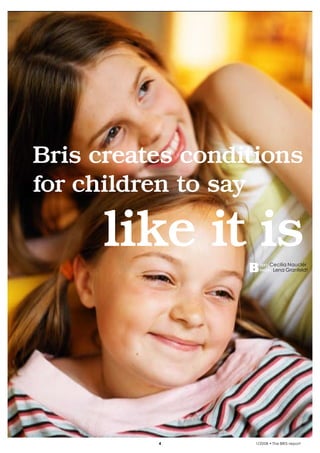
      Bris creates conditions
      for children to say

           like it is     text
                          photo
                                 Cecilia Nauclér
                                  Lena Granfeldt


                       1/2008 • The BRIS-report
krönika


  “BRIS’	documentation	over	the	
  contacts	with	children	and	young	
  people	is	a	unique	informational	base.	
  All	adults,	from	parents	to	politicians,	
  have	something	to	learn	from	the	
  children’s	accounts,”	says	Peter	Irgens,	
  BRIS	Documentation	Manager.	

  “i think what is unique about BRIS’ documen-                are not a general measure of how all children and
  tation of the contacts with children and young              young people in Sweden are doing.”
  people is that the children tell us about their life           However, what BRIS can read from the docu-
  situation based on their needs, without being               mentation of the contacts is differences between
  dependent on the adult with whom the child                  various contact areas from year to year.
  is speaking,” says Peter Irgens, Documentation                 “We can confirm that several thousand child-
  Manager for BRIS Support Services.                          ren contact us because they are victims of violence
      Children are always in some form of depen-              and abuse, and we can also see that poor mental
  dent relationship with nearby adults, which af-             health is on the rise. Through the differences, we
  fects the communication between them.                       can also see tendencies for social changes,” says
      “Children often say what they think is expec-           Peter Irgens.
  ted of them, or answer questions,” Peter Irgens             New youth phenomena, which are sometimes
  explains.                                                   covered in the media, are difficult to discover in
      But in the contact with BRIS, it is the child
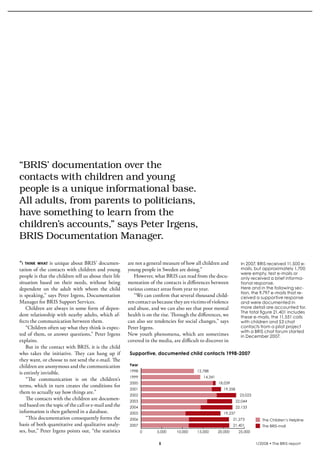
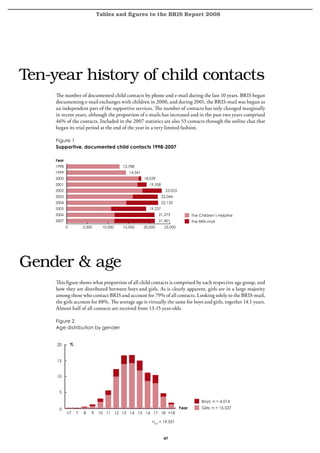
  who takes the initiative. They can hang up if                Supportive, documented child contacts 1998-2007
  they want, or choose to not send the e-mail. The
  children are anonymous and the communication                Year
                                                              1998                               12,788
  is entirely invisible.
                                                              1999                                  14,341                                                       Year
      “The communication is on the children’s
                                                              2000                                           18,039                                              1998
  terms, which in turn creates the conditions for
                                                              2001                                              19,358                                           1999
  them to actually say how things are.”
                                                              2002                                                         23,023                                2000
      The contacts with the children are documen-             2003                                                       22,044                                  2001
  ted based on the topic of the call or Children’s Helpline
                                   The e-mail and the         2004                                                       22,133                                  2002
  information is then gathered in a database.
                                   The BRIS-mail              2005                                              19,237                                           2003
      “This documentation consequently forms the              2006                                                    21,273           The Children’s Helpline   2004
  basis of both quantitative and qualitative analy-           2007                                                    21,401           The BRIS-mail             2005
  ses, but,” Peter Irgens points out, “the statistics                0      5,000     10,000     15,000      20,000       25,000                                 2006
                                                                                                                                                                 2007
                                                                                                                                   1/2008 • The BRIS-report            0
krönika


                                       BRIS’ documentation. Although
                                       BRIS nurses a dream about also
Who contacts BRIS?                     being better at having “its ear to
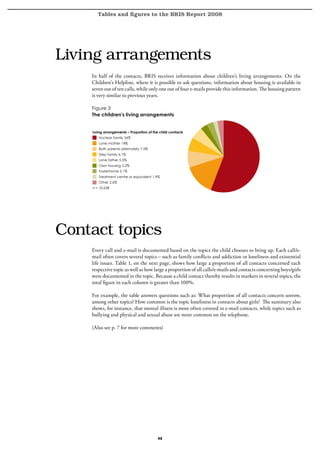
4 Girls are in the majority in         the ground” as Peter Irgens puts it.
contacts with BRIS. They ac-
count for 79 percent of the            Either the documentation system
contacts.                              must be further developed to be
    The average age of those           able to discern new phenomena, or
who contacted BRIS was 14.1
years in 2007. The average age         it may be so that a new phenome-
is similar between girls and           non must “land” with the child-
boys, but it is somewhat higher        ren, become day-to-day, before
in the BRIS-mail compared with
the contacts in the Children’s         children contact BRIS about it,
Helpline                               Irgens believes.
                                           What BRIS can read from the
                                       documentation from 2007 is that
                                       family conflicts, loneliness and pro-
                                       blems with friendships continue to
                                       dominate the contact areas. Poor
                                       mental health continues to increase
                                       with topics such as eating disorders
                                       and problems of suicide and self- Peter Irgens, Documentation Manager, BRIS
                                       harm. Life issues, such as questions
                                       of identity, existential questions about life, issues     Based on the documentation, parents can also
                                       concerning sorrow and the body and appearance, learn a great deal about the child perspective,
                                       are also clearly on the rise.                          that is to say, what effects parents’ actions have
                                           “Girls in their teenage years are in the overwhel- on children and young people, or what an adult
                                       ming majority in the contacts, which does not mean should do so that a child feels listened to.
                                       the boys have fewer problems, but rather that BRIS’       “The documentation also contains numerous
                                       channels do not suit the boys,” says Peter Irgens.     fantastic examples of things adults do that are good,
                                           “Our channels are based on children and and those that are bad,” continues Peter Irgens.
                                       young people being able to verbalise their pro-           Those who work with children and young
                                       blems, which means that it is not only the boys people also have a great deal to learn from what
                                       that we do not reach to the same extent, but also children tell BRIS, he believes.
                                       children who do not speak Swedish well enough             “Children tell us what they think about stu-
                                       or the younger children, for instance.”                dent health services or child psychiatry, for in-
                                           But for the adults who are where the children stance. Where else could these professional cate-
                                       are, BRIS’ documentation has a great deal to of- gories find out how the children perceive them?
                                       fer, Peter Irgens believes, particularly to parents.   I wish that all professional categories that work
                                           “It is notable in all of the contacts that the with children and young people would ask us
                                       children want to have more from their parents, what children say about them in particular. We
                                       primarily more time. They miss the adults. Pa- could give them tailor-made guidance in how
                                       rents can really learn from this.”                     children want to be treated by them!”


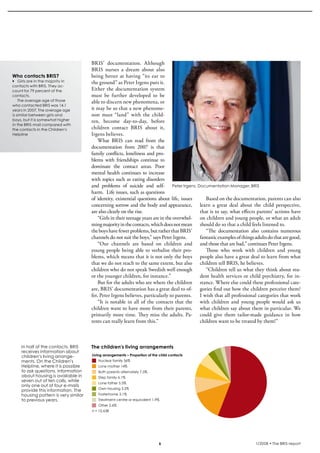
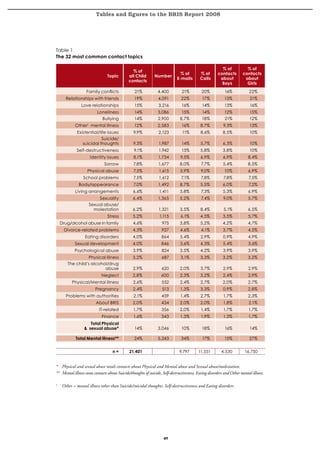
     In half of the contacts, BRIS     The children’s living arrangements
     receives information about
     children’s living arrange-        Living arrangements – Proportion of the child contacts
     ments. On the Children’s             Nuclear family 56%
     Helpline, where it is possible       Lone mother 14%
     to ask questions, information        Both parents alternately 7.5%
     about housing is available in        Step family 6.1%
     seven out of ten calls, while
                                          Lone father 5.5%
     only one out of four e-mails
                                          Own housing 3.2%
     provide this information. The
     housing pattern is very similar      Fosterhome 3.1%
     to previous years.                   Treatment centre or equivalent 1.9%
                                          Other 2.6%
                                       n = 10,638


                                                                                                 Living arrangements – Proportion of the child contacts
                                                                                                    Nuclear family 56%
                                                                                                    Lone mother 14%
                                                                                                   Both parents alternately 7.5%       1/2008 • The BRIS-report
                                                                                                    Step family 6.1%
Year         2000                                                 18,039
                                                                                      1998         2001                    12,788                            19,358
                                                                                      1999         2002                        14,341                                   23,023
krönika                                                                            2000            2003                                 18,039                        22,044
                                                                        The Children’s Helpline
                                                                                   2001            2004                                    19,358                     22,133
                                                                        The BRIS-mail
                                                                                   2002            2005                                                    19,237
                                                                                                                                                      23,023
                                                                                      2003         2006                                             22,044      21,273
                                                        The Children’s Helpline       2004         2007                                             22,133       21,401
                                                        The BRIS-mail                 2005                0        5,000      10,000      15,000
                                                                                                                                           19,237      20,000          25,000
                                                                                      2006                                                       21,273
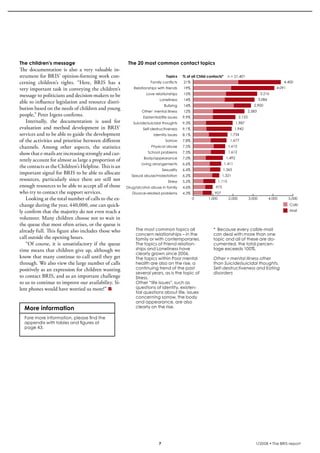
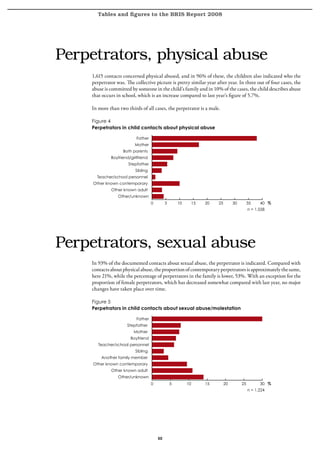
  The children’s message                                           The 20 most common contact topics
                                                                             2007                                                                21,401
  The documentation is also a very valuable in-                                      0        5,000        10,000        15,000        20,000      25,000
  strument for BRIS’ opinion-forming work con-                                        Topics % of all Child contacts* n = 21,401
  cerning children’s rights. “Here, BRIS has a                             Family conflicts    21%                                                                4,400
  very important task in conveying the children’s              Relationships with friends      19%                                                            4,091
                                                                     Topics relationships contacts* n = 21,401
                                                                         Love % of all Child 15%                                                   3,216
  message to politicians and decision-makers to be
                                                                                 Loneliness    14%                                                3,086
                                                                                                                                                   4,400
  able to influence legislation and resource distri- Family conflicts 21%
                                                Relationships with friends      19%  Bullying  14%                                             2,900
                                                                                                                                              4,091
  bution based on the needs of children and young
                                                       Love relationships mental illness
                                                                     Other        1
                                                                                15%            12%                                  3,216 2,583
  people,” Peter Irgens confirms.                                     Existential/life issues 9,9%                                    2,123
                                                                                                                                   3,086
                                                                Loneliness      14%
     Internally, the documentation is used for                 Suicide/suicidal thoughts 9,3%
                                                                    Bullying    14%                                                 1,987
                                                                                                                                2,900
  evaluation and method development in BRIS’        Other mental Self-destructiveness 9,1%
                                                                   1
                                                                      illness   12%                                        2,583 1,942
  services and to be able to guide the development   Existential/life issues Identity issues 8,1%
                                                                                9,9%                                 2,123      1,734
  of the activities and prioritise between different
                                               Suicide/suicidal thoughts 9,3%Sorrow 7,8%                           1,987        1,677
  channels. Among other aspects, the statistics      Self-destructiveness 9,1% abuse 7,5%
                                                                            Physical                              1,942        1,615

  show that e-mails are increasing strongly and cur-                      School problems 7,5%
                                                            Identity issues 8,1%                               1,734           1,612
                                                                       Body/appearance 7,0%
                                                                     Sorrow 7,8%                               1,677         1,492
  rently account for almost as large a proportion of
                                                                                                                            1,411
  the contacts as the Children’s Helpline. This is an Physical Living arrangements 6,6%
                                                                     abuse 7,5%                               1,615
                                                         School problems 7,5%     Sexuality 6,4%              1,612        1,365
  important signal for BRIS to be able to allocate            Sexual abuse/molestation 6,2%                               1,321
                                                      Body/appearance 7,0%                                  1,492
  resources, particularly since there are still not arrangements 6,6% Stress 5,2%
                                                    Living                                                 1,411       1,115
  enough resources to be able to accept all of those Drug/alcohol abuse in family 4,6%
                                                                 Sexuality 6,4%                           1,365       975                                                        Cal
  who try to contact the support services. Sexual abuse/molestation 6,2%
                                                              Divorce-related problems 4,3%              1,321       927                                                         Mai
     Looking at the total number of calls to the ex-                  Stress 5,2%                    01,115      1,000         2,000        3,000        4,000       5,000
  change during the year, 440,000, one can quick- abuse in family 4,6%
                                            Drug/alcohol                                             975                                                              Calls
  ly confirm that the majority do not even reach a
                                               Divorce-related problems 4,3%                        927                                                               Mail

  volunteer. Many children choose not to wait in                                       0        1,000         2,000         3,000        4,000        5,000

  the queue that most often arises, or the queue is
  already full. This figure also includes those who             The most common topics all                          * Because every call/e-mail
                                                                concern relationships – in the                      can deal with more than one
  call outside the opening hours.                               family or with contemporaries.                      topic and all of these are do-
     “Of course, it is unsatisfactory if the queue              The topics of Friend relation-                      cumented, the total percen-
  time means that children give up, although we                 ships and Loneliness have                           tage exceeds 100%.
                                                                clearly grown since 2006.
  know that many continue to call until they get                The topics within Poor mental                       Other = mental illness other
  through. We also view the large number of calls               health are also on the rise, a                      than Suicide/suicidal thoughts,
  positively as an expression for children wanting              continuing trend of the past                        Self-destructiveness and Eating
                                                                several years, as is the topic of                   disorders
  to contact BRIS, and as an important challenge                Stress.
  to us to continue to improve our availability. Si-            Other “life issues”, such as
  lent phones would have worried us more!”                      questions of identity, existen-
                                                                        tial questions about life, issues
                                                                        concerning sorrow, the body
                                                                        and appearance, are also
     More information                                                   clearly on the rise.

     Fore more information, please find the
     appendix with tables and figures at
     page 43.


                                                                                       7                                                         1/2008 • The BRIS-report
krönika


  Children’s rights
  a natural part of
  decision-making
  Children make themselves heard through BRIS and BRIS must therefore
  become even more visible and stronger in illustrating the rights and
  needs of children for politicians and the public.


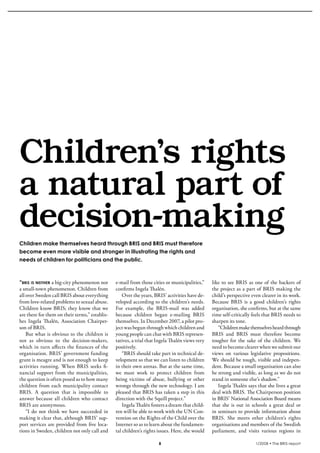
  “bris is neither a big-city phenomenon nor      e-mail from those cities or municipalities,”     like to see BRIS as one of the backers of
  a small-town phenomenon. Children from          confirms Ingela Thalén.                          the project as a part of BRIS making the
  all over Sweden call BRIS about everything          Over the years, BRIS’ activities have de-    child’s perspective even clearer in its work.
  from love-related problems to sexual abuse.     veloped according to the children’s needs.       Because BRIS is a good children’s rights
  Children know BRIS; they know that we           For example, the BRIS-mail was added             organisation, she confirms, but at the same
  are there for them on their terms,” establis-   because children began e-mailing BRIS            time self-critically feels that BRIS needs to
  hes Ingela Thalén, Association Chairper-        themselves. In December 2007, a pilot pro-       sharpen its tone.
  son of BRIS.                                    ject was begun through which children and           “Children make themselves heard through
      But what is obvious to the children is      young people can chat with BRIS represen-        BRIS and BRIS must therefore become
  not as obvious to the decision-makers,          tatives, a trial that Ingela Thalén views very   tougher for the sake of the children. We
  which in turn affects the finances of the       positively.                                      need to become clearer when we submit our
  organisation. BRIS’ government funding              “BRIS should take part in technical de-      views on various legislative propositions.
  grant is meagre and is not enough to keep       velopment so that we can listen to children      We should be tough, visible and indepen-
  activities running. When BRIS seeks fi-         in their own arenas. But at the same time,       dent. Because a small organisation can also
  nancial support from the municipalities,        we must work to protect children from            be strong and visible, as long as we do not
  the question is often posed as to how many      being victims of abuse, bullying or other        stand in someone else’s shadow.”
  children from each municipality contact         wrongs through the new technology. I am             Ingela Thalén says that she lives a great
  BRIS. A question that is impossible to          pleased that BRIS has taken a step in this       deal with BRIS. The Chairperson position
  answer because all children who contact         direction with the Squill project.”              in BRIS’ National Association Board means
  BRIS are anonymous.                                 Ingela Thalén fosters a dream that child-    that she is out in schools a great deal or
      “I do not think we have succeeded in        ren will be able to work with the UN Con-        in seminars to provide information about
  making it clear that, although BRIS’ sup-       vention on the Rights of the Child over the      BRIS. She meets other children’s rights
  port services are provided from five loca-      Internet so as to learn about the fundamen-      organisations and members of the Swedish
  tions in Sweden, children not only call and     tal children’s rights issues. Here, she would    parliament, and visits various regions in

                                                                        8                                                1/2008 • The BRIS-report
krönika


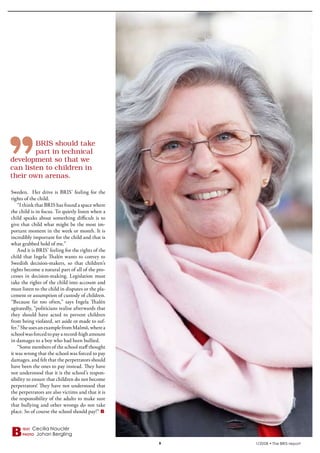
        BRIS	should	take	
        part	in	technical	
development	so	that	we		
can	listen	to	children	in		
their	own	arenas.

Sweden. Her drive is BRIS’ feeling for the
rights of the child.
    “I think that BRIS has found a space where
the child is in focus. To quietly listen when a
child speaks about something difficult is to
give that child what might be the most im-
portant moment in the week or month. It is
incredibly important for the child and that is
what grabbed hold of me.”
    And it is BRIS’ feeling for the rights of the
child that Ingela Thalén wants to convey to
Swedish decision-makers, so that children’s
rights become a natural part of all of the pro-
cesses in decision-making. Legislation must
take the rights of the child into account and
must listen to the child in disputes or the pla-
cement or assumption of custody of children.
“Because far too often,” says Ingela Thalén
agitatedly, “politicians realise afterwards that
they should have acted to prevent children
from being violated, set aside or made to suf-
fer.” She uses an example from Malmö, where a
school was forced to pay a record-high amount
in damages to a boy who had been bullied.
    “Some members of the school staff thought
it was wrong that the school was forced to pay
damages, and felt that the perpetrators should
have been the ones to pay instead. They have
not understood that it is the school’s respon-
sibility to ensure that children do not become
perpetrators! They have not understood that
the perpetrators are also victims and that it is
the responsibility of the adults to make sure
that bullying and other wrongs do not take
place. So of course the school should pay!”


      text   Cecilia Nauclér
      photo   Johan Bergling
                                                    9   1/2008 • The BRIS-report
krönika


          Stronger child
            perspective


              text   Cecilia Nauclér
              photo   Johan Bergling


                                10     1/2008 • The BRIS-report
krönika


  Secretary General Göran Harnesk has two important roles - to
  create as effective an organisation as possible and to act as a
  lobbyist towards decision-makers and the public. Because BRIS has
  considerable knowledge about the needs of children – knowledge
  which is in demand nationally as well as internationally.


  becoming a member of BRIS means that one            The child perspective must become rather it is proof that we in Sweden have
  wants children and young people to be given stronger in society in general, Harnesk be- come further in research and development
  a more acceptable existence in society. Göran lieves, and he is personally adamant about in children’s rights issues. We should share
  Harnesk, BRIS Secretary General, explains change in the legal system.                         this knowledge.”
  that it is the members who choose the boards        “It is impermissible that a child is mal-    By respect for the child and the individual,
  of the national and regional associations and treated in the social services or in the legal Göran Harnesk means that the meeting,
  through their votes they also determine the system simply because he or she cannot act the dialogue with the child must always
  direction for BRIS, based on the circum- like an adult or speak in an adult man- be guided by the child’s needs, on the
  stances and conditions of children.              ner. Sometimes, crimes cannot be proven child’s terms. “Because what the children
      “The members are incredibly important when a child is victimised, which is not who contact BRIS appreciate,” he says, “is
  for BRIS, particularly because they lobby strange because the child was alone with that the adults who answer the calls and
  for the interests and needs of children so the perpetrator when he or she was hurt! e-mails do not have any standard templates
  strongly. The members provide the organisa- Knowledge about the child’s perspective outlining how the call should go, or preju-
  tion with an enormous dynamic, which cre- and about children must grow!”                      dice about how children and young people
  ates the conditions necessary for children to       Also included in the Secretary General’s think and work.”
  be able to receive the support they                                                                              “The child determines
  seek from BRIS,” he says.                                                                                    the content of the dialogue,
      BRIS was established in 1971                      Children	who	have	contacted	                           regardless of the channel in
  and is an entirely voluntary, non-                    us	after	receiving	help	and	                           which the conversation takes
  profit and non-governmental or-             support	feel	that	BRIS	is	the	breathing	                         place. Today, children’s needs
  ganisation. In the almost 40 years                                                                           are seldom allowed to govern
  that the organisation has existed,
                                              space	they	cannot	find	anywhere	else.	                           and this is why children con-
  it has changed to today consist of          We	are	the	light	in	the	tunnel.                                  tact us.”
  a combination of employed repre-                                                                                 “For BRIS, every call and
  sentatives and volunteers of various kinds. work is contributing BRIS’ knowledge to every e-mail is unique,” Harnesk contin-
  A large part of the daily activities of the Sec- international forums.                        ues, “and every individual deserves to be
  retary General consists of working with the         “Compared with other countries in the affirmed and seen.” And children contact
  organisation so that it will be as effective world, BRIS has been around a very long BRIS to say that they feel that they have
  and clear as possible.                           time, which means that we are on the cut- been listened to and that the contact has
      “Every Swedish krona we receive is a do- ting edge with regard to technology, ano- given them strength.
  nation, which is why we must manage our nymity and confidentiality. Many are hun-                “Children who have contacted us after
  funds extremely well,” Harnesk confirms.         gry for our know-how.”                       receiving help and support feel that BRIS
      However, the primary role of the Secre-         Accordingly, BRIS participates in vari- is the breathing space they cannot find any-
  tary General is to act as a lobbyist, convey- ous international conferences and semi- where else. We are the light in the tunnel.”
  ing, together with the National Associa- nars to carry the organisation’s knowledge              Being sensitive to how children want the
  tion Board, the messages that arise in the further, but also to present the message communication with BRIS to be made is
  dialogue with children and young people about the respect for the child and the also a part of respecting the child. “BRIS
  to decision-makers, the public and all who individual. Because, according to Göran must simply be available where the children
  work professionally with children and Harnesk, there are many countries that need us,” Göran Harnesk says, “The organi-
  young people. In purely practical terms, still have difficulties in understanding ation may not have any ‘holy cows’.”
  this means that the Secretary General must that striking a child is prohibited by law            “We know that children want to have
  spend a large part of his working hours out in Sweden.                                        contact with us, but if the Children’s Help-
  in the field to meet co-operative partners          “This does not mean that adults in coun- line is something the children no longer
  and decision-makers, although his work tries that do not have laws against corporate want, then we must find new channels that
  also includes reading and writing reports.       punishment do not love their children, but suit the children’s needs.”


                                                                       11                                               1/2008 • The BRIS-report
krönika


  Children’s
  inner and
  outer world
  during the last few months of 2007, a group
  of BRIS employees delved into large parts of
  the year’s documentation over what children
  and young people have said on the Children’s
  Helpline and the BRIS-mail. This is a large,
  and at times difficult, effort and is therefore
  also extremely important. Some of the chil-
  dren who contact BRIS live in very vulnerable
  situations and they experience a deep loneli-
  ness because the adult world has failed them.
      BRIS documentation over what chil-
  dren and young people say clearly confirms
  that the world of children consists of two
  parts – an inner and an outer world. The
  outer world is the external environments in
  which they must exist: the family, school
  and out on the Internet.
      The inner world is the child’s personal
  and psychological perspective, in other
  words thoughts, dreams and emotions. The
  accounts of the children and young people
  indicate that various kinds of victimisation,
  such as conflicts at home or in school, affect
  their mental health, their inner world.
      The accounts indicate a connection and
  context between the different worlds. The
  children and young people often them-
  selves recognise the actual connection
  between their victimisation and why they          The	BRIS	Report	has	an	overriding	
  feel bad. And of course it may seem logical,
  even obvious that children are affected by        objective:	to	convey	the	voices	of	
  what they are exposed to. Yet, far too many
  say that they do not have a single adult who      children	to	politicians,	decision-
  listens to them, or supports them.
                                                    makers	and	those	who	work	with	
  Distinguishing topics
  In the documentation for 2007, a few topics
                                                    children	and	young	people.
  distinguish themselves. Family conflicts, i.e.
  conflicts in the family that the child does not

                                                           12                  1/2008 • The BRIS-report
krönika


                                                              The	children	and	
                                                              young	people	often	
                                                      themselves	recognise	the	
                                                      actual	connection	between	
                                                      their	victimisation	and	why	
                                                      they	feel	bad.	Yet,	far	too	
                                                      many	say	that	they	do	not	
                                                      have	a	single	adult	who	
                                                      listens	to	them.

                                                      cause but is drawn into, are still the single most
                                                      common reason for children to contact BRIS.
                                                      Some common situations about which children
                                                      and young people contact BRIS are alcohol or sub-
                                                      stance abuse in the family and divorces. We have
                                                      therefore chosen to present both as subtopics of the
                                                      area of family conflicts in this year’s BRIS Report.
                                                         Another topic that distinguished itself during
                                                      the year is school. Children spend most of their
                                                      time in school and, besides school work, school is
                                                      a place for meetings and contacts with both teach-
                                                      ers and other students. Most children get along
                                                      fine in school and with their teachers, but for
                                                      some, school is a place filled with performance
                                                      anxiety and bad adult relationships. To convey
                                                      what these children say, we have chosen to make
                                                      school a separate topical theme.
                                                         Since BRIS began, bullying and harassment
                                                      have been one of the most common reasons for
                                                      children to contact us. Despite anti-bullying
                                                      programs in schools, bullying remains one of
                                                      BRIS’ large areas of contact and was therefore
                                                      made a separate topical theme.
                                                         Problems in the family or bullying and harass-
                                                      ment are what the children themselves see as
                                                      the reasons for their poor mental health. Poor
                                                      mental health is a contact area that has grown
                                                      in recent years and BRIS has previously made
                                                      note of poor mental health among children and
                                                      young people. But because we believe it to be
                                                      such an important area with severe consequences
                                                      for the children, we have chosen to include it in
                                                      this year’s BRIS Report as well.
                                                         The children and young people often them-
                                                      selves recognise the actual connection between
                                                      their victimisation and why they feel bad. Yet, far
                                                      too many say that they do not have a single adult
                                                      who listens to them.

          NOTE!!
                                                          Hi, I think about suicide every day because
          The quotes from children are authentic,         I feel so small and nobody likes me. I was
          but certain information is always altered       bullied all through middle school and was
          to guarantee that no individual child           so angry with everyone. Now, every day I
          can be identified.                              think about killing myself, I can’t take it any
                                                          longer!!!
                                                                           E-mail from a 14-year-old boy


                                         13                                       1/2008 • The BRIS-report
krönika


          14   1/2008 • The BRIS-report
Theme: Family conflicts
krönika


  Family	conflicts	are	the	single	most	
  common	reason	for	children	to	contact	
  BRIS	and	difficult	conflicts	in	the	home	
  can	be	an	unexplored	basis	of	poor	
  mental	health	among	children.		
                                                                                              Eva Stenelund, BRIS representative
                                                                                              Region East.


  Abandonment
  in the presence
  of violence
               text   Gunnar Sandelin
               photo   Johan Bergling

          in more than one    out of five calls and e-mails,        Families in which serious conflicts take place
          children tell BRIS about conflicts and strife in          often constitute a closed system, where little
          the home. This primarily concerns serious events          information leaks out to the surroundings. The
          where the child’s self-image is changed by con-           children have become skilled at keeping up a
          stant messages of being unwanted and of being             good face and seldom communicate their distress
          on the way to being thrown out of the house.              so that their surroundings understand the situa-
             “It is not only common teenage conflicts               tion. Their family life has fundamentally broken
          about money, curfews and limits that have severe          down and many children live on an inner-plane
          effects on the child, but rather threats and vio-         where they lack both words and self-esteem to be
          lence. In the documentation, we see that when             able to formulate their feelings of worthlessness.
          alcohol is present, violence in the home is more          “Contacting BRIS anonymously then becomes
          serious,” says Eva Stenelund, BRIS representa-            particularly important,” says Eva Stenelund, who
          tive in Norrköping, who conducted a special re-           confirms that many boys also write and speak
          view of the contacts.                                     about the consequences.

                                                               15                                                1/2008 • The BRIS-report
Theme: Family conflicts
krönika


      It doesn’t feel like anyone cares or likes me any-
      more. Feels like I’m just in the way everywhere!
      Mum’s boyfriend is always angry at me now
      days, mostly when mum isn’t home. I’ve just
      begun cutting myself, because I’m sad every
      day and night.
                             E-mail from a 14-year-old girl


                   “The children get stomach aches, cannot sleep
                   and are scared of being beaten. They experience
                   a deep sense of grief that settles like a cork over
                   everything. Even if someone kindly asks if they
                   want to come along and have coffee, they react by
                   becoming sad and they often become withdrawn
                   from both adults and friends.”

                                                                              “These children appear to have given up. They
     I’ve become an awful person who bullies people,                          want to talk about how things are, but they do not
     skips school and does all kinds of bad things,
     sometimes it just feels like I want to give it all up.                   feel that they can and nor does anyone ask how
     I feel so worthless. My mum didn’t want to have                          they are doing. We adults have so many opinions,
     me and dad didn’t actually want to either, but                           but we often do not know how the things we say
     had to take me! They fight with each other all
     the time. .                                                              and point out affect children. Constantly seeing
                            E-mail from a 13-year-old boy                     one’s parents being mean to each other or hearing
                                                                              that one looks or acts like a divorced and loathed
                                                                              parent can make the children incapable of putting
                                                                              their feelings into words in other contexts.”
                   Unexplored basis for poor mental health
                   Eva Stenelund uses the work “self-shame” as a
                   summary for the constant feeling of being unde-                         If I complain about the littlest thing mum tells
                   sired, having the wrong appearance and not be-                         me to stop or she’ll send me to my dad. I don’t
                                                                                          feel safe in my own home. One night she threw
                   ing seen as good enough. Many children say that                        me out.
                   everything they do is wrong and that the adults                                                E-mail from a 14-year-old girl
                   constantly show their displeasure, through a con-
                   stant verbal grumbling and physically by pulling
                   and grabbing them. There are 12-year-olds who                          I just want to die. My parents fight with me and
                   tell BRIS that they feel worthless as soon as they                    shout and throw a lot of crap at me and every-
                   see their parents. Eva Stenelund believes that the                    thing they say builds up inside.
                                                                                                                   E-mail from a 13-year-old girl
                   difficult family conflicts that BRIS learns about
                   are an unexplored breeding ground for the gro-
                   wing incidence of poor mental health. “If one
                   keeps ones feelings inside for a long time, self-                     I’m a 14-year-old guy who…well… needs some
                   destructive behaviour is not far away,” she says.                     help. I feel bad, and have felt bad for several
                                                                                         years. My mum and dad fight a lot, shout and
                                                                                         yell and sometimes it ends with someone cry-
                                                                                         ing... it makes me feel so damned bad. The
       I love my mum, but my dad kills my joy to live, I can’t                            more my dear mother and father fight, the
      take it much longer. He complains about every-                                      more I feel how this awful wall comes up be-
      thing I do. Yells and shouts about everything! He                                   tween me and the rest of the world. I’m really
      says every day that he’s tired of taking care of me.                                asocial and hardly talk.
      That’s awful to hear when you’re 13!                                                                     E-mail from a 14-year-old boy
                                 E-mail from a 13-year-old girl


                                                                              The abandonment is the most imposing factor.
                                                                              Some children speak about constantly being sent
      Everything I do is wrong. I’m a disappointment to                       to their rooms, others wander around in town in
      my parents. When I see mum, I feel like shame is                        the evenings, some have a key with them and only
      a part of me.
                              E-mail from a 15-year-old girl                  go home when their parents are gone or are sleep-
                                                                              ing. Girls in their upper teens speak of finding an
                                                                              older guy they can live with and receive some af-


                                                                         16                                                  1/2008 • The BRIS-report
Theme: Family conflicts
krönika


                    firmation from. Some act out and become bullies,
                    but their surroundings do not make the connec-                I often dream about a better mum, a mum that
                    tion to underlying causes. The reader may think               I can really talk with about everything and who
                                                                                  understands me. My mum doesn’t. She just com-
                    that the children should become angry at their                plains about how I look and stuff.
                    harmful parents, “but to become angry, there                                           E-mail from a 15-year-old girl
                    must be a relationship that will survive, otherwise
                    one does not dare argue,” says Eva Stenelund.

                                                                                  I can’t say ANYTHING to my parents because we
     I feel pretty bad now adays… I think it’s because                            fight the whole time… we have NO contact…
     things are tough at home, at mum’s we just argue                             I’ve begun skipping out on my lessons and am
      and at dad’s it’s just tough because his wife                               angry all the time… I feel so damned bad and
      hates me and blames me for everything that                                  can’t talk with my parents… we just argue and
      goes wrong... I’ve even been thrown out. I feel                             none of us can trust each other... please... who
      so alone... and it’s really hard with other things                          should I talk to???
       and it just gets a lot harder from everything I’m                                                    E-mail from a 16-year-old girl
       going through… don’t know why I’m writing,
       but it feels good just to unload sometimes.
                           E-mail from a 16-year-old boy


                                                                                  I feel like an empty shell that’s trying to adjust
                    “Sometimes, they wish their parents were dead, but             but fails. I’ve held my feelings in for a few years
                                                                                   now. When mum has an outburst like usual I try
                    more often there is a strong longing for their parents         to ignore it. She has mood swings like a roller
                    to care: ‘If only they could get angry at me when I             coaster and I just feel confused and sad from
                    come home drunk,’ as one teenage girl expressed it.”            all the shouting and screaming.
                                                                                                         E-mail from a 17-year-old girl
                       Particularly difficult are family conflicts with
                    an honour-related background. These problems
                    not only apply to girls. Boys also contact us seek-
                    ing support and help. Eva Stenelund speaks about
                    a “triple victimisation”: first the threat from the
                    family, then the loneliness in the vacuum outside
                    the family and lastly the direct mortal danger
                    that the child/young person may be exposed to.


      I don’t know what to do… dad shouts, calls us
     things, hits us… he’s doing things all the time… I
     don’t want to live like this, I just don’t want to…
     I’ve thought about killing myself several times,
     but then my mum would be alone with him.
                            E-mail from a 15-year-old boy


    …especially the shit I get…that I don’t have any-
    thing to do with…but when I say I didn’t do what
    they accuse me of, they just shout ”go to your
    room. I can’t deal with having you here!!”
                             E-mail from a 16-year-old boy


                    “The family becomes larger than itself through
                    relatives, networks and branching, and the child
                    is his or her family, not an individual in a group.
                    This makes it particularly difficult to seek help if
                    one has not been in Sweden very long,” says Eva
                    Stenelund, who feels that it has been a trial to
                    study all accounts of family conflicts.
                        At the same time, it is hopeful that so many
                    children and young people nonetheless take the
                    step to contact BRIS.
                        “I am more worried for those who do not con-
                    tact us,” she says.


                                                                             17                                        1/2008 • The BRIS-report
Theme: Family conflicts
krönika


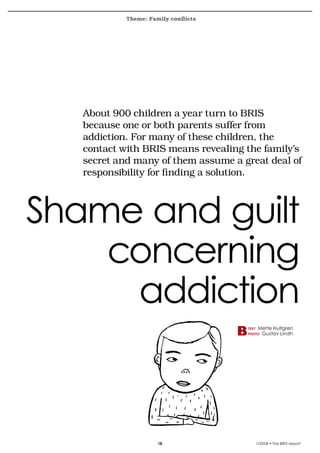
          About	900	children	a	year	turn	to	BRIS	
          because	one	or	both	parents	suffer	from	
          addiction.	For	many	of	these	children,	the	
          contact	with	BRIS	means	revealing	the	family’s	
          secret	and	many	of	them	assume	a	great	deal	of	
          responsibility	for	finding	a	solution.


    Shame and guilt
        concerning
         addiction
                                             text    Mette Hultgren
                                             photo    Gustav Lindh


                             18                     1/2008 • The BRIS-report
Theme: Family conflicts
krönika


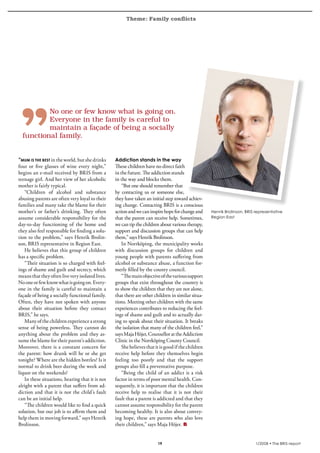
            No	one	or	few	know	what	is	going	on.	
            Everyone	in	the	family	is	careful	to	
            maintain	a	façade	of	being	a	socially	
    functional	family.


  “mum is the best in the world, but she drinks     Addiction stands in the way
  four or five glasses of wine every night,”        These children have no direct faith
  begins an e-mail received by BRIS from a          in the future. The addiction stands
  teenage girl. And her view of her alcoholic       in the way and blocks them.
  mother is fairly typical.                             “But one should remember that
     “Children of alcohol and substance             by contacting us or someone else,
  abusing parents are often very loyal to their     they have taken an initial step toward achiev-
  families and many take the blame for their        ing change. Contacting BRIS is a conscious
  mother’s or father’s drinking. They often         action and we can inspire hope for change and      Henrik Brolinson, BRIS representative
  assume considerable responsibility for the        that the parent can receive help. Sometimes,       Region East
  day-to-day functioning of the home and            we can tip the children about various therapy,
  they also feel responsible for finding a solu-    support and discussion groups that can help
  tion to the problem,” says Henrik Brolin-         them,” says Henrik Brolinson.
  son, BRIS representative in Region East.              In Norrköping, the municipality works
     He believes that this group of children        with discussion groups for children and
  has a specific problem.                           young people with parents suffering from
     “Their situation is so charged with feel-      alcohol or substance abuse, a function for-
  ings of shame and guilt and secrecy, which        merly filled by the county council.
  means that they often live very isolated lives.       “The main objective of the various support
  No one or few know what is going on. Every-       groups that exist throughout the country is
  one in the family is careful to maintain a        to show the children that they are not alone,
  façade of being a socially functional family.     that there are other children in similar situa-
  Often, they have not spoken with anyone           tions. Meeting other children with the same
  about their situation before they contact         experiences contributes to reducing the feel-
  BRIS,” he says.                                   ings of shame and guilt and to actually dar-
     Many of the children experience a strong       ing to speak about their situation. It breaks
  sense of being powerless. They cannot do          the isolation that many of the children feel,”
  anything about the problem and they as-           says Maja Höjer, Counsellor at the Addiction
  sume the blame for their parent’s addiction.      Clinic in the Norrköping County Council.
  Moreover, there is a constant concern for             She believes that it is good if the children
  the parent: how drunk will he or she get          receive help before they themselves begin
  tonight? Where are the hidden bottles? Is it      feeling too poorly and that the support
  normal to drink beer during the week and          groups also fill a preventative purpose.
  liquor on the weekends?                               “Being the child of an addict is a risk
     In these situations, hearing that it is not    factor in terms of poor mental health. Con-
  alright with a parent that suffers from ad-       sequently, it is important that the children
  diction and that it is not the child’s fault      receive help to realise that it is not their
  can be an initial help.                           fault that a parent is addicted and that they
     “The children would like to find a quick       cannot assume responsibility for the parent
  solution, but our job is to affirm them and       becoming healthy. It is also about convey-
  help them in moving forward,” says Henrik         ing hope, these are parents who also love
  Brolinson.                                        their children,” says Maja Höjer.


                                                                           19                                                 1/2008 • The BRIS-report
Theme: Family conflicts
krönika


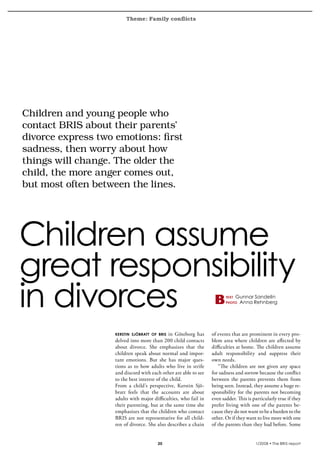
   Children	and	young	people	who	
   contact	BRIS	about	their	parents’	
   divorce	express	two	emotions:	first	
   sadness,	then	worry	about	how	
   things	will	change.	The	older	the	
   child,	the	more	anger	comes	out,	
   but	most	often	between	the	lines.


  Children assume
  great responsibility
  in divorces                                                               text
                                                                            photo
                                                                                   Gunnar Sandelin
                                                                                    Anna Rehnberg


                       kerstin sjöbratt of bris   in Göteborg has    of events that are prominent in every pro-
                       delved into more than 200 child contacts      blem area where children are affected by
                       about divorce. She emphasizes that the        difficulties at home. The children assume
                       children speak about normal and impor-        adult responsibility and suppress their
                       tant emotions. But she has major ques-        own needs.
                       tions as to how adults who live in strife        “The children are not given any space
                       and discord with each other are able to see   for sadness and sorrow because the conflict
                       to the best interest of the child.            between the parents prevents them from
                       From a child’s perspective, Kerstin Sjö-      being seen. Instead, they assume a huge re-
                       bratt feels that the accounts are about       sponsibility for the parents not becoming
                       adults with major difficulties, who fail in   even sadder. This is particularly true if they
                       their parenting, but at the same time she     prefer living with one of the parents be-
                       emphasizes that the children who contact      cause they do not want to be a burden to the
                       BRIS are not representative for all child-    other. Or if they want to live more with one
                       ren of divorce. She also describes a chain    of the parents than they had before. Some


                                           20                                              1/2008 • The BRIS-report
krönika


          are also afraid of their father’s anger, parti-    talk with another adult, such as a grand-
          cularly when it is directed at their mother,”      mother, a friend’s parents or an adult in
          says Kerstin Sjöbratt.                             school. Parents must therefore strive to
                                                             set aside their own anger and despair. The
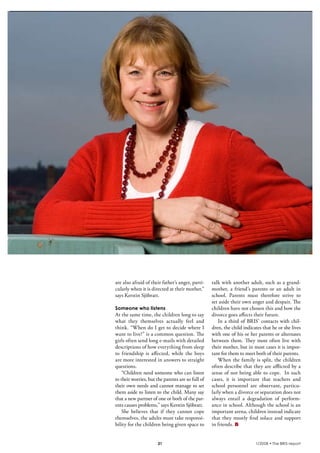
          Someone who listens                                children have not chosen this and how the
          At the same time, the children long to say         divorce goes affects their future.
          what they themselves actually feel and                In a third of BRIS’ contacts with chil-
          think. “When do I get to decide where I            dren, the child indicates that he or she lives
          want to live?” is a common question. The           with one of his or her parents or alternates
          girls often send long e-mails with detailed        between them. They most often live with
          descriptions of how everything from sleep          their mother, but in most cases it is impor-
          to friendship is affected, while the boys          tant for them to meet both of their parents.
          are more interested in answers to straight            When the family is split, the children
          questions.                                         often describe that they are afflicted by a
              “Children need someone who can listen          sense of not being able to cope. In such
          to their worries, but the parents are so full of   cases, it is important that teachers and
          their own needs and cannot manage to set           school personnel are observant, particu-
          them aside to listen to the child. Many say        larly when a divorce or separation does not
          that a new partner of one or both of the par-      always entail a degradation of perform-
          ents causes problems,” says Kerstin Sjöbratt.      ance in school. Although the school is an
              She believes that if they cannot cope          important arena, children instead indicate
          themselves, the adults must take responsi-         that they mostly find solace and support
          bility for the children being given space to       in friends.


                                 21                                                1/2008 • The BRIS-report
Theme: Family conflicts
krönika


                          When	a	child	in	a	family	has	been	affected	by	
                          serious	problems,	such	as	illness	or	criminality,	
                          his	or	her	siblings	often	react	by	withdrawing	
                          in	order	to	not	be	a	burden.	This	results	in	
                          them	becoming	more	or	less	invisible.	


  Pay attention to
  the silent children
                                                                              text   Gunnar Sandelin
                                                                                         Lena Sjöberg
                                                                              illustration


                                                                         when a sibling for various reasons takes up the ma-
          My brother has a muscle disorder and had to be in              jority of the parents’ resources, it often results in
          hospital all summer. The whole family was really sad
          and I can see that nobody in my family feels good.
                                                                         the other children in the family being pushed into
          I’m worried about how long they can carry on. I                a life in the background. It can be a question of
          try to do everything I can to make them happy.                 disease, mental impairment, disability, criminality
           Please, give me advice! I can’t handle pretend-
           ing that everything is fine anymore. Help me.
                                                                         or acting out in general that consumes the parents’
                                 E-mail from a 13-year-old girl          energy. Siblings of children with diagnoses such as
                                                                         ADHD, autism or Asperger’s syndrome often tell
                                                                         BRIS that they end up in conflict with their sib-
                                                                         lings. But even more common than conflict is that
           Once I was so scared when my sister and I                     they themselves withdraw in order to not be a bur-
           were home alone and she locked herself in and                 den and day-to-day life worries are suppressed.
          refused to come out and I heard that she was
          crying. I’ve never been so scared my entire life, I
                                                                             “When their parents are worried about a sib-
          thought she might kill herself or something.                   ling, they do not want to add to the burden. In
                                   E-mail from a 12-year-old girl        a family that has problems, a sibling can often
                                                                         constitute the only security, but here the entire
                                                                         family is affected so that they themselves become
                                                                         more or less invisible,” says BRIS representative
                                                                         Eva Stenelund.


                                                                                                          1/2008 • The BRIS-report
Theme: Family conflicts
krönika


                   Invisible children
                   A great deal concerns not taking responsibility
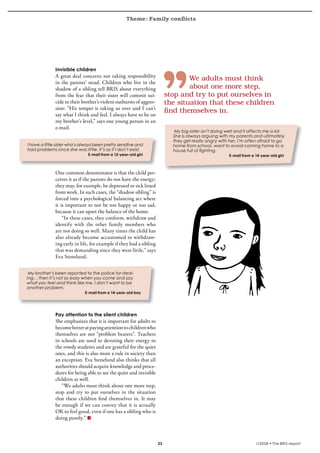
                                                                                       We	adults	must	think	
                   in the parents’ stead. Children who live in the
                   shadow of a sibling tell BRIS about everything                      about	one	more	step,		
                   from the fear that their sister will commit sui-            stop	and	try	to	put	ourselves	in	
                   cide to their brother’s violent outbursts of aggres-        the	situation	that	these	children	
                   sion: “His temper is taking us over and I can’t
                                                                               find	themselves	in.
                   say what I think and feel. I always have to be on
                   my brother’s level,” says one young person in an
                   e-mail.
                                                                                  My big sister isn’t doing well and it affects me a lot.
                                                                                 She is always arguing with my parents and ultimately
                                                                                 they get really angry with her. I’m often afraid to go
     I have a little sister who’s always been pretty sensitive and               home from school, want to avoid coming home to a
     had problems since she was little. It’s as if I don’t exist.                house full of fighting.
                                     E-mail from a 12-year-old girl                                          E-mail from a 14-year-old girl


                   One common denominator is that the child per-
                   ceives it as if the parents do not have the energy;
                   they may, for example, be depressed or sick listed
                   from work. In such cases, the “shadow sibling” is
                   forced into a psychological balancing act where
                   it is important to not be too happy or too sad,
                   because it can upset the balance of the home.
                       “In these cases, they conform, withdraw and
                   identify with the other family members who
                   are not doing so well. Many times the child has
                   also already become accustomed to withdraw-
                   ing early in life, for example if they had a sibling
                   that was demanding since they were little,” says
                   Eva Stenelund.


     My brother’s been reported to the police for steal-
    ing… then it’s not so easy when you come and say
    what you feel and think like me. I don’t want to be
    another problem.
                                   E-mail from a 14-year-old boy


                   Pay attention to the silent children
                   She emphasizes that it is important for adults to
                   become better at paying attention to children who
                   themselves are not “problem bearers”. Teachers
                   in schools are used to devoting their energy to
                   the rowdy students and are grateful for the quiet
                   ones, and this is also more a rule in society than
                   an exception. Eva Stenelund also thinks that all
                   authorities should acquire knowledge and proce-
                   dures for being able to see the quiet and invisible
                   children as well.
                      “We adults must think about one more step,
                   stop and try to put ourselves in the situation
                   that these children find themselves in. It may
                   be enough if we can convey that it is actually
                   OK to feel good, even if one has a sibling who is
                   doing poorly.”


                                                                                                                         1/2008 • The BRIS-report
Theme: Psychological abuse and emotional neglect
krönika


                                                           1/2008 • The BRIS-report
Theme: Psychological abuse and emotional neglect
krönika


  Children,	who	are	exposed	to	daily	degradation	or	
  are	threatened	or	violated	by	their	parents	or	who	
  entirely	lack	the	love	of	or	closeness	to	their	parents,	
  often	speak	to	BRIS	about	a	double	victimisation.	
  Because	when	they	seek	help,	they	are	met	by	an	
  unsympathetic	adult	world,	which	leads	to	the	
  children	being	afflicted	by	depression,	anxiety	and	
  self-destructive	behaviour.		


  On the edge
  of an abyss
  – psychological abuse and emotional neglect
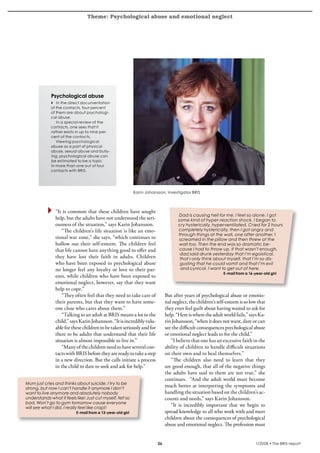
      text   Cecilia Nauclér       a comprehensive part of BRIS’ documented con-          “The children who are exposed to psychological
      illustration Lena Sjöberg    tacts with children and young people concerns          abuse or emotional neglect contact BRIS because
                                   psychological abuse and emotional neglect.             they want the help of an adult. They can themsel-
                                   “Most often, it is teenagers who contact BRIS in       ves see the connection between their background
                                   these areas,” says Karin Johansson, investigator       and that they are doing poorly. For many of those
                                   at BRIS. In part because it is first in the teenage    who are exposed to psychological abuse, there are
                                   years that a child is sufficiently developed to un-    only two alternatives left, either move out of the
                                   derstand that something is wrong at home, and          house, or commit suicide. Because they expe-
                                   in part because a child exposed to psychologi-         rience that they are on the edge of an abyss,” says
                                   cal abuse contacts BRIS first when the abuse has       Karin Johansson.
                                   gone so far that the child feels that he or she can-      The children describe that they suffer from
                                   not cope any longer.                                   serious psychological symptoms such as depres-
                                                                                          sion, anxiety, eating disorders and self-destruc-
                                                                                          tive behaviour. The children also tell BRIS about
                My brother hits me like every day. And today my dad hit
                me and pulled me by the neck and said that I wasn’t
                                                                                          unsympathetic surroundings. The psychological
                allowed to go out because I was home from school.                         abuse or neglect takes place behind the family’s
                Can’t handle all the abuse I get here at home any-                        closed doors and no one can conceive of what
                more. And mum has pushed me down on the floor so
                I got abrasions. Want a fast answer, because I don’t
                                                                                          the child’s situation is like. Instead, it is common
                 want to live this life anymore, as I do now.                             that the child clings to a pet with which he or she
                                          E-mail from a 14-year-old girl                  talks, in some cases the child has tried to estab-
                                                                                          lish contact with a school nurse or counsellor.

                                                                                                                    1/2008 • The BRIS-report
Theme: Psychological abuse and emotional neglect
krönika


                 Psychological abuse
                 4 In the direct documentation
                 of the contacts, four percent
                 of them are about psychologi-
                 cal abuse.
                    In a special review of the
                 contacts, one sees that it
                 rather exists in up to nine per-
                 cent of the contacts.
                    Viewing psychological
                 abuse as a part of physical
                 abuse, sexual abuse and bully-
                 ing, psychological abuse can
                 be estimated to be a topic
                 in more than one out of four
                 contacts with BRIS.


                                                                Karin Johansson, investigator BRIS


                    “It is common that these children have sought
                                                                                         Dad is causing hell for me. I feel so alone. I got
                    help, but the adults have not understood the seri-                  some kind of hyper-reaction shock. I began to
                    ousness of the situation,” says Karin Johansson.                    cry hysterically, hyperventilated. Cried for 2 hours
                        “The children’s life situation is like an emo-                  completely hysterically, then I got angry and
                                                                                        through things at the wall, one after another. I
                    tional war zone,” she says, “which continues to                      screamed in the pillow and then threw at the
                    hollow out their self-esteem. The children feel                      wall too. Then the end was so dramatic be-
                    that life cannot have anything good to offer and                     cause I had to throw up. If that wasn’t enough,
                                                                                         dad said drunk yesterday that I’m egoistical,
                    they have lost their faith in adults. Children                       that I only think about myself, that I’m so dis-
                    who have been exposed to psychological abuse                         gusting that he could vomit and that I’m evil
                    no longer feel any loyalty or love to their par-                      and cynical. I want to get out of here.
                                                                                                                E-mail from a 16-year-old girl
                    ents, while children who have been exposed to
                    emotional neglect, however, say that they want
                    help to cope.”
                        “They often feel that they need to take care of          But after years of psychological abuse or emotio-
                    their parents, but that they want to have some-              nal neglect, the children’s self-esteem is so low that
                    one close who cares about them.”                             they even feel guilt about having waited to ask for
                        “Talking to an adult at BRIS means a lot to the          help. “Here is where the adult world fails,” says Ka-
                    child,” says Karin Johansson. “It is incredibly valu-        rin Johansson, “when it does not want, dare or can
                    able for these children to be taken seriously and for        see the difficult consequences psychological abuse
                    there to be adults that understand that their life           or emotional neglect leads to for the child.”
                    situation is almost impossible to live in.”                     “I believe that one has an excessive faith in the
                        “Many of the children need to have several con-          ability of children to handle difficult situations
                    tacts with BRIS before they are ready to take a step         on their own and to heal themselves.”
                    in a new direction. But the calls initiate a process            “The children also need to learn that they
                    in the child to dare to seek and ask for help.”              are good enough, that all of the negative things
                                                                                 the adults have said to them are not true,” she
                                                                                 continues. “And the adult world must become
    Mum just cries and thinks about suicide. I try to be
    strong, but now I can’t handle it anymore I don’t
                                                                                 much better at interpreting the symptoms and
    want to live anymore and absolutely nobody                                   handling the situation based on the children’s ac-
    understands what it feels like! Just cut myself, felt so                     counts and needs,” says Karin Johansson.
    bad. Won’t go to gym tomorrow cause everyone
    will see what I did. I really feel like crap!!
                                                                                    “It is incredibly important that we begin to
                               E-mail from a 13-year-old girl                    spread knowledge to all who work with and meet
                                                                                 children about the consequences of psychological
                                                                                 abuse and emotional neglect. The profession must


                                                                                                                                1/2008 • The BRIS-report
Theme: Psychological abuse and emotional neglect
krönika


                    learn not to dismiss children when they come             you’re stupid, you fail in everything and can’t do
                    with these problems. Professionals must recognise        anything right, I wish I had never had you.
                    these problems, know what they should look for
                    and they must help the children to tell.”                emotional neglect     means a lack of love and
                                                                             stimulation, closeness and affirmation from
                    Definition:                                              adults close to the child. The children are given
                    psychological abuse    is defined by adults sys-         no words for feelings and thereby no tools to
                    tematically exposing children to degradation,            understand and handle their own emotions.
                    humiliation and aggression. Many children tell           Sometimes it can be difficult to determine if
                    about a combination of physical and psycho-              the child is exposed to psychological abuse or
                    logical abuse, about parents who express hate            emotional neglect. There is a fluid boundary
                    and distain for them, about step parents who do          between them.
                    not like them and clearly show it and biological            The children tell about immature parents,
                    parents who do not protest, about adults who             about parents who are under stress, there are of-
                    threaten physical abuse or threaten to throw             ten alcohol or other drugs involved, and about
                    them out, or about adults who say humiliating            parents with psychological disorders such as an
                    things to the children: whore, you’re worthless,         inability to feel empathy with the child.


      My parents twist everything I say so that they                               Our neighbours shout at their kids. One day, I
     can shout at me about it. My dad is a dicta-                                  came home late and found their daughter who
     tor with aggression problems. He says that I’m                                is TWO YEARS OLD out in the stairwell, she sat and
     mentally sick the whole time.                                                 cried. I knocked on the neighbour’s door and
                             E-mail from a 15-year-old boy                         gave them their daughter back, the neighbour
                                                                                   looked really happy and said that she had FOR-
                                                                                   GOTTEN her out there, 10 minutes later the kid
                                                                                   was out in the stairwell and crying again.
                                                                                                          E-mail from a 13-year-old girl
    I hate my dad. Every day he says that I’m a snotty-
    nosed little brat who shouldn’t have been born, that
    I was a damned mistake, that he wished I hadn’t
     been born and mum just agrees! She doesn’t pro-                           My mum’s husband, my pretend dad, has hit her
     test or anything. Dad hits me sometimes too, I just                       several times, once she even broke two ribs when
      want to hit back, but then I know that I’ll just be hit                  he beat her. I can’t handle their fighting here at
      more. Will kill myself if it keeps up like this. Is it my                home, I just want to go home to my dad. But when
      fault that my parents don’t like me? I just wished                       I’m there, I think my pretend dad beats my mum. I
      they were dead, didn’t have to deal with those                           sit and cry almost every night because she’s hurt
      damned idiots.                                                           and sad.
                              E-mail from a 15-year-old girl                                               E-mail from a 12-year-old girl


                                                                        27                                                  1/2008 • The BRIS-report
krönika


          28   1/2008 • The BRIS-report
Theme: School, bullying and a virtual weekday           bokslut 2007
krönika


   Teachers
   in positions
   of power
   text
   photo
          Nicklas Lund
           Lena Granefelt
                            Children	talk	about	the	school	from	different	
                            aspects	when	they	contact	BRIS.	In	many	
                            cases,	they	bring	up	thoughts	and	feelings	
                            about	performance	and	being	tired	of	school.	
                            They	perceive	a	great	deal	of	pressure,	talk	
                            about	the	stress	surrounding	marks	and	
                            feelings	of	being	“stuck”	in	school	work.	Some	
                            say	that	they	feel	condemned	because	they	
                            messed	up	or	because	they	do	not	have	the	
                            personal	pre-requisites	to	succeed.

                                                   29                         1/2008 • The BRIS-report
Theme: School, bullying and a virtual weekday
krönika


                 some of the children     and young people who
                 contact BRIS about problems with school, de-
                 scribe thoughts about life being over because
                 they could not perform in the way the school
                 required of them. Sometimes they describe the
                 connections between life at home and being
                 tired in school, but in many cases they describe
                 the school’s demands and the situation there as
                 the fundamental problem.


   I am so tired of school and I don’t know what
   to do. I’ve begun to not bother with my school
   work more and more, and have even skipped
   several times. But if I don’t study enough for
   the tests, it causes me loads of anxiety. There is
   such an unbelievable pressure to do well.
                         E-mail from a 17-year-old girl


   Before I was always really nervous before tests
   and got really disappointed if I “only” got an
   B, but now it feels “like manage” if we have
   an exam. I just don’t have the energy for
   school. And the teachers say that I’ve quit
    striving, but I can’t be bothered. And I have
    no friends in school either and hardly talk to
    anyone.
                        E-mail from a 14-year-old girl


                 Another topic the children describe concerns re-
                 lationships to adults. This can involve teachers
                 who do not see, teachers with whom they cannot
                 talk or who otherwise do not function in their
                 profession.
                     The contacts indicate that there are teachers who
                 make obvious mistakes; they are critical and rude
                 and make insulting remarks in front of the children’s
                 schoolmates. There are examples where the teacher
                 has resorted to actual physical violence by pushing
                 the child against a wall or pushing somebody down
                 in the snow. Children also speak of teachers who are
                 nice and kind, but all too forward.

           We have a teacher who calls us names. He
           grabs us really hard and shouts so that it hurts
           our ears.
                               E-mail from an 11-year-old girl


           Who can one talk to if a teacher is mean? My
           teacher is nice to some in the class and mean
           to others. Can one tell students that they are
           mad or stupid? Is there a line teachers can
            cross so that they cannot be teachers?
                                E-mail from a 15-year-old girl


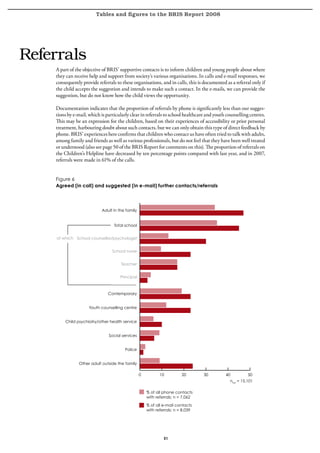
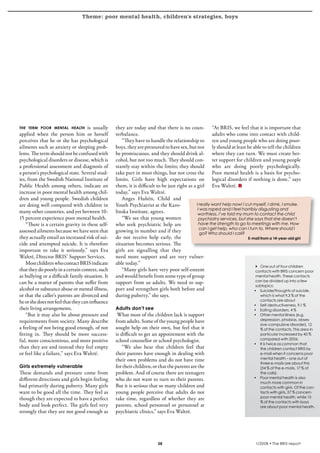
                                                                         30            1/2008 • The BRIS-report
Theme: School, bullying and a virtual weekday
krönika


                            Photo Ingvor Farinotte


                                                                 Anna Löfhede,
                                                                 BRIS representative,Northern Region


                                                          Many of the children’s examples also indicate
                                                          less obvious lacks, where teachers communi-
                                                          cate with children in the wrong way. Anna Löf-
                                                          hede, BRIS representative, Northern region,
                                                          seeks competence development in the subject of
                                                          “talking with children” for teachers and other
                                                          school personnel.
                                                             “It should be a prioritized area. To be able to
                                                          see each child and educate, support and help them
                                                          in their development, the staff needs competence
                                                          and guidance.


                                                                    I’ve changed schools in the hope of finding
                                                                     friends, but because I don’t know anyone in my
                                                                     new class, I never know what I should talk with
                                                                     them about.
                                                                                           E-mail from a 13-year-old girl


                                                          In all talk about goal fulfilment, the adults
                                                          should not forget that the children need to feel
                                                          affirmed and safe in the school environment and
                                                          dare to say how they are doing, and what support
                                                          they need to be able to perform well in school,”
                                                          Anna Löfhede continues. “It can be a question
                                                          ranging from signs of dyslexia and concentra-
                                                          tion difficulties to intolerable situations in the
                                                          child’s home environment.”


                                                     31                                                1/2008 • The BRIS-report
Theme: School, bullying and a virtual weekday
krönika


  “I don’t know what I should do” is how
  many of the contacts BRIS has about
  bullying begin. In the contacts, children
  constantly talk about a feeling of
  resignation, they either do not know
  where to turn, or when they tried to get
  help, they haven’t received any,” says
  Martin Höög, BRIS expert on issues of
  bullying.


  Children
  dependent
  on adults’ actions
  concerning bullying
      text   Nicklas Lund
      photo   Johan Bergling


                                                                             1/2008 • The BRIS-report
Theme: School, bullying and a virtual weekday
krönika


                   the aspect most  visible in the contacts BRIS had          self-esteem has received a serious blow, the child
                   in 2007 about bullying is that most children have          believes that this is his or her lot in life and many
                   not received any help. Children tell BRIS that             of the children do not even contact BRIS. How-
                   they have tried to talk with adults and, for ex-           ever, bullies and their accomplices do call,” says
                   ample, teachers have promised to talk, check up            Martin Höög.
                   on the matter, but nothing has improved.
                      Some children also say that they have been
                   directly insulted by their teacher when they                        I’m scared every day because I’ve gotten a lot of
                   have tried to get help. Instead of affirmation,                     texts and e-mails where they write “you’re gonna
                                                                                        die damned arab”. When we had history, we talked
                   the event is denied by the teacher who says that                     about Iraq and there was a question about what
                   the child is imagining things. “The contacts                         something was called and I answered and then a
                   show a clear inability to act among adults,” says                    guy shouted: The Arab knows something after all,
                                                                                        and everyone laughed, even the teacher laughed
                   Martin Höög, BRIS expert in issues of bullying,                      and said you’re lucky now you can show what you
                   who has delved into BRIS’ documentation in                            know. I’ve gone to the counsellor, but she says that
                   the subject.                                                          nicknames are nothing to get hung up about.
                                                                                                                  E-mail from a 16-year-old boy
                      “Children are dependent on adults acting and
                   how they act.”

                                                                                         If you would see me in school, you’d think I was a
     A 12-year-old girl calls and says that she is bullied                               happy girl with a lot of friends. But it’s not really
     by a gang of boys, daily. This most often occurs on                                like that! Deep down I’m really sad and just want
     the way to and from school, but also during other                                  to start crying as soon as someone says some-
     times. They stare her down and push her on the                                     thing mean…
                                                                                                                    E-mail from a 14-year-old girl
     bus. The adults at school do nothing, she says.
                                 Call with a 12-year-old girl


                                                                              To be able to combat bullying, school staff must
                                                                              understand group psychology, how the group dy-
     A boy says that he is bullied in school, is push and                     namic works. They must understand that the bully
     poked. Will talk to the janitor who he trusts.                           is also a role. This places great demand on the inte-
                                Call with a 12-year-old boy                   rest of adults and “liking to be with the kids”.
                                                                                  “Liking, being knowledgeable about and not
                                                                              violating,” says Martin Höög, when he speaks
                   He cannot emphasize the importance of affirming            of the teacher role and its authority, and how it
                   the children enough, that if they feel violated, it        guarantees integrity and competence.
                   is their right to feel that way. And he emphasizes
                   the adults’ responsibility to look into what lies
                   behind that feeling.                                                 A guy in his class sneaked up on him in the shower
                       “It is about taking the responsibility off of                    after gym class and took a picture of him that was
                                                                                       later put on the school’s bulletin board and in the
                   the kids and indicating the right to receive help,                  cafeteria. Many managed to see it and he is afraid
                   and guiding the child to contacting an adult that                   of what everyone will say.
                   they trust.”                                                                                       Call with a 13-year-old boy


                   Own strategies
                   The underlying causes of bullying are very seldom                   A girl who is tired of the teachers not acting when
                   personal and bullying often arises in groups that                   there is bullying in her school. She is not bullied her-
                   lack guidance or structure. The consequences of                     self, but gets really angry when she sees that others
                                                                                        are bullied and the teachers do nothing about
                   bullying are, however, devastating both for the                      it. She has asked the teachers why they don’t
                   person bullied and for the bully. Bullying lowers                     do something and then gets the response that
                   the child’s self-esteem and is an important cause                     they act when they feel it is necessary. Then one
                                                                                         can wonder what it is called when somebody is
                   of poor mental health, suicide, et cetera.                             pushed and completely showered in the hallway.
                      “To cope, children develop strategies and one                                                  Call with a 14-year-old girl
                   of them is to accept the bullying. But if their


                                                                                                                            1/2008 • The BRIS-report
Theme: School, bullying and a virtual weekday
krönika


          “Today, teachers are left in a vacuum since their
          authoritarian role was taken away, but no new
                                                                              Fact box
          tools were provided,” he continues.
                                                                             4 Bullying is, and has for many
              If one does not create order with the help of                   years been one of the most
          scare tactics and submission, one must, for ex-                     common reasons for contact-
                                                                              ing BRIS.
          ample, work with communication and group
                                                                                 Of the child contacts in 2007,
          processes, in which case one first needs to learn                   2,900 or 14 percent were about
          this as an adult. And there are examples of when                    bullying. This is a14 percent in-
                                                                              crease in the number of these
          teachers also subconsciously provide an approval
                                                                              contacts compared with 2006.
          of sour comments. A small twitch of the corner of                      It is more common that chil-
          one’s mouth might be enough and the fact that a                     dren call BRIS about bullying
                                                                             – 18 percent of the calls were
          teacher does not take a stand against mean com-
                                                                              about bullying, while 8.7 per-
          ments is a clear signal for a child.                                cent of the e-mails concerned
              “Children tell us about teachers who give                       bullying.
                                                                                 Bullying is almost twice as
          direct support, or themselves say mean things
                                                                              common in contacts with boys
          about the kids.”                                                   – 21 percent of the contacts
                                                                              about boys and 12 percent
                                                                              about girls concern bullying.
          Good to talk
                                                                                 In nine contacts out of
          But difficult experiences need not be a hinder to                   ten, more than one person
          doing well later, to having a good life. Martin                     commits the bullying. Boys are
                                                                              more often bullies (39 percent)
          Höög cannot emphasize enough that it is good
                                                                              than girls (18 percent), but it is
          for young people to talk about what they are ex-                    most common that the bullies
          posed to and not burry it inside. Those who con-                    are both boys and girls (42
                                                                              percent).
          tact BRIS want to talk with an adult and in many
          instances they also want concrete suggestions as
          to what they can do. In the contacts, the child-
          ren are afraid of talking with an adult at school,
          because, among other reasons, they are uncertain          Hi! I’m a 16-year-old girl who was bullied for many years.
          what consequences it might have; will the teacher         I heard that I was worthless and that I was a bitch etc.
          stand in front of the class and tell? If they have        from everyone at school. The teachers did nothing, but
                                                                     the bullying ended on its own in year 8. Now in year 9,
          had contact with an adult, many say that they get          I feel really bad psychologically. Have gotten really
          a response of “it didn’t work out, I’m sorry” and          poor self-confidence, think that I’m worthless and that
          that there is no plan B. “Moreover, the number of           I’m just in the way. I’m so scared that I won’t be able to
                                                                      handle things.
          adults in the children’s world has been cut back,                                          E-mail from a 16-year-old girl
          there are few adults left in schools,” says Martin
          Höög.
              “We need to understand how reliant children
          are on the adults at school and use this know-              … They hit me every day and say that I’m ugly, fat,
          ledge positively to offer children the opportu-             gross and laugh at me, I don’t go to gym anymore,
          nity of good and clear relationships. In which              I don’t care what the gym teacher says, I don’t
                                                                      want to be in the changing room. The school nurse
          case, more adults are often needed, but above               says that I have to try to be tougher. I hate school, I
          all greater knowledge and awareness among the               never want to go back!
          adults of how important they are.”                                                      E-mail from a 14-year-old boy


                                                                                                            1/2008 • The BRIS-report
Theme: School, bullying and a virtual weekday
krönika


        Important
   adult presence
   on the Internet
                                                       “The Internet is a part of the daily lives of young people today. On
                                                       the Net, many children and young people find friends, and young
                                                       people with problems can get help and support from other
                                                       young people. Adults must therefore learn more about the risks
                                                       and the opportunities of the Internet,” says Thomas Jonsland,
                                                       BRIS-chat project manager.

                                                            text      Nicklas Lund
                                                            photo      Johan Bergling


          children and young      people have a desire and                He seeks greater adult interest in what chil-
          the ability to unburden themselves by writing. In           dren are doing on the Internet, that adults ask
          addition to the contacts through the Children’s             “what did you do on the Net yesterday,” like
          Helpline and the BRIS-mail, more than 15,000                they ask about football practice or school. It is a
          posts were published on BRIS’ Discussion Fo-                way of becoming involved in the child’s activi-
          rum. The posts vary widely. Love and sex, poor              ties. ”BRIS contacts indicate that the children
          mental health and family conflicts are the largest          are positive to adult curiosity,” Thomas Jons-
          topics. There appears to be a great need to put             land says, “they want to tell, or at least receive
          words and receive reactions to thought about                confirmation that the adults care. Adults have
          suicide, for example, or other difficult thoughts,          everything to gain from learning how the Inter-
          explains Thomas Jonsland, BRIS representative               net, or an online game, or chat works.”
          of the Central Region and project manager for                   ”Adults are experts on real life, the day-to-
          the BRIS-chat. However, BRIS has a filter in not            day, and should apply it to the Internet. For ex-
          approving everything, such as posts that can be             ample, a child or young person might not think
          perceived as insulting, or posts that are serious in        about saving a chat contact to make a report to
          a destructive manner.                                       the police,” says Thomas Jonsland.
             ”The child should want to have help, not give                ”The children express how their parents show
          or receive tips on how to cut themselves, which             a fear of the Internet that comes from ignorance.
          is destructive and a cause of anxiety for both              But it is actually a win-win situation to get closer
          the reader and the writer. We always see to the             to each other. It is about dangers and opportuni-
          child’s best,” continues Thomas Jonsland.                   ties in life,” Thomas Jonsland confirms.

                                                                                                                   1/2008 • The BRIS-report
Theme: School, bullying and a virtual weekday
krönika


          Risks and opportunities                                     ”Children and young people are also more perso-
          Of course there is bullying on the Internet, just           nal in their support, they are more daring in that
          like everywhere else and it should also be handled          they often relate to themselves when they support
          in the same way. One difference is that the new             other young people,” says Thomas Jonsland. And
          arenas mean that the children can feel more vul-            there is an enormous need among young people
          nerable and never entirely free. If they leave the          to write about their feelings and experiences. This
          schoolyard, they are in a physical free-zone, but           is shown not least by the large amount of com-
          a text message or an e-mail can come when and               munities for children and young people that exist
          where ever. The anonymity entails risks, as well            on the Internet. But no other community has 100
          as opportunities – it is easier to say something            percent adult presence.
          hurtful and send it with a press of a button than               ”All submissions posted on the Discussion
          saying it face to face. At the same time, Internet          Forum have been reviewed by an adult modera-
          bullying is easier to prove than insulting words;           tor. And the children and young people whose
          it remains, black on white.                                 submissions are stopped receive an explanation of
              Thomas likes to speak about the positive aspects        why they cannot be published. We always have a
          of the Internet, that children recognise its possi-         dialogue with the children on BRIS.se.”
          bilities. ”A whole world of positive contacts opens
          up there, children get help on their own through
          other contemporaries and they are very good at                  What contacts does BRIS.se have?
          helping each other,” says Thomas Jonsland.                      4 During 2007, BRIS.se had almost 700,000
                                                                          visits. Page views amounted to 2.2 million,
              ”They find others with, for example, anorexia               nearly 60% more than in 2006.
          that have gotten out of difficult situations and                   More than 9,000 new users were added to
          receive support from them,” he says.                            the community section for children and young
                                                                          people on BRIS.se during 2007. Together, 10,426
              In the Discussion Forum on bris.se, children                active users made nearly 70,000 logins during
          and young people communicate with each other                    the year.
          over the Internet about problems or other things                    In addition to the 15,000 submissions to BRIS’
                                                                          various discussion forums, more than 600 po-
          they have on their hearts. Thomas Jonsland                      ems or novellas were published on the Poetry 
          views the Discussion Forum as a complement                      Short Story page. Beyond this, more than 1,000
          to the adult contacts in BRIS’ support services.                graffiti wall contributions were made, at latest
                                                                          250 submissions under “encouraging words
              ”Recognition and confirmation of not being                  breathing hope, joy and love” to the “Source of
          alone in their thoughts or problems mean an                     Joy” that opened last October.
          unbelievable amount to those who write on the
          Discussion Forum.”


                                                                                                                       1/2008 • The BRIS-report
Theme: poor mental health, children’s strategies, boys
krönika


  Poor
  mental
  health                                                Eva Waltré, Director BRIS’
                                                        Support Services


  on
                                         For several years, poor mental health among
                                         children and young people has been on the rise,
                                         primarily among young girls. According to Eva
                                         Waltré, Director BRIS’ Support Services, it is
                                         important to take children’s warning signals
                                         seriously so that the problems do not develop
                                         into illness and serious disorders.


  the rise                                               text
                                                         photo
                                                                Mette Hultgren
                                                                 Johan Bergling


                                    37                                           1/2008 • The BRIS-report
Theme: poor mental health, children’s strategies, boys
krönika


  the term poor mental health          is usually   they are today and that there is no coun- “At BRIS, we feel that it is important that
  applied when the person him or herself            terbalance.                                          adults who come into contact with child-
  perceives that he or she has psychological           “They have to handle the relationship to ren and young people who are doing poor-
  ailments such as anxiety or sleeping prob-        boys, they are pressured to have sex, but not ly should at least be able to tell the children
  lems. The term should not be confused with        be promiscuous, and they should drink al- where they can turn. We must create bet-
  psychological disorders or disease, which is      cohol, but not too much. They should con- ter support for children and young people
  a professional assessment and diagnosis of        stantly stay within the limits; they should who are doing poorly psychologically.
  a person’s psychological state. Several stud-     take part in most things, but not cross the Poor mental health is a basis for psycho-
  ies, from the Swedish National Institute of       limits. Girls have high expectations on logical disorders if nothing is done,” says
  Public Health among others, indicate an           them, it is difficult to be just right as a girl Eva Waltré.
  increase in poor mental health among chil-        today,” says Eva Waltré.
  dren and young people. Swedish children              Anges Hultén, Child and
  are doing well compared with children in          Youth Psychiatrist at the Karo-             I really want help now! I cut myself, I drink, I smoke.
                                                                                                 I was raped and I feel horribly disgusting and
  many other countries, and yet between 10-         linska Institute, agrees.                    worthless. I’ve told my mum to contact the child
  15 percent experience poor mental health.            “We see that young women                   psychiatry services, but she says that she doesn’t
      “There is a certain gravity in these self-    who seek psychiatric help are                 have the strength to go to meetings with me. How
                                                                                                  can I get help, who can I turn to. Where should I
  assessed ailments because we have seen that       growing in number and if they                  go? Who should I call?
  they actually entail an increased risk of sui-    do not receive help early, the                                          E-mail from a 14-year-old girl
  cide and attempted suicide. It is therefore       situation becomes serious. The
  important to take it seriously,” says Eva         girls are signalling that they
  Waltré, Director BRIS’ Support Services.          need more support and are very vulner-
      Most children who contact BRIS indicate       able today.”
                                                                                                                               4 One out of four children
  that they do poorly in a certain context, such       “Many girls have very poor self-esteem                                   contacts with BRIS concern poor
  as bullying or a difficult family situation. It   and would benefit from some type of group                                   mental health. These contacts
  can be a matter of parents that suffer from       support from us adults. We need to sup-                                     can be divided up into a few
                                                                                                                                subtopics:
  alcohol or substance abuse or mental illness,     port and strengthen girls both before and                                  • Suicide/thoughts of suicide,
  or that the caller’s parents are divorced and     during puberty,” she says.                                                     which is what 9.3 % of the
  he or she does not feel that they can influence                                                                                 contacts are about
                                                                                                                              •   Self-destructiveness, 9.1 %
  their living arrangements.                        Adults don’t see                                                          •   Eating disorders, 4 %
      “But it may also be about pressure and         What most of the children lack is support                                •   Other mental illness (e.g.
  requirements from society. Many describe          from adults. Some of the young people have                                    depression, phobias, obses-
                                                                                                                                  sive-compulsive disorder), 12
  a feeling of not being good enough, of not        sought help on their own, but feel that it                                    % of the contacts. This area in
  fitting in. They should be more success-          is difficult to get an appointment with the                                   particular increased by 40 %
  ful, more conscientious, and more positive        school counsellor or school psychologist.                                     compared with 2006.
                                                                                                                              •   It is twice as common that
  than they are and instead they feel empty             “We also hear that children feel that                                     the children contact BRIS by
  or feel like a failure,” says Eva Waltré.         their parents have enough in dealing with                                     e-mail when it concerns poor
                                                    their own problems and do not have time                                       mental health – one out of
                                                                                                                                  three e-mails are about this
  Girls extremely vulnerable                        for their children, or that the parents are the                               (34 % of the e-mails, 17 % of
  These demands and pressure come from              problem. And of course there are teenagers                                    the calls).
  different directions and girls begin feeling      who do not want to turn to their parents.                                 •   Poor mental health is also
                                                                                                                                  much more common in
  bad primarily during puberty. Many girls          But it is serious that so many children and                                   contacts with girls. Of the con-
  want to be good all the time. They feel as        young people perceive that adults do not                                      tacts with girls, 27 % concern
  though they are expected to have a perfect        take time, regardless of whether they are                                     poor mental health, while 15
                                                                                                                                  % of the contacts with boys
  body and look perfect. The girls feel very        parents, school personnel or personnel at                                     are about poor mental health.
  strongly that they are not good enough as         psychiatric clinics,” says Eva Waltré.


                                                                          38                                                   1/2008 • The BRIS-report
krönika


    Not only
    acting out


    Few boys tell anyone when they are having a hard
    time. This is also apparent in the contacts with BRIS.
    Only one out of five of the documented contacts are
    with a boy. But just because boys do not verbalise
    their emotional lives, it does not mean that they do
    not need the support of adults.

          text   Gunnar Sandelin
          photo   Ingvor Farinotte


                                                        39   1/2008 • The BRIS-report
Theme: poor mental health, children’s strategies, boys
krönika


                  “in general, boys have a more difficult time              taken advantage of by a step mother. Something
                  than girls in finding words and coherence in              like this is still a taboo subject seldom discussed
                  their emotional lives. They also express their in-        publicly.”
                  ner pain in different ways than girls,” says Karin           Other noticeable differences in BRIS contacts
                  Johansson, Psychologist and BRIS representa-              with boys and girls are that boys live with their lone
                  tive in Göteborg, who has reviewed calls and e-           fathers to a greater extent. They more often report
                  mails with a focus on what boys express.                  being exposed to physical abuse in the home than
                     “Boys can be overcome by uncontrolled ag-              do girls, who instead are more frequently abused by
                  gression, but they suffer from not having control         their mothers. Girls are also more affected by their
                  of their anger. Their way of expressing despera-          mother’s addiction while the boys are harmed by
                  tion and despair is the same thing as when girls          their fathers’ drinking. Another difference is that
                  cut or starve themselves,” she summarizes.                BRIS’ contacts with boys are a few minutes shorter
                                                                            on average than the contacts with girls.

     My dad is a dictator with aggression problems.
     He says that I’m mentally sick the whole time. My
     mum twists everything and lies to my dad so I get                                Hi Bris! Today I intended to kill myself! But it didn’t
     yelled at, she says that I’m anorectic and have                                  work! I don’t know why, but it just didn’t. It doesn’t
     problems.                                                                        feel like anyone cares or likes me anymore. Feels
                             E-mail from a 15-year-old boy                            like I’m just in the way everywhere! Mum’s new
                                                                                       boyfriend gets hung up about everything I do.
                                                                                       He almost strangled me and pushed me down
                                                                                       the stairs when I didn’t eat all of my dinner. I’ve
                                                                                       begun cutting myself, because I’m sad every
                  Only one out of five supportive contacts with                         day and night. Am tired and can’t sleep.
                  BRIS concerns boys. They call and write about                                               E-mail from a 14-year-old boy
                  the same things as girls, but there are clear dif-
                  ferences. Most prominent is that the proportion
                  of boys who tell about bullying is twice as large.
                  In their accounts, the changing room for gym                         I have a really hard time believing in myself and
                                                                                       what I do. And if I get compliments from someone,
                  class presents itself as an arena in which no one                   I have a real tough time accepting it and mostly
                  feels safe.                                                         get embarrassed and try to ”talk it away”.... This is
                      “Penis sizes and muscles are compared, towels                   beginning to get tough! I want to believe in myself.
                                                                                                                  E-mail from a 17-year-old boy
                  are whipped and clothes are hidden in hedges.
                  Many express anxiety over not being able to cov-
                  er themselves in front of their classmates. There
                  is a fear of getting an erection in the shower and        “We hear from the verbal boys, but then we have
                  then being derided in school.                             many boys who call and test us. It may be so that
                      I cannot understand why the adults take               BRIS fills an even more important function for
                  it for granted that children and young people             the boys because in their world there are few op-
                  would be comfortable with showing themselves              portunities to talk about thoughts and feelings,”
                  naked in front of each other,” continues Karin            concludes Karin Johansson.
                  Johansson.

                  Turn the despair inwards
                  Boys can also turn their despair inwards and
                  suffer headaches and stomach aches, develop
                  depression, eating disorders, self-destructive be-
                  haviour and thoughts of suicide. There are sons
                  who take great responsibility for their divorced
                  mothers or who live in families with alcohol or
                  substance abusing parents. These boys may not
                  be many in number, but Karin Johansson warns
                  that the quiet boys are forgotten. Some of the
                  “quiet boys” have been sexually abused by their
                  female guardians.
                     “The boys become silent because they are
                  attracted and humiliated at the same time. As
                  their bodies develop, for example, they can be


                                                                       40                                                    1/2008 • The BRIS-report
Theme: poor mental health, children’s strategies, boys
krönika


   Relationships
   help                                       Children and young people who are doing poorly
                                              know pretty well what makes them feel better for
                                              periods when their mental health weakens. But not all
                                              have access to immediate help. In the contacts with
                                              BRIS, it is clear that the relationship with someone who
                                              really listens and understands is the most important
                                              factor for being able to feel better.
                                                   text
                                                   Mette Hultgren


                                              “we see in the telephone calls, the e-mails and
                                              on the discussion forum that children and
                                              young people mention good relationships as a
                                              way of handling difficulties. One wants to share
                                              what one is going through with someone else. It
                                              can be anyone from a family member, a boy or
                                              girlfriend, a friend or an adult in their school,”
                                              says Helén Thorén, BRIS representative in Re-
                                              gion South.
                                                 “Many describe that they do not have rela-
          Michel Devillaz and Helén Thorén,   tionships, but would like to. Those that have
          BRIS representatives BRIS Region    good relationships express it as having so-
          South.
                                              meone they can always turn to, someone they
                                              can trust in all circumstances, and someone
                                              who is always there. Many of the children say


                                                          41                                       1/2008 • The BRIS-report
Theme: poor mental health, children’s strategies, boys
krönika


     that they want to have someone who lis-
  tens to them and who believes in what they         Referrals and assignments
  say, because they feel that no one listens or
  understands them,” says Helén Thorén.              Referrals                                    Assignments
     “Some have tried with other channels            An important part of BRIS’ way of            An assignment means that the child
  before they contact us, but they do not feel       working is to support and affirm chil-       contacting BRIS requests more active
  that they have received help and in such           dren and young people who contact us.        involvement by a BRIS representative.
  cases BRIS becomes a way of moving for-            But the child often needs continued          This can concern children who find
  ward. Then there are those who have never          support in his or her surroundings,          themselves in an acute, dangerous situ-
  told anyone about their situation and the          and in the contact with BRIS, people         ation, are harming themselves or need
  contact with BRIS is the first step in formu-      or organisations are often found close       help for other reasons.
  lating themselves. And being anonymous             to the child, in whom he or she has faith       Assignments always take place on
  in their contacts with BRIS helps; they can        and who can offer continued help. One        the child’s initiative and based on the
  express themselves without any pressure,”          of BRIS’ important tasks is to also in-      child’s needs. An assignment gives BRIS
  Helén Thorén continues.                            form children and young people about         the opportunity to conduct a range of
     Many also indicate that it is important to      their rights and where in society they       service from extended support and mo-
  be able to put words to how they feel. They        can receive help. When one agrees with       tivational talks to making contacts with
  either do so by talking or writing poetry or       the child that he or she will try such       authorities or other organisations. Em-
  by listening to music.                             a contact, it is recorded as a “referral”.   ployed BRIS representatives manage the
     “Music can be a way for many to get             In a response in e-mail, BRIS can like-      assignments and the child has contact
  help. It is about a type of identification,”       wise suggest a contact to the child, but     with a single person.
  she says.                                          the children must decide on their own           In 2007, BRIS concluded 85 assign-
                                                     about the referral.                          ments, which is slightly more than 2006.
  Fellowship provides better health                      Referrals are made in more than 70
  The children also express that the fellowship      percent of all contacts. Many times, it      A 14-year-old girl who has been beaten by
  with others is important. They often men-          can be difficult to find suitable adults,    her mother for many years refuses to return
  tion leisure interests that they share with oth-   regardless of whether they are profes-       home after having spent the weekend with
  ers, doing things together with others at all,     sional or private contacts. Fear of not      her father. She wants help from BRIS to
  finding oneself in a context.                      being believed or of being a burden is       contact social services and wonders how a
      “Interests and various hobbies’ that are       often reason why the child does not          police report is made.
  stimulating often help children and young          want to tell. Children also often per-          The BRIS representative contacts so-
  people a great deal. Looking at research           ceive that adults have already signalled     cial services in the girl’s municipality and
  on health-promoting factors, it is apparent        that they do not have time or energy, and    presents her wishes. The girl and the BRIS
  that interests are particularly important to       in school, the resources of student care     representative maintain contact until the
  feeling good, and we also see this in our          have often shrunk to a minimum.              girl feels that she has been listened to and
  contacts,” says Michel Devillaz, BRIS rep-             In eight out of ten e-mails, BRIS        has received her own social worker with
  resentative of Region South.                       suggests an organisation that the child      social services, with whom she can talk and
      And children and young people often            can contact, but agreements with the         who helps her move forward.
  find close and strengthening relationships         child are met in only six out of ten
  in these contexts.                                 phone calls. The difference is clear         A 16-year-old boy is living at a youth insti-
      “Sometimes, one has to take oneself            when we consider referrals to student        tution and tells of violations he has suffered
  more seriously as an adult. Many do not re-        healthcare, youth counselling centres        from by other young people there. The staff
  alise the special role they play as an adult. A    and child psychiatry services. Less than     does not believe him. His social worker at
  coach is often not just a coach, but also an       half as many referrals are made on the       social services has quit and he does not know
  adult who can listen to what the children          phone as in the e-mails, which can be        whom he can turn to. The BRIS representa-
  have to say,” says Michel Devillaz.                interpreted such that the children have      tive contacts social services to find out who is
      Taking adult responsibility in relation        little confidence in the organisations       responsible for his placement. After further
  to children and young people is basically          that BRIS sees as natural contacts in        talks with the boy, the BRIS representative
  about something as simple as taking time           the context.                                 submits a written report to social services to
  to listen and sincerely caring.                                                                 protest the lacks that the boy perceives and
      “Every meeting with a child or young                                                        to make clear what he is exposed to at the
  person is an important meeting. This is not                                                     institution.
  only true of professional meetings when a
  psychologist or counsellor meets the child,
  but other types of meetings as well.”
      “It is important for us adults to be sup-
  portive and give the children space to put
  words to how they are doing. We know that
  it helps. This is what so many children call
  and confirm,” says Helén Thorén.

                                                                                                                     1/2008 • The BRIS-report
Tabeller och figurer
         Appendix:
   till BRIS-rapporten 2008
  Tables and figures
    to the BRIS Report 2008
Contents
Introduction                             45
Ten-year history of child contacts       47
Gender  age                             47
Living arrangements                      48
Contact topics                           48
Perpetrators, physical abuse             50
Perpetrators, sexual abuse               50
Referrals                                51


                          Documentation Peter Irgens
                          Text Martin Höög
                          Ad Kristina Schollin-Borg
                          Translation Semantix

                          BRIS National Association
                          tel +46 (0)8-598 888 00
                          www.bris.se
Tables and figures to the BRIS Report 2008


BRIS documentation
of supportive contacts
   Every day, children and young people contact BRIS anonymously by telephone
   or e-mail. In BRIS’ database, large amounts of information are gathered with
   details about gender and age, and in many cases about the children’s living
   arrangements. Here, experiences, adult contacts and relations with authorities
   are described. From the database, both quantitative information, such as the
   number of contacts about bullying, and children’s own descriptions of how
   they perceive bullying can be retrieved. The BRIS Report describes children’s
   experiences with examples, analysis and reflection on prominent and current
   topics. In this table appendix, we provide a complement to this information
   with the numerical statistics.

   In order to understand and use figures and statistics, knowledge is required about
   how the statistics have been gathered. All information presented in the BRIS
   Report and in this appendix of tables is based on accounts from children and
   young people, who have themselves chosen to contact BRIS. Consequently, they
   do not comprise a cross-section or representative selection of Sweden’s children
   and young people, and the information should therefore not be used in such a
   way. Based on its figures, BRIS cannot say anything about how many children
   e.g. are affected by various forms of poor mental health. However, we can call
   attention to changes over time, we can tell about children’s experiences and
   needs, and we can note differences in how boys and girls or different age groups
   describe their situation. Because BRIS often has access to unique information from
   children and young people, the collective picture in the BRIS Report is important
   for all of those interested in the living conditions of children in Sweden today.

   BRIS’ contacts with children and young people are made through the Children’s
   Helpline and the BRIS-mail. At the end of 2007, a trial period also began with
   the BRIS-chat, and the slightly more than 50 chat sessions for which there was
   time are counted in the total 21,401 contacts covered by the documentation.
   Every call or e-mail constitutes a unique contact, and because children may
   contact BRIS multiple times, the total number of contacts are probably not equal
   to the number of children. The information that comes forth in the call or e-mail
   is documented throughout – but BRIS does not request information unless it is
   relevant based on the questions the child brings up. This means that information
   about e.g. age and living arrangements is not always included. In each figure
   there is an n-value, which indicates how many contacts the information is
   based on. Beyond the documented contacts, BRIS has a large number of
   shorter contacts every year, primarily by telephone, that do not contain enough
   information to be documented in more depth. These calls can be entirely silent or
   comprise very short conversations of an informational or test nature.


                                             45
Tables and figures to the BRIS Report 2008


                    46
Tables and figures to the BRIS Report 2008


          Ten-year history of child contacts
                                   The number of documented child contacts by phone and e-mail during the last 10 years. BRIS began
                                   documenting e-mail exchanges with children in 2000, and during 2001, the BRIS-mail was begun as
                                   an independent part of the supportive services. The number of contacts has only changed marginally
                                   in recent years, although the proportion of e-mails has increased and in the past two years comprised
                                   46% of the contacts. Included in the 2007 statistics are also 53 contacts through the online chat that
                                   began its trial period at the end of the year in a very limited fashion.

                                   Figure 1
                                   Supportive, documented child contacts 1998-2007

                                   Year
                                   1998                                         12,788
                                   1999                                              14,341                                                                    Year
                                   2000                                                         18,039                                                         1998                                          12,788
                                   2001                                                              19,358                                                    1999                                             14,34
                                   2002                                                                          23,023                                        2000
                                   2003                                                                       22,044                                           2001
    The Children’s Helpline        2004                                                                       22,133                                           2002
    The BRIS-mail                  2005                                                              19,237                                                    2003
                                   2006                                                                     21,273                The Children’s Helpline      2004
                                   2007                                                                     21,401                The BRIS-mail                2005
                                          0           5,000          10,000     15,000         20,000          25,000                                          2006
                                                                                                                                                               2007
                                                                                                                                                                      0       5,000          10,000          15,000


                        Topics      % of all Child contacts*           n = 21,401


          Gender  age
              Family conflicts
    Relationships with friends
           Love relationships
                                     21%
                                     19%
                                     15%                                                     3,216
                                                                                                         4,091
                                                                                                               4,400
                                                                                                                                                     Topics
                                                                                                                                            Family conflicts
                                                                                                                                                                % of all Child contacts*
                                                                                                                                                                 21%
                                                                                                                                                                                              n = 21,401

                    Loneliness       14%                                                    3,086                                 Relationships with friends     19%
                       Bullying    This figure shows what proportion of 2,900
                                     14%                                  all child contacts is comprised by each respective age 15% and
                                                                                                              Love relationships     group,
        Other1 mental illness      how they are distributed between2,583 and girls. As is clearly apparent, girls Lonelinesslarge majority
                                     12%                                boys                                           are in a 14%                                                                                    3
         Existential/life issues   among those who contact BRIS and account for 79% of all contacts. Looking solely to the BRIS-mail,
                                    9,9%                          2,123                                                    Bullying 14%                                                                           2,9
   Suicide/suicidal thoughts       the girls account for 88%. The average age is virtually the same for boys andmentaltogether12% years.
                                    9,3%                        1,987                                      Other1 girls, illness     14.1                                                                     2,583
         Self-destructiveness       9,1%                       1,942
                                   Almost half of all contacts are received from 13-15 year-olds.           Existential/life issues 9,9%                                                               2,123
                Identity issues     8,1%                                1,734                                                    Suicide/suicidal thoughts      9,3%                                 1,987
                        Sorrow      7,8%                                1,677                                                          Self-destructiveness     9,1%                                1,942
                                   Figure 2
              Physical abuse        7,5%                1,615                                                                                Identity issues    8,1%                           1,734
                                   Age distribution by gender
            School problems         7,5%                               1,612                                                                        Sorrow      7,8%                           1,677
         Body/appearance            7,0%                             1,492                                                                  Physical abuse      7,5%                          1,615
        Living arrangements         6,6% %
                                   20                               1,411                                                                 School problems       7,5%                          1,612
                     Sexuality      6,4%                            1,365                                                              Body/appearance          7,0%                         1,492
  Sexual abuse/molestation          6,2%                         1,321                                                                Living arrangements       6,6%                        1,411
                         Stress    15
                                    5,2%                       1,115                                                                              Sexuality     6,4%                        1,365
Drug/alcohol abuse in family        4,6%                      975                                                                   Calls
                                                                                                                                 Sexual abuse/molestation       6,2%                     1,321
   Divorce-related problems         4,3%                   927                                                                      Mail            Stress      5,2%                  1,115
                                   10
                                              0        1,000           2,000        3,000           4,000         5,000    Drug/alcohol abuse in family         4,6%                  975
                                                                                                                                 Divorce-related problems       4,3%               927
                                    5                                                                                                                                     0    1,000           2,000           3,000

                                                                                                                                        Boys; n = 4,014
                                    0                                                                                     Year          Girls; n = 15,537
                                          7      7   8   9     10 11 12 13 14 15 16 17 18 18

                                                                                                      ntot = 19,551


                                                                                                               47
Tables and figures to the BRIS Report 2008


Living arrangements
    In half of the contacts, BRIS receives information about children’s living arrangements. On the
    Children’s Helpline, where it is possible to ask questions, information about housing is available in
    seven out of ten calls, while only one out of four e-mails provide this information. The housing pattern
    is very similar to previous years.

    Figure 3
    The children’s living arrangements


    Living arrangements – Proportion of the child contacts
       Nuclear family 56%
       Lone mother 14%
       Both parents alternately 7.5%
       Step family 6.1%
       Lone father 5.5%
       Own housing 3.2%
       Fosterhome 3.1%
       Treatment centre or equivalent 1.9%
       Other 2.6%
    n = 10,638


                                                             Living arrangements – Proportion of the child contacts
                                                                Nuclear family 56%
                                                                Lone mother 14%
                                                                Both parents alternately 7.5%


Contact topics
                                                                Step family 6.1%
                                                                Lone father 5.5%
                                                                Own housing 3.2%
                                                                Fosterhome 3.1%
                                                                Treatment centre or equivalent 1.9%
                                                                Other 2.6%
                                                             n = 10,638
    Every call and e-mail is documented based on the topics the child chooses to bring up. Each call/e-
    mail often covers several topics – such as family conflicts and addiction or loneliness and existential
    life issues. Table 1, on the next page, shows how large a proportion of all contacts concerned each
    respective topic as well as how large a proportion of all calls/e-mails and contacts concerning boys/girls
    were documented in the topic. Because a child contact thereby results in markers in several topics, the
    total figure in each column is greater than 100%.

    For example, the table answers questions such as: What proportion of all contacts concern sorrow,
    among other topics? How common is the topic loneliness in contacts about girls? The summary also
    shows, for instance, that mental illness is more often covered in e-mail contacts, while topics such as
    bullying and physical and sexual abuse are more common on the telephone.

    (Also see p. 7 for more comments)


                                          48
Tables and figures to the BRIS Report 2008


Table 1
The 32 most common contact topics

                                                                                                        % of           % of
                                               % of
                                                                              % of        % of        contacts       contacts
                                Topic        all Child        Number
                                                                            E-mails       Calls        about          about
                                             contacts
                                                                                                        Boys           Girls
                   Family conflicts              21%            4,400          21%         20%            16%            22%
       Relationships with friends                19%            4,091         22%           17%           13%             21%
                Love relationships               15%            3,216          16%          14%           13%             16%
                          Loneliness             14%            3,086          15%          14%           12%             15%
                             Bullying            14%            2,900         8,7%          18%           21%             12%
            Other1 mental illness                12%            2,583          16%         8,7%          9,3%             13%
             Existential/life issues            9,9%            2,123          11%         8,6%          8,5%            10%
                           Suicide/
                suicidal thoughts               9,3%            1,987          14%         5,7%          6,3%            10%
             Self-destructiveness                9,1%           1,942          13%         5,8%          3,8%            10%
                     Identity issues            8,1%            1,734         9,5%         6,9%          6,9%            8,4%
                              Sorrow            7,8%            1,677         8,0%         7,7%          5,4%            8,5%
                    Physical abuse              7,5%            1,615         5,9%         9,0%           10%            6,9%
                 School problems                7,5%            1,612         7,1%         7,8%          7,8%            7,5%
              Body/appearance                   7,0%            1,492         8,7%         5,5%          6,0%            7,2%
            Living arrangements                 6,6%             1,411        5,8%         7,3%          5,3%            6,9%
                        Sexuality               6,4%            1,365         5,2%         7,4%          9,0%            5,7%
                    Sexual abuse/
                      molestation               6,2%            1,321         3,5%         8,4%          5,1%            6,5%
                                Stress          5,2%             1,115        6,1%         4,5%          3,5%            5,7%
    Drug/alcohol abuse in family                4,6%              975         3,8%         5,2%          4,2%            4,7%
      Divorce-related problems                  4,3%              927         4,6%         4,1%          3,7%            4,5%
                  Eating disorders              4,0%              864         5,4%         2,9%          0,9%            4,9%
            Sexual development                  4,0%              846         3,6%         4,3%          5,4%            3,6%
            Psychological abuse                 3,9%              824         3,5%         4,2%          3,9%            3,9%
                  Physical illness              3,2%              687         3,1%         3,3%          3,2%            3,2%
        The child’s alcohol/drug
                          abuse                 2,9%              620         2,0%         3,7%          2,9%            2,9%
                            Neglect             2,8%              600         2,3%         3,2%          2,4%            2,9%
          Physical/Mental illness               2,6%              552         2,4%         2,7%          2,0%            2,7%
                        Pregnancy               2,4%              513         1,3%         3,3%          0,9%            2,8%
       Problems with authorities                2,1%              459         1,4%         2,7%          1,7%            2,3%
                         About BRIS             2,0%              434         2,0%         2,0%          1,8%            2,1%
                           IT-related           1,7%              356         2,0%         1,4%          1,7%            1,7%
                            Finance             1,6%              343         1,3%         1,9%          1,3%            1,7%
                     Total Physical
                   sexual abuse*                14%            3,046          10%          18%           16%             14%

             Total Mental illness**              24%            5,243         34%           17%           15%            27%


                                   n=         21,401                         9,797       11,551         4,530          16,750


* Physical and sexual abuse totals contacts about Physical and Mental abuse and Sexual abuse/molestation.
** Mental illness sums contacts about Suicide/thoughts of suicide, Self-destructiveness, Eating disorders and Other mental illness.

1
     Other = mental illness other than Suicide/suicidal thoughts, Self-destructiveness and Eating disorders


                                                                   49
Tables and figures to the BRIS Report 2008


Perpetrators, physical abuse
    1,615 contacts concerned physical abused, and in 96% of these, the children also indicated who the
    perpetrator was. The collective picture is pretty similar year after year. In three out of four cases, the
    abuse is committed by someone in the child’s family and in 10% of the cases, the child describes abuse
    that occurs in school, which is an increase compared to last year’s figure of 5.7%.

    In more than two thirds of all cases, the perpetrator is a male.

    Figure 4
    Perpetrators in child contacts about physical abuse

                          Father
                         Mother
                   Both parents
             Boyfriend/girlfriend
                      Stepfather
                          Sibling
      Teacher/school personnel
    Other known contemporary
             Other known adult
                 Other/unknown
                                    0        5       10        15   20   25        30        35    40 %
                                                                                             n = 1,558


Perpetrators, sexual abuse
    In 93% of the documented contacts about sexual abuse, the perpetrator is indicated. Compared with
    contacts about physical abuse, the proportion of contemporary perpetrators is approximately the same,
    here 21%, while the percentage of perpetrators in the family is lower, 53%. With an exception for the
    proportion of female perpetrators, which has decreased somewhat compared with last year, no major
    changes have taken place over time.

    Figure 5
    Perpetrators in child contacts about sexual abuse/molestation

                          Father
                     Stepfather
                         Mother
                       Boyfriend
       Teacher/school personnel
                          Sibling
        Another family member
    Other known contemporary
             Other known adult
                 Other/unknown
                                    0            5        10        15        20        25         30 %
                                                                                             n = 1,224


                                        50
Tables and figures to the BRIS Report 2008


Referrals
    A part of the objective of BRIS’ supportive contacts is to inform children and young people about where
    they can receive help and support from society’s various organisations. In calls and e-mail responses, we
    consequently provide referrals to these organisations, and in calls, this is documented as a referral only if
    the child accepts the suggestion and intends to make such a contact. In the e-mails, we can provide the
    suggestion, but do not know how the child views the opportunity.

    Documentation indicates that the proportion of referrals by phone is significantly less than our sugges-
    tions by e-mail, which is particularly clear in referrals to school healthcare and youth counselling centres.
    This may be an expression for the children, based on their experiences of accessibility or prior personal
    treatment, harbouring doubt about such contacts, but we can only obtain this type of direct feedback by
    phone. BRIS’ experiences here confirms that children who contact us have often tried to talk with adults,
    among family and friends as well as various professionals, but do not feel that they have been well treated
    or understood (also see page 50 of the BRIS Report for comments on this). The proportion of referrals on
    the Children’s Helpline have decreased by ten percentage points compared with last year, and in 2007,
    referrals were made in 61% of the calls.


    Figure 6
    Agreed (in call) and suggested (in e-mail) further contacts/referrals


                           Adult in the family


                                  Total school


    of which School counsellor/psychologist


                                 School nurse


                                     Teacher


                                     Principal


                               Contemporary


                     Youth counselling centre


        Child psychiatry/other health service


                               Social services


                                        Police


               Other adult outside the family

                                                 0          10          20       30         40          50
                                                                                              ntot = 15,101

                                                     % of all phone contacts
                                                     with referrals; n = 7,062

                                                     % of all e-mail contacts
                                                     with referrals; n = 8,039


                                                              51

BRIS Report 2008

  • 1.
    tidningen or2t08 BRIS- rep 0 The Family conflicts l Psychological abuse and emotional neglect l Virtual weekday – internet #1/2008 #1/2008
  • 2.
    krönika BRIS Offices Riksförbundet BRIS (NationalAssociation) Karlavägen 121 SE-115 26 Stockholm Tel: +46 (0)8-598 888 00 Fax: +46 (0)8-598 888 01 BRIS E-mail: info@bris.se – Children’s Rights in Society – is an NGO, a voluntary organisation with BRIS region Nord no party political or religious affiliation, which supports children and young (Northern Region) people in distress and is a link between children, adults and the community. Kungsgatan 36 SE-903 25 Umeå The core of BRIS’ activities is comprised of the Children’s Helpline and the BRIS-mail, to which Tel: +46 (0)90-203 65 10 children and young people up to the age of 18 can turn anonymously and free-of-charge when they Fax: +46 (0)90-203 65 11 need support from an adult. BRIS also works as an opinion maker and referral organisation to in- E-mail: bris.nord@bris.se crease adults’ respect for children as individuals. BRIS works for the full application of the principles BRIS region Väst established in the UN Convention of the Rights of the Child. BRIS uses its collective knowledge (Western Region) of the situation of children and young people to inform, influence and create opinion in children’s Hvitfeldtsgatan 14 SE-411 20 Göteborg rights issues at various levels. BRIS also accepts calls from adults who need someone to talk to about Tel: +46 (0)31-750 11 30 their own or other’s children. Fax: +46 (0)31-750 11 31 E-mail: bris.vast@bris.se BRIS was founded in 1971 and is organised as one national and five regional associations. Offices BRIS region Mitt are located in Malmö, Göteborg, Norrköping, Stockholm and Umeå. BRIS’ activities are based on (Central Region) volunteer work and financial grants and donations from both private and public donors. BRIS has a Karlavägen 121 SE-115 26 Stockholm total of about 500 volunteer workers who man the Children’s Helpline and the BRIS-mail. Tel: +46 (0)8-598 888 10 These volunteers are recruited, trained and supervised by employed BRIS personnel. The BRIS Adult Fax: +46 (0)8-598 888 11 Helpline – about Children is usually manned by employed BRIS representatives and costs as much E-mail: bris.mitt@bris.se as a regular phone call. BRIS region Syd (Southern Region) Östra Rönneholmsvä- gen 7 The Children’s Helpline The BRIS-mail SE-211 47 Malmö – for those up to age 18. www.bris.se Tel: +46 (0)40-690 80 70 0200-230 230 Fax: +46 (0)40-690 80 71 E-mail: bris.syd@bris.se Monday to Friday: 3:00 pm – 9:00 pm The BRIS-mail provides personal answers Saturday, Sunday and holidays: within a few days. In the Discussion Forum, BRIS region Öst 3:00 pm – 6:00 pm which is also on BRIS.se, children and young (Eastern Region) Knäppingborgsgatan 7 people can communicate with each other SE-602 26 Norrköping BRIS Adult Helpline – about Children under the oversight of an adult moderator. Tel: +46 (0)11-440 05 50 077-150 50 50 Fax: +46 (0)11-440 05 51 E-mail: bris.ost@bris.se Monday to Friday: 10:00 am – 1:00 pm 1/2008 • The BRIS-report
  • 3.
    38 krönika content It is important for us adults to 8 be supportive and give the children space to put words to how they 20 are doing. We know 35 that it helps. 4 BRIS creates the conditions for children to say it like it is 24 Psychological abuse and emotional neglect – on the edge of an abyss 8 Children’s rights - a natural part of decision-making 28 School – teachers in positions of power 10 perspective Stronger child 32 Children dependent on adults’ actions concerning bullying 12 Children’sworld and outer inner 35 Internet – important aduld presence on the 14 – abandonment in the Family conflicts Internet presence of violence 37 Poor mental health on the rise 18 and guilt concerning 39 Addiction – shame addiction Boys – not only acting out 20 assume –great in Divorce children responsibility 41 Relationships help divorces 42 Referrals and assignments 22 silent children Pay attention to the 43 Appendix: tables and figures Publisher BRIS, Barnens Rätt I Samhället Documentation/research: Henrik Brolinson, Michel Address BRIS-tidningen, Devillaz, Peter Irgens, Thomas Jonsland, Martin Höög, Karin Karlavägen 121, 115 26 Stockholm Johansson, Anna Löfhede, Kerstin Sjöbratt, Helén Thorén, Editorial committee Eva Waltré Text Mette Hultgren, Nicklas Lund, Cecilia www.bris.se Karin Johansson, Martin Höög, Peter Nauclér, Gunnar Sandelin English translation Semantix Irgens, Eva Stenelund, Eva Waltré och Photo Johan Bergling, Ingvor Farinotte, Lena Granefelt, PG 901504-1 Cecilia Nauclér. Gustav Lindh, Nova, Anna Rehnberg Editor Cecilia Nauclér Illustrations Lena Sjöberg/Söderberg Agentur, Ad Kristina Schollin-Borg Responsible editor Ragna Wallmark 1/2008 • The BRIS-report
  • 4.
    krönika Bris creates conditions for children to say like it is text photo Cecilia Nauclér Lena Granfeldt 1/2008 • The BRIS-report
  • 5.
    krönika “BRIS’ documentation over the contacts with children and young people is a unique informational base. All adults, from parents to politicians, have something to learn from the children’s accounts,” says Peter Irgens, BRIS Documentation Manager. “i think what is unique about BRIS’ documen- are not a general measure of how all children and tation of the contacts with children and young young people in Sweden are doing.” people is that the children tell us about their life However, what BRIS can read from the docu- situation based on their needs, without being mentation of the contacts is differences between dependent on the adult with whom the child various contact areas from year to year. is speaking,” says Peter Irgens, Documentation “We can confirm that several thousand child- Manager for BRIS Support Services. ren contact us because they are victims of violence Children are always in some form of depen- and abuse, and we can also see that poor mental dent relationship with nearby adults, which af- health is on the rise. Through the differences, we fects the communication between them. can also see tendencies for social changes,” says “Children often say what they think is expec- Peter Irgens. ted of them, or answer questions,” Peter Irgens New youth phenomena, which are sometimes explains. covered in the media, are difficult to discover in But in the contact with BRIS, it is the child who takes the initiative. They can hang up if Supportive, documented child contacts 1998-2007 they want, or choose to not send the e-mail. The children are anonymous and the communication Year 1998 12,788 is entirely invisible. 1999 14,341 Year “The communication is on the children’s 2000 18,039 1998 terms, which in turn creates the conditions for 2001 19,358 1999 them to actually say how things are.” 2002 23,023 2000 The contacts with the children are documen- 2003 22,044 2001 ted based on the topic of the call or Children’s Helpline The e-mail and the 2004 22,133 2002 information is then gathered in a database. The BRIS-mail 2005 19,237 2003 “This documentation consequently forms the 2006 21,273 The Children’s Helpline 2004 basis of both quantitative and qualitative analy- 2007 21,401 The BRIS-mail 2005 ses, but,” Peter Irgens points out, “the statistics 0 5,000 10,000 15,000 20,000 25,000 2006 2007 1/2008 • The BRIS-report 0
  • 6.
    krönika BRIS’ documentation. Although BRIS nurses a dream about also Who contacts BRIS? being better at having “its ear to 4 Girls are in the majority in the ground” as Peter Irgens puts it. contacts with BRIS. They ac- count for 79 percent of the Either the documentation system contacts. must be further developed to be The average age of those able to discern new phenomena, or who contacted BRIS was 14.1 years in 2007. The average age it may be so that a new phenome- is similar between girls and non must “land” with the child- boys, but it is somewhat higher ren, become day-to-day, before in the BRIS-mail compared with the contacts in the Children’s children contact BRIS about it, Helpline Irgens believes. What BRIS can read from the documentation from 2007 is that family conflicts, loneliness and pro- blems with friendships continue to dominate the contact areas. Poor mental health continues to increase with topics such as eating disorders and problems of suicide and self- Peter Irgens, Documentation Manager, BRIS harm. Life issues, such as questions of identity, existential questions about life, issues Based on the documentation, parents can also concerning sorrow and the body and appearance, learn a great deal about the child perspective, are also clearly on the rise. that is to say, what effects parents’ actions have “Girls in their teenage years are in the overwhel- on children and young people, or what an adult ming majority in the contacts, which does not mean should do so that a child feels listened to. the boys have fewer problems, but rather that BRIS’ “The documentation also contains numerous channels do not suit the boys,” says Peter Irgens. fantastic examples of things adults do that are good, “Our channels are based on children and and those that are bad,” continues Peter Irgens. young people being able to verbalise their pro- Those who work with children and young blems, which means that it is not only the boys people also have a great deal to learn from what that we do not reach to the same extent, but also children tell BRIS, he believes. children who do not speak Swedish well enough “Children tell us what they think about stu- or the younger children, for instance.” dent health services or child psychiatry, for in- But for the adults who are where the children stance. Where else could these professional cate- are, BRIS’ documentation has a great deal to of- gories find out how the children perceive them? fer, Peter Irgens believes, particularly to parents. I wish that all professional categories that work “It is notable in all of the contacts that the with children and young people would ask us children want to have more from their parents, what children say about them in particular. We primarily more time. They miss the adults. Pa- could give them tailor-made guidance in how rents can really learn from this.” children want to be treated by them!” In half of the contacts, BRIS The children’s living arrangements receives information about children’s living arrange- Living arrangements – Proportion of the child contacts ments. On the Children’s Nuclear family 56% Helpline, where it is possible Lone mother 14% to ask questions, information Both parents alternately 7.5% about housing is available in Step family 6.1% seven out of ten calls, while Lone father 5.5% only one out of four e-mails Own housing 3.2% provide this information. The housing pattern is very similar Fosterhome 3.1% to previous years. Treatment centre or equivalent 1.9% Other 2.6% n = 10,638 Living arrangements – Proportion of the child contacts Nuclear family 56% Lone mother 14% Both parents alternately 7.5% 1/2008 • The BRIS-report Step family 6.1%
  • 7.
    Year 2000 18,039 1998 2001 12,788 19,358 1999 2002 14,341 23,023 krönika 2000 2003 18,039 22,044 The Children’s Helpline 2001 2004 19,358 22,133 The BRIS-mail 2002 2005 19,237 23,023 2003 2006 22,044 21,273 The Children’s Helpline 2004 2007 22,133 21,401 The BRIS-mail 2005 0 5,000 10,000 15,000 19,237 20,000 25,000 2006 21,273 The children’s message The 20 most common contact topics 2007 21,401 The documentation is also a very valuable in- 0 5,000 10,000 15,000 20,000 25,000 strument for BRIS’ opinion-forming work con- Topics % of all Child contacts* n = 21,401 cerning children’s rights. “Here, BRIS has a Family conflicts 21% 4,400 very important task in conveying the children’s Relationships with friends 19% 4,091 Topics relationships contacts* n = 21,401 Love % of all Child 15% 3,216 message to politicians and decision-makers to be Loneliness 14% 3,086 4,400 able to influence legislation and resource distri- Family conflicts 21% Relationships with friends 19% Bullying 14% 2,900 4,091 bution based on the needs of children and young Love relationships mental illness Other 1 15% 12% 3,216 2,583 people,” Peter Irgens confirms. Existential/life issues 9,9% 2,123 3,086 Loneliness 14% Internally, the documentation is used for Suicide/suicidal thoughts 9,3% Bullying 14% 1,987 2,900 evaluation and method development in BRIS’ Other mental Self-destructiveness 9,1% 1 illness 12% 2,583 1,942 services and to be able to guide the development Existential/life issues Identity issues 8,1% 9,9% 2,123 1,734 of the activities and prioritise between different Suicide/suicidal thoughts 9,3%Sorrow 7,8% 1,987 1,677 channels. Among other aspects, the statistics Self-destructiveness 9,1% abuse 7,5% Physical 1,942 1,615 show that e-mails are increasing strongly and cur- School problems 7,5% Identity issues 8,1% 1,734 1,612 Body/appearance 7,0% Sorrow 7,8% 1,677 1,492 rently account for almost as large a proportion of 1,411 the contacts as the Children’s Helpline. This is an Physical Living arrangements 6,6% abuse 7,5% 1,615 School problems 7,5% Sexuality 6,4% 1,612 1,365 important signal for BRIS to be able to allocate Sexual abuse/molestation 6,2% 1,321 Body/appearance 7,0% 1,492 resources, particularly since there are still not arrangements 6,6% Stress 5,2% Living 1,411 1,115 enough resources to be able to accept all of those Drug/alcohol abuse in family 4,6% Sexuality 6,4% 1,365 975 Cal who try to contact the support services. Sexual abuse/molestation 6,2% Divorce-related problems 4,3% 1,321 927 Mai Looking at the total number of calls to the ex- Stress 5,2% 01,115 1,000 2,000 3,000 4,000 5,000 change during the year, 440,000, one can quick- abuse in family 4,6% Drug/alcohol 975 Calls ly confirm that the majority do not even reach a Divorce-related problems 4,3% 927 Mail volunteer. Many children choose not to wait in 0 1,000 2,000 3,000 4,000 5,000 the queue that most often arises, or the queue is already full. This figure also includes those who The most common topics all * Because every call/e-mail concern relationships – in the can deal with more than one call outside the opening hours. family or with contemporaries. topic and all of these are do- “Of course, it is unsatisfactory if the queue The topics of Friend relation- cumented, the total percen- time means that children give up, although we ships and Loneliness have tage exceeds 100%. clearly grown since 2006. know that many continue to call until they get The topics within Poor mental Other = mental illness other through. We also view the large number of calls health are also on the rise, a than Suicide/suicidal thoughts, positively as an expression for children wanting continuing trend of the past Self-destructiveness and Eating several years, as is the topic of disorders to contact BRIS, and as an important challenge Stress. to us to continue to improve our availability. Si- Other “life issues”, such as lent phones would have worried us more!” questions of identity, existen- tial questions about life, issues concerning sorrow, the body and appearance, are also More information clearly on the rise. Fore more information, please find the appendix with tables and figures at page 43. 7 1/2008 • The BRIS-report
  • 8.
    krönika Children’srights a natural part of decision-making Children make themselves heard through BRIS and BRIS must therefore become even more visible and stronger in illustrating the rights and needs of children for politicians and the public. “bris is neither a big-city phenomenon nor e-mail from those cities or municipalities,” like to see BRIS as one of the backers of a small-town phenomenon. Children from confirms Ingela Thalén. the project as a part of BRIS making the all over Sweden call BRIS about everything Over the years, BRIS’ activities have de- child’s perspective even clearer in its work. from love-related problems to sexual abuse. veloped according to the children’s needs. Because BRIS is a good children’s rights Children know BRIS; they know that we For example, the BRIS-mail was added organisation, she confirms, but at the same are there for them on their terms,” establis- because children began e-mailing BRIS time self-critically feels that BRIS needs to hes Ingela Thalén, Association Chairper- themselves. In December 2007, a pilot pro- sharpen its tone. son of BRIS. ject was begun through which children and “Children make themselves heard through But what is obvious to the children is young people can chat with BRIS represen- BRIS and BRIS must therefore become not as obvious to the decision-makers, tatives, a trial that Ingela Thalén views very tougher for the sake of the children. We which in turn affects the finances of the positively. need to become clearer when we submit our organisation. BRIS’ government funding “BRIS should take part in technical de- views on various legislative propositions. grant is meagre and is not enough to keep velopment so that we can listen to children We should be tough, visible and indepen- activities running. When BRIS seeks fi- in their own arenas. But at the same time, dent. Because a small organisation can also nancial support from the municipalities, we must work to protect children from be strong and visible, as long as we do not the question is often posed as to how many being victims of abuse, bullying or other stand in someone else’s shadow.” children from each municipality contact wrongs through the new technology. I am Ingela Thalén says that she lives a great BRIS. A question that is impossible to pleased that BRIS has taken a step in this deal with BRIS. The Chairperson position answer because all children who contact direction with the Squill project.” in BRIS’ National Association Board means BRIS are anonymous. Ingela Thalén fosters a dream that child- that she is out in schools a great deal or “I do not think we have succeeded in ren will be able to work with the UN Con- in seminars to provide information about making it clear that, although BRIS’ sup- vention on the Rights of the Child over the BRIS. She meets other children’s rights port services are provided from five loca- Internet so as to learn about the fundamen- organisations and members of the Swedish tions in Sweden, children not only call and tal children’s rights issues. Here, she would parliament, and visits various regions in 8 1/2008 • The BRIS-report
  • 9.
    krönika BRIS should take part in technical development so that we can listen to children in their own arenas. Sweden. Her drive is BRIS’ feeling for the rights of the child. “I think that BRIS has found a space where the child is in focus. To quietly listen when a child speaks about something difficult is to give that child what might be the most im- portant moment in the week or month. It is incredibly important for the child and that is what grabbed hold of me.” And it is BRIS’ feeling for the rights of the child that Ingela Thalén wants to convey to Swedish decision-makers, so that children’s rights become a natural part of all of the pro- cesses in decision-making. Legislation must take the rights of the child into account and must listen to the child in disputes or the pla- cement or assumption of custody of children. “Because far too often,” says Ingela Thalén agitatedly, “politicians realise afterwards that they should have acted to prevent children from being violated, set aside or made to suf- fer.” She uses an example from Malmö, where a school was forced to pay a record-high amount in damages to a boy who had been bullied. “Some members of the school staff thought it was wrong that the school was forced to pay damages, and felt that the perpetrators should have been the ones to pay instead. They have not understood that it is the school’s respon- sibility to ensure that children do not become perpetrators! They have not understood that the perpetrators are also victims and that it is the responsibility of the adults to make sure that bullying and other wrongs do not take place. So of course the school should pay!” text Cecilia Nauclér photo Johan Bergling 9 1/2008 • The BRIS-report
  • 10.
    krönika Stronger child perspective text Cecilia Nauclér photo Johan Bergling 10 1/2008 • The BRIS-report
  • 11.
    krönika SecretaryGeneral Göran Harnesk has two important roles - to create as effective an organisation as possible and to act as a lobbyist towards decision-makers and the public. Because BRIS has considerable knowledge about the needs of children – knowledge which is in demand nationally as well as internationally. becoming a member of BRIS means that one The child perspective must become rather it is proof that we in Sweden have wants children and young people to be given stronger in society in general, Harnesk be- come further in research and development a more acceptable existence in society. Göran lieves, and he is personally adamant about in children’s rights issues. We should share Harnesk, BRIS Secretary General, explains change in the legal system. this knowledge.” that it is the members who choose the boards “It is impermissible that a child is mal- By respect for the child and the individual, of the national and regional associations and treated in the social services or in the legal Göran Harnesk means that the meeting, through their votes they also determine the system simply because he or she cannot act the dialogue with the child must always direction for BRIS, based on the circum- like an adult or speak in an adult man- be guided by the child’s needs, on the stances and conditions of children. ner. Sometimes, crimes cannot be proven child’s terms. “Because what the children “The members are incredibly important when a child is victimised, which is not who contact BRIS appreciate,” he says, “is for BRIS, particularly because they lobby strange because the child was alone with that the adults who answer the calls and for the interests and needs of children so the perpetrator when he or she was hurt! e-mails do not have any standard templates strongly. The members provide the organisa- Knowledge about the child’s perspective outlining how the call should go, or preju- tion with an enormous dynamic, which cre- and about children must grow!” dice about how children and young people ates the conditions necessary for children to Also included in the Secretary General’s think and work.” be able to receive the support they “The child determines seek from BRIS,” he says. the content of the dialogue, BRIS was established in 1971 Children who have contacted regardless of the channel in and is an entirely voluntary, non- us after receiving help and which the conversation takes profit and non-governmental or- support feel that BRIS is the breathing place. Today, children’s needs ganisation. In the almost 40 years are seldom allowed to govern that the organisation has existed, space they cannot find anywhere else. and this is why children con- it has changed to today consist of We are the light in the tunnel. tact us.” a combination of employed repre- “For BRIS, every call and sentatives and volunteers of various kinds. work is contributing BRIS’ knowledge to every e-mail is unique,” Harnesk contin- A large part of the daily activities of the Sec- international forums. ues, “and every individual deserves to be retary General consists of working with the “Compared with other countries in the affirmed and seen.” And children contact organisation so that it will be as effective world, BRIS has been around a very long BRIS to say that they feel that they have and clear as possible. time, which means that we are on the cut- been listened to and that the contact has “Every Swedish krona we receive is a do- ting edge with regard to technology, ano- given them strength. nation, which is why we must manage our nymity and confidentiality. Many are hun- “Children who have contacted us after funds extremely well,” Harnesk confirms. gry for our know-how.” receiving help and support feel that BRIS However, the primary role of the Secre- Accordingly, BRIS participates in vari- is the breathing space they cannot find any- tary General is to act as a lobbyist, convey- ous international conferences and semi- where else. We are the light in the tunnel.” ing, together with the National Associa- nars to carry the organisation’s knowledge Being sensitive to how children want the tion Board, the messages that arise in the further, but also to present the message communication with BRIS to be made is dialogue with children and young people about the respect for the child and the also a part of respecting the child. “BRIS to decision-makers, the public and all who individual. Because, according to Göran must simply be available where the children work professionally with children and Harnesk, there are many countries that need us,” Göran Harnesk says, “The organi- young people. In purely practical terms, still have difficulties in understanding ation may not have any ‘holy cows’.” this means that the Secretary General must that striking a child is prohibited by law “We know that children want to have spend a large part of his working hours out in Sweden. contact with us, but if the Children’s Help- in the field to meet co-operative partners “This does not mean that adults in coun- line is something the children no longer and decision-makers, although his work tries that do not have laws against corporate want, then we must find new channels that also includes reading and writing reports. punishment do not love their children, but suit the children’s needs.” 11 1/2008 • The BRIS-report
  • 12.
    krönika Children’s inner and outer world during the last few months of 2007, a group of BRIS employees delved into large parts of the year’s documentation over what children and young people have said on the Children’s Helpline and the BRIS-mail. This is a large, and at times difficult, effort and is therefore also extremely important. Some of the chil- dren who contact BRIS live in very vulnerable situations and they experience a deep loneli- ness because the adult world has failed them. BRIS documentation over what chil- dren and young people say clearly confirms that the world of children consists of two parts – an inner and an outer world. The outer world is the external environments in which they must exist: the family, school and out on the Internet. The inner world is the child’s personal and psychological perspective, in other words thoughts, dreams and emotions. The accounts of the children and young people indicate that various kinds of victimisation, such as conflicts at home or in school, affect their mental health, their inner world. The accounts indicate a connection and context between the different worlds. The children and young people often them- selves recognise the actual connection between their victimisation and why they The BRIS Report has an overriding feel bad. And of course it may seem logical, even obvious that children are affected by objective: to convey the voices of what they are exposed to. Yet, far too many say that they do not have a single adult who children to politicians, decision- listens to them, or supports them. makers and those who work with Distinguishing topics In the documentation for 2007, a few topics children and young people. distinguish themselves. Family conflicts, i.e. conflicts in the family that the child does not 12 1/2008 • The BRIS-report
  • 13.
    krönika The children and young people often themselves recognise the actual connection between their victimisation and why they feel bad. Yet, far too many say that they do not have a single adult who listens to them. cause but is drawn into, are still the single most common reason for children to contact BRIS. Some common situations about which children and young people contact BRIS are alcohol or sub- stance abuse in the family and divorces. We have therefore chosen to present both as subtopics of the area of family conflicts in this year’s BRIS Report. Another topic that distinguished itself during the year is school. Children spend most of their time in school and, besides school work, school is a place for meetings and contacts with both teach- ers and other students. Most children get along fine in school and with their teachers, but for some, school is a place filled with performance anxiety and bad adult relationships. To convey what these children say, we have chosen to make school a separate topical theme. Since BRIS began, bullying and harassment have been one of the most common reasons for children to contact us. Despite anti-bullying programs in schools, bullying remains one of BRIS’ large areas of contact and was therefore made a separate topical theme. Problems in the family or bullying and harass- ment are what the children themselves see as the reasons for their poor mental health. Poor mental health is a contact area that has grown in recent years and BRIS has previously made note of poor mental health among children and young people. But because we believe it to be such an important area with severe consequences for the children, we have chosen to include it in this year’s BRIS Report as well. The children and young people often them- selves recognise the actual connection between their victimisation and why they feel bad. Yet, far too many say that they do not have a single adult who listens to them. NOTE!! Hi, I think about suicide every day because The quotes from children are authentic, I feel so small and nobody likes me. I was but certain information is always altered bullied all through middle school and was to guarantee that no individual child so angry with everyone. Now, every day I can be identified. think about killing myself, I can’t take it any longer!!! E-mail from a 14-year-old boy 13 1/2008 • The BRIS-report
  • 14.
    krönika 14 1/2008 • The BRIS-report
  • 15.
    Theme: Family conflicts krönika Family conflicts are the single most common reason for children to contact BRIS and difficult conflicts in the home can be an unexplored basis of poor mental health among children. Eva Stenelund, BRIS representative Region East. Abandonment in the presence of violence text Gunnar Sandelin photo Johan Bergling in more than one out of five calls and e-mails, Families in which serious conflicts take place children tell BRIS about conflicts and strife in often constitute a closed system, where little the home. This primarily concerns serious events information leaks out to the surroundings. The where the child’s self-image is changed by con- children have become skilled at keeping up a stant messages of being unwanted and of being good face and seldom communicate their distress on the way to being thrown out of the house. so that their surroundings understand the situa- “It is not only common teenage conflicts tion. Their family life has fundamentally broken about money, curfews and limits that have severe down and many children live on an inner-plane effects on the child, but rather threats and vio- where they lack both words and self-esteem to be lence. In the documentation, we see that when able to formulate their feelings of worthlessness. alcohol is present, violence in the home is more “Contacting BRIS anonymously then becomes serious,” says Eva Stenelund, BRIS representa- particularly important,” says Eva Stenelund, who tive in Norrköping, who conducted a special re- confirms that many boys also write and speak view of the contacts. about the consequences. 15 1/2008 • The BRIS-report
  • 16.
    Theme: Family conflicts krönika It doesn’t feel like anyone cares or likes me any- more. Feels like I’m just in the way everywhere! Mum’s boyfriend is always angry at me now days, mostly when mum isn’t home. I’ve just begun cutting myself, because I’m sad every day and night. E-mail from a 14-year-old girl “The children get stomach aches, cannot sleep and are scared of being beaten. They experience a deep sense of grief that settles like a cork over everything. Even if someone kindly asks if they want to come along and have coffee, they react by becoming sad and they often become withdrawn from both adults and friends.” “These children appear to have given up. They I’ve become an awful person who bullies people, want to talk about how things are, but they do not skips school and does all kinds of bad things, sometimes it just feels like I want to give it all up. feel that they can and nor does anyone ask how I feel so worthless. My mum didn’t want to have they are doing. We adults have so many opinions, me and dad didn’t actually want to either, but but we often do not know how the things we say had to take me! They fight with each other all the time. . and point out affect children. Constantly seeing E-mail from a 13-year-old boy one’s parents being mean to each other or hearing that one looks or acts like a divorced and loathed parent can make the children incapable of putting their feelings into words in other contexts.” Unexplored basis for poor mental health Eva Stenelund uses the work “self-shame” as a summary for the constant feeling of being unde- If I complain about the littlest thing mum tells sired, having the wrong appearance and not be- me to stop or she’ll send me to my dad. I don’t feel safe in my own home. One night she threw ing seen as good enough. Many children say that me out. everything they do is wrong and that the adults E-mail from a 14-year-old girl constantly show their displeasure, through a con- stant verbal grumbling and physically by pulling and grabbing them. There are 12-year-olds who I just want to die. My parents fight with me and tell BRIS that they feel worthless as soon as they shout and throw a lot of crap at me and every- see their parents. Eva Stenelund believes that the thing they say builds up inside. E-mail from a 13-year-old girl difficult family conflicts that BRIS learns about are an unexplored breeding ground for the gro- wing incidence of poor mental health. “If one keeps ones feelings inside for a long time, self- I’m a 14-year-old guy who…well… needs some destructive behaviour is not far away,” she says. help. I feel bad, and have felt bad for several years. My mum and dad fight a lot, shout and yell and sometimes it ends with someone cry- ing... it makes me feel so damned bad. The I love my mum, but my dad kills my joy to live, I can’t more my dear mother and father fight, the take it much longer. He complains about every- more I feel how this awful wall comes up be- thing I do. Yells and shouts about everything! He tween me and the rest of the world. I’m really says every day that he’s tired of taking care of me. asocial and hardly talk. That’s awful to hear when you’re 13! E-mail from a 14-year-old boy E-mail from a 13-year-old girl The abandonment is the most imposing factor. Some children speak about constantly being sent Everything I do is wrong. I’m a disappointment to to their rooms, others wander around in town in my parents. When I see mum, I feel like shame is the evenings, some have a key with them and only a part of me. E-mail from a 15-year-old girl go home when their parents are gone or are sleep- ing. Girls in their upper teens speak of finding an older guy they can live with and receive some af- 16 1/2008 • The BRIS-report
  • 17.
    Theme: Family conflicts krönika firmation from. Some act out and become bullies, but their surroundings do not make the connec- I often dream about a better mum, a mum that tion to underlying causes. The reader may think I can really talk with about everything and who understands me. My mum doesn’t. She just com- that the children should become angry at their plains about how I look and stuff. harmful parents, “but to become angry, there E-mail from a 15-year-old girl must be a relationship that will survive, otherwise one does not dare argue,” says Eva Stenelund. I can’t say ANYTHING to my parents because we I feel pretty bad now adays… I think it’s because fight the whole time… we have NO contact… things are tough at home, at mum’s we just argue I’ve begun skipping out on my lessons and am and at dad’s it’s just tough because his wife angry all the time… I feel so damned bad and hates me and blames me for everything that can’t talk with my parents… we just argue and goes wrong... I’ve even been thrown out. I feel none of us can trust each other... please... who so alone... and it’s really hard with other things should I talk to??? and it just gets a lot harder from everything I’m E-mail from a 16-year-old girl going through… don’t know why I’m writing, but it feels good just to unload sometimes. E-mail from a 16-year-old boy I feel like an empty shell that’s trying to adjust “Sometimes, they wish their parents were dead, but but fails. I’ve held my feelings in for a few years now. When mum has an outburst like usual I try more often there is a strong longing for their parents to ignore it. She has mood swings like a roller to care: ‘If only they could get angry at me when I coaster and I just feel confused and sad from come home drunk,’ as one teenage girl expressed it.” all the shouting and screaming. E-mail from a 17-year-old girl Particularly difficult are family conflicts with an honour-related background. These problems not only apply to girls. Boys also contact us seek- ing support and help. Eva Stenelund speaks about a “triple victimisation”: first the threat from the family, then the loneliness in the vacuum outside the family and lastly the direct mortal danger that the child/young person may be exposed to. I don’t know what to do… dad shouts, calls us things, hits us… he’s doing things all the time… I don’t want to live like this, I just don’t want to… I’ve thought about killing myself several times, but then my mum would be alone with him. E-mail from a 15-year-old boy …especially the shit I get…that I don’t have any- thing to do with…but when I say I didn’t do what they accuse me of, they just shout ”go to your room. I can’t deal with having you here!!” E-mail from a 16-year-old boy “The family becomes larger than itself through relatives, networks and branching, and the child is his or her family, not an individual in a group. This makes it particularly difficult to seek help if one has not been in Sweden very long,” says Eva Stenelund, who feels that it has been a trial to study all accounts of family conflicts. At the same time, it is hopeful that so many children and young people nonetheless take the step to contact BRIS. “I am more worried for those who do not con- tact us,” she says. 17 1/2008 • The BRIS-report
  • 18.
    Theme: Family conflicts krönika About 900 children a year turn to BRIS because one or both parents suffer from addiction. For many of these children, the contact with BRIS means revealing the family’s secret and many of them assume a great deal of responsibility for finding a solution. Shame and guilt concerning addiction text Mette Hultgren photo Gustav Lindh 18 1/2008 • The BRIS-report
  • 19.
    Theme: Family conflicts krönika No one or few know what is going on. Everyone in the family is careful to maintain a façade of being a socially functional family. “mum is the best in the world, but she drinks Addiction stands in the way four or five glasses of wine every night,” These children have no direct faith begins an e-mail received by BRIS from a in the future. The addiction stands teenage girl. And her view of her alcoholic in the way and blocks them. mother is fairly typical. “But one should remember that “Children of alcohol and substance by contacting us or someone else, abusing parents are often very loyal to their they have taken an initial step toward achiev- families and many take the blame for their ing change. Contacting BRIS is a conscious mother’s or father’s drinking. They often action and we can inspire hope for change and Henrik Brolinson, BRIS representative assume considerable responsibility for the that the parent can receive help. Sometimes, Region East day-to-day functioning of the home and we can tip the children about various therapy, they also feel responsible for finding a solu- support and discussion groups that can help tion to the problem,” says Henrik Brolin- them,” says Henrik Brolinson. son, BRIS representative in Region East. In Norrköping, the municipality works He believes that this group of children with discussion groups for children and has a specific problem. young people with parents suffering from “Their situation is so charged with feel- alcohol or substance abuse, a function for- ings of shame and guilt and secrecy, which merly filled by the county council. means that they often live very isolated lives. “The main objective of the various support No one or few know what is going on. Every- groups that exist throughout the country is one in the family is careful to maintain a to show the children that they are not alone, façade of being a socially functional family. that there are other children in similar situa- Often, they have not spoken with anyone tions. Meeting other children with the same about their situation before they contact experiences contributes to reducing the feel- BRIS,” he says. ings of shame and guilt and to actually dar- Many of the children experience a strong ing to speak about their situation. It breaks sense of being powerless. They cannot do the isolation that many of the children feel,” anything about the problem and they as- says Maja Höjer, Counsellor at the Addiction sume the blame for their parent’s addiction. Clinic in the Norrköping County Council. Moreover, there is a constant concern for She believes that it is good if the children the parent: how drunk will he or she get receive help before they themselves begin tonight? Where are the hidden bottles? Is it feeling too poorly and that the support normal to drink beer during the week and groups also fill a preventative purpose. liquor on the weekends? “Being the child of an addict is a risk In these situations, hearing that it is not factor in terms of poor mental health. Con- alright with a parent that suffers from ad- sequently, it is important that the children diction and that it is not the child’s fault receive help to realise that it is not their can be an initial help. fault that a parent is addicted and that they “The children would like to find a quick cannot assume responsibility for the parent solution, but our job is to affirm them and becoming healthy. It is also about convey- help them in moving forward,” says Henrik ing hope, these are parents who also love Brolinson. their children,” says Maja Höjer. 19 1/2008 • The BRIS-report
  • 20.
    Theme: Family conflicts krönika Children and young people who contact BRIS about their parents’ divorce express two emotions: first sadness, then worry about how things will change. The older the child, the more anger comes out, but most often between the lines. Children assume great responsibility in divorces text photo Gunnar Sandelin Anna Rehnberg kerstin sjöbratt of bris in Göteborg has of events that are prominent in every pro- delved into more than 200 child contacts blem area where children are affected by about divorce. She emphasizes that the difficulties at home. The children assume children speak about normal and impor- adult responsibility and suppress their tant emotions. But she has major ques- own needs. tions as to how adults who live in strife “The children are not given any space and discord with each other are able to see for sadness and sorrow because the conflict to the best interest of the child. between the parents prevents them from From a child’s perspective, Kerstin Sjö- being seen. Instead, they assume a huge re- bratt feels that the accounts are about sponsibility for the parents not becoming adults with major difficulties, who fail in even sadder. This is particularly true if they their parenting, but at the same time she prefer living with one of the parents be- emphasizes that the children who contact cause they do not want to be a burden to the BRIS are not representative for all child- other. Or if they want to live more with one ren of divorce. She also describes a chain of the parents than they had before. Some 20 1/2008 • The BRIS-report
  • 21.
    krönika are also afraid of their father’s anger, parti- talk with another adult, such as a grand- cularly when it is directed at their mother,” mother, a friend’s parents or an adult in says Kerstin Sjöbratt. school. Parents must therefore strive to set aside their own anger and despair. The Someone who listens children have not chosen this and how the At the same time, the children long to say divorce goes affects their future. what they themselves actually feel and In a third of BRIS’ contacts with chil- think. “When do I get to decide where I dren, the child indicates that he or she lives want to live?” is a common question. The with one of his or her parents or alternates girls often send long e-mails with detailed between them. They most often live with descriptions of how everything from sleep their mother, but in most cases it is impor- to friendship is affected, while the boys tant for them to meet both of their parents. are more interested in answers to straight When the family is split, the children questions. often describe that they are afflicted by a “Children need someone who can listen sense of not being able to cope. In such to their worries, but the parents are so full of cases, it is important that teachers and their own needs and cannot manage to set school personnel are observant, particu- them aside to listen to the child. Many say larly when a divorce or separation does not that a new partner of one or both of the par- always entail a degradation of perform- ents causes problems,” says Kerstin Sjöbratt. ance in school. Although the school is an She believes that if they cannot cope important arena, children instead indicate themselves, the adults must take responsi- that they mostly find solace and support bility for the children being given space to in friends. 21 1/2008 • The BRIS-report
  • 22.
    Theme: Family conflicts krönika When a child in a family has been affected by serious problems, such as illness or criminality, his or her siblings often react by withdrawing in order to not be a burden. This results in them becoming more or less invisible. Pay attention to the silent children text Gunnar Sandelin Lena Sjöberg illustration when a sibling for various reasons takes up the ma- My brother has a muscle disorder and had to be in jority of the parents’ resources, it often results in hospital all summer. The whole family was really sad and I can see that nobody in my family feels good. the other children in the family being pushed into I’m worried about how long they can carry on. I a life in the background. It can be a question of try to do everything I can to make them happy. disease, mental impairment, disability, criminality Please, give me advice! I can’t handle pretend- ing that everything is fine anymore. Help me. or acting out in general that consumes the parents’ E-mail from a 13-year-old girl energy. Siblings of children with diagnoses such as ADHD, autism or Asperger’s syndrome often tell BRIS that they end up in conflict with their sib- lings. But even more common than conflict is that Once I was so scared when my sister and I they themselves withdraw in order to not be a bur- were home alone and she locked herself in and den and day-to-day life worries are suppressed. refused to come out and I heard that she was crying. I’ve never been so scared my entire life, I “When their parents are worried about a sib- thought she might kill herself or something. ling, they do not want to add to the burden. In E-mail from a 12-year-old girl a family that has problems, a sibling can often constitute the only security, but here the entire family is affected so that they themselves become more or less invisible,” says BRIS representative Eva Stenelund. 1/2008 • The BRIS-report
  • 23.
    Theme: Family conflicts krönika Invisible children A great deal concerns not taking responsibility We adults must think in the parents’ stead. Children who live in the shadow of a sibling tell BRIS about everything about one more step, from the fear that their sister will commit sui- stop and try to put ourselves in cide to their brother’s violent outbursts of aggres- the situation that these children sion: “His temper is taking us over and I can’t find themselves in. say what I think and feel. I always have to be on my brother’s level,” says one young person in an e-mail. My big sister isn’t doing well and it affects me a lot. She is always arguing with my parents and ultimately they get really angry with her. I’m often afraid to go I have a little sister who’s always been pretty sensitive and home from school, want to avoid coming home to a had problems since she was little. It’s as if I don’t exist. house full of fighting. E-mail from a 12-year-old girl E-mail from a 14-year-old girl One common denominator is that the child per- ceives it as if the parents do not have the energy; they may, for example, be depressed or sick listed from work. In such cases, the “shadow sibling” is forced into a psychological balancing act where it is important to not be too happy or too sad, because it can upset the balance of the home. “In these cases, they conform, withdraw and identify with the other family members who are not doing so well. Many times the child has also already become accustomed to withdraw- ing early in life, for example if they had a sibling that was demanding since they were little,” says Eva Stenelund. My brother’s been reported to the police for steal- ing… then it’s not so easy when you come and say what you feel and think like me. I don’t want to be another problem. E-mail from a 14-year-old boy Pay attention to the silent children She emphasizes that it is important for adults to become better at paying attention to children who themselves are not “problem bearers”. Teachers in schools are used to devoting their energy to the rowdy students and are grateful for the quiet ones, and this is also more a rule in society than an exception. Eva Stenelund also thinks that all authorities should acquire knowledge and proce- dures for being able to see the quiet and invisible children as well. “We adults must think about one more step, stop and try to put ourselves in the situation that these children find themselves in. It may be enough if we can convey that it is actually OK to feel good, even if one has a sibling who is doing poorly.” 1/2008 • The BRIS-report
  • 24.
    Theme: Psychological abuseand emotional neglect krönika 1/2008 • The BRIS-report
  • 25.
    Theme: Psychological abuseand emotional neglect krönika Children, who are exposed to daily degradation or are threatened or violated by their parents or who entirely lack the love of or closeness to their parents, often speak to BRIS about a double victimisation. Because when they seek help, they are met by an unsympathetic adult world, which leads to the children being afflicted by depression, anxiety and self-destructive behaviour. On the edge of an abyss – psychological abuse and emotional neglect text Cecilia Nauclér a comprehensive part of BRIS’ documented con- “The children who are exposed to psychological illustration Lena Sjöberg tacts with children and young people concerns abuse or emotional neglect contact BRIS because psychological abuse and emotional neglect. they want the help of an adult. They can themsel- “Most often, it is teenagers who contact BRIS in ves see the connection between their background these areas,” says Karin Johansson, investigator and that they are doing poorly. For many of those at BRIS. In part because it is first in the teenage who are exposed to psychological abuse, there are years that a child is sufficiently developed to un- only two alternatives left, either move out of the derstand that something is wrong at home, and house, or commit suicide. Because they expe- in part because a child exposed to psychologi- rience that they are on the edge of an abyss,” says cal abuse contacts BRIS first when the abuse has Karin Johansson. gone so far that the child feels that he or she can- The children describe that they suffer from not cope any longer. serious psychological symptoms such as depres- sion, anxiety, eating disorders and self-destruc- tive behaviour. The children also tell BRIS about My brother hits me like every day. And today my dad hit me and pulled me by the neck and said that I wasn’t unsympathetic surroundings. The psychological allowed to go out because I was home from school. abuse or neglect takes place behind the family’s Can’t handle all the abuse I get here at home any- closed doors and no one can conceive of what more. And mum has pushed me down on the floor so I got abrasions. Want a fast answer, because I don’t the child’s situation is like. Instead, it is common want to live this life anymore, as I do now. that the child clings to a pet with which he or she E-mail from a 14-year-old girl talks, in some cases the child has tried to estab- lish contact with a school nurse or counsellor. 1/2008 • The BRIS-report
  • 26.
    Theme: Psychological abuseand emotional neglect krönika Psychological abuse 4 In the direct documentation of the contacts, four percent of them are about psychologi- cal abuse. In a special review of the contacts, one sees that it rather exists in up to nine per- cent of the contacts. Viewing psychological abuse as a part of physical abuse, sexual abuse and bully- ing, psychological abuse can be estimated to be a topic in more than one out of four contacts with BRIS. Karin Johansson, investigator BRIS “It is common that these children have sought Dad is causing hell for me. I feel so alone. I got help, but the adults have not understood the seri- some kind of hyper-reaction shock. I began to ousness of the situation,” says Karin Johansson. cry hysterically, hyperventilated. Cried for 2 hours “The children’s life situation is like an emo- completely hysterically, then I got angry and through things at the wall, one after another. I tional war zone,” she says, “which continues to screamed in the pillow and then threw at the hollow out their self-esteem. The children feel wall too. Then the end was so dramatic be- that life cannot have anything good to offer and cause I had to throw up. If that wasn’t enough, dad said drunk yesterday that I’m egoistical, they have lost their faith in adults. Children that I only think about myself, that I’m so dis- who have been exposed to psychological abuse gusting that he could vomit and that I’m evil no longer feel any loyalty or love to their par- and cynical. I want to get out of here. E-mail from a 16-year-old girl ents, while children who have been exposed to emotional neglect, however, say that they want help to cope.” “They often feel that they need to take care of But after years of psychological abuse or emotio- their parents, but that they want to have some- nal neglect, the children’s self-esteem is so low that one close who cares about them.” they even feel guilt about having waited to ask for “Talking to an adult at BRIS means a lot to the help. “Here is where the adult world fails,” says Ka- child,” says Karin Johansson. “It is incredibly valu- rin Johansson, “when it does not want, dare or can able for these children to be taken seriously and for see the difficult consequences psychological abuse there to be adults that understand that their life or emotional neglect leads to for the child.” situation is almost impossible to live in.” “I believe that one has an excessive faith in the “Many of the children need to have several con- ability of children to handle difficult situations tacts with BRIS before they are ready to take a step on their own and to heal themselves.” in a new direction. But the calls initiate a process “The children also need to learn that they in the child to dare to seek and ask for help.” are good enough, that all of the negative things the adults have said to them are not true,” she continues. “And the adult world must become Mum just cries and thinks about suicide. I try to be strong, but now I can’t handle it anymore I don’t much better at interpreting the symptoms and want to live anymore and absolutely nobody handling the situation based on the children’s ac- understands what it feels like! Just cut myself, felt so counts and needs,” says Karin Johansson. bad. Won’t go to gym tomorrow cause everyone will see what I did. I really feel like crap!! “It is incredibly important that we begin to E-mail from a 13-year-old girl spread knowledge to all who work with and meet children about the consequences of psychological abuse and emotional neglect. The profession must 1/2008 • The BRIS-report
  • 27.
    Theme: Psychological abuseand emotional neglect krönika learn not to dismiss children when they come you’re stupid, you fail in everything and can’t do with these problems. Professionals must recognise anything right, I wish I had never had you. these problems, know what they should look for and they must help the children to tell.” emotional neglect means a lack of love and stimulation, closeness and affirmation from Definition: adults close to the child. The children are given psychological abuse is defined by adults sys- no words for feelings and thereby no tools to tematically exposing children to degradation, understand and handle their own emotions. humiliation and aggression. Many children tell Sometimes it can be difficult to determine if about a combination of physical and psycho- the child is exposed to psychological abuse or logical abuse, about parents who express hate emotional neglect. There is a fluid boundary and distain for them, about step parents who do between them. not like them and clearly show it and biological The children tell about immature parents, parents who do not protest, about adults who about parents who are under stress, there are of- threaten physical abuse or threaten to throw ten alcohol or other drugs involved, and about them out, or about adults who say humiliating parents with psychological disorders such as an things to the children: whore, you’re worthless, inability to feel empathy with the child. My parents twist everything I say so that they Our neighbours shout at their kids. One day, I can shout at me about it. My dad is a dicta- came home late and found their daughter who tor with aggression problems. He says that I’m is TWO YEARS OLD out in the stairwell, she sat and mentally sick the whole time. cried. I knocked on the neighbour’s door and E-mail from a 15-year-old boy gave them their daughter back, the neighbour looked really happy and said that she had FOR- GOTTEN her out there, 10 minutes later the kid was out in the stairwell and crying again. E-mail from a 13-year-old girl I hate my dad. Every day he says that I’m a snotty- nosed little brat who shouldn’t have been born, that I was a damned mistake, that he wished I hadn’t been born and mum just agrees! She doesn’t pro- My mum’s husband, my pretend dad, has hit her test or anything. Dad hits me sometimes too, I just several times, once she even broke two ribs when want to hit back, but then I know that I’ll just be hit he beat her. I can’t handle their fighting here at more. Will kill myself if it keeps up like this. Is it my home, I just want to go home to my dad. But when fault that my parents don’t like me? I just wished I’m there, I think my pretend dad beats my mum. I they were dead, didn’t have to deal with those sit and cry almost every night because she’s hurt damned idiots. and sad. E-mail from a 15-year-old girl E-mail from a 12-year-old girl 27 1/2008 • The BRIS-report
  • 28.
    krönika 28 1/2008 • The BRIS-report
  • 29.
    Theme: School, bullyingand a virtual weekday bokslut 2007 krönika Teachers in positions of power text photo Nicklas Lund Lena Granefelt Children talk about the school from different aspects when they contact BRIS. In many cases, they bring up thoughts and feelings about performance and being tired of school. They perceive a great deal of pressure, talk about the stress surrounding marks and feelings of being “stuck” in school work. Some say that they feel condemned because they messed up or because they do not have the personal pre-requisites to succeed. 29 1/2008 • The BRIS-report
  • 30.
    Theme: School, bullyingand a virtual weekday krönika some of the children and young people who contact BRIS about problems with school, de- scribe thoughts about life being over because they could not perform in the way the school required of them. Sometimes they describe the connections between life at home and being tired in school, but in many cases they describe the school’s demands and the situation there as the fundamental problem. I am so tired of school and I don’t know what to do. I’ve begun to not bother with my school work more and more, and have even skipped several times. But if I don’t study enough for the tests, it causes me loads of anxiety. There is such an unbelievable pressure to do well. E-mail from a 17-year-old girl Before I was always really nervous before tests and got really disappointed if I “only” got an B, but now it feels “like manage” if we have an exam. I just don’t have the energy for school. And the teachers say that I’ve quit striving, but I can’t be bothered. And I have no friends in school either and hardly talk to anyone. E-mail from a 14-year-old girl Another topic the children describe concerns re- lationships to adults. This can involve teachers who do not see, teachers with whom they cannot talk or who otherwise do not function in their profession. The contacts indicate that there are teachers who make obvious mistakes; they are critical and rude and make insulting remarks in front of the children’s schoolmates. There are examples where the teacher has resorted to actual physical violence by pushing the child against a wall or pushing somebody down in the snow. Children also speak of teachers who are nice and kind, but all too forward. We have a teacher who calls us names. He grabs us really hard and shouts so that it hurts our ears. E-mail from an 11-year-old girl Who can one talk to if a teacher is mean? My teacher is nice to some in the class and mean to others. Can one tell students that they are mad or stupid? Is there a line teachers can cross so that they cannot be teachers? E-mail from a 15-year-old girl 30 1/2008 • The BRIS-report
  • 31.
    Theme: School, bullyingand a virtual weekday krönika Photo Ingvor Farinotte Anna Löfhede, BRIS representative,Northern Region Many of the children’s examples also indicate less obvious lacks, where teachers communi- cate with children in the wrong way. Anna Löf- hede, BRIS representative, Northern region, seeks competence development in the subject of “talking with children” for teachers and other school personnel. “It should be a prioritized area. To be able to see each child and educate, support and help them in their development, the staff needs competence and guidance. I’ve changed schools in the hope of finding friends, but because I don’t know anyone in my new class, I never know what I should talk with them about. E-mail from a 13-year-old girl In all talk about goal fulfilment, the adults should not forget that the children need to feel affirmed and safe in the school environment and dare to say how they are doing, and what support they need to be able to perform well in school,” Anna Löfhede continues. “It can be a question ranging from signs of dyslexia and concentra- tion difficulties to intolerable situations in the child’s home environment.” 31 1/2008 • The BRIS-report
  • 32.
    Theme: School, bullyingand a virtual weekday krönika “I don’t know what I should do” is how many of the contacts BRIS has about bullying begin. In the contacts, children constantly talk about a feeling of resignation, they either do not know where to turn, or when they tried to get help, they haven’t received any,” says Martin Höög, BRIS expert on issues of bullying. Children dependent on adults’ actions concerning bullying text Nicklas Lund photo Johan Bergling 1/2008 • The BRIS-report
  • 33.
    Theme: School, bullyingand a virtual weekday krönika the aspect most visible in the contacts BRIS had self-esteem has received a serious blow, the child in 2007 about bullying is that most children have believes that this is his or her lot in life and many not received any help. Children tell BRIS that of the children do not even contact BRIS. How- they have tried to talk with adults and, for ex- ever, bullies and their accomplices do call,” says ample, teachers have promised to talk, check up Martin Höög. on the matter, but nothing has improved. Some children also say that they have been directly insulted by their teacher when they I’m scared every day because I’ve gotten a lot of have tried to get help. Instead of affirmation, texts and e-mails where they write “you’re gonna die damned arab”. When we had history, we talked the event is denied by the teacher who says that about Iraq and there was a question about what the child is imagining things. “The contacts something was called and I answered and then a show a clear inability to act among adults,” says guy shouted: The Arab knows something after all, and everyone laughed, even the teacher laughed Martin Höög, BRIS expert in issues of bullying, and said you’re lucky now you can show what you who has delved into BRIS’ documentation in know. I’ve gone to the counsellor, but she says that the subject. nicknames are nothing to get hung up about. E-mail from a 16-year-old boy “Children are dependent on adults acting and how they act.” If you would see me in school, you’d think I was a A 12-year-old girl calls and says that she is bullied happy girl with a lot of friends. But it’s not really by a gang of boys, daily. This most often occurs on like that! Deep down I’m really sad and just want the way to and from school, but also during other to start crying as soon as someone says some- times. They stare her down and push her on the thing mean… E-mail from a 14-year-old girl bus. The adults at school do nothing, she says. Call with a 12-year-old girl To be able to combat bullying, school staff must understand group psychology, how the group dy- A boy says that he is bullied in school, is push and namic works. They must understand that the bully poked. Will talk to the janitor who he trusts. is also a role. This places great demand on the inte- Call with a 12-year-old boy rest of adults and “liking to be with the kids”. “Liking, being knowledgeable about and not violating,” says Martin Höög, when he speaks He cannot emphasize the importance of affirming of the teacher role and its authority, and how it the children enough, that if they feel violated, it guarantees integrity and competence. is their right to feel that way. And he emphasizes the adults’ responsibility to look into what lies behind that feeling. A guy in his class sneaked up on him in the shower “It is about taking the responsibility off of after gym class and took a picture of him that was later put on the school’s bulletin board and in the the kids and indicating the right to receive help, cafeteria. Many managed to see it and he is afraid and guiding the child to contacting an adult that of what everyone will say. they trust.” Call with a 13-year-old boy Own strategies The underlying causes of bullying are very seldom A girl who is tired of the teachers not acting when personal and bullying often arises in groups that there is bullying in her school. She is not bullied her- lack guidance or structure. The consequences of self, but gets really angry when she sees that others are bullied and the teachers do nothing about bullying are, however, devastating both for the it. She has asked the teachers why they don’t person bullied and for the bully. Bullying lowers do something and then gets the response that the child’s self-esteem and is an important cause they act when they feel it is necessary. Then one can wonder what it is called when somebody is of poor mental health, suicide, et cetera. pushed and completely showered in the hallway. “To cope, children develop strategies and one Call with a 14-year-old girl of them is to accept the bullying. But if their 1/2008 • The BRIS-report
  • 34.
    Theme: School, bullyingand a virtual weekday krönika “Today, teachers are left in a vacuum since their authoritarian role was taken away, but no new Fact box tools were provided,” he continues. 4 Bullying is, and has for many If one does not create order with the help of years been one of the most scare tactics and submission, one must, for ex- common reasons for contact- ing BRIS. ample, work with communication and group Of the child contacts in 2007, processes, in which case one first needs to learn 2,900 or 14 percent were about this as an adult. And there are examples of when bullying. This is a14 percent in- crease in the number of these teachers also subconsciously provide an approval contacts compared with 2006. of sour comments. A small twitch of the corner of It is more common that chil- one’s mouth might be enough and the fact that a dren call BRIS about bullying – 18 percent of the calls were teacher does not take a stand against mean com- about bullying, while 8.7 per- ments is a clear signal for a child. cent of the e-mails concerned “Children tell us about teachers who give bullying. Bullying is almost twice as direct support, or themselves say mean things common in contacts with boys about the kids.” – 21 percent of the contacts about boys and 12 percent about girls concern bullying. Good to talk In nine contacts out of But difficult experiences need not be a hinder to ten, more than one person doing well later, to having a good life. Martin commits the bullying. Boys are more often bullies (39 percent) Höög cannot emphasize enough that it is good than girls (18 percent), but it is for young people to talk about what they are ex- most common that the bullies posed to and not burry it inside. Those who con- are both boys and girls (42 percent). tact BRIS want to talk with an adult and in many instances they also want concrete suggestions as to what they can do. In the contacts, the child- ren are afraid of talking with an adult at school, because, among other reasons, they are uncertain Hi! I’m a 16-year-old girl who was bullied for many years. what consequences it might have; will the teacher I heard that I was worthless and that I was a bitch etc. stand in front of the class and tell? If they have from everyone at school. The teachers did nothing, but the bullying ended on its own in year 8. Now in year 9, had contact with an adult, many say that they get I feel really bad psychologically. Have gotten really a response of “it didn’t work out, I’m sorry” and poor self-confidence, think that I’m worthless and that that there is no plan B. “Moreover, the number of I’m just in the way. I’m so scared that I won’t be able to handle things. adults in the children’s world has been cut back, E-mail from a 16-year-old girl there are few adults left in schools,” says Martin Höög. “We need to understand how reliant children are on the adults at school and use this know- … They hit me every day and say that I’m ugly, fat, ledge positively to offer children the opportu- gross and laugh at me, I don’t go to gym anymore, nity of good and clear relationships. In which I don’t care what the gym teacher says, I don’t want to be in the changing room. The school nurse case, more adults are often needed, but above says that I have to try to be tougher. I hate school, I all greater knowledge and awareness among the never want to go back! adults of how important they are.” E-mail from a 14-year-old boy 1/2008 • The BRIS-report
  • 35.
    Theme: School, bullyingand a virtual weekday krönika Important adult presence on the Internet “The Internet is a part of the daily lives of young people today. On the Net, many children and young people find friends, and young people with problems can get help and support from other young people. Adults must therefore learn more about the risks and the opportunities of the Internet,” says Thomas Jonsland, BRIS-chat project manager. text Nicklas Lund photo Johan Bergling children and young people have a desire and He seeks greater adult interest in what chil- the ability to unburden themselves by writing. In dren are doing on the Internet, that adults ask addition to the contacts through the Children’s “what did you do on the Net yesterday,” like Helpline and the BRIS-mail, more than 15,000 they ask about football practice or school. It is a posts were published on BRIS’ Discussion Fo- way of becoming involved in the child’s activi- rum. The posts vary widely. Love and sex, poor ties. ”BRIS contacts indicate that the children mental health and family conflicts are the largest are positive to adult curiosity,” Thomas Jons- topics. There appears to be a great need to put land says, “they want to tell, or at least receive words and receive reactions to thought about confirmation that the adults care. Adults have suicide, for example, or other difficult thoughts, everything to gain from learning how the Inter- explains Thomas Jonsland, BRIS representative net, or an online game, or chat works.” of the Central Region and project manager for ”Adults are experts on real life, the day-to- the BRIS-chat. However, BRIS has a filter in not day, and should apply it to the Internet. For ex- approving everything, such as posts that can be ample, a child or young person might not think perceived as insulting, or posts that are serious in about saving a chat contact to make a report to a destructive manner. the police,” says Thomas Jonsland. ”The child should want to have help, not give ”The children express how their parents show or receive tips on how to cut themselves, which a fear of the Internet that comes from ignorance. is destructive and a cause of anxiety for both But it is actually a win-win situation to get closer the reader and the writer. We always see to the to each other. It is about dangers and opportuni- child’s best,” continues Thomas Jonsland. ties in life,” Thomas Jonsland confirms. 1/2008 • The BRIS-report
  • 36.
    Theme: School, bullyingand a virtual weekday krönika Risks and opportunities ”Children and young people are also more perso- Of course there is bullying on the Internet, just nal in their support, they are more daring in that like everywhere else and it should also be handled they often relate to themselves when they support in the same way. One difference is that the new other young people,” says Thomas Jonsland. And arenas mean that the children can feel more vul- there is an enormous need among young people nerable and never entirely free. If they leave the to write about their feelings and experiences. This schoolyard, they are in a physical free-zone, but is shown not least by the large amount of com- a text message or an e-mail can come when and munities for children and young people that exist where ever. The anonymity entails risks, as well on the Internet. But no other community has 100 as opportunities – it is easier to say something percent adult presence. hurtful and send it with a press of a button than ”All submissions posted on the Discussion saying it face to face. At the same time, Internet Forum have been reviewed by an adult modera- bullying is easier to prove than insulting words; tor. And the children and young people whose it remains, black on white. submissions are stopped receive an explanation of Thomas likes to speak about the positive aspects why they cannot be published. We always have a of the Internet, that children recognise its possi- dialogue with the children on BRIS.se.” bilities. ”A whole world of positive contacts opens up there, children get help on their own through other contemporaries and they are very good at What contacts does BRIS.se have? helping each other,” says Thomas Jonsland. 4 During 2007, BRIS.se had almost 700,000 visits. Page views amounted to 2.2 million, ”They find others with, for example, anorexia nearly 60% more than in 2006. that have gotten out of difficult situations and More than 9,000 new users were added to receive support from them,” he says. the community section for children and young people on BRIS.se during 2007. Together, 10,426 In the Discussion Forum on bris.se, children active users made nearly 70,000 logins during and young people communicate with each other the year. over the Internet about problems or other things In addition to the 15,000 submissions to BRIS’ various discussion forums, more than 600 po- they have on their hearts. Thomas Jonsland ems or novellas were published on the Poetry views the Discussion Forum as a complement Short Story page. Beyond this, more than 1,000 to the adult contacts in BRIS’ support services. graffiti wall contributions were made, at latest 250 submissions under “encouraging words ”Recognition and confirmation of not being breathing hope, joy and love” to the “Source of alone in their thoughts or problems mean an Joy” that opened last October. unbelievable amount to those who write on the Discussion Forum.” 1/2008 • The BRIS-report
  • 37.
    Theme: poor mentalhealth, children’s strategies, boys krönika Poor mental health Eva Waltré, Director BRIS’ Support Services on For several years, poor mental health among children and young people has been on the rise, primarily among young girls. According to Eva Waltré, Director BRIS’ Support Services, it is important to take children’s warning signals seriously so that the problems do not develop into illness and serious disorders. the rise text photo Mette Hultgren Johan Bergling 37 1/2008 • The BRIS-report
  • 38.
    Theme: poor mentalhealth, children’s strategies, boys krönika the term poor mental health is usually they are today and that there is no coun- “At BRIS, we feel that it is important that applied when the person him or herself terbalance. adults who come into contact with child- perceives that he or she has psychological “They have to handle the relationship to ren and young people who are doing poor- ailments such as anxiety or sleeping prob- boys, they are pressured to have sex, but not ly should at least be able to tell the children lems. The term should not be confused with be promiscuous, and they should drink al- where they can turn. We must create bet- psychological disorders or disease, which is cohol, but not too much. They should con- ter support for children and young people a professional assessment and diagnosis of stantly stay within the limits; they should who are doing poorly psychologically. a person’s psychological state. Several stud- take part in most things, but not cross the Poor mental health is a basis for psycho- ies, from the Swedish National Institute of limits. Girls have high expectations on logical disorders if nothing is done,” says Public Health among others, indicate an them, it is difficult to be just right as a girl Eva Waltré. increase in poor mental health among chil- today,” says Eva Waltré. dren and young people. Swedish children Anges Hultén, Child and are doing well compared with children in Youth Psychiatrist at the Karo- I really want help now! I cut myself, I drink, I smoke. I was raped and I feel horribly disgusting and many other countries, and yet between 10- linska Institute, agrees. worthless. I’ve told my mum to contact the child 15 percent experience poor mental health. “We see that young women psychiatry services, but she says that she doesn’t “There is a certain gravity in these self- who seek psychiatric help are have the strength to go to meetings with me. How can I get help, who can I turn to. Where should I assessed ailments because we have seen that growing in number and if they go? Who should I call? they actually entail an increased risk of sui- do not receive help early, the E-mail from a 14-year-old girl cide and attempted suicide. It is therefore situation becomes serious. The important to take it seriously,” says Eva girls are signalling that they Waltré, Director BRIS’ Support Services. need more support and are very vulner- Most children who contact BRIS indicate able today.” 4 One out of four children that they do poorly in a certain context, such “Many girls have very poor self-esteem contacts with BRIS concern poor as bullying or a difficult family situation. It and would benefit from some type of group mental health. These contacts can be a matter of parents that suffer from support from us adults. We need to sup- can be divided up into a few subtopics: alcohol or substance abuse or mental illness, port and strengthen girls both before and • Suicide/thoughts of suicide, or that the caller’s parents are divorced and during puberty,” she says. which is what 9.3 % of the he or she does not feel that they can influence contacts are about • Self-destructiveness, 9.1 % their living arrangements. Adults don’t see • Eating disorders, 4 % “But it may also be about pressure and What most of the children lack is support • Other mental illness (e.g. requirements from society. Many describe from adults. Some of the young people have depression, phobias, obses- sive-compulsive disorder), 12 a feeling of not being good enough, of not sought help on their own, but feel that it % of the contacts. This area in fitting in. They should be more success- is difficult to get an appointment with the particular increased by 40 % ful, more conscientious, and more positive school counsellor or school psychologist. compared with 2006. • It is twice as common that than they are and instead they feel empty “We also hear that children feel that the children contact BRIS by or feel like a failure,” says Eva Waltré. their parents have enough in dealing with e-mail when it concerns poor their own problems and do not have time mental health – one out of three e-mails are about this Girls extremely vulnerable for their children, or that the parents are the (34 % of the e-mails, 17 % of These demands and pressure come from problem. And of course there are teenagers the calls). different directions and girls begin feeling who do not want to turn to their parents. • Poor mental health is also much more common in bad primarily during puberty. Many girls But it is serious that so many children and contacts with girls. Of the con- want to be good all the time. They feel as young people perceive that adults do not tacts with girls, 27 % concern though they are expected to have a perfect take time, regardless of whether they are poor mental health, while 15 % of the contacts with boys body and look perfect. The girls feel very parents, school personnel or personnel at are about poor mental health. strongly that they are not good enough as psychiatric clinics,” says Eva Waltré. 38 1/2008 • The BRIS-report
  • 39.
    krönika Not only acting out Few boys tell anyone when they are having a hard time. This is also apparent in the contacts with BRIS. Only one out of five of the documented contacts are with a boy. But just because boys do not verbalise their emotional lives, it does not mean that they do not need the support of adults. text Gunnar Sandelin photo Ingvor Farinotte 39 1/2008 • The BRIS-report
  • 40.
    Theme: poor mentalhealth, children’s strategies, boys krönika “in general, boys have a more difficult time taken advantage of by a step mother. Something than girls in finding words and coherence in like this is still a taboo subject seldom discussed their emotional lives. They also express their in- publicly.” ner pain in different ways than girls,” says Karin Other noticeable differences in BRIS contacts Johansson, Psychologist and BRIS representa- with boys and girls are that boys live with their lone tive in Göteborg, who has reviewed calls and e- fathers to a greater extent. They more often report mails with a focus on what boys express. being exposed to physical abuse in the home than “Boys can be overcome by uncontrolled ag- do girls, who instead are more frequently abused by gression, but they suffer from not having control their mothers. Girls are also more affected by their of their anger. Their way of expressing despera- mother’s addiction while the boys are harmed by tion and despair is the same thing as when girls their fathers’ drinking. Another difference is that cut or starve themselves,” she summarizes. BRIS’ contacts with boys are a few minutes shorter on average than the contacts with girls. My dad is a dictator with aggression problems. He says that I’m mentally sick the whole time. My mum twists everything and lies to my dad so I get Hi Bris! Today I intended to kill myself! But it didn’t yelled at, she says that I’m anorectic and have work! I don’t know why, but it just didn’t. It doesn’t problems. feel like anyone cares or likes me anymore. Feels E-mail from a 15-year-old boy like I’m just in the way everywhere! Mum’s new boyfriend gets hung up about everything I do. He almost strangled me and pushed me down the stairs when I didn’t eat all of my dinner. I’ve begun cutting myself, because I’m sad every Only one out of five supportive contacts with day and night. Am tired and can’t sleep. BRIS concerns boys. They call and write about E-mail from a 14-year-old boy the same things as girls, but there are clear dif- ferences. Most prominent is that the proportion of boys who tell about bullying is twice as large. In their accounts, the changing room for gym I have a really hard time believing in myself and what I do. And if I get compliments from someone, class presents itself as an arena in which no one I have a real tough time accepting it and mostly feels safe. get embarrassed and try to ”talk it away”.... This is “Penis sizes and muscles are compared, towels beginning to get tough! I want to believe in myself. E-mail from a 17-year-old boy are whipped and clothes are hidden in hedges. Many express anxiety over not being able to cov- er themselves in front of their classmates. There is a fear of getting an erection in the shower and “We hear from the verbal boys, but then we have then being derided in school. many boys who call and test us. It may be so that I cannot understand why the adults take BRIS fills an even more important function for it for granted that children and young people the boys because in their world there are few op- would be comfortable with showing themselves portunities to talk about thoughts and feelings,” naked in front of each other,” continues Karin concludes Karin Johansson. Johansson. Turn the despair inwards Boys can also turn their despair inwards and suffer headaches and stomach aches, develop depression, eating disorders, self-destructive be- haviour and thoughts of suicide. There are sons who take great responsibility for their divorced mothers or who live in families with alcohol or substance abusing parents. These boys may not be many in number, but Karin Johansson warns that the quiet boys are forgotten. Some of the “quiet boys” have been sexually abused by their female guardians. “The boys become silent because they are attracted and humiliated at the same time. As their bodies develop, for example, they can be 40 1/2008 • The BRIS-report
  • 41.
    Theme: poor mentalhealth, children’s strategies, boys krönika Relationships help Children and young people who are doing poorly know pretty well what makes them feel better for periods when their mental health weakens. But not all have access to immediate help. In the contacts with BRIS, it is clear that the relationship with someone who really listens and understands is the most important factor for being able to feel better. text Mette Hultgren “we see in the telephone calls, the e-mails and on the discussion forum that children and young people mention good relationships as a way of handling difficulties. One wants to share what one is going through with someone else. It can be anyone from a family member, a boy or girlfriend, a friend or an adult in their school,” says Helén Thorén, BRIS representative in Re- gion South. “Many describe that they do not have rela- Michel Devillaz and Helén Thorén, tionships, but would like to. Those that have BRIS representatives BRIS Region good relationships express it as having so- South. meone they can always turn to, someone they can trust in all circumstances, and someone who is always there. Many of the children say 41 1/2008 • The BRIS-report
  • 42.
    Theme: poor mentalhealth, children’s strategies, boys krönika that they want to have someone who lis- tens to them and who believes in what they Referrals and assignments say, because they feel that no one listens or understands them,” says Helén Thorén. Referrals Assignments “Some have tried with other channels An important part of BRIS’ way of An assignment means that the child before they contact us, but they do not feel working is to support and affirm chil- contacting BRIS requests more active that they have received help and in such dren and young people who contact us. involvement by a BRIS representative. cases BRIS becomes a way of moving for- But the child often needs continued This can concern children who find ward. Then there are those who have never support in his or her surroundings, themselves in an acute, dangerous situ- told anyone about their situation and the and in the contact with BRIS, people ation, are harming themselves or need contact with BRIS is the first step in formu- or organisations are often found close help for other reasons. lating themselves. And being anonymous to the child, in whom he or she has faith Assignments always take place on in their contacts with BRIS helps; they can and who can offer continued help. One the child’s initiative and based on the express themselves without any pressure,” of BRIS’ important tasks is to also in- child’s needs. An assignment gives BRIS Helén Thorén continues. form children and young people about the opportunity to conduct a range of Many also indicate that it is important to their rights and where in society they service from extended support and mo- be able to put words to how they feel. They can receive help. When one agrees with tivational talks to making contacts with either do so by talking or writing poetry or the child that he or she will try such authorities or other organisations. Em- by listening to music. a contact, it is recorded as a “referral”. ployed BRIS representatives manage the “Music can be a way for many to get In a response in e-mail, BRIS can like- assignments and the child has contact help. It is about a type of identification,” wise suggest a contact to the child, but with a single person. she says. the children must decide on their own In 2007, BRIS concluded 85 assign- about the referral. ments, which is slightly more than 2006. Fellowship provides better health Referrals are made in more than 70 The children also express that the fellowship percent of all contacts. Many times, it A 14-year-old girl who has been beaten by with others is important. They often men- can be difficult to find suitable adults, her mother for many years refuses to return tion leisure interests that they share with oth- regardless of whether they are profes- home after having spent the weekend with ers, doing things together with others at all, sional or private contacts. Fear of not her father. She wants help from BRIS to finding oneself in a context. being believed or of being a burden is contact social services and wonders how a “Interests and various hobbies’ that are often reason why the child does not police report is made. stimulating often help children and young want to tell. Children also often per- The BRIS representative contacts so- people a great deal. Looking at research ceive that adults have already signalled cial services in the girl’s municipality and on health-promoting factors, it is apparent that they do not have time or energy, and presents her wishes. The girl and the BRIS that interests are particularly important to in school, the resources of student care representative maintain contact until the feeling good, and we also see this in our have often shrunk to a minimum. girl feels that she has been listened to and contacts,” says Michel Devillaz, BRIS rep- In eight out of ten e-mails, BRIS has received her own social worker with resentative of Region South. suggests an organisation that the child social services, with whom she can talk and And children and young people often can contact, but agreements with the who helps her move forward. find close and strengthening relationships child are met in only six out of ten in these contexts. phone calls. The difference is clear A 16-year-old boy is living at a youth insti- “Sometimes, one has to take oneself when we consider referrals to student tution and tells of violations he has suffered more seriously as an adult. Many do not re- healthcare, youth counselling centres from by other young people there. The staff alise the special role they play as an adult. A and child psychiatry services. Less than does not believe him. His social worker at coach is often not just a coach, but also an half as many referrals are made on the social services has quit and he does not know adult who can listen to what the children phone as in the e-mails, which can be whom he can turn to. The BRIS representa- have to say,” says Michel Devillaz. interpreted such that the children have tive contacts social services to find out who is Taking adult responsibility in relation little confidence in the organisations responsible for his placement. After further to children and young people is basically that BRIS sees as natural contacts in talks with the boy, the BRIS representative about something as simple as taking time the context. submits a written report to social services to to listen and sincerely caring. protest the lacks that the boy perceives and “Every meeting with a child or young to make clear what he is exposed to at the person is an important meeting. This is not institution. only true of professional meetings when a psychologist or counsellor meets the child, but other types of meetings as well.” “It is important for us adults to be sup- portive and give the children space to put words to how they are doing. We know that it helps. This is what so many children call and confirm,” says Helén Thorén. 1/2008 • The BRIS-report
  • 43.
    Tabeller och figurer Appendix: till BRIS-rapporten 2008 Tables and figures to the BRIS Report 2008
  • 44.
    Contents Introduction 45 Ten-year history of child contacts 47 Gender age 47 Living arrangements 48 Contact topics 48 Perpetrators, physical abuse 50 Perpetrators, sexual abuse 50 Referrals 51 Documentation Peter Irgens Text Martin Höög Ad Kristina Schollin-Borg Translation Semantix BRIS National Association tel +46 (0)8-598 888 00 www.bris.se
  • 45.
    Tables and figuresto the BRIS Report 2008 BRIS documentation of supportive contacts Every day, children and young people contact BRIS anonymously by telephone or e-mail. In BRIS’ database, large amounts of information are gathered with details about gender and age, and in many cases about the children’s living arrangements. Here, experiences, adult contacts and relations with authorities are described. From the database, both quantitative information, such as the number of contacts about bullying, and children’s own descriptions of how they perceive bullying can be retrieved. The BRIS Report describes children’s experiences with examples, analysis and reflection on prominent and current topics. In this table appendix, we provide a complement to this information with the numerical statistics. In order to understand and use figures and statistics, knowledge is required about how the statistics have been gathered. All information presented in the BRIS Report and in this appendix of tables is based on accounts from children and young people, who have themselves chosen to contact BRIS. Consequently, they do not comprise a cross-section or representative selection of Sweden’s children and young people, and the information should therefore not be used in such a way. Based on its figures, BRIS cannot say anything about how many children e.g. are affected by various forms of poor mental health. However, we can call attention to changes over time, we can tell about children’s experiences and needs, and we can note differences in how boys and girls or different age groups describe their situation. Because BRIS often has access to unique information from children and young people, the collective picture in the BRIS Report is important for all of those interested in the living conditions of children in Sweden today. BRIS’ contacts with children and young people are made through the Children’s Helpline and the BRIS-mail. At the end of 2007, a trial period also began with the BRIS-chat, and the slightly more than 50 chat sessions for which there was time are counted in the total 21,401 contacts covered by the documentation. Every call or e-mail constitutes a unique contact, and because children may contact BRIS multiple times, the total number of contacts are probably not equal to the number of children. The information that comes forth in the call or e-mail is documented throughout – but BRIS does not request information unless it is relevant based on the questions the child brings up. This means that information about e.g. age and living arrangements is not always included. In each figure there is an n-value, which indicates how many contacts the information is based on. Beyond the documented contacts, BRIS has a large number of shorter contacts every year, primarily by telephone, that do not contain enough information to be documented in more depth. These calls can be entirely silent or comprise very short conversations of an informational or test nature. 45
  • 46.
    Tables and figuresto the BRIS Report 2008 46
  • 47.
    Tables and figuresto the BRIS Report 2008 Ten-year history of child contacts The number of documented child contacts by phone and e-mail during the last 10 years. BRIS began documenting e-mail exchanges with children in 2000, and during 2001, the BRIS-mail was begun as an independent part of the supportive services. The number of contacts has only changed marginally in recent years, although the proportion of e-mails has increased and in the past two years comprised 46% of the contacts. Included in the 2007 statistics are also 53 contacts through the online chat that began its trial period at the end of the year in a very limited fashion. Figure 1 Supportive, documented child contacts 1998-2007 Year 1998 12,788 1999 14,341 Year 2000 18,039 1998 12,788 2001 19,358 1999 14,34 2002 23,023 2000 2003 22,044 2001 The Children’s Helpline 2004 22,133 2002 The BRIS-mail 2005 19,237 2003 2006 21,273 The Children’s Helpline 2004 2007 21,401 The BRIS-mail 2005 0 5,000 10,000 15,000 20,000 25,000 2006 2007 0 5,000 10,000 15,000 Topics % of all Child contacts* n = 21,401 Gender age Family conflicts Relationships with friends Love relationships 21% 19% 15% 3,216 4,091 4,400 Topics Family conflicts % of all Child contacts* 21% n = 21,401 Loneliness 14% 3,086 Relationships with friends 19% Bullying This figure shows what proportion of 2,900 14% all child contacts is comprised by each respective age 15% and Love relationships group, Other1 mental illness how they are distributed between2,583 and girls. As is clearly apparent, girls Lonelinesslarge majority 12% boys are in a 14% 3 Existential/life issues among those who contact BRIS and account for 79% of all contacts. Looking solely to the BRIS-mail, 9,9% 2,123 Bullying 14% 2,9 Suicide/suicidal thoughts the girls account for 88%. The average age is virtually the same for boys andmentaltogether12% years. 9,3% 1,987 Other1 girls, illness 14.1 2,583 Self-destructiveness 9,1% 1,942 Almost half of all contacts are received from 13-15 year-olds. Existential/life issues 9,9% 2,123 Identity issues 8,1% 1,734 Suicide/suicidal thoughts 9,3% 1,987 Sorrow 7,8% 1,677 Self-destructiveness 9,1% 1,942 Figure 2 Physical abuse 7,5% 1,615 Identity issues 8,1% 1,734 Age distribution by gender School problems 7,5% 1,612 Sorrow 7,8% 1,677 Body/appearance 7,0% 1,492 Physical abuse 7,5% 1,615 Living arrangements 6,6% % 20 1,411 School problems 7,5% 1,612 Sexuality 6,4% 1,365 Body/appearance 7,0% 1,492 Sexual abuse/molestation 6,2% 1,321 Living arrangements 6,6% 1,411 Stress 15 5,2% 1,115 Sexuality 6,4% 1,365 Drug/alcohol abuse in family 4,6% 975 Calls Sexual abuse/molestation 6,2% 1,321 Divorce-related problems 4,3% 927 Mail Stress 5,2% 1,115 10 0 1,000 2,000 3,000 4,000 5,000 Drug/alcohol abuse in family 4,6% 975 Divorce-related problems 4,3% 927 5 0 1,000 2,000 3,000 Boys; n = 4,014 0 Year Girls; n = 15,537 7 7 8 9 10 11 12 13 14 15 16 17 18 18 ntot = 19,551 47
  • 48.
    Tables and figuresto the BRIS Report 2008 Living arrangements In half of the contacts, BRIS receives information about children’s living arrangements. On the Children’s Helpline, where it is possible to ask questions, information about housing is available in seven out of ten calls, while only one out of four e-mails provide this information. The housing pattern is very similar to previous years. Figure 3 The children’s living arrangements Living arrangements – Proportion of the child contacts Nuclear family 56% Lone mother 14% Both parents alternately 7.5% Step family 6.1% Lone father 5.5% Own housing 3.2% Fosterhome 3.1% Treatment centre or equivalent 1.9% Other 2.6% n = 10,638 Living arrangements – Proportion of the child contacts Nuclear family 56% Lone mother 14% Both parents alternately 7.5% Contact topics Step family 6.1% Lone father 5.5% Own housing 3.2% Fosterhome 3.1% Treatment centre or equivalent 1.9% Other 2.6% n = 10,638 Every call and e-mail is documented based on the topics the child chooses to bring up. Each call/e- mail often covers several topics – such as family conflicts and addiction or loneliness and existential life issues. Table 1, on the next page, shows how large a proportion of all contacts concerned each respective topic as well as how large a proportion of all calls/e-mails and contacts concerning boys/girls were documented in the topic. Because a child contact thereby results in markers in several topics, the total figure in each column is greater than 100%. For example, the table answers questions such as: What proportion of all contacts concern sorrow, among other topics? How common is the topic loneliness in contacts about girls? The summary also shows, for instance, that mental illness is more often covered in e-mail contacts, while topics such as bullying and physical and sexual abuse are more common on the telephone. (Also see p. 7 for more comments) 48
  • 49.
    Tables and figuresto the BRIS Report 2008 Table 1 The 32 most common contact topics % of % of % of % of % of contacts contacts Topic all Child Number E-mails Calls about about contacts Boys Girls Family conflicts 21% 4,400 21% 20% 16% 22% Relationships with friends 19% 4,091 22% 17% 13% 21% Love relationships 15% 3,216 16% 14% 13% 16% Loneliness 14% 3,086 15% 14% 12% 15% Bullying 14% 2,900 8,7% 18% 21% 12% Other1 mental illness 12% 2,583 16% 8,7% 9,3% 13% Existential/life issues 9,9% 2,123 11% 8,6% 8,5% 10% Suicide/ suicidal thoughts 9,3% 1,987 14% 5,7% 6,3% 10% Self-destructiveness 9,1% 1,942 13% 5,8% 3,8% 10% Identity issues 8,1% 1,734 9,5% 6,9% 6,9% 8,4% Sorrow 7,8% 1,677 8,0% 7,7% 5,4% 8,5% Physical abuse 7,5% 1,615 5,9% 9,0% 10% 6,9% School problems 7,5% 1,612 7,1% 7,8% 7,8% 7,5% Body/appearance 7,0% 1,492 8,7% 5,5% 6,0% 7,2% Living arrangements 6,6% 1,411 5,8% 7,3% 5,3% 6,9% Sexuality 6,4% 1,365 5,2% 7,4% 9,0% 5,7% Sexual abuse/ molestation 6,2% 1,321 3,5% 8,4% 5,1% 6,5% Stress 5,2% 1,115 6,1% 4,5% 3,5% 5,7% Drug/alcohol abuse in family 4,6% 975 3,8% 5,2% 4,2% 4,7% Divorce-related problems 4,3% 927 4,6% 4,1% 3,7% 4,5% Eating disorders 4,0% 864 5,4% 2,9% 0,9% 4,9% Sexual development 4,0% 846 3,6% 4,3% 5,4% 3,6% Psychological abuse 3,9% 824 3,5% 4,2% 3,9% 3,9% Physical illness 3,2% 687 3,1% 3,3% 3,2% 3,2% The child’s alcohol/drug abuse 2,9% 620 2,0% 3,7% 2,9% 2,9% Neglect 2,8% 600 2,3% 3,2% 2,4% 2,9% Physical/Mental illness 2,6% 552 2,4% 2,7% 2,0% 2,7% Pregnancy 2,4% 513 1,3% 3,3% 0,9% 2,8% Problems with authorities 2,1% 459 1,4% 2,7% 1,7% 2,3% About BRIS 2,0% 434 2,0% 2,0% 1,8% 2,1% IT-related 1,7% 356 2,0% 1,4% 1,7% 1,7% Finance 1,6% 343 1,3% 1,9% 1,3% 1,7% Total Physical sexual abuse* 14% 3,046 10% 18% 16% 14% Total Mental illness** 24% 5,243 34% 17% 15% 27% n= 21,401 9,797 11,551 4,530 16,750 * Physical and sexual abuse totals contacts about Physical and Mental abuse and Sexual abuse/molestation. ** Mental illness sums contacts about Suicide/thoughts of suicide, Self-destructiveness, Eating disorders and Other mental illness. 1 Other = mental illness other than Suicide/suicidal thoughts, Self-destructiveness and Eating disorders 49
  • 50.
    Tables and figuresto the BRIS Report 2008 Perpetrators, physical abuse 1,615 contacts concerned physical abused, and in 96% of these, the children also indicated who the perpetrator was. The collective picture is pretty similar year after year. In three out of four cases, the abuse is committed by someone in the child’s family and in 10% of the cases, the child describes abuse that occurs in school, which is an increase compared to last year’s figure of 5.7%. In more than two thirds of all cases, the perpetrator is a male. Figure 4 Perpetrators in child contacts about physical abuse Father Mother Both parents Boyfriend/girlfriend Stepfather Sibling Teacher/school personnel Other known contemporary Other known adult Other/unknown 0 5 10 15 20 25 30 35 40 % n = 1,558 Perpetrators, sexual abuse In 93% of the documented contacts about sexual abuse, the perpetrator is indicated. Compared with contacts about physical abuse, the proportion of contemporary perpetrators is approximately the same, here 21%, while the percentage of perpetrators in the family is lower, 53%. With an exception for the proportion of female perpetrators, which has decreased somewhat compared with last year, no major changes have taken place over time. Figure 5 Perpetrators in child contacts about sexual abuse/molestation Father Stepfather Mother Boyfriend Teacher/school personnel Sibling Another family member Other known contemporary Other known adult Other/unknown 0 5 10 15 20 25 30 % n = 1,224 50
  • 51.
    Tables and figuresto the BRIS Report 2008 Referrals A part of the objective of BRIS’ supportive contacts is to inform children and young people about where they can receive help and support from society’s various organisations. In calls and e-mail responses, we consequently provide referrals to these organisations, and in calls, this is documented as a referral only if the child accepts the suggestion and intends to make such a contact. In the e-mails, we can provide the suggestion, but do not know how the child views the opportunity. Documentation indicates that the proportion of referrals by phone is significantly less than our sugges- tions by e-mail, which is particularly clear in referrals to school healthcare and youth counselling centres. This may be an expression for the children, based on their experiences of accessibility or prior personal treatment, harbouring doubt about such contacts, but we can only obtain this type of direct feedback by phone. BRIS’ experiences here confirms that children who contact us have often tried to talk with adults, among family and friends as well as various professionals, but do not feel that they have been well treated or understood (also see page 50 of the BRIS Report for comments on this). The proportion of referrals on the Children’s Helpline have decreased by ten percentage points compared with last year, and in 2007, referrals were made in 61% of the calls. Figure 6 Agreed (in call) and suggested (in e-mail) further contacts/referrals Adult in the family Total school of which School counsellor/psychologist School nurse Teacher Principal Contemporary Youth counselling centre Child psychiatry/other health service Social services Police Other adult outside the family 0 10 20 30 40 50 ntot = 15,101 % of all phone contacts with referrals; n = 7,062 % of all e-mail contacts with referrals; n = 8,039 51