05
     The BRIS Report
        Calls and E-mails to BRIS 2005
the bris report 2005 : content


                            Contents: The BRIS Report


                                                                         1. Summary................................................................................................... 5


2005                                                                     2. Child contacts in BRIS support services 2005....................................... 6


                                                                         3. BRIS.se..................................................................................................... 10


                                                                         4. Children and violence............................................................................ 14


                                                                         5. Children and family............................................................................... 24


                                                                         6. BRIS’ Adult contacts............................................................................... 30


                                                                         7. Tsunami contacts...................................................................................32


 To protect the children’s anonymity, all quotes from children are somewhat edited. Persons pictured have no connection to the text.
 Responsible editor: Ingela Thalén, Chairperson BRIS National Association // Texts: Gunnar Sandelin, Press Secretary BRIS
 Research: Peter Irgens, R&D Secretary BRIS // Graphical design: IK Stockholm // Production: Grannen, Per Tannergård
 Translation: Eqvator AB
                                                                                                                                                                                                 3
the bris report 2005


     4
                       photo: magnus kristenson, mosebacke media
the bris report 2005 : Summary


    Summary
        In total, BRIS volunteers supportively answered 19,237   Mental illness
        calls and e-mails in 2005. E-mails have increased in     Most children in Sweden are doing well and receive
        the last few years and now almost half of all contacts   care from adults in their surroundings, but mental
        are made through the BRIS-mail. Family conflicts,         illness increasingly dominates our contacts with
        mental illness, bullying, violence and self-inflicted     children. All information indicates that mental


1
        violence of different kinds were central topical areas   illness is also on the rise in society as a result of
        in the contacts with children in 2005.                   increasing numbers of young people being forced
           Over the year, the BRIS.se website has had a total    into an existence that they feel they cannot handle.
        of about 428,000 visits, which is an increase of 24%     One of BRIS’ most important external objectives is to
        compared to 2004. See Supportive child contacts          contribute to identifying and changing this trend.
        during 2005, chapter 2.
                                                                 Two focal areas
        Platform of BRIS´ activities 2006                        Based on the documented supportive contacts in
        At the same time, the BRIS Report 2005 constitutes       2005 over which BRIS has maintained statistics, two
        the platform of BRIS´ activities in 2006. Based on       focal areas in particular have been identified:
        what children and young people have conveyed we          children and violence and children and family.
        are taking a foothold for a year that among other        These areas are permeated by mental illness and
        things includes a parliamentary election and a large     the lack of adult support. Because children are our
        international conference in Stockholm about              clients, the main emphasis of our outreach services
        helplines for children.                                  will be based on these focal areas in 2006. Read
                                                                 more about Children and violence, chapter 4, and
        Adult guarantee                                          Children and family, chapter 5.
        To promote the mental health of children, BRIS will
        work on an adult guarantee in children’s lives as an
        overall theme in 2006. The written and oral accounts
        of children consistently bear witness to a lack of
        physically and mentally present adults. BRIS
        therefore wants to emphasize the adult world’s
        responsibility – every child is entitled to adult
        support. The objective is for the adult guarantee to
        be emphasized and prioritised on the political
        agenda.


                                                                                                                               5
the bris report 2005 : Child contacts in BRIS support 2005


                                                      Child contacts in
                                                        BRIS support 2005
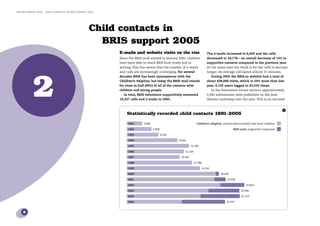
                                                             E-mails and website visits on the rise                             The e-mails increased to 8,459 and the calls
                                                             Since the BRIS-mail started in January 2001, children              decreased to 10,778 – an overall decrease of 13% in
                                                             have been able to reach BRIS both orally and in                    supportive contacts compared to the previous year.
                                                             writing. This has meant that the number of e-mails                 At the same time the trend is for the calls to become


            2
                                                             and calls are increasingly converging. For several                 longer. An average call lasted almost 15 minutes.
                                                             decades BRIS has been synonymous with the                               During 2005 the BRIS.se website had a total of
                                                             Children’s Helpline, but today the BRIS-mail stands                about 428,000 visits, which is 24% more than last
                                                             for close to half (44%) of all of the contacts with                year. 9,732 users logged in 65,233 times.
                                                             children and young people.                                              In the Discussion Forum section, approximately
                                                               In total, BRIS volunteers supportively answered                  9,300 submissions were published on the nine
                                                             19,237 calls and e-mails in 2005.                                  themes underway over the year. This is an increase


                                                                                                                                                                                       1
                                                                  Statistically recorded child contacts 1991-2005

                                                                  1991       3 000                                   Children’s Helpline, statistically recorded calls from children

                                                                  1992               4 828                                                         BRIS-mail, supportive responses

                                                                  1993                       6 203

                                                                  1994                               9 926

                                                                  1995                                          12 189

                                                                  1996                                    11 169

                                                                  1997                                 10 345

                                                                  1998                                             12 788

                                                                  1999                                                      14 341

                                                                  2000                                                                    18 039

                                                                  2001                                                                         19 358

                                                                  2002                                                                                      23 023

                                                                  2003                                                                                  22 044

                                                                  2004                                                                                  22 133

                                                                  2005                                                                        19 237


     6
the bris report 2005 : Child contacts in BRIS support 2005


                                                                                                                              2
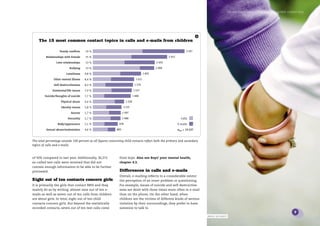
    The 15 most common contact topics in calls and e-mails from children

                    Family conflicts    19 %                                                                         3 597

         Relationships with friends     15 %                                                          2 915

                 Love relationships     13 %                                                  2 430

                            Bullying    13 %                                                  2 408

                         Loneliness     9,8 %                                         1 892

               Other mental illness     8,4 %                                 1 621

               Self-destructiveness     8,2 %                                1 576

              Existential/life issues   7,9 %                               1 527

         Suicide/thoughts of suicide    7,7 %                               1 488

                     Physical abuse     6,4 %                       1 228

                     Identity issues    5,8 %                      1125

                             Sorrow     5,7 %                     1 097

                          Sexuality     5,7 %                     1 088                                         Calls

                  Body/appearance       5,1 %                978                                              E-mails

          Sexual abuse/molestation      4,6 %               883                                               ntot = 19 237


The total percentage exceeds 100 percent as all figures concerning child contacts reflect both the primary and secondary
topics of calls and e-mails.


of 50% compared to last year. Additionally, 30,272            from boys. Also see Boys’ poor mental health,
so-called test calls were received that did not               chapter 4.3.
contain enough information to be able to be further
processed.                                                    Differences in calls and e-mails
                                                              Overall, e-mailing reflects to a considerable extent
Eight out of ten contacts concern girls                       the perception of an inner problem or questioning.
It is primarily the girls that contact BRIS and they          For example, issues of suicide and self-destructive-
mainly do so by writing: almost nine out of ten e-            ness are dealt with three times more often in e-mail
mails as well as seven out of ten calls from children         than on the phone. On the other hand, when
are about girls. In total, eight out of ten child             children are the victims of different kinds of serious
contacts concern girls. But beyond the statistically          violation by their surroundings, they prefer to have
recorded contacts, seven out of ten test calls come           someone to talk to.
                                                                                                                                                                                                   7
                                                                                                                                  photo: ulf huett
the bris report 2005 : Child contacts in BRIS support 2005


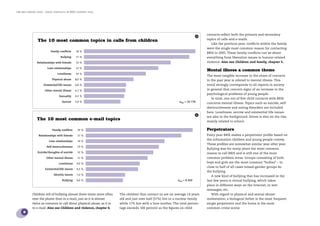
                                                                                                                                  contacts reflect both the primary and secondary
                                                                                                                              3
                                                                                                                                  topics of calls and e-mails.
                The 10 most common topics in calls from children
                                                                                                                                    Like the previous year, conflicts within the family
                                                                                                                                  were the single most common reason for contacting
                          Family conflicts     18 %
                                                                                                                                  BRIS in 2005. These family conflicts can be about
                                  Bullying     17 %                                                                               everything from liberation issues to honour-related
               Relationships with friends      14 %                                                                               violence. Also see Children and family, chapter 5.

                       Love relationships      12 %
                                                                                                                                  Mental illness a common theme
                               Loneliness      10 %
                                                                                                                                  The most tangible increase in the share of contacts
                           Physical abuse      8,0 %                                                                              in the past year is related to mental illness. This
                    Existential/life issues    6,8 %                                                                              trend strongly corresponds to all reports in society
                     Other mental illness      6,7 %                                                                              in general that concern signs of an increase in the
                                                                                                                                  psychological problems of young people.
                                Sexuality      6,5 %
                                                                                                                                    In total, one out of five child contacts with BRIS
                                   Sorrow      5,9 %                                                          ntot = 10 778
                                                                                                                                  concerns mental illness. Topics such as suicide, self-
                                                                                                                                  destructiveness and eating disorders are included
                                                                                                                                  here. Loneliness, sorrow and existential life-issues
                                                                                                                              4
                                                                                                                                  are also in the background. Stress is also on the rise,
               The 10 most common e-mail topics                                                                                   mainly related to school.

                           Family conflicts     19 %                                                                              Perpetrators
                Relationships with friends      17 %                                                                              Every year BRIS makes a perpetrator profile based on

                        Love relationships
                                                                                                                                  the information children and young people convey.
                                                14 %
                                                                                                                                  These profiles are somewhat similar year after year.
                      Self-destructiveness      13 %
                                                                                                                                  Bullying was for many years the most common
                Suicide/thoughts of suicide     12 %                                                                              reason to call BRIS and is still one of the most
                      Other mental illness      11 %                                                                              common problem areas. Groups consisting of both
                                Loneliness      9,6 %                                                                             boys and girls are the most common “bullies” – in
                                                                                                                                  close to half of all cases mixed-gender groups do
                     Existential/life issues    9,3 %
                                                                                                                                  the bullying.
                            Identity issues     7,0 %
                                                                                                                                    A new kind of bullying that has increased in the
                                   Bullying     6,6 %                                                        ntot = 8 459         last few years is virtual bullying, which takes
                                                                                                                                  place in different ways on the Internet, in text
                                                                                                                                  messages, etc.
            Children tell of bullying almost three times more often   The children that contact us are on average 14 years          With regard to physical and sexual abuse/
            over the phone than in e-mail, just as it is almost       old and just over half (57%) live in a nuclear family       molestation, a biological father is the most frequent
            twice as common to call about physical abuse, as it is    while 17% live with a lone mother. The total percen-        single perpetrator and the home is the most
            to e-mail. Also see Children and violence, chapter 4.     tage exceeds 100 percent as the figures on child             common crime scene.
     8
the bris report 2005 : Child contacts in BRIS support 2005


                                                                                                                             And the children remain anonymous as long as they
                                                                                                                        5
                                                                                                                             themselves want. In proportion to the total number
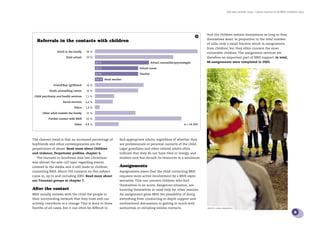
   Referrals in the contacts with children
                                                                                                                             of calls, only a small fraction result in assignments
                                                                                                                             from children, but they often concern the most
                  Adult in the family   38 %                                                                                 vulnerable children. The assignment services are
                        Total school    29 %                                                                                 therefore an important part of BRIS support. In total,
                                                20 %                                   School counsellor/psychologist        48 assignments were completed in 2005.

                                                16 %                         School nurse

                                                16 %                         Teacher

                                                3,0 % Head teacher

               Friend/Boy-/girlfriend   18 %

            Youth counselling centre    16 %

 Child psychiatry and health services   7,1 %

                      Social services   6,6 %

                               Police   1,8 %

       Other adult outside the family   15 %

           Further contact with BRIS    32 %

                               Other    8,8 %                                                                   n = 14 224


The clearest trend is that an increased percentage of           find appropriate adults, regardless of whether they
boyfriends and other contemporaries are the                     are professionals or personal contacts of the child.
perpetrators of abuse. Read more about Children                 Legal guardians and other related adults often
and violence, Perpetrator profiles, chapter 4.                   indicate that they do not have time or energy, and
   The tsunami in Southeast Asia last Christmas                 student care has shrunk its resources to a minimum.
was almost the sole call topic regarding events
covered in the media and it still leads to children             Assignments
contacting BRIS. About 250 contacts on this subject             Assignments mean that the child contacting BRIS
came in, up to and including 2005. Read more about              requests more active involvement by a BRIS repre-
our Tsunami groups in chapter 7.                                sentative. This can concern children who find
                                                                themselves in an acute, dangerous situation, are
After the contact                                               harming themselves or need help for other reasons.
BRIS usually reviews with the child the people in               An assignment gives BRIS the possibility of doing
their surrounding network that they trust and can               everything from conducting in-depth support and
actively contribute to a change. This is done in three          motivational discussions to getting in touch with
fourths of all cases, but it can often be difficult to           authorities or initiating similar contacts.                  photo: lena granefelt
                                                                                                                                                                                              9
the bris report 2005 : BRIS.se


                                 BRIS.se
                                      BRIS.se started in January 2001 because there was a       E-mail emboldens
                                      need for children and young people to communicate         This past summer 631 children and young people
                                      over the Internet. Today the website consists of a        responded to a survey on our website about what
                                      number of functions, which are touched upon in this       they thought of the BRIS-mail. Many mention that
                                      chapter. BRIS.se is a forum for support efforts, infor-   communication over e-mail has given them courage


             3
                                      mation and knowledge retrieval where the main             and self-confidence. They have received advice and
                                      emphasis lies on secure forms of BRIS’ dialogue with      support in moving on with their problems. They also
                                      children and young people. It is also a platform for      think that the e-mail contact has given them
                                      reaching out in terms of influencing public opinion,       another view of the matter. Some children, however,
                                      maintaining contact with the media and gathering          still do not know if they have any use for the
                                      funding for support services.                             answers and a small group (28 children) express
                                         Over the year, the BRIS.se website has had a           displeasure and disappointment over inadequate
                                      total of about 428,000 visits, which is an increase       treatment.
                                      of 24% compared to 2004.                                    Blowing off steam, being able to tell their story,
                                         The following support functions on the Web are         being taken seriously, having someone on their side,
                                      covered in this chapter:                                  getting encouragement, knowing what is right and
                                                                                                wrong, helping to see other possibilities and
                                      • The BRIS-mail                                           learning that they are not alone are other important
                                      • Discussion Forums                                       things that the children bring up. Understanding, in
                                      • Support and advice                                      particular, is perceived as being important and tops
                                                                                                the list of what our visitors want to get out of the
                                      • BRIS Young People
                                                                                                BRIS-mail. The word feedback summarises the issue:
                                      • Ask the lawyer                                          children want to know, get answers and input from
                                      • The Red Pages (administered by BRIS)                    an adult at BRIS. More information on the BRIS-mail
                                                                                                can be found in chapters 1, 2, 4 and 5.
                                      3.1 The BRIS-mail
                                      The largest section on BRIS.se is the BRIS-mail,          3.2 Discussion Forum
                                      which will soon be as extensive as the Children’s         On the Discussion Forum, children and young
                                      Helpline. The fundamental principal of the contacts       people have the opportunity of asking questions,
                                      is based on the children being able to write to us        discussing issues and giving answers to each other
                                      anonymously, using their own passwords so that            under the oversight of a BRIS moderator for the
                                      their e-mail is just as secure as the calls.              fourth year running. Here, they can write incognito
                                         During 2005, 10,217 e-mails were received, of          about everything from every-day concerns to deeper
                                      which 8,459 were supportively answered and                problems. By getting answers from others who have
                                      constituted 44% of the statistically recorded child       been in the same situation or have ideas on how
                                      contacts.                                                 they can resolve a tough situation, those who post a
    10
the bris report 2005 : BRIS.se


question have an opportunity to find new solutions       Response: help :S
to things that feel insurmountable.                     Her mum shouldn’t blame her. Parents getting a
   Many also share their positive thoughts and tell     divorce is not the kids fault. That’s what every book
others how they have solved a particular problem or     about divorce in the world says. Stay on her side. If
tell of enjoyable meetings or events that they have     it’s as bad as it sounds she needs you very much.
experienced.                                            You should do something fun like go to the cinema
   During 2005, about 10,200 contributions were         or something. When people are having a tough time
submitted to the Discussion Forum, of which 9,337       they should have something to look forward to.
were posted after approval by BRIS.
   During 2005 the following themes were discussed:     What should I do?
Friendship, Docudramas, Family, the Catastrophe         Hi! I’m a 13-year-old girl. I’m in year seven and am
in Asia, Love, Tricky Situations, Questions to guys,    completely undeveloped. I’ve got tiny breasts. All of
How should a parent act? What makes you happy?          my classmates have large, nice looking breasts, but I
Had problems on the Internet? and various topics        almost have nothing. I have just enough for a 65A. I
in the open forum: The floor is open.                    want to use a push-up bra, but my mum won’t let
                                                        me. What should I do? Please give me some tips/
Love Theme:                                             from a horse-loving girl.
How to kiss??                                           Response: What should I do?                               in each subject. The page is customised for children
i wonder when you kiss someone.. do you tilt your       Hi. :)                                                    and young people, but also directed at parents and
head, but touch the lips like a normal peck or do you   It’s really sad that people have to feel bad because of   other important adults. On Support and advice there
open the mouth right when you touch?? appreciate        things like their breasts. I’m in year nine and I know    is also help in finding where to turn if one needs
an answer!                                              that breasts grow at different speeds on different        someone to talk to, including a section for those
Response: How to kiss??                                 people and everyone looks different. There isn’t          who are friends of someone doing poorly. Here it is
A kiss consists of about 10% technique and 90%          anything you can do to get a bigger bust, all you can     common that friends get in touch when they learn
feeling. It will all work out when the time is right.   do is wait and not think so much about it. This isn’t     of something in faith and then do not know how
                                                        a fun answer, but that’s how it is.                       they should help without breaking that faith.
The floor is open:                                       Response:                                                   On Support and advice one can also get a picture
help :S                                                 Are you really sure that you’re alone in having small     of what children and young people say when they
How should I help my friend..she’s in a bad way, a 15   breasts? Look around you carefully. Your breasts will     contact BRIS. This is done by unidentified call and e-
year-old girl who hardly knows up from down             grow for several more years and is the brain in the       mail examples that are available on the page.
anymore. Her parents are divorced now, but her          bust? No, luckily the brain’s in the head. I think you
mum blames it all on her, and she gets shit every       should try to let go of this and think about some-        3.4 Young people’s section
day everywhere and from everyone. She’s down and        thing that makes you feel better. :) Good luck :)         BRIS Young People is a page that is customised to
they’re still kicking her, I dunno what I should do                                                               the target group of 13-18 year-olds on which one has
anymore...??? =(                                        3.3 Support and advice                                    the possibility of registering as a youth member or
Response: help :S                                       At BRIS.se there is a subsection called Support and       school representative. As a school representative,
All you can do is just try to keep a supporting arm     advice, where those interested can read more about        one works with current material to spread informa-
around her shoulders and be there for her the whole     different topics in the support services. Every area      tion about BRIS at one’s school, sports club or
time when she needs it. Good luck!                      has a fact sheet that brings up current information       recreation centre.
                                                                                                                                                                              11
the bris report 2005 : BRIS.se


                                                         On BRIS Young People one can also send postcards        victimised in many other cases also do not know
                                                         to friends, answer a current question and make          who can help them or who is responsible for what
                                                         oneself heard by going into the notice board.           happens. Ask the lawyer is intended as an aid to
                                                            The visitors also have the opportunity of reading    children and young people in all of these situations
                                                         more about the UN Convention of the Rights of the       who want to know more and want to find some
                                                         Child and watch films bring up the rights of young       clarity in what applies with regard to our legislation.
                                                         people.                                                     Today there are about 400 registered questions of
                                                            A section that is often used is “Write a poem or     a legal nature from children and young people with
                                                         short story”. Many young people share their thoughts    their answers from BRIS, which emphasizes the
                                                         by posting a contribution that others can read and      need of an independent forum with the possibility
                                                         also comment on.                                        for children and young people to ask questions.
                                                                                                                 BRIS’ intention is to continue to administer and
                                                         It’s too tough                                          refine the service. The following is a selection of
                                                         Love is tough                                           excerpts from the questions that came in during
                                                         It slips between our fingers                             2005:
                                                         it’s in the words you say
                                                         in your prettiest smile..                               •   I’m 9 years old and turn 10 soon and am wonde-
                                                         It’s in your breath on my cheek.                        ring what I should do to move to my dad. I’ve said
                                                         It’s the weight in my heart..                           this to mum the whole time, but she doesn’t listen.
                                                         Every day without your hands & your smile..             What happens if I refuse to go to her? Mum says
                                                         is a day of sorrow..                                    that she and dad will talk to the family court, but
                                                         I love you.                                             will anyone listen to me?
                                                         By: The Black that luv him
                                                                                                                 •   If I tell my psychologist at the child psychiatry
                                                         All contributions to the Notice Board and Write a       clinic that I cut myself, does he have to tell my
                                                         poem or short story are approved by a moderator         parents?
                                                         before they are posted.
                                                                                                                 •   Hi! I went and talked to social services when I was
                                                         3.5 Ask the lawyer                                      younger. Now I’m 15 and I wonder if I can read my
                                                         Ask the lawyer has been developed to give children      records and if so how can I get a hold of them?
                                                         and young people up to age 18 an opportunity to ask
                                                         questions that have legal ties. The service is open     •   Can my psychologist come to my trial that will be
                                                         around the clock and the goal is for the questions to   held in a few months. It’s about rape of a minor.
                                                         be answered within 24 hours.                            How long a sentence can the guy who did it get?
                                                            Many children and young people often convey the
                                                         feeling that adults do not listen or cannot answer      3.6 The Red Pages
                                                         questions important to them. It is particularly         For the last two years BRIS has operated and
                                                         difficult to get answers on what rights and obliga-      administered a new website, www.rodasidorna.se,
                                                         tions children and parents have to each other. Those    which is a search engine for children and young
    12
                                 photo: lena granefelt
the bris report 2005 : BRIS.se


people up to age 18. Through the Red Pages, young
                                                                                                                                                                       6
people can get help to quickly and easily find
organisations, services and authorities that exist
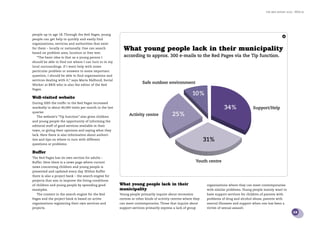
for them – locally or nationally. One can search         What young people lack in their municipality
based on problem area, location or free text.
   “The basic idea is that as a young person I
                                                        What young people lack in their municipality
                                                         according to approx. 300 e-mails to the Red Pages via the Tip function.
should be able to find out where I can turn to in my    according to approx. 300 e-mails to the Red Pages via the Tip function.
local surroundings. If I want help with some
particular problem or answers to some important
question, I should be able to find organisations and                    Safe outdoor environment
services dealing with it,” says Maria Rådlund, Social
                                                                       Safe outdoor environment
Worker at BRIS who is also the editor of the Red
Pages.
                                                                                                        10 %
                                                                                                        10 %
Well-visited website
During 2005 the traffic to the Red Pages increased
                                                                                                                            34%               Support/Help
markedly to about 40,000 visits per month in the last           Activity centre           25%                               34%                 Support/Help
quarter.
   The website’s “Tip function” also gives children
                                                              Activity centre             25%
and young people the opportunity of informing the
editorial staff of good services available in their
town, or giving their opinions and saying what they                                                             31%
lack. Here there is also information about authori-
ties and tips on where to turn with different                                                                   31%
questions or problems.

Buffer                                                                                                       Youth centre
The Red Pages has its own section for adults –
Buffer. Here there is a news page where current                                                           Youth centre
news concerning children and young people is
presented and updated every day. Within Buffer
there is also a project bank – the search engine for
projects that aim to improve the living conditions
of children and young people by spreading good          What young people lack in their                           organisations where they can meet contemporaries
examples.                                               municipality                                              with similar problems. Young people mainly want to
   The content in the search engine for the Red         Young people primarily inquire about recreation           have support services for children of parents with
Pages and the project bank is based on active           centres or other kinds of activity centres where they     problems of drug and alcohol abuse, parents with
organisations registering their own services and        can meet contemporaries. Those that inquire about         mental illnesses and support when one has been a
projects.                                               support services primarily express a lack of group        victim of sexual assault.
                                                                                                                                                                             13
the bris report 2005 : Children and violence


                                               Children and violence
                                                                         Adult guarantee as a social concept                         concerning children and violence, we see many lonely
                                                                         In the report’s introduction, it was emphasized that        and victimised children. This is true when children are
                                                                         this year BRIS will work with the overall theme of an       exposed to adult’s violence and when children inflict
                                                                         adult guarantee in children’s lives. BRIS wants to          violence on contemporaries or physically harm
                                                                         make the adult guarantee a social concept because           themselves. BRIS’ material on children and violence is


            4
                                                                         every child should be entitled to meaningful adult          extensive. Therefore we have chosen to focus on three
                                                                         relationships. The background is that all too many          areas, all of which constitute important aspects of the
                                                                         children that contact BRIS bear witness to the fact         lives of children exposed to violence today:
                                                                         that what is fundamentally lacking in their lives are
                                                                         aware, meaningful and mature adults.
                                                                                                                                     • Adult’s violence toward children, which is
                                                                                                                                     comprised of physical and sexual abuse.
                                                                            The lack of a meaningful adult presence is the
                                                                         basis for the chapter Children and violence because it      • Violence between children, which primarily
                                                                         is like a binding tie through the theme in all aspects.     concerns bullying.
                                                                                                                                     • Self-inflicted violence, which is tied to mental
                                                                         Three aspects of violence                                   illness.
                                                                         Whether dealing with adults’ violence toward children,
                                                                         children’s violence toward each other or children’s         From violence to self-inflicted violence
                                                                         violence toward themselves, there is a tie to the lack of   Since the mid-90s BRIS has experienced a pendulum
                                                                         supportive adult relationships. In all texts and calls      motion in the contacts with children and young


                                                                                                                                                                                                7
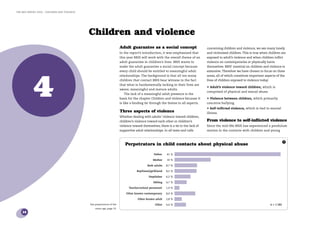
                                                                             Perpetrators in child contacts about physical abuse

                                                                                                  Father    41 %

                                                                                                 Mother     14 %

                                                                                             Both adults    8,7 %

                                                                                     Boyfriend/girlfriend   8,5 %

                                                                                              Stepfather    6,2 %

                                                                                                  Sibling   4,7 %

                                                                               Teacher/school personnel     1,9 %

                                                                             Other known contemporary       8,0 %

                                                                                      Other known adult     2,8 %
                                               See perpetrators of the                             Other    4,4 %                                                                   n = 1 182
                                                   same age, page 19.
    14
the bris report 2005 : Children and violence


people, which we call from violence to self-inflicted
                                                                                                                                                                           8
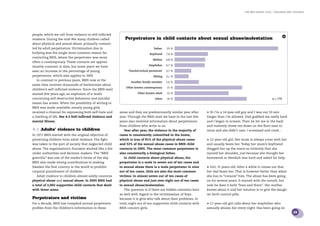
violence. During the mid-90s many children called           Perpetrators in child contacts about sexual abuse/molestation
about physical and sexual abuse, primarily commit-
ted by adult perpetrators. Victimisation due to                                   Father    23 %
bullying was the single most common reason for                                 Boyfriend    7,4 %
contacting BRIS, where the perpetrator was most
                                                                                  Mother    6,8 %
often a contemporary. These contacts are approx-
                                                                               Stepfather   6,7 %
imately constant to date, but some years we have
seen an increase in the percentage of young                    Teacher/school personnel     3,7 %
perpetrators, which also applies to 2005.                                         Sibling   3,1 %
  In contrast to previous years, BRIS now at the
                                                                Another family member       5,4 %
same time receives thousands of testimonies about
                                                             Other known contemporary       15 %
children’s self-inflicted violence. Since the BRIS-mail
started five years ago, an explosion of e-mails                       Other known adult      12 %

concerning self-destructive behaviour and suicidal                                 Other    16 %                                                                 n = 779
issues has arisen. When the possibility of writing to
BRIS was made available, mainly young girls
received a channel for expressing both self-hate and     areas and they are predominantly similar year after      • Hi I’m a 14-year-old guy and I was out 10 min
a loathing of life. See 4.3 Self-inflicted violence and   year. Through the BRIS-mail we have in the last few      longer than I’m allowed. Dad grabbed me really hard
mental illness.                                          years also received information about perpetrators       and I began to scream. Then he hit me in the back
                                                         from children who write to us.                           and violently threw me down on the floor next to
4.1 Adults’ violence to children                           Year after year, the violence in the majority of       mum and she didn’t care. I screamed and cried…
In 1971 BRIS started with the original objective of      cases is consistently committed in the home,
protecting children from adult violence. The fight        which is true of 81% of the physical abuse cases         • 12-year-old girl. Her mum is always cross with her
was taken to the part of society that neglected child    and 52% of the sexual abuse cases in BRIS child          and usually beats her. Today her mum’s boyfriend
abuse. The organisation’s founders worked like a fire     contacts in 2005. The most common perpetrator is         dragged her up the stairs so violently that she
under authorities and decision-makers. The “BRIS         also consistently a biological father.                   injured her shoulder, just because she thought her
guerrilla” was one of the media’s terms of the day.        In child contacts about physical abuse, the            homework in Swedish was hard and asked for help.
BRIS also made strong contributions in making            perpetrator is a male in seven out of ten cases and
Sweden the first country in the world to prohibit         in sexual abuse there is a male perpetrator in nine      • Girl, 15 years old. After a while it comes out that
corporal punishment of children.                         out of ten cases. Girls are also the most common         her dad beats her. That is however better than when
  Adult violence to children almost solely concerns      victims: in almost seven out of ten cases of             she has to “console” him. The abuse has been going
physical abuse and sexual abuse. In 2005 BRIS had        physical abuse and just over eight out of ten cases      on for several years. It started with the mouth, but
a total of 2,002 supportive child contacts that dealt    in sexual abuse/molestation.                             now he does it both “here and there”. Her mother
with these areas.                                          The question is if there are hidden statistics here    knows about it and her solution is to give the daugh-
                                                         as well with regard to the victimisation of boys         ter birth control pills.
Perpetrators and victims                                 because it is girls who talk about their problems. In
For a decade, BRIS has compiled annual perpetrator       total, eight out of ten supportive child contacts with   • 17-year-old girl calls about her stepfather who
profiles from the children’s information in these         BRIS concern girls.                                      sexually abuses her every night. Has been going on
                                                                                                                                                                                15
the bris report 2005 : Children and violence


            for 2 years. He threatens her and says that she will          There are several groups of adults that abuse         regard to further training of employees in schools,
            not manage if she tells anyone. She takes pills that       their position of power for assault. Similar expe-       the social services, the police and the justice system.
            close her off to be able to stand it. Has two younger      riences are had by children victimised by violence or      During 2005 BRIS has reacted to a few cases in
            siblings whom she does not dare leave out of fear          sexual abuse perpetrated by persons on whom they         particular where the courts, despite more stringent
            that they will also have problems. Her mother does         are dependent in various ways, such as leaders,          legislation, have reduced sentences and damages in
            not know anything.                                         teachers or treatment personnel.                         courts of appeal with regard to damages to children
                                                                          All too often our volunteers note after the call      as the victims of crime in sexual abuse.
            The child protects the attacker                            that the child does not want to tell anyone about          “For many years we have criticized the ignorance
            When a close relative abuses the child, it is a double     what is happening. It is possible to speak ano-          of and lack of a child-based perspective in Swedish
            betrayal: the person, who above all should protect         nymously to BRIS, but not to anyone else. The same       courts. Psychological assault is often enough to
            the child, abuses this dependency for violence. The        applies to the BRIS-mail, where children and young       make a child not resist. And an assault in childhood
            last stronghold of trust crumbles when what should         people write and explain incognito, but then do not      lasts longer than if it happened at an adult age,”
            be an adult support turns into its opposite. At BRIS       want to go any further.                                  says Göran Harnesk, General Secretary of BRIS. Also
            we constantly hear of how feelings of shame and                                                                     see Ask the lawyer, chapter 3.
            guilt get the upper hand over the child. Children          Inadequate professionalism
            easily assume blame themselves, especially when a          BRIS also learns of children’s experiences of contacts   4.2 Violence between children
            close adult is the perpetrator.                            with authorities in association with physical and        An important starting point is to primarily view
               For a violated child, trust in the adult world is       sexual abuse. As in other contexts, here there is        violence between children as an expression of
            already damaged – and it is from this perspective          naturally an under-representation of the cases where     vulnerability, insecurity and a sense of being lost in
            that children sometimes look around to find help.           children quickly and correctly find good help and         life. On commission of the Government, the National
            The smallest doubt or signals that it will not hold        treatment. The signals to BRIS show in the meantime      Agency for Education and the Swedish National
            the entire way can however get the child to back-out       that society all too often fails to provide the most     Agency for School Improvement have coined the
            entirely. Not daring to tell, not believing it will make   vulnerable children fast and professional help.          overall term “abusive treatment” when equal rights
            any difference – or believing it will just get worse,         Among the questions that come to BRIS’ legal          are violated. All schools must have plans of action
            not knowing what is happening – are all adequate           queries, many concern how to go about making a           against abusive treatment, which includes sexual
            reasons for a child to stay silent.                        report and how an investigation is done. How are         harassment and racism, among other things.
               Frequently they themselves also paint pictures of       hearings conducted? Does one have to testify in the        The term also includes bullying, but what
            threatening trials, prison sentences, splitting the        presence of others? Who will protect me afterwards?      distinguishes bullying is that the victim is offended
            family, etc.                                               What happens to the person I report? Today there         on several occasions and that there is an imbalance
                                                                       are many good examples and trials with regard to         in power between perpetrator and victim.
            Disadvantaged and dependent                                making it easier for children to make a report, but
            In the background lies the drastic conflict of loyalty      for most of the children it is a complicated way to      Bullying
            that arises when one of the parents physically or          go. BRIS and others have long called attention to the    Bullying is one of the most important problem areas
            sexually abuses the child. What happens with the           need for improved collaboration between different        in BRIS’ history. During the mid-1990s, the statistics
            family if a report is made? And will anyone believe        actors as well as increased competence of those who      exploded and bullying became the most common
            what the child says? For many children, the strategy       will meet vulnerable children in various contexts.       reason for children to contact BRIS up to the last few
            becomes thinking instead about the possibility of          There is a great deal left to do on the treatment of     years. With the e-mail services, mental illness and
            themselves leaving the home environment and the            children in crisis both with regard to simplification     family conflicts have however become the areas
            possibility of getting a foster family.                    and clarification on an organisational level and with     most on the rise.
    16
the bris report 2005 : Children and violence


                                                            17
photo: lena granefeltr
the bris report 2005 : Children and violence


            The contacts about bullying have in the last few          subjected to beating and sexually explicit verbal           view is still that there are children in far too many
            years been somewhat constant, but are primarily           abuse. Now they don’t dare walk home. Their                 cases who do not get the support to which they are
            made over the phone; victimisation due to bullying        parents must pick them up. The headmaster does              entitled. Victimisation is doubled when the child
            is something children and young people want to talk       nothing, a report to the National Board of Education        calls the situation to the attention of adults, but is
            about. This topic is twice as common among                just sits on a pile.                                        not believed. Or that the responsibility is put back
            contacts with boys as with girls. More than one out                                                                   on them: “You just have to get a little tougher!”
            of five BRIS contacts with boys deal with bullying         • 11-year-old boy who says that several older boys
            compared to one out of ten for girls.                     have threatened to set him on fire because he has            • They tease me the whole time because I am
                                                                      braces. He is very scared.                                  Muslim. Once they forced me to eat pork. When I
            Bullies and bullied                                                                                                   told my dad, he got angry with me. I tell the teachers
            We know that bullying almost always takes place in        Insufficient adult support                                   but they just say that I have to get a little tougher.
            school. With regard to perpetrators/bullies, mixed-       BRIS’ experience is that children try in many ways to       Boy age 12
            gender groups have been the most common way of            handle the bullying on their own and that it often
            bullying in the last few years, which is the case in      seems difficult to get the right help from adults.           It is therefore important as an adult to remember
            almost half of all cases.                                 Many times the victim has told people in charge at          that bullying and harassment can never be written
               Otherwise, boys are more often bullies than            their school without success. The inability of the          off as “normal trouble between kids”. The children’s
            girls. Bullying of different kinds is primarily brought   school world to deal with bullying is similar to            stories from their own perspective proves the
            up by younger children up to the lower teens and          previous years, despite action plans and directives         opposite: their lacking self-esteem, joy of life, and
            the share of contacts decreases as age increases. The     from above.                                                 possibility to learn and develop influence their
            bullying that takes place at higher ages is also done                                                                 entire life situation. Not being accepted, being
            to a lesser extent by groups than by individuals.         • Standing on the side of the bullied is much more          frozen out and belittled leaves particularly serious
               What we recognise is the timeless nature of            difficult. I don’t think there is one GOOD adult to          scars on a growing child who is in the midst of
            bullying. It is about freezing someone out, spreading     rely on at my school, you have no idea! I have              getting to know and develop his or her personality.
            rumours and false accusations. Here there are             spoken with my teacher about this but she got ideas            Because adult support so often fails, it affects the
            wrecked bicycles, soaked clothes, constant insults        and I had to talk to the counsellor!! Hello... Boy age 15   children’s way of handling the situation. One way is to
            about looks, background etc. And of course pure                                                                       normalise the situation and accept that “I deserve
            personal violence: kicks, hits, locking someone in,       • I hate all adults. I’ve been bullied for 4 years so I     this”. BRIS has contact with many children who
            spraying with water, holding the head down in the         had a panic attack when I started at the new school.        describe how they keep a stiff upper lip, put up with it,
            toilette. The list goes on.                               Then I had to go to a bunch of meetings where               become invisible, dream themselves away and belittle
                                                                      everyone stares me down… Girl age 14                        themselves. For these children, it also translates to a
            • Girl, age 15, who is crying and starts the call by                                                                  destructive behaviour – to themselves or others.
            saying she “does not want to live any longer”. It         The lack of adult support that many children
            turns out that she has been bullied for 7 years and it    describe is particularly serious because it is through      Setting clear boundaries
            is just getting worse. Today classmates threw all of      the presence of clear and confident adults that              It is therefore important to realise that the bullying
            her clothes in the shower in PE.                          much of the bullying can be prevented. Of course            is primarily tied to the group. When worry and
                                                                      there is an under-representation in BRIS’ materials         stress arise in a group, when the rules of conduct or
            • A 14-year-old girl calls and says that she and her      of the cases where children receive quick and               the leadership is unclear, when the individual is not
            friend have been physically abused by a gang of boys      intelligent support and help from adults because            sure of where she or he belongs or feels they are
            who constantly fight with them. They have been             there is then seldom reason to contact us. But our          called into question – then the mechanisms of
    18
the bris report 2005 : Children and violence


                        rejection arise. It is the obligation of the adults in   • The girls in my class have written a load of nasty
                        charge to see to it that boundaries are set for this.    things to me on lunar like “Damned anal cunt”
                           In BRIS’ contacts there are also a number of child-   “Freaking Idiot” “Geek” and “I’m gonna bully you to
                        ren who describe themselves as bullies, and who do       death” …Girl, age 12
                        not know how to quit, to “change roles”. Here too,
                        the school’s adults have an important job: to help       • A few “mates” in school have spread a picture of him
                        children in constructive role changes, to find good       when he was drunk and vomited at a party. After that
                        ways of getting affirmation and being seen.               he has received a load of cruel nicknames and everyone
                                                                                 laughs at him. He is afraid that his parents will find out.
                        Virtual bullying                                         Also see 4.4 Destructive contacts on the Internet.
                        Along with new arenas being made available, we
                        have in the last few years received a small, but         Teacher training
                        growing number of contacts that deal with new            In a 2004 debate article in Dagens Nyheter, BRIS
                        kinds of harassment. Through the Internet and            brought up the issue of the responsibility of adults in
                        mobile telephone, bullying has found a new arena.        school in cases of bullying. Focus was placed on the
                           Through e-mail, guest book postings and photo-        teacher colleges’ insufficient training in preventative
                        graphs on websites, comments on chat pages and in        work. The quality of training at all schools of educa-
                        text messages, children and young people have had        tion in the country was surveyed and assessed. The
                        to put up with persecution of various kinds, which       results showed that only two of the country’s training
                        when done repeatedly could be called virtual             programmes for new teachers gave them adequate
                        bullying. Through the Internet’s fast circulation        proficiency. Therefore BRIS demanded that the Govern-
                        ability, things can gain unmanageable proportions        ment charge the National Agency for Higher Education
                        for a child, such as when anonymous threats fill the      with reviewing teacher training programmes to better
                        mobile’s display, or pictures are published or e-        adapt them to an adult presence in schools with ade-
                        mailed on the Net for everlasting circulation. In        quate competence to combat the violation of students.
                        2005 BRIS had more than 700 contacts with
                        children and young people that dealt with IT-            Perpetrators of the same age
                        related issues and problems. It is among these           A clear trend in the child contacts of 2005 is the
                        contacts that this kind of bullying is touched upon.     marked rise in perpetrators of the same age with
                                                                                 regard to physical and sexual abuse. In physical
                        • I don’t know what to do, a girl wrote that I’m         abuse, the share of same-age perpetrators rose to
                        ugly!! Then I wrote that she was stupid. And she’s       22% from 15% the year before. 30% of the sexual
                        dissing me on msn and writing a bunch of mean            abuse/molestation was committed by a contem-
                        things about me: retard ! cunt! Girl, age 13             porary. In 2004 this figure was 24%. See perpetrator
                                                                                 figures pp. 14/15. These same-age perpetrators are
                        • They wrote that I’m like fat, stupid and a little      usually boyfriends or contemporaries known to the
                        “retarded” and they published my mobile number on        victims from their surroundings/circle of acquain-
                        the page where they wrote: “If you want to call a real   tances. Siblings, unknown contemporaries or, on
                        idiot” and then my e-mail address. Boy, age 14           rare occasions, girlfriends can also be perpetrators.
                                                                                                                                               19
photo: lena granefelt
the bris report 2005 : Children and violence


                                                                       • A 15-year-old girl has been raped and beaten by           means 4,001 contacts in this area, which includes
                                                                       her 18-year-old boyfriend. She is ashamed of it and         self-destructiveness, suicide/thoughts of suicide,
                                                                       has not dared tell anyone. This was not the first time       eating disorders and other mental illness. A very
                                                                       it has happened.                                            large majority, 90%, concern girls. This picture is
                                                                                                                                   also confirmed in BRIS Adult Helpline. See chapter
                                                                       • A 14-year-old girl says that a gang of boys usually       2, figure 2, and chapter 6 on the Adult Helpline.
                                                                       comes to her school and they pull girls in some-
                                                                       where and have unprotected sex with them. She               Loneliness and lack of adults
                                                                       feels this is humiliating, but sees no solution. She        What is striking is that these children and young
                                                                       thinks the adults know about it and see it, but do          people basically express a great loneliness that
                                                                       not care. “Am I pregnant?” she wonders.                     permeates their thoughts, feelings and actions. They
                                                                                                                                   tell of both an outer and inner loneliness. The purely
                                                                       Sometimes the share of same-age perpetrators varies         physical loneliness expresses itself in them seldom
                                                                       strongly from year to year. The difference this year is     having someone to talk to or do things with. They also
                                                                       that the trend is clear with regard to physical and         live with an inner alienation where they describe
                                                                       sexual abuse. The influx of BRIS contacts with children      confusion in what they feel, think and do. The feeling
                                                                       and young people about bullying and mental illness          of loneliness is then amplified by the lack of adults in
                                                                       shows that an increasing number of young people are         their lives who can help them get their inner lives in
                                                                       not doing well. The extent of a connection to the per-      order. These children and young people often express
                                                                       centage of young perpetrators in this context is unclear.   a clear worry and fear of not being able to find help.
                                                                                                                                   BRIS finds it very worrying that young people that are
                                                                       • 13-year-old boy says that when he goes skateboar-         doing so poorly do not seem to have the adult support
                                                                       ding there is a gang of immigrants that rob and beat        they need. A central function of society is helping to
                                                                       him. He has reported them to the police once, but it        find adults that can help these children deal with their
                                                                       all ended with the gang beating him again.                  various thoughts and feelings and offer hope that the
                                                                                                                                   state of things can be changed for the better.
                                                                       4.3 Self-inflicted violence and
                                                                       mental illness                                              • I am a guy who’ll soon turn 16 and I really have a
                                                                       Since 2002 BRIS has been sounding the alarm that            big problem. I am almost always alone. I have hardly
                                                                       many girls who e-mail have contemplated suicide             any friends. I simply don’t dare to do things. It just
                                                                       for a long time, and some of them have made                 gets worse and worse...
                                                                       several attempts to end their life. It is also common
                                                                       that girls with suicidal and self-destructive tenden-       • I feel alone even if I have loads of friends! why is
                                                                       cies have little faith in adults and have prior             this? I can talk with my friends and things but I
                                                                       negative experience of professional help. BRIS              don’t know why I feel so lonely:( Girl, age 13.
                                                                       demanded therefore that the government make
                                                                       large investments in preventative measures.                 Self-mutilation most common
                                                                          In 2005 mental illness was mentioned in one              There were 1,576 supportive contacts with children
                                                                       out of five supportive child contacts with BRIS. This        and young people that directly dealt with self-
    20
                                               photo: lena granefelt
the bris report 2005 : Children and violence


destructiveness. These most often consist of injuring         Medication                                                 taking it? Are the pills what makes me feel stupid in
oneself by mutilation. Here there is a broad group            During the year BRIS has received a large number of        school? are some of the questions. Some of the
with many underlying causes of their psychological            calls and e-mails about medication and pills. Almost       contacts also tell of pills as a form of intoxication in
suffering that also shows varying degrees of severity         500 of the child contacts brought this up. Here too        connection with alcohol consumption. For example,
in the mutilation. The common denominator is                  the overwhelming majority are about girls who in           some young people are worried that they both take
however that they often tried in vain to get the adult        various ways use medication against psychological          pills and drink alcohol on the weekends.
world to react at the start of their self-destructive         problems.
path, which led to increased worry and anxiety.                  The majority of the contacts deal with young            • 16-year-old girl who says that she will kill herself.
   Their internal stress then rose and the ensuing            people who describe the use of different kinds of          She has the pills in front of her, takes sleeping pills,
increase in pain was in turn deadened by more                 medicines to counter anxiety or panic attacks or to        sedatives and neuroleptics. She “snorts” sleeping
mutilation. Many describe how they at the time                have the strength to live or to feel better etc. It is     medication to get a faster rush. Has not gone to
experience a certain relief because the psychological         often unclear what medicine they use, but they are         school in the autumn as she couldn’t manage after
pain is embodied in physical pain, visible blood and          most often called “anti-depressants” or “happy             being committed to the child psychiatry ward.
scars. This is also a kind of cry for help, showing           pills”.
their surroundings that they need attention.                                                                             Many of those who take medication also tell of
                                                              • “I don’t know what I should do? I suffer anxiety         conflicts with their parents and tough family
• I sit at the desk and feel how horrible life is…            about everything. Have lost my appetite. Never want        situations, and that they feel very vulnerable and
want to cry, but the tears don’t come… feel the dull          to do anything. Take medicine against depression           alone in their harsh family situation.
knife hard against my hip and pull… Girl, age 13              but don’t think it helps. Hate my life. What the hell
                                                              should I do?” E-mail, boy, age 17                          • I take antidepp pills – my dad and his girlfriend
• I have thoughts of suicide. I cut myself because                                                                       and mum and her boyfriend have alcohol problems –
just for a while I want to feel pain somewhere else           Many describe that the medication does not help            I can’t talk with anyone. What I want is to have
than in my heart. I just cut harder and harder every          and that they have been given different prescrip-          someone to talk to – maybe a contact family. 16-
time... Girl, age 15                                          tions over time; some also question if the prescrip-       year-old girl.
                                                              tions are meaningful. A few feel pressured to take
• hi .. I’m a 12 year old girl who thinks about suicide...    the medicine even though they themselves do not            Whether or not prescribing psycho-pharmaceuticals
I just can’t carry on living anymore. don’t dare talk to my   want to and wonder where they can turn to get              in difficult family situations is for the child’s best, is
parents… is there any way for me to want to live again?       effective help.                                            an important question. BRIS thinks that it can more
                                                                                                                         be a matter of resource shortages that lead to the
• why live? why even breath? i don’t think i’m                • I’ve moved in with my boyfriend after loads of           child only getting medicine in these situations,
important anywhere and never dare believe in                  trouble at home I wish they weren’t so demanding I         instead of or without parallel treatment. Also see
people that say ugly me is good enough. Boy, age 16           take medicine but I have no psychiatric contact            Children and family, chapter 5.
                                                              beyond the medicine.
• 15-year-old girl who describes her life as chaotic.                                                                    Boys’ poor mental health
She heard voices in her head and after that her               It is notable that few who take these anti-depressive      In 2005 BRIS also chose to put the spotlight on the
parents contacted a child psychiatrist and got the            medications describe having an ongoing supportive          poor mental health of boys through a debate article
medicine Valium. There was also a counsellor                  discussion contact at the same time. They also             in Dagens Nyheter, among other things. In this area,
contact at her school, but now she has also started           describe worry about the pharmaceutical product’s          for the last three years BRIS has been warning of the
seeing pictures in her head. Frightening scenes…              potential side effects: Does it affect looks? Can I stop   explosive increase in signs of serious mental illness
                                                                                                                                                                                        21
the bris report 2005 : Children and violence


            among our teenage girls, primarily in the e-mails           Can’t deal with everything being a problem. This is      anyone I knew but an old 53 year old man. He said
            about self-destructive behaviour and problems of            the last try. Help me damned it.                         that he knew where I live and that I should watch
            suicide. But even if the girls can have an aggressive                                                                out for him. I’M SCARED!
            self-contempt, it is BRIS experience that they at the       “An important issue is how society at an early stage
            same time are verbally expressive and seek help.            will be able to help boys express their feelings in      • I want to warn everyone about meeting someone
            Eight out of ten supportive contacts during 2005            words. We must also find out more about what tools        from the Internet. The guy I was supposed to meet
            were about girls.                                           boys themselves feel they need to be able to make        got me to... yeah, imagine all of the idiots you know
               In spite of this we have approximately 4,000             themselves understood and be treated when they           and then add them all up and times that by three.
            calls and e-mails from boys annually that speak of          have problems,” says Göran Harnesk BRIS General          Then you’ll get how many stupid things I did. I
            how tough their lives can be. Looking at the boys’          Secretary.                                               started drinking, cut myself, was involved in an
            contacts with BRIS, they are over-represented in the                                                                 awful assault, started to abuse pain pills, I was
            areas of bullying and physical abuse, sexuality and         4.4 Destructive contacts over                            dying.
            sexual development.                                         the Internet                                                I’m not saying this will happen to all of the girls
               We also know that in total there are about as            In 2004 we could clearly see a distinct increase in      that meet someone on the Internet, but it did to me,
            many boys as girls who contact BRIS, but the                destructive contacts over the Internet. This negative    please don’t do it.
            problem is that they most often are not able to             trend has since continued in 2005 as well. The
            formulate themselves in a manner indicative of              Internet is often used as a tool to harm other people.   • Hi, six months ago I made a film of myself. I was
            seeking help. Instead of ending up in our documen-          This can involve bullying over the Internet (see the     undressed and I sent it to my boyfriend. Now we’re
            ted statistics over supportive contacts, the boys are       heading Virtual bullying in this chapter), spreading     not together anymore, but all the time he threatens
            found among the test calls. These contain too little        lies about someone or posting private information        me with putting the film out on the Net if we don’t
            information to be able to be documented seriously,          about people. It often involves a young person           have sex. I really don’t want to but don’t know what
            but our studies show that many boys have a need of          having had a contact on the Internet that was            I should do. Is there anyone that has any good
            testing us and that they often do so in a provocative       perceived as trustworthy, for example a boyfriend or     advice? Don’t tell me to talk to mum because I don’t
            manner with sexually explicit words and shouts,             an older person who in various ways expresses a          dare…
            among other things, that are mixed with incomplete          desire to help in a tough situation.
            messages about their own victimisation.                       The child/young person has often shared private        Other things that are brought up are contacts where
               While the girls cry for help by cutting themselves       thoughts, or even pictures of him or herself, with or    a child or young person has found out that someone
            and taking pills, boys and young men succeed in             without clothes. This can be done by e-mailing           wants to commit suicide in confidence. This can be a
            their suicide attempts to a substantially greater           pictures or through a web cam.                           person close or someone that they do not at all
            extent (NASP 2001, 2002). BRIS’ experience shows            Here many bear witness of the trust being abused         know where he or she lives. Many get in touch with
            that poor self-esteem, despair and a perception of          when the person they have had contact with sends         BRIS about their worry and wonder what they
            not being good enough often lie behind an extrover-         these private pictures or thoughts to others. This is    should do.
            ted posture.                                                how three young people describe their meeting with          It is however important to know that even if
               In the boys’ case, underlying depression can also        someone they met on the Internet, taken from BRIS        many calls and e-mails to BRIS concern destructive
            play a role. One boy expresses it like this in an e-mail:   Discussion Forum:                                        meetings over the Internet, the majority of the
                                                                                                                                 contacts are positive. Many of the children and
            • Now death is close. Wounds on my wrists. Suicide.         • Hi! I’m really scared! A guy on lunarstorm contac-     young people who contact BRIS about this, describe
            It’s not getting better. Bad start in life. No help.        ted me and I thought it was someone I knew… I            friendship, love and joy and that the Internet has
            School doesn’t give a damn, no body gives a damn.           answered him but then it turned out that it wasn’t       given them friends for life.
    22
23
photo: lena granefeltr
the bris report 2005 : Children and family


                                             Children and family
                                                   Three focal areas                                          The family is always important
                                                   Based on what children and young people have told          In BRIS’ contacts with children and young people the
                                                   BRIS during 2005, children and family is one of our        parents and the family are always important. For the
                                                   focal areas in 2006. The children’s primary circle of      child, a family conflict brings things to a head, but
                                                   close adults, who should support and raise the             the important thing from a child’s perspective is that


            5
                                                   children to be secure adults, are in the family. Yet the   there are ways out of conflicts where no one needs to
                                                   children say that it is in the home or in the network      feel hurt or unfairly treated. For many the contact
                                                   around the family that a very large share of the           with BRIS constitutes an opportunity to “blow off
                                                   assaults and in-depth conflicts occur. Upon closer          steam” – to anonymously be able to express feelings
                                                   inspection of our statistics concerning children and       that everyone else is nuts and unsympathetic. But we
                                                   family we have chosen to emphasize three areas:            often also hear about situations that are considerably
                                                                                                              more serious, where in-depth conflicts and mistrust
                                                   • Family conflicts – an area that has “topped” BRIS’        lead to a deadlock or an acute crisis that is impos-
                                                   statistics as the most common contact topic the last
                                                                                                              sible for children to handle because of their position
                                                   few years.
                                                                                                              of dependency and disadvantage in relation to
                                                   • “Different worlds” – children who live with              parents or other guardians.
                                                   different norm systems with separated parents.
                                                   • Neglected children – who live in families with           The adult has the power
                                                   substance or alcohol abuse, mental illness, poverty etc.   One of the most common reasons for children to
                                                                                                              contact BRIS is a situation where children and
                                                   5.1 Family conflicts                                        parents/guardians come into conflict with each
                                                   In the last few years, family conflicts have overtaken      other. Sometimes tensions that temporarily arise are
                                                   bullying’s place as the single most common reason for      what incite the child’s need for support, but often
                                                   children to contact BRIS. Family conflicts have always      more long-term conflicts are involved where the
                                                   been central through the years, but now constitute the     child does not see a way out. As always when it
                                                   most common topic in both calls and e-mails. During        comes to parents there are strong ties of loyalty on
                                                   2005 almost 3,600 child contacts as well as one out of     the child’s part. Many children find it extremely
                                                   four adult calls concerned family conflicts.                difficult to criticise their parents. This is not a
                                                      Under this heading everything from normal               situation one wants to be in and BRIS’ experience is
                                                   liberation processes to more violent conflicts with,        that the child also feels a great sense of responsibi-
                                                   among other things, cultural clashes with teenagers in     lity for seeking possible solutions.
                                                   immigrant families can occur. The conflicts can arise
                                                   in different constellations, but the most common is        • 14-year-old girl who is worried that her mother will
                                                   that the child who contacts BRIS has him or herself        die and keeps tabs on her food intake. Her mother has
                                                   ended up in a conflict usually with both parents, or        been anorexic for many years. Her parents have been
                                                   just one of the parents.                                   divorced for eight years. Her little sister lives with her
    24
the bris report 2005 : Children and family


father. The girl has feelings of guilt over thinking bad   relationships are difficult. She feels that her mother      radio channels broadcast programs that in different
thoughts about her mother and being ashamed of her.        gets hurt every time after a failed relationship. Now      ways try to “coach” parents in their rearing job. In
                                                           her mother has met yet another new man…                    BRIS’ opinion, it is good that the responsibility of
As both emotionally and materially dependent, the                                                                     adults is stressed in all conceivable ways. In BRIS’
child is in a weak position that is almost always          Trouble between parents                                    adult contacts, we also get a clear message about
perceived as hopeless with regard to the possibility       Trouble between parents creates insecurity for child-      how tough it can be to be a parent today and how
of change. Through the children’s stories, it becomes      ren. Many child calls and e-mails bear witness to          stressing daily life can be for both adults and
clear that it is the adult who has the power, which        worries about parents quarrelling a lot and the            children.
these tangible examples show:                              potential of it leading to a divorce. The children            Nevertheless children and young people can
                                                           understand that the reasons can be finances,                never assume responsibility or be made to blame for
• The 15-year-old boy told his parents that he is gay.     unemployment, substance or alcohol abuse or the            adults not being able to cope. Having a functioning
They responded by throwing him out and taking the          children themselves, among other things. Sometimes         relationship, the communication between adult and
house keys. Now he lives with his boyfriend’s              parents already live separately, but argue about           child working because they respect and listen to
grandmother.                                               custodial and visitation issues where the child ends       each other, is and remains primarily the adults’
                                                           up in the middle of the conflict. Children who              responsibility.
• Adopted 11-year-old girl with divorced parents           contact BRIS often think about what they them-
that have new partners. Her parents fight and let the       selves can do about their parents’ troubles; they          The family and child psychiatry
girl carry messages between them and she does not          assume responsibility and not infrequently try to          From the hundreds of contacts that BRIS annually
get along with either of them or her mother’s new          mediate between the parents.                               has with children where there are references to
partner. Has been told that she will be sent back to          This also involves complicated loyalties where          child and youth psychiatric services, we can draw
the country she came from.                                 children can be forced to defend one parent from           the conclusion that in these contexts it is common
                                                           the other. But children are also clear-sighted, and        that children often do not dare tell what they have
The conflicts are about money, friends, love relations-     can see that a divorce is not just something threate-      been subjected to. The children in these cases are
hips (including the parents’), school and performance      ning: “Is it normal to want one’s parents to get a         primarily between the ages of 13-18 and most are
expectations, unfairness between siblings, computer        divorce?” is one question.                                 girls who are doing very poorly. They tell BRIS that
usage, divorce, sexuality etc. The cause of the trouble                                                               they often do not dare contact the child psychiatry
or the child’s problem is however not infrequently         • Boy, age 12, is unhappy about his parents quarrel-       services at all and that one of the foremost reasons
just a triggering factor in a tense and pressured          ling all the time, as he expresses it. He is very afraid   is fear that their parents will find out what they say.
situation, where one finds it difficult to talk with each    that they will get a divorce. He actually thinks they         The reason for them not wanting to tell the truth
other and there is not always mutual trust.                will, but does not dare ask.                               is that it is often the parents themselves that
                                                                                                                      physically and/or psychologically abuse them,
• How can my own parents tell me that I am the             • If I ever get married I will never hit my wife like      neglect them or betray them. Children also describe
biggest mistake of their lives. I feel absolutely          dad does to mum...15-year-old boy                          how parents manipulate the counsellor and portray
horrible about it. I can’t stand living under the same                                                                themselves as considerate. In some cases, the child
roof as them anymore. Can’t handle living with             An adult responsibility                                    has also been the subject of threats of revenge if
them anymore. Where can I go? Girl, age 15                 The parental role has been discussed and debated in        they tell. Another reason for remaining silent is
                                                           various contexts in the last few years. In national        worry that the child psychiatry services will make a
• 17-year-old girl calls because she is worried about      commission reports the need of parental support            report to social services, which could have undesira-
her mother. She thinks all of her mother’s love            has been emphasized and several television and             ble and/or inconceivable consequences for the child.
                                                                                                                                                                                   25
the bris report 2005 : Children and family


                                                                    Caught between the lines of the law
                                                                    BRIS’ experience over the years is that children in
                                                                    these cases seldom want to make an immediate
                                                                    report. Their primary need is support and the desire
                                                                    for the victimisations to end. Many have the insight
                                                                    that they are in need of help and sometimes express
                                                                    a desire for a treatment contact where the family is
                                                                    not involved, which is not possible at most of the
                                                                    child psychiatry clinics.
                                                                      Here the child is caught in between various laws
                                                                    such as the Health and Medical Services Act, the
                                                                    Secrecy Act, the Social Services Act and the Parental
                                                                    Code, which give parents the right to insight in their
                                                                    child’s treatment. In BRIS’ opinion, society should to
                                                                    a greater extent rely on the UN Convention on the
                                                                    Rights of the Child, which upholds the child’s right
                                                                    to healthcare and the child’s best always being the
                                                                    guiding principle. This would make it possible to
                                                                    admit children without the parents’ knowledge by
                                                                    virtue of the Secrecy Act, if child psychiatry together
                                                                    with the child deems it to be the best.

                                                                    5.2 “Different worlds”
                                                                    More than half a million children in Sweden live
                                                                    with separated parents. Every year just over 50,000
                                                                    children are affected by their parents’ divorce or
                                                                    separation (Statistics Sweden). A large number of
                                                                    the contacts that children and young people have
                                                                    with BRIS also deal directly or indirectly with the
                                                                    parents’ separations and their consequences.
                                                                    Conflicts that have their origins in children living in
                                                                    different worlds run like a binding tie through many
                                                                    calls and e-mails to BRIS. This topic is also dominant
                                                                    on our adult helpline. Also see chapter 6.

                                                                    Split family common
                                                                    Just over four out of ten contacts with BRIS come
                                                                    from children who do not live with both of their
                                                                    biological parents, which is an over-representation
    26
                                             photo: fredrik nyman
the bris report 2005 : Children and family


compared to the overall population. Approximately         • A 10-year-old boy with separated parents has two            Children as a messenger
630 supportive child contacts dealt directly with         siblings ages 12 and 8. They live with mum, but are           An extremely complicated situation for the child
problems of divorce.                                      with dad every other weekend. Now dad wants to have           arises in a conflict when one parent insidiously
   The children most often contact us a while after       them every other week, but the problem is that the            delegates his or her opinions. Being drawn into a
the divorce, when they live off-and-on with one of        children do not like his new girlfriend – she shouts          game between adults where one becomes a mes-
the parents, usually a lone mother. They express          and argues with them. But the boy does not dare say           senger or representative of the will of one side is a
thoughts about where they live, stress and sadness        this out of fear that his dad will get angry or upset.        psychological strain not meant for children. Child-
about the family being split up, and feelings of                                                                        ren often express their unhappiness over being
loneliness, abandonment, and not being listened to.       • A 14-year-old girl wants to stay with her mum when          pressured into these attempts at visitation sabotage:
It is also common that they reflect on what they           her parents separate. She will try to tell her dad, but she
should do to get the parents to get along or that they    is also afraid that he might get upset. At the same time      • Mum says all the time that dad doesn’t want to see
assume the blame for what has happened:                   she says that no one has asked her what she wants.            me and she doesn’t want me to go to dad, but when I
                                                                                                                        see dad we have a great time. Dad doesn’t say that he
• A 7-year-old girl calls and says that her parents       Visitation problems surrounding the children are              doesn’t want to see me. Mum has asked me to say
are going to get divorced, but she does not want          also a common reason for adults to call BRIS. Also            things to social services that aren’t true. Is she allowed
them to. She wonders if there is anything she can do      see chapter 6.                                                to do that? I like them both but can’t handle mum’s
so it does not happen.                                                                                                  grumbling about dad much longer. It’s not right.
                                                          When no one listens
• A 13-year-old girl says: “My parents always quarrel.    On the other hand, many children that contact BRIS            What should I do?
And now they’ve decided to separate. The last few         have clearly expressed their wishes in how they               Although all divorces affect children in different
days they have quarrelled over me and it feels like I     want to live, but their parents do not take them into         ways, the commonality among our contacts is that
am the reason they are separating. I want to run          consideration. In many cases this generates feelings          children and young people seldom feel they are
away and come back when they are getting along.”          of insult and anger. Calls and e-mails as well as             listened to. “What should I do to get them to listen
                                                          questions to our lawyer on the web reflect how                 to me?” is therefore a recurring question that adults
Living arrangements the most                              central these issues are in children’s lives and how          must take seriously. The children who contact BRIS
common problem                                            important it is to be respected for their opinions and        often need help in expressing their feelings and
For the children in separated families the living         thoughts on what rights they have:                            daring to stand up for their wishes on living
arrangements are the most common problem. The                                                                           arrangements.
living arrangements are often dysfunctional from          • I live with dad and am with mum on the weekends. I             When one has one’s own problems it can be
the child’s perspective, which is why the child’s         want to be with my mum more, but dad refuses. What            difficult to be empathetic, but the children’s stories
wishes often concern living more or less with one         should I do to be able to be with my mum more? Help me.       show that the parents must make an effort to listen
parent. The difficulty in expressing these desires                                                                       and understand their situation. Most of the parents
consists of the fear that the other parent can be hurt    • I would prefer to live with my dad, but mum won’t           have spoken with their children, but children
and the potential of the contact with him or her          let me. The court order has to be followed, she says.         continuously need time and space to talk about their
being negatively impacted.                                How can I get them to listen to me?                           situation. This is a prerequisite for the adults to be
   The strong tie to parents means that children in                                                                     able to make decisions that are for the child’s best.
their dependent position often take more considera-       • What can I do when there’s an agreement between             Children with separated parents tell about family
tion of their guardian’s feelings than of their own and   my mum and dad about me living with dad every                 conflicts, neglect, physical and mental illness and
end up in real conflicts when they express their wishes:   weekend. I refuse to go. Do I have to?                        alcohol and substance abuse relatively more often
                                                                                                                                                                                      27
the bris report 2005 : Children and family


            than others. There is a group of vulnerable children       Children regularly describe that they have to assume         and it doesn’t matter what I say because no one
            here that are in need of help from other adults.           great responsibility. Beyond managing school on              listens to me. I’ve decided to just run away. It may be
                                                                       their own, they often must also assume the entire            the only way to get social services to understand.
            5.3 Neglected children                                     responsibility for the home, younger siblings and            Girl, age 16.
            Neglected children are particularly vulnerable             parents. Having to be a parent to their own parents
            because they have parents that for various reasons         is a common experience. They often convey a feeling          • Social services has made their investigation and
            cannot handle their parental responsibilities. The         of great loneliness and say that both their own              decided that it’s better for me to live with my mum
            parents can waver for various reasons such as their        situation and the conditions at home are largely             because that’s what’s generally better for kids. They
            own alcohol or substance abuse, criminality, mental        unknown to their surroundings.                               take no consideration of the fact that my step-dad
            illness or intellectual disability. These children are                                                                  has hit me for two years and that I don’t want to live
            dependent on there being other functioning adults          • A 12-year-old boy. His dad is dead and his mum             with him. 14-year-old girl.
            in their network or on support from authorities.           drinks too much. He is worried about his mum and
               In BRIS’ statistics over supportive contacts we often   does not know what he should do because she does             Children placed in foster homes
            find them under headings like psychological abuse,          not realise that she drinks. There is no counsellor at       Despite involvement by the authorities, the neglec-
            neglect, alcohol or substance abuse, physical/mental       his school, but he will try to talk with the school nurse.   ted children can continue to be victimised. Upon
            illness in the family and sometimes among children                                                                      placement in a foster home the authorities take over
            placed in foster homes as well. In these cases BRIS can    • A 13-year-old girl who wishes her mum will get             responsibility, but these children often get in touch
            offer more than supportive conversations by trying to      treatment for her substance abuse. The girl has              with BRIS and say that the new living arrangements
            find helpful adults in their surroundings together with     three siblings; the youngest is one year old. The            do not work. Society not only gets involved, but also
            the child or going further and instigating supportive      children have written an anonymous letter to social          all too easily leaves children in the lurch. During
            efforts by authorities on assignment of the child. Also    services and requested help because they are afraid          2005 we had at least 350 child contacts concerning
            see Assignments, chapter 2.                                their mum will get angry.                                    children who were placed in foster homes, at
                                                                                                                                    treatment centres or the like.
            Responsibility and poverty                                 Authorities’ adult perspective                                  In year 2000, BRIS prepared a report about
            The neglected children that contact BRIS tell of           Over the years many children have expressed their            children in various kinds of foster homes and social
            many difficulties in their daily lives that no child in     mistrust of authorities to BRIS, primarily the social        care that reflected their simple demand to be
            our society should need to suffer. Many are upper          services and child psychiatry services in its various        listened to and have a trustworthy adult at hand.
            elementary or lower middle school children who say         forms. The children’s feelings of not being listened         The fundamental problem has since then remained
            that they do not have any food and are hungry,             to is the common denominator; a kind of adult                the same, however. Research has come to the
            among other things because the parents do not have         perspective where the children are not the subject,          conclusion that the people that have been placed in
            any money, are seldom home or because they drink.          but merely the object of potential measures. Some            foster homes in their childhood have much worse
                                                                       of the neglected children describe that their voice is       opportunities than others (Vinnerljung, National
            • An 11-year-old boy calls and says that he is home        not heard when their situation is finally noticed and         Board of Health and Welfare 2005). It is therefore
            alone and hungry. There is no food and his mother          the authorities are brought in.                              important to bring attention to their situation as
            just drinks.                                                                                                            soon as possible.
                                                                       • I have grown up with psychological abuse my
            • A 10-year-old girl says that she does not know           entire life and had enough and got in touch with             • Girl in a foster home who wonders if she can
            where her mother is, that sometimes her mother             social services. But mum and dad put up a nice front         switch families and what will happen then. She has
            is drunk and that the money at home has run out.           at their meetings. Then they listen to my parents            lived with the family for about one year. It was OK at
    28
the bris report 2005 : Children and family


first, but now she thinks it has changed. The parents       anyone to talk to who will do anything. What              others want to start studies, but do not get into a
call her stupid and mean among other things. The           should I do? wonders a 17 year-old girl                   programme and many do not know what they want
family does not think of her as a “real” child.                                                                      to do. Self-esteem can easily drop and there is a risk
                                                           • A guy, age 17, who says that his mum has been           that these young adults can end up in depression or
• Angry and disappointed girl. Was placed in a foster      picked up by the police and was taken to the              alcohol and substance abuse. The time when one
home and has not had contact with her real family          psychiatric hospital while she violently resisted. He     must leave the days of youth and take the step into
since. The placement feels wrong. Many questions           feels sad and does not know if his mum will get           adult life is a difficult transition for many who call
about her upbringing. The girl says that social services   well again. Has no one to talk to.                        or write to BRIS, which tries to support them. But
have not bothered to ask her how she is doing.                                                                       not even BRIS can answer what social authority
                                                           • A guy who is 16-years-old and says that his father is   these young people/young adults should turn to.
In a debate article in Sydsvenska Dagbladet in             unemployed and drinks most days. When he does,
December, BRIS’ National Association Chairperson,          the boy is threatened, harassed and denigrated. His
Ingela Thalén, demanded that these children’s              father has beaten him several times when he was
stories must be taken seriously and suggested              drunk.
among other things more secure relationships to
foster homes, earlier focus on potential custodial         The boundary between neglect and physical
transfer and adoption, a municipal maintenance             violence can sometimes be difficult to draw. We
obligation during the school years and a municipal         know that neglected children run a greater risk
“follow-up programme” once the child has turned 18.        than others of being victimised by physical and
   Other important aspects are that institutional          sexual abuse of different kinds, but in this chapter
care must be equipped with a quality and evaluation        we have focused on neglect without physical
system and that all children and young people              violence in the family sphere. Also see Children
concerned should be interviewed about their needs          and violence, chapter 4.
and views.
                                                           5.4 Young adults
On the edge of violence                                    Young people over the age of 18 also call or write to
Some of the children who live under neglect,               BRIS and wonder where they should turn to with
mistreatment, psychological abuse and other forms          their problems. During 2005 we had just over 800
of neglect also speak of difficult situations that are      such contacts.
more or less characterised by violence:                      These young people find themselves in a kind of
                                                           vacuum because they do not fall under child
• I don’t dare call the helpline but emailing might be     psychiatry services and adult psychiatry services do
good. I have a mum who has been drinking her               not feel right. They have no school healthcare to
whole life. Live with mum, I don’t see my dad very         contact and are also too old for BRIS. They are on
often and he doesn’t seem to care. When mum                the way into adult life and are at a loss as to where
drinks she turns into a monster, completely mad            they can find support and help. They often live at
and screams the whole time. Coping with getting up         home because they have no money of their own,
to go to school is really hard when I’ve not slept a       which entails difficulties in their family situations.
wink because mum’s been drinking. I don’t have             Some want to start working, but cannot find a job,         photo: fredrik nyman
                                                                                                                                                                                  29
the bris report 2005 : BRIS’ Adult contacts


                                              BRIS’ Adult contacts
                                                    Children need adults. This is the collective experience    questions, and get help in going further. Many of the
                                                    at BRIS from our extensive dialogue with children and      calls are about the child being in a natural development
                                                    young people. The children’s stories confirm their          process about which the caller feels uncertainty and
                                                    reliance on present, involved adults. Therefore the        has questions. In other calls, the caller is encouraged
                                                    theme of an adult guarantee will be a cornerstone in       to find adequate help for the child. The calls to the


            6
                                                    BRIS activities in 2006. The calls from adults that our    Adult Helpline last on average just over 24 minutes.
                                                    employed BRIS representatives receive are also a part         During 2005 BRIS expanded the possibility for
                                                    of this experience. The Adult Helpline is a tool to con-   adults to call. This resulted in 2,570 statistically
                                                    vey and make the child perspective visible to adults.      recorded adult calls, which is an increase of 20%
                                                                                                               compared to the previous year.
                                                    BRIS Adult Helpline – about Children
                                                    Adults can call the BRIS Adult Helpline – about            Women call about young children
                                                    Children to talk about issues concerning children and      In almost eight out of ten cases the adult caller is
                                                    young people. It is an opportunity for adults to call      a woman and half of all callers are mothers. The
                                                    about children who do not have the possibility of          adults call about children who are younger than on
                                                    contacting BRIS on their own; a helpline for adults        the Children’s Helpline. The average age of the
                                                    who are worried about children in their surroundings.      “adult helpline children” is barely 11.
                                                    It can also be professional adults in the child’s             Adults call somewhat more often about girls,
                                                    surroundings that want support and advice. Together        55% of the calls, but more of the calls from adults
                                                    with BRIS the adult can express his or her concern and     concern boys than on the Children’s Helpline.


                                                                                                                                                                      9
                                                         Callers in calls from adults

                                                                                   Mother     51 %

                                                                                    Father    15 %

                                                                             Grandparent      9,5 %

                                                                     Sibling/other relative   5,3 %

                                                     Friend’s parent/Family acquaintance      5,2 %

                                                                               Stepparent     4,3 %

                                                      Authority representative/other prof.    3,6 %

                                                                                Neighbour     1,4 %

                                                                                     Other    4,3 %                                                          n = 2 564


    30
the bris report 2005 : BRIS’ Adult contacts


                                                                                                                         Examples from the Adult Helpline
                                                                                                                    10
  The 10 most common topics in calls from adults about children                                                          • Mother of an 8-year-old boy calls about the boy
                                                                                                                         strongly expressing that he no longer wants to live.
           The child’s mental health 35 %                                                                                Wonders how she should handle this.

        Problems in the parental role 31 %
                                                                                                                         • A teacher of a 13-year-old girl wonders what she
                                                                                                                         should do. The girl has been very sad and said that
           Divorce-related problems 30 %                                                                                 she has cut herself on the arms several times.
                                             20 %                                     Visitation problems                • Mother of two teenage boys is worried about them
                                             12 %                 Custody conflicts                                      sitting in front of the computer too much. They do
                                                                                                                         not go out and miss school a lot.
                                             11 %               Other problems of divorce
                                                                                                                         • Stepparent who is worried about her partner’s 15-
                    Family conflicts 24 %
                                                                                                                         year-old daughter. The girl says that she hurts herself
  Other problems related to the child 18 %                                                                               by cutting herself. She does not like living with her
           Problems with authorities 15 %                                                                                mum and her new husband, of whom the girl is afraid.
                     Physical abuse 12 %                                                                                 • Mother of a 10-year-old girl has problems after the
                                                                                                                         divorce because her ex-husband blames her and says
                            Neglect 10 %
                                                                                                                         to the child that everything is the mother’s fault.
           Sexual abuse/molestation 8,8 %
                                                                                                                         • Mother of a 6-year-old girl says that the girl does
                Psychological abuse 8,5 %                                                                   n = 2 570    not want to go to her father. The physical abuse
                                                                                                                         investigation has been discontinued due to lack of
                                                                                                                         evidence. The mother wonders how she can cope
Compared to the Children’s Helpline, there is yet ano-      when they constituted more than a third of the               with forcing the girl to go.
ther excess of calls about children who live with a lone    calls. This is a confirmation of BRIS child contacts          • Mother of a teenage boy calls and says that they are
mother, with both parents alternately or in a stepfamily.   where mental illness is prominent.                           in the middle of a custody battle and neither she nor
                                                               At the same time, almost as many calls are about          the boy feel that they are listened to in family court.
Mental illness and parental                                 problems in the parental role where there has also           • Father of an 8-year-old boy is worried about his son
problems most common                                        been a strong rise in the calls.                             who lives with him on the weekends. The boy has
There is great concern for the children’s mental               Within these two topics, the calls have increased         said that he wants to move to his dad, but that his
health among adults. The calls and e-mails from             by 60% and 48% respectively compared to 2004.                mother will not allow it because she would be alone.
children and young people confirm their need for                Adults overall seem to be increasingly concerned          • Paternal grandmother of a preschool girl is
adult support. In particularly vulnerable situations,       in their parental roles. They express fear about             worried about the girl who lives with her father
when the child’s mental health is imbalanced or in          being inadequate and ask for support and advice              every other weekend. The caller is worried about not
changes in the family situation, the need for adult         from BRIS.                                                   being able to see her granddaughter because she has
support is particularly pressing. Through the Adult            The calls about divorce conflicts (visitation/             little contact with the child’s father.
Helpline, BRIS can convey this knowledge and in such        custody etc.) constitute just about one third of the         • A mother is worried about her teenage daughter
a way be a link between the child and the adult.            contacts on the Adult Helpline. The calls about              who chats on unknown websites. Believes the girl is
   As early as last year, a pronounced increase in          physical abuse have increased somewhat. These are            seeing a boy that is considerably older.
the calls about the child’s mental health was               89% family related and show an increase in the               • Mother worried about her 16-year-old son who has
noticed and this was further reinforced in 2005             share of abusive mothers.                                    fits of rage and breaks things at home.
                                                                                                                                                                                          31
the bris report 2005 : Tsunami contacts


                                          Tsunami contacts
                                               • Hi! I was in Phuket 26 Dec 04. I want to meet some-    • My big sister is in Thailand. We have not heard
                                               one that was there when it happened too cause it feels   from her, she may be dead. I think about her all the
                                               wrong to just talk to people who’ve seen it on TV.       time. I love her so much. My parents have called the
                                               E-mail to BRIS.                                          Ministry for Foreign Affairs, and looked at pictures
                                                                                                        on the Internet, but they can’t find her. It feels like


            7
                                               In the period immediately following the tsunami          I’m going mad. What should I do?
                                               catastrophe in Southeast Asia, BRIS received about       E-mail from a 12-year-old girl.
                                               100 calls and e-mails on the subject from children
                                               and young people. Many were directly affected; some      Many children and young people continued to call or
                                               had experienced the trauma there when parents            write in the weeks after the catastrophe to express
                                               were lost while they survived. Others were injured, or   the shock over what happened. Several also expressed
                                               missing siblings or relatives about whom they had        a desire to do something for those affected.
                                               heard no news, while some waited in vain for their
                                               best friend to show up here at home. Below are some      • I have so much anxiety that I can’t sleep without
                                               examples from the week after the catastrophe:            stopping to think about what’s happened. But I don’t
                                                                                                        feel bad for me, I feel bad for all the people that died
                                               • A 13-year-old girl calls because her best friend is    in the tidal wave. The people who’ve lost loved ones
                                               in Thailand and no one has heard anything from the       that have died. I don’t know what I should do.
                                               family. She is very worried that something happened      E-mail from a 13-year-old girl.
                                               to her friend.


    32
the bris report 2005 : Tsunami contacts


photos: Göran Harnesk och Eva Waltré, BRIS
                                                                           33
the bris report 2005 : Tsunami contacts


                                          • I can’t sleep at nights, just dream about water and      representatives together with externally recruited
                                          little babies floating around in the water. It feels like   child group counsellors. The children in BRIS
                                          the world is so unfair. I’ve collected money, but it       mourning groups have both been affected by a perso-
                                          feels like I’m not doing enough!                           nal trauma related to the catastrophe and have also
                                          E-mail from a 15-year-old boy.                             lost relatives. This is how the groups differentiate
                                                                                                     themselves compared to other mourning groups for
                                          In the year that has passed, BRIS has had about 150        children that are held throughout the country, such as
                                          more supportive contacts about the tsunami by              Save the Children, which has long experience of work
                                          e-mail or on the phone. These contacts have been           with children in mourning.
                                          about everything from those directly affected to those
                                          that feel anxiety over how friends and their families      Pedagogy
                                          will be able to carry on with life. Common questions       All meetings in the child groups follow a given struc-
                                          are what it is like to be in mourning and how one          ture that contains a mixture of conversations in large
                                          should act when talking to the person affected.            groups, in smaller groups and between two people.
                                                                                                     The children write, paint, draw and play freely. Every
                                          7.1 BRIS’ child group project                              meeting has a carefully selected mix of various means
                                          Shortly after the catastrophe BRIS offered affected        of expression. “There has been great interest in coming
                                          children and young people between the ages of 8            to the groups from everyone. This way many children
                                          and 18 the opportunity of group meetings with              have been given the opportunity of moving on and
                                          others in similar situations. Over the year BRIS has       finding a little hope in spite of everything they have
                                          held a total of seven child groups throughout the          experienced,” summarises Eva Waltré, a psychologist
                                          country, of which five were in Stockholm and one            at BRIS who has worked with the tsunami groups.
                                          each in Malmö and Göteborg. More than 40 children
                                          participated in the group support. The first groups         Objective
                                          started at the end of February. In Stockholm, two          Children who experience difficult, common expe-
                                          parent/relative groups were started in connection          riences often have a need of being able to share
                                          with the child groups. The adult groups were for           these with each other under adult guidance. BRIS
                                          those that have children or close relatives in our         experience from the catastrophes of Estonia and
                                          child groups. All groups, child and adult groups,          September 11, 2001 was that many children after a
                                          continued passed the anniversary.                          while look outside of their natural networks to find
                                                                                                     help in handling their thoughts and feelings.
                                          Mourning and trauma groups                                    An important role for the group counsellors is
                                          These groups address children between the ages of 8        also to convey general information about what
                                          and 18 and the division was done based on received         happens when one experiences a traumatic event.
                                          applications and the age of the children. There are        This knowledge can help the children move on. For
                                          groups for the children/young people who have lost         children in our mourning groups, the loss and their
                                          close relatives and groups for those who survived          sorrow is about a process of adaptation. A sorrow that
                                          and not lost someone close. The groups’ size varies        will last throughout life, where they need to find a
                                          between 6 to 8 children. They are led by BRIS              balance between moving on in life and remembering.
    34
Co-authors: Martin Höög, Jenny Ingårda, Eva Waltré, Kerstin Sjöbratt, Olof Hülphers,
        Sofia Grönkvist, Maria Rådlund, Johnny Nordström, Karin Johansson, BRIS.
Riksförbundet BRIS         BRIS
(Head Office)
Karlavägen 121             BRIS – Children’s Rights in Society – was founded in 1971 and is an NGO, a voluntary organisation with no party political affiliation,
SE-115 26 Stockholm        which supports children in distress. BRIS acts as a supplement to public bodies and authorities, and is a link between children,
Tel: +46 (0)8-598 888 00   adults and the community. BRIS also aims to influence public opinion in order to increase the respect that adults have for children
Fax: +46 (0)8-598 888 01
info@bris.se               as individuals, and to ensure that decision-makers promote a more child-friendly society in line with the UN Convention on the
                           Rights of the Child. BRIS is a national association, which operates in five regions, each of which have helplines, employed personnel
BRIS region Mitt           and volunteers at their offices.
(Central Region)
Karlavägen 121
SE-115 26 Stockholm        Support services
Tel: +46 (0)8-598 888 10   BRIS support for children and young people has its base in the Children’s Helpline
Fax: +46 (0)8-598 888 11
                           and the BRIS-mail. During 2005 a total of more than 19,000 statistically
bris.mitt@bris.se
                           recorded contacts came in via these channels.
BRIS region Nord             As of January 2006, BRIS extended the opening hours of the
(Northern Region)
                           Children’s Helpline, which reaches out to children and young people
Kungsgatan 36, 2 tr
SE-903 25 Umeå             up to the age of 18: Monday-Friday 3:00 pm – 9:00 pm and Satur-
Tel: +46 (0)90-203 65 10   day, Sunday and holidays 3:00 pm – 6:00 pm. Calls are automati-                      The Children’s Helpline:
Fax: +46 (0)90-203 65 11
bris.nord@bris.se
                           cally routed to one of the open regional offices. BRIS bears the
                                                                                                                   0200-230 230
                           cost of the children’s calls, which are usually made from
BRIS region Syd            mobile telephones. Calls to the Children’s Helpline do not
(Southern Region)          appear on the caller’s telephone bills, and BRIS neither                                       BRIS-mail:
Östra Rönneholmsv. 7
SE-211 47 Malmö
                           sees nor traces the caller’s telephone number.
                             At the BRIS.se website, children and young people
                                                                                                                       www.bris.se
Tel: +46 (0)40-690 80 70
Fax: +46 (0)40-690 80 71   have among other things the opportunity to e-mail BRIS
bris.syd@bris.se
                           under safe conditions. Many prefer to write instead of                     BRIS Adult Helpline – about Children:
BRIS region Väst
(Western Region)
                           calling, and today the BRIS-mail is BRIS’ most expansive
                           activity with just over 10,000 e-mails received in 2005.
                                                                                                                   077-150 50 50
Hvitfeldtsgatan 14
SE-411 20 Göteborg
Tel: +46 (0)31-750 11 30
                           BRIS Adult Helpline – about Children                                             Membership and donations:
Fax: +46 (0)31-750 11 31
bris.vast@bris.se
                           The BRIS Adult Helpline – about Children receives calls
                           from adults who need someone to talk to about pro-
                                                                                                                     Pg 901504-1
                           blems relating to children. Calls are received at different
BRIS region Öst
(Eastern Region)           offices and, unlike the Children’s Helpline, which is free,
Knäppingborgsgatan 7       calls are charged at standard rates.
SE-602 26 Norrköping
                             The helpline for adults is open every weekday from
Tel: +46 (0)11-440 05 50
Fax: +46 (0)11-440 05 51   10:00 am – 1:00 pm. In 2005, almost 2,600 calls were
bris.ost@bris.se           received from adults.

Bris Report 2005

  • 1.
    05 The BRIS Report Calls and E-mails to BRIS 2005
  • 3.
    the bris report2005 : content Contents: The BRIS Report 1. Summary................................................................................................... 5 2005 2. Child contacts in BRIS support services 2005....................................... 6 3. BRIS.se..................................................................................................... 10 4. Children and violence............................................................................ 14 5. Children and family............................................................................... 24 6. BRIS’ Adult contacts............................................................................... 30 7. Tsunami contacts...................................................................................32 To protect the children’s anonymity, all quotes from children are somewhat edited. Persons pictured have no connection to the text. Responsible editor: Ingela Thalén, Chairperson BRIS National Association // Texts: Gunnar Sandelin, Press Secretary BRIS Research: Peter Irgens, R&D Secretary BRIS // Graphical design: IK Stockholm // Production: Grannen, Per Tannergård Translation: Eqvator AB 3
  • 4.
    the bris report2005 4 photo: magnus kristenson, mosebacke media
  • 5.
    the bris report2005 : Summary Summary In total, BRIS volunteers supportively answered 19,237 Mental illness calls and e-mails in 2005. E-mails have increased in Most children in Sweden are doing well and receive the last few years and now almost half of all contacts care from adults in their surroundings, but mental are made through the BRIS-mail. Family conflicts, illness increasingly dominates our contacts with mental illness, bullying, violence and self-inflicted children. All information indicates that mental 1 violence of different kinds were central topical areas illness is also on the rise in society as a result of in the contacts with children in 2005. increasing numbers of young people being forced Over the year, the BRIS.se website has had a total into an existence that they feel they cannot handle. of about 428,000 visits, which is an increase of 24% One of BRIS’ most important external objectives is to compared to 2004. See Supportive child contacts contribute to identifying and changing this trend. during 2005, chapter 2. Two focal areas Platform of BRIS´ activities 2006 Based on the documented supportive contacts in At the same time, the BRIS Report 2005 constitutes 2005 over which BRIS has maintained statistics, two the platform of BRIS´ activities in 2006. Based on focal areas in particular have been identified: what children and young people have conveyed we children and violence and children and family. are taking a foothold for a year that among other These areas are permeated by mental illness and things includes a parliamentary election and a large the lack of adult support. Because children are our international conference in Stockholm about clients, the main emphasis of our outreach services helplines for children. will be based on these focal areas in 2006. Read more about Children and violence, chapter 4, and Adult guarantee Children and family, chapter 5. To promote the mental health of children, BRIS will work on an adult guarantee in children’s lives as an overall theme in 2006. The written and oral accounts of children consistently bear witness to a lack of physically and mentally present adults. BRIS therefore wants to emphasize the adult world’s responsibility – every child is entitled to adult support. The objective is for the adult guarantee to be emphasized and prioritised on the political agenda. 5
  • 6.
    the bris report2005 : Child contacts in BRIS support 2005 Child contacts in BRIS support 2005 E-mails and website visits on the rise The e-mails increased to 8,459 and the calls Since the BRIS-mail started in January 2001, children decreased to 10,778 – an overall decrease of 13% in have been able to reach BRIS both orally and in supportive contacts compared to the previous year. writing. This has meant that the number of e-mails At the same time the trend is for the calls to become 2 and calls are increasingly converging. For several longer. An average call lasted almost 15 minutes. decades BRIS has been synonymous with the During 2005 the BRIS.se website had a total of Children’s Helpline, but today the BRIS-mail stands about 428,000 visits, which is 24% more than last for close to half (44%) of all of the contacts with year. 9,732 users logged in 65,233 times. children and young people. In the Discussion Forum section, approximately In total, BRIS volunteers supportively answered 9,300 submissions were published on the nine 19,237 calls and e-mails in 2005. themes underway over the year. This is an increase 1 Statistically recorded child contacts 1991-2005 1991 3 000 Children’s Helpline, statistically recorded calls from children 1992 4 828 BRIS-mail, supportive responses 1993 6 203 1994 9 926 1995 12 189 1996 11 169 1997 10 345 1998 12 788 1999 14 341 2000 18 039 2001 19 358 2002 23 023 2003 22 044 2004 22 133 2005 19 237 6
  • 7.
    the bris report2005 : Child contacts in BRIS support 2005 2 The 15 most common contact topics in calls and e-mails from children Family conflicts 19 % 3 597 Relationships with friends 15 % 2 915 Love relationships 13 % 2 430 Bullying 13 % 2 408 Loneliness 9,8 % 1 892 Other mental illness 8,4 % 1 621 Self-destructiveness 8,2 % 1 576 Existential/life issues 7,9 % 1 527 Suicide/thoughts of suicide 7,7 % 1 488 Physical abuse 6,4 % 1 228 Identity issues 5,8 % 1125 Sorrow 5,7 % 1 097 Sexuality 5,7 % 1 088 Calls Body/appearance 5,1 % 978 E-mails Sexual abuse/molestation 4,6 % 883 ntot = 19 237 The total percentage exceeds 100 percent as all figures concerning child contacts reflect both the primary and secondary topics of calls and e-mails. of 50% compared to last year. Additionally, 30,272 from boys. Also see Boys’ poor mental health, so-called test calls were received that did not chapter 4.3. contain enough information to be able to be further processed. Differences in calls and e-mails Overall, e-mailing reflects to a considerable extent Eight out of ten contacts concern girls the perception of an inner problem or questioning. It is primarily the girls that contact BRIS and they For example, issues of suicide and self-destructive- mainly do so by writing: almost nine out of ten e- ness are dealt with three times more often in e-mail mails as well as seven out of ten calls from children than on the phone. On the other hand, when are about girls. In total, eight out of ten child children are the victims of different kinds of serious contacts concern girls. But beyond the statistically violation by their surroundings, they prefer to have recorded contacts, seven out of ten test calls come someone to talk to. 7 photo: ulf huett
  • 8.
    the bris report2005 : Child contacts in BRIS support 2005 contacts reflect both the primary and secondary 3 topics of calls and e-mails. The 10 most common topics in calls from children Like the previous year, conflicts within the family were the single most common reason for contacting Family conflicts 18 % BRIS in 2005. These family conflicts can be about Bullying 17 % everything from liberation issues to honour-related Relationships with friends 14 % violence. Also see Children and family, chapter 5. Love relationships 12 % Mental illness a common theme Loneliness 10 % The most tangible increase in the share of contacts Physical abuse 8,0 % in the past year is related to mental illness. This Existential/life issues 6,8 % trend strongly corresponds to all reports in society Other mental illness 6,7 % in general that concern signs of an increase in the psychological problems of young people. Sexuality 6,5 % In total, one out of five child contacts with BRIS Sorrow 5,9 % ntot = 10 778 concerns mental illness. Topics such as suicide, self- destructiveness and eating disorders are included here. Loneliness, sorrow and existential life-issues 4 are also in the background. Stress is also on the rise, The 10 most common e-mail topics mainly related to school. Family conflicts 19 % Perpetrators Relationships with friends 17 % Every year BRIS makes a perpetrator profile based on Love relationships the information children and young people convey. 14 % These profiles are somewhat similar year after year. Self-destructiveness 13 % Bullying was for many years the most common Suicide/thoughts of suicide 12 % reason to call BRIS and is still one of the most Other mental illness 11 % common problem areas. Groups consisting of both Loneliness 9,6 % boys and girls are the most common “bullies” – in close to half of all cases mixed-gender groups do Existential/life issues 9,3 % the bullying. Identity issues 7,0 % A new kind of bullying that has increased in the Bullying 6,6 % ntot = 8 459 last few years is virtual bullying, which takes place in different ways on the Internet, in text messages, etc. Children tell of bullying almost three times more often The children that contact us are on average 14 years With regard to physical and sexual abuse/ over the phone than in e-mail, just as it is almost old and just over half (57%) live in a nuclear family molestation, a biological father is the most frequent twice as common to call about physical abuse, as it is while 17% live with a lone mother. The total percen- single perpetrator and the home is the most to e-mail. Also see Children and violence, chapter 4. tage exceeds 100 percent as the figures on child common crime scene. 8
  • 9.
    the bris report2005 : Child contacts in BRIS support 2005 And the children remain anonymous as long as they 5 themselves want. In proportion to the total number Referrals in the contacts with children of calls, only a small fraction result in assignments from children, but they often concern the most Adult in the family 38 % vulnerable children. The assignment services are Total school 29 % therefore an important part of BRIS support. In total, 20 % School counsellor/psychologist 48 assignments were completed in 2005. 16 % School nurse 16 % Teacher 3,0 % Head teacher Friend/Boy-/girlfriend 18 % Youth counselling centre 16 % Child psychiatry and health services 7,1 % Social services 6,6 % Police 1,8 % Other adult outside the family 15 % Further contact with BRIS 32 % Other 8,8 % n = 14 224 The clearest trend is that an increased percentage of find appropriate adults, regardless of whether they boyfriends and other contemporaries are the are professionals or personal contacts of the child. perpetrators of abuse. Read more about Children Legal guardians and other related adults often and violence, Perpetrator profiles, chapter 4. indicate that they do not have time or energy, and The tsunami in Southeast Asia last Christmas student care has shrunk its resources to a minimum. was almost the sole call topic regarding events covered in the media and it still leads to children Assignments contacting BRIS. About 250 contacts on this subject Assignments mean that the child contacting BRIS came in, up to and including 2005. Read more about requests more active involvement by a BRIS repre- our Tsunami groups in chapter 7. sentative. This can concern children who find themselves in an acute, dangerous situation, are After the contact harming themselves or need help for other reasons. BRIS usually reviews with the child the people in An assignment gives BRIS the possibility of doing their surrounding network that they trust and can everything from conducting in-depth support and actively contribute to a change. This is done in three motivational discussions to getting in touch with fourths of all cases, but it can often be difficult to authorities or initiating similar contacts. photo: lena granefelt 9
  • 10.
    the bris report2005 : BRIS.se BRIS.se BRIS.se started in January 2001 because there was a E-mail emboldens need for children and young people to communicate This past summer 631 children and young people over the Internet. Today the website consists of a responded to a survey on our website about what number of functions, which are touched upon in this they thought of the BRIS-mail. Many mention that chapter. BRIS.se is a forum for support efforts, infor- communication over e-mail has given them courage 3 mation and knowledge retrieval where the main and self-confidence. They have received advice and emphasis lies on secure forms of BRIS’ dialogue with support in moving on with their problems. They also children and young people. It is also a platform for think that the e-mail contact has given them reaching out in terms of influencing public opinion, another view of the matter. Some children, however, maintaining contact with the media and gathering still do not know if they have any use for the funding for support services. answers and a small group (28 children) express Over the year, the BRIS.se website has had a displeasure and disappointment over inadequate total of about 428,000 visits, which is an increase treatment. of 24% compared to 2004. Blowing off steam, being able to tell their story, The following support functions on the Web are being taken seriously, having someone on their side, covered in this chapter: getting encouragement, knowing what is right and wrong, helping to see other possibilities and • The BRIS-mail learning that they are not alone are other important • Discussion Forums things that the children bring up. Understanding, in • Support and advice particular, is perceived as being important and tops the list of what our visitors want to get out of the • BRIS Young People BRIS-mail. The word feedback summarises the issue: • Ask the lawyer children want to know, get answers and input from • The Red Pages (administered by BRIS) an adult at BRIS. More information on the BRIS-mail can be found in chapters 1, 2, 4 and 5. 3.1 The BRIS-mail The largest section on BRIS.se is the BRIS-mail, 3.2 Discussion Forum which will soon be as extensive as the Children’s On the Discussion Forum, children and young Helpline. The fundamental principal of the contacts people have the opportunity of asking questions, is based on the children being able to write to us discussing issues and giving answers to each other anonymously, using their own passwords so that under the oversight of a BRIS moderator for the their e-mail is just as secure as the calls. fourth year running. Here, they can write incognito During 2005, 10,217 e-mails were received, of about everything from every-day concerns to deeper which 8,459 were supportively answered and problems. By getting answers from others who have constituted 44% of the statistically recorded child been in the same situation or have ideas on how contacts. they can resolve a tough situation, those who post a 10
  • 11.
    the bris report2005 : BRIS.se question have an opportunity to find new solutions Response: help :S to things that feel insurmountable. Her mum shouldn’t blame her. Parents getting a Many also share their positive thoughts and tell divorce is not the kids fault. That’s what every book others how they have solved a particular problem or about divorce in the world says. Stay on her side. If tell of enjoyable meetings or events that they have it’s as bad as it sounds she needs you very much. experienced. You should do something fun like go to the cinema During 2005, about 10,200 contributions were or something. When people are having a tough time submitted to the Discussion Forum, of which 9,337 they should have something to look forward to. were posted after approval by BRIS. During 2005 the following themes were discussed: What should I do? Friendship, Docudramas, Family, the Catastrophe Hi! I’m a 13-year-old girl. I’m in year seven and am in Asia, Love, Tricky Situations, Questions to guys, completely undeveloped. I’ve got tiny breasts. All of How should a parent act? What makes you happy? my classmates have large, nice looking breasts, but I Had problems on the Internet? and various topics almost have nothing. I have just enough for a 65A. I in the open forum: The floor is open. want to use a push-up bra, but my mum won’t let me. What should I do? Please give me some tips/ Love Theme: from a horse-loving girl. How to kiss?? Response: What should I do? in each subject. The page is customised for children i wonder when you kiss someone.. do you tilt your Hi. :) and young people, but also directed at parents and head, but touch the lips like a normal peck or do you It’s really sad that people have to feel bad because of other important adults. On Support and advice there open the mouth right when you touch?? appreciate things like their breasts. I’m in year nine and I know is also help in finding where to turn if one needs an answer! that breasts grow at different speeds on different someone to talk to, including a section for those Response: How to kiss?? people and everyone looks different. There isn’t who are friends of someone doing poorly. Here it is A kiss consists of about 10% technique and 90% anything you can do to get a bigger bust, all you can common that friends get in touch when they learn feeling. It will all work out when the time is right. do is wait and not think so much about it. This isn’t of something in faith and then do not know how a fun answer, but that’s how it is. they should help without breaking that faith. The floor is open: Response: On Support and advice one can also get a picture help :S Are you really sure that you’re alone in having small of what children and young people say when they How should I help my friend..she’s in a bad way, a 15 breasts? Look around you carefully. Your breasts will contact BRIS. This is done by unidentified call and e- year-old girl who hardly knows up from down grow for several more years and is the brain in the mail examples that are available on the page. anymore. Her parents are divorced now, but her bust? No, luckily the brain’s in the head. I think you mum blames it all on her, and she gets shit every should try to let go of this and think about some- 3.4 Young people’s section day everywhere and from everyone. She’s down and thing that makes you feel better. :) Good luck :) BRIS Young People is a page that is customised to they’re still kicking her, I dunno what I should do the target group of 13-18 year-olds on which one has anymore...??? =( 3.3 Support and advice the possibility of registering as a youth member or Response: help :S At BRIS.se there is a subsection called Support and school representative. As a school representative, All you can do is just try to keep a supporting arm advice, where those interested can read more about one works with current material to spread informa- around her shoulders and be there for her the whole different topics in the support services. Every area tion about BRIS at one’s school, sports club or time when she needs it. Good luck! has a fact sheet that brings up current information recreation centre. 11
  • 12.
    the bris report2005 : BRIS.se On BRIS Young People one can also send postcards victimised in many other cases also do not know to friends, answer a current question and make who can help them or who is responsible for what oneself heard by going into the notice board. happens. Ask the lawyer is intended as an aid to The visitors also have the opportunity of reading children and young people in all of these situations more about the UN Convention of the Rights of the who want to know more and want to find some Child and watch films bring up the rights of young clarity in what applies with regard to our legislation. people. Today there are about 400 registered questions of A section that is often used is “Write a poem or a legal nature from children and young people with short story”. Many young people share their thoughts their answers from BRIS, which emphasizes the by posting a contribution that others can read and need of an independent forum with the possibility also comment on. for children and young people to ask questions. BRIS’ intention is to continue to administer and It’s too tough refine the service. The following is a selection of Love is tough excerpts from the questions that came in during It slips between our fingers 2005: it’s in the words you say in your prettiest smile.. • I’m 9 years old and turn 10 soon and am wonde- It’s in your breath on my cheek. ring what I should do to move to my dad. I’ve said It’s the weight in my heart.. this to mum the whole time, but she doesn’t listen. Every day without your hands & your smile.. What happens if I refuse to go to her? Mum says is a day of sorrow.. that she and dad will talk to the family court, but I love you. will anyone listen to me? By: The Black that luv him • If I tell my psychologist at the child psychiatry All contributions to the Notice Board and Write a clinic that I cut myself, does he have to tell my poem or short story are approved by a moderator parents? before they are posted. • Hi! I went and talked to social services when I was 3.5 Ask the lawyer younger. Now I’m 15 and I wonder if I can read my Ask the lawyer has been developed to give children records and if so how can I get a hold of them? and young people up to age 18 an opportunity to ask questions that have legal ties. The service is open • Can my psychologist come to my trial that will be around the clock and the goal is for the questions to held in a few months. It’s about rape of a minor. be answered within 24 hours. How long a sentence can the guy who did it get? Many children and young people often convey the feeling that adults do not listen or cannot answer 3.6 The Red Pages questions important to them. It is particularly For the last two years BRIS has operated and difficult to get answers on what rights and obliga- administered a new website, www.rodasidorna.se, tions children and parents have to each other. Those which is a search engine for children and young 12 photo: lena granefelt
  • 13.
    the bris report2005 : BRIS.se people up to age 18. Through the Red Pages, young 6 people can get help to quickly and easily find organisations, services and authorities that exist for them – locally or nationally. One can search What young people lack in their municipality based on problem area, location or free text. “The basic idea is that as a young person I What young people lack in their municipality according to approx. 300 e-mails to the Red Pages via the Tip function. should be able to find out where I can turn to in my according to approx. 300 e-mails to the Red Pages via the Tip function. local surroundings. If I want help with some particular problem or answers to some important question, I should be able to find organisations and Safe outdoor environment services dealing with it,” says Maria Rådlund, Social Safe outdoor environment Worker at BRIS who is also the editor of the Red Pages. 10 % 10 % Well-visited website During 2005 the traffic to the Red Pages increased 34% Support/Help markedly to about 40,000 visits per month in the last Activity centre 25% 34% Support/Help quarter. The website’s “Tip function” also gives children Activity centre 25% and young people the opportunity of informing the editorial staff of good services available in their town, or giving their opinions and saying what they 31% lack. Here there is also information about authori- ties and tips on where to turn with different 31% questions or problems. Buffer Youth centre The Red Pages has its own section for adults – Buffer. Here there is a news page where current Youth centre news concerning children and young people is presented and updated every day. Within Buffer there is also a project bank – the search engine for projects that aim to improve the living conditions of children and young people by spreading good What young people lack in their organisations where they can meet contemporaries examples. municipality with similar problems. Young people mainly want to The content in the search engine for the Red Young people primarily inquire about recreation have support services for children of parents with Pages and the project bank is based on active centres or other kinds of activity centres where they problems of drug and alcohol abuse, parents with organisations registering their own services and can meet contemporaries. Those that inquire about mental illnesses and support when one has been a projects. support services primarily express a lack of group victim of sexual assault. 13
  • 14.
    the bris report2005 : Children and violence Children and violence Adult guarantee as a social concept concerning children and violence, we see many lonely In the report’s introduction, it was emphasized that and victimised children. This is true when children are this year BRIS will work with the overall theme of an exposed to adult’s violence and when children inflict adult guarantee in children’s lives. BRIS wants to violence on contemporaries or physically harm make the adult guarantee a social concept because themselves. BRIS’ material on children and violence is 4 every child should be entitled to meaningful adult extensive. Therefore we have chosen to focus on three relationships. The background is that all too many areas, all of which constitute important aspects of the children that contact BRIS bear witness to the fact lives of children exposed to violence today: that what is fundamentally lacking in their lives are aware, meaningful and mature adults. • Adult’s violence toward children, which is comprised of physical and sexual abuse. The lack of a meaningful adult presence is the basis for the chapter Children and violence because it • Violence between children, which primarily is like a binding tie through the theme in all aspects. concerns bullying. • Self-inflicted violence, which is tied to mental Three aspects of violence illness. Whether dealing with adults’ violence toward children, children’s violence toward each other or children’s From violence to self-inflicted violence violence toward themselves, there is a tie to the lack of Since the mid-90s BRIS has experienced a pendulum supportive adult relationships. In all texts and calls motion in the contacts with children and young 7 Perpetrators in child contacts about physical abuse Father 41 % Mother 14 % Both adults 8,7 % Boyfriend/girlfriend 8,5 % Stepfather 6,2 % Sibling 4,7 % Teacher/school personnel 1,9 % Other known contemporary 8,0 % Other known adult 2,8 % See perpetrators of the Other 4,4 % n = 1 182 same age, page 19. 14
  • 15.
    the bris report2005 : Children and violence people, which we call from violence to self-inflicted 8 violence. During the mid-90s many children called Perpetrators in child contacts about sexual abuse/molestation about physical and sexual abuse, primarily commit- ted by adult perpetrators. Victimisation due to Father 23 % bullying was the single most common reason for Boyfriend 7,4 % contacting BRIS, where the perpetrator was most Mother 6,8 % often a contemporary. These contacts are approx- Stepfather 6,7 % imately constant to date, but some years we have seen an increase in the percentage of young Teacher/school personnel 3,7 % perpetrators, which also applies to 2005. Sibling 3,1 % In contrast to previous years, BRIS now at the Another family member 5,4 % same time receives thousands of testimonies about Other known contemporary 15 % children’s self-inflicted violence. Since the BRIS-mail started five years ago, an explosion of e-mails Other known adult 12 % concerning self-destructive behaviour and suicidal Other 16 % n = 779 issues has arisen. When the possibility of writing to BRIS was made available, mainly young girls received a channel for expressing both self-hate and areas and they are predominantly similar year after • Hi I’m a 14-year-old guy and I was out 10 min a loathing of life. See 4.3 Self-inflicted violence and year. Through the BRIS-mail we have in the last few longer than I’m allowed. Dad grabbed me really hard mental illness. years also received information about perpetrators and I began to scream. Then he hit me in the back from children who write to us. and violently threw me down on the floor next to 4.1 Adults’ violence to children Year after year, the violence in the majority of mum and she didn’t care. I screamed and cried… In 1971 BRIS started with the original objective of cases is consistently committed in the home, protecting children from adult violence. The fight which is true of 81% of the physical abuse cases • 12-year-old girl. Her mum is always cross with her was taken to the part of society that neglected child and 52% of the sexual abuse cases in BRIS child and usually beats her. Today her mum’s boyfriend abuse. The organisation’s founders worked like a fire contacts in 2005. The most common perpetrator is dragged her up the stairs so violently that she under authorities and decision-makers. The “BRIS also consistently a biological father. injured her shoulder, just because she thought her guerrilla” was one of the media’s terms of the day. In child contacts about physical abuse, the homework in Swedish was hard and asked for help. BRIS also made strong contributions in making perpetrator is a male in seven out of ten cases and Sweden the first country in the world to prohibit in sexual abuse there is a male perpetrator in nine • Girl, 15 years old. After a while it comes out that corporal punishment of children. out of ten cases. Girls are also the most common her dad beats her. That is however better than when Adult violence to children almost solely concerns victims: in almost seven out of ten cases of she has to “console” him. The abuse has been going physical abuse and sexual abuse. In 2005 BRIS had physical abuse and just over eight out of ten cases on for several years. It started with the mouth, but a total of 2,002 supportive child contacts that dealt in sexual abuse/molestation. now he does it both “here and there”. Her mother with these areas. The question is if there are hidden statistics here knows about it and her solution is to give the daugh- as well with regard to the victimisation of boys ter birth control pills. Perpetrators and victims because it is girls who talk about their problems. In For a decade, BRIS has compiled annual perpetrator total, eight out of ten supportive child contacts with • 17-year-old girl calls about her stepfather who profiles from the children’s information in these BRIS concern girls. sexually abuses her every night. Has been going on 15
  • 16.
    the bris report2005 : Children and violence for 2 years. He threatens her and says that she will There are several groups of adults that abuse regard to further training of employees in schools, not manage if she tells anyone. She takes pills that their position of power for assault. Similar expe- the social services, the police and the justice system. close her off to be able to stand it. Has two younger riences are had by children victimised by violence or During 2005 BRIS has reacted to a few cases in siblings whom she does not dare leave out of fear sexual abuse perpetrated by persons on whom they particular where the courts, despite more stringent that they will also have problems. Her mother does are dependent in various ways, such as leaders, legislation, have reduced sentences and damages in not know anything. teachers or treatment personnel. courts of appeal with regard to damages to children All too often our volunteers note after the call as the victims of crime in sexual abuse. The child protects the attacker that the child does not want to tell anyone about “For many years we have criticized the ignorance When a close relative abuses the child, it is a double what is happening. It is possible to speak ano- of and lack of a child-based perspective in Swedish betrayal: the person, who above all should protect nymously to BRIS, but not to anyone else. The same courts. Psychological assault is often enough to the child, abuses this dependency for violence. The applies to the BRIS-mail, where children and young make a child not resist. And an assault in childhood last stronghold of trust crumbles when what should people write and explain incognito, but then do not lasts longer than if it happened at an adult age,” be an adult support turns into its opposite. At BRIS want to go any further. says Göran Harnesk, General Secretary of BRIS. Also we constantly hear of how feelings of shame and see Ask the lawyer, chapter 3. guilt get the upper hand over the child. Children Inadequate professionalism easily assume blame themselves, especially when a BRIS also learns of children’s experiences of contacts 4.2 Violence between children close adult is the perpetrator. with authorities in association with physical and An important starting point is to primarily view For a violated child, trust in the adult world is sexual abuse. As in other contexts, here there is violence between children as an expression of already damaged – and it is from this perspective naturally an under-representation of the cases where vulnerability, insecurity and a sense of being lost in that children sometimes look around to find help. children quickly and correctly find good help and life. On commission of the Government, the National The smallest doubt or signals that it will not hold treatment. The signals to BRIS show in the meantime Agency for Education and the Swedish National the entire way can however get the child to back-out that society all too often fails to provide the most Agency for School Improvement have coined the entirely. Not daring to tell, not believing it will make vulnerable children fast and professional help. overall term “abusive treatment” when equal rights any difference – or believing it will just get worse, Among the questions that come to BRIS’ legal are violated. All schools must have plans of action not knowing what is happening – are all adequate queries, many concern how to go about making a against abusive treatment, which includes sexual reasons for a child to stay silent. report and how an investigation is done. How are harassment and racism, among other things. Frequently they themselves also paint pictures of hearings conducted? Does one have to testify in the The term also includes bullying, but what threatening trials, prison sentences, splitting the presence of others? Who will protect me afterwards? distinguishes bullying is that the victim is offended family, etc. What happens to the person I report? Today there on several occasions and that there is an imbalance are many good examples and trials with regard to in power between perpetrator and victim. Disadvantaged and dependent making it easier for children to make a report, but In the background lies the drastic conflict of loyalty for most of the children it is a complicated way to Bullying that arises when one of the parents physically or go. BRIS and others have long called attention to the Bullying is one of the most important problem areas sexually abuses the child. What happens with the need for improved collaboration between different in BRIS’ history. During the mid-1990s, the statistics family if a report is made? And will anyone believe actors as well as increased competence of those who exploded and bullying became the most common what the child says? For many children, the strategy will meet vulnerable children in various contexts. reason for children to contact BRIS up to the last few becomes thinking instead about the possibility of There is a great deal left to do on the treatment of years. With the e-mail services, mental illness and themselves leaving the home environment and the children in crisis both with regard to simplification family conflicts have however become the areas possibility of getting a foster family. and clarification on an organisational level and with most on the rise. 16
  • 17.
    the bris report2005 : Children and violence 17 photo: lena granefeltr
  • 18.
    the bris report2005 : Children and violence The contacts about bullying have in the last few subjected to beating and sexually explicit verbal view is still that there are children in far too many years been somewhat constant, but are primarily abuse. Now they don’t dare walk home. Their cases who do not get the support to which they are made over the phone; victimisation due to bullying parents must pick them up. The headmaster does entitled. Victimisation is doubled when the child is something children and young people want to talk nothing, a report to the National Board of Education calls the situation to the attention of adults, but is about. This topic is twice as common among just sits on a pile. not believed. Or that the responsibility is put back contacts with boys as with girls. More than one out on them: “You just have to get a little tougher!” of five BRIS contacts with boys deal with bullying • 11-year-old boy who says that several older boys compared to one out of ten for girls. have threatened to set him on fire because he has • They tease me the whole time because I am braces. He is very scared. Muslim. Once they forced me to eat pork. When I Bullies and bullied told my dad, he got angry with me. I tell the teachers We know that bullying almost always takes place in Insufficient adult support but they just say that I have to get a little tougher. school. With regard to perpetrators/bullies, mixed- BRIS’ experience is that children try in many ways to Boy age 12 gender groups have been the most common way of handle the bullying on their own and that it often bullying in the last few years, which is the case in seems difficult to get the right help from adults. It is therefore important as an adult to remember almost half of all cases. Many times the victim has told people in charge at that bullying and harassment can never be written Otherwise, boys are more often bullies than their school without success. The inability of the off as “normal trouble between kids”. The children’s girls. Bullying of different kinds is primarily brought school world to deal with bullying is similar to stories from their own perspective proves the up by younger children up to the lower teens and previous years, despite action plans and directives opposite: their lacking self-esteem, joy of life, and the share of contacts decreases as age increases. The from above. possibility to learn and develop influence their bullying that takes place at higher ages is also done entire life situation. Not being accepted, being to a lesser extent by groups than by individuals. • Standing on the side of the bullied is much more frozen out and belittled leaves particularly serious What we recognise is the timeless nature of difficult. I don’t think there is one GOOD adult to scars on a growing child who is in the midst of bullying. It is about freezing someone out, spreading rely on at my school, you have no idea! I have getting to know and develop his or her personality. rumours and false accusations. Here there are spoken with my teacher about this but she got ideas Because adult support so often fails, it affects the wrecked bicycles, soaked clothes, constant insults and I had to talk to the counsellor!! Hello... Boy age 15 children’s way of handling the situation. One way is to about looks, background etc. And of course pure normalise the situation and accept that “I deserve personal violence: kicks, hits, locking someone in, • I hate all adults. I’ve been bullied for 4 years so I this”. BRIS has contact with many children who spraying with water, holding the head down in the had a panic attack when I started at the new school. describe how they keep a stiff upper lip, put up with it, toilette. The list goes on. Then I had to go to a bunch of meetings where become invisible, dream themselves away and belittle everyone stares me down… Girl age 14 themselves. For these children, it also translates to a • Girl, age 15, who is crying and starts the call by destructive behaviour – to themselves or others. saying she “does not want to live any longer”. It The lack of adult support that many children turns out that she has been bullied for 7 years and it describe is particularly serious because it is through Setting clear boundaries is just getting worse. Today classmates threw all of the presence of clear and confident adults that It is therefore important to realise that the bullying her clothes in the shower in PE. much of the bullying can be prevented. Of course is primarily tied to the group. When worry and there is an under-representation in BRIS’ materials stress arise in a group, when the rules of conduct or • A 14-year-old girl calls and says that she and her of the cases where children receive quick and the leadership is unclear, when the individual is not friend have been physically abused by a gang of boys intelligent support and help from adults because sure of where she or he belongs or feels they are who constantly fight with them. They have been there is then seldom reason to contact us. But our called into question – then the mechanisms of 18
  • 19.
    the bris report2005 : Children and violence rejection arise. It is the obligation of the adults in • The girls in my class have written a load of nasty charge to see to it that boundaries are set for this. things to me on lunar like “Damned anal cunt” In BRIS’ contacts there are also a number of child- “Freaking Idiot” “Geek” and “I’m gonna bully you to ren who describe themselves as bullies, and who do death” …Girl, age 12 not know how to quit, to “change roles”. Here too, the school’s adults have an important job: to help • A few “mates” in school have spread a picture of him children in constructive role changes, to find good when he was drunk and vomited at a party. After that ways of getting affirmation and being seen. he has received a load of cruel nicknames and everyone laughs at him. He is afraid that his parents will find out. Virtual bullying Also see 4.4 Destructive contacts on the Internet. Along with new arenas being made available, we have in the last few years received a small, but Teacher training growing number of contacts that deal with new In a 2004 debate article in Dagens Nyheter, BRIS kinds of harassment. Through the Internet and brought up the issue of the responsibility of adults in mobile telephone, bullying has found a new arena. school in cases of bullying. Focus was placed on the Through e-mail, guest book postings and photo- teacher colleges’ insufficient training in preventative graphs on websites, comments on chat pages and in work. The quality of training at all schools of educa- text messages, children and young people have had tion in the country was surveyed and assessed. The to put up with persecution of various kinds, which results showed that only two of the country’s training when done repeatedly could be called virtual programmes for new teachers gave them adequate bullying. Through the Internet’s fast circulation proficiency. Therefore BRIS demanded that the Govern- ability, things can gain unmanageable proportions ment charge the National Agency for Higher Education for a child, such as when anonymous threats fill the with reviewing teacher training programmes to better mobile’s display, or pictures are published or e- adapt them to an adult presence in schools with ade- mailed on the Net for everlasting circulation. In quate competence to combat the violation of students. 2005 BRIS had more than 700 contacts with children and young people that dealt with IT- Perpetrators of the same age related issues and problems. It is among these A clear trend in the child contacts of 2005 is the contacts that this kind of bullying is touched upon. marked rise in perpetrators of the same age with regard to physical and sexual abuse. In physical • I don’t know what to do, a girl wrote that I’m abuse, the share of same-age perpetrators rose to ugly!! Then I wrote that she was stupid. And she’s 22% from 15% the year before. 30% of the sexual dissing me on msn and writing a bunch of mean abuse/molestation was committed by a contem- things about me: retard ! cunt! Girl, age 13 porary. In 2004 this figure was 24%. See perpetrator figures pp. 14/15. These same-age perpetrators are • They wrote that I’m like fat, stupid and a little usually boyfriends or contemporaries known to the “retarded” and they published my mobile number on victims from their surroundings/circle of acquain- the page where they wrote: “If you want to call a real tances. Siblings, unknown contemporaries or, on idiot” and then my e-mail address. Boy, age 14 rare occasions, girlfriends can also be perpetrators. 19 photo: lena granefelt
  • 20.
    the bris report2005 : Children and violence • A 15-year-old girl has been raped and beaten by means 4,001 contacts in this area, which includes her 18-year-old boyfriend. She is ashamed of it and self-destructiveness, suicide/thoughts of suicide, has not dared tell anyone. This was not the first time eating disorders and other mental illness. A very it has happened. large majority, 90%, concern girls. This picture is also confirmed in BRIS Adult Helpline. See chapter • A 14-year-old girl says that a gang of boys usually 2, figure 2, and chapter 6 on the Adult Helpline. comes to her school and they pull girls in some- where and have unprotected sex with them. She Loneliness and lack of adults feels this is humiliating, but sees no solution. She What is striking is that these children and young thinks the adults know about it and see it, but do people basically express a great loneliness that not care. “Am I pregnant?” she wonders. permeates their thoughts, feelings and actions. They tell of both an outer and inner loneliness. The purely Sometimes the share of same-age perpetrators varies physical loneliness expresses itself in them seldom strongly from year to year. The difference this year is having someone to talk to or do things with. They also that the trend is clear with regard to physical and live with an inner alienation where they describe sexual abuse. The influx of BRIS contacts with children confusion in what they feel, think and do. The feeling and young people about bullying and mental illness of loneliness is then amplified by the lack of adults in shows that an increasing number of young people are their lives who can help them get their inner lives in not doing well. The extent of a connection to the per- order. These children and young people often express centage of young perpetrators in this context is unclear. a clear worry and fear of not being able to find help. BRIS finds it very worrying that young people that are • 13-year-old boy says that when he goes skateboar- doing so poorly do not seem to have the adult support ding there is a gang of immigrants that rob and beat they need. A central function of society is helping to him. He has reported them to the police once, but it find adults that can help these children deal with their all ended with the gang beating him again. various thoughts and feelings and offer hope that the state of things can be changed for the better. 4.3 Self-inflicted violence and mental illness • I am a guy who’ll soon turn 16 and I really have a Since 2002 BRIS has been sounding the alarm that big problem. I am almost always alone. I have hardly many girls who e-mail have contemplated suicide any friends. I simply don’t dare to do things. It just for a long time, and some of them have made gets worse and worse... several attempts to end their life. It is also common that girls with suicidal and self-destructive tenden- • I feel alone even if I have loads of friends! why is cies have little faith in adults and have prior this? I can talk with my friends and things but I negative experience of professional help. BRIS don’t know why I feel so lonely:( Girl, age 13. demanded therefore that the government make large investments in preventative measures. Self-mutilation most common In 2005 mental illness was mentioned in one There were 1,576 supportive contacts with children out of five supportive child contacts with BRIS. This and young people that directly dealt with self- 20 photo: lena granefelt
  • 21.
    the bris report2005 : Children and violence destructiveness. These most often consist of injuring Medication taking it? Are the pills what makes me feel stupid in oneself by mutilation. Here there is a broad group During the year BRIS has received a large number of school? are some of the questions. Some of the with many underlying causes of their psychological calls and e-mails about medication and pills. Almost contacts also tell of pills as a form of intoxication in suffering that also shows varying degrees of severity 500 of the child contacts brought this up. Here too connection with alcohol consumption. For example, in the mutilation. The common denominator is the overwhelming majority are about girls who in some young people are worried that they both take however that they often tried in vain to get the adult various ways use medication against psychological pills and drink alcohol on the weekends. world to react at the start of their self-destructive problems. path, which led to increased worry and anxiety. The majority of the contacts deal with young • 16-year-old girl who says that she will kill herself. Their internal stress then rose and the ensuing people who describe the use of different kinds of She has the pills in front of her, takes sleeping pills, increase in pain was in turn deadened by more medicines to counter anxiety or panic attacks or to sedatives and neuroleptics. She “snorts” sleeping mutilation. Many describe how they at the time have the strength to live or to feel better etc. It is medication to get a faster rush. Has not gone to experience a certain relief because the psychological often unclear what medicine they use, but they are school in the autumn as she couldn’t manage after pain is embodied in physical pain, visible blood and most often called “anti-depressants” or “happy being committed to the child psychiatry ward. scars. This is also a kind of cry for help, showing pills”. their surroundings that they need attention. Many of those who take medication also tell of • “I don’t know what I should do? I suffer anxiety conflicts with their parents and tough family • I sit at the desk and feel how horrible life is… about everything. Have lost my appetite. Never want situations, and that they feel very vulnerable and want to cry, but the tears don’t come… feel the dull to do anything. Take medicine against depression alone in their harsh family situation. knife hard against my hip and pull… Girl, age 13 but don’t think it helps. Hate my life. What the hell should I do?” E-mail, boy, age 17 • I take antidepp pills – my dad and his girlfriend • I have thoughts of suicide. I cut myself because and mum and her boyfriend have alcohol problems – just for a while I want to feel pain somewhere else Many describe that the medication does not help I can’t talk with anyone. What I want is to have than in my heart. I just cut harder and harder every and that they have been given different prescrip- someone to talk to – maybe a contact family. 16- time... Girl, age 15 tions over time; some also question if the prescrip- year-old girl. tions are meaningful. A few feel pressured to take • hi .. I’m a 12 year old girl who thinks about suicide... the medicine even though they themselves do not Whether or not prescribing psycho-pharmaceuticals I just can’t carry on living anymore. don’t dare talk to my want to and wonder where they can turn to get in difficult family situations is for the child’s best, is parents… is there any way for me to want to live again? effective help. an important question. BRIS thinks that it can more be a matter of resource shortages that lead to the • why live? why even breath? i don’t think i’m • I’ve moved in with my boyfriend after loads of child only getting medicine in these situations, important anywhere and never dare believe in trouble at home I wish they weren’t so demanding I instead of or without parallel treatment. Also see people that say ugly me is good enough. Boy, age 16 take medicine but I have no psychiatric contact Children and family, chapter 5. beyond the medicine. • 15-year-old girl who describes her life as chaotic. Boys’ poor mental health She heard voices in her head and after that her It is notable that few who take these anti-depressive In 2005 BRIS also chose to put the spotlight on the parents contacted a child psychiatrist and got the medications describe having an ongoing supportive poor mental health of boys through a debate article medicine Valium. There was also a counsellor discussion contact at the same time. They also in Dagens Nyheter, among other things. In this area, contact at her school, but now she has also started describe worry about the pharmaceutical product’s for the last three years BRIS has been warning of the seeing pictures in her head. Frightening scenes… potential side effects: Does it affect looks? Can I stop explosive increase in signs of serious mental illness 21
  • 22.
    the bris report2005 : Children and violence among our teenage girls, primarily in the e-mails Can’t deal with everything being a problem. This is anyone I knew but an old 53 year old man. He said about self-destructive behaviour and problems of the last try. Help me damned it. that he knew where I live and that I should watch suicide. But even if the girls can have an aggressive out for him. I’M SCARED! self-contempt, it is BRIS experience that they at the “An important issue is how society at an early stage same time are verbally expressive and seek help. will be able to help boys express their feelings in • I want to warn everyone about meeting someone Eight out of ten supportive contacts during 2005 words. We must also find out more about what tools from the Internet. The guy I was supposed to meet were about girls. boys themselves feel they need to be able to make got me to... yeah, imagine all of the idiots you know In spite of this we have approximately 4,000 themselves understood and be treated when they and then add them all up and times that by three. calls and e-mails from boys annually that speak of have problems,” says Göran Harnesk BRIS General Then you’ll get how many stupid things I did. I how tough their lives can be. Looking at the boys’ Secretary. started drinking, cut myself, was involved in an contacts with BRIS, they are over-represented in the awful assault, started to abuse pain pills, I was areas of bullying and physical abuse, sexuality and 4.4 Destructive contacts over dying. sexual development. the Internet I’m not saying this will happen to all of the girls We also know that in total there are about as In 2004 we could clearly see a distinct increase in that meet someone on the Internet, but it did to me, many boys as girls who contact BRIS, but the destructive contacts over the Internet. This negative please don’t do it. problem is that they most often are not able to trend has since continued in 2005 as well. The formulate themselves in a manner indicative of Internet is often used as a tool to harm other people. • Hi, six months ago I made a film of myself. I was seeking help. Instead of ending up in our documen- This can involve bullying over the Internet (see the undressed and I sent it to my boyfriend. Now we’re ted statistics over supportive contacts, the boys are heading Virtual bullying in this chapter), spreading not together anymore, but all the time he threatens found among the test calls. These contain too little lies about someone or posting private information me with putting the film out on the Net if we don’t information to be able to be documented seriously, about people. It often involves a young person have sex. I really don’t want to but don’t know what but our studies show that many boys have a need of having had a contact on the Internet that was I should do. Is there anyone that has any good testing us and that they often do so in a provocative perceived as trustworthy, for example a boyfriend or advice? Don’t tell me to talk to mum because I don’t manner with sexually explicit words and shouts, an older person who in various ways expresses a dare… among other things, that are mixed with incomplete desire to help in a tough situation. messages about their own victimisation. The child/young person has often shared private Other things that are brought up are contacts where While the girls cry for help by cutting themselves thoughts, or even pictures of him or herself, with or a child or young person has found out that someone and taking pills, boys and young men succeed in without clothes. This can be done by e-mailing wants to commit suicide in confidence. This can be a their suicide attempts to a substantially greater pictures or through a web cam. person close or someone that they do not at all extent (NASP 2001, 2002). BRIS’ experience shows Here many bear witness of the trust being abused know where he or she lives. Many get in touch with that poor self-esteem, despair and a perception of when the person they have had contact with sends BRIS about their worry and wonder what they not being good enough often lie behind an extrover- these private pictures or thoughts to others. This is should do. ted posture. how three young people describe their meeting with It is however important to know that even if In the boys’ case, underlying depression can also someone they met on the Internet, taken from BRIS many calls and e-mails to BRIS concern destructive play a role. One boy expresses it like this in an e-mail: Discussion Forum: meetings over the Internet, the majority of the contacts are positive. Many of the children and • Now death is close. Wounds on my wrists. Suicide. • Hi! I’m really scared! A guy on lunarstorm contac- young people who contact BRIS about this, describe It’s not getting better. Bad start in life. No help. ted me and I thought it was someone I knew… I friendship, love and joy and that the Internet has School doesn’t give a damn, no body gives a damn. answered him but then it turned out that it wasn’t given them friends for life. 22
  • 23.
  • 24.
    the bris report2005 : Children and family Children and family Three focal areas The family is always important Based on what children and young people have told In BRIS’ contacts with children and young people the BRIS during 2005, children and family is one of our parents and the family are always important. For the focal areas in 2006. The children’s primary circle of child, a family conflict brings things to a head, but close adults, who should support and raise the the important thing from a child’s perspective is that 5 children to be secure adults, are in the family. Yet the there are ways out of conflicts where no one needs to children say that it is in the home or in the network feel hurt or unfairly treated. For many the contact around the family that a very large share of the with BRIS constitutes an opportunity to “blow off assaults and in-depth conflicts occur. Upon closer steam” – to anonymously be able to express feelings inspection of our statistics concerning children and that everyone else is nuts and unsympathetic. But we family we have chosen to emphasize three areas: often also hear about situations that are considerably more serious, where in-depth conflicts and mistrust • Family conflicts – an area that has “topped” BRIS’ lead to a deadlock or an acute crisis that is impos- statistics as the most common contact topic the last sible for children to handle because of their position few years. of dependency and disadvantage in relation to • “Different worlds” – children who live with parents or other guardians. different norm systems with separated parents. • Neglected children – who live in families with The adult has the power substance or alcohol abuse, mental illness, poverty etc. One of the most common reasons for children to contact BRIS is a situation where children and 5.1 Family conflicts parents/guardians come into conflict with each In the last few years, family conflicts have overtaken other. Sometimes tensions that temporarily arise are bullying’s place as the single most common reason for what incite the child’s need for support, but often children to contact BRIS. Family conflicts have always more long-term conflicts are involved where the been central through the years, but now constitute the child does not see a way out. As always when it most common topic in both calls and e-mails. During comes to parents there are strong ties of loyalty on 2005 almost 3,600 child contacts as well as one out of the child’s part. Many children find it extremely four adult calls concerned family conflicts. difficult to criticise their parents. This is not a Under this heading everything from normal situation one wants to be in and BRIS’ experience is liberation processes to more violent conflicts with, that the child also feels a great sense of responsibi- among other things, cultural clashes with teenagers in lity for seeking possible solutions. immigrant families can occur. The conflicts can arise in different constellations, but the most common is • 14-year-old girl who is worried that her mother will that the child who contacts BRIS has him or herself die and keeps tabs on her food intake. Her mother has ended up in a conflict usually with both parents, or been anorexic for many years. Her parents have been just one of the parents. divorced for eight years. Her little sister lives with her 24
  • 25.
    the bris report2005 : Children and family father. The girl has feelings of guilt over thinking bad relationships are difficult. She feels that her mother radio channels broadcast programs that in different thoughts about her mother and being ashamed of her. gets hurt every time after a failed relationship. Now ways try to “coach” parents in their rearing job. In her mother has met yet another new man… BRIS’ opinion, it is good that the responsibility of As both emotionally and materially dependent, the adults is stressed in all conceivable ways. In BRIS’ child is in a weak position that is almost always Trouble between parents adult contacts, we also get a clear message about perceived as hopeless with regard to the possibility Trouble between parents creates insecurity for child- how tough it can be to be a parent today and how of change. Through the children’s stories, it becomes ren. Many child calls and e-mails bear witness to stressing daily life can be for both adults and clear that it is the adult who has the power, which worries about parents quarrelling a lot and the children. these tangible examples show: potential of it leading to a divorce. The children Nevertheless children and young people can understand that the reasons can be finances, never assume responsibility or be made to blame for • The 15-year-old boy told his parents that he is gay. unemployment, substance or alcohol abuse or the adults not being able to cope. Having a functioning They responded by throwing him out and taking the children themselves, among other things. Sometimes relationship, the communication between adult and house keys. Now he lives with his boyfriend’s parents already live separately, but argue about child working because they respect and listen to grandmother. custodial and visitation issues where the child ends each other, is and remains primarily the adults’ up in the middle of the conflict. Children who responsibility. • Adopted 11-year-old girl with divorced parents contact BRIS often think about what they them- that have new partners. Her parents fight and let the selves can do about their parents’ troubles; they The family and child psychiatry girl carry messages between them and she does not assume responsibility and not infrequently try to From the hundreds of contacts that BRIS annually get along with either of them or her mother’s new mediate between the parents. has with children where there are references to partner. Has been told that she will be sent back to This also involves complicated loyalties where child and youth psychiatric services, we can draw the country she came from. children can be forced to defend one parent from the conclusion that in these contexts it is common the other. But children are also clear-sighted, and that children often do not dare tell what they have The conflicts are about money, friends, love relations- can see that a divorce is not just something threate- been subjected to. The children in these cases are hips (including the parents’), school and performance ning: “Is it normal to want one’s parents to get a primarily between the ages of 13-18 and most are expectations, unfairness between siblings, computer divorce?” is one question. girls who are doing very poorly. They tell BRIS that usage, divorce, sexuality etc. The cause of the trouble they often do not dare contact the child psychiatry or the child’s problem is however not infrequently • Boy, age 12, is unhappy about his parents quarrel- services at all and that one of the foremost reasons just a triggering factor in a tense and pressured ling all the time, as he expresses it. He is very afraid is fear that their parents will find out what they say. situation, where one finds it difficult to talk with each that they will get a divorce. He actually thinks they The reason for them not wanting to tell the truth other and there is not always mutual trust. will, but does not dare ask. is that it is often the parents themselves that physically and/or psychologically abuse them, • How can my own parents tell me that I am the • If I ever get married I will never hit my wife like neglect them or betray them. Children also describe biggest mistake of their lives. I feel absolutely dad does to mum...15-year-old boy how parents manipulate the counsellor and portray horrible about it. I can’t stand living under the same themselves as considerate. In some cases, the child roof as them anymore. Can’t handle living with An adult responsibility has also been the subject of threats of revenge if them anymore. Where can I go? Girl, age 15 The parental role has been discussed and debated in they tell. Another reason for remaining silent is various contexts in the last few years. In national worry that the child psychiatry services will make a • 17-year-old girl calls because she is worried about commission reports the need of parental support report to social services, which could have undesira- her mother. She thinks all of her mother’s love has been emphasized and several television and ble and/or inconceivable consequences for the child. 25
  • 26.
    the bris report2005 : Children and family Caught between the lines of the law BRIS’ experience over the years is that children in these cases seldom want to make an immediate report. Their primary need is support and the desire for the victimisations to end. Many have the insight that they are in need of help and sometimes express a desire for a treatment contact where the family is not involved, which is not possible at most of the child psychiatry clinics. Here the child is caught in between various laws such as the Health and Medical Services Act, the Secrecy Act, the Social Services Act and the Parental Code, which give parents the right to insight in their child’s treatment. In BRIS’ opinion, society should to a greater extent rely on the UN Convention on the Rights of the Child, which upholds the child’s right to healthcare and the child’s best always being the guiding principle. This would make it possible to admit children without the parents’ knowledge by virtue of the Secrecy Act, if child psychiatry together with the child deems it to be the best. 5.2 “Different worlds” More than half a million children in Sweden live with separated parents. Every year just over 50,000 children are affected by their parents’ divorce or separation (Statistics Sweden). A large number of the contacts that children and young people have with BRIS also deal directly or indirectly with the parents’ separations and their consequences. Conflicts that have their origins in children living in different worlds run like a binding tie through many calls and e-mails to BRIS. This topic is also dominant on our adult helpline. Also see chapter 6. Split family common Just over four out of ten contacts with BRIS come from children who do not live with both of their biological parents, which is an over-representation 26 photo: fredrik nyman
  • 27.
    the bris report2005 : Children and family compared to the overall population. Approximately • A 10-year-old boy with separated parents has two Children as a messenger 630 supportive child contacts dealt directly with siblings ages 12 and 8. They live with mum, but are An extremely complicated situation for the child problems of divorce. with dad every other weekend. Now dad wants to have arises in a conflict when one parent insidiously The children most often contact us a while after them every other week, but the problem is that the delegates his or her opinions. Being drawn into a the divorce, when they live off-and-on with one of children do not like his new girlfriend – she shouts game between adults where one becomes a mes- the parents, usually a lone mother. They express and argues with them. But the boy does not dare say senger or representative of the will of one side is a thoughts about where they live, stress and sadness this out of fear that his dad will get angry or upset. psychological strain not meant for children. Child- about the family being split up, and feelings of ren often express their unhappiness over being loneliness, abandonment, and not being listened to. • A 14-year-old girl wants to stay with her mum when pressured into these attempts at visitation sabotage: It is also common that they reflect on what they her parents separate. She will try to tell her dad, but she should do to get the parents to get along or that they is also afraid that he might get upset. At the same time • Mum says all the time that dad doesn’t want to see assume the blame for what has happened: she says that no one has asked her what she wants. me and she doesn’t want me to go to dad, but when I see dad we have a great time. Dad doesn’t say that he • A 7-year-old girl calls and says that her parents Visitation problems surrounding the children are doesn’t want to see me. Mum has asked me to say are going to get divorced, but she does not want also a common reason for adults to call BRIS. Also things to social services that aren’t true. Is she allowed them to. She wonders if there is anything she can do see chapter 6. to do that? I like them both but can’t handle mum’s so it does not happen. grumbling about dad much longer. It’s not right. When no one listens • A 13-year-old girl says: “My parents always quarrel. On the other hand, many children that contact BRIS What should I do? And now they’ve decided to separate. The last few have clearly expressed their wishes in how they Although all divorces affect children in different days they have quarrelled over me and it feels like I want to live, but their parents do not take them into ways, the commonality among our contacts is that am the reason they are separating. I want to run consideration. In many cases this generates feelings children and young people seldom feel they are away and come back when they are getting along.” of insult and anger. Calls and e-mails as well as listened to. “What should I do to get them to listen questions to our lawyer on the web reflect how to me?” is therefore a recurring question that adults Living arrangements the most central these issues are in children’s lives and how must take seriously. The children who contact BRIS common problem important it is to be respected for their opinions and often need help in expressing their feelings and For the children in separated families the living thoughts on what rights they have: daring to stand up for their wishes on living arrangements are the most common problem. The arrangements. living arrangements are often dysfunctional from • I live with dad and am with mum on the weekends. I When one has one’s own problems it can be the child’s perspective, which is why the child’s want to be with my mum more, but dad refuses. What difficult to be empathetic, but the children’s stories wishes often concern living more or less with one should I do to be able to be with my mum more? Help me. show that the parents must make an effort to listen parent. The difficulty in expressing these desires and understand their situation. Most of the parents consists of the fear that the other parent can be hurt • I would prefer to live with my dad, but mum won’t have spoken with their children, but children and the potential of the contact with him or her let me. The court order has to be followed, she says. continuously need time and space to talk about their being negatively impacted. How can I get them to listen to me? situation. This is a prerequisite for the adults to be The strong tie to parents means that children in able to make decisions that are for the child’s best. their dependent position often take more considera- • What can I do when there’s an agreement between Children with separated parents tell about family tion of their guardian’s feelings than of their own and my mum and dad about me living with dad every conflicts, neglect, physical and mental illness and end up in real conflicts when they express their wishes: weekend. I refuse to go. Do I have to? alcohol and substance abuse relatively more often 27
  • 28.
    the bris report2005 : Children and family than others. There is a group of vulnerable children Children regularly describe that they have to assume and it doesn’t matter what I say because no one here that are in need of help from other adults. great responsibility. Beyond managing school on listens to me. I’ve decided to just run away. It may be their own, they often must also assume the entire the only way to get social services to understand. 5.3 Neglected children responsibility for the home, younger siblings and Girl, age 16. Neglected children are particularly vulnerable parents. Having to be a parent to their own parents because they have parents that for various reasons is a common experience. They often convey a feeling • Social services has made their investigation and cannot handle their parental responsibilities. The of great loneliness and say that both their own decided that it’s better for me to live with my mum parents can waver for various reasons such as their situation and the conditions at home are largely because that’s what’s generally better for kids. They own alcohol or substance abuse, criminality, mental unknown to their surroundings. take no consideration of the fact that my step-dad illness or intellectual disability. These children are has hit me for two years and that I don’t want to live dependent on there being other functioning adults • A 12-year-old boy. His dad is dead and his mum with him. 14-year-old girl. in their network or on support from authorities. drinks too much. He is worried about his mum and In BRIS’ statistics over supportive contacts we often does not know what he should do because she does Children placed in foster homes find them under headings like psychological abuse, not realise that she drinks. There is no counsellor at Despite involvement by the authorities, the neglec- neglect, alcohol or substance abuse, physical/mental his school, but he will try to talk with the school nurse. ted children can continue to be victimised. Upon illness in the family and sometimes among children placement in a foster home the authorities take over placed in foster homes as well. In these cases BRIS can • A 13-year-old girl who wishes her mum will get responsibility, but these children often get in touch offer more than supportive conversations by trying to treatment for her substance abuse. The girl has with BRIS and say that the new living arrangements find helpful adults in their surroundings together with three siblings; the youngest is one year old. The do not work. Society not only gets involved, but also the child or going further and instigating supportive children have written an anonymous letter to social all too easily leaves children in the lurch. During efforts by authorities on assignment of the child. Also services and requested help because they are afraid 2005 we had at least 350 child contacts concerning see Assignments, chapter 2. their mum will get angry. children who were placed in foster homes, at treatment centres or the like. Responsibility and poverty Authorities’ adult perspective In year 2000, BRIS prepared a report about The neglected children that contact BRIS tell of Over the years many children have expressed their children in various kinds of foster homes and social many difficulties in their daily lives that no child in mistrust of authorities to BRIS, primarily the social care that reflected their simple demand to be our society should need to suffer. Many are upper services and child psychiatry services in its various listened to and have a trustworthy adult at hand. elementary or lower middle school children who say forms. The children’s feelings of not being listened The fundamental problem has since then remained that they do not have any food and are hungry, to is the common denominator; a kind of adult the same, however. Research has come to the among other things because the parents do not have perspective where the children are not the subject, conclusion that the people that have been placed in any money, are seldom home or because they drink. but merely the object of potential measures. Some foster homes in their childhood have much worse of the neglected children describe that their voice is opportunities than others (Vinnerljung, National • An 11-year-old boy calls and says that he is home not heard when their situation is finally noticed and Board of Health and Welfare 2005). It is therefore alone and hungry. There is no food and his mother the authorities are brought in. important to bring attention to their situation as just drinks. soon as possible. • I have grown up with psychological abuse my • A 10-year-old girl says that she does not know entire life and had enough and got in touch with • Girl in a foster home who wonders if she can where her mother is, that sometimes her mother social services. But mum and dad put up a nice front switch families and what will happen then. She has is drunk and that the money at home has run out. at their meetings. Then they listen to my parents lived with the family for about one year. It was OK at 28
  • 29.
    the bris report2005 : Children and family first, but now she thinks it has changed. The parents anyone to talk to who will do anything. What others want to start studies, but do not get into a call her stupid and mean among other things. The should I do? wonders a 17 year-old girl programme and many do not know what they want family does not think of her as a “real” child. to do. Self-esteem can easily drop and there is a risk • A guy, age 17, who says that his mum has been that these young adults can end up in depression or • Angry and disappointed girl. Was placed in a foster picked up by the police and was taken to the alcohol and substance abuse. The time when one home and has not had contact with her real family psychiatric hospital while she violently resisted. He must leave the days of youth and take the step into since. The placement feels wrong. Many questions feels sad and does not know if his mum will get adult life is a difficult transition for many who call about her upbringing. The girl says that social services well again. Has no one to talk to. or write to BRIS, which tries to support them. But have not bothered to ask her how she is doing. not even BRIS can answer what social authority • A guy who is 16-years-old and says that his father is these young people/young adults should turn to. In a debate article in Sydsvenska Dagbladet in unemployed and drinks most days. When he does, December, BRIS’ National Association Chairperson, the boy is threatened, harassed and denigrated. His Ingela Thalén, demanded that these children’s father has beaten him several times when he was stories must be taken seriously and suggested drunk. among other things more secure relationships to foster homes, earlier focus on potential custodial The boundary between neglect and physical transfer and adoption, a municipal maintenance violence can sometimes be difficult to draw. We obligation during the school years and a municipal know that neglected children run a greater risk “follow-up programme” once the child has turned 18. than others of being victimised by physical and Other important aspects are that institutional sexual abuse of different kinds, but in this chapter care must be equipped with a quality and evaluation we have focused on neglect without physical system and that all children and young people violence in the family sphere. Also see Children concerned should be interviewed about their needs and violence, chapter 4. and views. 5.4 Young adults On the edge of violence Young people over the age of 18 also call or write to Some of the children who live under neglect, BRIS and wonder where they should turn to with mistreatment, psychological abuse and other forms their problems. During 2005 we had just over 800 of neglect also speak of difficult situations that are such contacts. more or less characterised by violence: These young people find themselves in a kind of vacuum because they do not fall under child • I don’t dare call the helpline but emailing might be psychiatry services and adult psychiatry services do good. I have a mum who has been drinking her not feel right. They have no school healthcare to whole life. Live with mum, I don’t see my dad very contact and are also too old for BRIS. They are on often and he doesn’t seem to care. When mum the way into adult life and are at a loss as to where drinks she turns into a monster, completely mad they can find support and help. They often live at and screams the whole time. Coping with getting up home because they have no money of their own, to go to school is really hard when I’ve not slept a which entails difficulties in their family situations. wink because mum’s been drinking. I don’t have Some want to start working, but cannot find a job, photo: fredrik nyman 29
  • 30.
    the bris report2005 : BRIS’ Adult contacts BRIS’ Adult contacts Children need adults. This is the collective experience questions, and get help in going further. Many of the at BRIS from our extensive dialogue with children and calls are about the child being in a natural development young people. The children’s stories confirm their process about which the caller feels uncertainty and reliance on present, involved adults. Therefore the has questions. In other calls, the caller is encouraged theme of an adult guarantee will be a cornerstone in to find adequate help for the child. The calls to the 6 BRIS activities in 2006. The calls from adults that our Adult Helpline last on average just over 24 minutes. employed BRIS representatives receive are also a part During 2005 BRIS expanded the possibility for of this experience. The Adult Helpline is a tool to con- adults to call. This resulted in 2,570 statistically vey and make the child perspective visible to adults. recorded adult calls, which is an increase of 20% compared to the previous year. BRIS Adult Helpline – about Children Adults can call the BRIS Adult Helpline – about Women call about young children Children to talk about issues concerning children and In almost eight out of ten cases the adult caller is young people. It is an opportunity for adults to call a woman and half of all callers are mothers. The about children who do not have the possibility of adults call about children who are younger than on contacting BRIS on their own; a helpline for adults the Children’s Helpline. The average age of the who are worried about children in their surroundings. “adult helpline children” is barely 11. It can also be professional adults in the child’s Adults call somewhat more often about girls, surroundings that want support and advice. Together 55% of the calls, but more of the calls from adults with BRIS the adult can express his or her concern and concern boys than on the Children’s Helpline. 9 Callers in calls from adults Mother 51 % Father 15 % Grandparent 9,5 % Sibling/other relative 5,3 % Friend’s parent/Family acquaintance 5,2 % Stepparent 4,3 % Authority representative/other prof. 3,6 % Neighbour 1,4 % Other 4,3 % n = 2 564 30
  • 31.
    the bris report2005 : BRIS’ Adult contacts Examples from the Adult Helpline 10 The 10 most common topics in calls from adults about children • Mother of an 8-year-old boy calls about the boy strongly expressing that he no longer wants to live. The child’s mental health 35 % Wonders how she should handle this. Problems in the parental role 31 % • A teacher of a 13-year-old girl wonders what she should do. The girl has been very sad and said that Divorce-related problems 30 % she has cut herself on the arms several times. 20 % Visitation problems • Mother of two teenage boys is worried about them 12 % Custody conflicts sitting in front of the computer too much. They do not go out and miss school a lot. 11 % Other problems of divorce • Stepparent who is worried about her partner’s 15- Family conflicts 24 % year-old daughter. The girl says that she hurts herself Other problems related to the child 18 % by cutting herself. She does not like living with her Problems with authorities 15 % mum and her new husband, of whom the girl is afraid. Physical abuse 12 % • Mother of a 10-year-old girl has problems after the divorce because her ex-husband blames her and says Neglect 10 % to the child that everything is the mother’s fault. Sexual abuse/molestation 8,8 % • Mother of a 6-year-old girl says that the girl does Psychological abuse 8,5 % n = 2 570 not want to go to her father. The physical abuse investigation has been discontinued due to lack of evidence. The mother wonders how she can cope Compared to the Children’s Helpline, there is yet ano- when they constituted more than a third of the with forcing the girl to go. ther excess of calls about children who live with a lone calls. This is a confirmation of BRIS child contacts • Mother of a teenage boy calls and says that they are mother, with both parents alternately or in a stepfamily. where mental illness is prominent. in the middle of a custody battle and neither she nor At the same time, almost as many calls are about the boy feel that they are listened to in family court. Mental illness and parental problems in the parental role where there has also • Father of an 8-year-old boy is worried about his son problems most common been a strong rise in the calls. who lives with him on the weekends. The boy has There is great concern for the children’s mental Within these two topics, the calls have increased said that he wants to move to his dad, but that his health among adults. The calls and e-mails from by 60% and 48% respectively compared to 2004. mother will not allow it because she would be alone. children and young people confirm their need for Adults overall seem to be increasingly concerned • Paternal grandmother of a preschool girl is adult support. In particularly vulnerable situations, in their parental roles. They express fear about worried about the girl who lives with her father when the child’s mental health is imbalanced or in being inadequate and ask for support and advice every other weekend. The caller is worried about not changes in the family situation, the need for adult from BRIS. being able to see her granddaughter because she has support is particularly pressing. Through the Adult The calls about divorce conflicts (visitation/ little contact with the child’s father. Helpline, BRIS can convey this knowledge and in such custody etc.) constitute just about one third of the • A mother is worried about her teenage daughter a way be a link between the child and the adult. contacts on the Adult Helpline. The calls about who chats on unknown websites. Believes the girl is As early as last year, a pronounced increase in physical abuse have increased somewhat. These are seeing a boy that is considerably older. the calls about the child’s mental health was 89% family related and show an increase in the • Mother worried about her 16-year-old son who has noticed and this was further reinforced in 2005 share of abusive mothers. fits of rage and breaks things at home. 31
  • 32.
    the bris report2005 : Tsunami contacts Tsunami contacts • Hi! I was in Phuket 26 Dec 04. I want to meet some- • My big sister is in Thailand. We have not heard one that was there when it happened too cause it feels from her, she may be dead. I think about her all the wrong to just talk to people who’ve seen it on TV. time. I love her so much. My parents have called the E-mail to BRIS. Ministry for Foreign Affairs, and looked at pictures on the Internet, but they can’t find her. It feels like 7 In the period immediately following the tsunami I’m going mad. What should I do? catastrophe in Southeast Asia, BRIS received about E-mail from a 12-year-old girl. 100 calls and e-mails on the subject from children and young people. Many were directly affected; some Many children and young people continued to call or had experienced the trauma there when parents write in the weeks after the catastrophe to express were lost while they survived. Others were injured, or the shock over what happened. Several also expressed missing siblings or relatives about whom they had a desire to do something for those affected. heard no news, while some waited in vain for their best friend to show up here at home. Below are some • I have so much anxiety that I can’t sleep without examples from the week after the catastrophe: stopping to think about what’s happened. But I don’t feel bad for me, I feel bad for all the people that died • A 13-year-old girl calls because her best friend is in the tidal wave. The people who’ve lost loved ones in Thailand and no one has heard anything from the that have died. I don’t know what I should do. family. She is very worried that something happened E-mail from a 13-year-old girl. to her friend. 32
  • 33.
    the bris report2005 : Tsunami contacts photos: Göran Harnesk och Eva Waltré, BRIS 33
  • 34.
    the bris report2005 : Tsunami contacts • I can’t sleep at nights, just dream about water and representatives together with externally recruited little babies floating around in the water. It feels like child group counsellors. The children in BRIS the world is so unfair. I’ve collected money, but it mourning groups have both been affected by a perso- feels like I’m not doing enough! nal trauma related to the catastrophe and have also E-mail from a 15-year-old boy. lost relatives. This is how the groups differentiate themselves compared to other mourning groups for In the year that has passed, BRIS has had about 150 children that are held throughout the country, such as more supportive contacts about the tsunami by Save the Children, which has long experience of work e-mail or on the phone. These contacts have been with children in mourning. about everything from those directly affected to those that feel anxiety over how friends and their families Pedagogy will be able to carry on with life. Common questions All meetings in the child groups follow a given struc- are what it is like to be in mourning and how one ture that contains a mixture of conversations in large should act when talking to the person affected. groups, in smaller groups and between two people. The children write, paint, draw and play freely. Every 7.1 BRIS’ child group project meeting has a carefully selected mix of various means Shortly after the catastrophe BRIS offered affected of expression. “There has been great interest in coming children and young people between the ages of 8 to the groups from everyone. This way many children and 18 the opportunity of group meetings with have been given the opportunity of moving on and others in similar situations. Over the year BRIS has finding a little hope in spite of everything they have held a total of seven child groups throughout the experienced,” summarises Eva Waltré, a psychologist country, of which five were in Stockholm and one at BRIS who has worked with the tsunami groups. each in Malmö and Göteborg. More than 40 children participated in the group support. The first groups Objective started at the end of February. In Stockholm, two Children who experience difficult, common expe- parent/relative groups were started in connection riences often have a need of being able to share with the child groups. The adult groups were for these with each other under adult guidance. BRIS those that have children or close relatives in our experience from the catastrophes of Estonia and child groups. All groups, child and adult groups, September 11, 2001 was that many children after a continued passed the anniversary. while look outside of their natural networks to find help in handling their thoughts and feelings. Mourning and trauma groups An important role for the group counsellors is These groups address children between the ages of 8 also to convey general information about what and 18 and the division was done based on received happens when one experiences a traumatic event. applications and the age of the children. There are This knowledge can help the children move on. For groups for the children/young people who have lost children in our mourning groups, the loss and their close relatives and groups for those who survived sorrow is about a process of adaptation. A sorrow that and not lost someone close. The groups’ size varies will last throughout life, where they need to find a between 6 to 8 children. They are led by BRIS balance between moving on in life and remembering. 34
  • 35.
    Co-authors: Martin Höög,Jenny Ingårda, Eva Waltré, Kerstin Sjöbratt, Olof Hülphers, Sofia Grönkvist, Maria Rådlund, Johnny Nordström, Karin Johansson, BRIS.
  • 36.
    Riksförbundet BRIS BRIS (Head Office) Karlavägen 121 BRIS – Children’s Rights in Society – was founded in 1971 and is an NGO, a voluntary organisation with no party political affiliation, SE-115 26 Stockholm which supports children in distress. BRIS acts as a supplement to public bodies and authorities, and is a link between children, Tel: +46 (0)8-598 888 00 adults and the community. BRIS also aims to influence public opinion in order to increase the respect that adults have for children Fax: +46 (0)8-598 888 01 info@bris.se as individuals, and to ensure that decision-makers promote a more child-friendly society in line with the UN Convention on the Rights of the Child. BRIS is a national association, which operates in five regions, each of which have helplines, employed personnel BRIS region Mitt and volunteers at their offices. (Central Region) Karlavägen 121 SE-115 26 Stockholm Support services Tel: +46 (0)8-598 888 10 BRIS support for children and young people has its base in the Children’s Helpline Fax: +46 (0)8-598 888 11 and the BRIS-mail. During 2005 a total of more than 19,000 statistically bris.mitt@bris.se recorded contacts came in via these channels. BRIS region Nord As of January 2006, BRIS extended the opening hours of the (Northern Region) Children’s Helpline, which reaches out to children and young people Kungsgatan 36, 2 tr SE-903 25 Umeå up to the age of 18: Monday-Friday 3:00 pm – 9:00 pm and Satur- Tel: +46 (0)90-203 65 10 day, Sunday and holidays 3:00 pm – 6:00 pm. Calls are automati- The Children’s Helpline: Fax: +46 (0)90-203 65 11 bris.nord@bris.se cally routed to one of the open regional offices. BRIS bears the 0200-230 230 cost of the children’s calls, which are usually made from BRIS region Syd mobile telephones. Calls to the Children’s Helpline do not (Southern Region) appear on the caller’s telephone bills, and BRIS neither BRIS-mail: Östra Rönneholmsv. 7 SE-211 47 Malmö sees nor traces the caller’s telephone number. At the BRIS.se website, children and young people www.bris.se Tel: +46 (0)40-690 80 70 Fax: +46 (0)40-690 80 71 have among other things the opportunity to e-mail BRIS bris.syd@bris.se under safe conditions. Many prefer to write instead of BRIS Adult Helpline – about Children: BRIS region Väst (Western Region) calling, and today the BRIS-mail is BRIS’ most expansive activity with just over 10,000 e-mails received in 2005. 077-150 50 50 Hvitfeldtsgatan 14 SE-411 20 Göteborg Tel: +46 (0)31-750 11 30 BRIS Adult Helpline – about Children Membership and donations: Fax: +46 (0)31-750 11 31 bris.vast@bris.se The BRIS Adult Helpline – about Children receives calls from adults who need someone to talk to about pro- Pg 901504-1 blems relating to children. Calls are received at different BRIS region Öst (Eastern Region) offices and, unlike the Children’s Helpline, which is free, Knäppingborgsgatan 7 calls are charged at standard rates. SE-602 26 Norrköping The helpline for adults is open every weekday from Tel: +46 (0)11-440 05 50 Fax: +46 (0)11-440 05 51 10:00 am – 1:00 pm. In 2005, almost 2,600 calls were bris.ost@bris.se received from adults.