Blueprint for Action:
Current planning efforts in King County to
  prevent and end youth homelessness


           PRESENTED BY KATIE HONG
              RAIKES FOUNDATION
               FEBRUARY 9, 2012
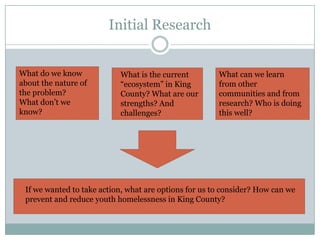
Initial Research


What do we know            What is the current         What can we learn
about the nature of        “ecosystem” in King         from other
the problem?               County? What are our        communities and from
What don’t we              strengths? And              research? Who is doing
know?                      challenges?                 this well?


 If we wanted to take action, what are options for us to consider? How can we
 prevent and reduce youth homelessness in King County?
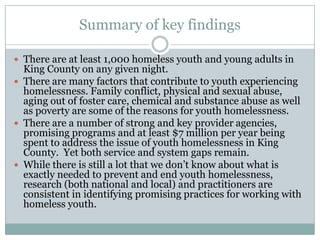
Summary of key findings

 There are at least 1,000 homeless youth and young adults in
  King County on any given night.
 There are many factors that contribute to youth experiencing
  homelessness. Family conflict, physical and sexual abuse,
  aging out of foster care, chemical and substance abuse as well
  as poverty are some of the reasons for youth homelessness.
 There are a number of strong and key provider agencies,
  promising programs and at least $7 million per year being
  spent to address the issue of youth homelessness in King
  County. Yet both service and system gaps remain.
 While there is still a lot that we don’t know about what is
  exactly needed to prevent and end youth homelessness,
  research (both national and local) and practitioners are
  consistent in identifying promising practices for working with
  homeless youth.
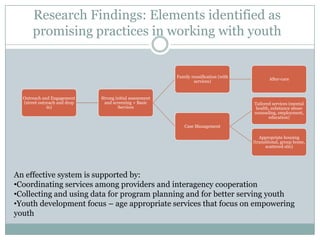
Research Findings: Elements identified as
      promising practices in working with youth


                                                          Family reunification (with
                                                                                               After-care
                                                                  services)


  Outreach and Engagement     Strong initial assessment
  (street outreach and drop    and screening + Basic                                   Tailored services (mental
              in)                     Services                                          health, substance abuse
                                                                                       counseling, employment,
                                                                                              education)

                                                             Case Management

                                                                                          Appropriate housing
                                                                                       (transitional, group home,
                                                                                             scattered site)


An effective system is supported by:
•Coordinating services among providers and interagency cooperation
•Collecting and using data for program planning and for better serving youth
•Youth development focus – age appropriate services that focus on empowering
youth
Research Findings: What is working well?

 Communication and coordination
    Regular meetings of case management staff, outreach staff to share
     information and collaborate on advocacy efforts

 “low barrier” services and youth-centered choices
    Service providers are working with kids where they are (street outreach,
     meals, services, and giving youth choices among service providers, etc.)


 Innovative and coordinated services for high risk and
 street youth with multiple barriers
    United Way “wrap around” services project (e.g., Groundwork Project)
    South King County “Coming Up” project (KCHA, Auburn Youth Services,
     Valley Cities counseling)
    Catalyst “low barrier” transitional housing
Research Findings: What are the main “gaps”

 Need more of everything – every part of the housing and
 services continuum need more resources
    A growing consensus that more beds/resources are needed for youth
     under 18
 Not enough focus on prevention
 Not enough access to mental health and chemical
  dependency services
 Not enough emphasis on the “back end”- employment
  and education
 No clear roadmap and a coordinated system for how we
  prevent and end youth homelessness in our community
 No a functional data system to track system level
  progress or to better serve youth
What prompted Portland’s Youth Continuum?

A Citizen Commission report on services to homeless youth in Portland in 1998 found that:
 Data collection on the homeless youth population and service system was inadequate
 There was poor government leadership and no overall plan for addressing homeless youth issues
 Service providers and government staff were not being held accountable
 There was no guiding philosophy for service delivery
 Service delivery was fragmented
 A lack of outcome based standards resulted in an inability to assess the effectiveness of services
 Public funding for homeless youth services is inadequate


     This really resonated with various stakeholders in King County – many
     who reflected that this could describe where we are in King County
     today
Alignment of several efforts

 United Way and the Committee to End
  Homelessness Efforts to look at “systems
  transformation”
 Provider led efforts to talk about better coordinating
  on a regional basis to prevent and reduce youth
  homelessness
 Private funders interest in systems transformation
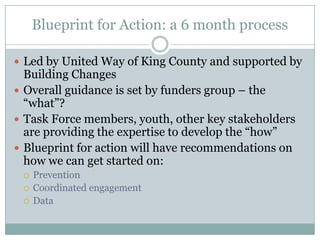
Blueprint for Action: a 6 month process

 Led by United Way of King County and supported by
  Building Changes
 Overall guidance is set by funders group – the
  “what”?
 Task Force members, youth, other key stakeholders
  are providing the expertise to develop the “how”
 Blueprint for action will have recommendations on
  how we can get started on:
    Prevention
    Coordinated engagement
    Data
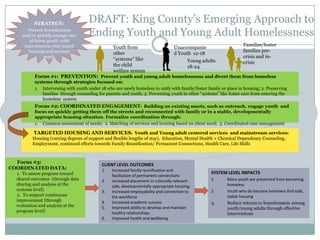
STRATEGY:
                                     DRAFT: King County’s Emerging Approach to
       Prevent homelessness
    and/or quickly engage out-       Ending Youth and Young Adult Homelessness
        of-home youth with
     interventions that match                                                                                      Families/foster
                                                 Youth from                       Unaccompanie
       housing and services                                                                                        families pre-
                                                 other                            d Youth 12-18
              needs.                                                                                               crisis and in-
                                                 “systems” like                          Young adults              crisis
                                                 the child                               18-24
                                                 welfare system
          Focus #1: PREVENTION: Prevent youth and young adult homelessness and divert them from homeless
          systems through strategies focused on:
          1. Intervening with youth under 18 who are newly homeless to unify with family/foster family or place in housing; 2. Preserving
              families through counseling for parents and youth; 3. Preventing youth in other “systems” like foster care from entering the
              homeless system
          Focus #2: COORDINATED ENGAGEMENT: Building on existing assets, such as outreach, engage youth and
          focus on quickly getting them off the streets and reconnected with family or in a stable, developmentally
          appropriate housing situation. Formalize coordination through:
          1. Common assessment of needs; 2. Matching of services and housing based on client need; 3. Coordinated case management

         TARGETED HOUSING AND SERVICES: Youth and Young adult centered services and mainstream services:
         Housing (varying degrees of support and flexible lengths of stay), Education, Mental Health + Chemical Dependency Counseling,
         Employment, continued efforts towards Family Reunification/ Permanent Connections, Health Care, Life Skills


  Focus #3:
                                            CLIENT LEVEL OUTCOMES
COORDINATED DATA:                           1.   Increased family reunification and
  1. To assess progress toward                                                                     SYSTEM LEVEL IMPACTS
                                                 facilitation of permanent connections
  shared outcomes (through data             2.   Increased placement in culturally relevant        1.      More youth are prevented from becoming
  sharing and analysis at the                    safe, developmentally appropriate housing;                homeless
  systems level)                            3.   Increased employability and connection to         2.      Youth who do become homeless find safe,
  2. To support continuous                       the workforce                                             stable housing
  improvement (through                      4.   Increased academic success                        3.      Reduce returns to homelessness among
  evaluation and analysis at the            5.   Improved ability to develop and maintain                  youth/young adults through effective
  program level)                                 healthy relationships                                     interventions
                                            6.   Improved health and wellbeing
Advice for other communities?

 Leverage existing research and studies


 Convene diverse stakeholders who are interested and
 can play unique role in the solutions

 Structure a clear, finite process with end goal and
 clear expectations for participants

 Take action – start small but have the longer term
 vision in mind

1.1 A Blueprint for Ending Youth Homelessness

  • 1.
    Blueprint for Action: Currentplanning efforts in King County to prevent and end youth homelessness PRESENTED BY KATIE HONG RAIKES FOUNDATION FEBRUARY 9, 2012
  • 2.
    Initial Research What dowe know What is the current What can we learn about the nature of “ecosystem” in King from other the problem? County? What are our communities and from What don’t we strengths? And research? Who is doing know? challenges? this well? If we wanted to take action, what are options for us to consider? How can we prevent and reduce youth homelessness in King County?
  • 3.
    Summary of keyfindings  There are at least 1,000 homeless youth and young adults in King County on any given night.  There are many factors that contribute to youth experiencing homelessness. Family conflict, physical and sexual abuse, aging out of foster care, chemical and substance abuse as well as poverty are some of the reasons for youth homelessness.  There are a number of strong and key provider agencies, promising programs and at least $7 million per year being spent to address the issue of youth homelessness in King County. Yet both service and system gaps remain.  While there is still a lot that we don’t know about what is exactly needed to prevent and end youth homelessness, research (both national and local) and practitioners are consistent in identifying promising practices for working with homeless youth.
  • 4.
    Research Findings: Elementsidentified as promising practices in working with youth Family reunification (with After-care services) Outreach and Engagement Strong initial assessment (street outreach and drop and screening + Basic Tailored services (mental in) Services health, substance abuse counseling, employment, education) Case Management Appropriate housing (transitional, group home, scattered site) An effective system is supported by: •Coordinating services among providers and interagency cooperation •Collecting and using data for program planning and for better serving youth •Youth development focus – age appropriate services that focus on empowering youth
  • 5.
    Research Findings: Whatis working well?  Communication and coordination  Regular meetings of case management staff, outreach staff to share information and collaborate on advocacy efforts  “low barrier” services and youth-centered choices  Service providers are working with kids where they are (street outreach, meals, services, and giving youth choices among service providers, etc.)  Innovative and coordinated services for high risk and street youth with multiple barriers  United Way “wrap around” services project (e.g., Groundwork Project)  South King County “Coming Up” project (KCHA, Auburn Youth Services, Valley Cities counseling)  Catalyst “low barrier” transitional housing
  • 6.
    Research Findings: Whatare the main “gaps”  Need more of everything – every part of the housing and services continuum need more resources  A growing consensus that more beds/resources are needed for youth under 18  Not enough focus on prevention  Not enough access to mental health and chemical dependency services  Not enough emphasis on the “back end”- employment and education  No clear roadmap and a coordinated system for how we prevent and end youth homelessness in our community  No a functional data system to track system level progress or to better serve youth
  • 7.
    What prompted Portland’sYouth Continuum? A Citizen Commission report on services to homeless youth in Portland in 1998 found that:  Data collection on the homeless youth population and service system was inadequate  There was poor government leadership and no overall plan for addressing homeless youth issues  Service providers and government staff were not being held accountable  There was no guiding philosophy for service delivery  Service delivery was fragmented  A lack of outcome based standards resulted in an inability to assess the effectiveness of services  Public funding for homeless youth services is inadequate This really resonated with various stakeholders in King County – many who reflected that this could describe where we are in King County today
  • 8.
    Alignment of severalefforts  United Way and the Committee to End Homelessness Efforts to look at “systems transformation”  Provider led efforts to talk about better coordinating on a regional basis to prevent and reduce youth homelessness  Private funders interest in systems transformation
  • 9.
    Blueprint for Action:a 6 month process  Led by United Way of King County and supported by Building Changes  Overall guidance is set by funders group – the “what”?  Task Force members, youth, other key stakeholders are providing the expertise to develop the “how”  Blueprint for action will have recommendations on how we can get started on:  Prevention  Coordinated engagement  Data
  • 10.
    STRATEGY: DRAFT: King County’s Emerging Approach to Prevent homelessness and/or quickly engage out- Ending Youth and Young Adult Homelessness of-home youth with interventions that match Families/foster Youth from Unaccompanie housing and services families pre- other d Youth 12-18 needs. crisis and in- “systems” like Young adults crisis the child 18-24 welfare system Focus #1: PREVENTION: Prevent youth and young adult homelessness and divert them from homeless systems through strategies focused on: 1. Intervening with youth under 18 who are newly homeless to unify with family/foster family or place in housing; 2. Preserving families through counseling for parents and youth; 3. Preventing youth in other “systems” like foster care from entering the homeless system Focus #2: COORDINATED ENGAGEMENT: Building on existing assets, such as outreach, engage youth and focus on quickly getting them off the streets and reconnected with family or in a stable, developmentally appropriate housing situation. Formalize coordination through: 1. Common assessment of needs; 2. Matching of services and housing based on client need; 3. Coordinated case management TARGETED HOUSING AND SERVICES: Youth and Young adult centered services and mainstream services: Housing (varying degrees of support and flexible lengths of stay), Education, Mental Health + Chemical Dependency Counseling, Employment, continued efforts towards Family Reunification/ Permanent Connections, Health Care, Life Skills Focus #3: CLIENT LEVEL OUTCOMES COORDINATED DATA: 1. Increased family reunification and 1. To assess progress toward SYSTEM LEVEL IMPACTS facilitation of permanent connections shared outcomes (through data 2. Increased placement in culturally relevant 1. More youth are prevented from becoming sharing and analysis at the safe, developmentally appropriate housing; homeless systems level) 3. Increased employability and connection to 2. Youth who do become homeless find safe, 2. To support continuous the workforce stable housing improvement (through 4. Increased academic success 3. Reduce returns to homelessness among evaluation and analysis at the 5. Improved ability to develop and maintain youth/young adults through effective program level) healthy relationships interventions 6. Improved health and wellbeing
  • 11.
    Advice for othercommunities?  Leverage existing research and studies  Convene diverse stakeholders who are interested and can play unique role in the solutions  Structure a clear, finite process with end goal and clear expectations for participants  Take action – start small but have the longer term vision in mind