Bijay Shrestha
Solanaceous Fruit Vegetable Crops
BRINJAL
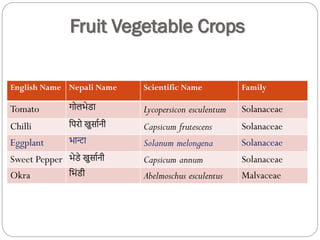
Fruit Vegetable Crops
English Name Nepali Name Scientific Name Family
Tomato गोलभेडा Lycopersicon esculentum Solanaceae
Chilli पिरो खुर्ाानी Capsicum frutescens Solanaceae
Eggplant भान्टा Solanum melongena Solanaceae
Sweet Pepper भेडे खुर्ाानी Capsicum annum Solanaceae
Okra पभिंडी Abelmoschus esculentus Malvaceae
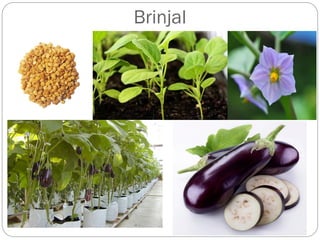
Brinjal
INTRODUCTION
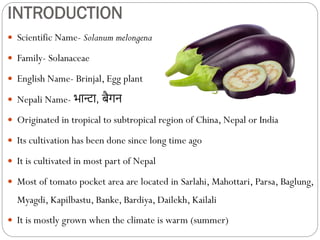
 Scientific Name- Solanum melongena
 Family- Solanaceae
 English Name- Brinjal, Egg plant
 Nepali Name- भान्टा, बैगन
 Originated in tropical to subtropical region of China, Nepal or India
 Its cultivation has been done since long time ago
 It is cultivated in most part of Nepal
 Most of tomato pocket area are located in Sarlahi, Mahottari, Parsa, Baglung,
Myagdi, Kapilbastu, Banke, Bardiya, Dailekh, Kailali
 It is mostly grown when the climate is warm (summer)
Uses
 Eggplant can provide at least 5% of a person’s daily requirement of
fiber, copper, manganese, B-6, and thiamine.
 Contains other vitamins and minerals.
 A source of phenolic compounds that act as antioxidants
 Contains anthocyanins, which helps reduce the risk of heart disease
 Lowers blood cholesterol and helps in prevention of cancer
 Useful to reduce tooth ache
 Acts as medicine to diabetic patients
Climate and Soil Requirement
 Climate:
A day neutral crop
Susceptible to severe frost
Summer crop so long summer climatic condition are preferable
Optimum temperature for plant growth and fruit setting is 21-27°C
Fruit setting is adversely affected when minimum temperature is below
15°C and maximum temperature exceeds 35°C
 Soil:
Can be cultivated in various types of soil
Grows best in sandy and loamy soil with adequate amount of organic
matters
Requires slightly acidic soil with pH range 5.5 to 6.0
Variety
 Nurki-
For terai, mid-hill and high hills of Nepal
Plant height is medium and stem-leaves are of pinkish color
Hard stalk
Fruit length is 15-20cm and about 4-5 fruits are developed in a cluster
It can be harvested in 60-65days after transplanting
Yield-25-30MT/ha
 Pusa Purple Long:
Fruit is purple in color and matures early
Fruit length is 20-25cm
Harvesting begins after 75-80 days after sowing
Yield - approx. 1500kg/ropani
 Other varieties- NS 797,Arka Keshav,Anna 806, Runako
Land preparation and Manure Application
 Land Preparation:
2-3 deep ploughing along with clearing the weeds and crop debris
Soil should be well pulverized and well levelled
 Manure Application:
For ropani of land-
FYM -1500kg
DAP – 7 kg
Urea – 6kg
MOP- 4.5 kg
Before final ploughing half of N and rest of all fertilizers should be applied.
Remaining 3kg of urea is applied in split dose where first 1.5kg is applied
after 20-25 DAT and other 1.5kg is applied after the initiation of flowering.
Top dressing is done by making ring around the plant.
Seed rate and seedling transplanting
 For one ropani of land required seedling is prepared by using only 20-
25g of seeds.
 Seedling is prepared in 45-60 days of sowing.
 The seed bed should be well irrigated and moistened one day before the
transplanting.
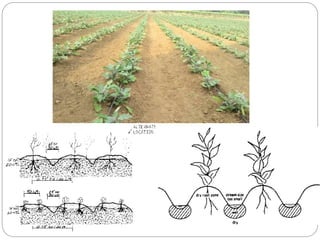
 Seedlings are transplanted in furrows in light soils and on side of the
ridges in case of heavy soils
 Transplanting is done at evening time
 In winter, ridge should be 120cm wide and spacing should be 60cm R-R
and 45 cm P-P.
 In rainy season, transplanting is done in middle part of 45cm wider
ridge while P-P spacing is 45cm.
 The width of furrow between two consecutive ridge is 30cm.
Time for sowing, transplanting, and harvesting
 Brinjal is generally sown and transplanted after the end of winter season
in mid and high hills whereas after the end of rainy season in terai region
 Such cultivation practices lead to harvesting season as follow:
 It harvested during summer - rainy season in mid and high hills while during
winter season in terai region
 Sowing and transplanting date along with their harvesting date is as
given below:
Area Sowing and transplanting Harvesting
High hills Chaitra-Baishak Asar- Bhadra
Mid hills Magh-Falgun Baishak-Asar
Terai Bhadra-Asoj Mangsir-Magh
Weeding and irrigation
 At time of top dressing the plant in 20-25 days after the transplantation,
the surface soil should be properly raked and weeded.
 The eggplant should be weeded and top dressed with additional compost
in 20-25 days after the first weeding.
 After that, the plant can be weeded 1-2 times and looking at the
condition of the crop and field.
 The furrows should be drained with water. The eggplants should be
watered at the interval of 10 - 15 days in winter while at 5 -7 days or
when the soil becomes dry in the summer season.
 The moisture of soil can be maintained using shade or compost mulch.
Pruning
 First pruning should be done in the month of Asar-Shrawan as this time
there is a lot of damaging fruits by fruits fly. It is appropriate to prune
plant before flowering.
 Second round of pruning in Mangsir-Poush after harvested all fruits.
 The pruning should be done with secateurs or sharp sickles.
 While first and second pruning, leave total of two growing branches on
the main stem.
 De-suckering should be done. Remove the lower leaves that grow so
that air can pass freely.
 Cut and remove the upper part of eggplant that withers due to pod
borer during day time. It should be done when this problem is found.
 Auxiliary roots should be pruned underground making a round circle
with a hoe or spade, and put compost around plant.
Harvesting and Yield
 Fruits should be picked when the fruit reaches the size as per the species and
when it has an attractive color.All fruits should be picked in cool of the
morning with the help of scissors or sickle.
 After fruit is picked, should be consumed soon. It is better to consume the
eggplants within 5 days of harvesting in hot season, and within 5-7 days in
winter season.
 It can be stored for 7-10 days if the temperature of 7-10 °C with RH of 90-
95% can be maintained.
 From one ropani of land following yield can be obtained:
 SummerYield-1500 kg
 Winter yield – 2000-2500kg
D/s and pests of Brinjal:
PESTS :
 Brinjal shoot and fruit borer
 Aphids
 Red Spider Mite
Write about symptom and control of given d/s and pests.
Submit Next Sunday
DISEASES:
• Phomopsis Blight
• Little leaf
Thank You

Brinjal

  • 1.
    Bijay Shrestha Solanaceous FruitVegetable Crops BRINJAL
  • 2.
    Fruit Vegetable Crops EnglishName Nepali Name Scientific Name Family Tomato गोलभेडा Lycopersicon esculentum Solanaceae Chilli पिरो खुर्ाानी Capsicum frutescens Solanaceae Eggplant भान्टा Solanum melongena Solanaceae Sweet Pepper भेडे खुर्ाानी Capsicum annum Solanaceae Okra पभिंडी Abelmoschus esculentus Malvaceae
  • 3.
  • 4.
    INTRODUCTION  Scientific Name-Solanum melongena  Family- Solanaceae  English Name- Brinjal, Egg plant  Nepali Name- भान्टा, बैगन  Originated in tropical to subtropical region of China, Nepal or India  Its cultivation has been done since long time ago  It is cultivated in most part of Nepal  Most of tomato pocket area are located in Sarlahi, Mahottari, Parsa, Baglung, Myagdi, Kapilbastu, Banke, Bardiya, Dailekh, Kailali  It is mostly grown when the climate is warm (summer)
  • 5.
    Uses  Eggplant canprovide at least 5% of a person’s daily requirement of fiber, copper, manganese, B-6, and thiamine.  Contains other vitamins and minerals.  A source of phenolic compounds that act as antioxidants  Contains anthocyanins, which helps reduce the risk of heart disease  Lowers blood cholesterol and helps in prevention of cancer  Useful to reduce tooth ache  Acts as medicine to diabetic patients
  • 6.
    Climate and SoilRequirement  Climate: A day neutral crop Susceptible to severe frost Summer crop so long summer climatic condition are preferable Optimum temperature for plant growth and fruit setting is 21-27°C Fruit setting is adversely affected when minimum temperature is below 15°C and maximum temperature exceeds 35°C  Soil: Can be cultivated in various types of soil Grows best in sandy and loamy soil with adequate amount of organic matters Requires slightly acidic soil with pH range 5.5 to 6.0
  • 7.
    Variety  Nurki- For terai,mid-hill and high hills of Nepal Plant height is medium and stem-leaves are of pinkish color Hard stalk Fruit length is 15-20cm and about 4-5 fruits are developed in a cluster It can be harvested in 60-65days after transplanting Yield-25-30MT/ha  Pusa Purple Long: Fruit is purple in color and matures early Fruit length is 20-25cm Harvesting begins after 75-80 days after sowing Yield - approx. 1500kg/ropani  Other varieties- NS 797,Arka Keshav,Anna 806, Runako
  • 8.
    Land preparation andManure Application  Land Preparation: 2-3 deep ploughing along with clearing the weeds and crop debris Soil should be well pulverized and well levelled  Manure Application: For ropani of land- FYM -1500kg DAP – 7 kg Urea – 6kg MOP- 4.5 kg Before final ploughing half of N and rest of all fertilizers should be applied. Remaining 3kg of urea is applied in split dose where first 1.5kg is applied after 20-25 DAT and other 1.5kg is applied after the initiation of flowering. Top dressing is done by making ring around the plant.
  • 9.
    Seed rate andseedling transplanting  For one ropani of land required seedling is prepared by using only 20- 25g of seeds.  Seedling is prepared in 45-60 days of sowing.  The seed bed should be well irrigated and moistened one day before the transplanting.  Seedlings are transplanted in furrows in light soils and on side of the ridges in case of heavy soils  Transplanting is done at evening time  In winter, ridge should be 120cm wide and spacing should be 60cm R-R and 45 cm P-P.  In rainy season, transplanting is done in middle part of 45cm wider ridge while P-P spacing is 45cm.  The width of furrow between two consecutive ridge is 30cm.
  • 11.
    Time for sowing,transplanting, and harvesting  Brinjal is generally sown and transplanted after the end of winter season in mid and high hills whereas after the end of rainy season in terai region  Such cultivation practices lead to harvesting season as follow:  It harvested during summer - rainy season in mid and high hills while during winter season in terai region  Sowing and transplanting date along with their harvesting date is as given below: Area Sowing and transplanting Harvesting High hills Chaitra-Baishak Asar- Bhadra Mid hills Magh-Falgun Baishak-Asar Terai Bhadra-Asoj Mangsir-Magh
  • 12.
    Weeding and irrigation At time of top dressing the plant in 20-25 days after the transplantation, the surface soil should be properly raked and weeded.  The eggplant should be weeded and top dressed with additional compost in 20-25 days after the first weeding.  After that, the plant can be weeded 1-2 times and looking at the condition of the crop and field.  The furrows should be drained with water. The eggplants should be watered at the interval of 10 - 15 days in winter while at 5 -7 days or when the soil becomes dry in the summer season.  The moisture of soil can be maintained using shade or compost mulch.
  • 13.
    Pruning  First pruningshould be done in the month of Asar-Shrawan as this time there is a lot of damaging fruits by fruits fly. It is appropriate to prune plant before flowering.  Second round of pruning in Mangsir-Poush after harvested all fruits.  The pruning should be done with secateurs or sharp sickles.  While first and second pruning, leave total of two growing branches on the main stem.  De-suckering should be done. Remove the lower leaves that grow so that air can pass freely.  Cut and remove the upper part of eggplant that withers due to pod borer during day time. It should be done when this problem is found.  Auxiliary roots should be pruned underground making a round circle with a hoe or spade, and put compost around plant.
  • 14.
    Harvesting and Yield Fruits should be picked when the fruit reaches the size as per the species and when it has an attractive color.All fruits should be picked in cool of the morning with the help of scissors or sickle.  After fruit is picked, should be consumed soon. It is better to consume the eggplants within 5 days of harvesting in hot season, and within 5-7 days in winter season.  It can be stored for 7-10 days if the temperature of 7-10 °C with RH of 90- 95% can be maintained.  From one ropani of land following yield can be obtained:  SummerYield-1500 kg  Winter yield – 2000-2500kg
  • 15.
    D/s and pestsof Brinjal: PESTS :  Brinjal shoot and fruit borer  Aphids  Red Spider Mite Write about symptom and control of given d/s and pests. Submit Next Sunday DISEASES: • Phomopsis Blight • Little leaf
  • 16.