Therapeutic Diet in Renal
Diseases
Types of renal diseases
Acute renal failure
Chronic renal failure
Nephrotic syndrome
Acute glomerulonephritis
Therapeutic diet
for
Acute renal failure
Patient
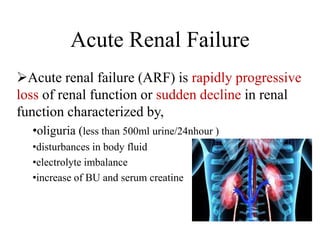
Acute Renal Failure
Acute renal failure (ARF) is rapidly progressive
loss of renal function or sudden decline in renal
function characterized by,
•oliguria (less than 500ml urine/24nhour )
•disturbances in body fluid
•electrolyte imbalance
•increase of BU and serum creatine
Energy requirement
 ARF has no effect on the patient’s energy
requirement.
Patients with any stage of ARF, total energy
requirement intake is 20 -30 kcal/kg/day
Carbohydrate
Daily carbohydrate requirement 3-5g/kg/day.
Patients with ARF should offer high
carbohydrate diet.
Protein
Daily requirement 0.8 – 1.0 g/kg/day
Regulate protein intake according to impaired
renal function.
Protein should be high biologic value rich in
essential amino acids
eg – dairy products, eggs, meat
Fluid
Fluid provision depends on,
clinical condition
stage of ARF
current treatment
In oliguric and fluid overload patients, fluid
intake may be restricted.
Electrolytes
Mainly concentrate on potassium, sodium and
phosphate.
Depends on
individualized blood biochemistry
patient’s clinical condition
dietary provision
Be aware that food and fluid containing large
amount of sodium, potassium and phosphorus
may need to be restricted.
Therapeutic Diet
for Chronic Kidney
Disease Patient
Chronic Kidney
Diseases(CKD)
CKD is abnormalities of kidney structure or
function, present for more than three months,
with implication for health.
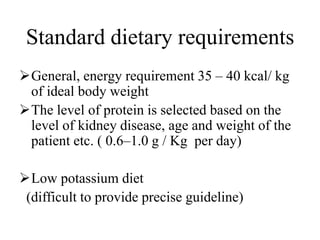
Standard dietary requirements
General, energy requirement 35 – 40 kcal/ kg
of ideal body weight
The level of protein is selected based on the
level of kidney disease, age and weight of the
patient etc. ( 0.6–1.0 g / Kg per day)
Low potassium diet
(difficult to provide precise guideline)
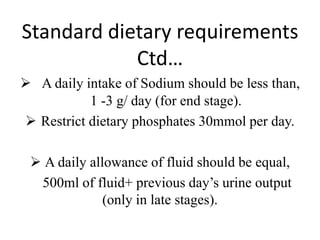
Standard dietary requirements
Ctd…
 A daily intake of Sodium should be less than,
1 -3 g/ day (for end stage).
 Restrict dietary phosphates 30mmol per day.
 A daily allowance of fluid should be equal,
500ml of fluid+ previous day’s urine output
(only in late stages).
Dietary Guideline
Carbohydrates
Energy requirement of 35 kcal/ kg per day
Quantity of carbohydrate or starchy food
depends on patient’s BMI, other associated
diseases like diabetes, level of the kidney
disease.
 BMI < 18.5 kg/m2, - 2500 kcal
BMI between 18.5 – 25 kg/m2,2000−2500kcal
BMI is above 25 kg/m2,2000 Kcal
Protein
A low or moderate protein diet
( proteins are broken down, urea accumulates in
the body, early protein restriction in CKD
glomerular damage may slow down and delay
the need to initiate dialysis therapy).
Generally accepted levels
stage I to III −0.75 g/kg BW per day
stage IV to V −0.6 g/kg BW per day
Salt
Kidney function declines, sodium and fluids
may accumulate in the body (Oedema)
1–3 g/day is recommended
 If GFR is above 10% and if patient is free of
Oedema and hypertension an intake < 5g
Salt Ctd…
Limit foods with added salt
(chips, cheese, sauce, chutneys, pickles, savories,
salted biscuits, processed meat such as sausages,
ham & bacon and salted nuts)
Specific preparations are preferred
(Low sodium, No salt added, Sodium
free, Sodium reduced ,Unsalted)
Potassium (K)
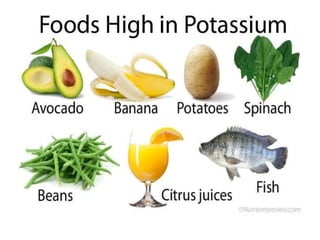
Serum K levels can be high in severe renal
failure
Very high potassium levels (6.5mmol/L or
higher potassium) can lead to a cardiac arrest
or cardiac arrhythmias.
Dietary potassium restriction necessary in
GFR reduced < 10 ml/min
Serum K levels are greater than 5 mEq/ L, a
potassium restricted diet of 2–3 g/day should
be initiated.
Methods to reduce the amount
of potassium in foods
This is for foods such as potatoes, sweet
potatoes, beet root, carrot, cabbage and herbs.
Cut in to small pieces and wash well.
Wash with warm water.
Keep in water for whole night and wash. (at
least two hours.)
Boil well and remove the water.
If needed those foods can be fried.
Phosphorus
 kidney function is deteriorated up to GFR
25-30ml per minute, phosphate retention
 Phosphate up to 800 – 1000 mg/ day is
necessary for patients with stages 3 onward
 Serum phosphorus level is greater than 4.6
mg/ dl Phosphate intake can be reduced
Calcium
Serum calcium levels may not decrease until
GFR 30 ml/ min
Foods rich in calcium (primarily dairy
products) should be avoided
1.5 – 2 g − stages 3 & 4
1.5 – 1.8 g – for stages 4 & 5
Fat & Oil
good source of energy
Oil may help improve appetite
Many patients with CKD suffer from loss of
appetite
around 20 – 30 % of calories can be taken,
good sources are,
(Avocado, cashew, peanut, pumpkin seeds,
gingelly, kottan and oils from gingelly, olive, and
sunflower_)
Fat & Oil Ctd…
Use low fat or non fat milk or milk products
Limit saturated fats like butter
Avoid food containing high trans fat
LDL levels of100 mg/dl and triglyceride levels
less than 150 mg/dl.
Vitamins & Minerals
• Restriction of protein and certain minerals in
the diet of CKD patients automatically result
in deficiency of vitamins.
• Supplementation with critical vitamins &
minerals is essential.
Vitamins & Minerals
Supplementation,
• Folic acid 1 mg/day
• Pyridoxin -5 mg/day
• Other B complex vitamins - use as RDA
• Ascorbic acid 60 – 100 mg/day
• vitamin D
• Iron supplements
Fluid
Fluid intake should not be restricted until the
later stage
In the latter stages , amount of fluid required
equals to the volume of urine out put plus 500
ml/ day
Fluid Ctd….
When the patient is in need restricting water,
−limit food with high water contents
(soup, ice cream, grapes, melons,
tomatoes,jelly, gravy, lettuce )
− use smaller cups or glasses
– avoid salty food
– stay cool on hot days
Sample Menu
Example diet plan for CKD patient
( Considering calories requirement 2000Kcl ,
body weight 50 kg person)
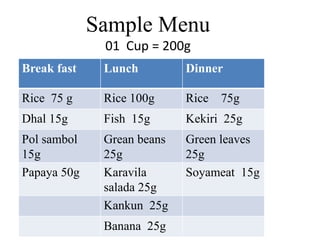
Sample Menu
01 Cup = 200g
Break fast Lunch Dinner
Rice 75 g Rice 100g Rice 75g
Dhal 15g Fish 15g Kekiri 25g
Pol sambol
15g
Grean beans
25g
Green leaves
25g
Papaya 50g Karavila
salada 25g
Soyameat 15g
Kankun 25g
Banana 25g
Therapeutic diet
for
Haemodialysis
Patient
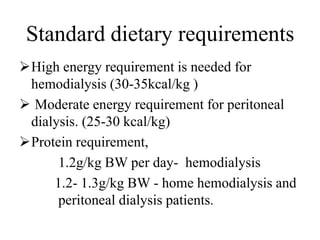
Standard dietary requirements
High energy requirement is needed for
hemodialysis (30-35kcal/kg )
 Moderate energy requirement for peritoneal
dialysis. (25-30 kcal/kg)
Protein requirement,
1.2g/kg BW per day- hemodialysis
1.2- 1.3g/kg BW - home hemodialysis and
peritoneal dialysis patients.
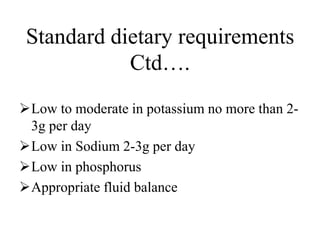
Standard dietary requirements
Ctd….
Low to moderate in potassium no more than 2-
3g per day
Low in Sodium 2-3g per day
Low in phosphorus
Appropriate fluid balance
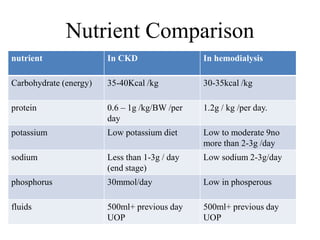
Nutrient Comparison
nutrient In CKD In hemodialysis
Carbohydrate (energy) 35-40Kcal /kg 30-35kcal /kg
protein 0.6 – 1g /kg/BW /per
day
1.2g / kg /per day.
potassium Low potassium diet Low to moderate 9no
more than 2-3g /day
sodium Less than 1-3g / day
(end stage)
Low sodium 2-3g/day
phosphorus 30mmol/day Low in phosperous
fluids 500ml+ previous day
UOP
500ml+ previous day
UOP
nutrient In CKD In hemodialysis
Carbohydrate (energy) 35-40Kcal /kg 30-35kcal /kg
protein 0.6 – 1g /kg/BW /per
day
1.2g / kg /per day.
potassium Low potassium diet Low to moderate 9no
more than 2-3g /day
sodium Less than 1-3g / day
(end stage)
Low sodium 2-3g/day
phosphorus 30mmol/day Low in phosperous
fluids 500ml+ previous day
UOP
500ml+ previous day
UOP
Example diet plan for haemodialysis
patient
( Considering calori requirement
1500Kcl , body weight 50 kg person)
time Type of food amount
6.30 a. m Milk with tea 1 cup
8.00 a. m
[Breakfast]
Rice
Dhall
Green beans
papaw
2 cup
1/2 cup
1 cup
½ cup
10.00a.m (Morning snack] yoghurt 1cup
1.00p.m
[Lunch]
Rice
Chicken / fish
Ladies fingers
apple
3cups
Amount of a box of matches
1 cup
1/2
4.00p.m [Evening snack] White bread 2 slices
8.00p.m
[Dinner]
Noodles
Long beans
Chicken/ fish
dhall
3cups
1 cup
Amount of a box of matches
½ cup
1cup=125ml.
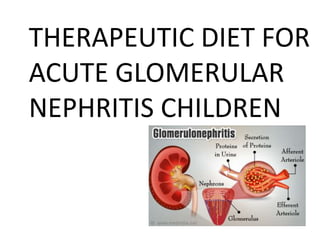
THERAPEUTIC DIET FOR
ACUTE GLOMERULAR
NEPHRITIS CHILDREN
Acute Glomerular Nephritis
• Is inflammation of the filtering mechanisms of
the kidneys, which called glomeruli .It can
happen due to infection or injury.
Dietary Modifications
• Energy: Requirements are calculated based
on age & weight and an additional
allowance of 10% is given for infections.
PROTEIN
• Dietary requirement for older children is
0.5g/ kg .It is – 1.5g/kg for younger children .
• Low protein diet - give rest to kidneys
• If anuria – proteins should be stopped.
• In oliguria –dietary protein must be restricted.
Sodium
• Daily requirement is 500-1000 mg/day
• It varies with the oliguria &hypertension.
• To reduce sodium intake, avoid adding salt
to foods when cooking.
• Avoid consuming foods containing high
sodiumx
• Ex:- canned foods, processed foods,
salted snacks and processed
meats, like sausages,bacon and ham.
Potassium
• Daily requirement is 1mmol/kg/day.
• If urine formation is reduce, potassium
restricted.
Ex:-such as bananas, sweet potatoes,
oranges, spinach, tomatoes, nuts, legumes and
dairy products.
• Too little potassium can be even dangerous.
Calcium
• Calcium: daily requirement is 1 g/ day.
Phosphorus
• Daily requirement is 8-12 mg/kg/day.
• Mostly found in all foods .
FLUID
• Daily fluid replacement -1000 ml plus daily
amount excreted in urine.
• Water consumed with the drugs, water
present in milk, tea, coffee should be
considered.
ex:- infants- 30ml/kg
older children-20 ml /kg
Therapeutic Diet
For Nephrotic
Syndrome Children
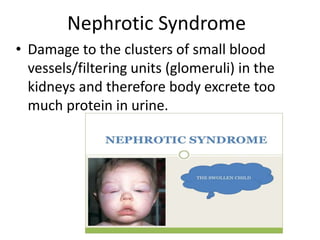
Nephrotic Syndrome
• Damage to the clusters of small blood
vessels/filtering units (glomeruli) in the
kidneys and therefore body excrete too
much protein in urine.
• Monitoring a diet can be challenging, but it can
also improve health and alleviate symptoms of
nephrotic syndrome.
• Make sure that child follow a sensible and
healthy eating plan.
• Daily dietary requirement -100Kcal/kg/day
Standard dietary requirements
PROTEIN
• A diet that is moderate in protein can help
to reduce the amount of protein lost in the urine and
preserve kidney function.
• Restricted protein as 2-3g/ kg /day
• High protein diets do not increase the levels of
protein in blood and therefore should be avoided.
Ex:- high protein drinks, powders and supplements
• It is important that not to avoid protein, as muscle
wasting and malnutrition may occur.
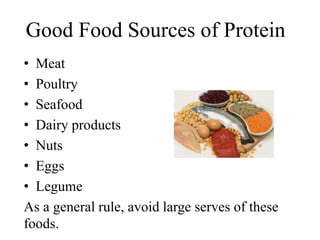
Good Food Sources of Protein
• Meat
• Poultry
• Seafood
• Dairy products
• Nuts
• Eggs
• Legume
As a general rule, avoid large serves of these
foods.
FAT
• It is common to have high levels of cholesterol
and triglycerides (blood fats)in nephrotic
syndrome Patients.It may increase the risk of
heart disease.
• It is advisable to follow a diet low in fat,
• particularly avoid food sources of saturated
fat.
• Limit high fat foods
Ex:-Butter,Full fat dairy, Pastry,biscuits,coconut
milk, Chicken skin and visible fat on meat.
FAT Cont’d.....
• Better to Choose foods that are baked, boiled or
rather than fried or Deep-fried.
• Try not to add a lot of extra fat, such as margarine
to foods.
• Cooking with healthy oils such as olive,coconut or
vegetable oils.Hi
SALT
• A low salt diet is recommended in nephrotic
syndrome to help reduce fluid retention & prevent
hypertension.
• Limit sodium intake to 400 milligrams (mg) per
meal (150 mg per snack).
• Salt intake should be 2-3g per day .
• Avoid using salt in cooking and “fast” foods.
• Choose foods that are low in salt, specially the
home prepared meals.
Vitamins
• Vitamin supplements can be taken.
• Ex:- Vitamin c
Vitamin D-400IU/day
Vitamin E- 2.5-3 mg/ day
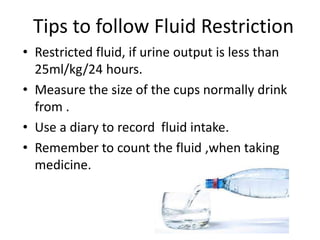
Tips to follow Fluid Restriction
• Restricted fluid, if urine output is less than
25ml/kg/24 hours.
• Measure the size of the cups normally drink
from .
• Use a diary to record fluid intake.
• Remember to count the fluid ,when taking
medicine.
Reduce sugar intake.:-
• Not to add sugar to food and drinks.
• Replace soft drinks and sugar-free varieties.
• Cut down as much as possible on sweets such
as candies,cakes, cookies and chocolate.
Eat more fiber rich foods:-
• Whole-wheat or multi-grain breads and
breakfast cereals.
• Choose more fresh fruits and vegetables.They
make excellent snacks!
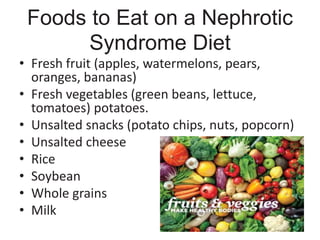
Foods to Eat on a Nephrotic
Syndrome Diet
• Fresh fruit (apples, watermelons, pears,
oranges, bananas)
• Fresh vegetables (green beans, lettuce,
tomatoes) potatoes.
• Unsalted snacks (potato chips, nuts, popcorn)
• Unsalted cheese
• Rice
• Soybean
• Whole grains
• Milk
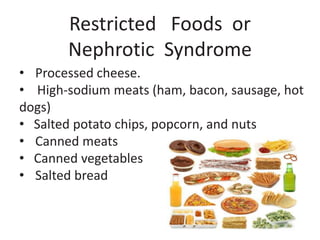
• Processed cheese.
• High-sodium meats (ham, bacon, sausage, hot
dogs)
• Salted potato chips, popcorn, and nuts
• Canned meats
• Canned vegetables
• Salted bread
Restricted Foods or
Nephrotic Syndrome
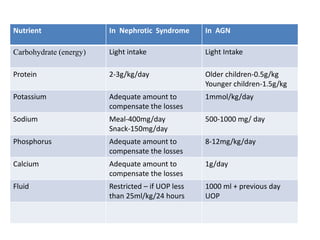
Nutrient In Nephrotic Syndrome In AGN
Carbohydrate (energy) Light intake Light Intake
Protein 2-3g/kg/day Older children-0.5g/kg
Younger children-1.5g/kg
Potassium Adequate amount to
compensate the losses
1mmol/kg/day
Sodium Meal-400mg/day
Snack-150mg/day
500-1000 mg/ day
Phosphorus Adequate amount to
compensate the losses
8-12mg/kg/day
Calcium Adequate amount to
compensate the losses
1g/day
Fluid Restricted – if UOP less
than 25ml/kg/24 hours
1000 ml + previous day
UOP

diet in CKD-newest.pptx

  • 1.
    Therapeutic Diet inRenal Diseases
  • 2.
    Types of renaldiseases Acute renal failure Chronic renal failure Nephrotic syndrome Acute glomerulonephritis
  • 3.
  • 4.
    Acute Renal Failure Acuterenal failure (ARF) is rapidly progressive loss of renal function or sudden decline in renal function characterized by, •oliguria (less than 500ml urine/24nhour ) •disturbances in body fluid •electrolyte imbalance •increase of BU and serum creatine
  • 5.
    Energy requirement  ARFhas no effect on the patient’s energy requirement. Patients with any stage of ARF, total energy requirement intake is 20 -30 kcal/kg/day
  • 6.
    Carbohydrate Daily carbohydrate requirement3-5g/kg/day. Patients with ARF should offer high carbohydrate diet.
  • 7.
    Protein Daily requirement 0.8– 1.0 g/kg/day Regulate protein intake according to impaired renal function. Protein should be high biologic value rich in essential amino acids eg – dairy products, eggs, meat
  • 8.
    Fluid Fluid provision dependson, clinical condition stage of ARF current treatment In oliguric and fluid overload patients, fluid intake may be restricted.
  • 9.
    Electrolytes Mainly concentrate onpotassium, sodium and phosphate. Depends on individualized blood biochemistry patient’s clinical condition dietary provision Be aware that food and fluid containing large amount of sodium, potassium and phosphorus may need to be restricted.
  • 10.
    Therapeutic Diet for ChronicKidney Disease Patient
  • 11.
    Chronic Kidney Diseases(CKD) CKD isabnormalities of kidney structure or function, present for more than three months, with implication for health.
  • 12.
    Standard dietary requirements General,energy requirement 35 – 40 kcal/ kg of ideal body weight The level of protein is selected based on the level of kidney disease, age and weight of the patient etc. ( 0.6–1.0 g / Kg per day) Low potassium diet (difficult to provide precise guideline)
  • 13.
    Standard dietary requirements Ctd… A daily intake of Sodium should be less than, 1 -3 g/ day (for end stage).  Restrict dietary phosphates 30mmol per day.  A daily allowance of fluid should be equal, 500ml of fluid+ previous day’s urine output (only in late stages).
  • 14.
    Dietary Guideline Carbohydrates Energy requirementof 35 kcal/ kg per day Quantity of carbohydrate or starchy food depends on patient’s BMI, other associated diseases like diabetes, level of the kidney disease.  BMI < 18.5 kg/m2, - 2500 kcal BMI between 18.5 – 25 kg/m2,2000−2500kcal BMI is above 25 kg/m2,2000 Kcal
  • 15.
    Protein A low ormoderate protein diet ( proteins are broken down, urea accumulates in the body, early protein restriction in CKD glomerular damage may slow down and delay the need to initiate dialysis therapy). Generally accepted levels stage I to III −0.75 g/kg BW per day stage IV to V −0.6 g/kg BW per day
  • 16.
    Salt Kidney function declines,sodium and fluids may accumulate in the body (Oedema) 1–3 g/day is recommended  If GFR is above 10% and if patient is free of Oedema and hypertension an intake < 5g
  • 17.
    Salt Ctd… Limit foodswith added salt (chips, cheese, sauce, chutneys, pickles, savories, salted biscuits, processed meat such as sausages, ham & bacon and salted nuts) Specific preparations are preferred (Low sodium, No salt added, Sodium free, Sodium reduced ,Unsalted)
  • 18.
    Potassium (K) Serum Klevels can be high in severe renal failure Very high potassium levels (6.5mmol/L or higher potassium) can lead to a cardiac arrest or cardiac arrhythmias. Dietary potassium restriction necessary in GFR reduced < 10 ml/min Serum K levels are greater than 5 mEq/ L, a potassium restricted diet of 2–3 g/day should be initiated.
  • 19.
    Methods to reducethe amount of potassium in foods This is for foods such as potatoes, sweet potatoes, beet root, carrot, cabbage and herbs. Cut in to small pieces and wash well. Wash with warm water. Keep in water for whole night and wash. (at least two hours.) Boil well and remove the water. If needed those foods can be fried.
  • 21.
    Phosphorus  kidney functionis deteriorated up to GFR 25-30ml per minute, phosphate retention  Phosphate up to 800 – 1000 mg/ day is necessary for patients with stages 3 onward  Serum phosphorus level is greater than 4.6 mg/ dl Phosphate intake can be reduced
  • 23.
    Calcium Serum calcium levelsmay not decrease until GFR 30 ml/ min Foods rich in calcium (primarily dairy products) should be avoided 1.5 – 2 g − stages 3 & 4 1.5 – 1.8 g – for stages 4 & 5
  • 24.
    Fat & Oil goodsource of energy Oil may help improve appetite Many patients with CKD suffer from loss of appetite around 20 – 30 % of calories can be taken, good sources are, (Avocado, cashew, peanut, pumpkin seeds, gingelly, kottan and oils from gingelly, olive, and sunflower_)
  • 25.
    Fat & OilCtd… Use low fat or non fat milk or milk products Limit saturated fats like butter Avoid food containing high trans fat LDL levels of100 mg/dl and triglyceride levels less than 150 mg/dl.
  • 26.
    Vitamins & Minerals •Restriction of protein and certain minerals in the diet of CKD patients automatically result in deficiency of vitamins. • Supplementation with critical vitamins & minerals is essential.
  • 27.
    Vitamins & Minerals Supplementation, •Folic acid 1 mg/day • Pyridoxin -5 mg/day • Other B complex vitamins - use as RDA • Ascorbic acid 60 – 100 mg/day • vitamin D • Iron supplements
  • 28.
    Fluid Fluid intake shouldnot be restricted until the later stage In the latter stages , amount of fluid required equals to the volume of urine out put plus 500 ml/ day
  • 29.
    Fluid Ctd…. When thepatient is in need restricting water, −limit food with high water contents (soup, ice cream, grapes, melons, tomatoes,jelly, gravy, lettuce ) − use smaller cups or glasses – avoid salty food – stay cool on hot days
  • 30.
    Sample Menu Example dietplan for CKD patient ( Considering calories requirement 2000Kcl , body weight 50 kg person)
  • 31.
    Sample Menu 01 Cup= 200g Break fast Lunch Dinner Rice 75 g Rice 100g Rice 75g Dhal 15g Fish 15g Kekiri 25g Pol sambol 15g Grean beans 25g Green leaves 25g Papaya 50g Karavila salada 25g Soyameat 15g Kankun 25g Banana 25g
  • 32.
  • 33.
    Standard dietary requirements Highenergy requirement is needed for hemodialysis (30-35kcal/kg )  Moderate energy requirement for peritoneal dialysis. (25-30 kcal/kg) Protein requirement, 1.2g/kg BW per day- hemodialysis 1.2- 1.3g/kg BW - home hemodialysis and peritoneal dialysis patients.
  • 34.
    Standard dietary requirements Ctd…. Lowto moderate in potassium no more than 2- 3g per day Low in Sodium 2-3g per day Low in phosphorus Appropriate fluid balance
  • 35.
    Nutrient Comparison nutrient InCKD In hemodialysis Carbohydrate (energy) 35-40Kcal /kg 30-35kcal /kg protein 0.6 – 1g /kg/BW /per day 1.2g / kg /per day. potassium Low potassium diet Low to moderate 9no more than 2-3g /day sodium Less than 1-3g / day (end stage) Low sodium 2-3g/day phosphorus 30mmol/day Low in phosperous fluids 500ml+ previous day UOP 500ml+ previous day UOP nutrient In CKD In hemodialysis Carbohydrate (energy) 35-40Kcal /kg 30-35kcal /kg protein 0.6 – 1g /kg/BW /per day 1.2g / kg /per day. potassium Low potassium diet Low to moderate 9no more than 2-3g /day sodium Less than 1-3g / day (end stage) Low sodium 2-3g/day phosphorus 30mmol/day Low in phosperous fluids 500ml+ previous day UOP 500ml+ previous day UOP
  • 36.
    Example diet planfor haemodialysis patient ( Considering calori requirement 1500Kcl , body weight 50 kg person)
  • 37.
    time Type offood amount 6.30 a. m Milk with tea 1 cup 8.00 a. m [Breakfast] Rice Dhall Green beans papaw 2 cup 1/2 cup 1 cup ½ cup 10.00a.m (Morning snack] yoghurt 1cup 1.00p.m [Lunch] Rice Chicken / fish Ladies fingers apple 3cups Amount of a box of matches 1 cup 1/2 4.00p.m [Evening snack] White bread 2 slices 8.00p.m [Dinner] Noodles Long beans Chicken/ fish dhall 3cups 1 cup Amount of a box of matches ½ cup 1cup=125ml.
  • 38.
    THERAPEUTIC DIET FOR ACUTEGLOMERULAR NEPHRITIS CHILDREN
  • 39.
    Acute Glomerular Nephritis •Is inflammation of the filtering mechanisms of the kidneys, which called glomeruli .It can happen due to infection or injury.
  • 40.
    Dietary Modifications • Energy:Requirements are calculated based on age & weight and an additional allowance of 10% is given for infections.
  • 41.
    PROTEIN • Dietary requirementfor older children is 0.5g/ kg .It is – 1.5g/kg for younger children . • Low protein diet - give rest to kidneys • If anuria – proteins should be stopped. • In oliguria –dietary protein must be restricted.
  • 42.
    Sodium • Daily requirementis 500-1000 mg/day • It varies with the oliguria &hypertension. • To reduce sodium intake, avoid adding salt to foods when cooking. • Avoid consuming foods containing high sodiumx • Ex:- canned foods, processed foods, salted snacks and processed meats, like sausages,bacon and ham.
  • 43.
    Potassium • Daily requirementis 1mmol/kg/day. • If urine formation is reduce, potassium restricted. Ex:-such as bananas, sweet potatoes, oranges, spinach, tomatoes, nuts, legumes and dairy products. • Too little potassium can be even dangerous.
  • 44.
    Calcium • Calcium: dailyrequirement is 1 g/ day.
  • 45.
    Phosphorus • Daily requirementis 8-12 mg/kg/day. • Mostly found in all foods .
  • 46.
    FLUID • Daily fluidreplacement -1000 ml plus daily amount excreted in urine. • Water consumed with the drugs, water present in milk, tea, coffee should be considered. ex:- infants- 30ml/kg older children-20 ml /kg
  • 47.
  • 48.
    Nephrotic Syndrome • Damageto the clusters of small blood vessels/filtering units (glomeruli) in the kidneys and therefore body excrete too much protein in urine.
  • 49.
    • Monitoring adiet can be challenging, but it can also improve health and alleviate symptoms of nephrotic syndrome. • Make sure that child follow a sensible and healthy eating plan. • Daily dietary requirement -100Kcal/kg/day Standard dietary requirements
  • 50.
    PROTEIN • A dietthat is moderate in protein can help to reduce the amount of protein lost in the urine and preserve kidney function. • Restricted protein as 2-3g/ kg /day • High protein diets do not increase the levels of protein in blood and therefore should be avoided. Ex:- high protein drinks, powders and supplements • It is important that not to avoid protein, as muscle wasting and malnutrition may occur.
  • 51.
    Good Food Sourcesof Protein • Meat • Poultry • Seafood • Dairy products • Nuts • Eggs • Legume As a general rule, avoid large serves of these foods.
  • 52.
    FAT • It iscommon to have high levels of cholesterol and triglycerides (blood fats)in nephrotic syndrome Patients.It may increase the risk of heart disease. • It is advisable to follow a diet low in fat, • particularly avoid food sources of saturated fat. • Limit high fat foods Ex:-Butter,Full fat dairy, Pastry,biscuits,coconut milk, Chicken skin and visible fat on meat.
  • 53.
    FAT Cont’d..... • Betterto Choose foods that are baked, boiled or rather than fried or Deep-fried. • Try not to add a lot of extra fat, such as margarine to foods. • Cooking with healthy oils such as olive,coconut or vegetable oils.Hi
  • 54.
    SALT • A lowsalt diet is recommended in nephrotic syndrome to help reduce fluid retention & prevent hypertension. • Limit sodium intake to 400 milligrams (mg) per meal (150 mg per snack). • Salt intake should be 2-3g per day . • Avoid using salt in cooking and “fast” foods. • Choose foods that are low in salt, specially the home prepared meals.
  • 55.
    Vitamins • Vitamin supplementscan be taken. • Ex:- Vitamin c Vitamin D-400IU/day Vitamin E- 2.5-3 mg/ day
  • 56.
    Tips to followFluid Restriction • Restricted fluid, if urine output is less than 25ml/kg/24 hours. • Measure the size of the cups normally drink from . • Use a diary to record fluid intake. • Remember to count the fluid ,when taking medicine.
  • 57.
    Reduce sugar intake.:- •Not to add sugar to food and drinks. • Replace soft drinks and sugar-free varieties. • Cut down as much as possible on sweets such as candies,cakes, cookies and chocolate. Eat more fiber rich foods:- • Whole-wheat or multi-grain breads and breakfast cereals. • Choose more fresh fruits and vegetables.They make excellent snacks!
  • 58.
    Foods to Eaton a Nephrotic Syndrome Diet • Fresh fruit (apples, watermelons, pears, oranges, bananas) • Fresh vegetables (green beans, lettuce, tomatoes) potatoes. • Unsalted snacks (potato chips, nuts, popcorn) • Unsalted cheese • Rice • Soybean • Whole grains • Milk
  • 59.
    • Processed cheese. •High-sodium meats (ham, bacon, sausage, hot dogs) • Salted potato chips, popcorn, and nuts • Canned meats • Canned vegetables • Salted bread Restricted Foods or Nephrotic Syndrome
  • 60.
    Nutrient In NephroticSyndrome In AGN Carbohydrate (energy) Light intake Light Intake Protein 2-3g/kg/day Older children-0.5g/kg Younger children-1.5g/kg Potassium Adequate amount to compensate the losses 1mmol/kg/day Sodium Meal-400mg/day Snack-150mg/day 500-1000 mg/ day Phosphorus Adequate amount to compensate the losses 8-12mg/kg/day Calcium Adequate amount to compensate the losses 1g/day Fluid Restricted – if UOP less than 25ml/kg/24 hours 1000 ml + previous day UOP

Editor's Notes

  • #19 Patients on low potassium diet advised to boil vegetables for 5–10 minutes using large amount of water and to discard water after cooking to further decrease the vegetable potassium content.
  • #26 some nuts may contain high level of potassium