VANAKKAM
Breathing & Tranquility
Effects of Yogic Breathing practices
on inducing a calming effect on the
brain
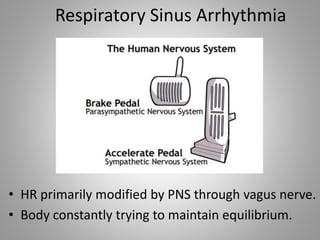
• HR primarily modified by PNS through vagus nerve.
• Body constantly trying to maintain equilibrium.
Respiratory Sinus Arrhythmia
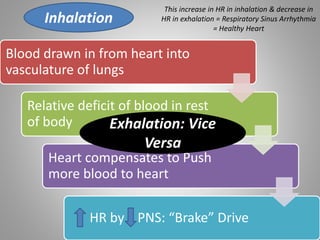
Blood drawn in from heart into
vasculature of lungs
Relative deficit of blood in rest
of body
Heart compensates to Push
more blood to heart
HR by PNS: “Brake” Drive
Inhalation
Exhalation: Vice
Versa
This increase in HR in inhalation & decrease in
HR in exhalation = Respiratory Sinus Arrhythmia
= Healthy Heart
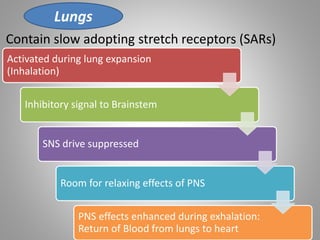
Contain slow adopting stretch receptors (SARs)
Lungs
Activated during lung expansion
(Inhalation)
Inhibitory signal to Brainstem
SNS drive suppressed
Room for relaxing effects of PNS
PNS effects enhanced during exhalation:
Return of Blood from lungs to heart
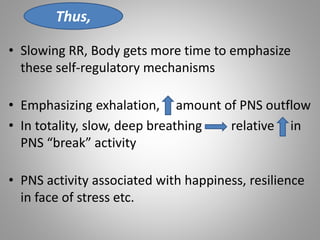
• Slowing RR, Body gets more time to emphasize
these self-regulatory mechanisms
• Emphasizing exhalation, amount of PNS outflow
• In totality, slow, deep breathing relative in
PNS “break” activity
• PNS activity associated with happiness, resilience
in face of stress etc.
Thus,
Research on Mice
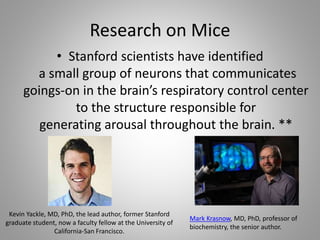
• Stanford scientists have identified
a small group of neurons that communicates
goings-on in the brain’s respiratory control center
to the structure responsible for
generating arousal throughout the brain. **
Kevin Yackle, MD, PhD, the lead author, former Stanford
graduate student, now a faculty fellow at the University of
California-San Francisco.
Mark Krasnow, MD, PhD, professor of
biochemistry, the senior author.
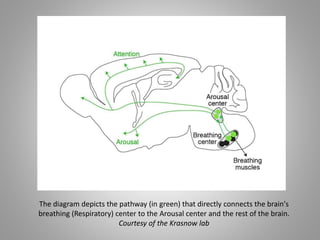
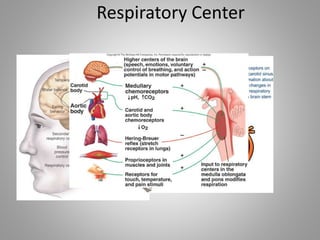
The diagram depicts the pathway (in green) that directly connects the brain's
breathing (Respiratory) center to the Arousal center and the rest of the brain.
Courtesy of the Krasnow lab
Respiratory Center
Arousal Centre
• A physiological and psychological state of being awoken or of
sense organs stimulated to a point of perception.
• It involves activation of the reticular activating system in the
brainstem, the autonomic nervous system, and the endocrine
system, leading to increased heart rate and blood pressure and a
condition of sensory alertness, mobility, and readiness to respond.
• The arousal system involves five major neural systems based on
brain's neurotransmitters: acetylcholine, norepinephrine,
dopamine, histamine, and serotonin. When these systems are in
action, the receiving neural areas become sensitive and responsive
to incoming signals, producing alertness and cortical activity.
• Arousal is important in regulating consciousness, attention,
alertness, and information processing. It is a crucial for motivating
certain behaviours, such as mobility, the pursuit of nutrition, the
fight-or-flight response and sexual activity, and in emotion
Tranquility?
• A regulated breathing process can have
tranquilizing effects due to its direct connections
to the brain and CNS.
• It has some connection with the hypothalamus &
the brain center which controls emotional
responses.
• Hypothalamus is responsible for transforming
perception into cognitive experience.
Erratic breathing sends erratic impulses to this
center and thus creates disturbed responses.
Greatest stress as per Yoga philosophy
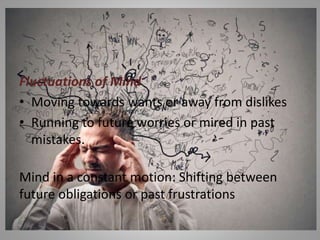
Fluctuations of Mind
• Moving towards wants or away from dislikes
• Running to future worries or mired in past
mistakes.
Mind in a constant motion: Shifting between
future obligations or past frustrations
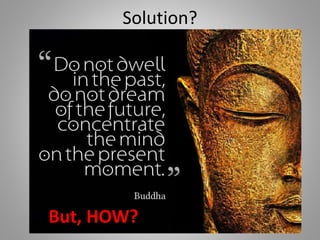
Solution?
But, HOW?
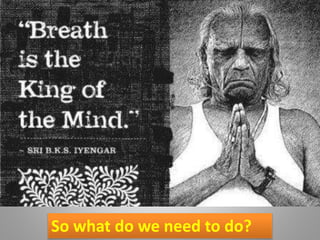
So what do we need to do?
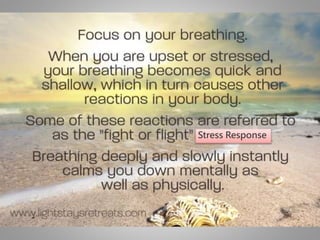
Stress Response
“Chale vaate chalam chittam, nishchale
nischalam bhavet
yogi sthanutvamaapnoti tatto vaayum
nirodhayet” …. 2/2 HYP
when prana moves, chitta (the mental force)
moves. When prana is without movement,
chitta is without movement. By this (steadiness
of prana) the yogi attains steadiness and should
thus restrain the vayu (air).
WHY?
Link Between Prana and Mind
• Prana and mind are intricately linked.
• Fluctuation of one fluctuation of the other.
• When either the mind or prana becomes
balanced the other is steadied.
• Hatha yoga says, control the prana and the mind
is automatically controlled, whereas raja yoga
says, control the mind and prana becomes
controlled. These are two paths of yoga.
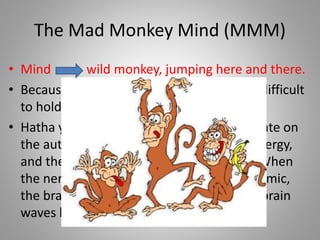
The Mad Monkey Mind (MMM)
• Mind wild monkey, jumping here and there.
• Because of this inborn tendency it is very difficult
to hold it still.
• Hatha yoga says let the mind be, concentrate on
the autonomic body functions and vital energy,
and the mind will become quiet by itself. When
the nervous impulses are steady and rhythmic,
the brain functions are regulated and the brain
waves become rhythmic.
Disintegration to integration
• Disintegration is the cause of stress.
• ‘Kshipta’ Chitta Bhumi – Sage Patanjali
Yogic (unifying) practices- to induce
integration- Move to ‘Ekagra’ State
• Breath – bridge between body and mind.
• If manas is on breath, it can be trained to go
inward along with the breath.
• ‘Yato Manah Tatto Pranah’
• The idea is to develop the consciousness over our
breath pattern
• To make the ‘choice’ on how to breathe. (longer
exhalation or a slow, deep inhalation, rhythmicity)
• To develop the prefrontal cortex by exercising our
ability to act, based on our will, backed by the
wisdom.
• To culture ourselves through breath training, to
overpower our instinctual nature by a more
mindful behavior.
Taking a Conscious control of
ourselves is the key to tranquility
Yoga is stilling the whirlpools of the sub-conscious mind
Yoga or the highest state of union with the cosmos, the end goal of all
human life, can be realized only when this agitated mind stuff becomes still
and silent.
-Patanjali Yoga Sutra C.1 V.2
References
• http://www.yogamag.net/archives/1997/ajan97/pranbran.shtml
• https://med.stanford.edu/news/all-news/2017/03/study-discovers-how-
slow-breathing-induces-tranquility.html
• http://www.npr.org/sections/health-shots/2017/03/30/522033368/a-tiny-
spot-in-mouse-brains-may-explain-how-breathing-calms-the-mind
• https://www.psychologytoday.com/blog/the-neuroscience-
mindfulness/201602/the-science-slow-deep-breathing
• https://www.youtube.com/watch?v=_BFDgTci0ck
• Article: Yoga Breathing, Meditation and Longevity – Richard P. Brown and
Patricia L. Gerbarg, 2009
• Yoga and modern man – Yogacharya Dr. Ananda Balayogi Bhavnani, Satya
Press Tamil Nadu, 2002
• Anatomy of Hatha Yoga – H. David Coulter - Himalayan International
Institute of Yoga Science and Philosophy of the USA, 1981
• Hatha Yoga Pradipika – Swami Muktibodhananda, Yoga Publications Trust,
Munger, Bihar, India, 2012
• Four Chapters on Freedom: Commentary on Yoga Sutras of Patanjali,
Satyananda Saraswati, Yoga Publications Trust, Munger, Bihar, India
Breathing and tranquility

Breathing and tranquility

  • 1.
  • 2.
    Breathing & Tranquility Effectsof Yogic Breathing practices on inducing a calming effect on the brain
  • 3.
    • HR primarilymodified by PNS through vagus nerve. • Body constantly trying to maintain equilibrium. Respiratory Sinus Arrhythmia
  • 4.
    Blood drawn infrom heart into vasculature of lungs Relative deficit of blood in rest of body Heart compensates to Push more blood to heart HR by PNS: “Brake” Drive Inhalation Exhalation: Vice Versa This increase in HR in inhalation & decrease in HR in exhalation = Respiratory Sinus Arrhythmia = Healthy Heart
  • 5.
    Contain slow adoptingstretch receptors (SARs) Lungs Activated during lung expansion (Inhalation) Inhibitory signal to Brainstem SNS drive suppressed Room for relaxing effects of PNS PNS effects enhanced during exhalation: Return of Blood from lungs to heart
  • 6.
    • Slowing RR,Body gets more time to emphasize these self-regulatory mechanisms • Emphasizing exhalation, amount of PNS outflow • In totality, slow, deep breathing relative in PNS “break” activity • PNS activity associated with happiness, resilience in face of stress etc. Thus,
  • 7.
    Research on Mice •Stanford scientists have identified a small group of neurons that communicates goings-on in the brain’s respiratory control center to the structure responsible for generating arousal throughout the brain. ** Kevin Yackle, MD, PhD, the lead author, former Stanford graduate student, now a faculty fellow at the University of California-San Francisco. Mark Krasnow, MD, PhD, professor of biochemistry, the senior author.
  • 8.
    The diagram depictsthe pathway (in green) that directly connects the brain's breathing (Respiratory) center to the Arousal center and the rest of the brain. Courtesy of the Krasnow lab
  • 9.
  • 10.
    Arousal Centre • Aphysiological and psychological state of being awoken or of sense organs stimulated to a point of perception. • It involves activation of the reticular activating system in the brainstem, the autonomic nervous system, and the endocrine system, leading to increased heart rate and blood pressure and a condition of sensory alertness, mobility, and readiness to respond. • The arousal system involves five major neural systems based on brain's neurotransmitters: acetylcholine, norepinephrine, dopamine, histamine, and serotonin. When these systems are in action, the receiving neural areas become sensitive and responsive to incoming signals, producing alertness and cortical activity. • Arousal is important in regulating consciousness, attention, alertness, and information processing. It is a crucial for motivating certain behaviours, such as mobility, the pursuit of nutrition, the fight-or-flight response and sexual activity, and in emotion
  • 11.
  • 13.
    • A regulatedbreathing process can have tranquilizing effects due to its direct connections to the brain and CNS. • It has some connection with the hypothalamus & the brain center which controls emotional responses. • Hypothalamus is responsible for transforming perception into cognitive experience. Erratic breathing sends erratic impulses to this center and thus creates disturbed responses.
  • 14.
    Greatest stress asper Yoga philosophy Fluctuations of Mind • Moving towards wants or away from dislikes • Running to future worries or mired in past mistakes. Mind in a constant motion: Shifting between future obligations or past frustrations
  • 15.
  • 16.
    So what dowe need to do?
  • 18.
  • 19.
    “Chale vaate chalamchittam, nishchale nischalam bhavet yogi sthanutvamaapnoti tatto vaayum nirodhayet” …. 2/2 HYP when prana moves, chitta (the mental force) moves. When prana is without movement, chitta is without movement. By this (steadiness of prana) the yogi attains steadiness and should thus restrain the vayu (air). WHY?
  • 20.
    Link Between Pranaand Mind • Prana and mind are intricately linked. • Fluctuation of one fluctuation of the other. • When either the mind or prana becomes balanced the other is steadied. • Hatha yoga says, control the prana and the mind is automatically controlled, whereas raja yoga says, control the mind and prana becomes controlled. These are two paths of yoga.
  • 21.
    The Mad MonkeyMind (MMM) • Mind wild monkey, jumping here and there. • Because of this inborn tendency it is very difficult to hold it still. • Hatha yoga says let the mind be, concentrate on the autonomic body functions and vital energy, and the mind will become quiet by itself. When the nervous impulses are steady and rhythmic, the brain functions are regulated and the brain waves become rhythmic.
  • 22.
    Disintegration to integration •Disintegration is the cause of stress. • ‘Kshipta’ Chitta Bhumi – Sage Patanjali Yogic (unifying) practices- to induce integration- Move to ‘Ekagra’ State • Breath – bridge between body and mind. • If manas is on breath, it can be trained to go inward along with the breath. • ‘Yato Manah Tatto Pranah’
  • 23.
    • The ideais to develop the consciousness over our breath pattern • To make the ‘choice’ on how to breathe. (longer exhalation or a slow, deep inhalation, rhythmicity) • To develop the prefrontal cortex by exercising our ability to act, based on our will, backed by the wisdom. • To culture ourselves through breath training, to overpower our instinctual nature by a more mindful behavior. Taking a Conscious control of ourselves is the key to tranquility
  • 24.
    Yoga is stillingthe whirlpools of the sub-conscious mind Yoga or the highest state of union with the cosmos, the end goal of all human life, can be realized only when this agitated mind stuff becomes still and silent. -Patanjali Yoga Sutra C.1 V.2
  • 26.
    References • http://www.yogamag.net/archives/1997/ajan97/pranbran.shtml • https://med.stanford.edu/news/all-news/2017/03/study-discovers-how- slow-breathing-induces-tranquility.html •http://www.npr.org/sections/health-shots/2017/03/30/522033368/a-tiny- spot-in-mouse-brains-may-explain-how-breathing-calms-the-mind • https://www.psychologytoday.com/blog/the-neuroscience- mindfulness/201602/the-science-slow-deep-breathing • https://www.youtube.com/watch?v=_BFDgTci0ck • Article: Yoga Breathing, Meditation and Longevity – Richard P. Brown and Patricia L. Gerbarg, 2009 • Yoga and modern man – Yogacharya Dr. Ananda Balayogi Bhavnani, Satya Press Tamil Nadu, 2002 • Anatomy of Hatha Yoga – H. David Coulter - Himalayan International Institute of Yoga Science and Philosophy of the USA, 1981 • Hatha Yoga Pradipika – Swami Muktibodhananda, Yoga Publications Trust, Munger, Bihar, India, 2012 • Four Chapters on Freedom: Commentary on Yoga Sutras of Patanjali, Satyananda Saraswati, Yoga Publications Trust, Munger, Bihar, India

Editor's Notes

  • #8 Cluster of neurons linking respiration to relaxation, excitement, attention, anxiety located deep in brain stem – ‘breathing pacemaker’ Heart pacemaker – only 1 dimensional slow – fast continuum. RC – different types of breaths – regular, excited, laughing, sighing, yawning, gasping, sleeping, sobbing. Researchers wondered if different sub types of neurons within RC might be responsible for these different types of breaths. With advanced technologies, they could selectively destroy any one of these neuronal subtypes — and only that subtype — based on its unique signature of active genes. Then they could observe how this particular subtype’s loss affected the animals’ breathing. The key is a smattering of about 175 neurons in a part of the brain the researchers call the breathing pacemaker, which is a cluster of nearly 3,000 neurons that sit in the brainstem and control autonomic breathing. Through their research is in mice, the researchers found that those 175 neurons are the communication highway between the breathing pacemaker and the part of the brain responsible for attention, arousal and panic. So breathing rate could directly affect feeling calm or anxious, and vice versa. If that mouse pathway works the same way in humans, it would explain why we get so chilled out after slowing down our breathing. To figure this out, researchers first divvied up the 3,000 neurons in the breathing pacemaker by their genetics, as neurons with similar genes might have similar roles in the brain. That's how they zeroed in on that 175. The next challenge was to uncover their function. Sometimes the best way to see what something does is to see what happens when it's gone, so the researchers inactivated those neurons. To do so, they first genetically engineered mice to have receptors to a toxin only on the neurons of interest. That let them kill off only those neurons by injecting the mice with the toxin, which is made by bacteria called diphtheria.
  • #13 This is the start. To this presentation, to this topic, to today, to everyday, to the stresses of life, to life as a whole and to beyond. Every moment we step ahead, we it is towards a solution we are trying to find. There are problems. And there are solutions. Inner peace it is. Once you know what you’ce to achieve, you’ll understand the way, identify and discriminate the wrong ways, work towards the acceptable one.
  • #19 this is not something we or the world doesnt know of. What new am I telling you today ? : 1 … basics of the brain connection with this concept 2. yogic connection with this concept….. But more importantly, what I want u to know is… that this concept of slow breathing tranquilizes the mind, is just EVERYWHERE. In some form of the other, with sounds or counts or visuals etc .. Across religions or sects. Modern med or ancient yoga. The universality of this technique is worth taking notice of.
  • #20 my 30 slide presentation today is an initial step to understand myself in simple lay man language what maharishi has explained in these 2 simple lines … and share my learning with you all today.