A GENERAL APPROACH
TO TEACHING ANY
YOGA PRACTICE
Yogacharya Dr. ANANDA BALAYOGI BHAVANANI
MBBS, ADY, PGDFH, PGDY, MD (Alt Med), FIAY, C-IAYT, DSc (Yoga)
Director & Professor Yoga Therapy:
Centre for Yoga Education, Therapy and Research (CYTER),
Sri Balaji Vidyapeeth, Pondicherry. www.sbvu.ac.in/cyter
• Start with the name of the practice.
• Describe the meaning and associated
cultural and Yogic aspects of the
practice.
• E.g. Vashistasana would lead to a
description of the great Sapta Rishi and
his Tapasya etc
• Explain what type of practice it is. E.g.
• Asana (pose-posture-poise)
• Pranayama (breath, mind, prana)
• Mudra (energy, mindfulness).
• What is its place in Yogic scheme of
practices
• Bahiranga/Antaranga; Hatha/Raja;
Bhakti/Karma etc.
• What is the classification and sub
classification?
• Activating, energizing, relaxing.....
• Cultural, meditative or recuperative
posture …….
• Cooling, heating, cleaning, balancing
Pranayama ……
• Hastha, Pada, Kaya Mudra…
• How to do the actual practice?
• Give a step-by-step explanation and
demonstration with emphasis on
• breath patterns and mental focus to
be adopted in the postures,
• timings to be followed, and
• breathing cycles in Pranayama etc.
• Be clear about what should not be done
when attempting the practice.
• Step-by-step correction of students’
practice with demonstration of
common mistakes is essential.
• Preferably through verbal cues.
• Hands-on corrections should be done
ONLY AFTER obtaining CONSENT.
• Describe the benefits of the practice
• Use both modern scientific updates as
well as the scriptural references to
substantiate your statements.
• Hypothetical postulates may be
expressed, but…
• Don’t make outlandish claims.
• If you don’t know something, be honest.
• Safety aspects must be explained in as
much detail as possible.
• Give clear statements regarding the
contraindications to the practice.
• Try to use both the scientific as well as
scriptural references to substantiate
your statements.
• Remember, Ahimsa is the first Yama…
• Describe the salient features of the
practice with appropriate scientific and
scriptural references.
• Give specific instructions about the
complementary practices with
adequate references where necessary.
• Yoga is all about balance and harmony.
• Give detailed instructions about the
relaxation to be done after the practice
• Emphasize the importance of the
period of relaxation that maximizes the
benefits of the practice.
• Shavasana may be the most important
part of a class at times.
• Be yourself, be at ease as this enables
the students to be so too.
• Gently stretch their limits, but make
sure you don’t push them to their
breaking point.
• Do your best and leave the rest!
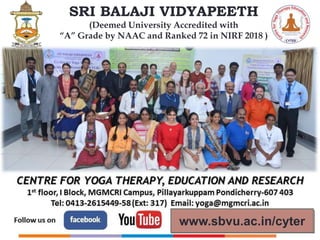
SRI BALAJI VIDYAPEETH
(Deemed University Accredited with
“A” Grade by NAAC and Ranked 72 in NIRF 2018 )
www.sbvu.ac.in/cyter