
TCM
PRESENTATION
NAME – ANUP DUBEY
ROLL NO - 37
BATCH – 2011 (MBBS)
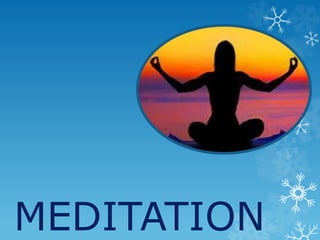
MEDITATION
WHAT IS MEDITATION?
Mind is often a helpless victim of various types
of turbulence like anger, grief, sensuality,
revenge and remorse and this condition is
prone to harm one’s own self or others.
With mediation one learns the art of single-
pointed concentration, which elevates the level
of efficiency in any assignment and opens the
right avenue for success.
Contd…
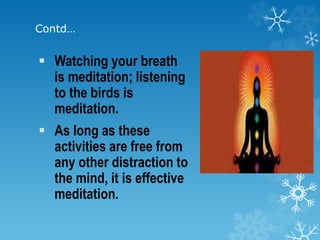
 Watching your breath
is meditation; listening
to the birds is
meditation.
 As long as these
activities are free from
any other distraction to
the mind, it is effective
meditation.
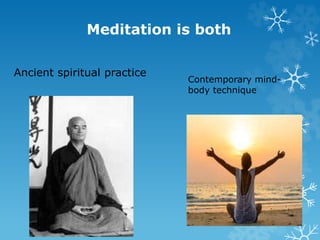
Meditation is both
Ancient spiritual practice
Contemporary mind-
body technique
HISTORY
Some of the earliest references to meditation are
found in the Hindu Vedas. History of meditation is
intimately bound up with the religious context within
which it was practiced.
Secular forms of meditation were introduced in India
in the 1950s as a Westernized form of Hindu
meditative techniques and arrived in the United
States and Europe in the 1960s. Rather than focusing
on spiritual growth, secular meditation emphasizes
stress reduction, relaxation and self-improvement.
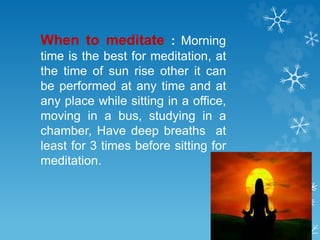
When to meditate : Morning
time is the best for meditation, at
the time of sun rise other it can
be performed at any time and at
any place while sitting in a office,
moving in a bus, studying in a
chamber, Have deep breaths at
least for 3 times before sitting for
meditation.
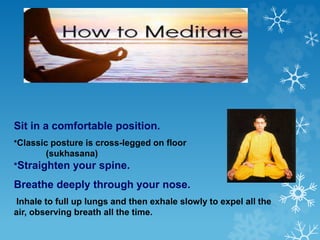
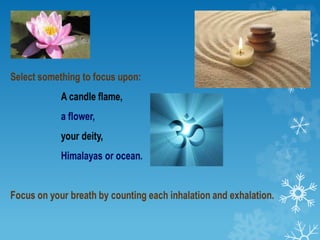
Sit in a comfortable position.
*Classic posture is cross-legged on floor
(sukhasana)
*Straighten your spine.
Breathe deeply through your nose.
Inhale to full up lungs and then exhale slowly to expel all the
air, observing breath all the time.
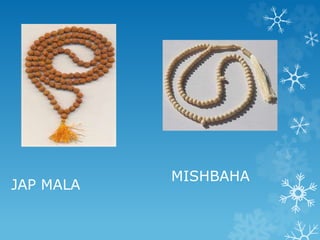
Most of the ancient religions of the world have a tradition of
using some type of prayer beads as tools in devotional
meditation.Most prayer beads consist of pearls or beads
linked together by a thread.The Roman Catholic rosary is a
string of beads containing five sets with ten small beads.
Each set of ten is separated by another bead. The Hindu japa
mala has 108 beads (the figure 108 in itself having spiritual
significance, as well as those used in Jainism and Buddhist
prayer beads.Each bead is counted once as a person recites a
mantra until the person has gone all the way around the
mala.The Muslim mishbaha has 99 beads. Specific
meditations of each religion may be different.
PRAYER BEADS
JAP MALA
MISHBAHA
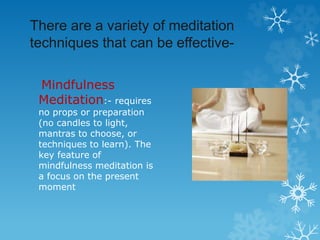
There are a variety of meditation
techniques that can be effective-
Mindfulness
Meditation:- requires
no props or preparation
(no candles to light,
mantras to choose, or
techniques to learn). The
key feature of
mindfulness meditation is
a focus on the present
moment
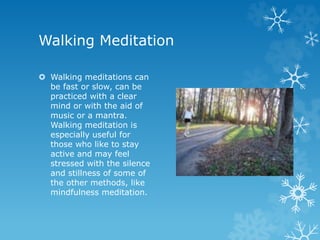
Walking Meditation
 Walking meditations can
be fast or slow, can be
practiced with a clear
mind or with the aid of
music or a mantra.
Walking meditation is
especially useful for
those who like to stay
active and may feel
stressed with the silence
and stillness of some of
the other methods, like
mindfulness meditation.
Mantra Meditation
 It combines some of
the benefits of
positive affirmations
with the benefits of
meditation with the
repetition of a single
word or sound
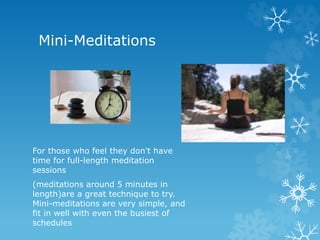
Mini-Meditations
For those who feel they don't have
time for full-length meditation
sessions
(meditations around 5 minutes in
length)are a great technique to try.
Mini-meditations are very simple, and
fit in well with even the busiest of
schedules
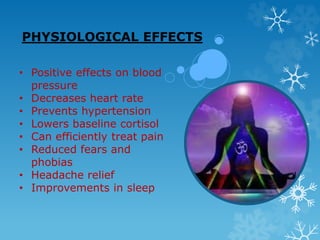
PHYSIOLOGICAL EFFECTS
• Positive effects on blood
pressure
• Decreases heart rate
• Prevents hypertension
• Lowers baseline cortisol
• Can efficiently treat pain
• Reduced fears and
phobias
• Headache relief
• Improvements in sleep
Other studies have shown that
meditation:
• Can decrease stress
• Can decrease anxiety and depression
• Can produce a general state of positive
mental health
• Shows potential for stress
management
• Relates to an internal focus of control,
greater self-actualization.
Research
* Migraine headache sufferer experience a 32%
reduction in frequency or severity of migraine.
* Psoriasis lesions heal 4 times faster with
ultraviolet photo therapy along with meditation.
* Chronic pain relaxation techniques are very
effective in lessening the suffering.
* Cancer treatment : Meditation alleviates the
suffering of chronic pain and allows people
undergoing chemo to better manage pain and side
effects.
THANK YOU

meditation in india

  • 1.
    TCM PRESENTATION NAME – ANUPDUBEY ROLL NO - 37 BATCH – 2011 (MBBS)
  • 2.
  • 3.
    WHAT IS MEDITATION? Mindis often a helpless victim of various types of turbulence like anger, grief, sensuality, revenge and remorse and this condition is prone to harm one’s own self or others. With mediation one learns the art of single- pointed concentration, which elevates the level of efficiency in any assignment and opens the right avenue for success.
  • 4.
    Contd…  Watching yourbreath is meditation; listening to the birds is meditation.  As long as these activities are free from any other distraction to the mind, it is effective meditation.
  • 5.
    Meditation is both Ancientspiritual practice Contemporary mind- body technique
  • 6.
    HISTORY Some of theearliest references to meditation are found in the Hindu Vedas. History of meditation is intimately bound up with the religious context within which it was practiced. Secular forms of meditation were introduced in India in the 1950s as a Westernized form of Hindu meditative techniques and arrived in the United States and Europe in the 1960s. Rather than focusing on spiritual growth, secular meditation emphasizes stress reduction, relaxation and self-improvement.
  • 7.
    When to meditate: Morning time is the best for meditation, at the time of sun rise other it can be performed at any time and at any place while sitting in a office, moving in a bus, studying in a chamber, Have deep breaths at least for 3 times before sitting for meditation.
  • 8.
    Sit in acomfortable position. *Classic posture is cross-legged on floor (sukhasana) *Straighten your spine. Breathe deeply through your nose. Inhale to full up lungs and then exhale slowly to expel all the air, observing breath all the time.
  • 10.
    Most of theancient religions of the world have a tradition of using some type of prayer beads as tools in devotional meditation.Most prayer beads consist of pearls or beads linked together by a thread.The Roman Catholic rosary is a string of beads containing five sets with ten small beads. Each set of ten is separated by another bead. The Hindu japa mala has 108 beads (the figure 108 in itself having spiritual significance, as well as those used in Jainism and Buddhist prayer beads.Each bead is counted once as a person recites a mantra until the person has gone all the way around the mala.The Muslim mishbaha has 99 beads. Specific meditations of each religion may be different. PRAYER BEADS
  • 11.
  • 12.
    There are avariety of meditation techniques that can be effective- Mindfulness Meditation:- requires no props or preparation (no candles to light, mantras to choose, or techniques to learn). The key feature of mindfulness meditation is a focus on the present moment
  • 13.
    Walking Meditation  Walkingmeditations can be fast or slow, can be practiced with a clear mind or with the aid of music or a mantra. Walking meditation is especially useful for those who like to stay active and may feel stressed with the silence and stillness of some of the other methods, like mindfulness meditation.
  • 14.
    Mantra Meditation  Itcombines some of the benefits of positive affirmations with the benefits of meditation with the repetition of a single word or sound
  • 15.
    Mini-Meditations For those whofeel they don't have time for full-length meditation sessions (meditations around 5 minutes in length)are a great technique to try. Mini-meditations are very simple, and fit in well with even the busiest of schedules
  • 16.
    PHYSIOLOGICAL EFFECTS • Positiveeffects on blood pressure • Decreases heart rate • Prevents hypertension • Lowers baseline cortisol • Can efficiently treat pain • Reduced fears and phobias • Headache relief • Improvements in sleep
  • 17.
    Other studies haveshown that meditation: • Can decrease stress • Can decrease anxiety and depression • Can produce a general state of positive mental health • Shows potential for stress management • Relates to an internal focus of control, greater self-actualization.
  • 18.
    Research * Migraine headachesufferer experience a 32% reduction in frequency or severity of migraine. * Psoriasis lesions heal 4 times faster with ultraviolet photo therapy along with meditation. * Chronic pain relaxation techniques are very effective in lessening the suffering. * Cancer treatment : Meditation alleviates the suffering of chronic pain and allows people undergoing chemo to better manage pain and side effects.
  • 19.