Presented by
Elixir Group
 JanetAlfred Oriunuebho
 MilitaAdeyemo
 Elizabeth Kukua Apprey
 Ibrahim Umar
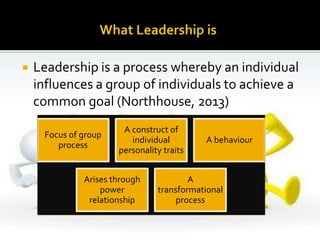
 Leadership is a process whereby an individual
influences a group of individuals to achieve a
common goal (Northhouse, 2013)
Focus of group
process
A construct of
individual
personality traits
A behaviour
Arises through
power
relationship
A
transformational
process
 Increases performance
 Increases productivity
 Increases profitability
 Followers are the leader’s partner in shaping
the goals and purposes of a group or
organization
 Followers are the leader’s partner in shaping
the goals and purposes of a group or
organization;
 Research demonstrates that teams
consistently outperform individuals.
 Teams provide complementary roles
 If you were an animal which animal will you
be???
 4 broad categories of team members
 Belbin’s Team roles
Leadership and Followership: WhatTango
Teaches Us
 http://www.youtube.com/watch?v=Cswrnc1d
ggg
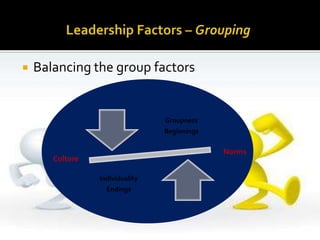
 Balancing the group factors
Groupness
Beginnings
Individuality
Endings
Norms
Culture
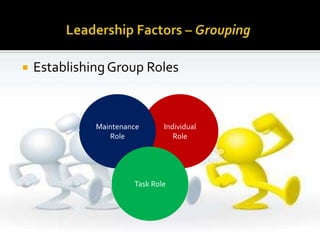
Individual
Role
 EstablishingGroup Roles
Maintenance
Role
Task Role
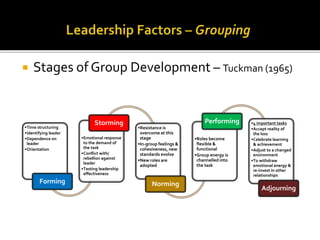
 Stages of Group Development – Tuckman (1965)
•Time structuring
•Identifying leader
•Dependence on
leader
•Orientation
Forming
•Emotional response
to the demand of
the task
•Conflict with/
rebellion against
leader
•Testing leadership
effectiveness
Storming
•Resistance is
overcome at this
stage
•In-group feelings &
cohesiveness, new
standards evolve
•New roles are
adopted
Norming
•Roles become
flexible &
functional
•Group energy is
channelled into
the task
Performing •4 important tasks
•Accept reality of
the loss
•Celebrate learning
& achievement
•Adjust to a changed
environment
•To withdraw
emotional energy &
re-invest in other
relationships
Adjourning
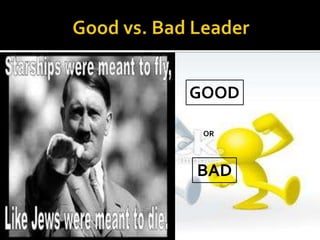
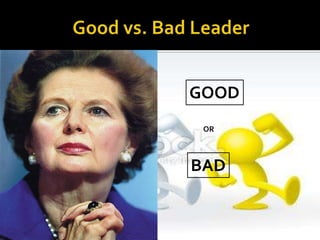
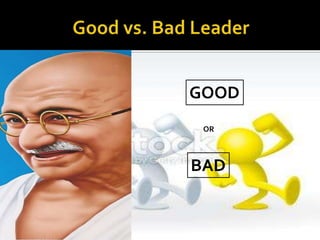
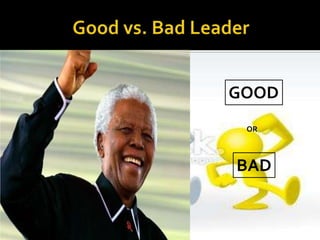
 Leadership is a particular type of human
relationship
 Leadership is about the nature of the
leader/follower relationship.
 Successful leaders have the ability to bring
about change for better or worse
 Power and/or influence
 Vision
 Obligation
 Responsibility
 Commitment
GOOD
BAD
OR
OR
GOOD
BAD
OR
GOOD
BAD
OR
GOOD
BAD
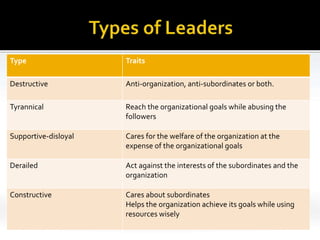
Type Traits
Destructive Anti-organization, anti-subordinates or both.
Tyrannical Reach the organizational goals while abusing the
followers
Supportive-disloyal Cares for the welfare of the organization at the
expense of the organizational goals
Derailed Act against the interests of the subordinates and the
organization
Constructive Cares about subordinates
Helps the organization achieve its goals while using
resources wisely
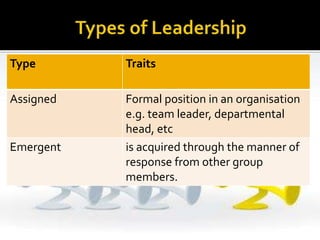
Type Traits
Assigned Formal position in an organisation
e.g. team leader, departmental
head, etc
Emergent is acquired through the manner of
response from other group
members.
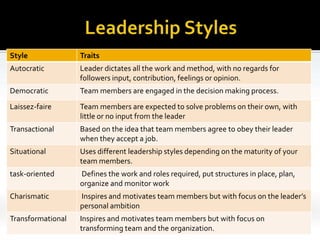
Style Traits
Autocratic Leader dictates all the work and method, with no regards for
followers input, contribution, feelings or opinion.
Democratic Team members are engaged in the decision making process.
Laissez-faire Team members are expected to solve problems on their own, with
little or no input from the leader
Transactional Based on the idea that team members agree to obey their leader
when they accept a job.
Situational Uses different leadership styles depending on the maturity of your
team members.
task-oriented Defines the work and roles required, put structures in place, plan,
organize and monitor work
Charismatic Inspires and motivates team members but with focus on the leader’s
personal ambition
Transformational Inspires and motivates team members but with focus on
transforming team and the organization.
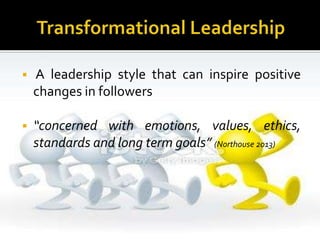
 A leadership style that can inspire positive
changes in followers
 “concerned with emotions, values, ethics,
standards and long term goals” (Northouse 2013)
 Intellectual stimulation
 Individualised consideration
 Inspirational motivation
 Idealised influence
ItayTalgam: Lead like the great conductors
 http://www.youtube.com/watch?v=R9g3Q-
qvtss
 Abuses power
 Hoards privileges
 mismanages information
 Acts inconsistently
 Misplace or betray loyalties
 Fails to assume responsibilities
 Good leaders are ethical & effective leaders
(Ciulla, 1995)
 Leaders usually bring about change or are
successful at doing something but the
 Ethical questions to ask will be –
 What are the leader’s intentions?
 How did the leader go about bringing change?
 Was the change itself good?
 Promotion of honesty
 Own actions mirroring their values and beliefs:
espoused values are the same as values in
action (Yukl, 2006).
 Not just following the law and obeying
regulations
 Doing the ‘right’ thing and influencing others to
do the right thing.
 Managing conflict and taking responsibility
 Managing change effectively
 Change usually comes with some amount of
loss no matter how positive
 A change in project scope, management or
tactics
 How does a leader manage members who are
stuck in the old days and are adamant /slow to
adapt
 Belbin’s 9 team member behaviour
 An awareness of the various members in a
team.Traits and characteristics that make them
different such as;
 Religion
 Age
 Disability
 Religion and belief
 Sexual Orientation
 (UK EqualityAct 2012 for example)
 A team is a group of two or more people, who
work together to achieve a common goal
 VirtualTeams: separated by time, distance or
organizational structure
 Functional teams: production, service,
management, project, advisory
 Self-managing teams – great deal of
autonomy and control, may not have a
formal leader (poss. an overseer) – Orpheus
Chamber Orchestra – no conductor
 Performance and Maintenance:
 The first is the ‘quality of decision-making, the
ability to implement decisions, the outcomes of
teamwork in terms of problems solved and work
completed, and finally the quality of institutional
leadership provided by the team.’
 The second is the ‘cohesiveness of the team and
the ability of group members to satisfy their own
needs while working effectively with other team
members.’ (both Nadler, 1998, p.24, in Northouse 2013)
TEDxToronto - Drew Dudley
"Leading with Lollipops"
 http://www.youtube.com/watch?v=hVCBrkrF
rBE
 BASS, B. M., 1990. Bass & Stogdill’s handbook of leadership: a
survey of theory & research. NewYork: Free Press
 BEEREL, A. 2013. Leadership and Change Management.
London:SAGE
 BENNIS,W. G. & NANUS, B., 1985. Leaders:The strategies for
taking charge. NewYork: Harper & Row.
 FRENCH, J. R. & RAVEN, B., 1962.The bases of social power.
In D. Cartwright (ed.), Studies in social power (pp. 259 – 269).
Ann Arbor, MI: Institute for Social Research.
 KOTTER, J. P., 1990. A Force for Change: How Leadership
Differs from Management. NewYork : Free Press
 NORTHOUSE, P. G. (2001). LeadershipTheory and Practice,
4th edition. California: SAGE Publications, Inc.
 NORTHOUSE, P. G., 2013. LeadershipTheory and Practice
(6th ed). London: SAGE.
 http://www.systemicleadershipinstitute.org/

Ethical and effective leadership

  • 1.
  • 2.
     JanetAlfred Oriunuebho MilitaAdeyemo  Elizabeth Kukua Apprey  Ibrahim Umar
  • 3.
     Leadership isa process whereby an individual influences a group of individuals to achieve a common goal (Northhouse, 2013) Focus of group process A construct of individual personality traits A behaviour Arises through power relationship A transformational process
  • 4.
     Increases performance Increases productivity  Increases profitability
  • 5.
     Followers arethe leader’s partner in shaping the goals and purposes of a group or organization
  • 6.
     Followers arethe leader’s partner in shaping the goals and purposes of a group or organization;  Research demonstrates that teams consistently outperform individuals.  Teams provide complementary roles  If you were an animal which animal will you be???  4 broad categories of team members  Belbin’s Team roles
  • 7.
    Leadership and Followership:WhatTango Teaches Us  http://www.youtube.com/watch?v=Cswrnc1d ggg
  • 8.
     Balancing thegroup factors Groupness Beginnings Individuality Endings Norms Culture
  • 9.
  • 10.
     Stages ofGroup Development – Tuckman (1965) •Time structuring •Identifying leader •Dependence on leader •Orientation Forming •Emotional response to the demand of the task •Conflict with/ rebellion against leader •Testing leadership effectiveness Storming •Resistance is overcome at this stage •In-group feelings & cohesiveness, new standards evolve •New roles are adopted Norming •Roles become flexible & functional •Group energy is channelled into the task Performing •4 important tasks •Accept reality of the loss •Celebrate learning & achievement •Adjust to a changed environment •To withdraw emotional energy & re-invest in other relationships Adjourning
  • 11.
     Leadership isa particular type of human relationship  Leadership is about the nature of the leader/follower relationship.  Successful leaders have the ability to bring about change for better or worse
  • 12.
     Power and/orinfluence  Vision  Obligation  Responsibility  Commitment
  • 13.
  • 14.
  • 15.
  • 16.
  • 17.
    Type Traits Destructive Anti-organization,anti-subordinates or both. Tyrannical Reach the organizational goals while abusing the followers Supportive-disloyal Cares for the welfare of the organization at the expense of the organizational goals Derailed Act against the interests of the subordinates and the organization Constructive Cares about subordinates Helps the organization achieve its goals while using resources wisely
  • 18.
    Type Traits Assigned Formalposition in an organisation e.g. team leader, departmental head, etc Emergent is acquired through the manner of response from other group members.
  • 19.
    Style Traits Autocratic Leaderdictates all the work and method, with no regards for followers input, contribution, feelings or opinion. Democratic Team members are engaged in the decision making process. Laissez-faire Team members are expected to solve problems on their own, with little or no input from the leader Transactional Based on the idea that team members agree to obey their leader when they accept a job. Situational Uses different leadership styles depending on the maturity of your team members. task-oriented Defines the work and roles required, put structures in place, plan, organize and monitor work Charismatic Inspires and motivates team members but with focus on the leader’s personal ambition Transformational Inspires and motivates team members but with focus on transforming team and the organization.
  • 20.
     A leadershipstyle that can inspire positive changes in followers  “concerned with emotions, values, ethics, standards and long term goals” (Northouse 2013)
  • 21.
     Intellectual stimulation Individualised consideration  Inspirational motivation  Idealised influence
  • 22.
    ItayTalgam: Lead likethe great conductors  http://www.youtube.com/watch?v=R9g3Q- qvtss
  • 23.
     Abuses power Hoards privileges  mismanages information  Acts inconsistently  Misplace or betray loyalties  Fails to assume responsibilities
  • 24.
     Good leadersare ethical & effective leaders (Ciulla, 1995)  Leaders usually bring about change or are successful at doing something but the  Ethical questions to ask will be –  What are the leader’s intentions?  How did the leader go about bringing change?  Was the change itself good?
  • 25.
     Promotion ofhonesty  Own actions mirroring their values and beliefs: espoused values are the same as values in action (Yukl, 2006).  Not just following the law and obeying regulations  Doing the ‘right’ thing and influencing others to do the right thing.  Managing conflict and taking responsibility  Managing change effectively
  • 26.
     Change usuallycomes with some amount of loss no matter how positive  A change in project scope, management or tactics  How does a leader manage members who are stuck in the old days and are adamant /slow to adapt
  • 27.
     Belbin’s 9team member behaviour  An awareness of the various members in a team.Traits and characteristics that make them different such as;  Religion  Age  Disability  Religion and belief  Sexual Orientation  (UK EqualityAct 2012 for example)
  • 28.
     A teamis a group of two or more people, who work together to achieve a common goal
  • 29.
     VirtualTeams: separatedby time, distance or organizational structure  Functional teams: production, service, management, project, advisory  Self-managing teams – great deal of autonomy and control, may not have a formal leader (poss. an overseer) – Orpheus Chamber Orchestra – no conductor
  • 30.
     Performance andMaintenance:  The first is the ‘quality of decision-making, the ability to implement decisions, the outcomes of teamwork in terms of problems solved and work completed, and finally the quality of institutional leadership provided by the team.’  The second is the ‘cohesiveness of the team and the ability of group members to satisfy their own needs while working effectively with other team members.’ (both Nadler, 1998, p.24, in Northouse 2013)
  • 31.
    TEDxToronto - DrewDudley "Leading with Lollipops"  http://www.youtube.com/watch?v=hVCBrkrF rBE
  • 32.
     BASS, B.M., 1990. Bass & Stogdill’s handbook of leadership: a survey of theory & research. NewYork: Free Press  BEEREL, A. 2013. Leadership and Change Management. London:SAGE  BENNIS,W. G. & NANUS, B., 1985. Leaders:The strategies for taking charge. NewYork: Harper & Row.  FRENCH, J. R. & RAVEN, B., 1962.The bases of social power. In D. Cartwright (ed.), Studies in social power (pp. 259 – 269). Ann Arbor, MI: Institute for Social Research.  KOTTER, J. P., 1990. A Force for Change: How Leadership Differs from Management. NewYork : Free Press  NORTHOUSE, P. G. (2001). LeadershipTheory and Practice, 4th edition. California: SAGE Publications, Inc.  NORTHOUSE, P. G., 2013. LeadershipTheory and Practice (6th ed). London: SAGE.  http://www.systemicleadershipinstitute.org/