BREAKING BAD
NEWS
DR MOHAMMMED LUKMAN ABOLAJI,
DEPARTMENT OF FAMILY MEDICINE ,
AMINU KANO TEACHING HOSPITAL KANO.
1
OUTLINE
 INTRODUCTION
 DEFINATION OF BAD NEWS/EXAMPLES
 APPROACH TO BREAKING BAD NEWS
 SPIKES PROTOCOL
 KEY POINTS/ CONCLUSION
 PRACTICAL DEMOSTRATION OF BREAKING BAD
NEWS
2
INTRODUCTION
 Breaking bad news to patients has been a subject of
professional concern for many years, interest growing
alongside a culture of increasing medical disclosure of
diagnosis and prognosis [Buckman,1992].
 The life of a sick person can be shortened not only by the act,
but also by the words or the manner of a physician. It is,
therefore, a sacred duty to guard himself carefully in this
respect, and to avoid all things which have tendency to
discourage the patient and to depress the spirit [American
medical association].
3
INTRODUCTION
 Breaking bad news demands a great deal of professionalism, patience, and
energy. It requires the twofold complex process of finding
 Appropriate kind words and understandable terminology.
 The secondary task of assessing how the patient and family are reacting.
 The degree of distress that the conversation is inducing.
 The subsequent tailoring of information as the FP responds to the assessment
process.
4
5
An expert in breaking bad news is not someone who gets it right
every time – he or she is merely someone who gets it wrong less
often.
- R Buckman
What is bad news?
 Any news that seriously and adversely changes the
patient’s views of his/her future. Buckman,1992.
 Situations where there is either a feeling of no hope,
 a threat to persons mental or physical wellbeing,
 risk of upsetting an established life style,
 or where a message is given which conveys to an
individual fewer choices in his or her life.
Bor et al.,1993
 Any information that is not welcome. Arber and gallagher,
2003.
6
Examples of bad news
These include:
 Cancer diagnosis
 Intra uterine foetal death
 Life long illnesses e.g. Diabetes, hypertension, HIV, infective hepatitis,
 Poor prognosis related to chronic diseases e.g. heart failure, stroke
 Informing parents about their child’s serious mental/physical handicap
 Disease recurrence
 Spread of disease
 Failure of treatment to affect disease progression
 The presence of irreversible side effects
 Results of genetic tests
 Death
7
8
WHY SHOULD IT BE DONE ?
 Improve the patient’s and family’s ability to plan and cope,
 Encourage realistic goals and autonomy,
 Support the patient emotionally,
 Strengthen the doctor-patient relationship,
 Foster collaboration among the patient, family, doctors and
other professionals.
 Reduces stress in doctors
 Facilitates open discussion among patient, relatives and
doctors
 Empowers patient by allowing them a greater say in
treatment
9
WHAT MAKES IT DIFFICULT?
The physician’s perspective:
 Uncertainty about the patient's condition & expectations
 Fear of destroying the patient's hope
 Fear of their inadequacy in the face of uncontrollable disease.
 Fear of patient’s anticipated emotional reactions.
 Embarrassment at having previously painted too optimistic a
picture for the patient
 Cultural constraints and language barriers
 Lack of training in breaking bad news
10
WHAT MAKES IT DIFFICULT? Cont’
The patient’s perspective:
 Patient often have vivid memories of receiving bad news
 Negative experiences can have lasting effects on anxiety and
depression
 Fears of social stigma and impact of disability and illness
11
12
OTHER MODELS FOR BREAKING BAD
NEWS
SAAIQ Approach
S ET the scene as soon as
possible
A SSESS the understanding of
the attendant
A LERT them that I have bad
news
I NFORM in clear,
understandable words
Q UICKLY repeat summary of
the situation
COMFORT MODEL
C ommunication
O rientation
M indfulness
F amily
O ngoing
R eiterative
T eam
SAD NEWS Approach
S et up & Sit down
A sk , don’t tell
D eliver the news
N o fancy lingo
E xpect, permit & respond to
emotion
W ait
S upport & Summarise
CONES
C ontext
O pening shot
N arrative
E motion
S trategy and summary
FOUR Cs
C ompassion
C ompetence
C onfession
C harting
13
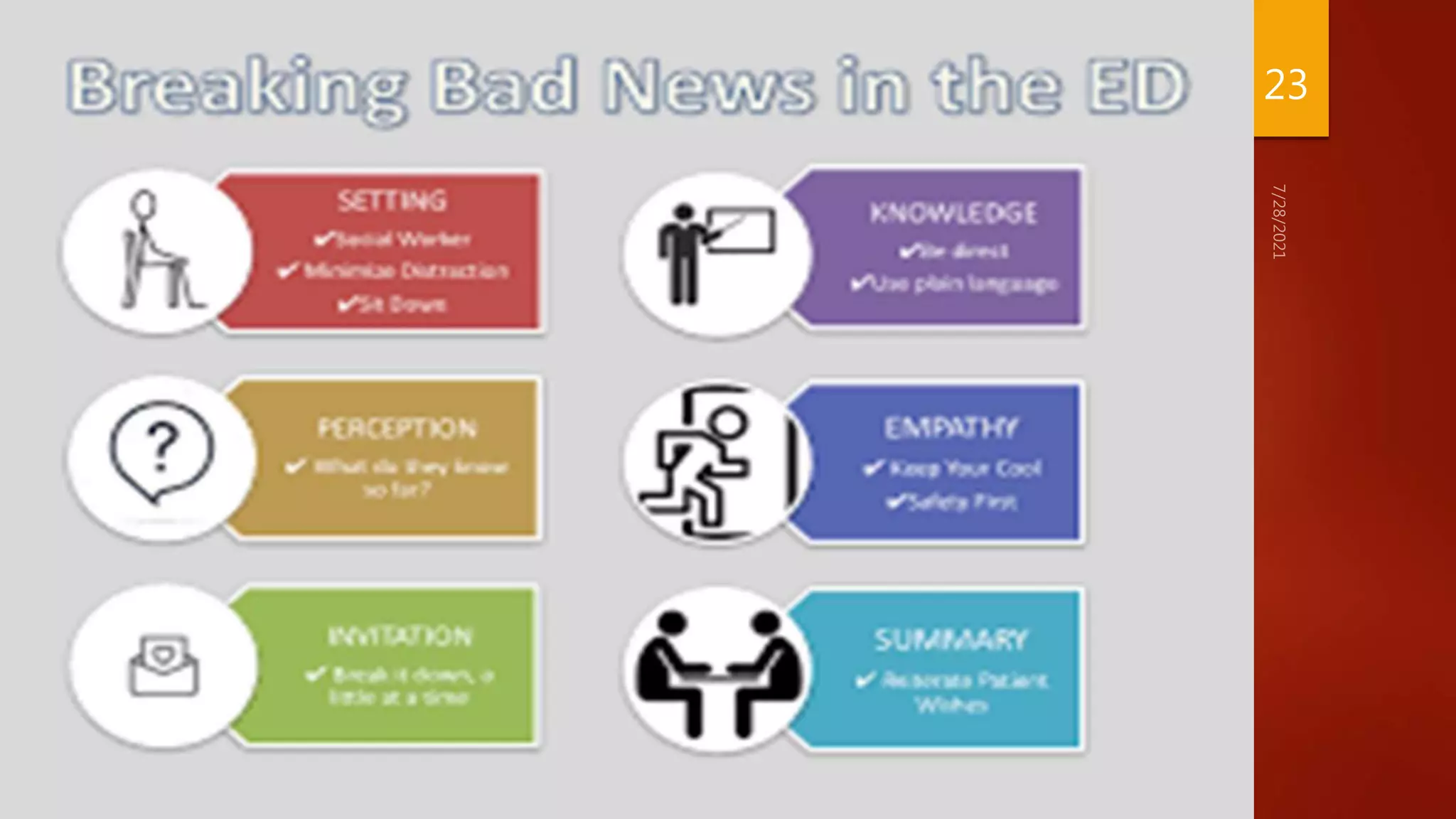
SPIKES Six-Step Protocol
 SPIKES Six-step protocol
 Setting 1. Set the stage.
 Perception 2. What does the patient know?
 Invitation 3. How much does the patient
w want to know?
 Knowledge 4. Share the information.
 Emotion 5. Respond to feelings.
 Subsequent 6. Plan next steps and follow-up
14
SETTING: Set the stage
 Plan what you will say
 Confirm medical facts
 Don’t delegate
 Create a conducive environment
 physician’s office, quiet room in a hospital setting, the patient’s
home or a private hospital room)
 Draw curtains, close the door, sit down (and not behind a big desk)
 Allot adequate time
 Prevent interruptions
 Introduce self & greet
 Determine who else the patient would like present
15
PERCEPTION: What Does the Patient
Know?
 Ask patient what they know, feel, fear, etc
 Establish what the patient knows
 Assess ability to comprehend new bad news
 Reschedule if unprepared
16
INVITATION: How Much Does the
Patient Want to Know ?
 Ask patient if she/he wishes to know the details of
the condition and/or treatment
 Accept patient’s right not to know
 Offer to answer questions later if she/he wishes
 Elicit and address the patient’s concerns
 Recognize, support various patient preferences
Decline voluntarily to receive information
Designate someone to communicate on his or her behalf
17
KNOWLEDGE: Sharing the Information
 Give a warning shot
“unfortunately, I have got some bad news to tell
you”
(may lessen the shock that can follow the disclosure of
bad news)
 Say it, then stop
 Avoid monologue; promote dialogue
 Use plain language
 Pause frequently
 Check for understanding
 Don’t minimize severity
 Avoid vagueness, confusion
18
EMPATHY/EMOTION: Responding to
Feelings
 Be prepared for Outburst of strong emotion
Broad range of reactions (fear, anger, sadness, denial, guilt)
 Give time to react
 Listen quietly, attentively
 Encourage descriptions of feelings
 Use nonverbal communication
 Empathize with the patient
“Hearing the result of the test is clearly a major shock to
you”
“Obviously, this piece of news is very upsetting”
“Clearly, this is very distressing”
19
Responding to Feelings, cont.
If patient cries
 allow some time to cry
 Offer tissue if it is available
 Could touch the patient if appropriate
 After a few moments you should continue talking
even if patient continues to cry
20
If Patient refuses to accept the
diagnosis?
 Explore reasons for Patient denial
 Get family members involved
 Do not be combative
 Check if the Patient has a clear understanding
 Appreciate that there is an information gap and try
to educate the Patient
21
SUBSEQUENT: Planning, Follow-up
 Plan for next steps
Additional information, tests, treat symptoms, referrals as needed
 Discuss potential sources of support (emotional and spiritual needs and
other support systems)
 Multidisciplinary involvement (social work, palliative care, religious bodies
when appropriate) to provide further support to the patient
 Acknowledge & answer questions
 Summarize plan (Use “teach back” technique)
 Give contact information (phone number or email)
 Set next appointment
 Before leaving, assess patient safety and home supports
 Repeat news at future visits
22
23
DO’S AND DON’T’S
DO’S
 Ensure privacy and confidentiality
 Respect
 Honest
 Simple language
 Listen
 Sensitive to the nonverbal language
 Allow for silence, tears and other
patient reactions
 Document and liaise with the
multidisciplinary team
DON’T’S
 Overload with information
 Distort the truth
 Give false reassurance
 Feel obliged to keep talking all the
time
 Withhold information
 Assume that you know what is of
most concern to the patient
 Criticize
 Make judgments
24
When Language is a Barrier
Use a skilled translator
Familiar with medical terminology
Comfortable translating bad news
Avoid family as primary translators
Speak directly to the patient
25
CONCLUSION
 Breaking bad news is an important clinical skill that can be frequently
utilized in the context of routine practice.
 Following an established protocol while integrating empathetic
communication makes the difficult task of breaking bad news more
comfortable for the FP and helps improve the communication between the
patient and family.
 These skills can be learned in continuing education programs or easily
integrated into FP curriculum
26
REFFRENCES
 Dr Zainab Abdulazeez’S Breaking bad news hospital presentation
 Dr Fawziya Shehu Malami’s Breaking bad news departmental presentation
 Baile, W., Buckman, R., Lenzi, E., Glober, G., Beale, E., & Kudelka, A. SPIKES – a six-step
protocol for delivering bad news: Application to the Patient with Cancer. Oncologist
2000; 5(4):302-311.
 Scoles PV, Hawkins RE, LaDuca A. Assessment of clinical skills in medical practice. J
Contin Educ Health Prof. 2003;23(3):182–190. [PubMed] [Google Scholar]
 Aled J. Putting practice into teaching: an exploratory study of nursing undergraduates’
interpersonal skills and the effects of using empirical data as a teaching and learning
resource. J Clin Nurs. 2007;16(12):2297–2307. [PubMed] [Google Scholar]
 Charlton CR, Dearing KS, Berry JA, Johnson MJ. Nurse practitioners’ communication
styles and their impact on patient outcomes: an integrated literature review. J Am Acad
Nurse Pract. 2008;20(7):382–388. [PubMed] [Google Scholar]
27
THANK YOU FOR YOUR
ATTENTION
28

Breaking bad news

  • 1.
    BREAKING BAD NEWS DR MOHAMMMEDLUKMAN ABOLAJI, DEPARTMENT OF FAMILY MEDICINE , AMINU KANO TEACHING HOSPITAL KANO. 1
  • 2.
    OUTLINE  INTRODUCTION  DEFINATIONOF BAD NEWS/EXAMPLES  APPROACH TO BREAKING BAD NEWS  SPIKES PROTOCOL  KEY POINTS/ CONCLUSION  PRACTICAL DEMOSTRATION OF BREAKING BAD NEWS 2
  • 3.
    INTRODUCTION  Breaking badnews to patients has been a subject of professional concern for many years, interest growing alongside a culture of increasing medical disclosure of diagnosis and prognosis [Buckman,1992].  The life of a sick person can be shortened not only by the act, but also by the words or the manner of a physician. It is, therefore, a sacred duty to guard himself carefully in this respect, and to avoid all things which have tendency to discourage the patient and to depress the spirit [American medical association]. 3
  • 4.
    INTRODUCTION  Breaking badnews demands a great deal of professionalism, patience, and energy. It requires the twofold complex process of finding  Appropriate kind words and understandable terminology.  The secondary task of assessing how the patient and family are reacting.  The degree of distress that the conversation is inducing.  The subsequent tailoring of information as the FP responds to the assessment process. 4
  • 5.
    5 An expert inbreaking bad news is not someone who gets it right every time – he or she is merely someone who gets it wrong less often. - R Buckman
  • 6.
    What is badnews?  Any news that seriously and adversely changes the patient’s views of his/her future. Buckman,1992.  Situations where there is either a feeling of no hope,  a threat to persons mental or physical wellbeing,  risk of upsetting an established life style,  or where a message is given which conveys to an individual fewer choices in his or her life. Bor et al.,1993  Any information that is not welcome. Arber and gallagher, 2003. 6
  • 7.
    Examples of badnews These include:  Cancer diagnosis  Intra uterine foetal death  Life long illnesses e.g. Diabetes, hypertension, HIV, infective hepatitis,  Poor prognosis related to chronic diseases e.g. heart failure, stroke  Informing parents about their child’s serious mental/physical handicap  Disease recurrence  Spread of disease  Failure of treatment to affect disease progression  The presence of irreversible side effects  Results of genetic tests  Death 7
  • 8.
  • 9.
    WHY SHOULD ITBE DONE ?  Improve the patient’s and family’s ability to plan and cope,  Encourage realistic goals and autonomy,  Support the patient emotionally,  Strengthen the doctor-patient relationship,  Foster collaboration among the patient, family, doctors and other professionals.  Reduces stress in doctors  Facilitates open discussion among patient, relatives and doctors  Empowers patient by allowing them a greater say in treatment 9
  • 10.
    WHAT MAKES ITDIFFICULT? The physician’s perspective:  Uncertainty about the patient's condition & expectations  Fear of destroying the patient's hope  Fear of their inadequacy in the face of uncontrollable disease.  Fear of patient’s anticipated emotional reactions.  Embarrassment at having previously painted too optimistic a picture for the patient  Cultural constraints and language barriers  Lack of training in breaking bad news 10
  • 11.
    WHAT MAKES ITDIFFICULT? Cont’ The patient’s perspective:  Patient often have vivid memories of receiving bad news  Negative experiences can have lasting effects on anxiety and depression  Fears of social stigma and impact of disability and illness 11
  • 12.
  • 13.
    OTHER MODELS FORBREAKING BAD NEWS SAAIQ Approach S ET the scene as soon as possible A SSESS the understanding of the attendant A LERT them that I have bad news I NFORM in clear, understandable words Q UICKLY repeat summary of the situation COMFORT MODEL C ommunication O rientation M indfulness F amily O ngoing R eiterative T eam SAD NEWS Approach S et up & Sit down A sk , don’t tell D eliver the news N o fancy lingo E xpect, permit & respond to emotion W ait S upport & Summarise CONES C ontext O pening shot N arrative E motion S trategy and summary FOUR Cs C ompassion C ompetence C onfession C harting 13
  • 14.
    SPIKES Six-Step Protocol SPIKES Six-step protocol  Setting 1. Set the stage.  Perception 2. What does the patient know?  Invitation 3. How much does the patient w want to know?  Knowledge 4. Share the information.  Emotion 5. Respond to feelings.  Subsequent 6. Plan next steps and follow-up 14
  • 15.
    SETTING: Set thestage  Plan what you will say  Confirm medical facts  Don’t delegate  Create a conducive environment  physician’s office, quiet room in a hospital setting, the patient’s home or a private hospital room)  Draw curtains, close the door, sit down (and not behind a big desk)  Allot adequate time  Prevent interruptions  Introduce self & greet  Determine who else the patient would like present 15
  • 16.
    PERCEPTION: What Doesthe Patient Know?  Ask patient what they know, feel, fear, etc  Establish what the patient knows  Assess ability to comprehend new bad news  Reschedule if unprepared 16
  • 17.
    INVITATION: How MuchDoes the Patient Want to Know ?  Ask patient if she/he wishes to know the details of the condition and/or treatment  Accept patient’s right not to know  Offer to answer questions later if she/he wishes  Elicit and address the patient’s concerns  Recognize, support various patient preferences Decline voluntarily to receive information Designate someone to communicate on his or her behalf 17
  • 18.
    KNOWLEDGE: Sharing theInformation  Give a warning shot “unfortunately, I have got some bad news to tell you” (may lessen the shock that can follow the disclosure of bad news)  Say it, then stop  Avoid monologue; promote dialogue  Use plain language  Pause frequently  Check for understanding  Don’t minimize severity  Avoid vagueness, confusion 18
  • 19.
    EMPATHY/EMOTION: Responding to Feelings Be prepared for Outburst of strong emotion Broad range of reactions (fear, anger, sadness, denial, guilt)  Give time to react  Listen quietly, attentively  Encourage descriptions of feelings  Use nonverbal communication  Empathize with the patient “Hearing the result of the test is clearly a major shock to you” “Obviously, this piece of news is very upsetting” “Clearly, this is very distressing” 19
  • 20.
    Responding to Feelings,cont. If patient cries  allow some time to cry  Offer tissue if it is available  Could touch the patient if appropriate  After a few moments you should continue talking even if patient continues to cry 20
  • 21.
    If Patient refusesto accept the diagnosis?  Explore reasons for Patient denial  Get family members involved  Do not be combative  Check if the Patient has a clear understanding  Appreciate that there is an information gap and try to educate the Patient 21
  • 22.
    SUBSEQUENT: Planning, Follow-up Plan for next steps Additional information, tests, treat symptoms, referrals as needed  Discuss potential sources of support (emotional and spiritual needs and other support systems)  Multidisciplinary involvement (social work, palliative care, religious bodies when appropriate) to provide further support to the patient  Acknowledge & answer questions  Summarize plan (Use “teach back” technique)  Give contact information (phone number or email)  Set next appointment  Before leaving, assess patient safety and home supports  Repeat news at future visits 22
  • 23.
  • 24.
    DO’S AND DON’T’S DO’S Ensure privacy and confidentiality  Respect  Honest  Simple language  Listen  Sensitive to the nonverbal language  Allow for silence, tears and other patient reactions  Document and liaise with the multidisciplinary team DON’T’S  Overload with information  Distort the truth  Give false reassurance  Feel obliged to keep talking all the time  Withhold information  Assume that you know what is of most concern to the patient  Criticize  Make judgments 24
  • 25.
    When Language isa Barrier Use a skilled translator Familiar with medical terminology Comfortable translating bad news Avoid family as primary translators Speak directly to the patient 25
  • 26.
    CONCLUSION  Breaking badnews is an important clinical skill that can be frequently utilized in the context of routine practice.  Following an established protocol while integrating empathetic communication makes the difficult task of breaking bad news more comfortable for the FP and helps improve the communication between the patient and family.  These skills can be learned in continuing education programs or easily integrated into FP curriculum 26
  • 27.
    REFFRENCES  Dr ZainabAbdulazeez’S Breaking bad news hospital presentation  Dr Fawziya Shehu Malami’s Breaking bad news departmental presentation  Baile, W., Buckman, R., Lenzi, E., Glober, G., Beale, E., & Kudelka, A. SPIKES – a six-step protocol for delivering bad news: Application to the Patient with Cancer. Oncologist 2000; 5(4):302-311.  Scoles PV, Hawkins RE, LaDuca A. Assessment of clinical skills in medical practice. J Contin Educ Health Prof. 2003;23(3):182–190. [PubMed] [Google Scholar]  Aled J. Putting practice into teaching: an exploratory study of nursing undergraduates’ interpersonal skills and the effects of using empirical data as a teaching and learning resource. J Clin Nurs. 2007;16(12):2297–2307. [PubMed] [Google Scholar]  Charlton CR, Dearing KS, Berry JA, Johnson MJ. Nurse practitioners’ communication styles and their impact on patient outcomes: an integrated literature review. J Am Acad Nurse Pract. 2008;20(7):382–388. [PubMed] [Google Scholar] 27
  • 28.
    THANK YOU FORYOUR ATTENTION 28