Precision Induction Brazing
What is Brazing?
Brazing is a process for joining two metals with a filler material that melts,
flows and wets the metals’ surfaces at a temperature that is lower than
the melting temperature of the two metals. Protection from oxidation of
the metal surface and filler material during the joining process is achieved
using a covering gas or a flux material. Brazing and silver soldering are
terms that usually refer to the joining process where the filler materials
have a melt temperature above 400°C (752°F) to create a stronger joint.
Why Brazing?
The brazing process does not melt the base metals being joined yet
produces strong robust joints. Brazing offers distinct advantages over
other joining techniques:
• Similar and dissimilar metals can be brazed
• Brazing uses lower temperatures, resulting in less part distortion
and joint stress
• Dimensional integrity of the finished product is easier to control
• Brazing produces strong, low stress joints
Why Ambrell?
Induction heating is an ideal method for brazing. Ambrell has more than
10,000 systems installed in over 50 countries, and many of them are
brazing application installations. It’s our most common application that is
used daily, worldwide, in many different industries.
We also offer an exceptional customer experience before and after the
sale. Your specific brazing application will be analyzed and tested in the
nearest Ambrell Applications Lab. There is no charge, and you will
receive a system recommendation designed to deliver the best possible
solution for your brazing requirements. Ambrell delivers the expertise,
innovation and system quality to give your company a competitive edge.
Brazing is Ideal for Many
Applications in Manufacturing.
Replacing Torch and Furnace
Brazing with Induction Brazing
• Torch brazing is the most common form of brazing
today, but requires a skilled operator. However
many manufacturers are finding it harder to recruit
experienced brazing operators and the open
flame raises regulatory and safety concerns for
manufacturing plants.
• Furnace brazing is another widely used technique.
Manufacturing companies today are looking to
improve production efficiency, reduce manufacturing
costs and replace energy and space inefficient
furnaces while improving product quality.
• Induction addresses the issues of torch and
furnace brazing by removing the requirement
for a skilled operator, by reducing energy costs
and by decreasing the equipment footprint while
implementing a lean manufacturing process for
higher quality parts.
Induction Brazing Offers Numerous Benefits
•	Throughput: induction generates heat only in the portion of the part needed
•	Better efficiency
•	Better quality with less part distortion
•	Repeatability: after the coil and heating process are defined, you can count on a precise,
consistent quality braze every time
•	Easy integration: into a lean manufacturing process
•	Safety: no open flame or hot furnace
•	Small footprint: frees up valuable factory floor space
Induction brazing a brass mixing nozzle onto a twin feed
copper tube for an oxyacetylene torch nozzle assembly.
6 kW at 380 kHz for 36 seconds to 732°C (1350°F).
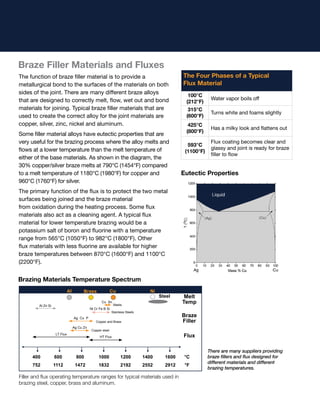
The Four Phases of a Typical
Flux Material
100°C
(212°F)
Water vapor boils off
315°C
(600°F)
Turns white and foams slightly
425°C
(800°F)
Has a milky look and flattens out
593°C
(1100°F)
Flux coating becomes clear and
glassy and joint is ready for braze
filler to flow
Eutectic Properties
There are many suppliers providing
braze fillers and flux designed for
different materials and different
brazing temperatures.
Brazing Materials Temperature Spectrum
Al Brass Cu
Steel
Ni
Al Zn Si
Cu Sn
Steels
Nl Cr Fe B Si
Stainless Steels
Ag Cu P
Copper and Brass
Ag Cu Zn
Copper steel
LT Flux
HT Flux Flux
Braze
Filler
Melt
Temp
400	 600	 800	 1000	 1200	 1400	 1600	°C
752	 1112	 1472	 1832	 2192	 2552	 2912	°F
Filler and flux operating temperature ranges for typical materials used in
brazing steel, copper, brass and aluminum.
The function of braze filler material is to provide a
metallurgical bond to the surfaces of the materials on both
sides of the joint. There are many different braze alloys
that are designed to correctly melt, flow, wet out and bond
materials for joining. Typical braze filler materials that are
used to create the correct alloy for the joint materials are
copper, silver, zinc, nickel and aluminum.
Some filler material alloys have eutectic properties that are
very useful for the brazing process where the alloy melts and
flows at a lower temperature than the melt temperature of
either of the base materials. As shown in the diagram, the
30% copper/silver braze melts at 790°C (1454°F) compared
to a melt temperature of 1180°C (1980°F) for copper and
960°C (1760°F) for silver.
The primary function of the flux is to protect the two metal
surfaces being joined and the braze material
from oxidation during the heating process. Some flux
materials also act as a cleaning agent. A typical flux
material for lower temperature brazing would be a
potassium salt of boron and fluorine with a temperature
range from 565°C (1050°F) to 982°C (1800°F). Other
flux materials with less fluorine are available for higher
braze temperatures between 870°C (1600°F) and 1100°C
(2200°F).
Braze Filler Materials and Fluxes
The Induction Brazing Process
Steel to steel brazing of part of a regulator used in the oil
industry. 200 kHz at 8 kW for 9 seconds to 732°C (1350°F).
Induction brazing is used in the joining of many different
metals for multiple applications. Typical joints are steel-to-
steel, steel-to-brass, steel-to-copper, copper-to-copper,
aluminum-to-aluminum and copper-to-aluminum.
The Six Steps to a Quality Induction
Brazed Joint:
1. Design the joint correctly allowing for a 40µm (0.0015”)
to 125µm (0.005”) clearance between the two surfaces
at the braze material flow temperature – to allow for
capillary action and joint wetting
2. Clean the surfaces of the joint materials
3. Apply flux to both pieces
4. Fixture the two pieces together with a braze ring or
pre-form and position in the coil
5. Heat the two pieces until both pieces achieve the
braze material flow temperature and stick feed the
braze material if pre-forms are not being used. (Our
application lab will make sure the coil is designed to
correctly heat your parts.)
6. Clean the brazed joint and remove all of the flux residue
Brazing steel tube fittings used on trucks. 300 kHz
at 3 kW for 45 seconds to 732°C (1350°F).
Tensile Strength with Joint Clearance
160000
140000
120000
100000
80000
60000
40000
20000
0
TensileStrengthpsi
Joint clearance 0.001”
0 	 1 	 1.5 	 2 	 2.5 	 3 	 3.5 	 4 	 4.5 	 5 	 5.5
Tensile Strength
Joint Clearance µm
0	 25	38	51	64	76	89	102	114	127	140
TensileStrengthMpa
The optimum braze joint strength occurs with a part joint clearance
between 25µm (0.001”) and 125µm (0.005”). Data from Lucas Milhaupt.
1103
965
827
689
552
414
276
138
A Smarter Brazing Solution
Whether you’re concerned with throughput, part quality or manufacturing
efficiency, induction heating is the ideal brazing method for your process
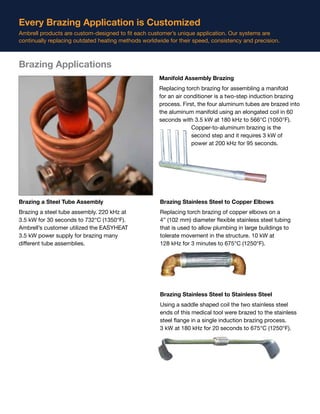
Brazing Stainless Steel to Copper Elbows
Replacing torch brazing of copper elbows on a
4” (102 mm) diameter flexible stainless steel tubing
that is used to allow plumbing in large buildings to
tolerate movement in the structure. 10 kW at
128 kHz for 3 minutes to 675°C (1250°F).
Brazing Stainless Steel to Stainless Steel
Using a saddle shaped coil the two stainless steel
ends of this medical tool were brazed to the stainless
steel flange in a single induction brazing process.
3 kW at 180 kHz for 20 seconds to 675°C (1250°F).
Manifold Assembly Brazing
Replacing torch brazing for assembling a manifold
for an air conditioner is a two-step induction brazing
process. First, the four aluminum tubes are brazed into
the aluminum manifold using an elongated coil in 60
seconds with 3.5 kW at 180 kHz to 566°C (1050°F).
Copper-to-aluminum brazing is the
second step and it requires 3 kW of
power at 200 kHz for 95 seconds.
Brazing Applications
Brazing a Steel Tube Assembly
Brazing a steel tube assembly. 220 kHz at
3.5 kW for 30 seconds to 732°C (1350°F).
Ambrell’s customer utilized the EASYHEAT
3.5 kW power supply for brazing many
different tube assemblies.
Every Brazing Application is Customized
Ambrell products are custom-designed to fit each customer’s unique application. Our systems are
continually replacing outdated heating methods worldwide for their speed, consistency and precision.
Aluminum Brazing Applications
Aluminum requires a lot of energy to heat using
induction and its thermal conductivity is 60%
compared to copper. Coil design and time for the
heat to flow is critical in a successful induction brazing
process for aluminum parts. Recent advances in lower
temperature aluminum braze materials has allowed
induction to effectively replace flame and furnace
heating in high volume brazing of aluminum assemblies.
The low melt temperature of aluminum requires that
the induction brazing process apply the energy to the
part correctly to raise both part surfaces to the braze
flow temperature at the same time without overheating
and melting the edges of the part. Get the experience
you need for aluminum brazing applications with
Ambrell.
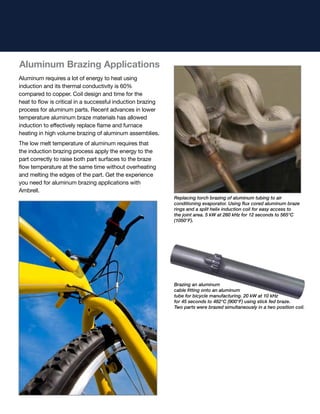
Replacing torch brazing of aluminum tubing to air
conditioning evaporator. Using flux cored aluminum braze
rings and a split helix induction coil for easy access to
the joint area. 5 kW at 260 kHz for 12 seconds to 565°C
(1050°F).
Brazing an aluminum
cable fitting onto an aluminum
tube for bicycle manufacturing. 20 kW at 10 kHz
for 45 seconds to 482°C (900°F) using stick fed braze.
Two parts were brazed simultaneously in a two position coil.
Steel Brazing Applications
Material
Thermal
Conductivity
k Cal/cm s ºC
Electrical
Resistivity
ρ ohm m x10ˆ– 8
Typical
Melting Temp
ºC ºF
Aluminum 0.60 2.65 660 1220
Brass 0.26 7.1 930 1710
Copper 0.95 1.7 1084 1983
Carbon
Steel
0.11 74 1480 2700
Stainless
Steel
0.05 74 1510 2750
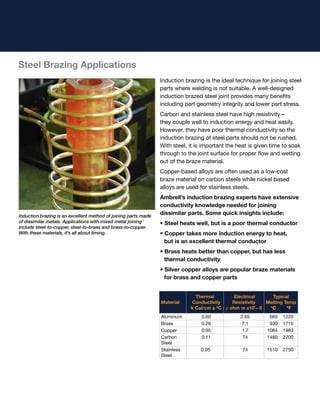
Induction brazing is an excellent method of joining parts made
of dissimilar metals. Applications with mixed metal joining
include steel-to-copper, steel-to-brass and brass-to-copper.
With these materials, it’s all about timing.
Induction brazing is the ideal technique for joining steel
parts where welding is not suitable. A well-designed
induction brazed steel joint provides many benefits
including part geometry integrity and lower part stress.
Carbon and stainless steel have high resistivity –
they couple well to induction energy and heat easily.
However, they have poor thermal conductivity so the
induction brazing of steel parts should not be rushed.
With steel, it is important the heat is given time to soak
through to the joint surface for proper flow and wetting
out of the braze material.
Copper-based alloys are often used as a low-cost
braze material on carbon steels while nickel based
alloys are used for stainless steels.
Ambrell’s induction brazing experts have extensive
conductivity knowledge needed for joining
dissimilar parts. Some quick insights include:
• Steel heats well, but is a poor thermal conductor
• Copper takes more induction energy to heat,
but is an excellent thermal conductor
• Brass heats better than copper, but has less
thermal conductivity
• Silver copper alloys are popular braze materials
for brass and copper parts
Induction brazing is an excellent method of joining
parts made of dissimilar metals. Applications with
mixed metal joining include steel-to-copper, steel-to-
brass and brass-to-copper. With these materials, it’s
all about timing. For a successful brazed joint between
different metals it is critical that both metal surfaces
reach the braze flow temperature at the same time
as the joint. The induction heating solution must take
into account the different thermal conductivities of the
materials, and the time each material takes to get to
temperature.
Steel, Copper and Brass Brazing
Sensor assembly using a 3/8” diameter stainless
steel tube brazed to the ½” diameter stainless
steel sensor body. 3.5 kW at 300 kHz for 20
seconds to 732°C (1350°).
Replacing torch brazing on a copper elbow to copper pipe
using a split helix coil. 7 kW at 190 kHz for 90 seconds to
760°C (1400°F).
Replacing torch brazing for two brass joints on a faucet
manifold. Each joint was induction brazed using a saddle
coil. 22 kW at 90 kHz for 30 seconds to 620°C (1150°F).
Replacing torch brazing with a multi-position helical coil to
induction braze two or three nickel plated steel ferrules to
nickel plated pins from an automobile light bulb. 8 kW at 360
kHz for 6 seconds to 620°C (1150°F).
Only with Ambrell will you get the experience
you need for precision brazing applications.
With our EASYHEAT™ and EKOHEAT®
we offer a
wide power and frequency range with our induction
heating systems. Whether you’re brazing large or
small parts or multiple metal materials, Ambrell can
help you maximize cost efficiencies and productivity.
Ambrell’s systems are versatile with multiple capacitor
and tap transformer configurations. They offer
efficient power conversion that will minimize your
energy costs. Our systems are user-friendly, offer
agile frequency tuning for repeatable heating, and
can be easily integrated into your existing process.
With their small footprint, they free up valuable floor
space in your facility.
Ambrell Induction Heating Systems at a Glance
Systems Include:
•	Ease of integration into production processes with a
small workhead – easily located in the work area
•	Wide frequency ranges allowing brazing of different
assemblies with the same power supply
•	Multiple capacitor and tap transformer configurations
for a more versatile brazing tool
•	Agile frequency tuning for accurate, repeatable heating
•	Efficient power conversion minimizes energy expenses
•	Expert coil designs that maximize power delivery and
save production time
•	User-friendly operator interface in multiple languages
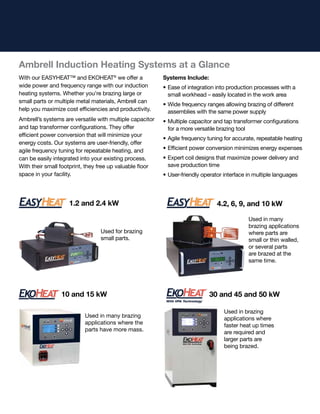
Used for brazing
small parts.
Used in brazing
applications where
faster heat up times
are required and
larger parts are
being brazed.
1.2 and 2.4 kW
30 and 45 and 50 kW
Used in many brazing
applications where the
parts have more mass.
10 and 15 kW
Used in many
brazing applications
where parts are
small or thin walled,
or several parts
are brazed at the
same time.
4.2, 6, 9, and 10 kW
Our Applications Laboratory – known in the industry as
THE LAB – is where we solve our customers’ most
challenging heating applications every day.
Dr. Girish Dahake, Sr. Vice President, Global Applications,
leads a worldwide team of elite engineers who are uniquely
qualified to assist you with your heating process needs.
Under the guidance of Dr. Dahake, our engineers have
evaluated thousands of applications in THE LAB, so it’s likely
we have already assessed an application similar to yours.
Ambrell’s team of engineers is world-renowned for producing
extraordinary results. Our innovative and effective induction
heating solutions consistently deliver performance excellence
in one application after another. It’s why THE LAB is the gold
standard in the industry.
Have our team of expert engineers design and test
the optimal solution for your application, free of
charge. All it takes are three easy steps:
1. Send us your parts and process requirements
2. Our engineers will analyze your process and heat
your parts to develop the right solution for your
specific application
3. You will receive your parts back for inspection
as well as a video of the heating process of your
parts, and a laboratory report with a system
recommendation
We also invite you to visit THE LAB where you can
experience our state-of-art testing facility, which is fully
equipped with Ambrell induction heating systems and
hundreds of proven coils. In addition, you can interface with
our engineers and see first-hand how they design prototype
coils and develop effective solutions to maximize the
efficiency of your heating process.
Free Application Testing
From THE LAB
“Induction heating is a precise,
repeatable and efficient method of
heating. However, in order to maximize
the benefits of induction, it’s critical to
have the correct system and coil design.
Our global team of highly-skilled
engineers look forward to assessing
your application and making the right
recommendation for your process.”
Dr. Girish Dahake,
Sr. Vice President, Global Applications
With a Reputation for Delivering Extraordinary
Results, Our Applications Laboratory is
the Gold Standard in the Industry.
For more information, contact
us today at +1 585 889 9000
or visit thelab.ambrell.com
411-0144-00
Ambrell Corporation
39 Main Street
Scottsville, NY 14546
United States
Tel: +1 585 889 9000
Fax: +1 585 889 4030
sales@ambrell.com
Ambrell B.V.
Holtersweg 1
7556 BS Hengelo
The Netherlands
Tel: +31 (0) 880 150 100
Fax: +31 (0) 546 788 154
sales-eu@ambrell.com
Ambrell, Ltd.
Phoenix Works, Saxon Way
Battledown Industrial Estate
Cheltenham, Gloucestershire
GL52 6RU United Kingdom
Tel: +44 (0)1242 514042
Fax: +44 (0)1242 224146
sales-uk@ambrell.com
Ambrell SARL
Tour Sébastopol
3 quai Kléber
67000 Strasbourg
France
Tel: +33 970 440 335
Fax: +33 367 840 019
sales-eu@ambrell.com
www.ambrell.com
411-0134-10 Rev B ©2016 All information subject to change without notice.
About Ambrell
Founded in 1986, Ambrell is a global leader in the induction heating market renowned for our application
and engineering expertise. Exceptional product quality and outstanding service and support are at the
core of our commitment to provide the best customer experience in the industry.
We are headquartered in the United States with operations in the United Kingdom, France and the
Netherlands. All products are engineered and made at our manufacturing facility in the United States, which
is ISO 9001:2008-certified. Over the last three decades we have expanded our global reach through an
extensive distribution network and today we have more than 10,000 systems installed in over 50 countries.

Brazing with Induction Heating

  • 1.
  • 2.
    What is Brazing? Brazingis a process for joining two metals with a filler material that melts, flows and wets the metals’ surfaces at a temperature that is lower than the melting temperature of the two metals. Protection from oxidation of the metal surface and filler material during the joining process is achieved using a covering gas or a flux material. Brazing and silver soldering are terms that usually refer to the joining process where the filler materials have a melt temperature above 400°C (752°F) to create a stronger joint. Why Brazing? The brazing process does not melt the base metals being joined yet produces strong robust joints. Brazing offers distinct advantages over other joining techniques: • Similar and dissimilar metals can be brazed • Brazing uses lower temperatures, resulting in less part distortion and joint stress • Dimensional integrity of the finished product is easier to control • Brazing produces strong, low stress joints Why Ambrell? Induction heating is an ideal method for brazing. Ambrell has more than 10,000 systems installed in over 50 countries, and many of them are brazing application installations. It’s our most common application that is used daily, worldwide, in many different industries. We also offer an exceptional customer experience before and after the sale. Your specific brazing application will be analyzed and tested in the nearest Ambrell Applications Lab. There is no charge, and you will receive a system recommendation designed to deliver the best possible solution for your brazing requirements. Ambrell delivers the expertise, innovation and system quality to give your company a competitive edge. Brazing is Ideal for Many Applications in Manufacturing.
  • 3.
    Replacing Torch andFurnace Brazing with Induction Brazing • Torch brazing is the most common form of brazing today, but requires a skilled operator. However many manufacturers are finding it harder to recruit experienced brazing operators and the open flame raises regulatory and safety concerns for manufacturing plants. • Furnace brazing is another widely used technique. Manufacturing companies today are looking to improve production efficiency, reduce manufacturing costs and replace energy and space inefficient furnaces while improving product quality. • Induction addresses the issues of torch and furnace brazing by removing the requirement for a skilled operator, by reducing energy costs and by decreasing the equipment footprint while implementing a lean manufacturing process for higher quality parts. Induction Brazing Offers Numerous Benefits • Throughput: induction generates heat only in the portion of the part needed • Better efficiency • Better quality with less part distortion • Repeatability: after the coil and heating process are defined, you can count on a precise, consistent quality braze every time • Easy integration: into a lean manufacturing process • Safety: no open flame or hot furnace • Small footprint: frees up valuable factory floor space Induction brazing a brass mixing nozzle onto a twin feed copper tube for an oxyacetylene torch nozzle assembly. 6 kW at 380 kHz for 36 seconds to 732°C (1350°F).
  • 4.
    The Four Phasesof a Typical Flux Material 100°C (212°F) Water vapor boils off 315°C (600°F) Turns white and foams slightly 425°C (800°F) Has a milky look and flattens out 593°C (1100°F) Flux coating becomes clear and glassy and joint is ready for braze filler to flow Eutectic Properties There are many suppliers providing braze fillers and flux designed for different materials and different brazing temperatures. Brazing Materials Temperature Spectrum Al Brass Cu Steel Ni Al Zn Si Cu Sn Steels Nl Cr Fe B Si Stainless Steels Ag Cu P Copper and Brass Ag Cu Zn Copper steel LT Flux HT Flux Flux Braze Filler Melt Temp 400 600 800 1000 1200 1400 1600 °C 752 1112 1472 1832 2192 2552 2912 °F Filler and flux operating temperature ranges for typical materials used in brazing steel, copper, brass and aluminum. The function of braze filler material is to provide a metallurgical bond to the surfaces of the materials on both sides of the joint. There are many different braze alloys that are designed to correctly melt, flow, wet out and bond materials for joining. Typical braze filler materials that are used to create the correct alloy for the joint materials are copper, silver, zinc, nickel and aluminum. Some filler material alloys have eutectic properties that are very useful for the brazing process where the alloy melts and flows at a lower temperature than the melt temperature of either of the base materials. As shown in the diagram, the 30% copper/silver braze melts at 790°C (1454°F) compared to a melt temperature of 1180°C (1980°F) for copper and 960°C (1760°F) for silver. The primary function of the flux is to protect the two metal surfaces being joined and the braze material from oxidation during the heating process. Some flux materials also act as a cleaning agent. A typical flux material for lower temperature brazing would be a potassium salt of boron and fluorine with a temperature range from 565°C (1050°F) to 982°C (1800°F). Other flux materials with less fluorine are available for higher braze temperatures between 870°C (1600°F) and 1100°C (2200°F). Braze Filler Materials and Fluxes
  • 5.
    The Induction BrazingProcess Steel to steel brazing of part of a regulator used in the oil industry. 200 kHz at 8 kW for 9 seconds to 732°C (1350°F). Induction brazing is used in the joining of many different metals for multiple applications. Typical joints are steel-to- steel, steel-to-brass, steel-to-copper, copper-to-copper, aluminum-to-aluminum and copper-to-aluminum. The Six Steps to a Quality Induction Brazed Joint: 1. Design the joint correctly allowing for a 40µm (0.0015”) to 125µm (0.005”) clearance between the two surfaces at the braze material flow temperature – to allow for capillary action and joint wetting 2. Clean the surfaces of the joint materials 3. Apply flux to both pieces 4. Fixture the two pieces together with a braze ring or pre-form and position in the coil 5. Heat the two pieces until both pieces achieve the braze material flow temperature and stick feed the braze material if pre-forms are not being used. (Our application lab will make sure the coil is designed to correctly heat your parts.) 6. Clean the brazed joint and remove all of the flux residue Brazing steel tube fittings used on trucks. 300 kHz at 3 kW for 45 seconds to 732°C (1350°F). Tensile Strength with Joint Clearance 160000 140000 120000 100000 80000 60000 40000 20000 0 TensileStrengthpsi Joint clearance 0.001” 0 1 1.5 2 2.5 3 3.5 4 4.5 5 5.5 Tensile Strength Joint Clearance µm 0 25 38 51 64 76 89 102 114 127 140 TensileStrengthMpa The optimum braze joint strength occurs with a part joint clearance between 25µm (0.001”) and 125µm (0.005”). Data from Lucas Milhaupt. 1103 965 827 689 552 414 276 138 A Smarter Brazing Solution Whether you’re concerned with throughput, part quality or manufacturing efficiency, induction heating is the ideal brazing method for your process
  • 6.
    Brazing Stainless Steelto Copper Elbows Replacing torch brazing of copper elbows on a 4” (102 mm) diameter flexible stainless steel tubing that is used to allow plumbing in large buildings to tolerate movement in the structure. 10 kW at 128 kHz for 3 minutes to 675°C (1250°F). Brazing Stainless Steel to Stainless Steel Using a saddle shaped coil the two stainless steel ends of this medical tool were brazed to the stainless steel flange in a single induction brazing process. 3 kW at 180 kHz for 20 seconds to 675°C (1250°F). Manifold Assembly Brazing Replacing torch brazing for assembling a manifold for an air conditioner is a two-step induction brazing process. First, the four aluminum tubes are brazed into the aluminum manifold using an elongated coil in 60 seconds with 3.5 kW at 180 kHz to 566°C (1050°F). Copper-to-aluminum brazing is the second step and it requires 3 kW of power at 200 kHz for 95 seconds. Brazing Applications Brazing a Steel Tube Assembly Brazing a steel tube assembly. 220 kHz at 3.5 kW for 30 seconds to 732°C (1350°F). Ambrell’s customer utilized the EASYHEAT 3.5 kW power supply for brazing many different tube assemblies. Every Brazing Application is Customized Ambrell products are custom-designed to fit each customer’s unique application. Our systems are continually replacing outdated heating methods worldwide for their speed, consistency and precision.
  • 7.
    Aluminum Brazing Applications Aluminumrequires a lot of energy to heat using induction and its thermal conductivity is 60% compared to copper. Coil design and time for the heat to flow is critical in a successful induction brazing process for aluminum parts. Recent advances in lower temperature aluminum braze materials has allowed induction to effectively replace flame and furnace heating in high volume brazing of aluminum assemblies. The low melt temperature of aluminum requires that the induction brazing process apply the energy to the part correctly to raise both part surfaces to the braze flow temperature at the same time without overheating and melting the edges of the part. Get the experience you need for aluminum brazing applications with Ambrell. Replacing torch brazing of aluminum tubing to air conditioning evaporator. Using flux cored aluminum braze rings and a split helix induction coil for easy access to the joint area. 5 kW at 260 kHz for 12 seconds to 565°C (1050°F). Brazing an aluminum cable fitting onto an aluminum tube for bicycle manufacturing. 20 kW at 10 kHz for 45 seconds to 482°C (900°F) using stick fed braze. Two parts were brazed simultaneously in a two position coil.
  • 8.
    Steel Brazing Applications Material Thermal Conductivity kCal/cm s ºC Electrical Resistivity ρ ohm m x10ˆ– 8 Typical Melting Temp ºC ºF Aluminum 0.60 2.65 660 1220 Brass 0.26 7.1 930 1710 Copper 0.95 1.7 1084 1983 Carbon Steel 0.11 74 1480 2700 Stainless Steel 0.05 74 1510 2750 Induction brazing is an excellent method of joining parts made of dissimilar metals. Applications with mixed metal joining include steel-to-copper, steel-to-brass and brass-to-copper. With these materials, it’s all about timing. Induction brazing is the ideal technique for joining steel parts where welding is not suitable. A well-designed induction brazed steel joint provides many benefits including part geometry integrity and lower part stress. Carbon and stainless steel have high resistivity – they couple well to induction energy and heat easily. However, they have poor thermal conductivity so the induction brazing of steel parts should not be rushed. With steel, it is important the heat is given time to soak through to the joint surface for proper flow and wetting out of the braze material. Copper-based alloys are often used as a low-cost braze material on carbon steels while nickel based alloys are used for stainless steels. Ambrell’s induction brazing experts have extensive conductivity knowledge needed for joining dissimilar parts. Some quick insights include: • Steel heats well, but is a poor thermal conductor • Copper takes more induction energy to heat, but is an excellent thermal conductor • Brass heats better than copper, but has less thermal conductivity • Silver copper alloys are popular braze materials for brass and copper parts
  • 9.
    Induction brazing isan excellent method of joining parts made of dissimilar metals. Applications with mixed metal joining include steel-to-copper, steel-to- brass and brass-to-copper. With these materials, it’s all about timing. For a successful brazed joint between different metals it is critical that both metal surfaces reach the braze flow temperature at the same time as the joint. The induction heating solution must take into account the different thermal conductivities of the materials, and the time each material takes to get to temperature. Steel, Copper and Brass Brazing Sensor assembly using a 3/8” diameter stainless steel tube brazed to the ½” diameter stainless steel sensor body. 3.5 kW at 300 kHz for 20 seconds to 732°C (1350°). Replacing torch brazing on a copper elbow to copper pipe using a split helix coil. 7 kW at 190 kHz for 90 seconds to 760°C (1400°F). Replacing torch brazing for two brass joints on a faucet manifold. Each joint was induction brazed using a saddle coil. 22 kW at 90 kHz for 30 seconds to 620°C (1150°F). Replacing torch brazing with a multi-position helical coil to induction braze two or three nickel plated steel ferrules to nickel plated pins from an automobile light bulb. 8 kW at 360 kHz for 6 seconds to 620°C (1150°F). Only with Ambrell will you get the experience you need for precision brazing applications.
  • 10.
    With our EASYHEAT™and EKOHEAT® we offer a wide power and frequency range with our induction heating systems. Whether you’re brazing large or small parts or multiple metal materials, Ambrell can help you maximize cost efficiencies and productivity. Ambrell’s systems are versatile with multiple capacitor and tap transformer configurations. They offer efficient power conversion that will minimize your energy costs. Our systems are user-friendly, offer agile frequency tuning for repeatable heating, and can be easily integrated into your existing process. With their small footprint, they free up valuable floor space in your facility. Ambrell Induction Heating Systems at a Glance Systems Include: • Ease of integration into production processes with a small workhead – easily located in the work area • Wide frequency ranges allowing brazing of different assemblies with the same power supply • Multiple capacitor and tap transformer configurations for a more versatile brazing tool • Agile frequency tuning for accurate, repeatable heating • Efficient power conversion minimizes energy expenses • Expert coil designs that maximize power delivery and save production time • User-friendly operator interface in multiple languages Used for brazing small parts. Used in brazing applications where faster heat up times are required and larger parts are being brazed. 1.2 and 2.4 kW 30 and 45 and 50 kW Used in many brazing applications where the parts have more mass. 10 and 15 kW Used in many brazing applications where parts are small or thin walled, or several parts are brazed at the same time. 4.2, 6, 9, and 10 kW
  • 11.
    Our Applications Laboratory– known in the industry as THE LAB – is where we solve our customers’ most challenging heating applications every day. Dr. Girish Dahake, Sr. Vice President, Global Applications, leads a worldwide team of elite engineers who are uniquely qualified to assist you with your heating process needs. Under the guidance of Dr. Dahake, our engineers have evaluated thousands of applications in THE LAB, so it’s likely we have already assessed an application similar to yours. Ambrell’s team of engineers is world-renowned for producing extraordinary results. Our innovative and effective induction heating solutions consistently deliver performance excellence in one application after another. It’s why THE LAB is the gold standard in the industry. Have our team of expert engineers design and test the optimal solution for your application, free of charge. All it takes are three easy steps: 1. Send us your parts and process requirements 2. Our engineers will analyze your process and heat your parts to develop the right solution for your specific application 3. You will receive your parts back for inspection as well as a video of the heating process of your parts, and a laboratory report with a system recommendation We also invite you to visit THE LAB where you can experience our state-of-art testing facility, which is fully equipped with Ambrell induction heating systems and hundreds of proven coils. In addition, you can interface with our engineers and see first-hand how they design prototype coils and develop effective solutions to maximize the efficiency of your heating process. Free Application Testing From THE LAB “Induction heating is a precise, repeatable and efficient method of heating. However, in order to maximize the benefits of induction, it’s critical to have the correct system and coil design. Our global team of highly-skilled engineers look forward to assessing your application and making the right recommendation for your process.” Dr. Girish Dahake, Sr. Vice President, Global Applications With a Reputation for Delivering Extraordinary Results, Our Applications Laboratory is the Gold Standard in the Industry. For more information, contact us today at +1 585 889 9000 or visit thelab.ambrell.com
  • 12.
    411-0144-00 Ambrell Corporation 39 MainStreet Scottsville, NY 14546 United States Tel: +1 585 889 9000 Fax: +1 585 889 4030 sales@ambrell.com Ambrell B.V. Holtersweg 1 7556 BS Hengelo The Netherlands Tel: +31 (0) 880 150 100 Fax: +31 (0) 546 788 154 sales-eu@ambrell.com Ambrell, Ltd. Phoenix Works, Saxon Way Battledown Industrial Estate Cheltenham, Gloucestershire GL52 6RU United Kingdom Tel: +44 (0)1242 514042 Fax: +44 (0)1242 224146 sales-uk@ambrell.com Ambrell SARL Tour Sébastopol 3 quai Kléber 67000 Strasbourg France Tel: +33 970 440 335 Fax: +33 367 840 019 sales-eu@ambrell.com www.ambrell.com 411-0134-10 Rev B ©2016 All information subject to change without notice. About Ambrell Founded in 1986, Ambrell is a global leader in the induction heating market renowned for our application and engineering expertise. Exceptional product quality and outstanding service and support are at the core of our commitment to provide the best customer experience in the industry. We are headquartered in the United States with operations in the United Kingdom, France and the Netherlands. All products are engineered and made at our manufacturing facility in the United States, which is ISO 9001:2008-certified. Over the last three decades we have expanded our global reach through an extensive distribution network and today we have more than 10,000 systems installed in over 50 countries.