
Presented to: Dr. Mona Eid
Presented by: Yomna ElHossary
Masters in Applied Linguistics Program
Alexandria University and AASTMT Egypt
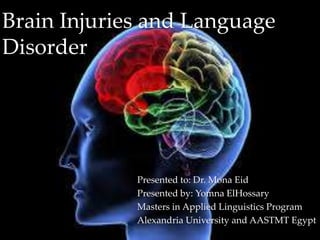
Brain Injuries and Language
Disorder
{
Agenda
I. Brain’s Anatomy
II. Language disorder caused by brain
injuries
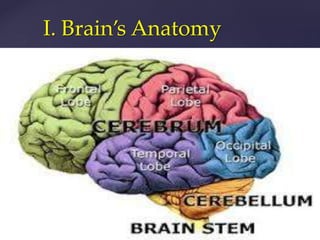
I. Brain’s Anatomy
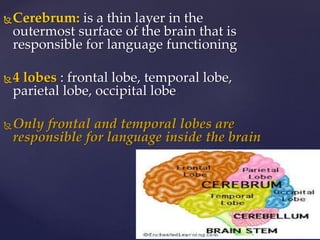
Cerebrum: is a thin layer in the
outermost surface of the brain that is
responsible for language functioning
4 lobes : frontal lobe, temporal lobe,
parietal lobe, occipital lobe
Only frontal and temporal lobes are
responsible for language inside the brain
II. Language Disorders caused
by Brain Injuries
a. Aphasia b. Dementia
“McNeil and Pratt defined aphasia as a multimodal
physiological impairment related to language
inefficiency after brain tissue damage in the language
dominant hemisphere, and this impairment also
impacts other language or symbol related processes
“(2001, p.907, cited in Pompon 2013 , p.1)
a. Aphasia
Injuries due to:
Tumors
Strokes
affecting brain tissues
responsible for language ability
-Causes
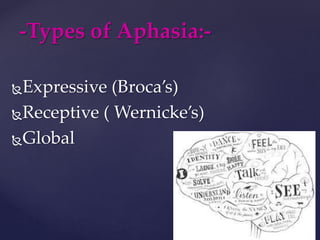
Expressive (Broca’s)
Receptive ( Wernicke’s)
Global
-Types of Aphasia:-
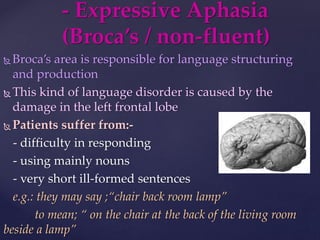
 Broca’s area is responsible for language structuring
and production
 This kind of language disorder is caused by the
damage in the left frontal lobe
 Patients suffer from:-
- difficulty in responding
- using mainly nouns
- very short ill-formed sentences
e.g.: they may say ;“chair back room lamp”
to mean; “ on the chair at the back of the living room
beside a lamp”
- Expressive Aphasia
(Broca’s / non-fluent)
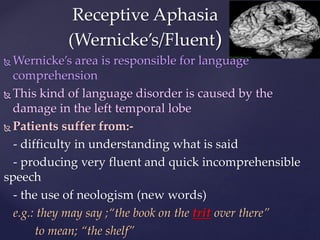
 Wernicke’s area is responsible for language
comprehension
 This kind of language disorder is caused by the
damage in the left temporal lobe
 Patients suffer from:-
- difficulty in understanding what is said
- producing very fluent and quick incomprehensible
speech
- the use of neologism (new words)
e.g.: they may say ;“the book on the trit over there”
to mean; “the shelf”
Receptive Aphasia
(Wernicke’s/Fluent)
 This kind of aphasia is the most severe one as it
affects the whole brain areas
 Patients suffer from:-
- difficulty in understanding what is said
- difficulty in producing language
Global Aphasia
According to Alzheimer's Association
(2016) ,the word dementia describes a
set of symptoms that may include
memory loss and difficulties with
thinking, problem-solving or language.
B. Dementia
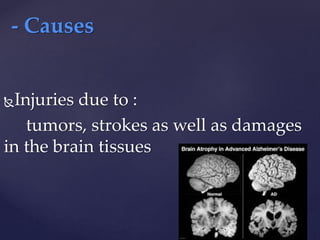
Injuries due to :
tumors, strokes as well as damages
in the brain tissues
- Causes
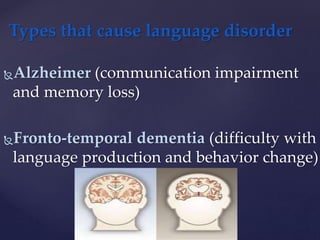
Alzheimer (communication impairment
and memory loss)
Fronto-temporal dementia (difficulty with
language production and behavior change)
Types that cause language disorder
 Brain has lobes responsible for language functioning
 When these lobes are damaged because of injuries they cause
language disability like; Aphasia and Dementia
 Aphasia has 3 types :-
- Expressive (language production deficiency)
- Receptive (language comprehension deficiency)
- Global (affecting both production and comprehension)
Dementia has 2 types related to language disorder:-
- Alzheimer (affecting memory and communication ability)
- Fronto-temporal (affecting language production and
behavior)
Summary
 Labreche, T., Plotkin, A., Szilva, M. .(May-June 2016).
Empowering Individuals with Aphasia and Visual Impairments
through Effective Communication .Journal of Visual Impairment
& Blindness. 183-187.
 Pompon, R. (2013) Examining Inhibition During Spoken Word
Production in Aphasia (Doctoral Dissertation). University of
Washington. Retrieved from UMI. (3588841)
 Alzeimer’s Association
http://www.alz.org/dementia/types-of-dementia.asp
https://www.nidcd.nih.gov/health/aphasia
References
Thank You!

Brain injuries and language disorder

  • 1.
    Presented to: Dr.Mona Eid Presented by: Yomna ElHossary Masters in Applied Linguistics Program Alexandria University and AASTMT Egypt Brain Injuries and Language Disorder
  • 2.
    { Agenda I. Brain’s Anatomy II.Language disorder caused by brain injuries
  • 3.
  • 4.
    Cerebrum: is athin layer in the outermost surface of the brain that is responsible for language functioning 4 lobes : frontal lobe, temporal lobe, parietal lobe, occipital lobe Only frontal and temporal lobes are responsible for language inside the brain
  • 5.
    II. Language Disorderscaused by Brain Injuries a. Aphasia b. Dementia
  • 6.
    “McNeil and Prattdefined aphasia as a multimodal physiological impairment related to language inefficiency after brain tissue damage in the language dominant hemisphere, and this impairment also impacts other language or symbol related processes “(2001, p.907, cited in Pompon 2013 , p.1) a. Aphasia
  • 7.
    Injuries due to: Tumors Strokes affectingbrain tissues responsible for language ability -Causes
  • 8.
    Expressive (Broca’s) Receptive (Wernicke’s) Global -Types of Aphasia:-
  • 9.
     Broca’s areais responsible for language structuring and production  This kind of language disorder is caused by the damage in the left frontal lobe  Patients suffer from:- - difficulty in responding - using mainly nouns - very short ill-formed sentences e.g.: they may say ;“chair back room lamp” to mean; “ on the chair at the back of the living room beside a lamp” - Expressive Aphasia (Broca’s / non-fluent)
  • 10.
     Wernicke’s areais responsible for language comprehension  This kind of language disorder is caused by the damage in the left temporal lobe  Patients suffer from:- - difficulty in understanding what is said - producing very fluent and quick incomprehensible speech - the use of neologism (new words) e.g.: they may say ;“the book on the trit over there” to mean; “the shelf” Receptive Aphasia (Wernicke’s/Fluent)
  • 11.
     This kindof aphasia is the most severe one as it affects the whole brain areas  Patients suffer from:- - difficulty in understanding what is said - difficulty in producing language Global Aphasia
  • 12.
    According to Alzheimer'sAssociation (2016) ,the word dementia describes a set of symptoms that may include memory loss and difficulties with thinking, problem-solving or language. B. Dementia
  • 13.
    Injuries due to: tumors, strokes as well as damages in the brain tissues - Causes
  • 14.
    Alzheimer (communication impairment andmemory loss) Fronto-temporal dementia (difficulty with language production and behavior change) Types that cause language disorder
  • 15.
     Brain haslobes responsible for language functioning  When these lobes are damaged because of injuries they cause language disability like; Aphasia and Dementia  Aphasia has 3 types :- - Expressive (language production deficiency) - Receptive (language comprehension deficiency) - Global (affecting both production and comprehension) Dementia has 2 types related to language disorder:- - Alzheimer (affecting memory and communication ability) - Fronto-temporal (affecting language production and behavior) Summary
  • 16.
     Labreche, T.,Plotkin, A., Szilva, M. .(May-June 2016). Empowering Individuals with Aphasia and Visual Impairments through Effective Communication .Journal of Visual Impairment & Blindness. 183-187.  Pompon, R. (2013) Examining Inhibition During Spoken Word Production in Aphasia (Doctoral Dissertation). University of Washington. Retrieved from UMI. (3588841)  Alzeimer’s Association http://www.alz.org/dementia/types-of-dementia.asp https://www.nidcd.nih.gov/health/aphasia References
  • 17.