Kelsey Sokol
 Most commonly inherited cause of mental
impairment
 1 in 3600 males and 1 in 4000 to 6000 females are
affected
 Caused by mutated FMR1 gene on the X
chromosome
 Gene discovered in 1991
 No cure but certain therapies can help
 Intellectual disability
 Significant in the majority
 Learning disability to mental retardation to autism
 Usually strengths and weaknesses
 Good memories for pictures and visual patterns
 Learn in simultaneous fashion instead of sequential
 Can be hard to teach reading
 Speak in rapid bursts, repeat words or perservation
 Physical features
 Large ears
 Long face with prominent chin
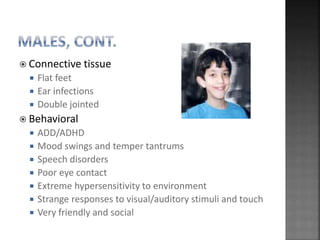
 Connective tissue
 Flat feet
 Ear infections
 Double jointed
 Behavioral
 ADD/ADHD
 Mood swings and temper tantrums
 Speech disorders
 Poor eye contact
 Extreme hypersensitivity to environment
 Strange responses to visual/auditory stimuli and touch
 Very friendly and social
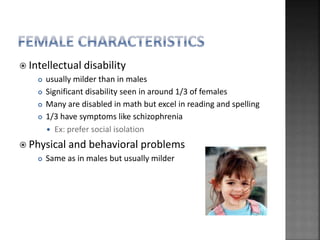
 Intellectual disability
 usually milder than in males
 Significant disability seen in around 1/3 of females
 Many are disabled in math but excel in reading and spelling
 1/3 have symptoms like schizophrenia
 Ex: prefer social isolation
 Physical and behavioral problems
 Same as in males but usually milder
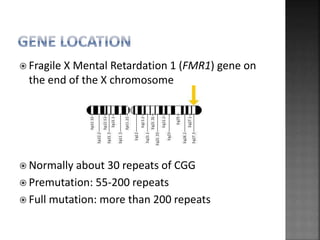
 Fragile X Mental Retardation 1 (FMR1) gene on
the end of the X chromosome
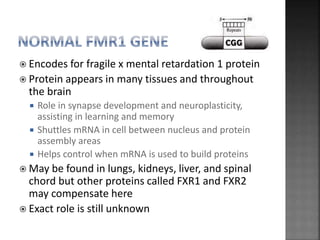
 Normally about 30 repeats of CGG
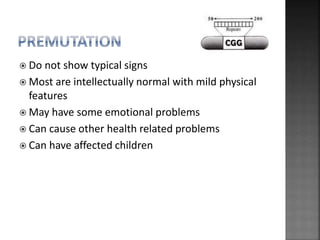
 Premutation: 55-200 repeats
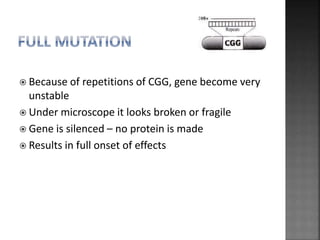
 Full mutation: more than 200 repeats
 Encodes for fragile x mental retardation 1 protein
 Protein appears in many tissues and throughout
the brain
 Role in synapse development and neuroplasticity,
assisting in learning and memory
 Shuttles mRNA in cell between nucleus and protein
assembly areas
 Helps control when mRNA is used to build proteins
 May be found in lungs, kidneys, liver, and spinal
chord but other proteins called FXR1 and FXR2
may compensate here
 Exact role is still unknown
 Do not show typical signs
 Most are intellectually normal with mild physical
features
 May have some emotional problems
 Can cause other health related problems
 Can have affected children
 Because of repetitions of CGG, gene become very
unstable
 Under microscope it looks broken or fragile
 Gene is silenced – no protein is made
 Results in full onset of effects
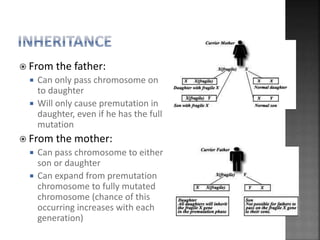
 From the father:
 Can only pass chromosome on
to daughter
 Will only cause premutation in
daughter, even if he has the full
mutation
 From the mother:
 Can pass chromosome to either
son or daughter
 Can expand from premutation
chromosome to fully mutated
chromosome (chance of this
occurring increases with each
generation)
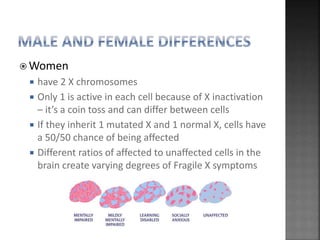
 Women
 have 2 X chromosomes
 Only 1 is active in each cell because of X inactivation
– it’s a coin toss and can differ between cells
 If they inherit 1 mutated X and 1 normal X, cells have
a 50/50 chance of being affected
 Different ratios of affected to unaffected cells in the
brain create varying degrees of Fragile X symptoms
 Men
 have 1 X chromosome and 1 Y chromosome
 All cells use same X chromosome
 If mother passed on mutated X, all cells will show
mutation
 If mother passed on premutated X, cells could show
mutation if it becomes full mutation
 If mother passed on normal X, no cells will show
mutation
 There is no cure, only treatment.
 Research is actively being conducted.
 Educational options
 Therapeutic options
 Medication options
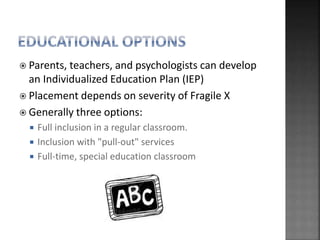
 Parents, teachers, and psychologists can develop
an Individualized Education Plan (IEP)
 Placement depends on severity of Fragile X
 Generally three options:
 Full inclusion in a regular classroom.
 Inclusion with "pull-out" services
 Full-time, special education classroom
 Speech-language therapists
 Improve pronunciation, slow down speech, etc
 Occupational therapists
 Help with tasks, daily activities, and career choice
 Physical therapists
 Motor control
 Behavioral therapists
 Identify distressing situations and help to prevent and
cope with them
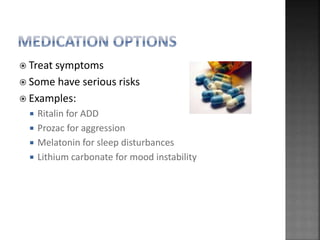
 Treat symptoms
 Some have serious risks
 Examples:
 Ritalin for ADD
 Prozac for aggression
 Melatonin for sleep disturbances
 Lithium carbonate for mood instability
 Caused by FMR1 gene mutation
 No artificial protein to replace FMR1 protein
 Most commonly inherited cause of mental
retardation

Fragile X presentation

  • 1.
  • 2.
     Most commonlyinherited cause of mental impairment  1 in 3600 males and 1 in 4000 to 6000 females are affected  Caused by mutated FMR1 gene on the X chromosome  Gene discovered in 1991  No cure but certain therapies can help
  • 3.
     Intellectual disability Significant in the majority  Learning disability to mental retardation to autism  Usually strengths and weaknesses  Good memories for pictures and visual patterns  Learn in simultaneous fashion instead of sequential  Can be hard to teach reading  Speak in rapid bursts, repeat words or perservation  Physical features  Large ears  Long face with prominent chin
  • 4.
     Connective tissue Flat feet  Ear infections  Double jointed  Behavioral  ADD/ADHD  Mood swings and temper tantrums  Speech disorders  Poor eye contact  Extreme hypersensitivity to environment  Strange responses to visual/auditory stimuli and touch  Very friendly and social
  • 5.
     Intellectual disability usually milder than in males  Significant disability seen in around 1/3 of females  Many are disabled in math but excel in reading and spelling  1/3 have symptoms like schizophrenia  Ex: prefer social isolation  Physical and behavioral problems  Same as in males but usually milder
  • 6.
     Fragile XMental Retardation 1 (FMR1) gene on the end of the X chromosome  Normally about 30 repeats of CGG  Premutation: 55-200 repeats  Full mutation: more than 200 repeats
  • 7.
     Encodes forfragile x mental retardation 1 protein  Protein appears in many tissues and throughout the brain  Role in synapse development and neuroplasticity, assisting in learning and memory  Shuttles mRNA in cell between nucleus and protein assembly areas  Helps control when mRNA is used to build proteins  May be found in lungs, kidneys, liver, and spinal chord but other proteins called FXR1 and FXR2 may compensate here  Exact role is still unknown
  • 8.
     Do notshow typical signs  Most are intellectually normal with mild physical features  May have some emotional problems  Can cause other health related problems  Can have affected children
  • 9.
     Because ofrepetitions of CGG, gene become very unstable  Under microscope it looks broken or fragile  Gene is silenced – no protein is made  Results in full onset of effects
  • 10.
     From thefather:  Can only pass chromosome on to daughter  Will only cause premutation in daughter, even if he has the full mutation  From the mother:  Can pass chromosome to either son or daughter  Can expand from premutation chromosome to fully mutated chromosome (chance of this occurring increases with each generation)
  • 11.
     Women  have2 X chromosomes  Only 1 is active in each cell because of X inactivation – it’s a coin toss and can differ between cells  If they inherit 1 mutated X and 1 normal X, cells have a 50/50 chance of being affected  Different ratios of affected to unaffected cells in the brain create varying degrees of Fragile X symptoms
  • 12.
     Men  have1 X chromosome and 1 Y chromosome  All cells use same X chromosome  If mother passed on mutated X, all cells will show mutation  If mother passed on premutated X, cells could show mutation if it becomes full mutation  If mother passed on normal X, no cells will show mutation
  • 13.
     There isno cure, only treatment.  Research is actively being conducted.  Educational options  Therapeutic options  Medication options
  • 14.
     Parents, teachers,and psychologists can develop an Individualized Education Plan (IEP)  Placement depends on severity of Fragile X  Generally three options:  Full inclusion in a regular classroom.  Inclusion with "pull-out" services  Full-time, special education classroom
  • 15.
     Speech-language therapists Improve pronunciation, slow down speech, etc  Occupational therapists  Help with tasks, daily activities, and career choice  Physical therapists  Motor control  Behavioral therapists  Identify distressing situations and help to prevent and cope with them
  • 16.
     Treat symptoms Some have serious risks  Examples:  Ritalin for ADD  Prozac for aggression  Melatonin for sleep disturbances  Lithium carbonate for mood instability
  • 17.
     Caused byFMR1 gene mutation  No artificial protein to replace FMR1 protein  Most commonly inherited cause of mental retardation