WELCOME 
GROUP-D 
PGDBIM 2014-15
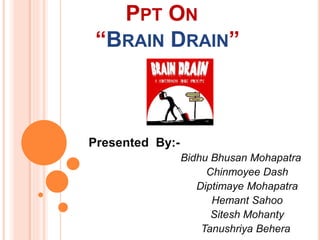
PPT ON 
“BRAIN DRAIN” 
Presented By:- 
Bidhu Bhusan Mohapatra 
Chinmoyee Dash 
Diptimaye Mohapatra 
Hemant Sahoo 
Sitesh Mohanty 
Tanushriya Behera
INTRODUCTION 
WHAT IS BRAIN DRAIN??? 
 Brain drain is the emigration of intelligent, well-educated 
individuals to somewhere for better pay or 
conditions, causing the place they came from to 
lose those skilled people, or "brains.“ 
Or Simply 
"a drain on resources and drain of young talent by 
emigration“ 
 Depletion or loss of intellectual and technical 
personnel resulting in gradual depletion of energy 
or resources. 
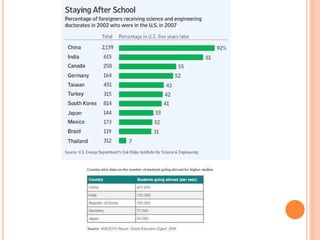
 China and India have recently been discovered to 
be at the top of the list of countries facing brain 
drain.
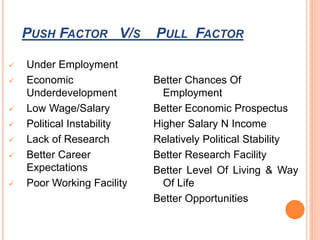
PUSH FACTOR V/S PULL FACTOR 
 Under Employment 
 Economic 
Underdevelopment 
 Low Wage/Salary 
 Political Instability 
 Lack of Research 
 Better Career 
Expectations 
 Poor Working Facility 
Better Chances Of 
Employment 
Better Economic Prospectus 
Higher Salary N Income 
Relatively Political Stability 
Better Research Facility 
Better Level Of Living & Way 
Of Life 
Better Opportunities
CONTENTS 
 Origin 
 Types 
 Brain Drain: Bane for India 
 Reasons of Brain Drain 
 Consequences of Brain Drain 
 Solutions to curve Brain Drain 
 Preventive measure 
 Advantages of Brain Drain 
 Conclusion
ORIGIN 
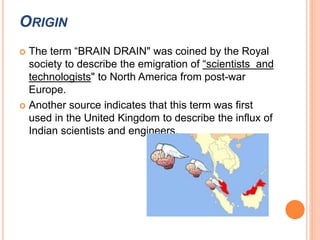
 The term “BRAIN DRAIN" was coined by the Royal 
society to describe the emigration of “scientists and 
technologists" to North America from post-war 
Europe. 
 Another source indicates that this term was first 
used in the United Kingdom to describe the influx of 
Indian scientists and engineers.
TYPES 
 Organizational:- The flight of talented, creative, 
and highly trained employees from large 
corporations such as Yahoo, HubSpot and 
Microsoft. This occurs when employees perceive 
the direction and leadership of the company and 
are unable to keep up with their personal and 
professional ambitions. 
 Geographical:- The flight of highly trained 
individuals and college graduates from their area of 
residence, for instance, those migrating from the 
mid-western United States to the coastal states and 
large metropolises. 
 Industrial: - The movement of traditionally skilled 
workers from one sector of an industry to another
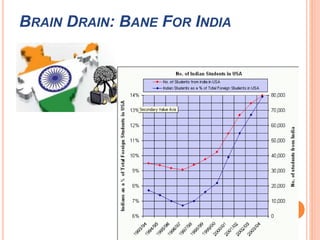
BRAIN DRAIN: BANE FOR INDIA
REASONS OF BRAIN DRAIN 
 Lack Of Employment And Low Salary:- Due to 
lack of employment and low salary people migrate 
as they are tempted to look for better salaries 
elsewhere. 
 Political Instability:- Due to political instability in 
home countries, people loose confidence on their 
governments and future prospects for a better 
life.Migration also takes place in response to wars, 
political and social turmoil. 
 Scholars Expectations Not Met:- Many scholars 
who go abroad for further studies remain there 
leaving their family and workplace behind with the 
hope that a better life can be achieved elsewhere, 
despite their well being at home. Expectations are
CONSEQUENCES OF BRAIN DRAIN 
 Loss Of Human Capital:- The flaws of Brain Drain 
are inherent in its title, it involves the loss of human 
capital, i.e. a skilled labour force which is vital to the 
development of society and the country. 
 Provides Personal Benefits:- “Essentially provids 
personal benefits for individuals rather than public 
benefits”-The brain drain benefits individuals more 
than society. 
 Uneven Distribution Of Knowledge:- Brain Drain 
results in uneven distribution of knowledge across 
space, resulting in a fall in economic development 
for the country.
 Loses potential entrepreneurs:- Entrepreneurs 
plays an important role in helping a country develop. 
The economy of a country that has a large number of 
world-class entrepreneurs can be more innovative 
than those of others. 
 Lack Of Health Care Workers:- Health workers from 
the developing countries leave and immigrate to the 
developed world. As a result countries lack sufficient 
health care workers, which harms the local health 
system and there is not sufficient manpower to do the 
work required, which further damages the health 
system rather than strengthening it.
SOLUTIONS TO CURVE THE BRAIN 
DRAIN: 
 Good Governance At The National And 
International Level:- Transparency in leadership 
is essential and should be maintained. It is about 
maintaining reasonable security for peoples' lives 
and property which is essential for economic 
progress, Thus withholding political and economical 
emigrants. 
 High Wages:- Offering higher wages for `insiders` 
according to their qualifications is essential, 
instead of over estimating and hiring expatrates, 
which are more costly.
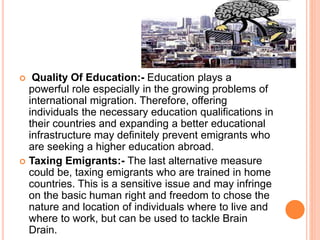
 Quality Of Education:- Education plays a 
powerful role especially in the growing problems of 
international migration. Therefore, offering 
individuals the necessary education qualifications in 
their countries and expanding a better educational 
infrastructure may definitely prevent emigrants who 
are seeking a higher education abroad. 
 Taxing Emigrants:- The last alternative measure 
could be, taxing emigrants who are trained in home 
countries. This is a sensitive issue and may infringe 
on the basic human right and freedom to chose the 
nature and location of individuals where to live and 
where to work, but can be used to tackle Brain 
Drain.
PREVENTIVE MEASURES 
 Different areas and nations have distinct policies to 
retain skilled workers due to the different national or 
regional situation.--in African countries, the health 
systems have been severely affected by brain drain, so 
various measures have been suggested and tried to 
limit the migration of health workers to rich countries. 
 China tries to create a normal and free atmosphere 
and mechanism that would help talents flourish 
 And in India, although suffering severe brain drain 
every year, the Indian government has not adopted 
strict policies because they believe that the overseas 
talent will eventually contribute to the nation in the 
future.
ADVANTAGES OF THE BRAIN DRAIN 
 Sending Remittances:- sending back of 
remittances increases economic development in 
the country and its standard of living. 
 Circular Migration:- The economy of the origin 
country may not be able to take advantage of the 
skilled labourers, so it is more beneficial for the 
workers to migrate and send back remittances. 
Second, when the migrant workers return home as 
part of the circular pattern, they may bring with 
them new skills and knowledge.
 Increase Living Standards:- It increase living 
standards in society 
“skilled migrants typically earn more therefore 
remit more thus fostering growth”. 
The remittance economy is a significant part of the 
brain drain as well an integral source of income for 
developed economies: “2011 remittances were 
estimated at $372bn”, and for countries such as 
Mexico and the Philippines were worth “$24 and 
$34 billion” respectively.
CONCLUSION 
In India best crammers are rewarded 
But in west who learn how to apply 
Skill is awarded… 
Raghu Kumar 
Co-founder of RKSV 
“Give a man a fish and you will feed him for a day. Teach a 
man to fish and you feed him for life”
CONCLUSION 
Brain Drain is a very big problem. Our India should be 
developed country instead of being a developing one. 
There is no doubt we Indians are more talented than 
others but due to lack facilities Indians are not able to 
show there talents. 
According to former Google Ceo Eric Schmidt : 
“India’s entrepreneurs have the ability to 
built
Brain Drain
Brain Drain

Brain Drain

  • 1.
  • 2.
    PPT ON “BRAINDRAIN” Presented By:- Bidhu Bhusan Mohapatra Chinmoyee Dash Diptimaye Mohapatra Hemant Sahoo Sitesh Mohanty Tanushriya Behera
  • 3.
    INTRODUCTION WHAT ISBRAIN DRAIN???  Brain drain is the emigration of intelligent, well-educated individuals to somewhere for better pay or conditions, causing the place they came from to lose those skilled people, or "brains.“ Or Simply "a drain on resources and drain of young talent by emigration“  Depletion or loss of intellectual and technical personnel resulting in gradual depletion of energy or resources.  China and India have recently been discovered to be at the top of the list of countries facing brain drain.
  • 4.
    PUSH FACTOR V/SPULL FACTOR  Under Employment  Economic Underdevelopment  Low Wage/Salary  Political Instability  Lack of Research  Better Career Expectations  Poor Working Facility Better Chances Of Employment Better Economic Prospectus Higher Salary N Income Relatively Political Stability Better Research Facility Better Level Of Living & Way Of Life Better Opportunities
  • 5.
    CONTENTS  Origin  Types  Brain Drain: Bane for India  Reasons of Brain Drain  Consequences of Brain Drain  Solutions to curve Brain Drain  Preventive measure  Advantages of Brain Drain  Conclusion
  • 6.
    ORIGIN  Theterm “BRAIN DRAIN" was coined by the Royal society to describe the emigration of “scientists and technologists" to North America from post-war Europe.  Another source indicates that this term was first used in the United Kingdom to describe the influx of Indian scientists and engineers.
  • 7.
    TYPES  Organizational:-The flight of talented, creative, and highly trained employees from large corporations such as Yahoo, HubSpot and Microsoft. This occurs when employees perceive the direction and leadership of the company and are unable to keep up with their personal and professional ambitions.  Geographical:- The flight of highly trained individuals and college graduates from their area of residence, for instance, those migrating from the mid-western United States to the coastal states and large metropolises.  Industrial: - The movement of traditionally skilled workers from one sector of an industry to another
  • 8.
  • 10.
    REASONS OF BRAINDRAIN  Lack Of Employment And Low Salary:- Due to lack of employment and low salary people migrate as they are tempted to look for better salaries elsewhere.  Political Instability:- Due to political instability in home countries, people loose confidence on their governments and future prospects for a better life.Migration also takes place in response to wars, political and social turmoil.  Scholars Expectations Not Met:- Many scholars who go abroad for further studies remain there leaving their family and workplace behind with the hope that a better life can be achieved elsewhere, despite their well being at home. Expectations are
  • 11.
    CONSEQUENCES OF BRAINDRAIN  Loss Of Human Capital:- The flaws of Brain Drain are inherent in its title, it involves the loss of human capital, i.e. a skilled labour force which is vital to the development of society and the country.  Provides Personal Benefits:- “Essentially provids personal benefits for individuals rather than public benefits”-The brain drain benefits individuals more than society.  Uneven Distribution Of Knowledge:- Brain Drain results in uneven distribution of knowledge across space, resulting in a fall in economic development for the country.
  • 12.
     Loses potentialentrepreneurs:- Entrepreneurs plays an important role in helping a country develop. The economy of a country that has a large number of world-class entrepreneurs can be more innovative than those of others.  Lack Of Health Care Workers:- Health workers from the developing countries leave and immigrate to the developed world. As a result countries lack sufficient health care workers, which harms the local health system and there is not sufficient manpower to do the work required, which further damages the health system rather than strengthening it.
  • 13.
    SOLUTIONS TO CURVETHE BRAIN DRAIN:  Good Governance At The National And International Level:- Transparency in leadership is essential and should be maintained. It is about maintaining reasonable security for peoples' lives and property which is essential for economic progress, Thus withholding political and economical emigrants.  High Wages:- Offering higher wages for `insiders` according to their qualifications is essential, instead of over estimating and hiring expatrates, which are more costly.
  • 14.
     Quality OfEducation:- Education plays a powerful role especially in the growing problems of international migration. Therefore, offering individuals the necessary education qualifications in their countries and expanding a better educational infrastructure may definitely prevent emigrants who are seeking a higher education abroad.  Taxing Emigrants:- The last alternative measure could be, taxing emigrants who are trained in home countries. This is a sensitive issue and may infringe on the basic human right and freedom to chose the nature and location of individuals where to live and where to work, but can be used to tackle Brain Drain.
  • 15.
    PREVENTIVE MEASURES Different areas and nations have distinct policies to retain skilled workers due to the different national or regional situation.--in African countries, the health systems have been severely affected by brain drain, so various measures have been suggested and tried to limit the migration of health workers to rich countries.  China tries to create a normal and free atmosphere and mechanism that would help talents flourish  And in India, although suffering severe brain drain every year, the Indian government has not adopted strict policies because they believe that the overseas talent will eventually contribute to the nation in the future.
  • 16.
    ADVANTAGES OF THEBRAIN DRAIN  Sending Remittances:- sending back of remittances increases economic development in the country and its standard of living.  Circular Migration:- The economy of the origin country may not be able to take advantage of the skilled labourers, so it is more beneficial for the workers to migrate and send back remittances. Second, when the migrant workers return home as part of the circular pattern, they may bring with them new skills and knowledge.
  • 17.
     Increase LivingStandards:- It increase living standards in society “skilled migrants typically earn more therefore remit more thus fostering growth”. The remittance economy is a significant part of the brain drain as well an integral source of income for developed economies: “2011 remittances were estimated at $372bn”, and for countries such as Mexico and the Philippines were worth “$24 and $34 billion” respectively.
  • 18.
    CONCLUSION In Indiabest crammers are rewarded But in west who learn how to apply Skill is awarded… Raghu Kumar Co-founder of RKSV “Give a man a fish and you will feed him for a day. Teach a man to fish and you feed him for life”
  • 19.
    CONCLUSION Brain Drainis a very big problem. Our India should be developed country instead of being a developing one. There is no doubt we Indians are more talented than others but due to lack facilities Indians are not able to show there talents. According to former Google Ceo Eric Schmidt : “India’s entrepreneurs have the ability to built