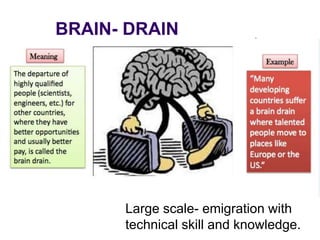
BRAIN- DRAIN 
Large scale- emigration with 
technical skill and knowledge.
CONTENTS 
 INTRODUCTION 
 HISTORY OF BRAIN DRAIN 
 CHARACTERISTICS 
 PUSH AND PULL FACTORS OF BRAIN DRAIN 
 MAGNITUDE OF BRAIN DRAIN 
 BRAIN DRAIN OF INDIA 
 BRAIN GAIN 
 REVERSE BRAIN DRAIN 
 CONCLUSION
INTRODUCTION 
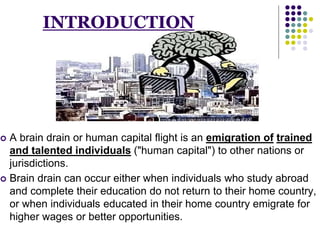
 A brain drain or human capital flight is an emigration of trained 
and talented individuals ("human capital") to other nations or 
jurisdictions. 
 Brain drain can occur either when individuals who study abroad 
and complete their education do not return to their home country, 
or when individuals educated in their home country emigrate for 
higher wages or better opportunities.
HISTORY OF BRAIN DRAIN
MAIN CHARACTERISTICS OF 
BRAIN DRAIN 
 There are numerous flows of skilled and trained persons from 
developing to developed countries. 
 In these flows engineers, medical personnel and scientists 
usually tend to predominate. 
 They are characterised by large flows from a comparatively small 
number of developed countries and by small flows from a larger 
number of developing countries.
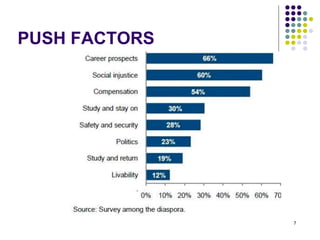
PUSH FACTORS OF BRAIN DRAIN 
 Under employment 
 Low wage/salary. 
 Lack of research and other facilities. 
 Lack of freedom. 
 Discrimination in appointment and promotion. 
 Poor working facilities 
 Desire for a better urban life. 
 Better career expectation. 
 Lack of satisfactory working conditions.
7 
PUSH FACTORS
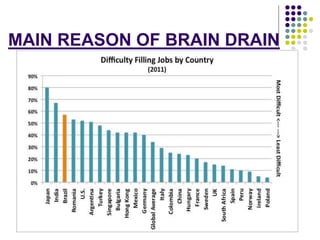
MAIN REASON OF BRAIN DRAIN
PULL FACTORS OF BRAIN DRAIN 
 Better economic prospects. 
 Higher salary and income. 
 Better level of living and way of life. 
 Prestige of foreign training. 
 Better working condition and better employment 
opportunities. 
 Technological gap. 
 Allocation of substantial funds for research.
MAGNITUDE OF BRAIN DRAIN 
 Migration of people as a phenomenon differs from country to 
country and from time to time. 
 The phenomenon of migration of high quality manpower can 
justify the use of the expression on the term “brain drain”.
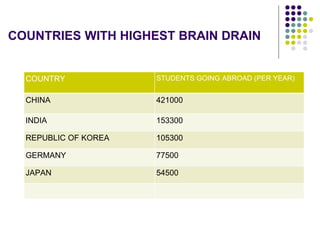
COUNTRIES WITH HIGHEST BRAIN DRAIN 
COUNTRY STUDENTS GOING ABROAD (PER YEAR) 
CHINA 421000 
INDIA 153300 
REPUBLIC OF KOREA 105300 
GERMANY 77500 
JAPAN 54500
MIGRATION TO USA
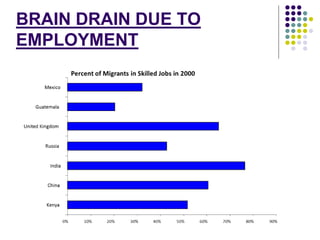
BRAIN DRAIN DUE TO 
EMPLOYMENT
BRAIN DRAIN IN INDIA 
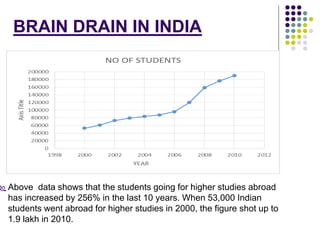
 Above data shows that the students going for higher studies abroad 
has increased by 256% in the last 10 years. When 53,000 Indian 
students went abroad for higher studies in 2000, the figure shot up to 
1.9 lakh in 2010.
INDIAN HIGHER EDUCATION 
ENROLLMENT IN TOP 7 COUNTRIES 
YEAR USA UK AUS CANADA NZ CHINA GER TOTAL 
2012 96754 12629 28929 11349 10237 5745 190055 
2011 100270 29900 15395 23601 12301 9370 4825 228774 
2010 103895 39090 21932 17549 11616 9014 3821 253743 
2009 104897 38500 28020 9561 9252 8468 3236 247631 
2008 103260 38065 28411 8325 6348 8145 3217 216516 
2007 94563 25905 27078 7304 3855 7190 3431 205852 
2006 83833 19228 29497 6927 2599 3245 3583 158215
COUNTRY CHOICE OF INDIAN 
STUDENTS
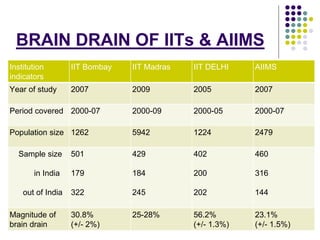
BRAIN DRAIN OF IITs & AIIMS 
Institution 
indicators 
IIT Bombay IIT Madras IIT DELHI AIIMS 
Year of study 2007 2009 2005 2007 
Period covered 2000-07 2000-09 2000-05 2000-07 
Population size 1262 5942 1224 2479 
Sample size 
in India 
out of India 
501 
179 
322 
429 
184 
245 
402 
200 
202 
460 
316 
144 
Magnitude of 
brain drain 
30.8% 
(+/- 2%) 
25-28% 56.2% 
(+/- 1.3%) 
23.1% 
(+/- 1.5%)
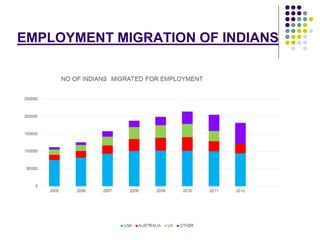
EMPLOYMENT MIGRATION OF INDIANS
19 
INDIANS IN EUROPE 
2001 2009 
EU country Indian 
immigrants 
Stock of 
Indian 
citizens 
EU country Indian 
immigrant 
s 
Stock of 
Indian 
citizens 
UK 16,001 1,50,676 UK 64,000 2,93,000 
Germany 8,949 35,183 Italy 12,769 91,855 
Italy 4,820 32,507 Germany 12,009 47,025 
Austria 836 4,879 Spain 5,956 29,754 
Spain 835 6,790 Holland 2,699 8,003 
Holland 684 3,361 Sweden 1,795 4,676 
Belgium 1,787 6,749 
France 1,458 13,000 
Poland 1,137 269 
Ireland 1,078 4,046
20 
Total 
acquisitions 
in EU-27 
United 
Kingdom 
Portugal Germany Italy Other 
% of total EU % of total EU % of total EU % of total EU % of total EU 
31,100 85.3% 3.2% 2.9% 2.9% 5.7% 
Employment Education Family reunification Other 
Permits 
by reason 
total permits 
Permits 
by reason 
total permits 
Permits 
by reason 
% of total 
permits 
Permits 
by reason 
total permits 
73,851 37% 51,501 26% 45,237 22% 30,809 15%
MAJOR PROBLEMS FACED BY INDIA DUE 
TO BRAIN DRAIN 
 A shortage of skilled and competent people in India. 
 A tremendous increase in wages of high-skill labors in India. 
 Problems for the public sector : With the exception of ICICI, none of 
the public sector finance companies have done a serious job of revamping 
their pay scales. They face two alternatives: a sharp increase in wages of high-skill 
labours, or bankruptcy. 
 Problems of governance : In government itself, low wages at senior 
levels are a serious problem. An economic advisor at the Finance Ministry 
earns less than Rs.20,000 a month. It is possible to have individuals take up 
these roles if they are independently wealthy; altruistic; power-hungry; corrupt 
or incompetent. This is not a happy state of affairs etc.
BRAIN GAIN 
An opposite situation, in which many trained and 
talented individuals seek entrance into a country, is called 
a brain gain. 
While simultaneously many qualified immigrants were 
coming to home country from a number of different 
nations. 
This phenomenon is common in developed countries 
where people come from many nations for higher studies 
& didn't return back.
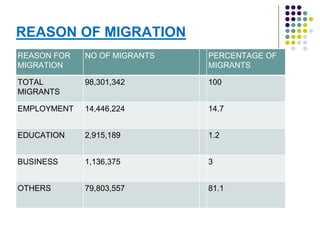
REASON OF MIGRATION 
REASON FOR 
MIGRATION 
NO OF MIGRANTS PERCENTAGE OF 
MIGRANTS 
TOTAL 
MIGRANTS 
98,301,342 100 
EMPLOYMENT 14,446,224 14.7 
EDUCATION 2,915,189 1.2 
BUSINESS 1,136,375 3 
OTHERS 79,803,557 81.1
Brain drain vs brain gain 
 A brain drain or human capital flight is an emigration of 
trained and talented individuals ("human capital") to other 
nations is called brain drain. 
 Brain drain can occur either when individuals who study 
abroad and complete their education do not return to their 
home country, or when individuals educated in their home 
country emigrate for higher wages or better opportunities. 
 This phenomenon is perhaps most problematic for 
developing nations, where it is widespread. In these 
countries, higher education and professional certification 
are often viewed as the surest path to escape from a 
troubled economy or difficult political situation.
REVERSE BRAIN DRAIN 
§ Reverse brain drain is a form of brain drain where human 
capital moves in reverse from a more developed country to 
a less developed country that is developing rapidly. 
§ These migrants may accumulate savings, also known as 
remittances, and develop skills overseas that can be used in 
their home country 
§ Brain drain can occur when scientists, engineers, or other 
intellectual elites migrate to a more developed country . 
These professionals then return to their home country after 
several years of experience to start a related business, 
teach in a university, or work for a multi-national in their 
home countryTheir return is thus "Reverse Brain Drain".
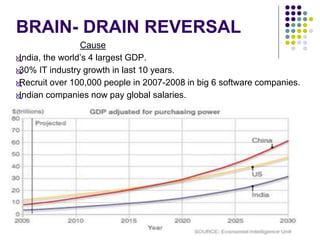
BRAIN- DRAIN REVERSAL 
Cause 
India, the world’s 4 largest GDP. 
30% IT industry growth in last 10 years. 
Recruit over 100,000 people in 2007-2008 in big 6 software companies. 
Indian companies now pay global salaries.
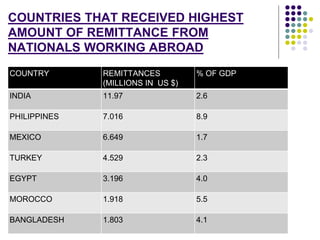
COUNTRIES THAT RECEIVED HIGHEST 
AMOUNT OF REMITTANCE FROM 
NATIONALS WORKING ABROAD 
COUNTRY REMITTANCES 
(MILLIONS IN US $) 
% OF GDP 
INDIA 11.97 2.6 
PHILIPPINES 7.016 8.9 
MEXICO 6.649 1.7 
TURKEY 4.529 2.3 
EGYPT 3.196 4.0 
MOROCCO 1.918 5.5 
BANGLADESH 1.803 4.1
28 
PIE CHART 
PERCENT
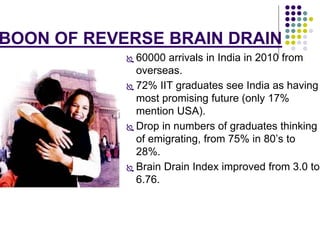
BOON OF REVERSE BRAIN DRAIN 
 60000 arrivals in India in 2010 from 
overseas. 
 72% IIT graduates see India as having 
most promising future (only 17% 
mention USA). 
 Drop in numbers of graduates thinking 
of emigrating, from 75% in 80’s to 
28%. 
 Brain Drain Index improved from 3.0 to 
6.76.
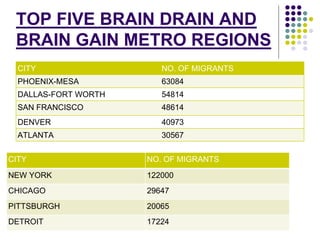
TOP FIVE BRAIN DRAIN AND 
BRAIN GAIN METRO REGIONS 
CITY NO. OF MIGRANTS 
PHOENIX-MESA 63084 
DALLAS-FORT WORTH 54814 
SAN FRANCISCO 48614 
DENVER 40973 
ATLANTA 30567 
CITY NO. OF MIGRANTS 
NEW YORK 122000 
CHICAGO 29647 
PITTSBURGH 20065 
DETROIT 17224
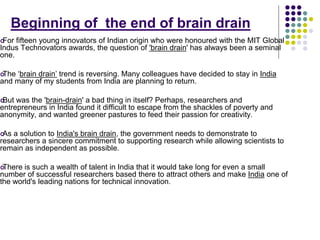
Beginning of the end of brain drain 
For fifteen young innovators of Indian origin who were honoured with the MIT Global 
Indus Technovators awards, the question of 'brain drain' has always been a seminal 
one. 
The ‘brain drain’ trend is reversing. Many colleagues have decided to stay in India 
and many of my students from India are planning to return. 
But was the 'brain-drain' a bad thing in itself? Perhaps, researchers and 
entrepreneurs in India found it difficult to escape from the shackles of poverty and 
anonymity, and wanted greener pastures to feed their passion for creativity. 
As a solution to India's brain drain, the government needs to demonstrate to 
researchers a sincere commitment to supporting research while allowing scientists to 
remain as independent as possible. 
There is such a wealth of talent in India that it would take long for even a small 
number of successful researchers based there to attract others and make India one of 
the world's leading nations for technical innovation.
Current brain drain issues 
 In particular, Eastern European countries have expressed 
concerns about brain drain to Ireland and the United 
Kingdom. Lithuania. 
 In Western Europe France is currently experiencing a 
brain drain, with young graduates moving to Britain, USA, 
and Canada because of economic and labor regulations 
making it extensively difficult to find white-collar private 
jobs. 
 Certainly there is a brain drain occurring in the last 5 
years in Germany, with 144 814 people leaving their 
country in 2005 due to economic problems, the highest 
rate of emigration from Germany since the end of World 
War II.
Larger countries have less brain 
drain 
 Report shows the extent of the drain brain problem in larger 
countries is much less. 
 On average for countries with more than 30 million people, 
the brain drain is less than five percent of all college educated 
people. The reason is that they have a large population of 
skilled people, so that even with a large share of skilled 
people in the migrant population, their share in the skilled 
population is nevertheless small, Countries such as China and 
India only have about three to five percent of their graduates 
living abroad. And it's a similar situation in Brazil, Indonesia 
and the former Soviet Union.
34 
ADVANTAGES OF BRAIN DRAIN 
The money the emigrants have sent back home has helped in alleviating It has resulted in less child labor, greater child schooling, more hours The money remittances have also reduced the level and severity Moreover, the money migrants sent back are spent more in investments
35 
DISADVANTAGES 
Due to the influence of brain drain, the investment in higher education is lost as Also, whatever social capital the individual has been a part of is reduced by his With all the college graduates leaving their homelands, it raises the question as The chances of Brain Waste are possible. In a similar way, there is a shortage A tremendous increase in wages of high-skill labour can be seen now in India. 
The emigration has also created innumerous problems in the public sector.
CONCLUSION 
 Scientists who have emigrated for several reasons are 
recoverable assets who can play a part in developing 
opportunities at home. However, recovery requires the 
opening of diverse and creative conduits. 
 Foreign professionals could be used to develop innovative 
graduate education opportunities at home and technology to 
be transferred to areas of national priorities for research and 
development. 
 Building an enlightened leadership and an enabling national 
scientific community, with the help of expatriate citizens, for 
the coherent development of scientific and technological 
capacity in developing countries will be mutually beneficial.
37 
THANK YOU

BRAIN DRAIN

  • 1.
    BRAIN- DRAIN Largescale- emigration with technical skill and knowledge.
  • 2.
    CONTENTS  INTRODUCTION  HISTORY OF BRAIN DRAIN  CHARACTERISTICS  PUSH AND PULL FACTORS OF BRAIN DRAIN  MAGNITUDE OF BRAIN DRAIN  BRAIN DRAIN OF INDIA  BRAIN GAIN  REVERSE BRAIN DRAIN  CONCLUSION
  • 3.
    INTRODUCTION  Abrain drain or human capital flight is an emigration of trained and talented individuals ("human capital") to other nations or jurisdictions.  Brain drain can occur either when individuals who study abroad and complete their education do not return to their home country, or when individuals educated in their home country emigrate for higher wages or better opportunities.
  • 4.
  • 5.
    MAIN CHARACTERISTICS OF BRAIN DRAIN  There are numerous flows of skilled and trained persons from developing to developed countries.  In these flows engineers, medical personnel and scientists usually tend to predominate.  They are characterised by large flows from a comparatively small number of developed countries and by small flows from a larger number of developing countries.
  • 6.
    PUSH FACTORS OFBRAIN DRAIN  Under employment  Low wage/salary.  Lack of research and other facilities.  Lack of freedom.  Discrimination in appointment and promotion.  Poor working facilities  Desire for a better urban life.  Better career expectation.  Lack of satisfactory working conditions.
  • 7.
  • 8.
    MAIN REASON OFBRAIN DRAIN
  • 9.
    PULL FACTORS OFBRAIN DRAIN  Better economic prospects.  Higher salary and income.  Better level of living and way of life.  Prestige of foreign training.  Better working condition and better employment opportunities.  Technological gap.  Allocation of substantial funds for research.
  • 10.
    MAGNITUDE OF BRAINDRAIN  Migration of people as a phenomenon differs from country to country and from time to time.  The phenomenon of migration of high quality manpower can justify the use of the expression on the term “brain drain”.
  • 11.
    COUNTRIES WITH HIGHESTBRAIN DRAIN COUNTRY STUDENTS GOING ABROAD (PER YEAR) CHINA 421000 INDIA 153300 REPUBLIC OF KOREA 105300 GERMANY 77500 JAPAN 54500
  • 12.
  • 13.
    BRAIN DRAIN DUETO EMPLOYMENT
  • 14.
    BRAIN DRAIN ININDIA  Above data shows that the students going for higher studies abroad has increased by 256% in the last 10 years. When 53,000 Indian students went abroad for higher studies in 2000, the figure shot up to 1.9 lakh in 2010.
  • 15.
    INDIAN HIGHER EDUCATION ENROLLMENT IN TOP 7 COUNTRIES YEAR USA UK AUS CANADA NZ CHINA GER TOTAL 2012 96754 12629 28929 11349 10237 5745 190055 2011 100270 29900 15395 23601 12301 9370 4825 228774 2010 103895 39090 21932 17549 11616 9014 3821 253743 2009 104897 38500 28020 9561 9252 8468 3236 247631 2008 103260 38065 28411 8325 6348 8145 3217 216516 2007 94563 25905 27078 7304 3855 7190 3431 205852 2006 83833 19228 29497 6927 2599 3245 3583 158215
  • 16.
    COUNTRY CHOICE OFINDIAN STUDENTS
  • 17.
    BRAIN DRAIN OFIITs & AIIMS Institution indicators IIT Bombay IIT Madras IIT DELHI AIIMS Year of study 2007 2009 2005 2007 Period covered 2000-07 2000-09 2000-05 2000-07 Population size 1262 5942 1224 2479 Sample size in India out of India 501 179 322 429 184 245 402 200 202 460 316 144 Magnitude of brain drain 30.8% (+/- 2%) 25-28% 56.2% (+/- 1.3%) 23.1% (+/- 1.5%)
  • 18.
  • 19.
    19 INDIANS INEUROPE 2001 2009 EU country Indian immigrants Stock of Indian citizens EU country Indian immigrant s Stock of Indian citizens UK 16,001 1,50,676 UK 64,000 2,93,000 Germany 8,949 35,183 Italy 12,769 91,855 Italy 4,820 32,507 Germany 12,009 47,025 Austria 836 4,879 Spain 5,956 29,754 Spain 835 6,790 Holland 2,699 8,003 Holland 684 3,361 Sweden 1,795 4,676 Belgium 1,787 6,749 France 1,458 13,000 Poland 1,137 269 Ireland 1,078 4,046
  • 20.
    20 Total acquisitions in EU-27 United Kingdom Portugal Germany Italy Other % of total EU % of total EU % of total EU % of total EU % of total EU 31,100 85.3% 3.2% 2.9% 2.9% 5.7% Employment Education Family reunification Other Permits by reason total permits Permits by reason total permits Permits by reason % of total permits Permits by reason total permits 73,851 37% 51,501 26% 45,237 22% 30,809 15%
  • 21.
    MAJOR PROBLEMS FACEDBY INDIA DUE TO BRAIN DRAIN  A shortage of skilled and competent people in India.  A tremendous increase in wages of high-skill labors in India.  Problems for the public sector : With the exception of ICICI, none of the public sector finance companies have done a serious job of revamping their pay scales. They face two alternatives: a sharp increase in wages of high-skill labours, or bankruptcy.  Problems of governance : In government itself, low wages at senior levels are a serious problem. An economic advisor at the Finance Ministry earns less than Rs.20,000 a month. It is possible to have individuals take up these roles if they are independently wealthy; altruistic; power-hungry; corrupt or incompetent. This is not a happy state of affairs etc.
  • 22.
    BRAIN GAIN Anopposite situation, in which many trained and talented individuals seek entrance into a country, is called a brain gain. While simultaneously many qualified immigrants were coming to home country from a number of different nations. This phenomenon is common in developed countries where people come from many nations for higher studies & didn't return back.
  • 23.
    REASON OF MIGRATION REASON FOR MIGRATION NO OF MIGRANTS PERCENTAGE OF MIGRANTS TOTAL MIGRANTS 98,301,342 100 EMPLOYMENT 14,446,224 14.7 EDUCATION 2,915,189 1.2 BUSINESS 1,136,375 3 OTHERS 79,803,557 81.1
  • 24.
    Brain drain vsbrain gain  A brain drain or human capital flight is an emigration of trained and talented individuals ("human capital") to other nations is called brain drain.  Brain drain can occur either when individuals who study abroad and complete their education do not return to their home country, or when individuals educated in their home country emigrate for higher wages or better opportunities.  This phenomenon is perhaps most problematic for developing nations, where it is widespread. In these countries, higher education and professional certification are often viewed as the surest path to escape from a troubled economy or difficult political situation.
  • 25.
    REVERSE BRAIN DRAIN § Reverse brain drain is a form of brain drain where human capital moves in reverse from a more developed country to a less developed country that is developing rapidly. § These migrants may accumulate savings, also known as remittances, and develop skills overseas that can be used in their home country § Brain drain can occur when scientists, engineers, or other intellectual elites migrate to a more developed country . These professionals then return to their home country after several years of experience to start a related business, teach in a university, or work for a multi-national in their home countryTheir return is thus "Reverse Brain Drain".
  • 26.
    BRAIN- DRAIN REVERSAL Cause India, the world’s 4 largest GDP. 30% IT industry growth in last 10 years. Recruit over 100,000 people in 2007-2008 in big 6 software companies. Indian companies now pay global salaries.
  • 27.
    COUNTRIES THAT RECEIVEDHIGHEST AMOUNT OF REMITTANCE FROM NATIONALS WORKING ABROAD COUNTRY REMITTANCES (MILLIONS IN US $) % OF GDP INDIA 11.97 2.6 PHILIPPINES 7.016 8.9 MEXICO 6.649 1.7 TURKEY 4.529 2.3 EGYPT 3.196 4.0 MOROCCO 1.918 5.5 BANGLADESH 1.803 4.1
  • 28.
    28 PIE CHART PERCENT
  • 29.
    BOON OF REVERSEBRAIN DRAIN  60000 arrivals in India in 2010 from overseas.  72% IIT graduates see India as having most promising future (only 17% mention USA).  Drop in numbers of graduates thinking of emigrating, from 75% in 80’s to 28%.  Brain Drain Index improved from 3.0 to 6.76.
  • 30.
    TOP FIVE BRAINDRAIN AND BRAIN GAIN METRO REGIONS CITY NO. OF MIGRANTS PHOENIX-MESA 63084 DALLAS-FORT WORTH 54814 SAN FRANCISCO 48614 DENVER 40973 ATLANTA 30567 CITY NO. OF MIGRANTS NEW YORK 122000 CHICAGO 29647 PITTSBURGH 20065 DETROIT 17224
  • 31.
    Beginning of theend of brain drain For fifteen young innovators of Indian origin who were honoured with the MIT Global Indus Technovators awards, the question of 'brain drain' has always been a seminal one. The ‘brain drain’ trend is reversing. Many colleagues have decided to stay in India and many of my students from India are planning to return. But was the 'brain-drain' a bad thing in itself? Perhaps, researchers and entrepreneurs in India found it difficult to escape from the shackles of poverty and anonymity, and wanted greener pastures to feed their passion for creativity. As a solution to India's brain drain, the government needs to demonstrate to researchers a sincere commitment to supporting research while allowing scientists to remain as independent as possible. There is such a wealth of talent in India that it would take long for even a small number of successful researchers based there to attract others and make India one of the world's leading nations for technical innovation.
  • 32.
    Current brain drainissues  In particular, Eastern European countries have expressed concerns about brain drain to Ireland and the United Kingdom. Lithuania.  In Western Europe France is currently experiencing a brain drain, with young graduates moving to Britain, USA, and Canada because of economic and labor regulations making it extensively difficult to find white-collar private jobs.  Certainly there is a brain drain occurring in the last 5 years in Germany, with 144 814 people leaving their country in 2005 due to economic problems, the highest rate of emigration from Germany since the end of World War II.
  • 33.
    Larger countries haveless brain drain  Report shows the extent of the drain brain problem in larger countries is much less.  On average for countries with more than 30 million people, the brain drain is less than five percent of all college educated people. The reason is that they have a large population of skilled people, so that even with a large share of skilled people in the migrant population, their share in the skilled population is nevertheless small, Countries such as China and India only have about three to five percent of their graduates living abroad. And it's a similar situation in Brazil, Indonesia and the former Soviet Union.
  • 34.
    34 ADVANTAGES OFBRAIN DRAIN The money the emigrants have sent back home has helped in alleviating It has resulted in less child labor, greater child schooling, more hours The money remittances have also reduced the level and severity Moreover, the money migrants sent back are spent more in investments
  • 35.
    35 DISADVANTAGES Dueto the influence of brain drain, the investment in higher education is lost as Also, whatever social capital the individual has been a part of is reduced by his With all the college graduates leaving their homelands, it raises the question as The chances of Brain Waste are possible. In a similar way, there is a shortage A tremendous increase in wages of high-skill labour can be seen now in India. The emigration has also created innumerous problems in the public sector.
  • 36.
    CONCLUSION  Scientistswho have emigrated for several reasons are recoverable assets who can play a part in developing opportunities at home. However, recovery requires the opening of diverse and creative conduits.  Foreign professionals could be used to develop innovative graduate education opportunities at home and technology to be transferred to areas of national priorities for research and development.  Building an enlightened leadership and an enabling national scientific community, with the help of expatriate citizens, for the coherent development of scientific and technological capacity in developing countries will be mutually beneficial.
  • 37.