YOUSEF ASSI
10914663
 Define
 PREREQUISITES
 CLINICAL CRITERIA
Duration of Observation
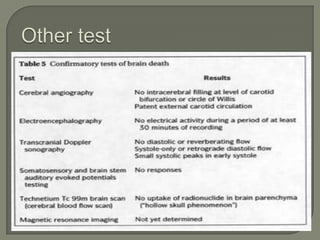
Other test
CONCLOSION
Is a clinical diagnosis which can be made
when there is complete and irreversible
cessation of all brain function.
 Since, it is now technically possible to
sustain cardiac, circulatory respiratory and
other organ function after the brain has
ceased to be alive, a diagnosis of brain
death can be made before the heart beat
stops.
The diagnosis of brain death is based
primarily on clinical criteria. A confirmatory
laboratory test may be done to supplement
the clinical diagnosis.
The presence of sedative drugs, hypothermia,
shock, or other potentially reversible conditions
that may depress brain function must be excluded
for these clinical criteria to be valid:
 Body temperature must be 32.2 degree (90 degree
F) or higher.
 If barbiturates (are drugs that act as central
nervous system depressants) are present in the
blood, or were used therapeutically for control of
intracranial pressure or seizures, serum levels
should not exceed 1 mg % at the time of the
clinical examination.
 Absence of severe hypotension (shock).
The clinical examination should be done
by a neurologist, neurosurgeon, or critical
care attending who is familiar with the
neurological examination and with these
criteria:
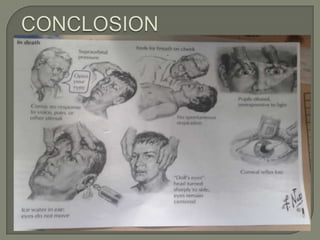
 Coma with cerebral unresponsitivity
 Apnea
 Absent brain stem reflexes
 Persistence of condition for 6 to 24 hours
The patient should be deeply comatose
with no movements, no withdrawal,
seizures, spontaneously or to noxious
stimulation. There may be spinal cord
reflexes.
Apnea, is an no breath, this results in a
lack of air movement into the lungs, and
cause oxygen levels in the blood to drop.
Divided into five tests or criteria
• Pupils - should be mid position in size (4
mm) or dilated in the absence of mydriatics
and unreactive to bright light or noxious
stimulation.
•
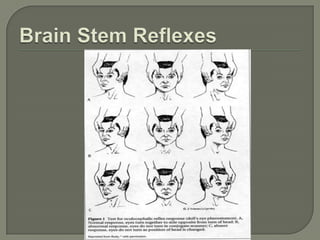
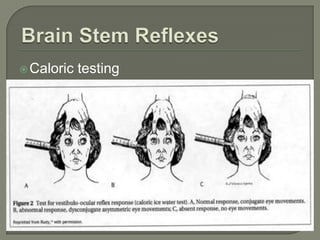
Eye movements - there should be no
spontaneous eye movements, and the
eyes should remain in the neutral position
on testing the occulocephalic and
occulovestibular reflexes. The
occulocephalic response is tested by rapid
rotation of the head to either side. In
eliciting the occulovestibular reflex, 20-30
ml of ice water are instilled into each ear
external auditory
Corneal Reflex - No blinking or eye
movement when the cornea is touched
lightly with cotton.
Gag Reflex - No gagging or coughing
when the oropharynx or trachea is
stimulated.
Caloric testing
The clinical examination may be repeated
after 12-24 hours. When there is a
structural brain damage and the diagnosis
is known with certainty, a shorter period of
observation is adequate if central nervous
system depressant drugs, metabolic and
anoxic causes have been excluded.
Although confirmatory tests are not
mandatory in most situations, additional
testing may be necessary for declaring
brain death in patients in whom the results
of specific components of clinical testing
cannot be reliably evaluated.
Brain death critiria

Brain death critiria

  • 1.
  • 2.
     Define  PREREQUISITES CLINICAL CRITERIA Duration of Observation Other test CONCLOSION
  • 3.
    Is a clinicaldiagnosis which can be made when there is complete and irreversible cessation of all brain function.  Since, it is now technically possible to sustain cardiac, circulatory respiratory and other organ function after the brain has ceased to be alive, a diagnosis of brain death can be made before the heart beat stops.
  • 4.
    The diagnosis ofbrain death is based primarily on clinical criteria. A confirmatory laboratory test may be done to supplement the clinical diagnosis.
  • 5.
    The presence ofsedative drugs, hypothermia, shock, or other potentially reversible conditions that may depress brain function must be excluded for these clinical criteria to be valid:  Body temperature must be 32.2 degree (90 degree F) or higher.  If barbiturates (are drugs that act as central nervous system depressants) are present in the blood, or were used therapeutically for control of intracranial pressure or seizures, serum levels should not exceed 1 mg % at the time of the clinical examination.  Absence of severe hypotension (shock).
  • 6.
    The clinical examinationshould be done by a neurologist, neurosurgeon, or critical care attending who is familiar with the neurological examination and with these criteria:  Coma with cerebral unresponsitivity  Apnea  Absent brain stem reflexes  Persistence of condition for 6 to 24 hours
  • 7.
    The patient shouldbe deeply comatose with no movements, no withdrawal, seizures, spontaneously or to noxious stimulation. There may be spinal cord reflexes.
  • 8.
    Apnea, is anno breath, this results in a lack of air movement into the lungs, and cause oxygen levels in the blood to drop.
  • 9.
    Divided into fivetests or criteria • Pupils - should be mid position in size (4 mm) or dilated in the absence of mydriatics and unreactive to bright light or noxious stimulation. •
  • 10.
    Eye movements -there should be no spontaneous eye movements, and the eyes should remain in the neutral position on testing the occulocephalic and occulovestibular reflexes. The occulocephalic response is tested by rapid rotation of the head to either side. In eliciting the occulovestibular reflex, 20-30 ml of ice water are instilled into each ear external auditory
  • 12.
    Corneal Reflex -No blinking or eye movement when the cornea is touched lightly with cotton. Gag Reflex - No gagging or coughing when the oropharynx or trachea is stimulated.
  • 13.
  • 14.
    The clinical examinationmay be repeated after 12-24 hours. When there is a structural brain damage and the diagnosis is known with certainty, a shorter period of observation is adequate if central nervous system depressant drugs, metabolic and anoxic causes have been excluded.
  • 15.
    Although confirmatory testsare not mandatory in most situations, additional testing may be necessary for declaring brain death in patients in whom the results of specific components of clinical testing cannot be reliably evaluated.