Traumatic brain injury
Dr jigar j. mehta
Critical care consultant
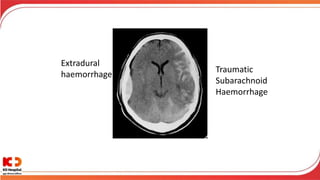
Extradural
haemorrhage
Traumatic
Subarachnoid
Haemorrhage
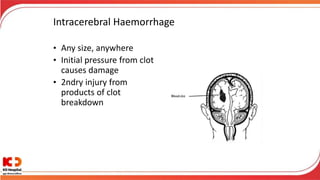
Intracerebral Haemorrhage
• Any size, anywhere
• Initial pressure from clot
causes damage
• 2ndry injury from
products of clot
breakdown
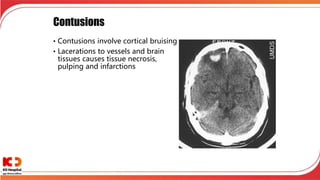
Contusions
• Contusions involve cortical bruising
• Lacerations to vessels and brain
tissues causes tissue necrosis,
pulping and infarctions
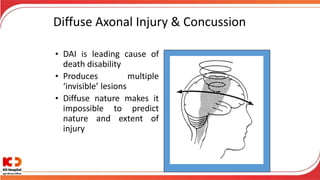
Diffuse Axonal Injury & Concussion
• DAI is leading cause of
death disability
• Produces multiple
‘invisible’ lesions
• Diffuse nature makes it
impossible to predict
nature and extent of
injury
Pathophysiologic types
• Primary (occurs at time of impact, irreversible)
• Secondary (changes developing after impact, potentially
preventable)
Primary Effects of Brain Injury
______________________________________________________
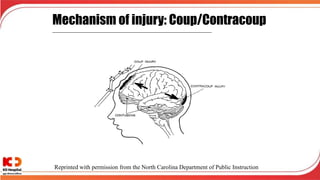
• Injury to brain tissue at the initial site of impact and at
the second injury site (Coup & Contracoup)
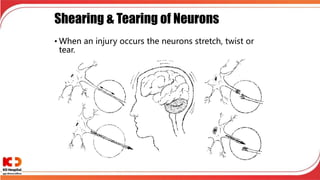
• Shearing and tearing of neurons throughout the brain
disrupts communication
Mechanism of injury: Coup/Contracoup
______________________________________________________
Reprinted with permission from the North Carolina Department of Public Instruction
Shearing & Tearing of Neurons
• When an injury occurs the neurons stretch, twist or
tear.
Mild, Moderate, Severe
______________________________________________________
• Injuries can range from “mild” (a brief change in mental
functioning) to “severe” (extended period of
unconsciousness)
• Significant long-term disability.
• Full effects of brain injury may not be apparent until later
when the child is expected to perform more advanced skills
and to self-regulate behavior.
Severity of Brain Injury: Mild
______________________________________________________
• Brief or no loss of consciousness
• Signs of concussion
• Nausea and vomiting
• Headache
• Fatigue
• Dizziness
• Poor recent memory
• Unable to form new memories following the injury
(less than 1 hour)
Severity of Brain Injury: Moderate
______________________________________________________
• Coma less than 24 hours
• Unable to form new memories following the injury (less than
24 hours)
Severity of Brain Injury: Severe
_______________________________________________________
• Coma more than 24 hours
• Unable to form new memories following the injury (longer
than 24 hours)
No one aim need
to see surrounding
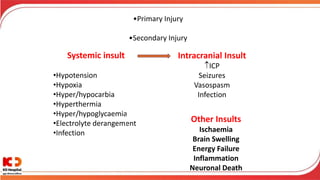
Systemic insult
•Hypotension
•Hypoxia
•Hyper/hypocarbia
•Hyperthermia
•Hyper/hypoglycaemia
•Electrolyte derangement
•Infection
Intracranial Insult
ICP
Seizures
Vasospasm
Infection
Other Insults
Ischaemia
Brain Swelling
Energy Failure
Inflammation
Neuronal Death
•Primary Injury
•Secondary Injury
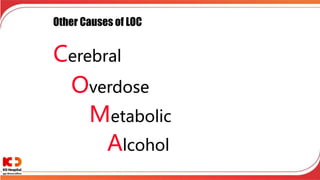
Other Causes of LOC
Cerebral
Overdose
Metabolic
Alcohol
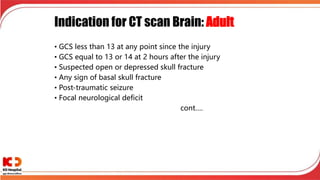
Indication for CT scan Brain: Adult
• GCS less than 13 at any point since the injury
• GCS equal to 13 or 14 at 2 hours after the injury
• Suspected open or depressed skull fracture
• Any sign of basal skull fracture
• Post-traumatic seizure
• Focal neurological deficit
cont….
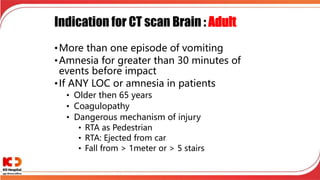
Indication for CT scan Brain : Adult
•More than one episode of vomiting
•Amnesia for greater than 30 minutes of
events before impact
•If ANY LOC or amnesia in patients
• Older then 65 years
• Coagulopathy
• Dangerous mechanism of injury
• RTA as Pedestrian
• RTA: Ejected from car
• Fall from > 1meter or > 5 stairs
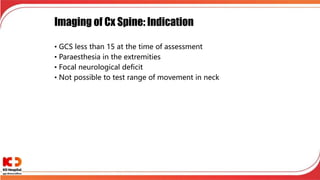
Imaging of Cx Spine: Indication
• GCS less than 15 at the time of assessment
• Paraesthesia in the extremities
• Focal neurological deficit
• Not possible to test range of movement in neck
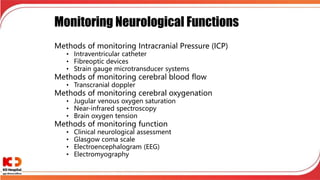
Monitoring Neurological Functions
Methods of monitoring Intracranial Pressure (ICP)
• Intraventricular catheter
• Fibreoptic devices
• Strain gauge microtransducer systems
Methods of monitoring cerebral blood flow
• Transcranial doppler
Methods of monitoring cerebral oxygenation
• Jugular venous oxygen saturation
• Near-infrared spectroscopy
• Brain oxygen tension
Methods of monitoring function
• Clinical neurological assessment
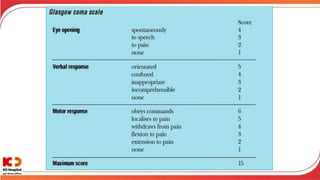
• Glasgow coma scale
• Electroencephalogram (EEG)
• Electromyography
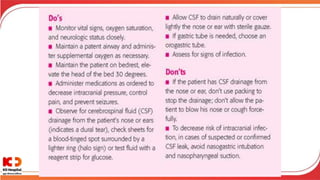
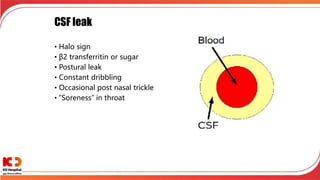
CSF leak
• Halo sign
• β2 transferritin or sugar
• Postural leak
• Constant dribbling
• Occasional post nasal trickle
• “Soreness” in throat
Initial Management of Severe Head Injury
• Undress the patient…..Completely
• A – Airway = Intubation / Tracheostomy
• B - Breathing + ventilator
• C - Circulation
• Replace lost blood volume
• Fix hypotension (< 90 mm Hg = bad)
• Fix hypoxia (< 60% SpO2 = bad)
• Hard Cervical Collar
• CT scan head (+/- body) when stable
• Primary assessment while pt is being
stabilized (includes plain spine X-Rays)
Points Of Interest
• Cerebral Dehydration (Anti edema measures)
• Steroids
• Seizure Prophylaxis
• Post Traumatic Amnesia
• ICP control
• Goal oriented activity
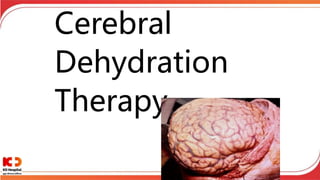
Cerebral
Dehydration
Therapy
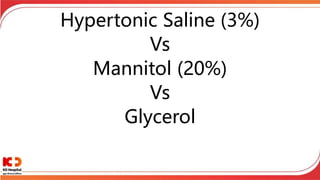
Hypertonic Saline (3%)
Vs
Mannitol (20%)
Vs
Glycerol
How It Works??
•Raising plasma osmolality from
310 mOsm/kgH2O to 344 mOsm/kgH2O can
shrink the brain by 10%, with half of the
shrinkage occurring in 12 minutes.
•Mannitol also reduces blood
viscosity [SURGICAL NEUROLOGY; Andrews,RJ;
39(3):218-222 (1993)] and oxidative damage.
•0.25-2 gm/kg body weight as 15-25%
solution
•Should be given fast over 20-30 minutes to
achieve peak effect
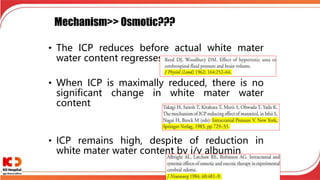
Mechanism>> Osmotic???
• The ICP reduces before actual white mater
water content regresses
• When ICP is maximally reduced, there is no
significant change in white mater water
content
• ICP remains high, despite of reduction in
white mater water content by i/v albumin
What is Ideal??
• Glycerol can be administered orally
• Long term Rebound edema
• >20% concentration Hemolysis
• BBB actively extrudes sodium, so less chance of
rebound edema with HS
• After initial dose (n=??) of mannitol causing brain
dehydration, repeated doses exacerbates edema
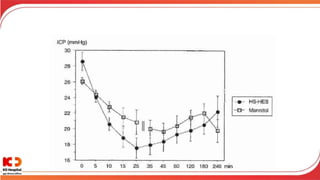
When given in an equimolar, rapid,
HSD reduces intracranial pressure more
than mannitol.
[Crit Care Med. 2005 Jan ;33:196-202; discussion
15644669]
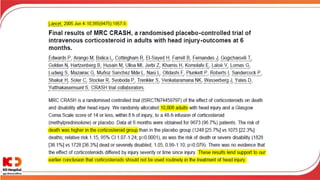
NO Role of
steroids in TBI
TBI
Post
Traumatic
Seizures
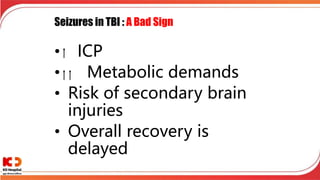
Seizures in TBI : A Bad Sign
• ICP
• Metabolic demands
• Risk of secondary brain
injuries
• Overall recovery is
delayed
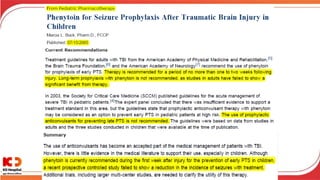
Current Concept (NOT Guideline)
• Immediate onset seizure following injury does not mean
seizure disorders
• Prophylactic AED is not necessary
• Post traumatic status epilepticus is rare
• Those who did not have seizures in early 7-8 days don’t
require long term prophylaxis
• Normal scalp EEG does no rule out seizure risk
How to
treat Head
Injury
(SEVERE)
ICP
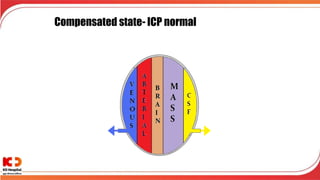
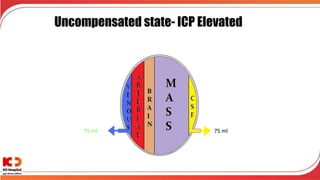
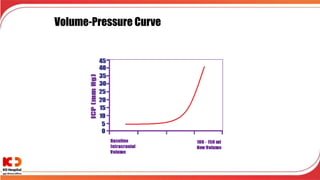
• After a brain injury the skull may become over full with
swollen brain tissue, blood or CSF
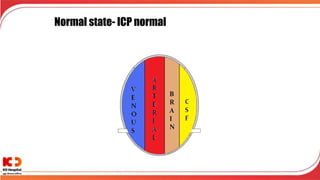
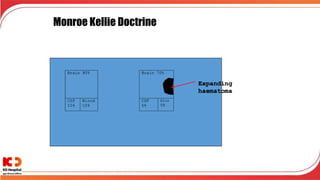
• Monroe Kellie Doctrine
• Increase in the volume of one
compartment must be offset by a decrease
in the volume of another compartment
• Total volume stays the same
Normal state- ICP normal
Compensated state- ICP normal
Uncompensated state- ICP Elevated
75 ml 75 ml
Volume-Pressure Curve
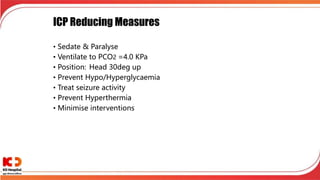
ICP Reducing Measures
• Sedate & Paralyse
• Ventilate to PCO2 =4.0 KPa
• Position: Head 30deg up
• Prevent Hypo/Hyperglycaemia
• Treat seizure activity
• Prevent Hyperthermia
• Minimise interventions
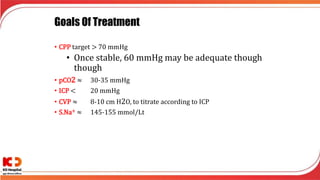
Goals Of Treatment
• CPP target > 70 mmHg
• Once stable, 60 mmHg may be adequate though
though
• pCO2 ≈ 30-35 mmHg
• ICP < 20 mmHg
• CVP ≈ 8-10 cm H2O, to titrate according to ICP
• S.Na+ ≈ 145-155 mmol/Lt
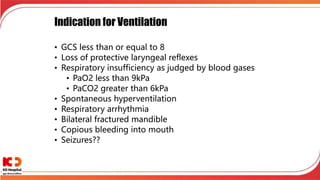
Indication for Ventilation
• GCS less than or equal to 8
• Loss of protective laryngeal reflexes
• Respiratory insufficiency as judged by blood gases
• PaO2 less than 9kPa
• PaCO2 greater than 6kPa
• Spontaneous hyperventilation
• Respiratory arrhythmia
• Bilateral fractured mandible
• Copious bleeding into mouth
• Seizures??
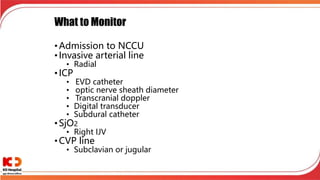
What to Monitor
• Admission to NCCU
• Invasive arterial line
• Radial
• ICP
• EVD catheter
• optic nerve sheath diameter
• Transcranial doppler
• Digital transducer
• Subdural catheter
• SjO2
• Right IJV
• CVP line
• Subclavian or jugular
Pre treatment
Before escalating vigorous medical management
• Remove any “significant” mass lesion
• Drain few ml CSF
• Jump to phase I of medical treatment
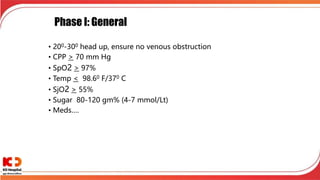
Phase I: General
• 200-300 head up, ensure no venous obstruction
• CPP > 70 mm Hg
• SpO2 > 97%
• Temp < 98.60 F/370 C
• SjO2 > 55%
• Sugar 80-120 gm% (4-7 mmol/Lt)
• Meds….
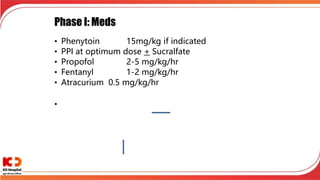
Phase I: Meds
• Phenytoin 15mg/kg if indicated
• PPI at optimum dose + Sucralfate
• Propofol 2-5 mg/kg/hr
• Fentanyl 1-2 mg/kg/hr
• Atracurium 0.5 mg/kg/hr
•
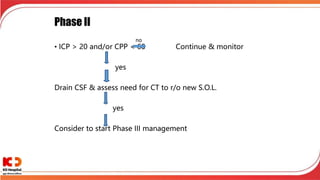
Phase II
• ICP > 20 and/or CPP < 60 Continue & monitor
yes
Drain CSF & assess need for CT to r/o new S.O.L.
yes
Consider to start Phase III management
no
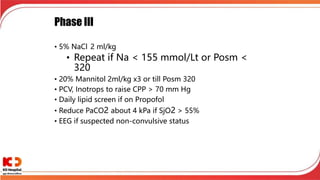
Phase III
• 5% NaCl 2 ml/kg
• Repeat if Na < 155 mmol/Lt or Posm <
320
• 20% Mannitol 2ml/kg x3 or till Posm 320
• PCV, Inotrops to raise CPP > 70 mm Hg
• Daily lipid screen if on Propofol
• Reduce PaCO2 about 4 kPa if SjO2 > 55%
• EEG if suspected non-convulsive status
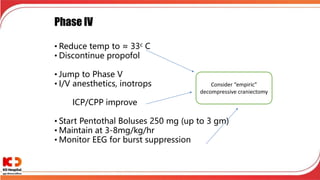
Phase IV
• Reduce temp to ≈ 33c C
• Discontinue propofol
• Jump to Phase V
• I/V anesthetics, inotrops
ICP/CPP improve
• Start Pentothal Boluses 250 mg (up to 3 gm)
• Maintain at 3-8mg/kg/hr
• Monitor EEG for burst suppression
Consider “empiric”
decompressive craniectomy
Monroe Kellie Doctrine
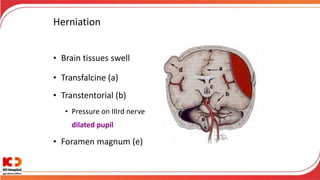
Herniation
• Brain tissues swell
• Transfalcine (a)
• Transtentorial (b)
• Pressure on IIIrd nerve
dilated pupil
• Foramen magnum (e)
Why measure ICP?
• Major cause of secondary injury
• Some evidence that keeping ICP < 20 improves outcome
• May be first indicator of something serious happening eg
clot enlarging
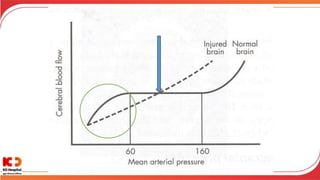
What about CPP?
• CPP: Cerebral Perfusion Pressure
• CPP = MAP – ICP
• Low perfusion causes ischaemia of brain &
secondary injury
• Aim for CPP > 60
• If low …
•Increase MAP
•Decrease ICP
………. Or both
How to increase BP?
• Increase fluid volume
• Use drugs
• Noradrenaline
• Dopamine
How to decrease ICP?
• Remove space occupying lesion
• Head-up 30° (imroves venous drainage)
• Decrease metabolism of brain
(Vasoconstriction from metabolic
autoregulation)
• Decrease brain blood volume
(Vasoconstriction from hyperventilation)
• Decrease brain water (Mannitol, hypertonic
saline)
• Decrease CSF volume (EVD)
• Open the skull to give more room
(Craniectomy)
Decrease Brain Metabolism
• Sedation
• Morphine, midazolam,Propofol
• Barbiturates
• Paralysis
• Stops muscle activity
• Cooling
• Effective to mild levels – 34 to 35 degrees
• Problems with infections and bleeding
Decrease Brain Volume
• Hyperosmotic diuresis
• Mannitol
• Hypertonic saline – in favour now
• Drain CSF
• Need ventricular catheter in place
• Raise Head of Bed/Check neck is free
• Reduces venous congestion
• Hyperventilation
• Low CO2 causes constriction of vessels
• Only use as last resort because also causes
ischaemia
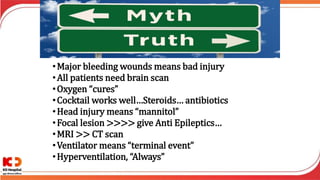
•Major bleeding wounds means bad injury
•All patients need brain scan
•Oxygen “cures”
•Cocktail works well…Steroids… antibiotics
•Head injury means “mannitol”
•Focal lesion >>>> give Anti Epileptics…
•MRI >> CT scan
•Ventilator means “terminal event”
•Hyperventilation, “Always”
Traumatic brain injury [Autosaved].pptx

Traumatic brain injury [Autosaved].pptx

  • 1.
    Traumatic brain injury Drjigar j. mehta Critical care consultant
  • 3.
  • 4.
    Intracerebral Haemorrhage • Anysize, anywhere • Initial pressure from clot causes damage • 2ndry injury from products of clot breakdown
  • 5.
    Contusions • Contusions involvecortical bruising • Lacerations to vessels and brain tissues causes tissue necrosis, pulping and infarctions
  • 6.
    Diffuse Axonal Injury& Concussion • DAI is leading cause of death disability • Produces multiple ‘invisible’ lesions • Diffuse nature makes it impossible to predict nature and extent of injury
  • 7.
    Pathophysiologic types • Primary(occurs at time of impact, irreversible) • Secondary (changes developing after impact, potentially preventable)
  • 8.
    Primary Effects ofBrain Injury ______________________________________________________ • Injury to brain tissue at the initial site of impact and at the second injury site (Coup & Contracoup) • Shearing and tearing of neurons throughout the brain disrupts communication
  • 9.
    Mechanism of injury:Coup/Contracoup ______________________________________________________ Reprinted with permission from the North Carolina Department of Public Instruction
  • 10.
    Shearing & Tearingof Neurons • When an injury occurs the neurons stretch, twist or tear.
  • 11.
    Mild, Moderate, Severe ______________________________________________________ •Injuries can range from “mild” (a brief change in mental functioning) to “severe” (extended period of unconsciousness) • Significant long-term disability. • Full effects of brain injury may not be apparent until later when the child is expected to perform more advanced skills and to self-regulate behavior.
  • 12.
    Severity of BrainInjury: Mild ______________________________________________________ • Brief or no loss of consciousness • Signs of concussion • Nausea and vomiting • Headache • Fatigue • Dizziness • Poor recent memory • Unable to form new memories following the injury (less than 1 hour)
  • 13.
    Severity of BrainInjury: Moderate ______________________________________________________ • Coma less than 24 hours • Unable to form new memories following the injury (less than 24 hours)
  • 14.
    Severity of BrainInjury: Severe _______________________________________________________ • Coma more than 24 hours • Unable to form new memories following the injury (longer than 24 hours)
  • 15.
    No one aimneed to see surrounding
  • 16.
    Systemic insult •Hypotension •Hypoxia •Hyper/hypocarbia •Hyperthermia •Hyper/hypoglycaemia •Electrolyte derangement •Infection IntracranialInsult ICP Seizures Vasospasm Infection Other Insults Ischaemia Brain Swelling Energy Failure Inflammation Neuronal Death •Primary Injury •Secondary Injury
  • 17.
    Other Causes ofLOC Cerebral Overdose Metabolic Alcohol
  • 19.
    Indication for CTscan Brain: Adult • GCS less than 13 at any point since the injury • GCS equal to 13 or 14 at 2 hours after the injury • Suspected open or depressed skull fracture • Any sign of basal skull fracture • Post-traumatic seizure • Focal neurological deficit cont….
  • 20.
    Indication for CTscan Brain : Adult •More than one episode of vomiting •Amnesia for greater than 30 minutes of events before impact •If ANY LOC or amnesia in patients • Older then 65 years • Coagulopathy • Dangerous mechanism of injury • RTA as Pedestrian • RTA: Ejected from car • Fall from > 1meter or > 5 stairs
  • 21.
    Imaging of CxSpine: Indication • GCS less than 15 at the time of assessment • Paraesthesia in the extremities • Focal neurological deficit • Not possible to test range of movement in neck
  • 22.
    Monitoring Neurological Functions Methodsof monitoring Intracranial Pressure (ICP) • Intraventricular catheter • Fibreoptic devices • Strain gauge microtransducer systems Methods of monitoring cerebral blood flow • Transcranial doppler Methods of monitoring cerebral oxygenation • Jugular venous oxygen saturation • Near-infrared spectroscopy • Brain oxygen tension Methods of monitoring function • Clinical neurological assessment • Glasgow coma scale • Electroencephalogram (EEG) • Electromyography
  • 25.
    CSF leak • Halosign • β2 transferritin or sugar • Postural leak • Constant dribbling • Occasional post nasal trickle • “Soreness” in throat
  • 26.
    Initial Management ofSevere Head Injury • Undress the patient…..Completely • A – Airway = Intubation / Tracheostomy • B - Breathing + ventilator • C - Circulation • Replace lost blood volume • Fix hypotension (< 90 mm Hg = bad) • Fix hypoxia (< 60% SpO2 = bad) • Hard Cervical Collar • CT scan head (+/- body) when stable • Primary assessment while pt is being stabilized (includes plain spine X-Rays)
  • 27.
    Points Of Interest •Cerebral Dehydration (Anti edema measures) • Steroids • Seizure Prophylaxis • Post Traumatic Amnesia • ICP control • Goal oriented activity
  • 28.
  • 29.
  • 30.
    How It Works?? •Raisingplasma osmolality from 310 mOsm/kgH2O to 344 mOsm/kgH2O can shrink the brain by 10%, with half of the shrinkage occurring in 12 minutes. •Mannitol also reduces blood viscosity [SURGICAL NEUROLOGY; Andrews,RJ; 39(3):218-222 (1993)] and oxidative damage. •0.25-2 gm/kg body weight as 15-25% solution •Should be given fast over 20-30 minutes to achieve peak effect
  • 31.
    Mechanism>> Osmotic??? • TheICP reduces before actual white mater water content regresses • When ICP is maximally reduced, there is no significant change in white mater water content • ICP remains high, despite of reduction in white mater water content by i/v albumin
  • 33.
    What is Ideal?? •Glycerol can be administered orally • Long term Rebound edema • >20% concentration Hemolysis • BBB actively extrudes sodium, so less chance of rebound edema with HS • After initial dose (n=??) of mannitol causing brain dehydration, repeated doses exacerbates edema When given in an equimolar, rapid, HSD reduces intracranial pressure more than mannitol. [Crit Care Med. 2005 Jan ;33:196-202; discussion 15644669]
  • 34.
  • 36.
  • 37.
    Seizures in TBI: A Bad Sign • ICP • Metabolic demands • Risk of secondary brain injuries • Overall recovery is delayed
  • 39.
    Current Concept (NOTGuideline) • Immediate onset seizure following injury does not mean seizure disorders • Prophylactic AED is not necessary • Post traumatic status epilepticus is rare • Those who did not have seizures in early 7-8 days don’t require long term prophylaxis • Normal scalp EEG does no rule out seizure risk
  • 40.
  • 41.
    ICP • After abrain injury the skull may become over full with swollen brain tissue, blood or CSF • Monroe Kellie Doctrine • Increase in the volume of one compartment must be offset by a decrease in the volume of another compartment • Total volume stays the same
  • 42.
  • 43.
  • 44.
    Uncompensated state- ICPElevated 75 ml 75 ml
  • 45.
  • 46.
    ICP Reducing Measures •Sedate & Paralyse • Ventilate to PCO2 =4.0 KPa • Position: Head 30deg up • Prevent Hypo/Hyperglycaemia • Treat seizure activity • Prevent Hyperthermia • Minimise interventions
  • 47.
    Goals Of Treatment •CPP target > 70 mmHg • Once stable, 60 mmHg may be adequate though though • pCO2 ≈ 30-35 mmHg • ICP < 20 mmHg • CVP ≈ 8-10 cm H2O, to titrate according to ICP • S.Na+ ≈ 145-155 mmol/Lt
  • 48.
    Indication for Ventilation •GCS less than or equal to 8 • Loss of protective laryngeal reflexes • Respiratory insufficiency as judged by blood gases • PaO2 less than 9kPa • PaCO2 greater than 6kPa • Spontaneous hyperventilation • Respiratory arrhythmia • Bilateral fractured mandible • Copious bleeding into mouth • Seizures??
  • 49.
    What to Monitor •Admission to NCCU • Invasive arterial line • Radial • ICP • EVD catheter • optic nerve sheath diameter • Transcranial doppler • Digital transducer • Subdural catheter • SjO2 • Right IJV • CVP line • Subclavian or jugular
  • 50.
    Pre treatment Before escalatingvigorous medical management • Remove any “significant” mass lesion • Drain few ml CSF • Jump to phase I of medical treatment
  • 51.
    Phase I: General •200-300 head up, ensure no venous obstruction • CPP > 70 mm Hg • SpO2 > 97% • Temp < 98.60 F/370 C • SjO2 > 55% • Sugar 80-120 gm% (4-7 mmol/Lt) • Meds….
  • 52.
    Phase I: Meds •Phenytoin 15mg/kg if indicated • PPI at optimum dose + Sucralfate • Propofol 2-5 mg/kg/hr • Fentanyl 1-2 mg/kg/hr • Atracurium 0.5 mg/kg/hr •
  • 53.
    Phase II • ICP> 20 and/or CPP < 60 Continue & monitor yes Drain CSF & assess need for CT to r/o new S.O.L. yes Consider to start Phase III management no
  • 54.
    Phase III • 5%NaCl 2 ml/kg • Repeat if Na < 155 mmol/Lt or Posm < 320 • 20% Mannitol 2ml/kg x3 or till Posm 320 • PCV, Inotrops to raise CPP > 70 mm Hg • Daily lipid screen if on Propofol • Reduce PaCO2 about 4 kPa if SjO2 > 55% • EEG if suspected non-convulsive status
  • 55.
    Phase IV • Reducetemp to ≈ 33c C • Discontinue propofol • Jump to Phase V • I/V anesthetics, inotrops ICP/CPP improve • Start Pentothal Boluses 250 mg (up to 3 gm) • Maintain at 3-8mg/kg/hr • Monitor EEG for burst suppression Consider “empiric” decompressive craniectomy
  • 56.
  • 57.
    Herniation • Brain tissuesswell • Transfalcine (a) • Transtentorial (b) • Pressure on IIIrd nerve dilated pupil • Foramen magnum (e)
  • 58.
    Why measure ICP? •Major cause of secondary injury • Some evidence that keeping ICP < 20 improves outcome • May be first indicator of something serious happening eg clot enlarging
  • 59.
    What about CPP? •CPP: Cerebral Perfusion Pressure • CPP = MAP – ICP • Low perfusion causes ischaemia of brain & secondary injury • Aim for CPP > 60 • If low … •Increase MAP •Decrease ICP ………. Or both
  • 60.
    How to increaseBP? • Increase fluid volume • Use drugs • Noradrenaline • Dopamine
  • 61.
    How to decreaseICP? • Remove space occupying lesion • Head-up 30° (imroves venous drainage) • Decrease metabolism of brain (Vasoconstriction from metabolic autoregulation) • Decrease brain blood volume (Vasoconstriction from hyperventilation) • Decrease brain water (Mannitol, hypertonic saline) • Decrease CSF volume (EVD) • Open the skull to give more room (Craniectomy)
  • 62.
    Decrease Brain Metabolism •Sedation • Morphine, midazolam,Propofol • Barbiturates • Paralysis • Stops muscle activity • Cooling • Effective to mild levels – 34 to 35 degrees • Problems with infections and bleeding
  • 63.
    Decrease Brain Volume •Hyperosmotic diuresis • Mannitol • Hypertonic saline – in favour now • Drain CSF • Need ventricular catheter in place • Raise Head of Bed/Check neck is free • Reduces venous congestion • Hyperventilation • Low CO2 causes constriction of vessels • Only use as last resort because also causes ischaemia
  • 64.
    •Major bleeding woundsmeans bad injury •All patients need brain scan •Oxygen “cures” •Cocktail works well…Steroids… antibiotics •Head injury means “mannitol” •Focal lesion >>>> give Anti Epileptics… •MRI >> CT scan •Ventilator means “terminal event” •Hyperventilation, “Always”