Persentationby ;
Mr.Md Faizan Alam
Student Teacher
Maulana Azad National Urdu University,Hyderabad
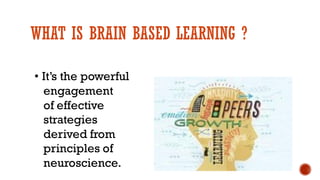
WHAT IS BRAIN BASED LEARNING ?
• It’s the powerful
engagement
of effective
strategies
derived from
principles of
neuroscience.
• Brain-based education is the"engagement of
Strategies based on principles derived from
an understanding of the brain”
•Brain-Based learning is a comprehensive approach to
instruction based on how current research
inneuroscience suggests our brain learns
naturally.
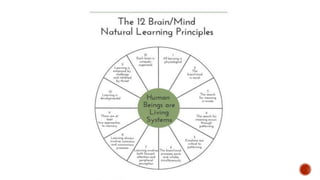
PRINCIPLES OF BRAIN BASED LEARNING
1. All learning is psychological.
2. The brain perceives whole
and parts simultaneously.
3 The brain is a parallel processor.
It can performseveral activities
at once.
4 Learning involved both focused
attention and peripheral
Perception.
5 Humans’ search for meaning is
innate.
6 The brain is Social.
7 Emotions are critical to
patterning, and drive ourattention,
meaning and memory.
8 We have at least two ways of organizing
memory :
* Spatial Memory System.
* A set of systems for Rote Learning.
9 Learning always involves conscious
and unconscious processes.
10 Learning is developmental.
11 Complex learning is enhanced by challenge
Treat associated with stress (helplessness).
12 Every brain in uniquely organized.
THREE INSTRUCTIONAL TECHNIQUES
Orchestrated immersion
Relaxed alertness
Active processing
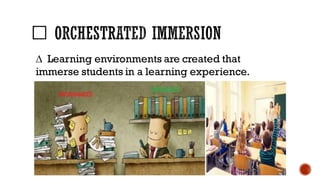
∆ Learning environments are created that
immerse students in a learning experience.
∆ An effort is made to eliminate fear while
maintaining a highly challenging environment.
∆ The learner consolidates and internalizes
Information by actively processing it.
In conclusion, brain-based learning strategies are an
excellent way to improve students’overall performance,
retention, and test-taking abilities.
As more and more educators and schools take the risks
and move to a more all-inclusive and creative
classroom environment, standardized testing will lose
importance and serve as a minor benchmark of achievement,
as opposed to its current status as the be all,
end all of an educator’s yearly performance review.
Brain based learning

Brain based learning

  • 1.
    Persentationby ; Mr.Md FaizanAlam Student Teacher Maulana Azad National Urdu University,Hyderabad
  • 2.
    WHAT IS BRAINBASED LEARNING ? • It’s the powerful engagement of effective strategies derived from principles of neuroscience.
  • 3.
    • Brain-based educationis the"engagement of Strategies based on principles derived from an understanding of the brain” •Brain-Based learning is a comprehensive approach to instruction based on how current research inneuroscience suggests our brain learns naturally.
  • 4.
    PRINCIPLES OF BRAINBASED LEARNING 1. All learning is psychological. 2. The brain perceives whole and parts simultaneously.
  • 5.
    3 The brainis a parallel processor. It can performseveral activities at once. 4 Learning involved both focused attention and peripheral Perception.
  • 6.
    5 Humans’ searchfor meaning is innate. 6 The brain is Social.
  • 7.
    7 Emotions arecritical to patterning, and drive ourattention, meaning and memory. 8 We have at least two ways of organizing memory : * Spatial Memory System. * A set of systems for Rote Learning.
  • 8.
    9 Learning alwaysinvolves conscious and unconscious processes. 10 Learning is developmental.
  • 9.
    11 Complex learningis enhanced by challenge Treat associated with stress (helplessness). 12 Every brain in uniquely organized.
  • 11.
    THREE INSTRUCTIONAL TECHNIQUES Orchestratedimmersion Relaxed alertness Active processing
  • 12.
    ∆ Learning environmentsare created that immerse students in a learning experience.
  • 13.
    ∆ An effortis made to eliminate fear while maintaining a highly challenging environment.
  • 14.
    ∆ The learnerconsolidates and internalizes Information by actively processing it.
  • 15.
    In conclusion, brain-basedlearning strategies are an excellent way to improve students’overall performance, retention, and test-taking abilities. As more and more educators and schools take the risks and move to a more all-inclusive and creative classroom environment, standardized testing will lose importance and serve as a minor benchmark of achievement, as opposed to its current status as the be all, end all of an educator’s yearly performance review.