Braille for visually impaired
persons
What Is Braille?
Braille is a system of raised dots that can be read with
the fingers by people who are blind or who have low
vision.
• Teachers, parents, and others who are not visually
impaired ordinarily read braille with their eyes.
• Braille is not a language. Rather, it is a code by which
many languages—such as English, Spanish, Arabic,
Chinese, and dozens of others—may be written and
read.
• Braille is used by thousands of people all over the
world in their native languages, and provides a
means of literacy for all.
What Does Braille Look Like?
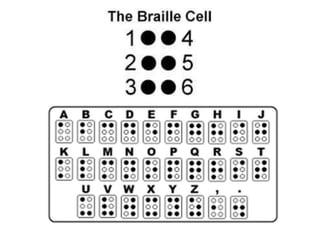
• Braille symbols are formed within units of space
known as braille cells.
• A full braille cell consists of six raised dots
arranged in two parallel rows each having three
dots.
• The dot positions are identified by numbers from
one through six. Sixty-four combinations are
possible using one or more of these six dots.
• A single cell can be used to represent an alphabet
letter, number, punctuation mark, or even a
whole word.
How Was Braille Invented?
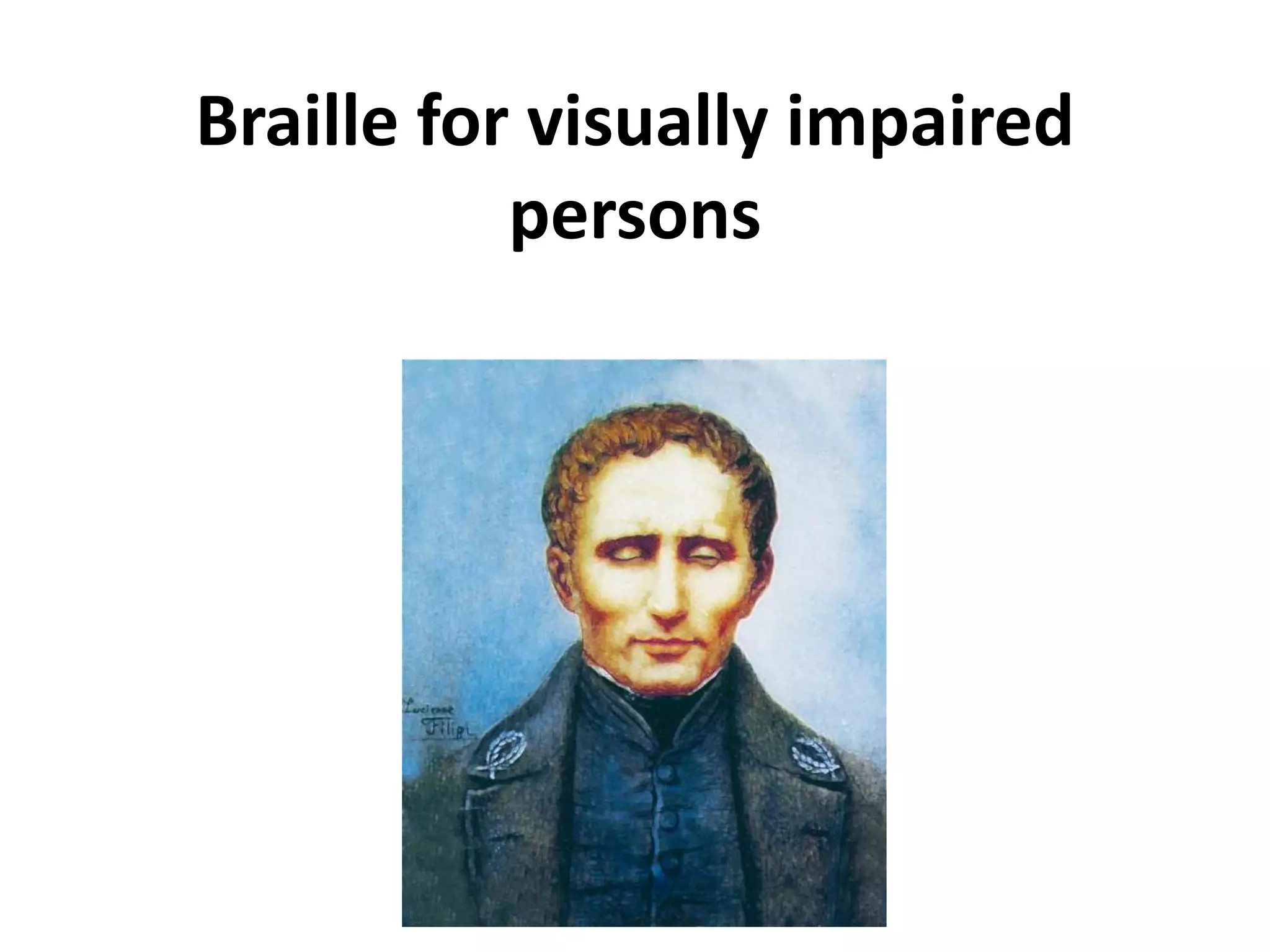
• Louis Braille was born in Coupvray, France, on January 4,
1809 became blind in childhood due to an accident.
• He attended the National Institute for Blind Youth in Paris,
France, as a student. At that time, books were created using
raised print which was laborious to produce, hard to read,
and difficult for individuals to write.
• While attending the Institute, Braille yearned for more books
to read. He experimented with ways to create an alphabet
that was easy to read with the fingertips.
• The writing system he invented, at age fifteen, evolved from
the tactile "Ecriture Nocturne" (night writing) code invented
by Charles Barbier for sending military messages that could
be read on the battlefield at night, without light. Braille
constructed a new method built specifically for the needs of
the blind in 1824.
Braille for visually impaired

Braille for visually impaired

  • 1.
    Braille for visuallyimpaired persons
  • 2.
    What Is Braille? Brailleis a system of raised dots that can be read with the fingers by people who are blind or who have low vision. • Teachers, parents, and others who are not visually impaired ordinarily read braille with their eyes. • Braille is not a language. Rather, it is a code by which many languages—such as English, Spanish, Arabic, Chinese, and dozens of others—may be written and read. • Braille is used by thousands of people all over the world in their native languages, and provides a means of literacy for all.
  • 3.
    What Does BrailleLook Like? • Braille symbols are formed within units of space known as braille cells. • A full braille cell consists of six raised dots arranged in two parallel rows each having three dots. • The dot positions are identified by numbers from one through six. Sixty-four combinations are possible using one or more of these six dots. • A single cell can be used to represent an alphabet letter, number, punctuation mark, or even a whole word.
  • 4.
    How Was BrailleInvented? • Louis Braille was born in Coupvray, France, on January 4, 1809 became blind in childhood due to an accident. • He attended the National Institute for Blind Youth in Paris, France, as a student. At that time, books were created using raised print which was laborious to produce, hard to read, and difficult for individuals to write. • While attending the Institute, Braille yearned for more books to read. He experimented with ways to create an alphabet that was easy to read with the fingertips. • The writing system he invented, at age fifteen, evolved from the tactile "Ecriture Nocturne" (night writing) code invented by Charles Barbier for sending military messages that could be read on the battlefield at night, without light. Braille constructed a new method built specifically for the needs of the blind in 1824.