Boundary Value
Testing
Venkatesh-Prasad Ranganath
Kansas State University
Normal Boundary Value
Testing (1 variable)
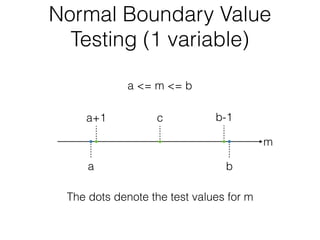
a <= m <= b
b-1
a b
a+1 c
m
The dots denote the test values for m
Normal Boundary Value
Testing (1 variable)
Given a <= m <= b,
• Test cases within limits
• m == a+1
• m == c (a < c < b)
• m == b-1
• Test cases at limits
• m == a
• m == b
Robust Boundary Value
Testing (1 variable)
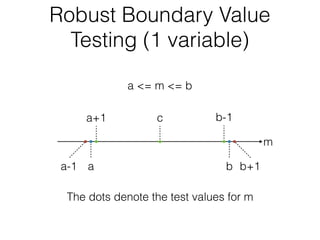
b-1
a <= m <= b
a b
a+1 c
a-1 b+1
m
The dots denote the test values for m
Robust Boundary Value
Testing (1 variable)
Given a <= m <= b,
• Test cases within limits
• m == a+1
• m == c (a < c < b)
• m == b-1
• Test cases at limits
• m == a
• m == b
• Test case beyond limits
• m == a-1
• m == b+1
a<=m<=b
c<=n<=d
d
c
a b
Normal Boundary Value
Testing (2 variables)
d
c
a b
Robust Boundary Value
Testing (2 variables)
a<=m<=b
c<=n<=d
Worst-case Boundary Value
Testing (2 variables)
d
c
a b
a<=m<=b
c<=n<=d
Robust Worst-case
Boundary Value Testing
d
c
a b
a<=m<=b
c<=n<=d
Boundary Value Testing
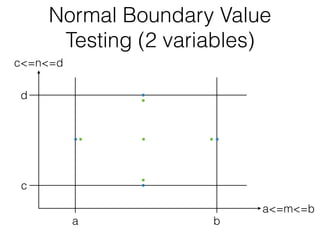
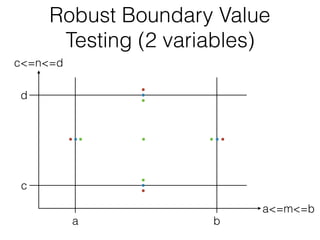
• Normal boundary value testing (including robust
variant) relies on the single-fault assumption
• failures are rarely the result of the simultaneous
occurrence of two (or more) faults
• To generate test cases, while holding all variables
at a valid value, consider valid and boundary
values for a variable
• 4n+1 (6n+1) test cases result from normal (robust)
boundary value testing where n is the number of
variables
Boundary Value Testing
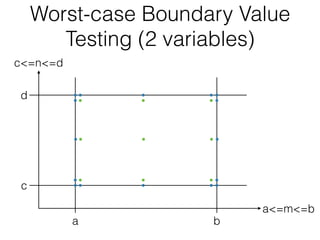
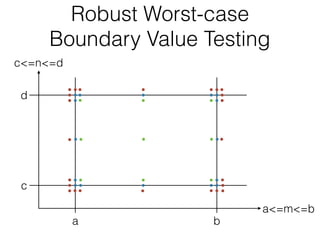
• Worst-case boundary value testing (including
robust variant) does not rely on the single-fault
assumption
• failures can result from simultaneous
occurrences of two (or more) faults
• To generate test cases, consider all combinations
of valid and boundary values for all variables
• 5n (7n) test cases result from worst-case (robust
worst-case) boundary value testing where n is the
number of variables
Limitations
• Does not consider the interactions of variables
(redundancy)
• May miss out on interesting parts of value ranges
(completeness)
• What about the specifications that do not
describe the output for invalid input?
• Too many tests in worst-case variants
• Works well with data types for which boundaries
can be well-defined.

Boundary Value Testing [7] - Software Testing Techniques (CIS640)

  • 1.
  • 2.
    Normal Boundary Value Testing(1 variable) a <= m <= b b-1 a b a+1 c m The dots denote the test values for m
  • 3.
    Normal Boundary Value Testing(1 variable) Given a <= m <= b, • Test cases within limits • m == a+1 • m == c (a < c < b) • m == b-1 • Test cases at limits • m == a • m == b
  • 4.
    Robust Boundary Value Testing(1 variable) b-1 a <= m <= b a b a+1 c a-1 b+1 m The dots denote the test values for m
  • 5.
    Robust Boundary Value Testing(1 variable) Given a <= m <= b, • Test cases within limits • m == a+1 • m == c (a < c < b) • m == b-1 • Test cases at limits • m == a • m == b • Test case beyond limits • m == a-1 • m == b+1
  • 6.
    a<=m<=b c<=n<=d d c a b Normal BoundaryValue Testing (2 variables)
  • 7.
    d c a b Robust BoundaryValue Testing (2 variables) a<=m<=b c<=n<=d
  • 8.
    Worst-case Boundary Value Testing(2 variables) d c a b a<=m<=b c<=n<=d
  • 9.
    Robust Worst-case Boundary ValueTesting d c a b a<=m<=b c<=n<=d
  • 10.
    Boundary Value Testing •Normal boundary value testing (including robust variant) relies on the single-fault assumption • failures are rarely the result of the simultaneous occurrence of two (or more) faults • To generate test cases, while holding all variables at a valid value, consider valid and boundary values for a variable • 4n+1 (6n+1) test cases result from normal (robust) boundary value testing where n is the number of variables
  • 11.
    Boundary Value Testing •Worst-case boundary value testing (including robust variant) does not rely on the single-fault assumption • failures can result from simultaneous occurrences of two (or more) faults • To generate test cases, consider all combinations of valid and boundary values for all variables • 5n (7n) test cases result from worst-case (robust worst-case) boundary value testing where n is the number of variables
  • 12.
    Limitations • Does notconsider the interactions of variables (redundancy) • May miss out on interesting parts of value ranges (completeness) • What about the specifications that do not describe the output for invalid input? • Too many tests in worst-case variants • Works well with data types for which boundaries can be well-defined.