Compatibility Testing 
using 
Patterns-based Trace Comparison 
Venkatesh-Prasad Ranganath, Kansas State University, USA 
Pradip Vallathol, University of Wisconsin-Madison, USA 
Pankaj Gupta, Microsoft Corporation, USA 
29th IEEE/ACM International Conference on 
Automated Software Engineering (ASE 2014) 
September 15 - 19, 2014 
Västerås, Sweden 
Thanks to Microsoft Research (India) and USB team (at Microsoft) for supporting this effort.
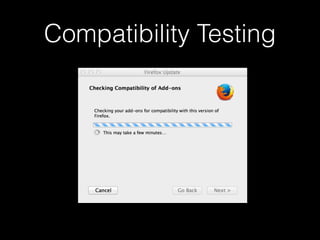
Compatibility Testing
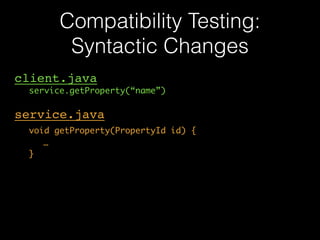
Compatibility Testing: 
Syntactic Changes 
client.java! 
! service.getProperty(“name”) 
! 
service.java! 
! void getProperty(PropertyId id) { 
… 
}!
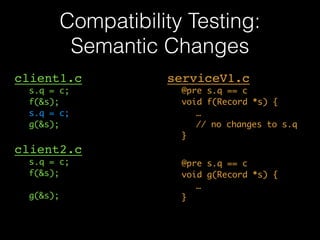
Compatibility Testing: 
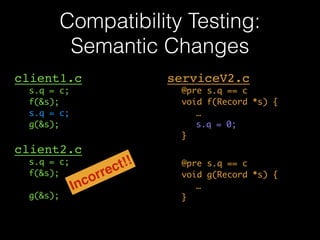
Semantic Changes 
client1.c! 
! s.q = c; 
f(&s); 
s.q = c; 
g(&s); 
! 
client2.c! 
! s.q = c; 
f(&s); 
! 
g(&s); 
! 
serviceV1.c! 
@pre s.q == c 
void f(Record *s) { 
… 
// no changes to s.q 
} 
! 
@pre s.q == c 
void g(Record *s) { 
… 
}
Compatibility Testing: 
Semantic Changes 
client1.c! 
! s.q = c; 
f(&s); 
s.q = c; 
g(&s); 
! 
client2.c! 
! s.q = c; 
f(&s); 
! 
g(&s); 
! 
serviceV2.c! 
@pre s.q == c 
void f(Record *s) { 
… 
s.q = 0; 
} 
! 
@pre s.q == c 
void g(Record *s) { 
… 
} 
Incorrect!!
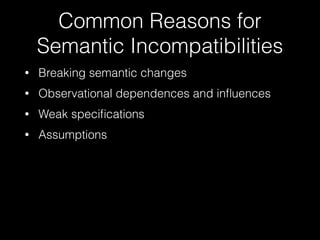
Common Reasons for 
Semantic Incompatibilities 
• Breaking semantic changes 
• Observational dependences and influences 
• Weak specifications 
• Assumptions
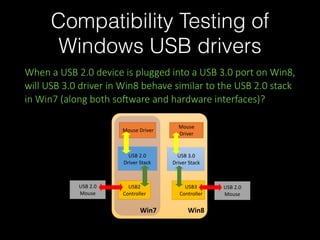
Compatibility Testing of 
Windows USB drivers 
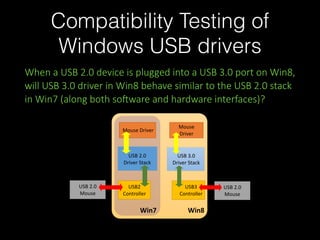
When a USB 2.0 device is plugged into a USB 3.0 port on Win8, 
will USB 3.0 driver in Win8 behave similar to the USB 2.0 stack 
in Win7 (along both soBware and hardware interfaces)? 
Mouse 
Driver 
USB 
3.0 
Driver 
Stack 
USB3 
Controller 
Win8 
Mouse 
Driver 
USB 
2.0 
Driver 
Stack 
USB2 
Controller 
Win7 
USB 
2.0 
Mouse 
USB 
2.0 
Mouse
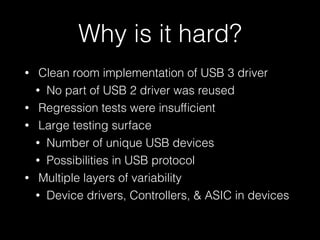
Why is it hard? 
• Clean room implementation of USB 3 driver 
• No part of USB 2 driver was reused 
• Regression tests were insufficient 
• Large testing surface 
• Number of unique USB devices 
• Possibilities in USB protocol 
• Multiple layers of variability 
• Device drivers, Controllers, & ASIC in devices
Compatibility Testing of 
Windows USB drivers 
When a USB 2.0 device is plugged into a USB 3.0 port on Win8, 
will USB 3.0 driver in Win8 behave similar to the USB 2.0 stack 
in Win7 (along both soBware and hardware interfaces)? 
Mouse 
Driver 
USB 
3.0 
Driver 
Stack 
USB3 
Controller 
Win8 
Mouse 
Driver 
USB 
2.0 
Driver 
Stack 
USB2 
Controller 
Win7 
USB 
2.0 
Mouse 
USB 
2.0 
Mouse
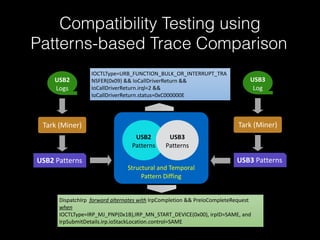
Compatibility Testing using 
Patterns-based Trace Comparison 
USB2 
Logs 
Tark 
(Miner) 
USB2 
Patterns 
USB3 
Log 
Tark 
(Miner) 
USB3 
Patterns 
IOCTLType=URB_FUNCTION_BULK_OR_INTERRUPT_TRA 
NSFER(0x09) 
&& 
IoCallDriverReturn 
&& 
IoCallDriverReturn.irql=2 
&& 
IoCallDriverReturn.status=0xC000000E 
USB2 
Patterns 
USB3 
Patterns 
Structural 
and 
Temporal 
Pattern 
Diffing 
DispatchIrp 
forward 
alternates 
with 
IrpCompletion 
&& 
PreIoCompleteRequest 
when 
IOCTLType=IRP_MJ_PNP(0x1B),IRP_MN_START_DEVICE(0x00), 
irpID=SAME, 
and 
IrpSubmitDetails.irp.ioStackLocation.control=SAME
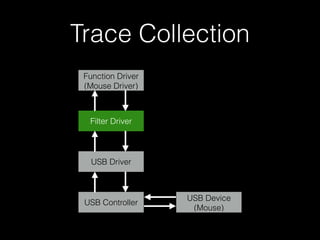
Trace Collection 
Function Driver 
(Mouse Driver) 
Filter Driver 
USB Driver 
USB Controller 
USB Device 
(Mouse)
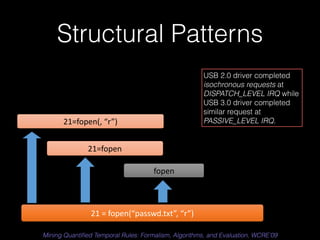
Structural Patterns 
fopen 
21=fopen(, 
“r”) 
21=fopen 
21 
= 
fopen(“passwd.txt”, 
“r”) 
USB 2.0 driver completed 
isochronous requests at 
DISPATCH_LEVEL IRQ while 
USB 3.0 driver completed 
similar request at 
PASSIVE_LEVEL IRQ. 
Mining Quantified Temporal Rules: Formalism, Algorithms, and Evaluation, WCRE’09
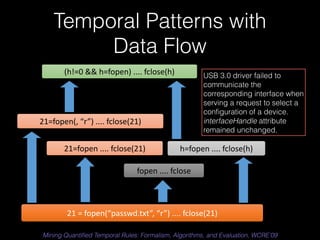
Temporal Patterns with 
Data Flow 
USB 3.0 driver failed to 
communicate the 
corresponding interface when 
serving a request to select a 
configuration of a device. 
interfaceHandle attribute 
remained unchanged. 
h=fopen 
.... 
fclose(h) 
(h!=0 
&& 
h=fopen) 
.... 
fclose(h) 
21=fopen(, 
“r”) 
.... 
fclose(21) 
21=fopen 
.... 
fclose(21) 
fopen 
.... 
fclose 
21 
= 
fopen(“passwd.txt”, 
“r”) 
.... 
fclose(21) 
Mining Quantified Temporal Rules: Formalism, Algorithms, and Evaluation, WCRE’09
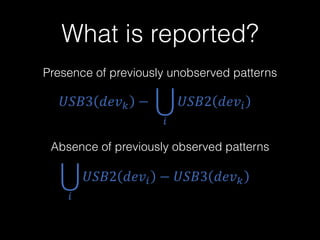
What is reported? 
Presence of previously unobserved patterns 
! 
! 
Absence of previously observed patterns 
Comment: This should be intersection
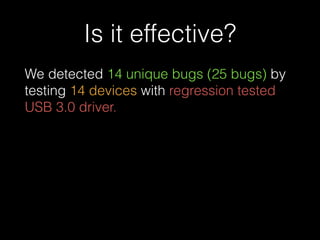
Is it effective? 
We detected 14 unique bugs (25 bugs) by 
testing 14 devices with regression tested 
USB 3.0 driver.
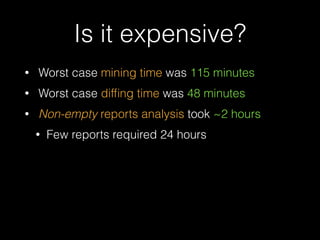
Is it expensive? 
• Worst case mining time was 115 minutes 
• Worst case diffing time was 48 minutes 
• Non-empty reports analysis took ~2 hours 
• Few reports required 24 hours
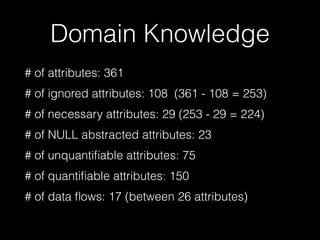
Domain Knowledge 
# of attributes: 361 
# of ignored attributes: 108 (361 - 108 = 253) 
# of necessary attributes: 29 (253 - 29 = 224) 
# of NULL abstracted attributes: 23 
# of unquantifiable attributes: 75 
# of quantifiable attributes: 150 
# of data flows: 17 (between 26 attributes)
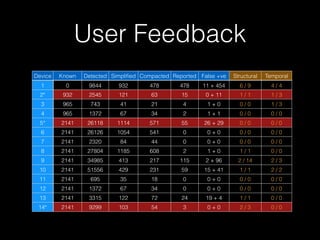
User Feedback 
Device Known Detected 
Simplified Compacted Reported False +ve Structural Temporal 
1 0 9844 932 478 478 11 + 454 6 / 9 4 / 4 
2* 932 2545 121 63 15 0 + 11 1 / 1 1 / 3 
3 965 743 41 21 4 1 + 0 0 / 0 1 / 3 
4 965 1372 67 34 2 1 + 1 0 / 0 0 / 0 
5* 2141 26118 1114 571 55 26 + 29 0 / 0 0 / 0 
6 2141 26126 1054 541 0 0 + 0 0 / 0 0 / 0 
7 2141 2320 84 44 0 0 + 0 0 / 0 0 / 0 
8 2141 27804 1185 608 2 1 + 0 1 / 1 0 / 0 
9 2141 34985 413 217 115 2 + 96 2 / 14 2 / 3 
10 2141 51556 429 231 59 15 + 41 1 / 1 2 / 2 
11 2141 695 35 18 0 0 + 0 0 / 0 0 / 0 
12 2141 1372 67 34 0 0 + 0 0 / 0 0 / 0 
13 2141 3315 122 72 24 19 + 4 1 / 1 0 / 0 
14* 2141 9299 103 54 3 0 + 0 2 / 3 0 / 0
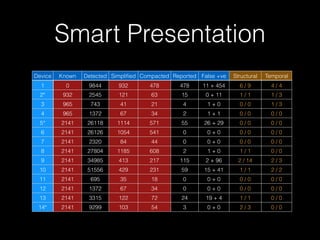
Smart Presentation 
Device Known Detected 
Simplified Compacted Reported False +ve Structural Temporal 
1 0 9844 932 478 478 11 + 454 6 / 9 4 / 4 
2* 932 2545 121 63 15 0 + 11 1 / 1 1 / 3 
3 965 743 41 21 4 1 + 0 0 / 0 1 / 3 
4 965 1372 67 34 2 1 + 1 0 / 0 0 / 0 
5* 2141 26118 1114 571 55 26 + 29 0 / 0 0 / 0 
6 2141 26126 1054 541 0 0 + 0 0 / 0 0 / 0 
7 2141 2320 84 44 0 0 + 0 0 / 0 0 / 0 
8 2141 27804 1185 608 2 1 + 0 1 / 1 0 / 0 
9 2141 34985 413 217 115 2 + 96 2 / 14 2 / 3 
10 2141 51556 429 231 59 15 + 41 1 / 1 2 / 2 
11 2141 695 35 18 0 0 + 0 0 / 0 0 / 0 
12 2141 1372 67 34 0 0 + 0 0 / 0 0 / 0 
13 2141 3315 122 72 24 19 + 4 1 / 1 0 / 0 
14* 2141 9299 103 54 3 0 + 0 2 / 3 0 / 0
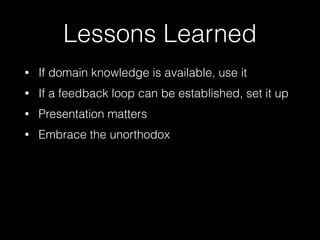
Lessons Learned 
• If domain knowledge is available, use it 
• If a feedback loop can be established, set it up 
• Presentation matters 
• Embrace the unorthodox
Limitations 
• Detects a class of incompatibilities
Threats to Validity 
• Generalization needs more experiments 
• Effect of latent factors need to be studied
Key Takeaways 
• An approach to compatibility testing via 
patterns-based trace comparison. 
• The use of structural and temporal patterns as 
trace abstractions to enable software 
engineering and maintenance tasks. 
• Of course, the lessons learned :)

Compatibility Testing using Patterns-based Trace Comparison

  • 1.
    Compatibility Testing using Patterns-based Trace Comparison Venkatesh-Prasad Ranganath, Kansas State University, USA Pradip Vallathol, University of Wisconsin-Madison, USA Pankaj Gupta, Microsoft Corporation, USA 29th IEEE/ACM International Conference on Automated Software Engineering (ASE 2014) September 15 - 19, 2014 Västerås, Sweden Thanks to Microsoft Research (India) and USB team (at Microsoft) for supporting this effort.
  • 2.
  • 3.
    Compatibility Testing: SyntacticChanges client.java! ! service.getProperty(“name”) ! service.java! ! void getProperty(PropertyId id) { … }!
  • 4.
    Compatibility Testing: SemanticChanges client1.c! ! s.q = c; f(&s); s.q = c; g(&s); ! client2.c! ! s.q = c; f(&s); ! g(&s); ! serviceV1.c! @pre s.q == c void f(Record *s) { … // no changes to s.q } ! @pre s.q == c void g(Record *s) { … }
  • 5.
    Compatibility Testing: SemanticChanges client1.c! ! s.q = c; f(&s); s.q = c; g(&s); ! client2.c! ! s.q = c; f(&s); ! g(&s); ! serviceV2.c! @pre s.q == c void f(Record *s) { … s.q = 0; } ! @pre s.q == c void g(Record *s) { … } Incorrect!!
  • 6.
    Common Reasons for Semantic Incompatibilities • Breaking semantic changes • Observational dependences and influences • Weak specifications • Assumptions
  • 7.
    Compatibility Testing of Windows USB drivers When a USB 2.0 device is plugged into a USB 3.0 port on Win8, will USB 3.0 driver in Win8 behave similar to the USB 2.0 stack in Win7 (along both soBware and hardware interfaces)? Mouse Driver USB 3.0 Driver Stack USB3 Controller Win8 Mouse Driver USB 2.0 Driver Stack USB2 Controller Win7 USB 2.0 Mouse USB 2.0 Mouse
  • 8.
    Why is ithard? • Clean room implementation of USB 3 driver • No part of USB 2 driver was reused • Regression tests were insufficient • Large testing surface • Number of unique USB devices • Possibilities in USB protocol • Multiple layers of variability • Device drivers, Controllers, & ASIC in devices
  • 9.
    Compatibility Testing of Windows USB drivers When a USB 2.0 device is plugged into a USB 3.0 port on Win8, will USB 3.0 driver in Win8 behave similar to the USB 2.0 stack in Win7 (along both soBware and hardware interfaces)? Mouse Driver USB 3.0 Driver Stack USB3 Controller Win8 Mouse Driver USB 2.0 Driver Stack USB2 Controller Win7 USB 2.0 Mouse USB 2.0 Mouse
  • 10.
    Compatibility Testing using Patterns-based Trace Comparison USB2 Logs Tark (Miner) USB2 Patterns USB3 Log Tark (Miner) USB3 Patterns IOCTLType=URB_FUNCTION_BULK_OR_INTERRUPT_TRA NSFER(0x09) && IoCallDriverReturn && IoCallDriverReturn.irql=2 && IoCallDriverReturn.status=0xC000000E USB2 Patterns USB3 Patterns Structural and Temporal Pattern Diffing DispatchIrp forward alternates with IrpCompletion && PreIoCompleteRequest when IOCTLType=IRP_MJ_PNP(0x1B),IRP_MN_START_DEVICE(0x00), irpID=SAME, and IrpSubmitDetails.irp.ioStackLocation.control=SAME
  • 11.
    Trace Collection FunctionDriver (Mouse Driver) Filter Driver USB Driver USB Controller USB Device (Mouse)
  • 12.
    Structural Patterns fopen 21=fopen(, “r”) 21=fopen 21 = fopen(“passwd.txt”, “r”) USB 2.0 driver completed isochronous requests at DISPATCH_LEVEL IRQ while USB 3.0 driver completed similar request at PASSIVE_LEVEL IRQ. Mining Quantified Temporal Rules: Formalism, Algorithms, and Evaluation, WCRE’09
  • 13.
    Temporal Patterns with Data Flow USB 3.0 driver failed to communicate the corresponding interface when serving a request to select a configuration of a device. interfaceHandle attribute remained unchanged. h=fopen .... fclose(h) (h!=0 && h=fopen) .... fclose(h) 21=fopen(, “r”) .... fclose(21) 21=fopen .... fclose(21) fopen .... fclose 21 = fopen(“passwd.txt”, “r”) .... fclose(21) Mining Quantified Temporal Rules: Formalism, Algorithms, and Evaluation, WCRE’09
  • 14.
    What is reported? Presence of previously unobserved patterns ! ! Absence of previously observed patterns Comment: This should be intersection
  • 15.
    Is it effective? We detected 14 unique bugs (25 bugs) by testing 14 devices with regression tested USB 3.0 driver.
  • 16.
    Is it expensive? • Worst case mining time was 115 minutes • Worst case diffing time was 48 minutes • Non-empty reports analysis took ~2 hours • Few reports required 24 hours
  • 17.
    Domain Knowledge #of attributes: 361 # of ignored attributes: 108 (361 - 108 = 253) # of necessary attributes: 29 (253 - 29 = 224) # of NULL abstracted attributes: 23 # of unquantifiable attributes: 75 # of quantifiable attributes: 150 # of data flows: 17 (between 26 attributes)
  • 18.
    User Feedback DeviceKnown Detected Simplified Compacted Reported False +ve Structural Temporal 1 0 9844 932 478 478 11 + 454 6 / 9 4 / 4 2* 932 2545 121 63 15 0 + 11 1 / 1 1 / 3 3 965 743 41 21 4 1 + 0 0 / 0 1 / 3 4 965 1372 67 34 2 1 + 1 0 / 0 0 / 0 5* 2141 26118 1114 571 55 26 + 29 0 / 0 0 / 0 6 2141 26126 1054 541 0 0 + 0 0 / 0 0 / 0 7 2141 2320 84 44 0 0 + 0 0 / 0 0 / 0 8 2141 27804 1185 608 2 1 + 0 1 / 1 0 / 0 9 2141 34985 413 217 115 2 + 96 2 / 14 2 / 3 10 2141 51556 429 231 59 15 + 41 1 / 1 2 / 2 11 2141 695 35 18 0 0 + 0 0 / 0 0 / 0 12 2141 1372 67 34 0 0 + 0 0 / 0 0 / 0 13 2141 3315 122 72 24 19 + 4 1 / 1 0 / 0 14* 2141 9299 103 54 3 0 + 0 2 / 3 0 / 0
  • 19.
    Smart Presentation DeviceKnown Detected Simplified Compacted Reported False +ve Structural Temporal 1 0 9844 932 478 478 11 + 454 6 / 9 4 / 4 2* 932 2545 121 63 15 0 + 11 1 / 1 1 / 3 3 965 743 41 21 4 1 + 0 0 / 0 1 / 3 4 965 1372 67 34 2 1 + 1 0 / 0 0 / 0 5* 2141 26118 1114 571 55 26 + 29 0 / 0 0 / 0 6 2141 26126 1054 541 0 0 + 0 0 / 0 0 / 0 7 2141 2320 84 44 0 0 + 0 0 / 0 0 / 0 8 2141 27804 1185 608 2 1 + 0 1 / 1 0 / 0 9 2141 34985 413 217 115 2 + 96 2 / 14 2 / 3 10 2141 51556 429 231 59 15 + 41 1 / 1 2 / 2 11 2141 695 35 18 0 0 + 0 0 / 0 0 / 0 12 2141 1372 67 34 0 0 + 0 0 / 0 0 / 0 13 2141 3315 122 72 24 19 + 4 1 / 1 0 / 0 14* 2141 9299 103 54 3 0 + 0 2 / 3 0 / 0
  • 20.
    Lessons Learned •If domain knowledge is available, use it • If a feedback loop can be established, set it up • Presentation matters • Embrace the unorthodox
  • 21.
    Limitations • Detectsa class of incompatibilities
  • 22.
    Threats to Validity • Generalization needs more experiments • Effect of latent factors need to be studied
  • 23.
    Key Takeaways •An approach to compatibility testing via patterns-based trace comparison. • The use of structural and temporal patterns as trace abstractions to enable software engineering and maintenance tasks. • Of course, the lessons learned :)