BOOSTER JUICE:
BRINGING
CANADIAN
SMOOTHIES TO
THE INDIAN
MARKET
Group 4
Jasmine Wang
Leasy Li
Abdullah Bin Gubair
Abdul Aziz Alsayed
Kai Haverila
 Inspired by juice bars in the US
 Nov.13th,1999, Dale Wishewan started the first Booster
Juice in Sherwood Park, Edmonton.
 First mover in Canada
 Grow the business by franchising
 Healthy product offering & mass customization
 11 “Boosters” & 38 varieties of beverages for its menu
 International expansion
 Successfully entered Saudi Arabia in 2004
 Further expanded to Netherlands, US, Mexico, Brazil, and UK.
 Challenges in Indian Market
INTRODUCTION TO
Q1: WHY IS BOOSTER JUICE NOT ACHIEVING
GREATER SUCCESS IN INDIA?
Inefficient use of some of the 4 P’s
 Place/Location Challenge:
 People from all socioeconomic classes
living together.
 Difficulty in choosing the right location
for the target market.
 Unsuccessful initial location decisions-
relocation expenses $35,000.
Price Challenge:
 Not many Indians can afford the
premium prices of Booster Juice.
Q1: CONTINUED
 Products:
 Booster Juice offers product in different
sizes
 Large, medium, and small
Indian Market Strategy:
 Only offer medium and small sizes at lower
prices.
Customer service:
 Workers are not interactive with customers.
Result: Customers not realizing the
products and their prices.
Q1: CONTINUED
 Supply Chain Management:
 Not finding the required local
suppliers in terms of quality.
 Had to import products from
Canada – Extra Costs.
 Delays due to importing
processes.
 Indirect competition from local cart
juice vendors.
Q2: ANALYZE INDIAN’S BUSINESS
ENVIRONMENT.
PESTEL ANALYSIS
Political
Environment
• Largest
democracies in the
world
• Runs on federal
government
• Greatly influenced
by the government
policies
• Influenced by
politician’s interests
as well as the
ideologies of
political parties.
Economic
Environment
• 4th largest buying
power
• Rapidly growing
middle class
• GDP is about 7.46
billion dollar and
estimated to grow
to 7.75 by 2020
Social
Environment
• Population of 1.2
billion
• Consists of 28
states and 7
territories
• Complex social
structure
• Diverse cultures,
religions and
languages
Q2: PESTEL ANALYSIS CONT’D
Technological
Environment
• One of the
strongest IT
infrastructure in
the world
• Served both 3G
and 4G
• Technology is
widely used
• Technological
support and
services are
easily available
Environmental
• Poor air quality
• Presence of
environmental
pressure groups
• Early stages of
recycling and
waste material
reduction process
Legal
Environment
• Regulations such
as minimum
wage and gender
discrimination
Q2: PORTER’S FIVE FORCES
• Many
substitutes
• Lower prices
• Low switching
costs.
• Low loyalty.
• Low barriers
to entry.
• Easy to enter
the market
with cheaper
prices.
• Many suppliers
in India.
• Low switching
cost.
Power of
Suppliers:
Low
Threats of
New
Entrants:
High
Threats of
Substitutes:
High
Power of
Buyers:
High
Intensity of Rivalry:
Low
Q2: CONCLUSION
The Indian market/industry is attractive.
Requires careful analysis before entry.
Q3: IDENTIFY MARKET SEGMENTS AND
CUSTOMERS FOR BOOSTER JUICE’S
PRODUCTS
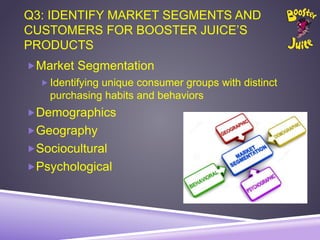
Market Segmentation
 Identifying unique consumer groups with distinct
purchasing habits and behaviors
Demographics
Geography
Sociocultural
Psychological
Q3: KEY ATTRIBUTES
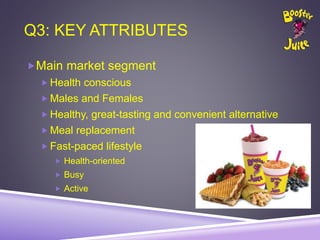
Main market segment
 Health conscious
 Males and Females
 Healthy, great-tasting and convenient alternative
 Meal replacement
 Fast-paced lifestyle
 Health-oriented
 Busy
 Active
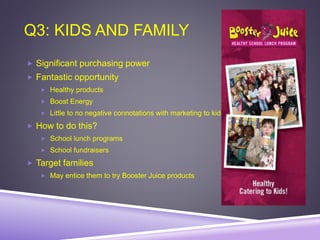
Q3: KIDS AND FAMILY
 Significant purchasing power
 Fantastic opportunity
 Healthy products
 Boost Energy
 Little to no negative connotations with marketing to kids
 How to do this?
 School lunch programs
 School fundraisers
 Target families
 May entice them to try Booster Juice products
Q3: EXERCISING AND ATHLETIC
MARKET
Could be used as a workout
snack or a post-workout meal
Celebrity endorsements
 José Bautista in Canada
 Cricket stars in India? E.g. Sachin
Tendulkar
Positive associations
Q3: MIDDLE AND UPPER CLASS
PRODUCT
Higher prices due to
differentiating features
 Higher Fruit Content
 Lower Ice Content
 No Added Sugars or
Preservatives
 Free Nutritional Supplement or
‘Booster’
 Using ‘superfoods’ like Goji and
Açaí berries
Q3: INDIAN MARKET
 Target market
 Young, health-conscious
consumers
 Aged 18 to 35
 Main selling point
 Offering a healthy, portable
meal
 Convenience
 Premium Product
 Targeting upper and middle
classes
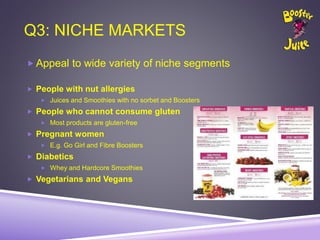
Q3: NICHE MARKETS
 Appeal to wide variety of niche segments
 People with nut allergies
 Juices and Smoothies with no sorbet and Boosters
 People who cannot consume gluten
 Most products are gluten-free
 Pregnant women
 E.g. Go Girl and Fibre Boosters
 Diabetics
 Whey and Hardcore Smoothies
 Vegetarians and Vegans
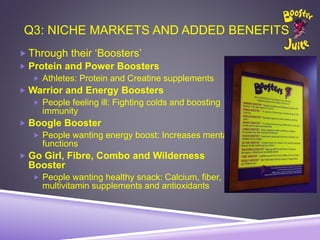
Q3: NICHE MARKETS AND ADDED BENEFITS
 Through their ‘Boosters’
 Protein and Power Boosters
 Athletes: Protein and Creatine supplements
 Warrior and Energy Boosters
 People feeling ill: Fighting colds and boosting
immunity
 Boogle Booster
 People wanting energy boost: Increases mental
functions
 Go Girl, Fibre, Combo and Wilderness
Booster
 People wanting healthy snack: Calcium, fiber,
multivitamin supplements and antioxidants
Q4: WHAT WOULD HAVE BEEN THE OPTIMAL
ENTRY STRATEGY FOR BOOSTER JUICE IN
INDIA IN 2009?
• Franchising strategy was the best entry strategy to enter the Indian market
• Control the operations in India
• Point-of-sale (POS) system
• Facilitates and helps to manage the difficulties of doing business in India
• Fazel Naqvi, the master franchisor:
1. Well connected in the Indian retail industry
2. Knew the wave of demand for healthy snack foods and
3. Had the knowledge of doing business in India
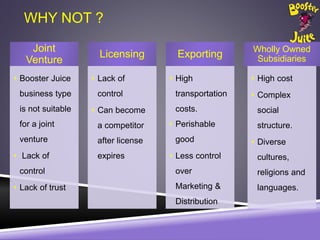
Joint
Venture
• Booster Juice
business type
is not suitable
for a joint
venture
• Lack of
control
• Lack of trust
Licensing
• Lack of
control
• Can become
a competitor
after license
expires
Exporting
• High
transportation
costs.
• Perishable
good
• Less control
over
Marketing &
Distribution
Wholly Owned
Subsidiaries
• High cost
• Complex
social
structure.
• Diverse
cultures,
religions and
languages.
WHY NOT ?
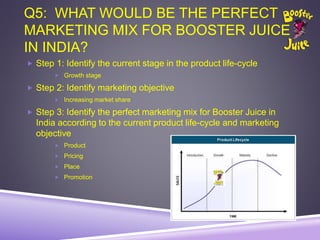
Q5: WHAT WOULD BE THE PERFECT
MARKETING MIX FOR BOOSTER JUICE
IN INDIA?
 Step 1: Identify the current stage in the product life-cycle
 Growth stage
 Step 2: Identify marketing objective
 Increasing market share
 Step 3: Identify the perfect marketing mix for Booster Juice in
India according to the current product life-cycle and marketing
objective
 Product
 Pricing
 Place
 Promotion
Q5: PRODUCT
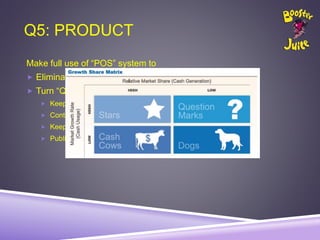
Make full use of “POS” system to
 Eliminate “Dogs”
 Turn “Question Marks” and “Stars” into “Cash Cows”
 Keep creating new products and observe consumers’ reactions.
 Continuously take in consumers’ ideas.
 Keep monitoring the quality and inventory level of the “Cash Cows”
 Publicize the fact about “polystyrene cups”.
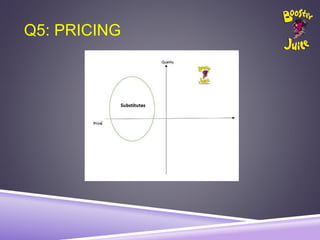
Q5: PRICING
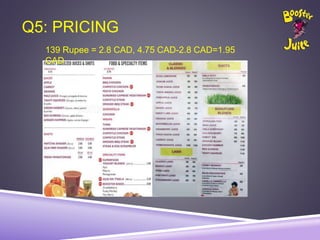
Q5: PRICING
Q5: PRICING
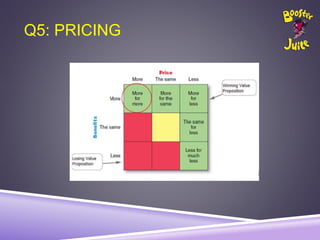
139 Rupee = 2.8 CAD, 4.75 CAD-2.8 CAD=1.95
CAD
Q5: PRICING
Recommendations:
 Keep their current pricing strategy
unchanged.
 Increase market share.
 Take advantage of home-grown resources in
India.
 Take advantage of low fixed costs, devote more
into employee development.
 Strive to achieve “more for even more” in product
position by providing superior service.
 Occasionally downscale the price by offering
bundle prices or discount prices.
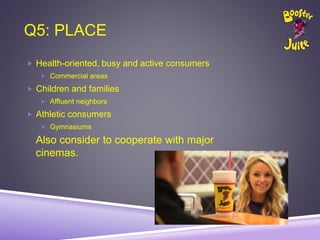
Q5: PLACE
 Health-oriented, busy and active consumers
 Commercial areas
 Children and families
 Affluent neighbors
 Athletic consumers
 Gymnasiums
Also consider to cooperate with major
cinemas.
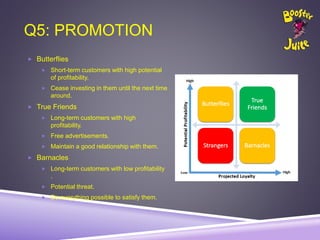
Q5: PROMOTION
 Butterflies
 Short-term customers with high potential
of profitability.
 Cease investing in them until the next time
around.
 True Friends
 Long-term customers with high
profitability.
 Free advertisements.
 Maintain a good relationship with them.
 Barnacles
 Long-term customers with low profitability
.
 Potential threat.
 Do everything possible to satisfy them.
Q5: PROMOTION
Recommendations:
 Create some festival events according to
Indian culture.
 Involve local celebrities in their
advertisements.
 Create campaigns through social media.
 Form strategic alliance with competitors.
 Hire a manager with high education level and
social status in each store.
 Membership cards and coupons for cinemas.
 Sponsor for athletic competitions in India.
 Get involved in Indian social welfare
activities.
Q6: SHOULD BOOSTER JUICE FOLLOW MCDONALD’S
STRATEGY BY “INDIAN-IZING” ITS STRATEGY?
● Should not completely copy McDonald’s
strategy.
Pure Localization Strategy
● Do need certain level of localization.
Pure Global / Standardization Strategy
● Find a Balance
Transnational Strategy
Q6: WHY NOT PURE LOCALIZATION?
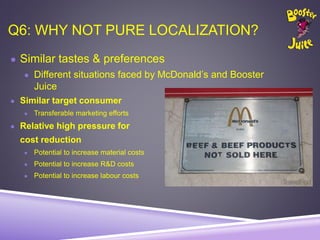
● Similar tastes & preferences
● Different situations faced by McDonald’s and Booster
Juice
● Similar target consumer
● Transferable marketing efforts
● Relative high pressure for
cost reduction
● Potential to increase material costs
● Potential to increase R&D costs
● Potential to increase labour costs
Q6: WHY NOT PURE LOCALIZATION?
● Longer experience curve
● Lack of slack resources
● Consistency of brand image
&
Country of origin effect
CONCLUSION
Find a balance between over-globalization & under-globalization
Effective and efficient transnational strategy
Successful expansion into India –
one of the most popular emerging markets in the world
FURTHER
RECOMMENDATIONS
● Build integrated value chain
● Creative promotion
● Retained earnings for international promotion
activities
● Be consistent with “premium” brand image
● Continuous innovation
Thank you for
listening!
Any Questions?

Booster Juice Final Presentation

  • 1.
    BOOSTER JUICE: BRINGING CANADIAN SMOOTHIES TO THEINDIAN MARKET Group 4 Jasmine Wang Leasy Li Abdullah Bin Gubair Abdul Aziz Alsayed Kai Haverila
  • 2.
     Inspired byjuice bars in the US  Nov.13th,1999, Dale Wishewan started the first Booster Juice in Sherwood Park, Edmonton.  First mover in Canada  Grow the business by franchising  Healthy product offering & mass customization  11 “Boosters” & 38 varieties of beverages for its menu  International expansion  Successfully entered Saudi Arabia in 2004  Further expanded to Netherlands, US, Mexico, Brazil, and UK.  Challenges in Indian Market INTRODUCTION TO
  • 3.
    Q1: WHY ISBOOSTER JUICE NOT ACHIEVING GREATER SUCCESS IN INDIA? Inefficient use of some of the 4 P’s  Place/Location Challenge:  People from all socioeconomic classes living together.  Difficulty in choosing the right location for the target market.  Unsuccessful initial location decisions- relocation expenses $35,000. Price Challenge:  Not many Indians can afford the premium prices of Booster Juice.
  • 4.
    Q1: CONTINUED  Products: Booster Juice offers product in different sizes  Large, medium, and small Indian Market Strategy:  Only offer medium and small sizes at lower prices. Customer service:  Workers are not interactive with customers. Result: Customers not realizing the products and their prices.
  • 5.
    Q1: CONTINUED  SupplyChain Management:  Not finding the required local suppliers in terms of quality.  Had to import products from Canada – Extra Costs.  Delays due to importing processes.  Indirect competition from local cart juice vendors.
  • 6.
    Q2: ANALYZE INDIAN’SBUSINESS ENVIRONMENT. PESTEL ANALYSIS Political Environment • Largest democracies in the world • Runs on federal government • Greatly influenced by the government policies • Influenced by politician’s interests as well as the ideologies of political parties. Economic Environment • 4th largest buying power • Rapidly growing middle class • GDP is about 7.46 billion dollar and estimated to grow to 7.75 by 2020 Social Environment • Population of 1.2 billion • Consists of 28 states and 7 territories • Complex social structure • Diverse cultures, religions and languages
  • 7.
    Q2: PESTEL ANALYSISCONT’D Technological Environment • One of the strongest IT infrastructure in the world • Served both 3G and 4G • Technology is widely used • Technological support and services are easily available Environmental • Poor air quality • Presence of environmental pressure groups • Early stages of recycling and waste material reduction process Legal Environment • Regulations such as minimum wage and gender discrimination
  • 8.
    Q2: PORTER’S FIVEFORCES • Many substitutes • Lower prices • Low switching costs. • Low loyalty. • Low barriers to entry. • Easy to enter the market with cheaper prices. • Many suppliers in India. • Low switching cost. Power of Suppliers: Low Threats of New Entrants: High Threats of Substitutes: High Power of Buyers: High Intensity of Rivalry: Low
  • 9.
    Q2: CONCLUSION The Indianmarket/industry is attractive. Requires careful analysis before entry.
  • 10.
    Q3: IDENTIFY MARKETSEGMENTS AND CUSTOMERS FOR BOOSTER JUICE’S PRODUCTS Market Segmentation  Identifying unique consumer groups with distinct purchasing habits and behaviors Demographics Geography Sociocultural Psychological
  • 11.
    Q3: KEY ATTRIBUTES Mainmarket segment  Health conscious  Males and Females  Healthy, great-tasting and convenient alternative  Meal replacement  Fast-paced lifestyle  Health-oriented  Busy  Active
  • 12.
    Q3: KIDS ANDFAMILY  Significant purchasing power  Fantastic opportunity  Healthy products  Boost Energy  Little to no negative connotations with marketing to kids  How to do this?  School lunch programs  School fundraisers  Target families  May entice them to try Booster Juice products
  • 13.
    Q3: EXERCISING ANDATHLETIC MARKET Could be used as a workout snack or a post-workout meal Celebrity endorsements  José Bautista in Canada  Cricket stars in India? E.g. Sachin Tendulkar Positive associations
  • 14.
    Q3: MIDDLE ANDUPPER CLASS PRODUCT Higher prices due to differentiating features  Higher Fruit Content  Lower Ice Content  No Added Sugars or Preservatives  Free Nutritional Supplement or ‘Booster’  Using ‘superfoods’ like Goji and Açaí berries
  • 15.
    Q3: INDIAN MARKET Target market  Young, health-conscious consumers  Aged 18 to 35  Main selling point  Offering a healthy, portable meal  Convenience  Premium Product  Targeting upper and middle classes
  • 16.
    Q3: NICHE MARKETS Appeal to wide variety of niche segments  People with nut allergies  Juices and Smoothies with no sorbet and Boosters  People who cannot consume gluten  Most products are gluten-free  Pregnant women  E.g. Go Girl and Fibre Boosters  Diabetics  Whey and Hardcore Smoothies  Vegetarians and Vegans
  • 17.
    Q3: NICHE MARKETSAND ADDED BENEFITS  Through their ‘Boosters’  Protein and Power Boosters  Athletes: Protein and Creatine supplements  Warrior and Energy Boosters  People feeling ill: Fighting colds and boosting immunity  Boogle Booster  People wanting energy boost: Increases mental functions  Go Girl, Fibre, Combo and Wilderness Booster  People wanting healthy snack: Calcium, fiber, multivitamin supplements and antioxidants
  • 18.
    Q4: WHAT WOULDHAVE BEEN THE OPTIMAL ENTRY STRATEGY FOR BOOSTER JUICE IN INDIA IN 2009? • Franchising strategy was the best entry strategy to enter the Indian market • Control the operations in India • Point-of-sale (POS) system • Facilitates and helps to manage the difficulties of doing business in India • Fazel Naqvi, the master franchisor: 1. Well connected in the Indian retail industry 2. Knew the wave of demand for healthy snack foods and 3. Had the knowledge of doing business in India
  • 19.
    Joint Venture • Booster Juice businesstype is not suitable for a joint venture • Lack of control • Lack of trust Licensing • Lack of control • Can become a competitor after license expires Exporting • High transportation costs. • Perishable good • Less control over Marketing & Distribution Wholly Owned Subsidiaries • High cost • Complex social structure. • Diverse cultures, religions and languages. WHY NOT ?
  • 20.
    Q5: WHAT WOULDBE THE PERFECT MARKETING MIX FOR BOOSTER JUICE IN INDIA?  Step 1: Identify the current stage in the product life-cycle  Growth stage  Step 2: Identify marketing objective  Increasing market share  Step 3: Identify the perfect marketing mix for Booster Juice in India according to the current product life-cycle and marketing objective  Product  Pricing  Place  Promotion
  • 21.
    Q5: PRODUCT Make fulluse of “POS” system to  Eliminate “Dogs”  Turn “Question Marks” and “Stars” into “Cash Cows”  Keep creating new products and observe consumers’ reactions.  Continuously take in consumers’ ideas.  Keep monitoring the quality and inventory level of the “Cash Cows”  Publicize the fact about “polystyrene cups”.
  • 22.
  • 23.
  • 24.
    Q5: PRICING 139 Rupee= 2.8 CAD, 4.75 CAD-2.8 CAD=1.95 CAD
  • 25.
    Q5: PRICING Recommendations:  Keeptheir current pricing strategy unchanged.  Increase market share.  Take advantage of home-grown resources in India.  Take advantage of low fixed costs, devote more into employee development.  Strive to achieve “more for even more” in product position by providing superior service.  Occasionally downscale the price by offering bundle prices or discount prices.

  • 26.
    Q5: PLACE  Health-oriented,busy and active consumers  Commercial areas  Children and families  Affluent neighbors  Athletic consumers  Gymnasiums Also consider to cooperate with major cinemas.
  • 27.
    Q5: PROMOTION  Butterflies Short-term customers with high potential of profitability.  Cease investing in them until the next time around.  True Friends  Long-term customers with high profitability.  Free advertisements.  Maintain a good relationship with them.  Barnacles  Long-term customers with low profitability .  Potential threat.  Do everything possible to satisfy them.
  • 28.
    Q5: PROMOTION Recommendations:  Createsome festival events according to Indian culture.  Involve local celebrities in their advertisements.  Create campaigns through social media.  Form strategic alliance with competitors.  Hire a manager with high education level and social status in each store.  Membership cards and coupons for cinemas.  Sponsor for athletic competitions in India.  Get involved in Indian social welfare activities.
  • 29.
    Q6: SHOULD BOOSTERJUICE FOLLOW MCDONALD’S STRATEGY BY “INDIAN-IZING” ITS STRATEGY? ● Should not completely copy McDonald’s strategy. Pure Localization Strategy ● Do need certain level of localization. Pure Global / Standardization Strategy ● Find a Balance Transnational Strategy
  • 30.
    Q6: WHY NOTPURE LOCALIZATION? ● Similar tastes & preferences ● Different situations faced by McDonald’s and Booster Juice ● Similar target consumer ● Transferable marketing efforts ● Relative high pressure for cost reduction ● Potential to increase material costs ● Potential to increase R&D costs ● Potential to increase labour costs
  • 31.
    Q6: WHY NOTPURE LOCALIZATION? ● Longer experience curve ● Lack of slack resources ● Consistency of brand image & Country of origin effect
  • 32.
    CONCLUSION Find a balancebetween over-globalization & under-globalization Effective and efficient transnational strategy Successful expansion into India – one of the most popular emerging markets in the world
  • 33.
    FURTHER RECOMMENDATIONS ● Build integratedvalue chain ● Creative promotion ● Retained earnings for international promotion activities ● Be consistent with “premium” brand image ● Continuous innovation
  • 34.