Boolean Operators
Prince George’s Community College
Library
Boolean operators
• Use BOOLEAN OPERATORS to relate the
  terms in specific ways that will affect the
  results of a search.
• Boolean operators are terms that create
  relationships between concepts and words
   • AND
   • OR
   • NOT
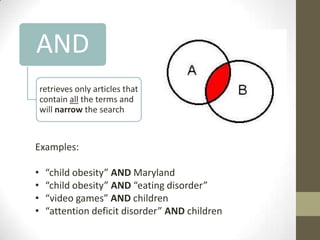
AND
    retrieves only articles that
    contain all the terms and
    will narrow the search


Examples:

•    “child obesity” AND Maryland
•    “child obesity” AND “eating disorder”
•    “video games” AND children
•    “attention deficit disorder” AND children
OR
     retrieves articles with
     any of the terms and
     will broaden the
     search


Examples:

• “child obesity” OR “overweight children”
• children OR juveniles
• “attention deficit hyperactive disorder” OR hyperactivity
NOT
eliminates articles containing
the second term even when
the first term is present. This
will narrow the search


Examples:

• obesity AND children NOT adults
• depression AND teen NOT adults
• “video games” AND teenagers NOT children
Using Nesting with Operators
• Use nesting to build a more complex search by putting
  keywords and/or phrases in parentheses to determine their
  relationship when more than one operator is used.
• Examples:
  • (children AND teenagers) AND (ADHD OR hyperactivity)
  • (children AND “video games”) NOT (teens OR adults)
Key Concepts
• USE QUOTATION MARKS " " before and after a
  phrase, two or more words that must be together in a
  defined order.
  • Examples:
     •   “African American”
     •   “eating disorder”
     •   “obsessive compulsive disorder”
     •   “video games”
• This lets the database know that you want to search for this
  phrase, and not the individual words that make up the phrase.
Questions?
• Send an e-mail to the
  library!
   • librefdesk@pgcc.edu


     Thank you for watching!

Boolean operators

  • 1.
    Boolean Operators Prince George’sCommunity College Library
  • 2.
    Boolean operators • UseBOOLEAN OPERATORS to relate the terms in specific ways that will affect the results of a search. • Boolean operators are terms that create relationships between concepts and words • AND • OR • NOT
  • 3.
    AND retrieves only articles that contain all the terms and will narrow the search Examples: • “child obesity” AND Maryland • “child obesity” AND “eating disorder” • “video games” AND children • “attention deficit disorder” AND children
  • 4.
    OR retrieves articles with any of the terms and will broaden the search Examples: • “child obesity” OR “overweight children” • children OR juveniles • “attention deficit hyperactive disorder” OR hyperactivity
  • 5.
    NOT eliminates articles containing thesecond term even when the first term is present. This will narrow the search Examples: • obesity AND children NOT adults • depression AND teen NOT adults • “video games” AND teenagers NOT children
  • 6.
    Using Nesting withOperators • Use nesting to build a more complex search by putting keywords and/or phrases in parentheses to determine their relationship when more than one operator is used. • Examples: • (children AND teenagers) AND (ADHD OR hyperactivity) • (children AND “video games”) NOT (teens OR adults)
  • 7.
    Key Concepts • USEQUOTATION MARKS " " before and after a phrase, two or more words that must be together in a defined order. • Examples: • “African American” • “eating disorder” • “obsessive compulsive disorder” • “video games” • This lets the database know that you want to search for this phrase, and not the individual words that make up the phrase.
  • 8.
    Questions? • Send ane-mail to the library! • librefdesk@pgcc.edu Thank you for watching!