BOILERS
Definition
Function
Application
Working principle
Classification
by
Dr Vishaldatt Kohir
Professor
Subject: Basic Mechanical Engineering
Module 2
https://www.youtube.com/watch?v=f03eZ0yX76A
You tube link
Definition of boilers:
The function of the boiler is to supply the steam at the required constant
pressure with its quality either dry or as nearly as dry, or superheated by
maintaining the steam generation rate and the steam flow rate.
Function of a boiler:
Application of boiler:
1. To supply hot water to homes/lodges
2. To keep food items hot
3. To carry out heating process in industry –Paper, Diary, sugar, textile,
medical and chemical
4. To run steam turbine in thermal power station
5. To run steam engines
 IBR (Indian Boiler Regulation ) Act 1923 gives detail specification boilers.
 Boiler is defined as a closed metallic vessel in which the water is heated
beyond the boiling state and converted into steam at said pressure.
Definition, Function and Application of boiler
Domestic water heaters
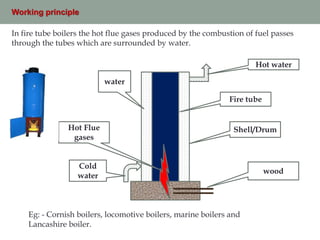
Fire tube
Shell/Drum
wood
Hot Flue
gases
water
Hot water
Cold
water
In fire tube boilers the hot flue gases produced by the combustion of fuel passes
through the tubes which are surrounded by water.
Eg: - Cornish boilers, locomotive boilers, marine boilers and
Lancashire boiler.
Working principle
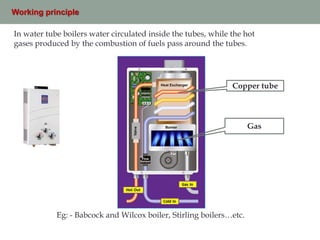
Gas
Copper tube
In water tube boilers water circulated inside the tubes, while the hot
gases produced by the combustion of fuels pass around the tubes.
Working principle
Eg: - Babcock and Wilcox boiler, Stirling boilers…etc.
Differences between Fire tube and Water tube boilers
According to the circulation of water and hot gases:-
a) Fire Tube boilers
b) Water Tube boilers
According to the location of furnace.
a. Internally fired boilers
b. Externally fired boilers
According to the circulation of water.
I. Natural circulation
II. Forced circulation
According to the axis of the shell.
a) Vertical boilers.
b) Horizontal boilers.
According to their uses.
1) Stationary boilers
2) Locomotive boilers
3) Marine boilers, etc…..
CLASSIFICATION OF BOILERS
Boilers

Boilers

  • 1.
    BOILERS Definition Function Application Working principle Classification by Dr VishaldattKohir Professor Subject: Basic Mechanical Engineering Module 2 https://www.youtube.com/watch?v=f03eZ0yX76A You tube link
  • 2.
    Definition of boilers: Thefunction of the boiler is to supply the steam at the required constant pressure with its quality either dry or as nearly as dry, or superheated by maintaining the steam generation rate and the steam flow rate. Function of a boiler: Application of boiler: 1. To supply hot water to homes/lodges 2. To keep food items hot 3. To carry out heating process in industry –Paper, Diary, sugar, textile, medical and chemical 4. To run steam turbine in thermal power station 5. To run steam engines  IBR (Indian Boiler Regulation ) Act 1923 gives detail specification boilers.  Boiler is defined as a closed metallic vessel in which the water is heated beyond the boiling state and converted into steam at said pressure. Definition, Function and Application of boiler
  • 3.
  • 4.
    Fire tube Shell/Drum wood Hot Flue gases water Hotwater Cold water In fire tube boilers the hot flue gases produced by the combustion of fuel passes through the tubes which are surrounded by water. Eg: - Cornish boilers, locomotive boilers, marine boilers and Lancashire boiler. Working principle
  • 5.
    Gas Copper tube In watertube boilers water circulated inside the tubes, while the hot gases produced by the combustion of fuels pass around the tubes. Working principle Eg: - Babcock and Wilcox boiler, Stirling boilers…etc.
  • 6.
    Differences between Firetube and Water tube boilers
  • 7.
    According to thecirculation of water and hot gases:- a) Fire Tube boilers b) Water Tube boilers According to the location of furnace. a. Internally fired boilers b. Externally fired boilers According to the circulation of water. I. Natural circulation II. Forced circulation According to the axis of the shell. a) Vertical boilers. b) Horizontal boilers. According to their uses. 1) Stationary boilers 2) Locomotive boilers 3) Marine boilers, etc….. CLASSIFICATION OF BOILERS