Steam Generators/Boilers
1
Dr. M. S. Ali, MED, SNIST, Hyderabad, India
Steam Boilers?
 In simple terms a boiler may be defined as
‘a closed vessel in which steam is produced from water by
combustion of fuel’.
 According to American Society of Mechanical of Mechanical
Engineers (ASME) a ‘steam generating unit’ is defined as:
‘A combination of apparatus for producing, furnishing, or
recovering heat together with the apparatus for transferring
the heat so made available to the fluid being heated and
vaporized’
2
Applications of Boiler
3
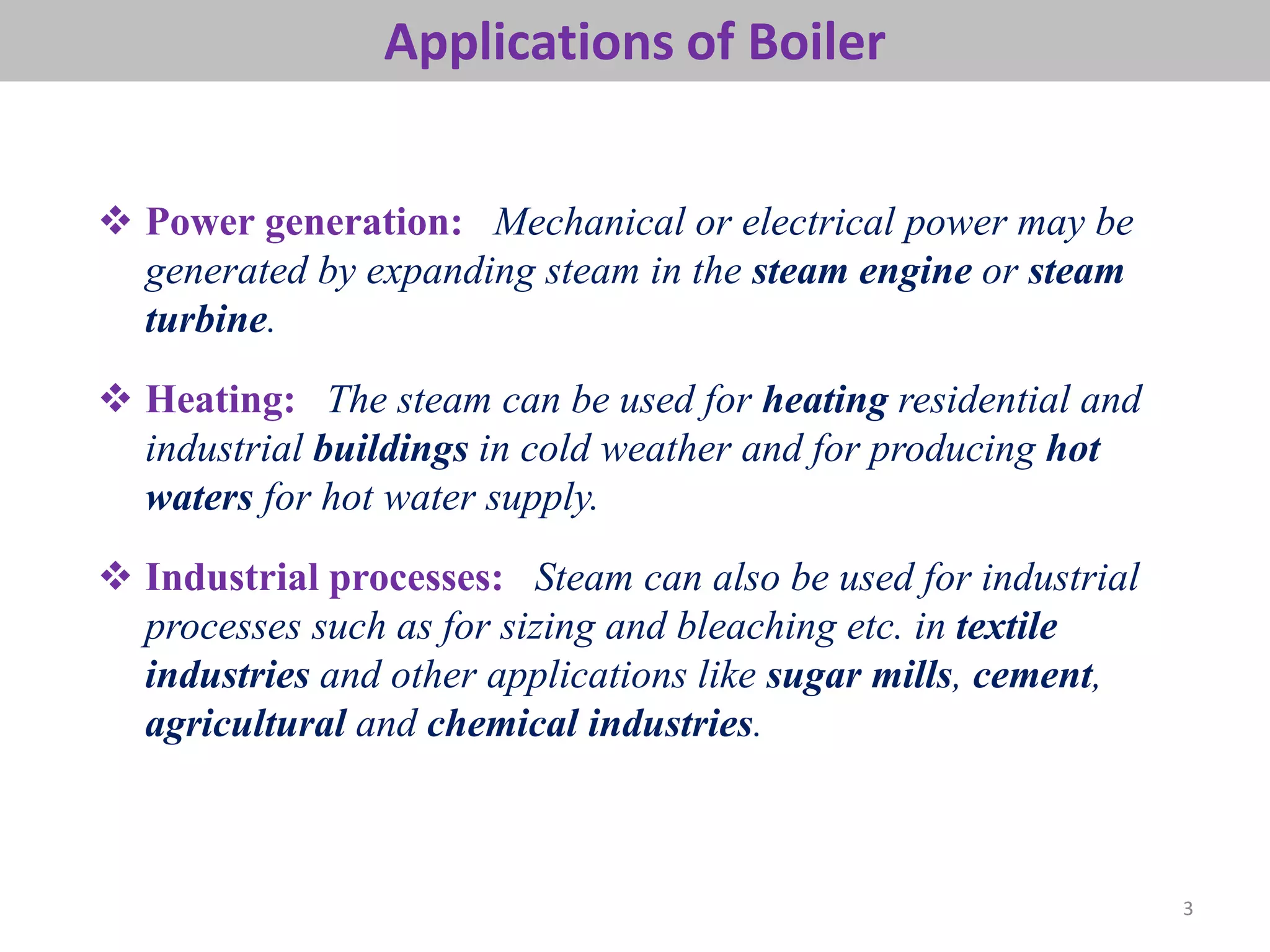
 Power generation: Mechanical or electrical power may be
generated by expanding steam in the steam engine or steam
turbine.
 Heating: The steam can be used for heating residential and
industrial buildings in cold weather and for producing hot
waters for hot water supply.
 Industrial processes: Steam can also be used for industrial
processes such as for sizing and bleaching etc. in textile
industries and other applications like sugar mills, cement,
agricultural and chemical industries.
1. Horizontal, Vertical, or Inclined
• If the axis of the boiler is horizontal, the boiler is called horizontal
boiler. The parts of a horizontal boiler can be inspected and repaired
easily but it occupies more space.
• If the axis is vertical, it is called vertical boiler. The vertical boiler
occupies less floor area.
• If the axis is inclined it is known as inclined boiler.
2. Fire Tube and Water Tube
• In the fire tube boiler, the hot gas are Inside the tubes and the water
surrounds the tube.
Examples- Cochran, Lancashire, and Locomotive boiler.
• In the water tube boilers, the water is inside the tubes and hot gases
surround them.
Examples- Babcock and Wilcox, Stirling, Yarrow boiler etc.
Classification of Boilers
4
3. Externally Fired and Internally Fired
• The boiler is known as externally fired if the furnace is outside the
boiler shell.
Examples- Babcock and Wilcox boiler, Stirling boiler etc.
• In case of internally fired boilers, the furnace is located inside the
boiler shell.
Example- Cochran, Lancashire boiler etc.
4. Forced Circulation and Natural Circulation
• In forced circulation type of boilers, the circulation of water is done by
a forced pump.
Examples- Velox, LaMont, Benson boiler etc.
• In natural circulation type of boilers, circulation of water in the boiler
takes place due to natural convention currents produced by the
application of heat.
Examples: Lancashire, Babcock and Wilcox boiler etc.
Classification of Boilers
5
5. High Pressure and Low Pressure Boilers
• The boilers which produce steam at pressures of 80 bar and above are
called high pressure boilers.
Examples- Babcock and Wilcox, Velox, LaMont, and Benson boilers
• The boilers which produce steam at pressures below 80 bar are called
low pressure boilers.
Examples: Cochran, Cornish, Lancashire and Locomotive boilers.
6. Stationary and Portable
• Stationary (land) boilers are used for central power plants and for
industrial process work etc. These are stationary because they are not
moved from one place to other place.
• Mobile (marine, and locomotive) boilers or portable boilers are those
which are moved from one place to another. These include locomotive
and marine type boilers, and other small units for use at temporary
sites (just as in small coal-field pits).
Classification of Boilers
6
7. Single Tube and Multi-tube Boilers
• The fire tube boilers are classified single tube and multi-tube boilers,
depending upon whether the fire tube is one or more than one.
Examples- Most of the boilers are Multi-tube type except Cornish,
and simple vertical boiler.
Classification of Boilers
7
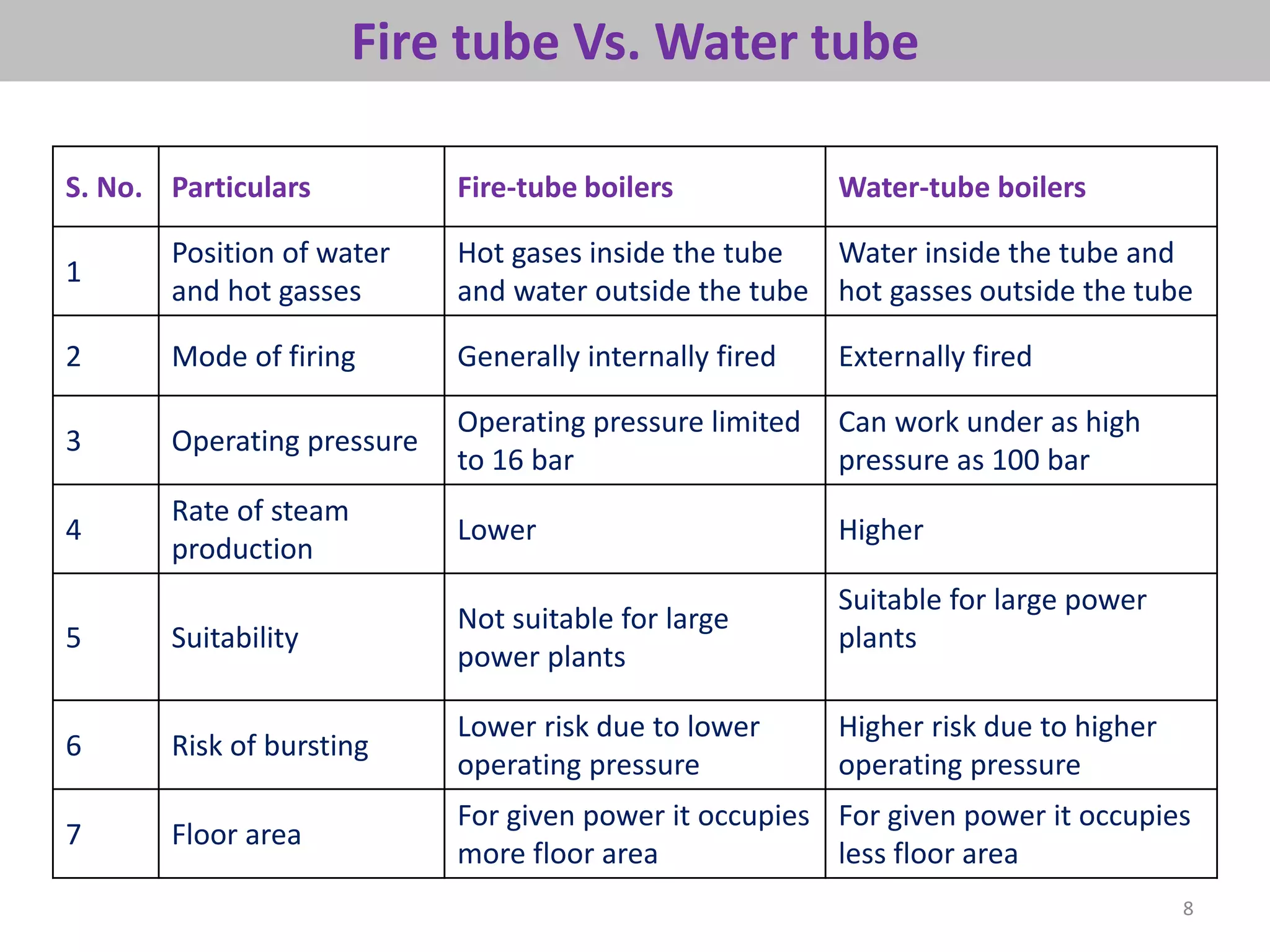
Fire tube Vs. Water tube
8
S. No. Particulars Fire-tube boilers Water-tube boilers
1
Position of water
and hot gasses
Hot gases inside the tube
and water outside the tube
Water inside the tube and
hot gasses outside the tube
2 Mode of firing Generally internally fired Externally fired
3 Operating pressure
Operating pressure limited
to 16 bar
Can work under as high
pressure as 100 bar
4
Rate of steam
production
Lower Higher
5 Suitability
Not suitable for large
power plants
Suitable for large power
plants
6 Risk of bursting
Lower risk due to lower
operating pressure
Higher risk due to higher
operating pressure
7 Floor area
For given power it occupies
more floor area
For given power it occupies
less floor area
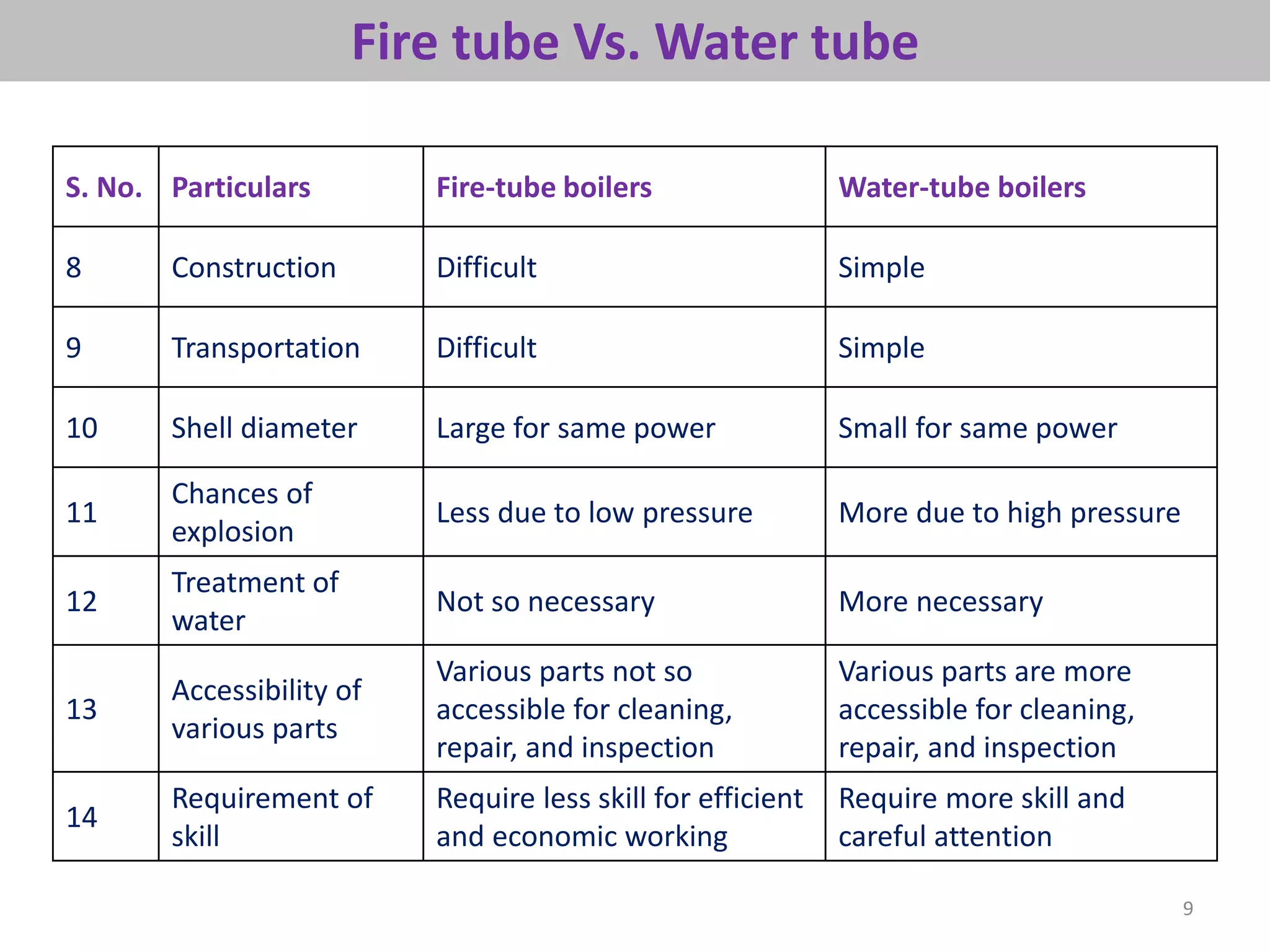
Fire tube Vs. Water tube
9
S. No. Particulars Fire-tube boilers Water-tube boilers
8 Construction Difficult Simple
9 Transportation Difficult Simple
10 Shell diameter Large for same power Small for same power
11
Chances of
explosion
Less due to low pressure More due to high pressure
12
Treatment of
water
Not so necessary More necessary
13
Accessibility of
various parts
Various parts not so
accessible for cleaning,
repair, and inspection
Various parts are more
accessible for cleaning,
repair, and inspection
14
Requirement of
skill
Require less skill for efficient
and economic working
Require more skill and
careful attention
BOILER TERMS
10
Shell: The shell of a boiler consists of one or more steel plates bent
into a cylindrical form and riveted or welded together The shell ends
are closed with the end plates.
Setting: The primary function of setting is to confine heat to the
boiler and form a passage for gases. It is made of brickwork and may
form the wall of the furnace and the combustion chamber. It also
provides support in some types of boilers (eg., Lancashire boiler)
Grate: It s the platform in the furnace upon which fuel is burnt and it
is made of cast iron bars. The bars are so arranged that air may pass
on to the fuel for combustion. The area of the grate on which the fire
rests in a coal or wood fired boiler is called grate surface.
BOILER TERMS
11
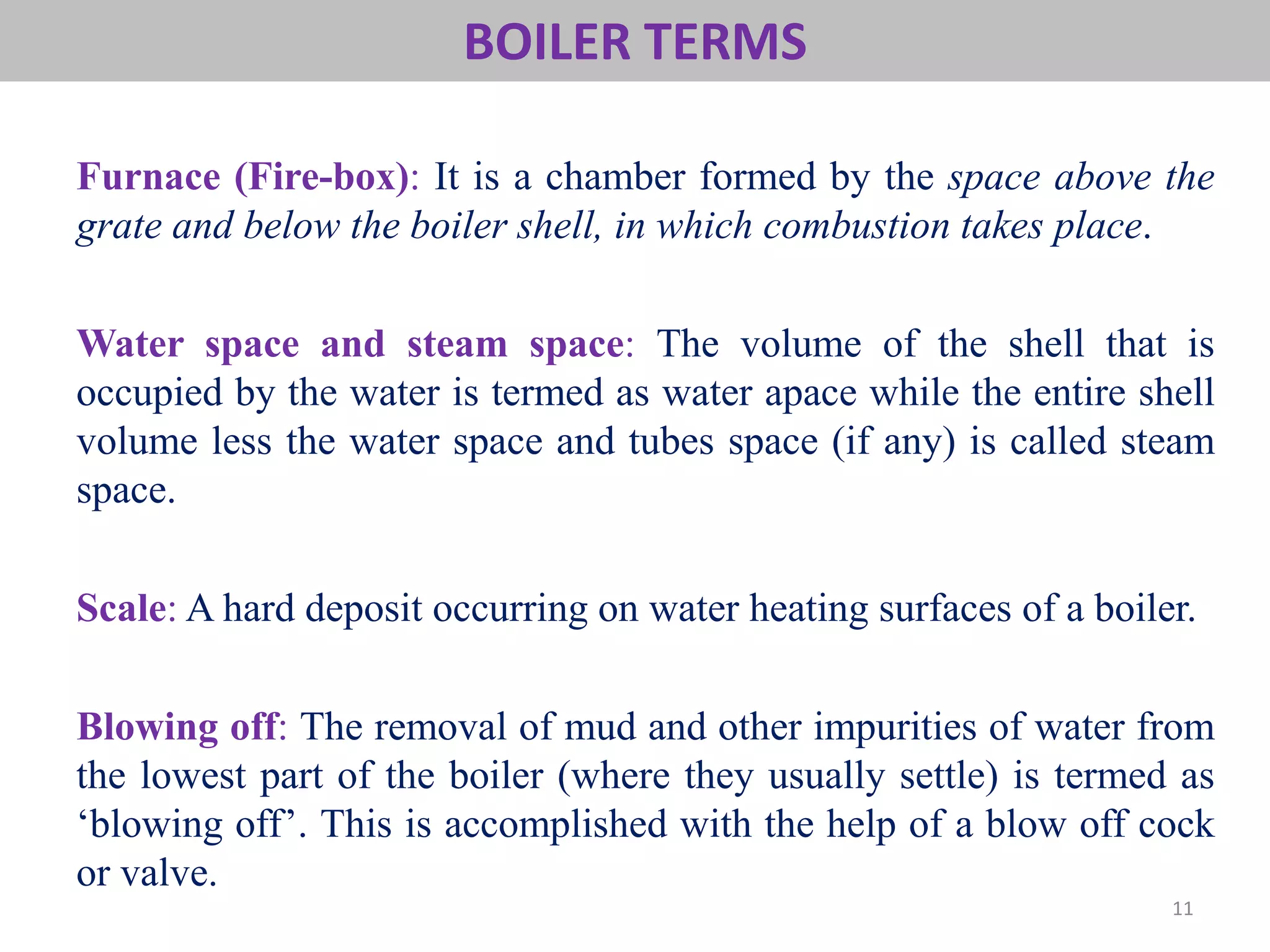
Furnace (Fire-box): It is a chamber formed by the space above the
grate and below the boiler shell, in which combustion takes place.
Water space and steam space: The volume of the shell that is
occupied by the water is termed as water apace while the entire shell
volume less the water space and tubes space (if any) is called steam
space.
Scale: A hard deposit occurring on water heating surfaces of a boiler.
Blowing off: The removal of mud and other impurities of water from
the lowest part of the boiler (where they usually settle) is termed as
‘blowing off’. This is accomplished with the help of a blow off cock
or valve.
BOILER TERMS
12
Mountings: Boiler Mountings are the components generally mounted on the
surface of the boiler for its safe and secured operation. These are the
essential parts of the boiler, without which the boiler operation is not
possible.
Examples: Stop valve, safety valves, fusible plug, blow-off cock,
pressure gauges, water level indicator etc.
Accessories: These are the devices which are installed with a boiler and its
neighboring area to increase the efficiency of the boiler. These are not the
essential part of the boiler and thus without installing these devices, the
boiler operation can be accomplished though at a lower efficiency.
Examples: superheaters, economizers, Air-preheater, feed pumps etc.
13
FIRE TUBE BOILERS
Cochran Boiler
14
Features
• Fire-tube boiler
• Vertical type
• Multi-tubular type
• Natural circulation
• Internally fired
• Maximum steam pressure of 15 bar
• Maximum steam capacity of 4000 kg/hour.
• Efficiency: 70~75%
15
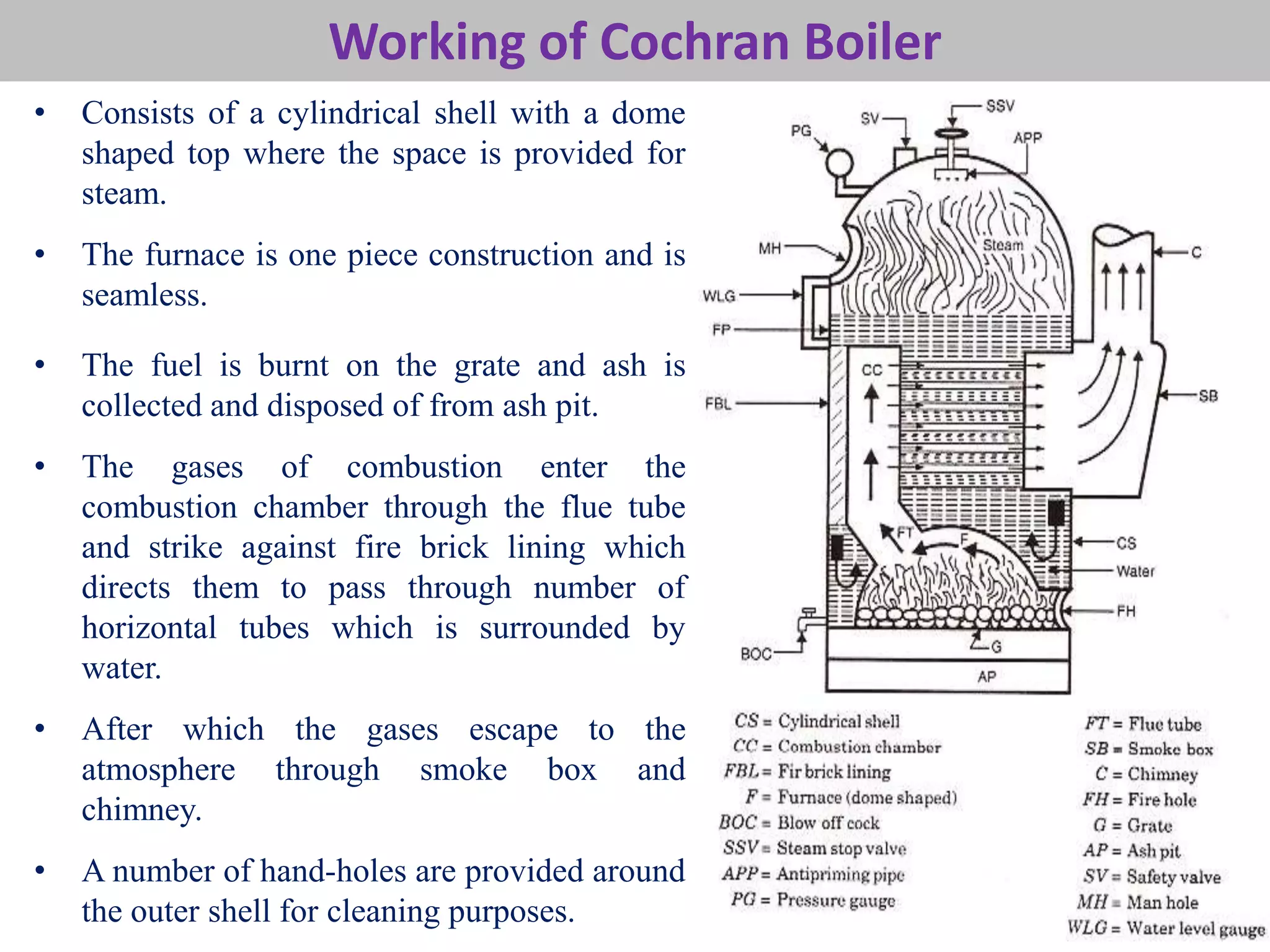
Working of Cochran Boiler
• The fuel is burnt on the grate and ash is
collected and disposed of from ash pit.
• The gases of combustion enter the
combustion chamber through the flue tube
and strike against fire brick lining which
directs them to pass through number of
horizontal tubes which is surrounded by
water.
• After which the gases escape to the
atmosphere through smoke box and
chimney.
• A number of hand-holes are provided around
the outer shell for cleaning purposes.
• Consists of a cylindrical shell with a dome
shaped top where the space is provided for
steam.
• The furnace is one piece construction and is
seamless.
16
Advantages
(i) Occupies less floor space.
(ii) Construction cost is Low.
(iii) Semi-portable and hence easy to install and transport.
(iv) Because of self contained furnace no brick work setting is necessary.
Disadvantages
(i) Capacity is less because of the vertical design.
(ii) Requires high head room space.
(iii) Difficulty in cleaning and inspection due to vertical design,
Advantages and Disadvantages of Cochran Boiler
17
Lancashire Boiler
Features
• Fire-tube boiler
• Horizontal
• Multi-tubular
• Natural circulation
• Internally fired
• Stationary
• Maximum steam pressure of 16 bar
• Maximum steam capacity of 9000 kg/hour.
• Efficiency: 50~70%
18
Construction of Lancashire Boiler
Boiler Parts
B = Bottom flue
C = Chimney
D = Dampers
E = Fire bridge
F = Flue tube
K = Main flue
S = Side flue
Mountings
1. High steam low water safety valve
2. Man hole
3. Antipriming pipe
4. Steam stop valve
5. Safety valve
6. Pressure gauge
7. Feed check valve
8. Water gauge
9. Blow down cock
10. Fusible plug
19
• The Lancashire boiler consists of a cylindrical shell Inside which two
large tubes are placed.
• The shell is constructed with several rings of cylindrical from and it is
placed horizontally over a brickwork which forms several channels for
the flow of hot gases.
• These two tubes are also constructed with several rings of cylindrical
form. They pass from one and of the shell to the other and are covered
with water.
• The furnace is placed at the front end of each tube and are known as
furnace tubes.
• The coal is introduced through the fire hole into the grate.
• There is low brickwork fire bridge behind the gate to prevent the entry
of the burning coal and ashes into the interior of the furnace tubes.
Working of Lancashire Boiler
20
• The combustion product from the grate pass up to the back end of the
furnace tubes and then in downward direction.
• Thereafter they move through the bottom channel or bottom flue up to
the front end of the boiler where they are divided and pass up to the side
flues.
• Now they move along the two side flue and come to the chimney.
• To control the flow of hot gases to the chimney, dampers (in the form of
sliding doors) are provided. As a result the flow of air to the grate can be
controlled.
Working of Lancashire Boiler
Interested to see animation?
21
Advantages
(i) Due to large reservoir capacity, the load fluctuations can be easily be met.
(ii) Easy to clean and inspect.
(iii) Heating surface area / unit volume of the boiler is considerably large.
(iv) Maintenance costs are low.
(v) It is reliable and easy to operate.
Disadvantages:
(i) Maximum pressure is limited to about 16 bar
(ii) More floor area is required due to brickwork settings
(iii) Due to large water capacity, boiler takes longer time to develop required pressures.
(iv) Since the furnace is inside the tubes the grate area is restricted
Applications:
(i) Sugar mills, textile industries where steam is required for power generation as well
as for the process work.
(ii) It is also used in chemical industries.
Advantages and Disadvantages of Lancashire Boiler
22
Cornish Boiler
• It is similar to Lancashire boiler in all respect, except there is only one
flue tube in Cornish boiler instead of two in Lancashire boiler.
• The steaming capacity and working pressure of a Cornish boiler is low
as compared to Lancashire boiler.
23
Typical Feature
- Fire tube type - Internally fired
- Horizontal - Multi-tubular
- Natural circulation - Artificial draft
- Portable boiler - Steam capacity: 9000 kg/h
- Working pressure: 14 bar - Efficiency: 70%
Locomotive Boiler
24
Locomotive Boiler
25
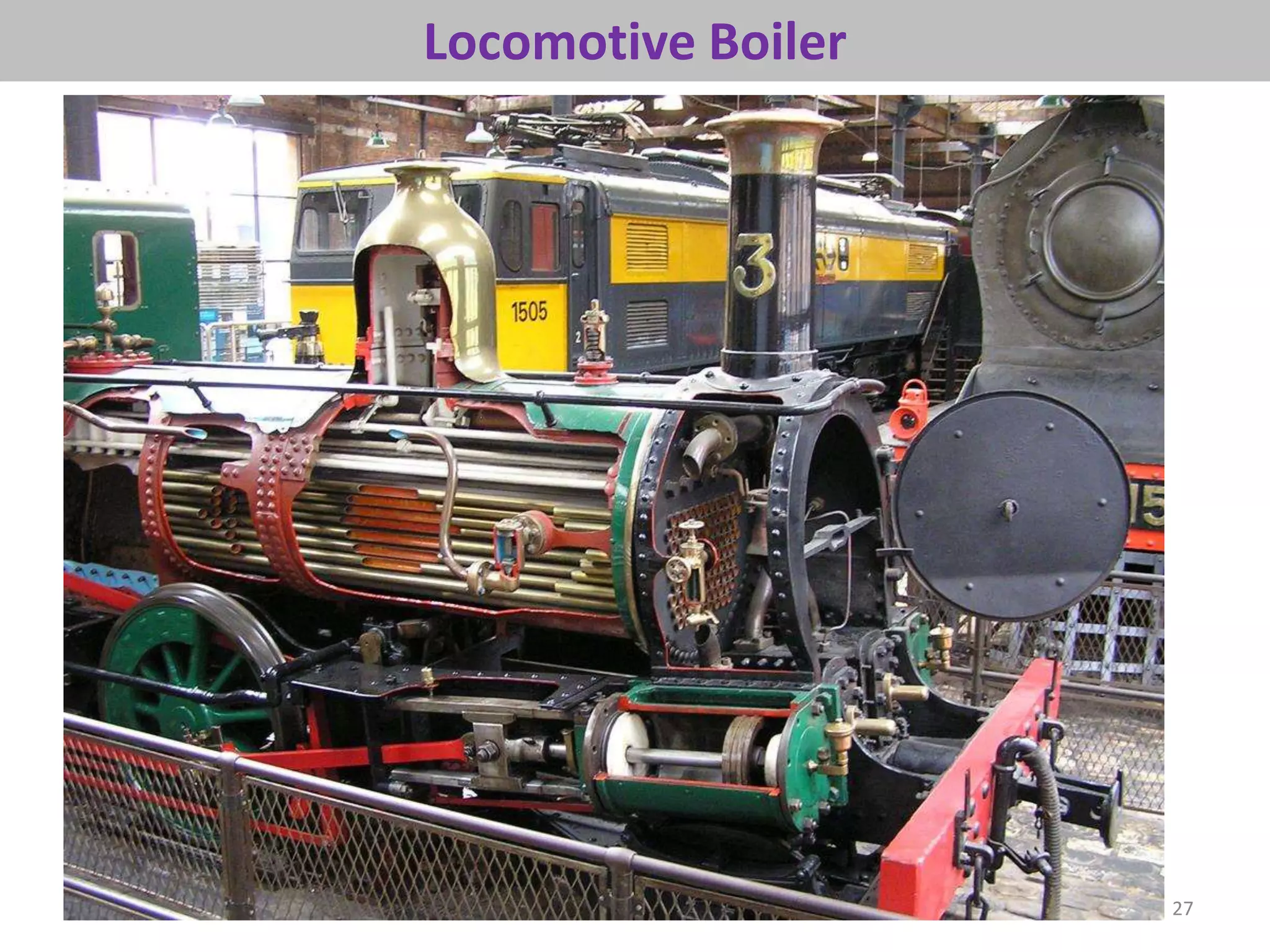
• The locomotive boiler consists of a cylindrical barrel with a rectangular fire box at
one end and a smoke box at the other end.
• The fire box is entirely surrounded by water except for the fire hole and the ash
pit. Dampers are used to control the flow of air to the grate.
• The hot gas passes from the fire box to the smoke box through a series of fire
tubes and then to the chimney.
• The heat of the hot gases is transmitted into the water through the heating surface
of the fire tubes and the steam generated is collected over the water surface.
• Some of the fire tubes are of Larger diameter. The superheater tubes are placed
inside larger diameter fire tubes.
• A dome shaped chamber (steam dome) is fitted on the upper part of the barrel,
from where the steam flows through a steam pipe into the superheated steam
chamber (superheater header).
• From the chamber it passes through the superheater tubes and again returns to
chamber from which it is led too the steam engine cylinders.
• The flow of steam is regulated by means of a regulator.
Working of Locomotive Boiler
26
• The locomotive boiler consists of a cylindrical barrel with a rectangular fire box at
one end and a smoke box at the other end.
• The fire box is entirely surrounded by water except for the fire hole and the ash
pit.
• Dampers are used to control the flow of air to the grate.
• The hot gas passes from the fire box to the smoke box through a series of fire
tubes and then to the chimney.
• The heat of the hot gases is transmitted into the water through the heating surface
of the fire tubes and the steam generated is collected over the water surface.
• Some of the fire tubes are of Larger diameter. The superheater tubes are placed
inside larger diameter fire tubes.
• A dome shaped chamber is fitted on the upper part of the barrel, from where the
steam flows into the superheated steam chamber (superheater header).
• From the chamber it passes through the superheater tubes and again returns to
chamber from which it is led to the steam engine cylinders.
• The flow of steam is regulated by means of a regulator.
Working of Locomotive Boiler
27
Locomotive Boiler
28
Advantages and Disadvantages of Locomotive Boiler
Advantages
(i) High steam capacity
(ii) Low cost of construction and installation
(iii) Portability
(iv) Compact
Disadvantages
(i) There are chances to corrosion and scale formation in the water legs
due to the accumulation of sediments and the mud particles
(ii) It is difficult to clean some water spaces
(iii) It cannot carry high overloads without being damaged by overheating
29
WATER TUBE BOILERS
30
Babcock and Wilcox Boiler
Features
• Horizontal & Stationary
• Externally fired
• Natural circulation
• Water tube boiler
• Working Pressure: 40 bar (max)
• Steaming capacity: 40000 kg/h (max)
• Efficiency: 60 to 80%.
31
Babcock and Wilcox Boiler
32
Babcock and Wilcox Boiler
33
Working of Babcock and Wilcox Boiler
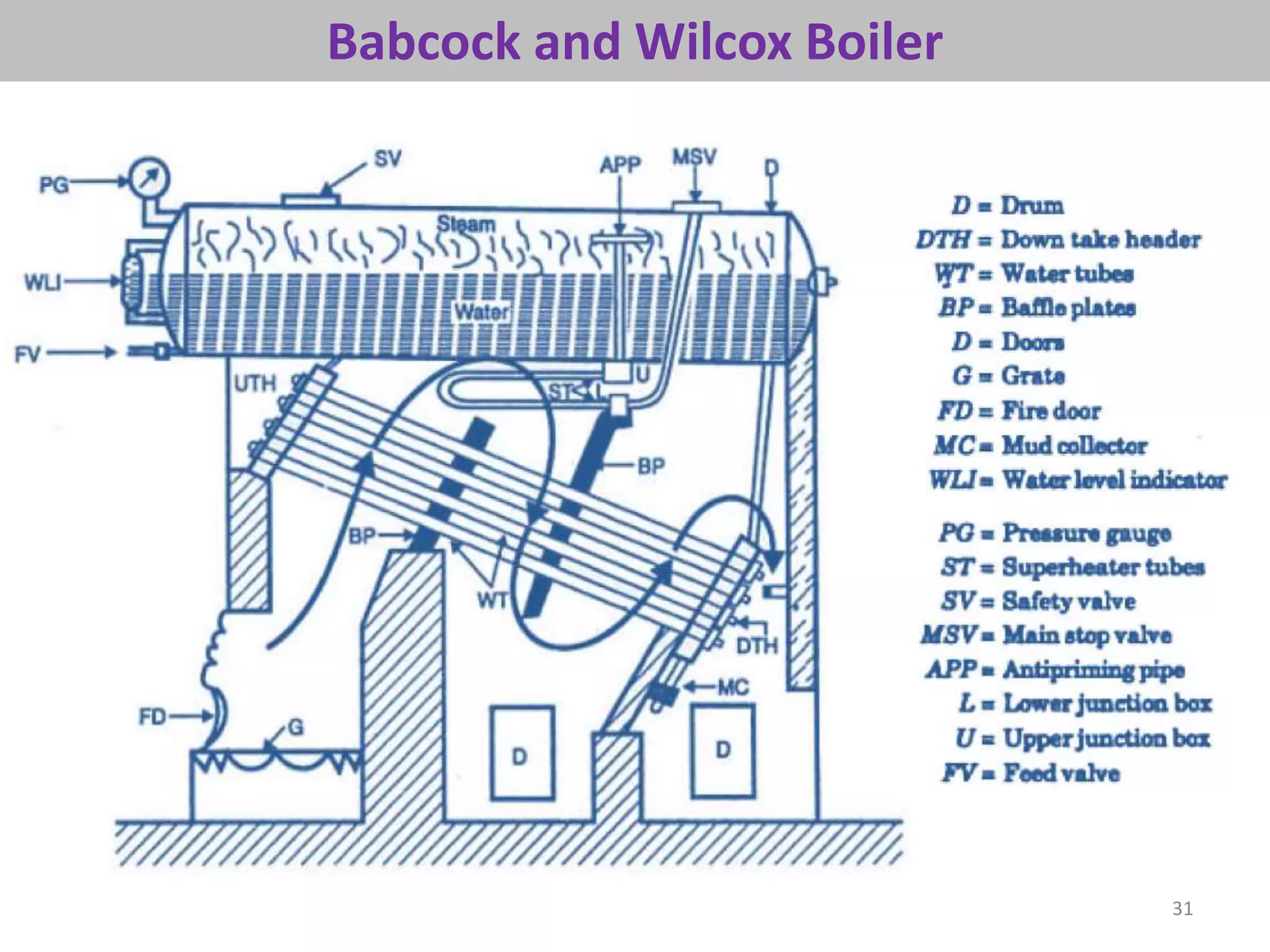
• This boiler consists of a horizontal drum connected to a series of front
end and rear end header by short riser tubes.
• The headers are connected by a series of inclined water tubes of mild
steel. The angle of inclination of the water tubes to the horizontal is
about 15o.
• The hot gases of combustion are forced to move upwards between the
water tubes by baffle plats provided.
• The water from the drum flows through the Inclined tubes via downtake
header and goes back Into the shell in the form of wet steam via uptake
header.
• The steam gets collected in the steam space of the drum from where it
enters superheater tubes via antipriming pipe where it is further heated
and is finally taken out through the main steam valve and supplied to the
engine when needed.
34
Stirling Boiler
Components
V = Stop valve
P = Steam pipe
b = Water baffle
B = Baffle wall
ST = Superheater tubes
T = Water tubes
G = Grate
M = Mud drum
Features
• Bent tube boiler
• Water tube boiler
• Externally fired
• Natural circulation
• Working Pressure: 60 bar (max)
• Steaming capacity: 50000 kg/h (max)
35
Stirling Boiler
36
Working of Stirling Boiler
• It consists of two upper drums known a steam drums and a lower drum known
as mud or water drum.
• The steam drums are connected to mud drum by banks of bent tubes.
• The steam and water space of the steam drums are interconnected with each
other to obtain water and steam balance.
• The feed water is delivered to the steam drum-1 which is fitted with a baffle.
The baffle deflects the water to move downwards into the drum.
• The water flows from the drum-1 to the mud drum through the rearmost water
tubes at the backside.
• As drum-1 is not subjected to high temperature so the impurities may not cause
harm to the drum.
• The baffle provided at the mud drum deflects the pure water to move upwards to
the drum-1 through the remaining half of the water tubes at the back.
• The water also flows from mud drum to the drum-2 through the water tubes
which are just over the furnace. So they attain a higher temperature than the
remaining portion of the boiler and a major portion of evaporation takes place in
these tubes.
37
Working of Stirling Boiler
• The steam is taken from the drum-1 through a steam pipe and then it passes
through the superheater tubes where the steam is superheated.
• Finally the steam moves to the stop valve from where it can be supplied for
further use.
• The combustion products ensuing from the grate move in the upward and
downward directions duo to the brick wall baffles and are finally discharged
through the chimney into the atmosphere.
• It as lighter and more flexible than the straight tube boilers. But it is
comparatively more difficult to clean and inspect the bent tubes.
38
High Pressure Boilers
Salient Features
• Steaming Capacity: 30 to 650 tonnes/hour
• Working Pressure: Above 80 bar which can go as high as 160 bar
• Maximum steam temperature: As high as 540 oC.
• Water tube boilers are preferred for high pressure (more than 30 bars) and
high steaming capacity (more than 30000 kg/hour)
• Forced circulation of water
• Improved heat transfer methods such as increasing water velocity, heating
water beyond critical pressure of steam, and mixing of superheated steam
with water
Examples
LaMont boiler, Benson boiler, Loeffler boiler, Babcock and Wilcox boiler
39
High Pressure Boilers
Advantages
• Increased evaporative capacity due to forced circulation of water
resulting in reduced size of the steam drum.
• Efficient utilization of heat of combustion due to the use of large number
of small diameter tubes.
• Increased rate of heat release due to increased rate of firing of fuel under
pressurized combustion.
• Requirement of less floor area due to compactness.
• Reduced tendency of scale formation due to high velocity of water inside
the tubes
• Reduced overheating and thermal stress problem due to uniform heating
of all the parts.
• Reduced differential expansions due to uniform temperature resulting in
reduced chances of gas or air leakages.
40
High Pressure Boilers
Advantages ….
• The components can be arranged horizontally as high head required for
natural circulation is eliminated using forced circulation. This provides
greater flexibility in the components arrangements.
• The steam can be raised quickly to meet the variable load requirements.
• 40 to 42% increase in efficiency by using high pressure and high
temperature steam.
• Can be used for carrying peak loads or stand by purposes due to its ability
of rapid start from cold if external supply of power is available.
41
High Pressure Boilers
Specifications
• Working Pressure
120 bar
• Temperature of steam
Above 5000 C
• Steam production rate
45 to 50 tonnes/hour
LaMont boiler
Demerits
• The deposition of salt and sediments
on the inner surfaces of the water
tubes resulting in reduced heat
transfer rate.
• Formation of bubbling at the inner
surfaces of the water tubes.
42
High Pressure Boilers
Benson boiler
Specifications
• Working Pressure
500 bar
• Temperature of steam
6500 C max
• Steam production rate
150 tonnes/hour

Steam generator@snist

  • 1.
    Steam Generators/Boilers 1 Dr. M.S. Ali, MED, SNIST, Hyderabad, India
  • 2.
    Steam Boilers?  Insimple terms a boiler may be defined as ‘a closed vessel in which steam is produced from water by combustion of fuel’.  According to American Society of Mechanical of Mechanical Engineers (ASME) a ‘steam generating unit’ is defined as: ‘A combination of apparatus for producing, furnishing, or recovering heat together with the apparatus for transferring the heat so made available to the fluid being heated and vaporized’ 2
  • 3.
    Applications of Boiler 3 Power generation: Mechanical or electrical power may be generated by expanding steam in the steam engine or steam turbine.  Heating: The steam can be used for heating residential and industrial buildings in cold weather and for producing hot waters for hot water supply.  Industrial processes: Steam can also be used for industrial processes such as for sizing and bleaching etc. in textile industries and other applications like sugar mills, cement, agricultural and chemical industries.
  • 4.
    1. Horizontal, Vertical,or Inclined • If the axis of the boiler is horizontal, the boiler is called horizontal boiler. The parts of a horizontal boiler can be inspected and repaired easily but it occupies more space. • If the axis is vertical, it is called vertical boiler. The vertical boiler occupies less floor area. • If the axis is inclined it is known as inclined boiler. 2. Fire Tube and Water Tube • In the fire tube boiler, the hot gas are Inside the tubes and the water surrounds the tube. Examples- Cochran, Lancashire, and Locomotive boiler. • In the water tube boilers, the water is inside the tubes and hot gases surround them. Examples- Babcock and Wilcox, Stirling, Yarrow boiler etc. Classification of Boilers 4
  • 5.
    3. Externally Firedand Internally Fired • The boiler is known as externally fired if the furnace is outside the boiler shell. Examples- Babcock and Wilcox boiler, Stirling boiler etc. • In case of internally fired boilers, the furnace is located inside the boiler shell. Example- Cochran, Lancashire boiler etc. 4. Forced Circulation and Natural Circulation • In forced circulation type of boilers, the circulation of water is done by a forced pump. Examples- Velox, LaMont, Benson boiler etc. • In natural circulation type of boilers, circulation of water in the boiler takes place due to natural convention currents produced by the application of heat. Examples: Lancashire, Babcock and Wilcox boiler etc. Classification of Boilers 5
  • 6.
    5. High Pressureand Low Pressure Boilers • The boilers which produce steam at pressures of 80 bar and above are called high pressure boilers. Examples- Babcock and Wilcox, Velox, LaMont, and Benson boilers • The boilers which produce steam at pressures below 80 bar are called low pressure boilers. Examples: Cochran, Cornish, Lancashire and Locomotive boilers. 6. Stationary and Portable • Stationary (land) boilers are used for central power plants and for industrial process work etc. These are stationary because they are not moved from one place to other place. • Mobile (marine, and locomotive) boilers or portable boilers are those which are moved from one place to another. These include locomotive and marine type boilers, and other small units for use at temporary sites (just as in small coal-field pits). Classification of Boilers 6
  • 7.
    7. Single Tubeand Multi-tube Boilers • The fire tube boilers are classified single tube and multi-tube boilers, depending upon whether the fire tube is one or more than one. Examples- Most of the boilers are Multi-tube type except Cornish, and simple vertical boiler. Classification of Boilers 7
  • 8.
    Fire tube Vs.Water tube 8 S. No. Particulars Fire-tube boilers Water-tube boilers 1 Position of water and hot gasses Hot gases inside the tube and water outside the tube Water inside the tube and hot gasses outside the tube 2 Mode of firing Generally internally fired Externally fired 3 Operating pressure Operating pressure limited to 16 bar Can work under as high pressure as 100 bar 4 Rate of steam production Lower Higher 5 Suitability Not suitable for large power plants Suitable for large power plants 6 Risk of bursting Lower risk due to lower operating pressure Higher risk due to higher operating pressure 7 Floor area For given power it occupies more floor area For given power it occupies less floor area
  • 9.
    Fire tube Vs.Water tube 9 S. No. Particulars Fire-tube boilers Water-tube boilers 8 Construction Difficult Simple 9 Transportation Difficult Simple 10 Shell diameter Large for same power Small for same power 11 Chances of explosion Less due to low pressure More due to high pressure 12 Treatment of water Not so necessary More necessary 13 Accessibility of various parts Various parts not so accessible for cleaning, repair, and inspection Various parts are more accessible for cleaning, repair, and inspection 14 Requirement of skill Require less skill for efficient and economic working Require more skill and careful attention
  • 10.
    BOILER TERMS 10 Shell: Theshell of a boiler consists of one or more steel plates bent into a cylindrical form and riveted or welded together The shell ends are closed with the end plates. Setting: The primary function of setting is to confine heat to the boiler and form a passage for gases. It is made of brickwork and may form the wall of the furnace and the combustion chamber. It also provides support in some types of boilers (eg., Lancashire boiler) Grate: It s the platform in the furnace upon which fuel is burnt and it is made of cast iron bars. The bars are so arranged that air may pass on to the fuel for combustion. The area of the grate on which the fire rests in a coal or wood fired boiler is called grate surface.
  • 11.
    BOILER TERMS 11 Furnace (Fire-box):It is a chamber formed by the space above the grate and below the boiler shell, in which combustion takes place. Water space and steam space: The volume of the shell that is occupied by the water is termed as water apace while the entire shell volume less the water space and tubes space (if any) is called steam space. Scale: A hard deposit occurring on water heating surfaces of a boiler. Blowing off: The removal of mud and other impurities of water from the lowest part of the boiler (where they usually settle) is termed as ‘blowing off’. This is accomplished with the help of a blow off cock or valve.
  • 12.
    BOILER TERMS 12 Mountings: BoilerMountings are the components generally mounted on the surface of the boiler for its safe and secured operation. These are the essential parts of the boiler, without which the boiler operation is not possible. Examples: Stop valve, safety valves, fusible plug, blow-off cock, pressure gauges, water level indicator etc. Accessories: These are the devices which are installed with a boiler and its neighboring area to increase the efficiency of the boiler. These are not the essential part of the boiler and thus without installing these devices, the boiler operation can be accomplished though at a lower efficiency. Examples: superheaters, economizers, Air-preheater, feed pumps etc.
  • 13.
  • 14.
    Cochran Boiler 14 Features • Fire-tubeboiler • Vertical type • Multi-tubular type • Natural circulation • Internally fired • Maximum steam pressure of 15 bar • Maximum steam capacity of 4000 kg/hour. • Efficiency: 70~75%
  • 15.
    15 Working of CochranBoiler • The fuel is burnt on the grate and ash is collected and disposed of from ash pit. • The gases of combustion enter the combustion chamber through the flue tube and strike against fire brick lining which directs them to pass through number of horizontal tubes which is surrounded by water. • After which the gases escape to the atmosphere through smoke box and chimney. • A number of hand-holes are provided around the outer shell for cleaning purposes. • Consists of a cylindrical shell with a dome shaped top where the space is provided for steam. • The furnace is one piece construction and is seamless.
  • 16.
    16 Advantages (i) Occupies lessfloor space. (ii) Construction cost is Low. (iii) Semi-portable and hence easy to install and transport. (iv) Because of self contained furnace no brick work setting is necessary. Disadvantages (i) Capacity is less because of the vertical design. (ii) Requires high head room space. (iii) Difficulty in cleaning and inspection due to vertical design, Advantages and Disadvantages of Cochran Boiler
  • 17.
    17 Lancashire Boiler Features • Fire-tubeboiler • Horizontal • Multi-tubular • Natural circulation • Internally fired • Stationary • Maximum steam pressure of 16 bar • Maximum steam capacity of 9000 kg/hour. • Efficiency: 50~70%
  • 18.
    18 Construction of LancashireBoiler Boiler Parts B = Bottom flue C = Chimney D = Dampers E = Fire bridge F = Flue tube K = Main flue S = Side flue Mountings 1. High steam low water safety valve 2. Man hole 3. Antipriming pipe 4. Steam stop valve 5. Safety valve 6. Pressure gauge 7. Feed check valve 8. Water gauge 9. Blow down cock 10. Fusible plug
  • 19.
    19 • The Lancashireboiler consists of a cylindrical shell Inside which two large tubes are placed. • The shell is constructed with several rings of cylindrical from and it is placed horizontally over a brickwork which forms several channels for the flow of hot gases. • These two tubes are also constructed with several rings of cylindrical form. They pass from one and of the shell to the other and are covered with water. • The furnace is placed at the front end of each tube and are known as furnace tubes. • The coal is introduced through the fire hole into the grate. • There is low brickwork fire bridge behind the gate to prevent the entry of the burning coal and ashes into the interior of the furnace tubes. Working of Lancashire Boiler
  • 20.
    20 • The combustionproduct from the grate pass up to the back end of the furnace tubes and then in downward direction. • Thereafter they move through the bottom channel or bottom flue up to the front end of the boiler where they are divided and pass up to the side flues. • Now they move along the two side flue and come to the chimney. • To control the flow of hot gases to the chimney, dampers (in the form of sliding doors) are provided. As a result the flow of air to the grate can be controlled. Working of Lancashire Boiler Interested to see animation?
  • 21.
    21 Advantages (i) Due tolarge reservoir capacity, the load fluctuations can be easily be met. (ii) Easy to clean and inspect. (iii) Heating surface area / unit volume of the boiler is considerably large. (iv) Maintenance costs are low. (v) It is reliable and easy to operate. Disadvantages: (i) Maximum pressure is limited to about 16 bar (ii) More floor area is required due to brickwork settings (iii) Due to large water capacity, boiler takes longer time to develop required pressures. (iv) Since the furnace is inside the tubes the grate area is restricted Applications: (i) Sugar mills, textile industries where steam is required for power generation as well as for the process work. (ii) It is also used in chemical industries. Advantages and Disadvantages of Lancashire Boiler
  • 22.
    22 Cornish Boiler • Itis similar to Lancashire boiler in all respect, except there is only one flue tube in Cornish boiler instead of two in Lancashire boiler. • The steaming capacity and working pressure of a Cornish boiler is low as compared to Lancashire boiler.
  • 23.
    23 Typical Feature - Firetube type - Internally fired - Horizontal - Multi-tubular - Natural circulation - Artificial draft - Portable boiler - Steam capacity: 9000 kg/h - Working pressure: 14 bar - Efficiency: 70% Locomotive Boiler
  • 24.
  • 25.
    25 • The locomotiveboiler consists of a cylindrical barrel with a rectangular fire box at one end and a smoke box at the other end. • The fire box is entirely surrounded by water except for the fire hole and the ash pit. Dampers are used to control the flow of air to the grate. • The hot gas passes from the fire box to the smoke box through a series of fire tubes and then to the chimney. • The heat of the hot gases is transmitted into the water through the heating surface of the fire tubes and the steam generated is collected over the water surface. • Some of the fire tubes are of Larger diameter. The superheater tubes are placed inside larger diameter fire tubes. • A dome shaped chamber (steam dome) is fitted on the upper part of the barrel, from where the steam flows through a steam pipe into the superheated steam chamber (superheater header). • From the chamber it passes through the superheater tubes and again returns to chamber from which it is led too the steam engine cylinders. • The flow of steam is regulated by means of a regulator. Working of Locomotive Boiler
  • 26.
    26 • The locomotiveboiler consists of a cylindrical barrel with a rectangular fire box at one end and a smoke box at the other end. • The fire box is entirely surrounded by water except for the fire hole and the ash pit. • Dampers are used to control the flow of air to the grate. • The hot gas passes from the fire box to the smoke box through a series of fire tubes and then to the chimney. • The heat of the hot gases is transmitted into the water through the heating surface of the fire tubes and the steam generated is collected over the water surface. • Some of the fire tubes are of Larger diameter. The superheater tubes are placed inside larger diameter fire tubes. • A dome shaped chamber is fitted on the upper part of the barrel, from where the steam flows into the superheated steam chamber (superheater header). • From the chamber it passes through the superheater tubes and again returns to chamber from which it is led to the steam engine cylinders. • The flow of steam is regulated by means of a regulator. Working of Locomotive Boiler
  • 27.
  • 28.
    28 Advantages and Disadvantagesof Locomotive Boiler Advantages (i) High steam capacity (ii) Low cost of construction and installation (iii) Portability (iv) Compact Disadvantages (i) There are chances to corrosion and scale formation in the water legs due to the accumulation of sediments and the mud particles (ii) It is difficult to clean some water spaces (iii) It cannot carry high overloads without being damaged by overheating
  • 29.
  • 30.
    30 Babcock and WilcoxBoiler Features • Horizontal & Stationary • Externally fired • Natural circulation • Water tube boiler • Working Pressure: 40 bar (max) • Steaming capacity: 40000 kg/h (max) • Efficiency: 60 to 80%.
  • 31.
  • 32.
  • 33.
    33 Working of Babcockand Wilcox Boiler • This boiler consists of a horizontal drum connected to a series of front end and rear end header by short riser tubes. • The headers are connected by a series of inclined water tubes of mild steel. The angle of inclination of the water tubes to the horizontal is about 15o. • The hot gases of combustion are forced to move upwards between the water tubes by baffle plats provided. • The water from the drum flows through the Inclined tubes via downtake header and goes back Into the shell in the form of wet steam via uptake header. • The steam gets collected in the steam space of the drum from where it enters superheater tubes via antipriming pipe where it is further heated and is finally taken out through the main steam valve and supplied to the engine when needed.
  • 34.
    34 Stirling Boiler Components V =Stop valve P = Steam pipe b = Water baffle B = Baffle wall ST = Superheater tubes T = Water tubes G = Grate M = Mud drum Features • Bent tube boiler • Water tube boiler • Externally fired • Natural circulation • Working Pressure: 60 bar (max) • Steaming capacity: 50000 kg/h (max)
  • 35.
  • 36.
    36 Working of StirlingBoiler • It consists of two upper drums known a steam drums and a lower drum known as mud or water drum. • The steam drums are connected to mud drum by banks of bent tubes. • The steam and water space of the steam drums are interconnected with each other to obtain water and steam balance. • The feed water is delivered to the steam drum-1 which is fitted with a baffle. The baffle deflects the water to move downwards into the drum. • The water flows from the drum-1 to the mud drum through the rearmost water tubes at the backside. • As drum-1 is not subjected to high temperature so the impurities may not cause harm to the drum. • The baffle provided at the mud drum deflects the pure water to move upwards to the drum-1 through the remaining half of the water tubes at the back. • The water also flows from mud drum to the drum-2 through the water tubes which are just over the furnace. So they attain a higher temperature than the remaining portion of the boiler and a major portion of evaporation takes place in these tubes.
  • 37.
    37 Working of StirlingBoiler • The steam is taken from the drum-1 through a steam pipe and then it passes through the superheater tubes where the steam is superheated. • Finally the steam moves to the stop valve from where it can be supplied for further use. • The combustion products ensuing from the grate move in the upward and downward directions duo to the brick wall baffles and are finally discharged through the chimney into the atmosphere. • It as lighter and more flexible than the straight tube boilers. But it is comparatively more difficult to clean and inspect the bent tubes.
  • 38.
    38 High Pressure Boilers SalientFeatures • Steaming Capacity: 30 to 650 tonnes/hour • Working Pressure: Above 80 bar which can go as high as 160 bar • Maximum steam temperature: As high as 540 oC. • Water tube boilers are preferred for high pressure (more than 30 bars) and high steaming capacity (more than 30000 kg/hour) • Forced circulation of water • Improved heat transfer methods such as increasing water velocity, heating water beyond critical pressure of steam, and mixing of superheated steam with water Examples LaMont boiler, Benson boiler, Loeffler boiler, Babcock and Wilcox boiler
  • 39.
    39 High Pressure Boilers Advantages •Increased evaporative capacity due to forced circulation of water resulting in reduced size of the steam drum. • Efficient utilization of heat of combustion due to the use of large number of small diameter tubes. • Increased rate of heat release due to increased rate of firing of fuel under pressurized combustion. • Requirement of less floor area due to compactness. • Reduced tendency of scale formation due to high velocity of water inside the tubes • Reduced overheating and thermal stress problem due to uniform heating of all the parts. • Reduced differential expansions due to uniform temperature resulting in reduced chances of gas or air leakages.
  • 40.
    40 High Pressure Boilers Advantages…. • The components can be arranged horizontally as high head required for natural circulation is eliminated using forced circulation. This provides greater flexibility in the components arrangements. • The steam can be raised quickly to meet the variable load requirements. • 40 to 42% increase in efficiency by using high pressure and high temperature steam. • Can be used for carrying peak loads or stand by purposes due to its ability of rapid start from cold if external supply of power is available.
  • 41.
    41 High Pressure Boilers Specifications •Working Pressure 120 bar • Temperature of steam Above 5000 C • Steam production rate 45 to 50 tonnes/hour LaMont boiler Demerits • The deposition of salt and sediments on the inner surfaces of the water tubes resulting in reduced heat transfer rate. • Formation of bubbling at the inner surfaces of the water tubes.
  • 42.
    42 High Pressure Boilers Bensonboiler Specifications • Working Pressure 500 bar • Temperature of steam 6500 C max • Steam production rate 150 tonnes/hour