BOILER
It is a closed vessel which generate steam at desired pressure and temp. by
transferring the heat from the burning fuel to water to change in to steam.
Applications of Steam:
# Power generation
# Industrial Process Work
# Heating Installations
# Hot water supplies
FACTOR AFFECTING THE BOILER SELECTION
• # Working pressure of steam
• # Quality of stem Required
• # Steam generation Rate
• # Fuel and water available
• #Type of fuel used
• # Facilities available for erection
• # Operation and Maintenance cost
• # Load Factor
• # Initial Cost
REQUIREMENTS OF GOOD BOILER
# It should produce max. quantity of steam with min. fuel
consumption
# It should be light in weight
# It should occupies small space
# Capable of quick start
# Meet Large variation of load
# Easy Maintenance
# Mud should not deposits on heated plates
# Installation should be simple
# It should as per safety regulation laid down by boiler act.
CLASSIFICATION OF BOILERS
# According to the Content in the tube
1. Fire Tube Boiler :
fire tube boiler hot gases passes through the tubes and water surrounds them.
Heat conducted through the wall of the tube from the hot gases to the
surrounding water
Examples: Cochran Boiler, Lancashire Boiler, Cornish Boiler and Locomotive
Boiler
. :
2. Water Tube Boiler :-
In water tube boiler water flows through the tubes and flue gases flows around
the tubes. Heat conducted through the wall of the tube from the hot gases to
the water inside the tube.
Examples: Babcock and Wilcox Boiler, Strirling Boiler, La mont Boiler and
Benson Boiler
# According to the Method of Firing
1. Internally Fired Boiler :
Are those boilers in which furnace is located inside the
boiler shell or drum. Most of boiler are internally fired boilers. Examples: Cochran
Boiler, Lancashire Boiler, and Locomotive Boiler
.2. Externally Fired Boiler :
Are those boilers in which furnace is located outside the
boiler shell or drum. Most of boiler are internally fired boilers.
Examples: Babcock and Wilcox Boiler
# According to the Pressure of Steam
1. Low Pressure Boilers:
Are those boilers which generates the steam at a pressure
below 80 bar is called Low Pressure Boilers
Examples: Cochran Boiler, Lancashire Boiler, and Locomotive Boiler
2. High Pressure Boilers:
Are those boilers which generates the steam at a pressure
More than 80 bar is called Low Pressure Boilers.
Examples: Babcock and Wilcox Boiler, Lamont, Benson Boiler
# According to Method of Circulation Of Water
1. Natural Circulation:::
In natural circulation boilers, Circulation of water is due to gravity.
Examples: Babcock and Wilcox Boiler, Lancashire Boiler, and Locomotive Boiler
2. Forced Circulation::
In forced circulation boilers Circulation of water by the pump driven
by external power. Examples: Lamount , Benson Boiler
# According to Axis of Shell or Drum
1. Vertical Boiler::-If the axis of the shell of the boiler is vertical so called vertical
boilers. Examples: Cochran Boiler
2. Horizontal Boiler:
If the axis of the shell of the boiler is horizontal so called horizontal
boilers. Examples: Laocomotive Boiler , Lancashire Boiler
# According to No. of Tubes
1. Single Tube Boiler :
In single tube boiler there is only one water tube or fire tube.
Examples: Cornish Boiler
2. Multi Tube Boiler :
In multi tube boiler there are two or more than two water tubes or
fire tubes. Examples: Cochran Boiler , Lancashire Boiler and Locomotive boiler
# According to Nature of Draught
1. Natural draught boiler:-
in natural draught boilers , draught is produced by natural circulation
of air and gas
2. Forced draught Boilers:
in Forced draught boilers , draught is produced by means of
mechanical fans
COMPARISON FIRE TUBE AND WATER TUBE BOILER
FIRE TUBE BOILER
1. Hot gases flow through the tubes
2. Generate steam pressure up to 25 bar
3. Rate of steam generation is up to 9 tons per
hour
4. Floor area required is more
5. Overall efficiency is 75%
6. Transportation and erection is difficult
7. Water does not circulate in definite direction
8. Operating cost is less
9. Bursting chances are less
10. used in large power plant
11. Greater risk in case of bursting
WATER TUBE BOILER
1. Water circulate inside the tubes
2. Generate steam pressure up to 250 bar
3. Rate of steam generation is up to 450
tons per hour
4. Floor area required is less
5. Overall efficiency is 90%
6. Transportation and erection is easy
7. Water circulate in definite direction
8. Operating cost is high
9. Bursting chances are more
10. used in process industries
11. lesser risk in case of bursting
COCHRAN BOILER
It is vertical ,multi tubular, fire tube ,
internally fired natural circulation Boiler.
It consist of a vertical cylindrical shell
having a hemispherical top and furnace is
also hemispherical . The fire grate is
arranged in the furnace and ash pit is
provided below the grate . A fire door is
attached to the fire box . The boiler has a
combustion chamber which is lined with
fire bricks. the end of the smoke tube are
fitted in the smoke box. The chimney is
provided on the top of the smoke box to
discharge of gas to the atmosphere. The
furnace is surrounded by water on all
sides except at opening of the fire door
and combustion chamber.
BABCOCK AND WILCOX BOILER
It is a horizontal drum, multi tubular,
water tube, externally fired , natural
circulation boiler. The water tube
boiler are used when pressure above
10 bar and steam capacity more than
7000 kg per hr. is required.
It consist of a drum mounted at the top
and connected by upper header and
down take header. A large no. of.
Water tubes connects the uptake and
down take header. the water tubes
are inclined 5 to 15 degrees to
promote water circulation. The
heating surface of the tubes. And half
of the cylinder surface of the water
drum which is exposed to the flue
gases. Below the uptake header the
furnace of the boiler is arranged.
There is a bridge wall deflector which
deflect the combustion gases upward.
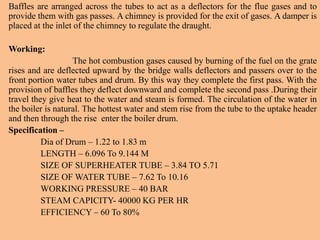
Baffles are arranged across the tubes to act as a deflectors for the flue gases and to
provide them with gas passes. A chimney is provided for the exit of gases. A damper is
placed at the inlet of the chimney to regulate the draught.
Working:
The hot combustion gases caused by burning of the fuel on the grate
rises and are deflected upward by the bridge walls deflectors and passers over to the
front portion water tubes and drum. By this way they complete the first pass. With the
provision of baffles they deflect downward and complete the second pass .During their
travel they give heat to the water and steam is formed. The circulation of the water in
the boiler is natural. The hottest water and stem rise from the tube to the uptake header
and then through the rise enter the boiler drum.
Specification –
Dia of Drum – 1.22 to 1.83 m
LENGTH – 6.096 To 9.144 M
SIZE OF SUPERHEATER TUBE – 3.84 TO 5.71
SIZE OF WATER TUBE – 7.62 To 10.16
WORKING PRESSURE – 40 BAR
STEAM CAPICITY- 40000 KG PER HR
EFFICIENCY – 60 To 80%
Boiler Mountings:
The boiler mountings are the part of the boiler and are required for proper
functioning. In accordance with the Indian Boiler regulations, of the boiler
mountings is essential fitting for safe working of a boiler. These mounting are the
integral part of the Boiler.
Some of the important mountings are:
1.WATER LEVEL INDICATOR Water level indicator
is a device to show the level of water in
boiler. It located in front of boiler in such a
position that the level of water can easily be
seen by attendant. Two water level indicators
are used on all boilers. . It consist three valve
and a glass tube . Steam valve D connects
the glass tube with steam space and valve E
connect the glass tube with water .Drain
Valve K is used at frequent intervals. If glass
is broken two balls after B and C close the
end of the glass tube and protects the water
and steam from escaping.
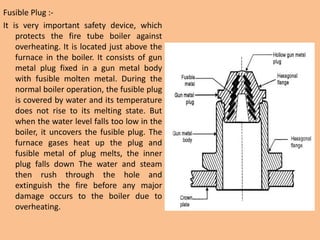
Fusible Plug :-
It is very important safety device, which
protects the fire tube boiler against
overheating. It is located just above the
furnace in the boiler. It consists of gun
metal plug fixed in a gun metal body
with fusible molten metal. During the
normal boiler operation, the fusible plug
is covered by water and its temperature
does not rise to its melting state. But
when the water level falls too low in the
boiler, it uncovers the fusible plug. The
furnace gases heat up the plug and
fusible metal of plug melts, the inner
plug falls down The water and steam
then rush through the hole and
extinguish the fire before any major
damage occurs to the boiler due to
overheating.
Pressure Gauge :-
The function of the pressure gauge is to indicate the
steam pressure of boiler in bar gauge. A pressure
gauge is fitted in front of boiler in such a position
that the operator can conveniently read it. It
reads the pressure of steam in the boiler and is
connected to steam space by a siphon tube. The
most commonly, the Bourdon pressure gauges
used. I A burden tube pressure gauge consist of a
elliptical elastic tube ABC bent in to an arc of a
circle. One end of the tube is fixed and connected
to the steam space in the boiler and other end is
connected to a sector link. When pressure
increases the tube tends to straighten and pinion
and sector arrangement rotate a pointer. The
pointer moves over a calibrated scale.
Blow-Off Cock:-
The function of blow-off cock is to
discharge mud and other sediments
deposited in the bottom most part of
the water space in the boiler, while
boiler is in operation. It can also be
used to drain-off boiler water. Hence it
is mounted at the lowest part of the
boiler. When it is open, water under
the pressure rushes out, thus carrying
sediments and mud. The cock is fitted
to the bottom of the boiler drum and
consist of a conical plug fitted to the
body.
SAFETY VALVES:
Safety valves are located on the top
of the boiler. They guard the boiler
against the excessive high pressure
of steam inside the drum. If the
pressure of steam in the boiler
drum exceeds the working
pressure then the safety valve
allows blow-off the excess quantity
of steam to atmosphere. Thus the
pressure of steam in the drum falls.
The escape of steam makes a audio
noise to warm the boiler
attendant.
There are four types of safety valve.
• 1. Dead weight safety valve.
• 2. Spring loaded safety valve
• 3. Lever loaded safety valve
• 4. High steam and low water safety
valve.
FEED CHECK VALVE :-
The feed check valve is fitted
to the boiler, slightly below
the working level in the
boiler. It is used to supply
high pressure feed water to
boiler. It also prevents the
returning of feed water from
the boiler if feed pump fails
to work.
Boiler Accessories
The accessories are mounted on the boiler to increase its efficiency. These units
are optional on an efficient boiler. With addition of accessories on the boiler,
the plant efficiency also increases.
The following accessories are normally used on a modern boiler:
(i) Economizer
(ii) Super heater
(iii) Air pre heater
(iv) Feed water pump
(v) Steam injector.
ECONOMIZER :-
An economizer is a heat
exchanger, used for heating
the feed water before it
enters the boiler. The
economizer recovers some of
waste heat of hot flue gases
going to chimney. It helps in
improving the boiler
efficiency. It is placed in the
path of flue gases at the rear
end of the boiler just before
air pre-heater.
SUPERHEATER:-
It is a heat exchanger in which
heat of combustion products
is used to dry the wet steam,
pressure remains constant,
its volume and temperature
increase. Basically, a super
heater consists of a set of
small diameter U tubes in
which steam flows and takes
up the heat from hot flue
gases.
AIR PRE- HEATER:-
The function of an air pre-heater is similar to that of an economizer. It
recovers some portion of the waste heat of hot flue gases going to chimney, and
transfers same to the fresh air before it enters the combustion chamber. Due to
preheating of air, the furnace temperature increases. It results in rapid combustion
of fuel with less soot, smoke and ash. The high furnace temperature can permit low
grade fuel with less atmospheric pollution. The air pre-heater is placed between
economizer and chimney.
FEED WATER PUMP:-
It is used to feed the water at a high pressure against the high pressure of
steam already existing inside the boiler.
STEAM INJECTOR:-
A steam injector lifts and forces the feed water into the boiler. It is usually
used for vertical and locomotive boilers and can be accommodated in small space.
It is less costly. It does not have any moving parts thus operation is salient.
Performance Evaluation of Boilers
• The performance parameters of boiler, like efficiency and
evaporation ratio reduces with time due to
• poor combustion,
• heat transfer surface fouling and
• poor operation and maintenance.
• Even for a new boiler, reasons such as deteriorating fuel quality,
water quality etc. can result in poor boiler performance.
• Boiler efficiency tests help us to find out the deviation of boiler
efficiency from the best efficiency and target problem area for
corrective action.
22
Performance Evaluation of Boilers
• Thermal efficiency of boiler is defined as the percentage of heat
input that is effectively utilized to generate steam.
• There are two methods of assessing boiler efficiency.
23
Performance Evaluation of Boilers
Direct Method
• This is also known as ‘input-output method’ due to the fact that it needs only the
useful output (steam) and the heat input (i.e. fuel) for evaluating the efficiency.
• This efficiency can be evaluated using the formula
• Parameters to be monitored for the calculation of boiler efficiency by direct
method are :
• Quantity of steam generated per hour (Q) in kg/hr.
• Quantity of fuel used per hour (q) in kg/hr.
• The working pressure (in kg/cm2) and superheat temperature (oC), if any
• The temperature of feed water (oC)
• Type of fuel and gross calorific value of the fuel (GCV) in kcal/kg of fuel
Where,
– hg – Enthalpy of saturated steam in kcal/kg of steam
– hf - Enthalpy of feed water in kcal/kg of water
Advantages of direct method:
– Plant people can evaluate quickly the efficiency of boilers
– Requires few parameters for computation
– Needs few instruments for monitoring
Disadvantages of direct method:
– Does not give clues to the operator as to why efficiency of system is lower
– Does not calculate various losses accountable for various efficiency levels
Indirect Method
• Indirect method is also called as heat loss method.
• The efficiency can be arrived at, by subtracting the heat loss fractions from 100.
• The principle losses that occur in a boiler are:
– Loss of heat due to dry flue gas
– Loss of heat due to moisture in fuel and combustion air
– Loss of heat due to combustion of hydrogen
– Loss of heat due to radiation
– Loss of heat due to unburnt
• The data required for calculation of boiler efficiency using indirect method are:
– Ultimate analysis of fuel (H2, O2, S, C, moisture content, ash content)
– Percentage of Oxygen or CO2 in the flue gas
– Flue gas temperature in 0C (Tf)
– Ambient temperature in 0C (Ta) & humidity of air in kg/kg of dry air.
– GCV of fuel in kcal/kg
– Percentage combustible in ash (in case of solid fuels)
– GCV of ash in kcal/kg (in case of solid fuels)
• Solution :
• Theoretical air requirement
• Actual mass of air supplied/ kg of fuel (AAS) = {1 + EA/100} x theoretical air
m = mass of dry flue gas in kg/kg of fuel
Cp = Specific heat of flue gas (0.23 kcal/kg 0C)
ii. Percentage heat loss due to evaporation of water formed due to H2 in fuel
iii. Percentage heat loss due to evaporation of moisture present in fuel
• In a relatively small boiler, with a capacity of 10 MW, the radiation and
unaccounted losses could amount to between 1% and 2% of the gross calorific
value of the fuel
• while in a 500 MW boiler, values between 0.2% to 1% are typical.
Energy Conservation Opportunities
1. Stack Temperature
2. Feed Water Preheating using Economizer
3. Combustion Air Preheat
4. Incomplete Combustion
5. Excess Air Control
6. Radiation and Convection Heat Loss
7. Automatic Blow down Control
8. Reduction of Scaling and Soot Losses
9. Proper Boiler Scheduling
10. Boiler Replacement
1. Stack Temperature
• The stack temperature should be as low as possible.
• However, it should not be so low that water vapor in the exhaust condenses on the
stack walls.
• This is important in fuels containing signficant sulphur as low temperature can lead
to sulphur dew point corrosion.
• Stack temperatures greater than 200°C indicates potential for recovery of waste
heat.
• It also indicate the scaling of heat transfer/recovery equipment and hence the
urgency of taking an early shut down for water / flue side cleaning.
2. Feed Water Preheating using Economiser
• Typically, the flue gases leaving a modern 3-pass shell boiler are at temperatures of
200 to 300 oC.
• Thus, there is a potential to recover heat from these gases.
• The flue gas exit temperature from a boiler is usually maintained at a minimum of
200 oC, so that the sulphur oxides in the flue gas do not condense and cause
corrosion in heat transfer surfaces.
• When a clean fuel such as natural gas, LPG or gas oil is used, the economy of heat
recovery must be worked out, as the flue gas temperature may be well below
200oC.
3. Combustion Air Preheat
• Combustion air preheating is an alternative to feed water heating.
• In order to improve thermal efficiency by 1%, the combustion air temperature must
be raised by 20 oC.
• Most gas and oil burners used in a boiler plant are not designed for high air preheat
temperatures.
• Modern burners can withstand much higher combustion air preheat,
4. Incomplete Combustion
• Incomplete combustion can arise from a shortage of air or poor distribution of fuel.
• It is usually obvious from the colour or smoke, and must be corrected immediately.
• In the case of oil and gas fired systems, CO or smoke (for oil fired systems only) with
normal or high excess air indicates burner system problems.
• A more frequent cause of incomplete combustion is the poor mixing of fuel and air
at the burner.
5. Excess Air Control
• Excess air is required in all practical cases to ensure complete combustion
• The optimum excess air level for maximum boiler efficiency occurs when the sum
of the losses due to incomplete combustion and loss due to heat in flue gases is
minimum.
• This level varies with furnace design, type of burner, fuel and process variables.
• It can be determined by conducting tests with different air fuel ratios.
•
6. Radiation and Convection Heat Loss
• The external surfaces of a shell boiler are hotter than the surroundings.
• The surfaces thus lose heat to the surroundings depending on the surface area and
the difference in temperature between the surface and the surroundings.
• Repairing or augmenting insulation can reduce heat loss through boiler walls and
piping.
7. Automatic Blowdown Control
• Uncontrolled continuous blowdown is very wasteful.
• Automatic blowdown controls can be installed that sense and respond to boiler
water conductivity and pH.
• A 10% blow down in a 15 kg/cm2 boiler results in 3% efficiency loss.
8. Reduction of Scaling and Soot Losses
• In oil and coal-fired boilers, soot buildup on tubes acts as an insulator against heat
transfer.
• Also same result will occur due to scaling on the water side.
• High exit gas temperatures at normal excess air indicate poor heat transfer
performance.
• Waterside deposits require a review of water treatment procedures and tube
cleaning to remove deposits.
• An estimated 1% efficiency loss occurs with every 22oC increase in stack
temperature.
9. Proper Boiler Scheduling
• Since, the optimum efficiency of boilers occurs at 65-85% of full load,
• it is usually more efficient, on the whole, to operate a fewer number of boilers at
higher loads, than to operate a large number at low loads.
10. Boiler Replacement
• The potential savings from replacing a boiler depend on the anticipated change in
overall efficiency.
• Since boiler plants traditionally have a useful life of well over 25 years, replacement
must be carefully studied.
Energy Conservation Opportunities
Draught
INTRODUCTION
The draught is one of the most essential systems of thermal power plant which supplies
required quantity of air for combustion and remove the burnt product from the system.
To move the air through the fuel bed and to produce the flow of hot gases through the
boiler, economizer, preheater and chimney required a difference of pressure
This difference of pressure for to maintaining the constant flow of air and discharging
the gases through the chimney to atmosphere is known as draught. Draught
Draught can be obtained by use of chimney, fan, steam or air jet or combination of
these. When the draught is produced With the help of chimney only, it is known as
Natural Draught and when the draught is produced by any other means except chimney
it I s known as artificial draught.
.
Types of Draughts :
Draught
Natural
draught
Artificial
Draught
Steam Jet
Draught
Forced
Draught
Induced
Draught
Mechanical
Draught
Forced
Draught
Induced
Draught
Balanced
Draught
The total draught required to produce the current of air and to discharge the hot gases
to the Atmosphere is the arithmetic sum of all draught losses in the series circuit.
The total draught losses in the air and gas loop system are given by
Fuel Bed Resistance (hb):
The fuel bed resistance depends on fuel size, bed thickness and combustion rate.
The effect of combustion rate on resistance for different types of stokers is shown
in Fig. The resistance of the spreader stoker is not shown in figure because much of
the coal is burned in suspension.
chimneyandductinLossHeadh
equipmentsinLossHeadh
HeadwaterofcmtoequivalentresistanceBedFuelh
Headwaterofcm.inHeadVelocityh
waterofcminDraughtTotao
d
e
b
v






t
debvt
h
hhhhh
• Head Loss in Equipments (he):
The manufacturers generally supply data for equipment resistance like air heater,
economizer, boiler passes, super heaters, etc. A survey of test data indicates that
the draught losses follow a parabolic law. the loss at another rating can be
calculated by using the following
The draught system is designed to give minimum velocity head loss V2/2g loss.
(where V is the velocity at the exit of the chimney.) But it must be sufficient to
diffuse and mix with the surrounding atmospheric air.
Its value also depends upon the natural air velocity at chimney height. Higher
velocity head is required if the natural air velocity is higher
No general data can be given for such loss. It is decided as per the site of the power
plant, air temperature and natural air flow condition.
To know the velocity head, a velocity versus, velocity head in cm of water is shown
in Fig
se
0.28.1
1
2
12
mofrategenerationsteamat thelossdraughttheishWhere
to
s
s
ee
m
m
hh 






Head Loss in Ducts and Chimney (hd):
The draught loss due to friction in air and gas ducts and chimney is given by Fanning
equation as
where Rh is hydraulic radius (cross-sectional area/wetted perimeter) and f is the
friction factor of the duct through which air or gas flows. The value of depends
upon the smoothness of the duct and Reynolds number of the Fluid flowing.
To find out the losses in bends, elbows and valves, the losses are generally given in
terms of equivalent duct length and the same equation as given above can be used
for finding the pressure loss
flowingfluidofmeterin
24
.
2







g
V
R
L
fh
h
d
Measurement of Draught:
The draught losses in different parts of the boiler plant are measured in mm of water
with the help of manometers. This pressure may be above atmospheric pressure or
below atmospheric pressure. For very accurate measurement, the Inclined type
manometer Is used
The typical draught at different points of the boiler plant measured by U-tube
manometer is shown in Fig.
The measurement of draught serves not only to find
out the resistance to the air and gas flow but it also indicates the rate of flow
ADVANTAGES :
(1) It does not require any external power for producing the draught.
(2) The capital investment is less. The maintenance cost is nil as
there is no mechanical part.
(3) Chimney keeps the flue gases at a high place in the atmosphere which
prevents the contamination of atmosphere.
(4) It has long life.
LIMITATIONS :
(1) The maximum pressure available for producing natural draught by chimney is
hardly 10 to 20 mm of water under the normal atmospheric and flue gas
temperatures.
(2) The available draught decreases with increase in outside air temperature and for
producing sufficient draught, the flue gases have to be discharged at comparatively
high temperatures resulting in the loss of overall plant efficiency. And thus
maximum utilization of Heat is not possible
(3) As there is no through mixing of air and fuel in the combustion chamber due to low
velocity of air therefore combustion is very poor. This increases the specific fuel
consumption
(4) The chimney has no flexibility to create more draught under peak load conditions
because the draught available is constant for a particular height of chimney and the
draught can be increased by allowing the flue gases to leave the combustion
chamber at higher temperatures. This reduces the overall efficiency of the plant
Artificial draught :
Because of insufficient head and lack of flexibility, The use of natural draught is limited
to small capacity boilers only. The draught required in actual power plant is
sufficiently high (300 mm of water) and to meet high draught requirement, some
other system must be used known as artificial draught.
The artificial draught is more economical when the required draught is above 40 mm
of water
Forced Draught :
In a forced draught system, a blower is installed near the base of the boiler. This
draught system is known as positive draught system or forced draught system
because the pressure of air throughout the system is above atmospheric pressure
and air is forced to flow through the system. The arrangement of the system is
shown in figure
A stack or chimney is also used in this system as shown in figure but it is not much
significant for producing draught
Induced draught :
• In this system, the blower is located near the base of the chimney instead of near
The grate . The air is sucked in the system by reducing Induced Draught Instead of
near the grate . The air is sucked in the system by reducing the pressure through
the system below atmosphere
• The action of the induced draught is similar to the action of the chimney. The
draught produced is independent of the temperature of the hot gases therefore
the gases may be discharged as cold as possible after recovering as much heat as
possible in air-preheater and economizer.
This draught is used generally when economizer and air-preheater are incorporated in
the system. The fan should be located at such a place that the temperature of the
gas handled by the fan is lowest.
• The chimney is also used in this system and its function is similar as mentioned in
forced draught but total draught produced in induced draught system is the sum of
the draughts produced by the fan and chimney. The arrangement of the system is
shown in Figure.
Advantages of mechanical draught over natural draught.
1. The artificial mechanical draught is better in control and more economical than
natural draught.
2. The rate of combustion is high as the available draught is more . The better
distribution and mixing of air with fuel is possible Therefore the Quantity of air
required per kg of Fuel is Less . Therefore The quantity of Air required per kg of fuel
is less.
3. The air flow can be regulated according to the requirement by changing the draught
pressure.
4. The chimney draught is produced at the cost of thermal efficiency of the plant
because it is necessary to exhaust the gases at high temperature to produce the
draught. In mechanical draught, the exhaust gases can be cooled to lowest possible
temperature before exhaust and improves the overall thermal efficiency of the plan
5. The height of the chimney used in mechanical draught can be reduced sufficiently as
the function of the chimney is only to exhaust the gases high in the atmosphere to
prevent the contamination.
6. The efficiency of the artificial draught is nearly 7% whereas the efficiency of the
chimney draught is hardly 1%
7. The fuel consumption per kW due to artificial draught is 15% less than the natural
draught.
8. The fuel burning capacity of the grate is 200 to 300 kg/m 2 in Area of grate per hour
with mechanical draught whereas it is hardly 50 kg/m 2 -hr with natural draught.
9. It prevents the formation of smoke as complete combustion is possible even with
less excess air.
The major disadvantage of the artificial draught is the high capital cost required and
high running and maintenance costs of the fans used.
NATURAL DRAUGHT AND DESIGN OF CHIMNEY
The natural draught is obtained with the use of tall chimney which may be sufficient or
insufficient.
   
 g
ga
ga
gHgH
p
gHp
p
gH















a
aa
/
11
g
/
1
2
/
1
aa
aa1
2
1
gH
pp
pp
levelgrateat thedifferencepressuretheNow
gasesfluehotofdensitytheisWherep
chmneyofheightcolumngasesfluehottopduePressurep
bygivenisgrateat thepressurethepassage,gasesfluethe
aswellaschmneytheupfillwillgaseshotthegrate,on theuplightenedisfireWhen the
airatm.ofDensityPressure,cAtmospheripWhere
pp
Hheightofcolumnairatm.toduepresurepp
bygivenislevelgrateat thepresssuretheair,icatmosphereby the
filledischmneythe,lightenednotisfireeChWhemn thofTopat thePressurepLet
Base)Chimney(Levelgrateat thePressurepLet
columnwaterofmm
1000
h
columnwaterofmmh
columnwaterofmmofIn term
1mmm
supplied.fuelofmassandsuppliedair
ofmasstheofsumthetoequalisproducedgasesfluetheofmassthat theknowweAs
Assumed1KgsuppliedfuelofMassm
Fuel)of/Kg(Kg.gasesflueofMassm
ChmneytheofHeightH
ChmneythesideinGasesFlueofTemp.Absolute
AirAtm.ofTemp.Absolute
N/m
111
353
w
w
aag
f
g
2
g
p
g
p
m
T
T
m
m
TT
Hp
f
g
a
a
a
ga























 


3
a
3
a
0
a
aa
0
0
3
0
0
00
Kg/m
353
273
773.0
chimneytheoutsideairofDensity
Fuelofg/m
273
773.0
TXV
TXV
T
V
presuresamrFor
chimneytheoutsideairatm.oftemp.Vol.andpressuresame
thetoreducedbothsuppliedairofvolthetoequaltakenbecangasesflueofvol.The
neglected.becansosuppliedairofvol.thetocomparedassmallisburntfuelofvol.The
pressureandTempNormalatvol.specific/m0.773
1.013
1x287x273
AirofMass
gaseshotofMass1
a
aa
a
a
a
aa
a
a
a
a
a
a
a
a
TTm
m
V
m
KTm
T
vm
T
V
T
V
Kg
p
mRT
v
mRTvp
m
m








 
mm
111
353
m
111
1000
353111
3531000
/1000p
Also
/
111
353p
3531353
-p
bygivenDifferencePressur
353
.
1
353
11
FuelofKg/m
353
TX
273
773.0
V
TXV
chimneytheinsidegaseshotforSimilarly
2
2
f
3
ff
f
0
0
0
0
f







 








 








 









 








 









fa
a
a
w
fa
a
a
w
fa
a
a
w
www
fa
a
a
fa
a
a
fa
fa
a
fa
a
f
a
faa
a
f
T
X
m
m
T
gHh
T
X
m
m
T
H
h
T
X
m
m
T
gHgh
So
mNghgh
mN
T
X
m
m
T
gH
gH
T
X
m
m
T
gH
Tm
m
Tm
m
V
m
Tmm
T
vm
TX
T
V



Height of Chimney:
The draught produced by chimney in terms of mm of water column is given by
Mass of Flue Gases :
Draught produced by chimney in terms of meter of flue gases column is given by
Mass of Gases flowing through any cross section of the chimney is given by
waterofmm
111
353













 

a
a
ga
w
m
m
TT
Hh













 1
1
1
a
g
a
a
T
T
m
m
HH
chimnyhethrough tpassinfgasesflueofVelocityC
sectioncrossanyatChimneyofdia.theisDD
4
A
Kg./Sec.
2
.



 CAm gg 
Velocity of flue gases passing through the chimney:
 
columngasflueofmeterofin termsChimneyin theLossHeadhWhere
2
/
/
1

 hHgC
Heat Balance Sheet
It is an account of heat supplied and heat utilized in various ways in the system.
It is done on sec. basis or min basis or hour basis
Heat Input per Min K Cal % Heat Expenditure per Min K Cal %
Heat Supplied by
Combustion of Gases
Qs 100%
(a) Heat in B.P. x ---
(b) Heat Carried away by cooling
water
y ----
( c) Heat carried away by exhaust
gases
z ----
(d) Unaccounted Heat
=Qs-( x + y + z)
m ---
Total Qs 100% 100%
Heat Balance Sheet
1. Heat Supplied to Engine
mf – mass of fuel consumed in one min
C.V. – Calorific Value of fuel
(a) B.P. : Measured by Dynamometer
(b) Heat Carried away by cooling Water
VfS CmQ .
 wiwowpw TTmC  .
Heat Balance Sheet
(c) Heat Carried away by gases
(d) Unaccounted Heat :
It is calculated from the above discussed Heats
  MinKJTTCm agepgg /. 
Mg – Mass of Exhaust Gases in Kg/Min
Cpg – Specific Heat of Exhaust Gases KJ/Kg. K
Tge – Temp. of Burnt Gases Coming out of Engine
Ta - Ambient Temp.
 ..PBQQQQ ExhaustwaterSdunaccounte 
Boilers ppt (energy conversion)

Boilers ppt (energy conversion)

  • 1.
    BOILER It is aclosed vessel which generate steam at desired pressure and temp. by transferring the heat from the burning fuel to water to change in to steam. Applications of Steam: # Power generation # Industrial Process Work # Heating Installations # Hot water supplies FACTOR AFFECTING THE BOILER SELECTION • # Working pressure of steam • # Quality of stem Required • # Steam generation Rate • # Fuel and water available • #Type of fuel used • # Facilities available for erection • # Operation and Maintenance cost • # Load Factor • # Initial Cost
  • 2.
    REQUIREMENTS OF GOODBOILER # It should produce max. quantity of steam with min. fuel consumption # It should be light in weight # It should occupies small space # Capable of quick start # Meet Large variation of load # Easy Maintenance # Mud should not deposits on heated plates # Installation should be simple # It should as per safety regulation laid down by boiler act.
  • 3.
    CLASSIFICATION OF BOILERS #According to the Content in the tube 1. Fire Tube Boiler : fire tube boiler hot gases passes through the tubes and water surrounds them. Heat conducted through the wall of the tube from the hot gases to the surrounding water Examples: Cochran Boiler, Lancashire Boiler, Cornish Boiler and Locomotive Boiler . : 2. Water Tube Boiler :- In water tube boiler water flows through the tubes and flue gases flows around the tubes. Heat conducted through the wall of the tube from the hot gases to the water inside the tube. Examples: Babcock and Wilcox Boiler, Strirling Boiler, La mont Boiler and Benson Boiler
  • 4.
    # According tothe Method of Firing 1. Internally Fired Boiler : Are those boilers in which furnace is located inside the boiler shell or drum. Most of boiler are internally fired boilers. Examples: Cochran Boiler, Lancashire Boiler, and Locomotive Boiler .2. Externally Fired Boiler : Are those boilers in which furnace is located outside the boiler shell or drum. Most of boiler are internally fired boilers. Examples: Babcock and Wilcox Boiler # According to the Pressure of Steam 1. Low Pressure Boilers: Are those boilers which generates the steam at a pressure below 80 bar is called Low Pressure Boilers Examples: Cochran Boiler, Lancashire Boiler, and Locomotive Boiler 2. High Pressure Boilers: Are those boilers which generates the steam at a pressure More than 80 bar is called Low Pressure Boilers. Examples: Babcock and Wilcox Boiler, Lamont, Benson Boiler
  • 5.
    # According toMethod of Circulation Of Water 1. Natural Circulation::: In natural circulation boilers, Circulation of water is due to gravity. Examples: Babcock and Wilcox Boiler, Lancashire Boiler, and Locomotive Boiler 2. Forced Circulation:: In forced circulation boilers Circulation of water by the pump driven by external power. Examples: Lamount , Benson Boiler # According to Axis of Shell or Drum 1. Vertical Boiler::-If the axis of the shell of the boiler is vertical so called vertical boilers. Examples: Cochran Boiler 2. Horizontal Boiler: If the axis of the shell of the boiler is horizontal so called horizontal boilers. Examples: Laocomotive Boiler , Lancashire Boiler
  • 6.
    # According toNo. of Tubes 1. Single Tube Boiler : In single tube boiler there is only one water tube or fire tube. Examples: Cornish Boiler 2. Multi Tube Boiler : In multi tube boiler there are two or more than two water tubes or fire tubes. Examples: Cochran Boiler , Lancashire Boiler and Locomotive boiler # According to Nature of Draught 1. Natural draught boiler:- in natural draught boilers , draught is produced by natural circulation of air and gas 2. Forced draught Boilers: in Forced draught boilers , draught is produced by means of mechanical fans
  • 7.
    COMPARISON FIRE TUBEAND WATER TUBE BOILER FIRE TUBE BOILER 1. Hot gases flow through the tubes 2. Generate steam pressure up to 25 bar 3. Rate of steam generation is up to 9 tons per hour 4. Floor area required is more 5. Overall efficiency is 75% 6. Transportation and erection is difficult 7. Water does not circulate in definite direction 8. Operating cost is less 9. Bursting chances are less 10. used in large power plant 11. Greater risk in case of bursting WATER TUBE BOILER 1. Water circulate inside the tubes 2. Generate steam pressure up to 250 bar 3. Rate of steam generation is up to 450 tons per hour 4. Floor area required is less 5. Overall efficiency is 90% 6. Transportation and erection is easy 7. Water circulate in definite direction 8. Operating cost is high 9. Bursting chances are more 10. used in process industries 11. lesser risk in case of bursting
  • 8.
    COCHRAN BOILER It isvertical ,multi tubular, fire tube , internally fired natural circulation Boiler. It consist of a vertical cylindrical shell having a hemispherical top and furnace is also hemispherical . The fire grate is arranged in the furnace and ash pit is provided below the grate . A fire door is attached to the fire box . The boiler has a combustion chamber which is lined with fire bricks. the end of the smoke tube are fitted in the smoke box. The chimney is provided on the top of the smoke box to discharge of gas to the atmosphere. The furnace is surrounded by water on all sides except at opening of the fire door and combustion chamber.
  • 9.
    BABCOCK AND WILCOXBOILER It is a horizontal drum, multi tubular, water tube, externally fired , natural circulation boiler. The water tube boiler are used when pressure above 10 bar and steam capacity more than 7000 kg per hr. is required. It consist of a drum mounted at the top and connected by upper header and down take header. A large no. of. Water tubes connects the uptake and down take header. the water tubes are inclined 5 to 15 degrees to promote water circulation. The heating surface of the tubes. And half of the cylinder surface of the water drum which is exposed to the flue gases. Below the uptake header the furnace of the boiler is arranged. There is a bridge wall deflector which deflect the combustion gases upward.
  • 10.
    Baffles are arrangedacross the tubes to act as a deflectors for the flue gases and to provide them with gas passes. A chimney is provided for the exit of gases. A damper is placed at the inlet of the chimney to regulate the draught. Working: The hot combustion gases caused by burning of the fuel on the grate rises and are deflected upward by the bridge walls deflectors and passers over to the front portion water tubes and drum. By this way they complete the first pass. With the provision of baffles they deflect downward and complete the second pass .During their travel they give heat to the water and steam is formed. The circulation of the water in the boiler is natural. The hottest water and stem rise from the tube to the uptake header and then through the rise enter the boiler drum. Specification – Dia of Drum – 1.22 to 1.83 m LENGTH – 6.096 To 9.144 M SIZE OF SUPERHEATER TUBE – 3.84 TO 5.71 SIZE OF WATER TUBE – 7.62 To 10.16 WORKING PRESSURE – 40 BAR STEAM CAPICITY- 40000 KG PER HR EFFICIENCY – 60 To 80%
  • 11.
    Boiler Mountings: The boilermountings are the part of the boiler and are required for proper functioning. In accordance with the Indian Boiler regulations, of the boiler mountings is essential fitting for safe working of a boiler. These mounting are the integral part of the Boiler. Some of the important mountings are:
  • 12.
    1.WATER LEVEL INDICATORWater level indicator is a device to show the level of water in boiler. It located in front of boiler in such a position that the level of water can easily be seen by attendant. Two water level indicators are used on all boilers. . It consist three valve and a glass tube . Steam valve D connects the glass tube with steam space and valve E connect the glass tube with water .Drain Valve K is used at frequent intervals. If glass is broken two balls after B and C close the end of the glass tube and protects the water and steam from escaping.
  • 13.
    Fusible Plug :- Itis very important safety device, which protects the fire tube boiler against overheating. It is located just above the furnace in the boiler. It consists of gun metal plug fixed in a gun metal body with fusible molten metal. During the normal boiler operation, the fusible plug is covered by water and its temperature does not rise to its melting state. But when the water level falls too low in the boiler, it uncovers the fusible plug. The furnace gases heat up the plug and fusible metal of plug melts, the inner plug falls down The water and steam then rush through the hole and extinguish the fire before any major damage occurs to the boiler due to overheating.
  • 14.
    Pressure Gauge :- Thefunction of the pressure gauge is to indicate the steam pressure of boiler in bar gauge. A pressure gauge is fitted in front of boiler in such a position that the operator can conveniently read it. It reads the pressure of steam in the boiler and is connected to steam space by a siphon tube. The most commonly, the Bourdon pressure gauges used. I A burden tube pressure gauge consist of a elliptical elastic tube ABC bent in to an arc of a circle. One end of the tube is fixed and connected to the steam space in the boiler and other end is connected to a sector link. When pressure increases the tube tends to straighten and pinion and sector arrangement rotate a pointer. The pointer moves over a calibrated scale.
  • 15.
    Blow-Off Cock:- The functionof blow-off cock is to discharge mud and other sediments deposited in the bottom most part of the water space in the boiler, while boiler is in operation. It can also be used to drain-off boiler water. Hence it is mounted at the lowest part of the boiler. When it is open, water under the pressure rushes out, thus carrying sediments and mud. The cock is fitted to the bottom of the boiler drum and consist of a conical plug fitted to the body.
  • 16.
    SAFETY VALVES: Safety valvesare located on the top of the boiler. They guard the boiler against the excessive high pressure of steam inside the drum. If the pressure of steam in the boiler drum exceeds the working pressure then the safety valve allows blow-off the excess quantity of steam to atmosphere. Thus the pressure of steam in the drum falls. The escape of steam makes a audio noise to warm the boiler attendant. There are four types of safety valve. • 1. Dead weight safety valve. • 2. Spring loaded safety valve • 3. Lever loaded safety valve • 4. High steam and low water safety valve.
  • 17.
    FEED CHECK VALVE:- The feed check valve is fitted to the boiler, slightly below the working level in the boiler. It is used to supply high pressure feed water to boiler. It also prevents the returning of feed water from the boiler if feed pump fails to work.
  • 18.
    Boiler Accessories The accessoriesare mounted on the boiler to increase its efficiency. These units are optional on an efficient boiler. With addition of accessories on the boiler, the plant efficiency also increases. The following accessories are normally used on a modern boiler: (i) Economizer (ii) Super heater (iii) Air pre heater (iv) Feed water pump (v) Steam injector.
  • 19.
    ECONOMIZER :- An economizeris a heat exchanger, used for heating the feed water before it enters the boiler. The economizer recovers some of waste heat of hot flue gases going to chimney. It helps in improving the boiler efficiency. It is placed in the path of flue gases at the rear end of the boiler just before air pre-heater.
  • 20.
    SUPERHEATER:- It is aheat exchanger in which heat of combustion products is used to dry the wet steam, pressure remains constant, its volume and temperature increase. Basically, a super heater consists of a set of small diameter U tubes in which steam flows and takes up the heat from hot flue gases.
  • 21.
    AIR PRE- HEATER:- Thefunction of an air pre-heater is similar to that of an economizer. It recovers some portion of the waste heat of hot flue gases going to chimney, and transfers same to the fresh air before it enters the combustion chamber. Due to preheating of air, the furnace temperature increases. It results in rapid combustion of fuel with less soot, smoke and ash. The high furnace temperature can permit low grade fuel with less atmospheric pollution. The air pre-heater is placed between economizer and chimney. FEED WATER PUMP:- It is used to feed the water at a high pressure against the high pressure of steam already existing inside the boiler. STEAM INJECTOR:- A steam injector lifts and forces the feed water into the boiler. It is usually used for vertical and locomotive boilers and can be accommodated in small space. It is less costly. It does not have any moving parts thus operation is salient.
  • 22.
    Performance Evaluation ofBoilers • The performance parameters of boiler, like efficiency and evaporation ratio reduces with time due to • poor combustion, • heat transfer surface fouling and • poor operation and maintenance. • Even for a new boiler, reasons such as deteriorating fuel quality, water quality etc. can result in poor boiler performance. • Boiler efficiency tests help us to find out the deviation of boiler efficiency from the best efficiency and target problem area for corrective action. 22
  • 23.
    Performance Evaluation ofBoilers • Thermal efficiency of boiler is defined as the percentage of heat input that is effectively utilized to generate steam. • There are two methods of assessing boiler efficiency. 23
  • 24.
    Performance Evaluation ofBoilers Direct Method • This is also known as ‘input-output method’ due to the fact that it needs only the useful output (steam) and the heat input (i.e. fuel) for evaluating the efficiency. • This efficiency can be evaluated using the formula • Parameters to be monitored for the calculation of boiler efficiency by direct method are : • Quantity of steam generated per hour (Q) in kg/hr. • Quantity of fuel used per hour (q) in kg/hr. • The working pressure (in kg/cm2) and superheat temperature (oC), if any • The temperature of feed water (oC) • Type of fuel and gross calorific value of the fuel (GCV) in kcal/kg of fuel
  • 25.
    Where, – hg –Enthalpy of saturated steam in kcal/kg of steam – hf - Enthalpy of feed water in kcal/kg of water Advantages of direct method: – Plant people can evaluate quickly the efficiency of boilers – Requires few parameters for computation – Needs few instruments for monitoring Disadvantages of direct method: – Does not give clues to the operator as to why efficiency of system is lower – Does not calculate various losses accountable for various efficiency levels
  • 26.
    Indirect Method • Indirectmethod is also called as heat loss method. • The efficiency can be arrived at, by subtracting the heat loss fractions from 100. • The principle losses that occur in a boiler are: – Loss of heat due to dry flue gas – Loss of heat due to moisture in fuel and combustion air – Loss of heat due to combustion of hydrogen – Loss of heat due to radiation – Loss of heat due to unburnt • The data required for calculation of boiler efficiency using indirect method are: – Ultimate analysis of fuel (H2, O2, S, C, moisture content, ash content) – Percentage of Oxygen or CO2 in the flue gas – Flue gas temperature in 0C (Tf) – Ambient temperature in 0C (Ta) & humidity of air in kg/kg of dry air. – GCV of fuel in kcal/kg – Percentage combustible in ash (in case of solid fuels) – GCV of ash in kcal/kg (in case of solid fuels)
  • 27.
    • Solution : •Theoretical air requirement • Actual mass of air supplied/ kg of fuel (AAS) = {1 + EA/100} x theoretical air
  • 28.
    m = massof dry flue gas in kg/kg of fuel Cp = Specific heat of flue gas (0.23 kcal/kg 0C) ii. Percentage heat loss due to evaporation of water formed due to H2 in fuel iii. Percentage heat loss due to evaporation of moisture present in fuel
  • 30.
    • In arelatively small boiler, with a capacity of 10 MW, the radiation and unaccounted losses could amount to between 1% and 2% of the gross calorific value of the fuel • while in a 500 MW boiler, values between 0.2% to 1% are typical.
  • 32.
    Energy Conservation Opportunities 1.Stack Temperature 2. Feed Water Preheating using Economizer 3. Combustion Air Preheat 4. Incomplete Combustion 5. Excess Air Control 6. Radiation and Convection Heat Loss 7. Automatic Blow down Control 8. Reduction of Scaling and Soot Losses 9. Proper Boiler Scheduling 10. Boiler Replacement
  • 33.
    1. Stack Temperature •The stack temperature should be as low as possible. • However, it should not be so low that water vapor in the exhaust condenses on the stack walls. • This is important in fuels containing signficant sulphur as low temperature can lead to sulphur dew point corrosion. • Stack temperatures greater than 200°C indicates potential for recovery of waste heat. • It also indicate the scaling of heat transfer/recovery equipment and hence the urgency of taking an early shut down for water / flue side cleaning. 2. Feed Water Preheating using Economiser • Typically, the flue gases leaving a modern 3-pass shell boiler are at temperatures of 200 to 300 oC. • Thus, there is a potential to recover heat from these gases. • The flue gas exit temperature from a boiler is usually maintained at a minimum of 200 oC, so that the sulphur oxides in the flue gas do not condense and cause corrosion in heat transfer surfaces. • When a clean fuel such as natural gas, LPG or gas oil is used, the economy of heat recovery must be worked out, as the flue gas temperature may be well below 200oC.
  • 34.
    3. Combustion AirPreheat • Combustion air preheating is an alternative to feed water heating. • In order to improve thermal efficiency by 1%, the combustion air temperature must be raised by 20 oC. • Most gas and oil burners used in a boiler plant are not designed for high air preheat temperatures. • Modern burners can withstand much higher combustion air preheat, 4. Incomplete Combustion • Incomplete combustion can arise from a shortage of air or poor distribution of fuel. • It is usually obvious from the colour or smoke, and must be corrected immediately. • In the case of oil and gas fired systems, CO or smoke (for oil fired systems only) with normal or high excess air indicates burner system problems. • A more frequent cause of incomplete combustion is the poor mixing of fuel and air at the burner. 5. Excess Air Control • Excess air is required in all practical cases to ensure complete combustion • The optimum excess air level for maximum boiler efficiency occurs when the sum of the losses due to incomplete combustion and loss due to heat in flue gases is minimum. • This level varies with furnace design, type of burner, fuel and process variables. • It can be determined by conducting tests with different air fuel ratios. •
  • 35.
    6. Radiation andConvection Heat Loss • The external surfaces of a shell boiler are hotter than the surroundings. • The surfaces thus lose heat to the surroundings depending on the surface area and the difference in temperature between the surface and the surroundings. • Repairing or augmenting insulation can reduce heat loss through boiler walls and piping. 7. Automatic Blowdown Control • Uncontrolled continuous blowdown is very wasteful. • Automatic blowdown controls can be installed that sense and respond to boiler water conductivity and pH. • A 10% blow down in a 15 kg/cm2 boiler results in 3% efficiency loss.
  • 36.
    8. Reduction ofScaling and Soot Losses • In oil and coal-fired boilers, soot buildup on tubes acts as an insulator against heat transfer. • Also same result will occur due to scaling on the water side. • High exit gas temperatures at normal excess air indicate poor heat transfer performance. • Waterside deposits require a review of water treatment procedures and tube cleaning to remove deposits. • An estimated 1% efficiency loss occurs with every 22oC increase in stack temperature. 9. Proper Boiler Scheduling • Since, the optimum efficiency of boilers occurs at 65-85% of full load, • it is usually more efficient, on the whole, to operate a fewer number of boilers at higher loads, than to operate a large number at low loads. 10. Boiler Replacement • The potential savings from replacing a boiler depend on the anticipated change in overall efficiency. • Since boiler plants traditionally have a useful life of well over 25 years, replacement must be carefully studied.
  • 37.
  • 38.
    Draught INTRODUCTION The draught isone of the most essential systems of thermal power plant which supplies required quantity of air for combustion and remove the burnt product from the system. To move the air through the fuel bed and to produce the flow of hot gases through the boiler, economizer, preheater and chimney required a difference of pressure This difference of pressure for to maintaining the constant flow of air and discharging the gases through the chimney to atmosphere is known as draught. Draught Draught can be obtained by use of chimney, fan, steam or air jet or combination of these. When the draught is produced With the help of chimney only, it is known as Natural Draught and when the draught is produced by any other means except chimney it I s known as artificial draught. .
  • 39.
    Types of Draughts: Draught Natural draught Artificial Draught Steam Jet Draught Forced Draught Induced Draught Mechanical Draught Forced Draught Induced Draught Balanced Draught
  • 40.
    The total draughtrequired to produce the current of air and to discharge the hot gases to the Atmosphere is the arithmetic sum of all draught losses in the series circuit. The total draught losses in the air and gas loop system are given by Fuel Bed Resistance (hb): The fuel bed resistance depends on fuel size, bed thickness and combustion rate. The effect of combustion rate on resistance for different types of stokers is shown in Fig. The resistance of the spreader stoker is not shown in figure because much of the coal is burned in suspension. chimneyandductinLossHeadh equipmentsinLossHeadh HeadwaterofcmtoequivalentresistanceBedFuelh Headwaterofcm.inHeadVelocityh waterofcminDraughtTotao d e b v       t debvt h hhhhh
  • 42.
    • Head Lossin Equipments (he): The manufacturers generally supply data for equipment resistance like air heater, economizer, boiler passes, super heaters, etc. A survey of test data indicates that the draught losses follow a parabolic law. the loss at another rating can be calculated by using the following The draught system is designed to give minimum velocity head loss V2/2g loss. (where V is the velocity at the exit of the chimney.) But it must be sufficient to diffuse and mix with the surrounding atmospheric air. Its value also depends upon the natural air velocity at chimney height. Higher velocity head is required if the natural air velocity is higher No general data can be given for such loss. It is decided as per the site of the power plant, air temperature and natural air flow condition. To know the velocity head, a velocity versus, velocity head in cm of water is shown in Fig se 0.28.1 1 2 12 mofrategenerationsteamat thelossdraughttheishWhere to s s ee m m hh       
  • 44.
    Head Loss inDucts and Chimney (hd): The draught loss due to friction in air and gas ducts and chimney is given by Fanning equation as where Rh is hydraulic radius (cross-sectional area/wetted perimeter) and f is the friction factor of the duct through which air or gas flows. The value of depends upon the smoothness of the duct and Reynolds number of the Fluid flowing. To find out the losses in bends, elbows and valves, the losses are generally given in terms of equivalent duct length and the same equation as given above can be used for finding the pressure loss flowingfluidofmeterin 24 . 2        g V R L fh h d
  • 45.
    Measurement of Draught: Thedraught losses in different parts of the boiler plant are measured in mm of water with the help of manometers. This pressure may be above atmospheric pressure or below atmospheric pressure. For very accurate measurement, the Inclined type manometer Is used The typical draught at different points of the boiler plant measured by U-tube manometer is shown in Fig. The measurement of draught serves not only to find out the resistance to the air and gas flow but it also indicates the rate of flow
  • 47.
    ADVANTAGES : (1) Itdoes not require any external power for producing the draught. (2) The capital investment is less. The maintenance cost is nil as there is no mechanical part. (3) Chimney keeps the flue gases at a high place in the atmosphere which prevents the contamination of atmosphere. (4) It has long life. LIMITATIONS : (1) The maximum pressure available for producing natural draught by chimney is hardly 10 to 20 mm of water under the normal atmospheric and flue gas temperatures. (2) The available draught decreases with increase in outside air temperature and for producing sufficient draught, the flue gases have to be discharged at comparatively high temperatures resulting in the loss of overall plant efficiency. And thus maximum utilization of Heat is not possible (3) As there is no through mixing of air and fuel in the combustion chamber due to low velocity of air therefore combustion is very poor. This increases the specific fuel consumption
  • 48.
    (4) The chimneyhas no flexibility to create more draught under peak load conditions because the draught available is constant for a particular height of chimney and the draught can be increased by allowing the flue gases to leave the combustion chamber at higher temperatures. This reduces the overall efficiency of the plant
  • 49.
    Artificial draught : Becauseof insufficient head and lack of flexibility, The use of natural draught is limited to small capacity boilers only. The draught required in actual power plant is sufficiently high (300 mm of water) and to meet high draught requirement, some other system must be used known as artificial draught. The artificial draught is more economical when the required draught is above 40 mm of water Forced Draught : In a forced draught system, a blower is installed near the base of the boiler. This draught system is known as positive draught system or forced draught system because the pressure of air throughout the system is above atmospheric pressure and air is forced to flow through the system. The arrangement of the system is shown in figure A stack or chimney is also used in this system as shown in figure but it is not much significant for producing draught
  • 51.
    Induced draught : •In this system, the blower is located near the base of the chimney instead of near The grate . The air is sucked in the system by reducing Induced Draught Instead of near the grate . The air is sucked in the system by reducing the pressure through the system below atmosphere • The action of the induced draught is similar to the action of the chimney. The draught produced is independent of the temperature of the hot gases therefore the gases may be discharged as cold as possible after recovering as much heat as possible in air-preheater and economizer. This draught is used generally when economizer and air-preheater are incorporated in the system. The fan should be located at such a place that the temperature of the gas handled by the fan is lowest. • The chimney is also used in this system and its function is similar as mentioned in forced draught but total draught produced in induced draught system is the sum of the draughts produced by the fan and chimney. The arrangement of the system is shown in Figure.
  • 52.
    Advantages of mechanicaldraught over natural draught. 1. The artificial mechanical draught is better in control and more economical than natural draught. 2. The rate of combustion is high as the available draught is more . The better distribution and mixing of air with fuel is possible Therefore the Quantity of air required per kg of Fuel is Less . Therefore The quantity of Air required per kg of fuel is less. 3. The air flow can be regulated according to the requirement by changing the draught pressure. 4. The chimney draught is produced at the cost of thermal efficiency of the plant because it is necessary to exhaust the gases at high temperature to produce the draught. In mechanical draught, the exhaust gases can be cooled to lowest possible temperature before exhaust and improves the overall thermal efficiency of the plan 5. The height of the chimney used in mechanical draught can be reduced sufficiently as the function of the chimney is only to exhaust the gases high in the atmosphere to prevent the contamination. 6. The efficiency of the artificial draught is nearly 7% whereas the efficiency of the chimney draught is hardly 1%
  • 53.
    7. The fuelconsumption per kW due to artificial draught is 15% less than the natural draught. 8. The fuel burning capacity of the grate is 200 to 300 kg/m 2 in Area of grate per hour with mechanical draught whereas it is hardly 50 kg/m 2 -hr with natural draught. 9. It prevents the formation of smoke as complete combustion is possible even with less excess air. The major disadvantage of the artificial draught is the high capital cost required and high running and maintenance costs of the fans used.
  • 54.
    NATURAL DRAUGHT ANDDESIGN OF CHIMNEY The natural draught is obtained with the use of tall chimney which may be sufficient or insufficient.      g ga ga gHgH p gHp p gH                a aa / 11 g / 1 2 / 1 aa aa1 2 1 gH pp pp levelgrateat thedifferencepressuretheNow gasesfluehotofdensitytheisWherep chmneyofheightcolumngasesfluehottopduePressurep bygivenisgrateat thepressurethepassage,gasesfluethe aswellaschmneytheupfillwillgaseshotthegrate,on theuplightenedisfireWhen the airatm.ofDensityPressure,cAtmospheripWhere pp Hheightofcolumnairatm.toduepresurepp bygivenislevelgrateat thepresssuretheair,icatmosphereby the filledischmneythe,lightenednotisfireeChWhemn thofTopat thePressurepLet Base)Chimney(Levelgrateat thePressurepLet
  • 55.
  • 56.
  • 57.
      mm 111 353 m 111 1000 353111 3531000 /1000p Also / 111 353p 3531353 -p bygivenDifferencePressur 353 . 1 353 11 FuelofKg/m 353 TX 273 773.0 V TXV chimneytheinsidegaseshotforSimilarly 2 2 f 3 ff f 0 0 0 0 f                                                           fa a a w fa a a w fa a a w www fa a a fa a a fa fa a fa a f a faa a f T X m m T gHh T X m m T H h T X m m T gHgh So mNghgh mN T X m m T gH gH T X m m T gH Tm m Tm m V m Tmm T vm TX T V   
  • 58.
    Height of Chimney: Thedraught produced by chimney in terms of mm of water column is given by Mass of Flue Gases : Draught produced by chimney in terms of meter of flue gases column is given by Mass of Gases flowing through any cross section of the chimney is given by waterofmm 111 353                 a a ga w m m TT Hh               1 1 1 a g a a T T m m HH chimnyhethrough tpassinfgasesflueofVelocityC sectioncrossanyatChimneyofdia.theisDD 4 A Kg./Sec. 2 .     CAm gg 
  • 59.
    Velocity of fluegases passing through the chimney:   columngasflueofmeterofin termsChimneyin theLossHeadhWhere 2 / / 1   hHgC
  • 67.
    Heat Balance Sheet Itis an account of heat supplied and heat utilized in various ways in the system. It is done on sec. basis or min basis or hour basis Heat Input per Min K Cal % Heat Expenditure per Min K Cal % Heat Supplied by Combustion of Gases Qs 100% (a) Heat in B.P. x --- (b) Heat Carried away by cooling water y ---- ( c) Heat carried away by exhaust gases z ---- (d) Unaccounted Heat =Qs-( x + y + z) m --- Total Qs 100% 100%
  • 68.
    Heat Balance Sheet 1.Heat Supplied to Engine mf – mass of fuel consumed in one min C.V. – Calorific Value of fuel (a) B.P. : Measured by Dynamometer (b) Heat Carried away by cooling Water VfS CmQ .  wiwowpw TTmC  .
  • 69.
    Heat Balance Sheet (c)Heat Carried away by gases (d) Unaccounted Heat : It is calculated from the above discussed Heats   MinKJTTCm agepgg /.  Mg – Mass of Exhaust Gases in Kg/Min Cpg – Specific Heat of Exhaust Gases KJ/Kg. K Tge – Temp. of Burnt Gases Coming out of Engine Ta - Ambient Temp.  ..PBQQQQ ExhaustwaterSdunaccounte 