 Social media & mental health
 Research: Social media & body image
 Photo / video digital manipulation
 Selfies
 The “ideal” female body
 Male body image
 Dancers, body image & social media
 Body positivity / neutrality
 Are you in control?
 Can you recognise digitally altered pictures?
 An issue that cuts across gender, age,
sexuality and ethnicity
 From an early age, you are bombarded with
images that define what an ‘ideal body’
looks like.
 The more comfortable you are with your
body, the greater your overall wellbeing,
and the less likely you are to engage in
destructive behaviours
Mark Rowland, Mental Health Foundation CEO
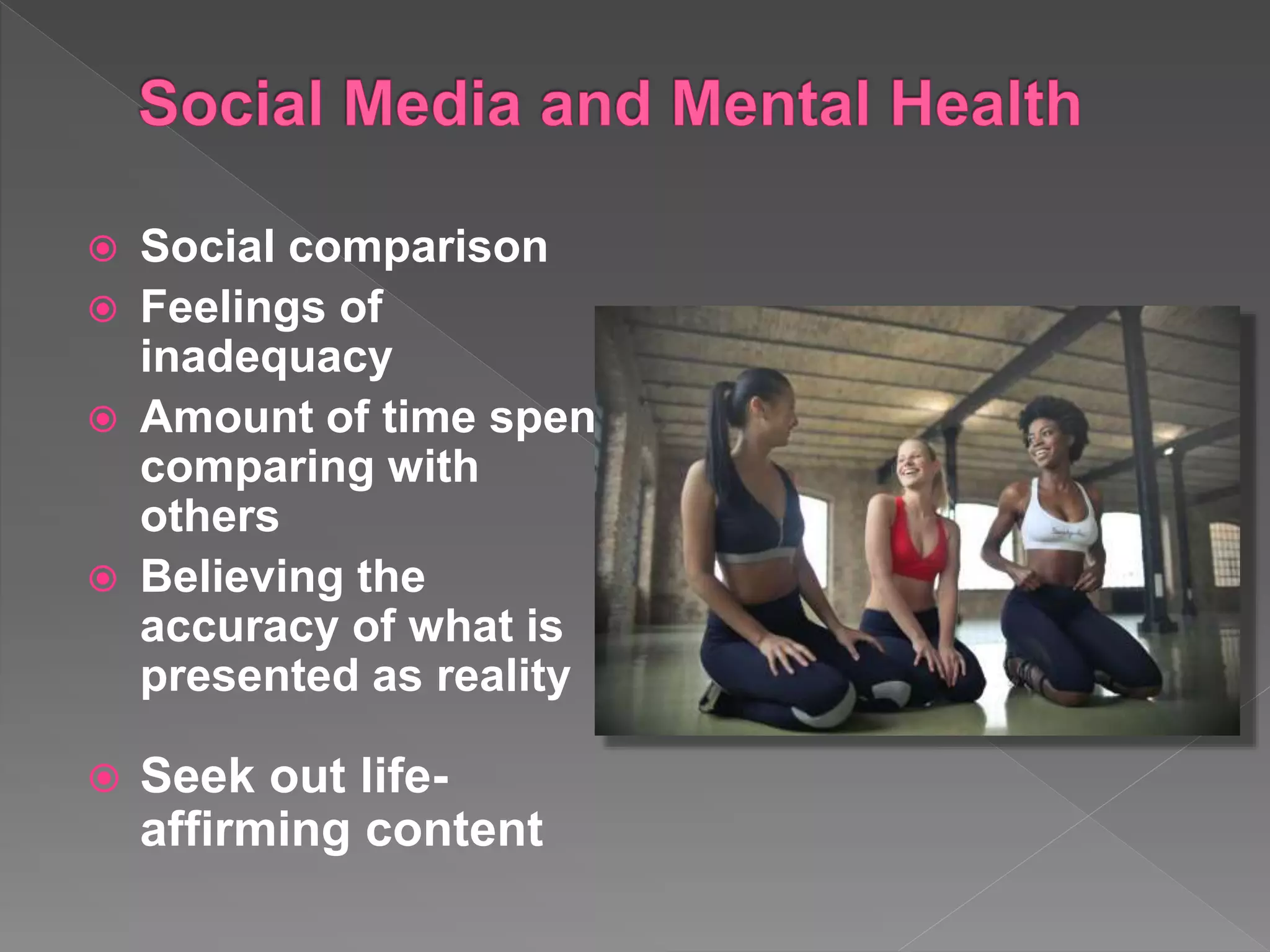
 Social comparison
 Feelings of
inadequacy
 Amount of time spent
comparing with
others
 Believing the
accuracy of what is
presented as reality
 Seek out life-
affirming content
Do social media cause negative feelings
about appearance, or are people with
negative feelings about their appearance
more likely to use social media?
30 years ago:
 How did women in
media look like?
 How did women in
real life look like?
Three common forms
used in media:
 Body changes
 Face changes
 Skin colour changes
 Social media
 Advertisements
 Videos
 Films
“We must stop exposing impressionable
children and teenagers to advertisements
portraying models with body types only
attainable with the help of photo editing
software.”Dr. Barbara McAneny, AMA
 Are we internalising an
unrealistic, unattainable,
fake "ideal" as
"beautiful"?
 Big business selling
“ideal beauty" products.
 People believing they
are happy, loved,
healthy, worthy because
of their appearance.
 Taken for others to see, or never shared
 Self(ie)-objectification
 Looking at the photos, imagining how
others see them
 Selecting, comparing to internalised
ideals
 Editing, checking reactions, counting
"likes"
 Wanting to look like the edited photo
 Focusing on APPEARANCE
 Filtering
 Airbrushing
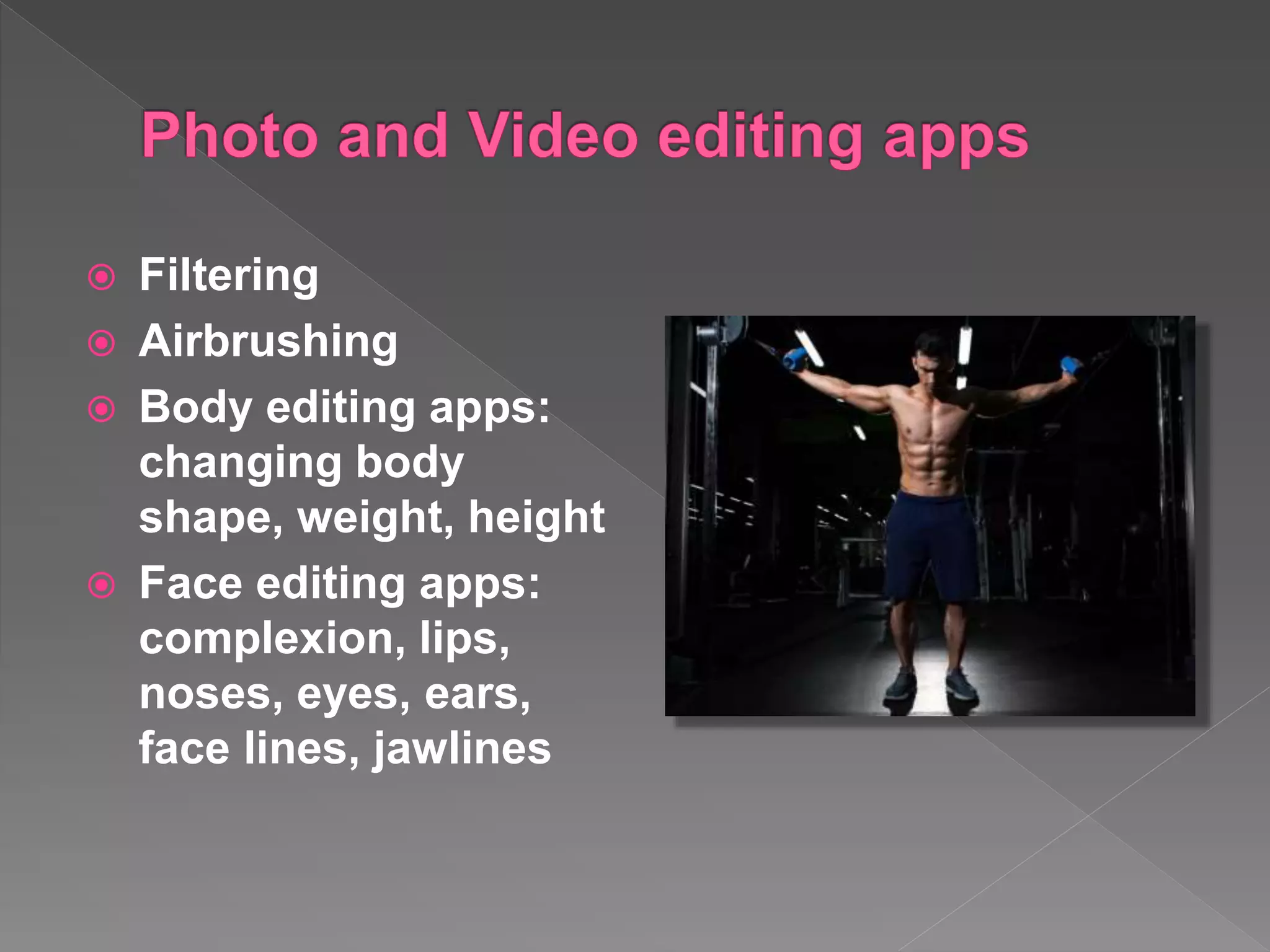
 Body editing apps:
changing body
shape, weight, height
 Face editing apps:
complexion, lips,
noses, eyes, ears,
face lines, jawlines
 People requesting medical procedures to
resemble their digital selves
 Filtered images “blurring the line of reality
and fantasy” could be triggering body
dysmorphic disorder (BDD), a mental
health condition where people become
fixated on imagined defects in their
appearance
Susruthi Rajanala et al
 The average female
weight has increased,
but women in the
media appear thinner
 Muscle definition is
now added to an
already impossibly thin
ideal
 Body dissatisfaction,
lower self-esteem,
worse mood,
restrictive eating or
vomiting
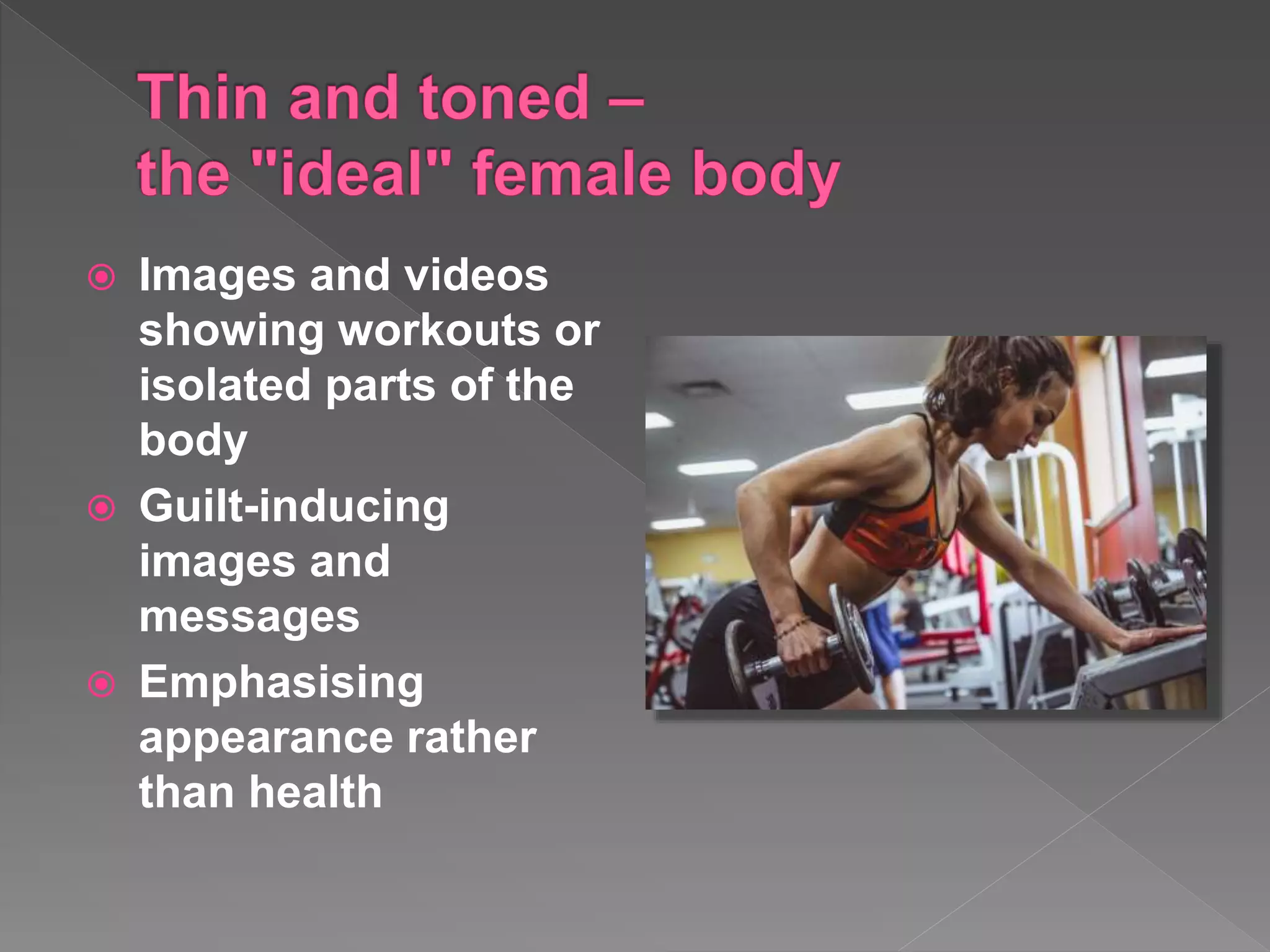
 Images and videos
showing workouts or
isolated parts of the
body
 Guilt-inducing
images and
messages
 Emphasising
appearance rather
than health
 "Inspirational", to achieve
fitness and health
 Is what the pictures show
attainable?
 Are you feeling
motivated, or intimidated
/ worried about how you
look / ashamed of your
body / anxious /
depressed?
 Is there a hidden
advertisement?
 Are you asked to buy
something? (products –
services)
 Thin Is In? Think
Again: The Rising
Importance of
Muscularity in the
Thin Ideal Female
Body (2018)
 Self-compassion,
self-kindness
 No body shame!
 Bodies are not
objects!
 Men under pressure
to achieve the
‘perfect’ body
 "Super-hero" effect
 "Fat-shaming"
 "Bulking up"
 Steroids
 Hair loss, height perception, skin, face
symmetry, other body parts
 Male body image, far more complex than
just “muscle”
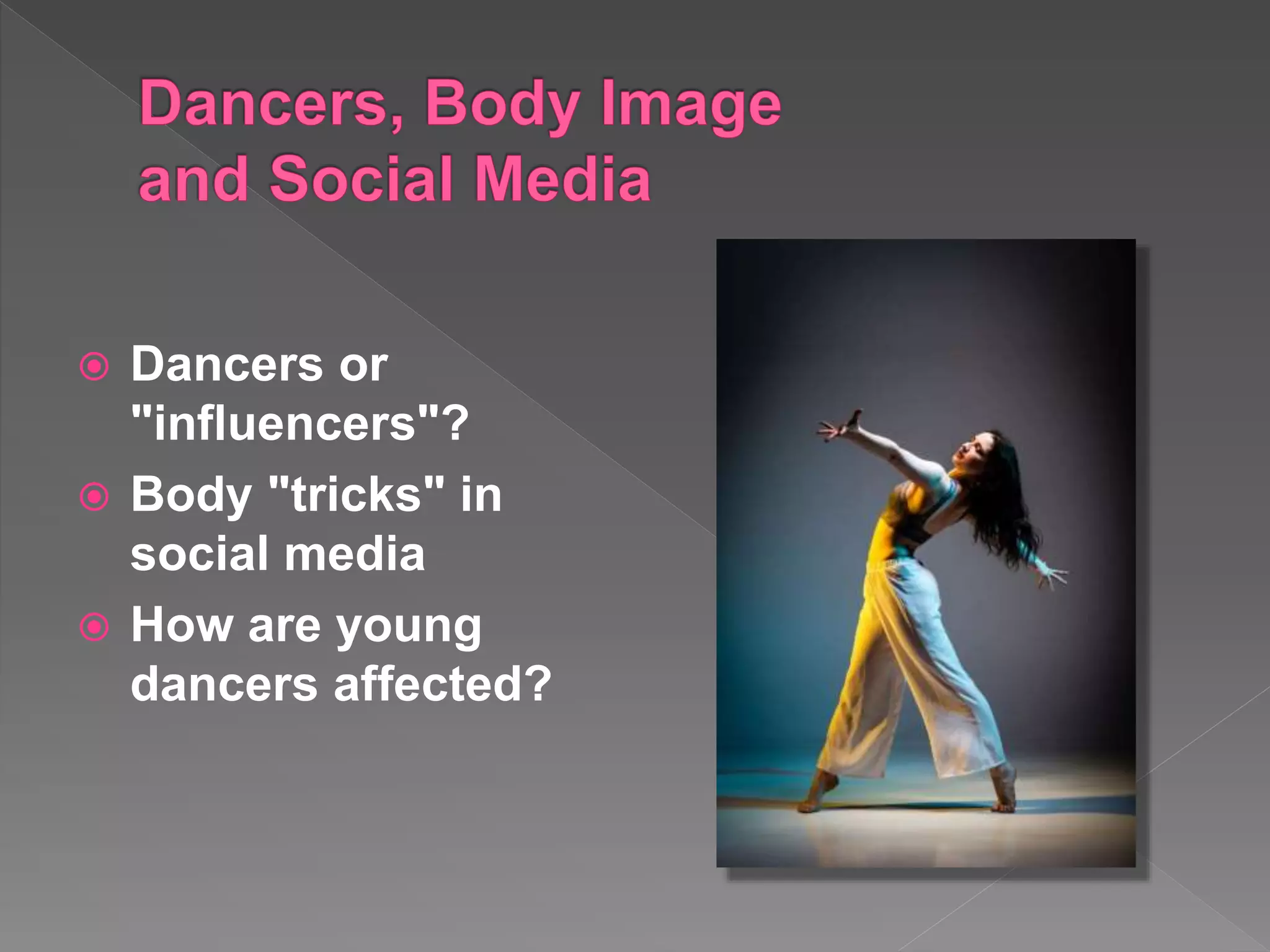
 Dancers or
"influencers"?
 Body "tricks" in
social media
 How are young
dancers affected?
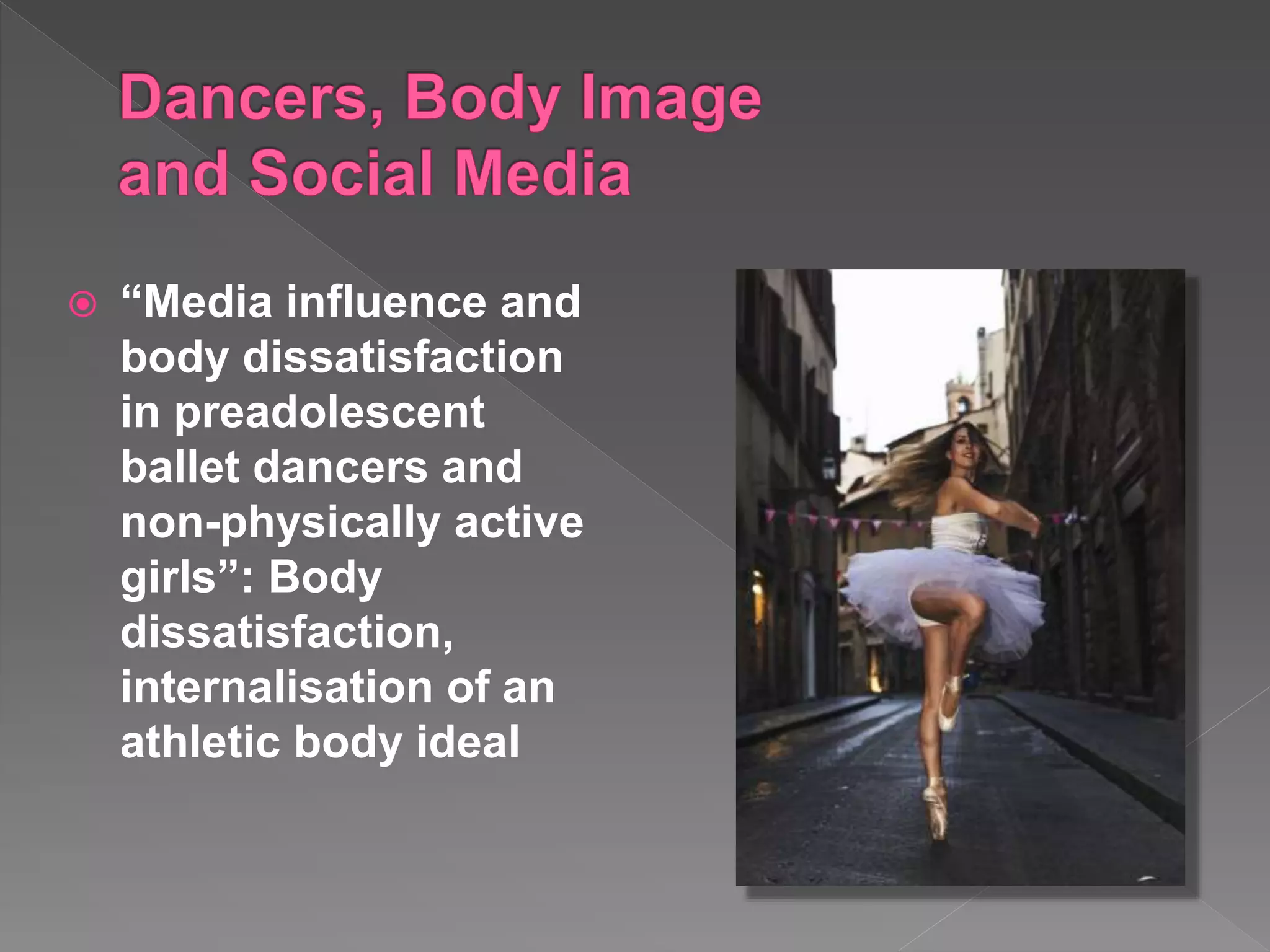
 “Media influence and
body dissatisfaction
in preadolescent
ballet dancers and
non-physically active
girls”: Body
dissatisfaction,
internalisation of an
athletic body ideal
 Bodies of all types
 "Real" vs. "edited" bodies
 Self-compassion quotes
 Body functionality instead of just body
appearance
 Body Neutrality: What the body *does*,
not how it appears
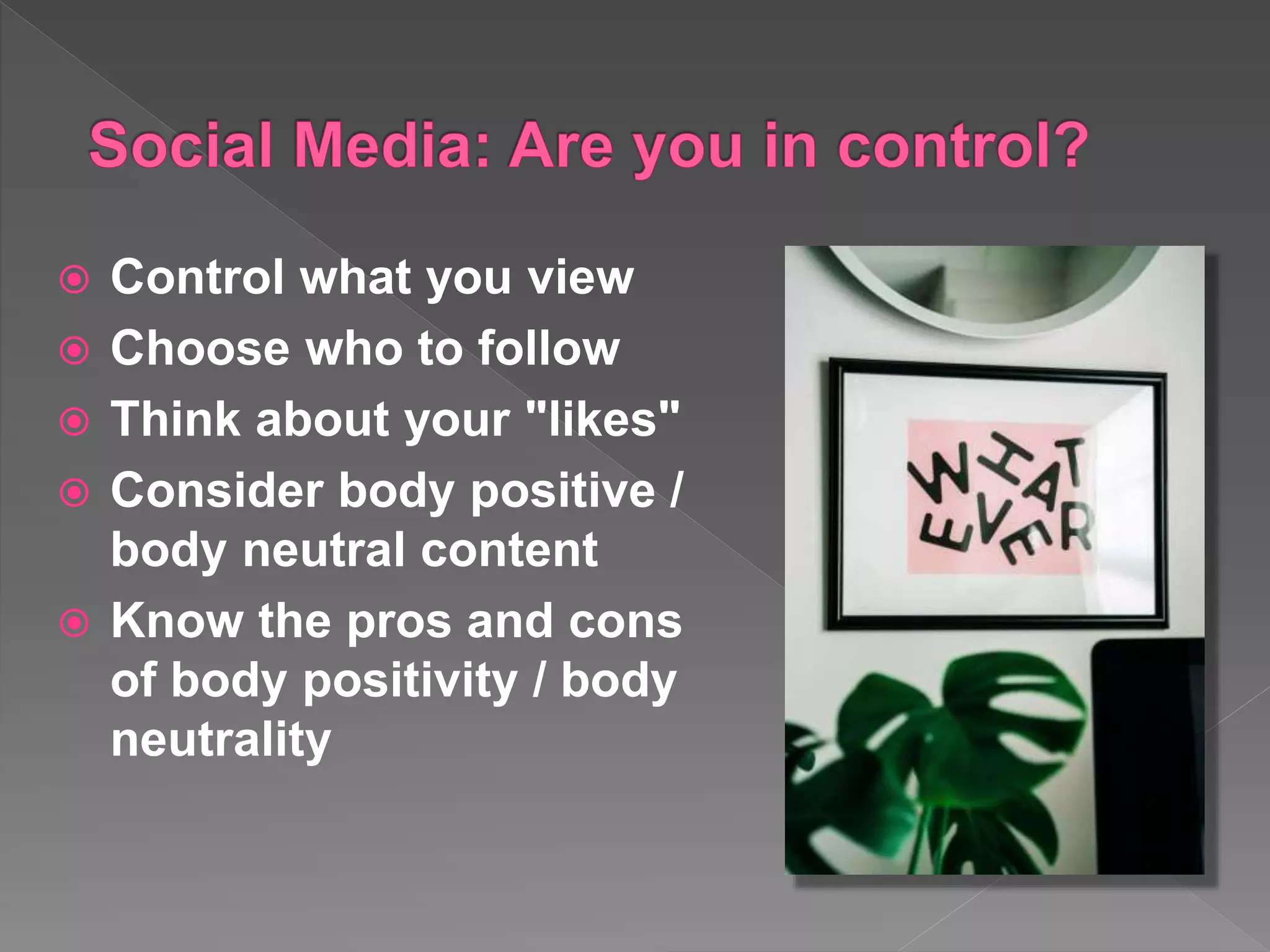
 Control what you view
 Choose who to follow
 Think about your "likes"
 Consider body positive /
body neutral content
 Know the pros and cons
of body positivity / body
neutrality
 Bozsik, F., Whisenhunt, B., Hudson, D., Bennett, B. and Lundgren, J. (2018). Thin Is
In? Think Again: The Rising Importance of Muscularity in the Thin Ideal Female
Body. Sex Roles, 79(9-10), pp.609-615.
 Cavazos-Rehg, P., Krauss, M., Costello, S., Kaiser, N., Cahn, E., Fitzsimmons-Craft,
E. and Wilfley, D. (2019). “I just want to be skinny.”: A content analysis of tweets
expressing eating disorder symptoms. PLOS ONE, 14(1).
 Cohen, R., Fardouly, J., Newton-John, T. and Slater, A. (2019). #BoPo on Instagram:
An experimental investigation of the effects of viewing body positive content on
young women’s mood and body image. New Media & Society.
 Cohen, R., Irwin, L., Newton-John, T. and Slater, A. (2019). #bodypositivity: A
content analysis of body positive accounts on Instagram. Body Image, 29, pp.47-
57.
 Cohen, R., Newton-John, T. and Slater, A. (2017). The relationship between
Facebook and Instagram appearance-focused activities and body image concerns
in young women. Body Image, 23, pp.183-187.
 Dantas, A., Alonso, D., Sánchez-Miguel, P. and del Río Sánchez, C. (2018). Factors
Dancers Associate with their Body Dissatisfaction. Body Image, 25, pp.40-47.
 Fardouly, J. and Vartanian, L. (2016). Social Media and Body Image Concerns:
Current Research and Future Directions. Current Opinion in Psychology, 9, pp.1-5.
 Hogue, J. and Mills, J. (2019). The effects of active social media engagement with
peers on body image in young women. Body Image, 28, pp.1-5.
 Holland, G. and Tiggemann, M. (2016). A systematic review of the impact of the use
of social networking sites on body image and disordered eating outcomes. Body
Image, 17, pp.100-110.
 Mills, J., Musto, S., Williams, L. and Tiggemann, M. (2018). “Selfie” harm: Effects on
mood and body image in young women. Body Image, 27, pp.86-92.
 Nerini, A. (2015). Media influence and body dissatisfaction in preadolescent ballet
dancers and non-physically active girls. Psychology of Sport and Exercise, 20,
pp.76-83.
 Simpson, C. and Mazzeo, S. (2016). Skinny Is Not Enough: A Content Analysis of
Fitspiration on Pinterest. Health Communication, 32(5), pp.560-56
 Swami, V. and Harris, A. (2012). Dancing Toward Positive Body Image? Examining
Body-Related Constructs with Ballet and Contemporary Dancers at Different
Levels. American Journal of Dance Therapy, 34(1), pp.39-52.
 Veldhuis, J., Alleva, J., Bij de Vaate, A., Keijer, M. and Konijn, E. (2018). Me, my
selfie, and I: The relations between selfie behaviors, body image, self-
objectification, and self-esteem in young women. Psychology of Popular Media
Culture.
 Walter, O. and Yanko, S. (2018). New observations on the influence of dance on
body image and development of eating disorders. Research in Dance Education,
19(3), pp.240-251.
Body Image and Social Media

Body Image and Social Media

  • 2.
     Social media& mental health  Research: Social media & body image  Photo / video digital manipulation  Selfies  The “ideal” female body  Male body image  Dancers, body image & social media  Body positivity / neutrality  Are you in control?  Can you recognise digitally altered pictures?
  • 3.
     An issuethat cuts across gender, age, sexuality and ethnicity  From an early age, you are bombarded with images that define what an ‘ideal body’ looks like.  The more comfortable you are with your body, the greater your overall wellbeing, and the less likely you are to engage in destructive behaviours Mark Rowland, Mental Health Foundation CEO
  • 4.
     Social comparison Feelings of inadequacy  Amount of time spent comparing with others  Believing the accuracy of what is presented as reality  Seek out life- affirming content
  • 5.
    Do social mediacause negative feelings about appearance, or are people with negative feelings about their appearance more likely to use social media?
  • 6.
    30 years ago: How did women in media look like?  How did women in real life look like? Three common forms used in media:  Body changes  Face changes  Skin colour changes
  • 7.
     Social media Advertisements  Videos  Films “We must stop exposing impressionable children and teenagers to advertisements portraying models with body types only attainable with the help of photo editing software.”Dr. Barbara McAneny, AMA
  • 8.
     Are weinternalising an unrealistic, unattainable, fake "ideal" as "beautiful"?  Big business selling “ideal beauty" products.  People believing they are happy, loved, healthy, worthy because of their appearance.
  • 9.
     Taken forothers to see, or never shared  Self(ie)-objectification  Looking at the photos, imagining how others see them  Selecting, comparing to internalised ideals  Editing, checking reactions, counting "likes"  Wanting to look like the edited photo  Focusing on APPEARANCE
  • 10.
     Filtering  Airbrushing Body editing apps: changing body shape, weight, height  Face editing apps: complexion, lips, noses, eyes, ears, face lines, jawlines
  • 11.
     People requestingmedical procedures to resemble their digital selves  Filtered images “blurring the line of reality and fantasy” could be triggering body dysmorphic disorder (BDD), a mental health condition where people become fixated on imagined defects in their appearance Susruthi Rajanala et al
  • 12.
     The averagefemale weight has increased, but women in the media appear thinner  Muscle definition is now added to an already impossibly thin ideal  Body dissatisfaction, lower self-esteem, worse mood, restrictive eating or vomiting
  • 13.
     Images andvideos showing workouts or isolated parts of the body  Guilt-inducing images and messages  Emphasising appearance rather than health
  • 14.
     "Inspirational", toachieve fitness and health  Is what the pictures show attainable?  Are you feeling motivated, or intimidated / worried about how you look / ashamed of your body / anxious / depressed?  Is there a hidden advertisement?  Are you asked to buy something? (products – services)
  • 15.
     Thin IsIn? Think Again: The Rising Importance of Muscularity in the Thin Ideal Female Body (2018)
  • 16.
     Self-compassion, self-kindness  Nobody shame!  Bodies are not objects!
  • 17.
     Men underpressure to achieve the ‘perfect’ body  "Super-hero" effect  "Fat-shaming"  "Bulking up"
  • 18.
     Steroids  Hairloss, height perception, skin, face symmetry, other body parts  Male body image, far more complex than just “muscle”
  • 19.
     Dancers or "influencers"? Body "tricks" in social media  How are young dancers affected?
  • 20.
     “Media influenceand body dissatisfaction in preadolescent ballet dancers and non-physically active girls”: Body dissatisfaction, internalisation of an athletic body ideal
  • 21.
     Bodies ofall types  "Real" vs. "edited" bodies  Self-compassion quotes  Body functionality instead of just body appearance  Body Neutrality: What the body *does*, not how it appears
  • 22.
     Control whatyou view  Choose who to follow  Think about your "likes"  Consider body positive / body neutral content  Know the pros and cons of body positivity / body neutrality
  • 24.
     Bozsik, F.,Whisenhunt, B., Hudson, D., Bennett, B. and Lundgren, J. (2018). Thin Is In? Think Again: The Rising Importance of Muscularity in the Thin Ideal Female Body. Sex Roles, 79(9-10), pp.609-615.  Cavazos-Rehg, P., Krauss, M., Costello, S., Kaiser, N., Cahn, E., Fitzsimmons-Craft, E. and Wilfley, D. (2019). “I just want to be skinny.”: A content analysis of tweets expressing eating disorder symptoms. PLOS ONE, 14(1).  Cohen, R., Fardouly, J., Newton-John, T. and Slater, A. (2019). #BoPo on Instagram: An experimental investigation of the effects of viewing body positive content on young women’s mood and body image. New Media & Society.  Cohen, R., Irwin, L., Newton-John, T. and Slater, A. (2019). #bodypositivity: A content analysis of body positive accounts on Instagram. Body Image, 29, pp.47- 57.  Cohen, R., Newton-John, T. and Slater, A. (2017). The relationship between Facebook and Instagram appearance-focused activities and body image concerns in young women. Body Image, 23, pp.183-187.  Dantas, A., Alonso, D., Sánchez-Miguel, P. and del Río Sánchez, C. (2018). Factors Dancers Associate with their Body Dissatisfaction. Body Image, 25, pp.40-47.  Fardouly, J. and Vartanian, L. (2016). Social Media and Body Image Concerns: Current Research and Future Directions. Current Opinion in Psychology, 9, pp.1-5.  Hogue, J. and Mills, J. (2019). The effects of active social media engagement with peers on body image in young women. Body Image, 28, pp.1-5.
  • 25.
     Holland, G.and Tiggemann, M. (2016). A systematic review of the impact of the use of social networking sites on body image and disordered eating outcomes. Body Image, 17, pp.100-110.  Mills, J., Musto, S., Williams, L. and Tiggemann, M. (2018). “Selfie” harm: Effects on mood and body image in young women. Body Image, 27, pp.86-92.  Nerini, A. (2015). Media influence and body dissatisfaction in preadolescent ballet dancers and non-physically active girls. Psychology of Sport and Exercise, 20, pp.76-83.  Simpson, C. and Mazzeo, S. (2016). Skinny Is Not Enough: A Content Analysis of Fitspiration on Pinterest. Health Communication, 32(5), pp.560-56  Swami, V. and Harris, A. (2012). Dancing Toward Positive Body Image? Examining Body-Related Constructs with Ballet and Contemporary Dancers at Different Levels. American Journal of Dance Therapy, 34(1), pp.39-52.  Veldhuis, J., Alleva, J., Bij de Vaate, A., Keijer, M. and Konijn, E. (2018). Me, my selfie, and I: The relations between selfie behaviors, body image, self- objectification, and self-esteem in young women. Psychology of Popular Media Culture.  Walter, O. and Yanko, S. (2018). New observations on the influence of dance on body image and development of eating disorders. Research in Dance Education, 19(3), pp.240-251.