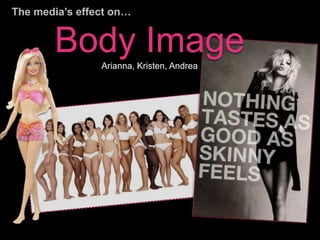


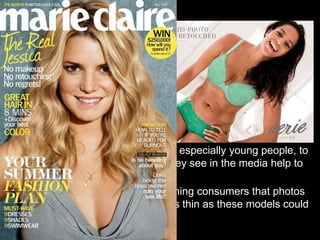

The media’s effect on… 
Body Image 
Arianna, Kristen, Andrea
What is body image? 
• The mental representation we create of 
what we think we look like. 
• Body dissatisfaction and eating disorders 
are found to be common in college 
females and adolescents. 
– The avg. person receive at least 14 messages 
a day related to attractiveness from the 
media.
Case Study 
Surveyed 100 students at Rutgers to see 
how they felt about their bodies
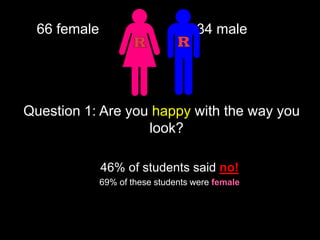
66 female 34 male 
Question 1: Are you happy with the way you 
look? 
46% of students said no! 
69% of these students were female
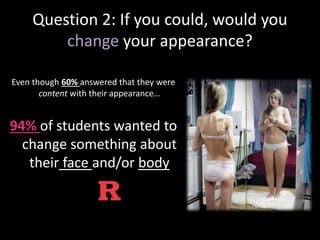
Question 2: If you could, would you 
change your appearance? 
Even though 60% answered that they were 
content with their appearance… 
94% of students wanted to 
change something about 
their face and/or body
Question 3: What would students 
change? 
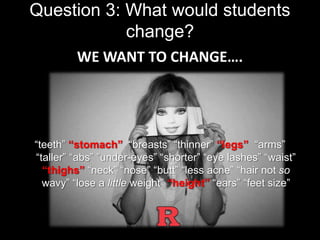
WE WANT TO CHANGE…. 
“teeth” “stomach” “breasts” “thinner” “legs” “arms” 
“taller” “abs” ”under-eyes” “shorter” “eye lashes” “waist” 
“thighs” “neck” “nose” “butt” “less acne” “hair not so 
wavy” “lose a little weight” “height” “ears” “feet size”
Question 4: Who taught you what 
the “perfect body” looks like? 
72% said they were taught by the media 
91% said NO, media’s representations of 
males/females are NOT a healthy image to 
follow
IT NEEDS TO STOP.
Question 5: What is beauty? 
“Beauty is where your looks don’t make you stand 
out in a bad way” 
“Self confidence” “Natural” “Anything” “Amazing” 
“Deceiving” “Personality” “Selflessness” 
“Compassion” “Confidence” “Healthy” “Nice” 
“Content” “Honest” “Happiness” “Inside” 
“Uniqueness” “in the heart” “different for 
everyone” 
“me” 
“you”
“The Social Construction of a 
Women’s Body” 
What is Internalization? 
• Women have internalized the “patriarchal” view of what body image is 
accepted into society 
• Women work towards restructuring their bodies to the “current body of 
fashion that is taut, small breasted, narrow-hipped, slim… almost like a 
young teen in a pubescent stage” rather than a grown women. 
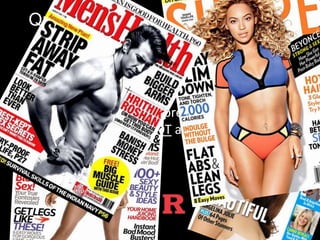
• Magazines run articles such as “Fat Burning Exercise Guide”, “Six 
Sleek- Down Strategies”, “Help Stamp out Cellulite”, and “How to Shed 
Ugly Winter Fat..”- these promote the body becoming an “enemy” to 
a women. 
• “Tyranny of Slenderness”  Women must be seen as slim, and are 
forbidden to look muscular or massive. Must take up as little space as 
possible.
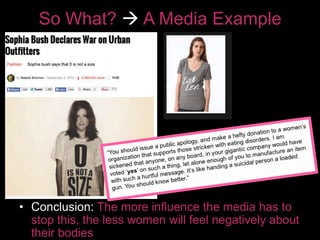
So What?  A Media Example 
• Conclusion: The more influence the media has to 
stop this, the less women will feel negatively about 
their bodies
Celebrities Speak OutCcCC 
• Emma Stone spoke out against body-shaming in an interview 
with seventeen magazine and Stone was not alone. 
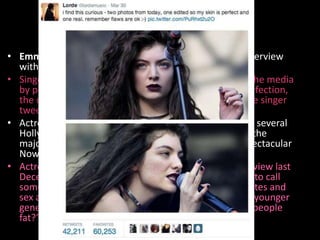
• Singer Lorde criticized excessive use of airbrushing in the media 
by posting two photos of herself, one retouched to perfection, 
the other revealing her real skin, blemishes and all. The singer 
tweeted, “Remember flaws are OK.” 
• Actress Shailene Woodley refused to wear makeup to several 
Hollywood events. She also opted to go barefaced for the 
majority of her role in last summer’s teen flick The Spectacular 
Now. 
• Actress Jennifer Lawrence criticized fat talk in an interview last 
December. She argued, “I just think it should be illegal to call 
somebody fat on TV. I mean, if we’re regulating cigarettes and 
sex and cuss words because of the effect it has on our younger 
generation, why aren’t we regulating thing like calling people 
fat?” 
• Actress Jennifer Lawrence slammed fat talk in an
SSO WHAT NOW? 
Solutions & Suggestions 
• Get More celebrities, like Sophia Bush, to encourage 
change. 
• What Do you Think we can do to Promote Change? 
• Stop the Influence of Media .. HOW?
RReducing Media’s Negative Impact 
• The Body Project/ Reflections- A scientifically supported 
group intervention focuses on cognitive dissonance to promote 
a health body image and decrease the risk for disordered 
eating. Through different activities group leaders will 
encourage young women to think, speak, write, and act in 
ways that critique the thin ideal and challenge their previously 
conditioned thoughts of beauty. 
• Media Literacy- Teaching people, especially young people, to 
think critically about the images they see in the media help to 
reduce body dissatisfaction. 
• Disclaimers and Warnings- Warning consumers that photos 
are retouched and trying to look as thin as these models could 
be harmful to one’s health.
WE BEAUTIFUL

Body image

  • 1.
    The media’s effecton… Body Image Arianna, Kristen, Andrea
  • 2.
    What is bodyimage? • The mental representation we create of what we think we look like. • Body dissatisfaction and eating disorders are found to be common in college females and adolescents. – The avg. person receive at least 14 messages a day related to attractiveness from the media.
  • 3.
    Case Study Surveyed100 students at Rutgers to see how they felt about their bodies
  • 4.
    66 female 34male Question 1: Are you happy with the way you look? 46% of students said no! 69% of these students were female
  • 5.
    Question 2: Ifyou could, would you change your appearance? Even though 60% answered that they were content with their appearance… 94% of students wanted to change something about their face and/or body
  • 6.
    Question 3: Whatwould students change? WE WANT TO CHANGE…. “teeth” “stomach” “breasts” “thinner” “legs” “arms” “taller” “abs” ”under-eyes” “shorter” “eye lashes” “waist” “thighs” “neck” “nose” “butt” “less acne” “hair not so wavy” “lose a little weight” “height” “ears” “feet size”
  • 7.
    Question 4: Whotaught you what the “perfect body” looks like? 72% said they were taught by the media 91% said NO, media’s representations of males/females are NOT a healthy image to follow
  • 8.
  • 9.
    Question 5: Whatis beauty? “Beauty is where your looks don’t make you stand out in a bad way” “Self confidence” “Natural” “Anything” “Amazing” “Deceiving” “Personality” “Selflessness” “Compassion” “Confidence” “Healthy” “Nice” “Content” “Honest” “Happiness” “Inside” “Uniqueness” “in the heart” “different for everyone” “me” “you”
  • 10.
    “The Social Constructionof a Women’s Body” What is Internalization? • Women have internalized the “patriarchal” view of what body image is accepted into society • Women work towards restructuring their bodies to the “current body of fashion that is taut, small breasted, narrow-hipped, slim… almost like a young teen in a pubescent stage” rather than a grown women. • Magazines run articles such as “Fat Burning Exercise Guide”, “Six Sleek- Down Strategies”, “Help Stamp out Cellulite”, and “How to Shed Ugly Winter Fat..”- these promote the body becoming an “enemy” to a women. • “Tyranny of Slenderness”  Women must be seen as slim, and are forbidden to look muscular or massive. Must take up as little space as possible.
  • 12.
    So What? A Media Example • Conclusion: The more influence the media has to stop this, the less women will feel negatively about their bodies
  • 13.
    Celebrities Speak OutCcCC • Emma Stone spoke out against body-shaming in an interview with seventeen magazine and Stone was not alone. • Singer Lorde criticized excessive use of airbrushing in the media by posting two photos of herself, one retouched to perfection, the other revealing her real skin, blemishes and all. The singer tweeted, “Remember flaws are OK.” • Actress Shailene Woodley refused to wear makeup to several Hollywood events. She also opted to go barefaced for the majority of her role in last summer’s teen flick The Spectacular Now. • Actress Jennifer Lawrence criticized fat talk in an interview last December. She argued, “I just think it should be illegal to call somebody fat on TV. I mean, if we’re regulating cigarettes and sex and cuss words because of the effect it has on our younger generation, why aren’t we regulating thing like calling people fat?” • Actress Jennifer Lawrence slammed fat talk in an
  • 14.
    SSO WHAT NOW? Solutions & Suggestions • Get More celebrities, like Sophia Bush, to encourage change. • What Do you Think we can do to Promote Change? • Stop the Influence of Media .. HOW?
  • 15.
    RReducing Media’s NegativeImpact • The Body Project/ Reflections- A scientifically supported group intervention focuses on cognitive dissonance to promote a health body image and decrease the risk for disordered eating. Through different activities group leaders will encourage young women to think, speak, write, and act in ways that critique the thin ideal and challenge their previously conditioned thoughts of beauty. • Media Literacy- Teaching people, especially young people, to think critically about the images they see in the media help to reduce body dissatisfaction. • Disclaimers and Warnings- Warning consumers that photos are retouched and trying to look as thin as these models could be harmful to one’s health.
  • 16.

Editor's Notes

  • #11 In “The Social Construction of Women’s Bodies” the article describes the pressures women feel about maintaining their body weight to the “desired” look the rest of society believes is acceptable. The term internalization is “the process of consolidating and embedding one's own beliefs, attitudes, and values when it comes to moral behavior. The accomplishment of this may involve the deliberate use of psychoanalytical or behavioral methods.” Women have internalized the “patriarchal” view of what body image is accepted into society Rather then women embracing their bodies, or working to improve their health women work towards restructuring their bodies to the “current body of fashion that is taut, small breasted, narrow-hipped, slim… almost like a young teen in a pubescent stage” rather than a grown women. Magazines run articles such as “Fat Burning Exercise Guide”, “Six Sleek- Down Strategies”, “Help Stamp out Cellulite”, and “How to Shed Ugly Winter Fat..”- these promote the body becoming an “enemy” to a women. “Tyranny of Slenderness”  Women must be seen as slim, and are forbidden to look muscular or massive. Must take up as little space as possible.
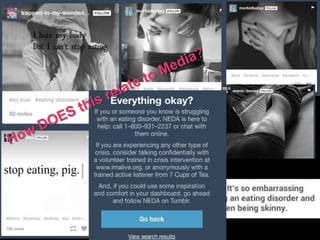
  • #12 Tumblr, a site used by millions of people everyday is a place where anyone can write blogs about anything. This is one place where girls openly talk about their eating disorders, and get feedback from other people who suffer with these eating disorders. It not only is a blog place for girls to openly talk about their eating disorders, but when you even try to search for “eating disorder blogs” This message pops up signifies that there are places to call for victims of eating disorders. These messages can help women dealing with disorders, and further seek out advice and information to help.
  • #13 Kristen Will Explain