Social Media, Celebrities,
and Body Image
BY KRISTI N. YUN
Body Image
The idealized body has been changing for centuries
Celebrities encourage body diversity
• Khloe Kardashian “Good American” jeans for all shapes and sizes
• Lady Gaga “Body Revolution” embracing all shapes and sizes
Today, the idealized-thin still dominates the media,
but there are attempts at changes being made
• Fat Acceptance
• Body Positivity
What is body
image?
Paul Schneider defined body image in the
1920s as “the picture of our own body which
we form in our mind, that is to say, the way in
which the body appears to ourselves”
Attitudes and perceptions have been added
to define it today as a person’s perceptions of
attitudes and their feelings towards their own
physical body
Body Image
and the Media
 Exposure to idealized-thin can cause negative
effects on women
 Body dissatisfaction
 Low self-esteem
 Social comparison
 Mental disorders
 Depression
 Anxiety
 Eating disorders
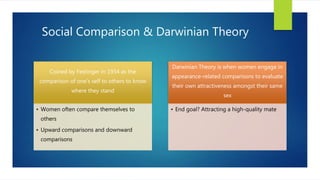
Social Comparison & Darwinian Theory
Coined by Festinger in 1954 as the
comparison of one’s self to others to know
where they stand
• Women often compare themselves to
others
• Upward comparisons and downward
comparisons
Darwinian Theory is when women engage in
appearance-related comparisons to evaluate
their own attractiveness amongst their same
sex
• End goal? Attracting a high-quality mate
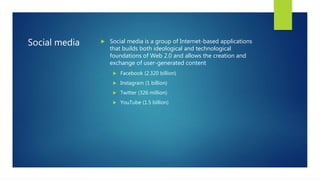
Social media  Social media is a group of Internet-based applications
that builds both ideological and technological
foundations of Web 2.0 and allows the creation and
exchange of user-generated content
 Facebook (2.320 billion)
 Instagram (1 billion)
 Twitter (326 million)
 YouTube (1.5 billion)
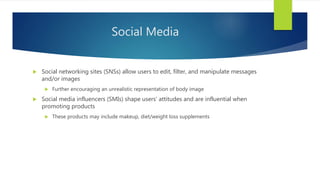
Social Media
 Social networking sites (SNSs) allow users to edit, filter, and manipulate messages
and/or images
 Further encouraging an unrealistic representation of body image
 Social media influencers (SMIs) shape users’ attitudes and are influential when
promoting products
 These products may include makeup, diet/weight loss supplements
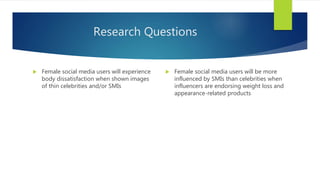
Research Questions
 Female social media users will experience
body dissatisfaction when shown images
of thin celebrities and/or SMIs
 Female social media users will be more
influenced by SMIs than celebrities when
influencers are endorsing weight loss and
appearance-related products
Limitations/Future
Research
 Social media still relatively new
 More research needed on how influential
celebrities and SMIs are on SNS users
 Negative effects on women from SNS users’
comments/criticisms
References
 Andsager, J.L. (2014). Research directions in social media and body image. Sex Roles, 71, 407-413. doi: 10.1007/s11199-014-0430-4
 Befort, C., Robinson Kurpius, S.E., Hull-Blanks, E., Foley Nicpon, M., Huser, L., & Sollenberger, S. (2001). Body image, self-esteem, and weight-related criticism from romantic partners. Journal of College Student Development, 42(5), 407-419.
 Bishop, R. (2000). More than meets the eye: An exploration of literature related to the mass media’s role in encouraging changes in body image. Annals of the International Communication Association, 23(1), 271-304. doi: 10.1080/23808985.2000.11678975
 Brown, Z. & Tiggemann, M. (2016). Attractive celebrity and peer images on Instagram: Effect on women’s mood and body image. Body Image, 19, 37-43.
 Burnette, C.B., Kwitowski, M.A., & Mazzeo, S.E. (2017). “I don’t need people to tell me I’m pretty on social media:” A qualitative study of social media and body image in early adolescent girls. Body Image, 23, 114-125.
 Brandwatch (2019). “123 Amazing Social Media Statistics and Facts.” Retrieved from: https://www.brandwatch.com/blog/amazing-social-media-statistics-and-facts/
 Choi, Y., Leshner, G., & Choi, J. (2008). Third-person effects of idealized body image in magazine advertisements. American Behavioral Scientist, 52(2), 147-164.
doi: 10.1177/0002764208321348
 Coleman, R. (2008). The becoming of bodies. Feminist Media Studies, 8(2), 163-179. doi: 10.1080/14680770801980547
 Colliander, J., & Marder, B. (2018). ‘Snap happy’ brands Increasing publicity effectiveness through a snapshot aesthetic when marketing a brand on Instagram. Computers in Human Behavior, 78, 34-43.
 David, P., Morrison, G., Johnson, M.A., & Ross, F. (2002). Body image, race, and fashion models: Social distance and social identification in third-person effects. Communication Research, 29(3), 270-292.
 Derenne, J.L., & Beresin, E.V. (2006). Body image, media, and eating disorders. Academic Psychiatry, 30(3), 257-261.
 Devaraj, S., & Lewis, V. (2010). Enhancing positive body image in women: An evaluation of a group intervention program. Journal of Applied Biobehavioral Research, 15(2), 103-116.
 Djafarova, E., & Rushworth, C. (2017). Exploring the credibility of online celebrities’ Instagram profiles in influencing the purchase of decisions of young female users. Computers in Human Behavior, 68, 1-7.
 Dohnt, H.K., & Tiggemann, M. (2008). Promoting positive body image in young girls: An evaluation of ‘Shapesville’. European Eating Disorders Review, 16, 222-233.
doi: 10.1002/erv.814
 Durham M.G. (1999). Girls, media, and the negotiation of sexuality: A study of race, class, and gender in adolescent peer groups. J&MC Quarterly, 76(2), 193-216.
 Engeln-Maddox, R., & Miller, S.A. (2005). Talking back to the media ideal: The development and validation of the critical processing of beauty images scale. Psychology of Women Quarterly, 32, 159-171.
 Fardouly, J., Diedrichs, P.C., Vartanian, L.R., & Halliwell, E. (2015). Social comparisons on social media: The impact of Facebook on young women’s body image concerns and mood. Body Image, 13, 38-45.
 Gleeson, K., & Frith, H. (2006). (De)constructing body image. Journal of Health Psychology, 11(1), 79-90. doi: 10/1177/1359105306058851
 Goodman, J.R., & Walsh-Cinders, K. (2004). Sculpting the female breast: How college women negotiate the media’s ideal breast image. J&MC Quarterly, 81(3), 657-674.
 Hargreaves, D.A., & Tiggemann, M. (2006). “Body image is for girls.” A qualitative study of boys’ body image. Journal of Health Psychology, 11(4), 567-576. doi: 10.1177/1359105306065017
 Hendrickse, J., Arpan, L.M., Clayton, R.B., Ridgway, J.L. (2017). Instagram and college women’s body image: Investigating the roles of appearance-related comparisons and intrasexual competition. Computers in Human Behavior, 74, 92-100.
 Kraus, A. & Gall Myrick, KJ. (2018). Feeling bad about feel-good ads: The emotional and body-image ramifications of body-positive media. Communication Research Reports, 35(2), 101-111. doi: 10.1080/08824096.2017.1383233
 Lee, H.R., Lee, H.E., Choi, J., Kim, J.H., & Han, H.L. (2014). Social media use, body image, and psychological well-being: A cross-cultural comparison of Korea and the United States. Journal of Health Communication, 19(12), 1343-1358.
doi: 10.1080/10810730.2014.904022
 Rabak-Wagener, J., Eickhoff-Shemek, J., & Kelly-Vance, L. (1998). The effects of media analysis on attitudes and behaviors regarding body image among college students. Journal of American College Health, 47(1), 29-35.
 Springer, E.A., Winzelberg, A.J., Perkins, R., & Barr Taylor, C. (1999). Effects of a body image curriculum for college students on improved body image. International Journal of Eating Disorders, 13-20.

Slideshare Yun_1

  • 1.
    Social Media, Celebrities, andBody Image BY KRISTI N. YUN
  • 2.
    Body Image The idealizedbody has been changing for centuries Celebrities encourage body diversity • Khloe Kardashian “Good American” jeans for all shapes and sizes • Lady Gaga “Body Revolution” embracing all shapes and sizes Today, the idealized-thin still dominates the media, but there are attempts at changes being made • Fat Acceptance • Body Positivity
  • 3.
    What is body image? PaulSchneider defined body image in the 1920s as “the picture of our own body which we form in our mind, that is to say, the way in which the body appears to ourselves” Attitudes and perceptions have been added to define it today as a person’s perceptions of attitudes and their feelings towards their own physical body
  • 4.
    Body Image and theMedia  Exposure to idealized-thin can cause negative effects on women  Body dissatisfaction  Low self-esteem  Social comparison  Mental disorders  Depression  Anxiety  Eating disorders
  • 5.
    Social Comparison &Darwinian Theory Coined by Festinger in 1954 as the comparison of one’s self to others to know where they stand • Women often compare themselves to others • Upward comparisons and downward comparisons Darwinian Theory is when women engage in appearance-related comparisons to evaluate their own attractiveness amongst their same sex • End goal? Attracting a high-quality mate
  • 6.
    Social media Social media is a group of Internet-based applications that builds both ideological and technological foundations of Web 2.0 and allows the creation and exchange of user-generated content  Facebook (2.320 billion)  Instagram (1 billion)  Twitter (326 million)  YouTube (1.5 billion)
  • 7.
    Social Media  Socialnetworking sites (SNSs) allow users to edit, filter, and manipulate messages and/or images  Further encouraging an unrealistic representation of body image  Social media influencers (SMIs) shape users’ attitudes and are influential when promoting products  These products may include makeup, diet/weight loss supplements
  • 8.
    Research Questions  Femalesocial media users will experience body dissatisfaction when shown images of thin celebrities and/or SMIs  Female social media users will be more influenced by SMIs than celebrities when influencers are endorsing weight loss and appearance-related products
  • 9.
    Limitations/Future Research  Social mediastill relatively new  More research needed on how influential celebrities and SMIs are on SNS users  Negative effects on women from SNS users’ comments/criticisms
  • 10.
    References  Andsager, J.L.(2014). Research directions in social media and body image. Sex Roles, 71, 407-413. doi: 10.1007/s11199-014-0430-4  Befort, C., Robinson Kurpius, S.E., Hull-Blanks, E., Foley Nicpon, M., Huser, L., & Sollenberger, S. (2001). Body image, self-esteem, and weight-related criticism from romantic partners. Journal of College Student Development, 42(5), 407-419.  Bishop, R. (2000). More than meets the eye: An exploration of literature related to the mass media’s role in encouraging changes in body image. Annals of the International Communication Association, 23(1), 271-304. doi: 10.1080/23808985.2000.11678975  Brown, Z. & Tiggemann, M. (2016). Attractive celebrity and peer images on Instagram: Effect on women’s mood and body image. Body Image, 19, 37-43.  Burnette, C.B., Kwitowski, M.A., & Mazzeo, S.E. (2017). “I don’t need people to tell me I’m pretty on social media:” A qualitative study of social media and body image in early adolescent girls. Body Image, 23, 114-125.  Brandwatch (2019). “123 Amazing Social Media Statistics and Facts.” Retrieved from: https://www.brandwatch.com/blog/amazing-social-media-statistics-and-facts/  Choi, Y., Leshner, G., & Choi, J. (2008). Third-person effects of idealized body image in magazine advertisements. American Behavioral Scientist, 52(2), 147-164. doi: 10.1177/0002764208321348  Coleman, R. (2008). The becoming of bodies. Feminist Media Studies, 8(2), 163-179. doi: 10.1080/14680770801980547  Colliander, J., & Marder, B. (2018). ‘Snap happy’ brands Increasing publicity effectiveness through a snapshot aesthetic when marketing a brand on Instagram. Computers in Human Behavior, 78, 34-43.  David, P., Morrison, G., Johnson, M.A., & Ross, F. (2002). Body image, race, and fashion models: Social distance and social identification in third-person effects. Communication Research, 29(3), 270-292.  Derenne, J.L., & Beresin, E.V. (2006). Body image, media, and eating disorders. Academic Psychiatry, 30(3), 257-261.  Devaraj, S., & Lewis, V. (2010). Enhancing positive body image in women: An evaluation of a group intervention program. Journal of Applied Biobehavioral Research, 15(2), 103-116.  Djafarova, E., & Rushworth, C. (2017). Exploring the credibility of online celebrities’ Instagram profiles in influencing the purchase of decisions of young female users. Computers in Human Behavior, 68, 1-7.  Dohnt, H.K., & Tiggemann, M. (2008). Promoting positive body image in young girls: An evaluation of ‘Shapesville’. European Eating Disorders Review, 16, 222-233. doi: 10.1002/erv.814  Durham M.G. (1999). Girls, media, and the negotiation of sexuality: A study of race, class, and gender in adolescent peer groups. J&MC Quarterly, 76(2), 193-216.  Engeln-Maddox, R., & Miller, S.A. (2005). Talking back to the media ideal: The development and validation of the critical processing of beauty images scale. Psychology of Women Quarterly, 32, 159-171.  Fardouly, J., Diedrichs, P.C., Vartanian, L.R., & Halliwell, E. (2015). Social comparisons on social media: The impact of Facebook on young women’s body image concerns and mood. Body Image, 13, 38-45.  Gleeson, K., & Frith, H. (2006). (De)constructing body image. Journal of Health Psychology, 11(1), 79-90. doi: 10/1177/1359105306058851  Goodman, J.R., & Walsh-Cinders, K. (2004). Sculpting the female breast: How college women negotiate the media’s ideal breast image. J&MC Quarterly, 81(3), 657-674.  Hargreaves, D.A., & Tiggemann, M. (2006). “Body image is for girls.” A qualitative study of boys’ body image. Journal of Health Psychology, 11(4), 567-576. doi: 10.1177/1359105306065017  Hendrickse, J., Arpan, L.M., Clayton, R.B., Ridgway, J.L. (2017). Instagram and college women’s body image: Investigating the roles of appearance-related comparisons and intrasexual competition. Computers in Human Behavior, 74, 92-100.  Kraus, A. & Gall Myrick, KJ. (2018). Feeling bad about feel-good ads: The emotional and body-image ramifications of body-positive media. Communication Research Reports, 35(2), 101-111. doi: 10.1080/08824096.2017.1383233  Lee, H.R., Lee, H.E., Choi, J., Kim, J.H., & Han, H.L. (2014). Social media use, body image, and psychological well-being: A cross-cultural comparison of Korea and the United States. Journal of Health Communication, 19(12), 1343-1358. doi: 10.1080/10810730.2014.904022  Rabak-Wagener, J., Eickhoff-Shemek, J., & Kelly-Vance, L. (1998). The effects of media analysis on attitudes and behaviors regarding body image among college students. Journal of American College Health, 47(1), 29-35.  Springer, E.A., Winzelberg, A.J., Perkins, R., & Barr Taylor, C. (1999). Effects of a body image curriculum for college students on improved body image. International Journal of Eating Disorders, 13-20.