The Impact of Media: Notions of
Beauty and Women’s Body Images
YoLanda Sanders
Texas Woman's University
Family Sciences MS, Graduate Student
Graduate Seminar Day Fall 2011
Introduction

Is media exposure accompanied by mass media and weight concern among
girls?

Past research has explored how women conceptualized their bodies related to
a media driven image of beauty

The research considered how the responses that emerge from this influence
reflected on women’s sense of self worth, insecurities, satisfaction and
displeasure related to their bodies that may lead to eating disorders such as
anorexia, bulimia, obsessive dieting, and excessive exercising

This research examined the impact of media’s representation of female
beauty, as presented in fashion magazines on women’s body images
perceptions
Self-Objectification Theory

According to Harper & Tiggemann (2008), self objectifiction is women's
response to media's thin ideal images

Interestingly, the objectification theory developed from studies on media
exposure among Western women only. Reportedly, from past studies, fashion
magazines are a significant factor in women's body images and self
objectification (Harper & Tiggemann, 2008)

Reportedly, from past studies, fashion magazines are a significant factor in
women's body images and self objectification (Harper & Tiggemann, 2008)

Lynch, Heil, Wagner and Havens (2008) study concludes that body
dissatsifaction is signficantly correlated with BMI, and is also associated with
women's self objectification, mood and body image
Literature Review

Tiggemann and Mcgill (2004) maintains that women participants’ brief
exposure to media images of females (11 images) led to increased levels of
body dissatisfaction and weight anxiety. Many girls in early adolescence rely
on magazine and television advertisements for information on weight loss and
appearance.

Exposure to media portrayed idealized images, focuses attention on the body,
and encourages scrutiny of the acceptability of its shape and size (Kilbourne,
1994; Myers & Biocca, 1992)

Since the ideal is unattainable for the majority of women, it is not surprising
that extents to which women internalize societal standards for thinness is a
strong predictor of body dissatisfaction, overestimate body size, depression,
and disordered eating behaviors (as cited in Levine & Smolak, 2002;
Monteath & Mcabe, 1997; Mussell et al., 2000; Polivy & Herman, 2002;
Tsiantas & King, 2001)
Statistics

The question remains what is causing these young participants to place
constant attention toward their bodies at potential health risks? The research
implied 49% participants are impacted by reading media fashion magazines
(Field et al., 1999)

Stice, Orjada and Tristan (2006) implied a vast majority of college women in
eating disorder prevention programs are psychologically influenced towards
negative body image including measures of depression and fat consumption.
The related body behavior factors on media influence are prevalent where
47% participants reported the desire of losing weight (Field et al., 1999)

Trampe, Stapel and Siero' s UCLA Body Project II conceptualized the idea
that increased sociocultural comparisons and body dissatisfaction caters to
young womens body images. They found that 61% of women desired
increased breasts size, while 25% were dissatisfied with their breast physical
appearance among African, European and Hispanic American college women
(Forbes & Frederick, 2007)
What is Body Dissatisfaction?

Body dissatisfaction is displeasure of physical appearance. The researchers
Garner, Garner and Van Egeren (1992) described body dissatisfaction as
attitudinal disturbances of body weight

Bearman, Presnell, and Martinez statistics show 50% of young women
reported being unhappy with their bodies (as cited in Smeesters, Mussweiler
& Mandel, 2009)

An International multidimensional assessment and comparative study was
based on the nature of body dissatisfaction. Non-western populations, along
with Korean and United States college women, ages 18-24 were included.
Body dissatisfaction was found highest among Korean college women(Jung
and Forbes, 2006).

This current project expands on previous literature by focusing on how the
media influences women's perceptions of their bodies

The purpose of the study was to conduct an explanatory research study
examining the influences of media advertisements on behavior modifications
such as excessive exercising, dieting, eating disorders, and body
dissatisfaction among college age women
Purpose of Study
Hypotheses

Hypotheses I : Increased media exposure will be accompanied by increased
dissatisfaction with one’s body image. This hypotheses derives from
numerous studies documenting the effects of exposure to media images on
disordered eating and body dissatisfaction among American women (Field et
al., 1999; Stice & Shaw, 1994).

Hypotheses 2: A high degree of body dissatisfaction will increase the
likelihood of maladaptive behaviors, such as eating disorders, excessive
dieting and excessive exercising. This hypotheses derives from studies
documenting common health problems, disordered eating and obesity among
young adult women (Mond, Hay, Darby, Paxton, Quirk, Butner, Owen &
Rodgers, 2009).
Participants

A total of 31(N = 31) college women enrolled in an introductory course in
Sociologyat the University of Arkansas, Little Rock campus participated in
the study for extra credit.

The students ranged in age from 18 to 25

The racial demographics included Hispanic, African American, Caucasian and
Native American women
Procedures

The cross-sectional study design used a questionnaire assessing women’s
patterns in regards to what is read and how often observed

The students were administered an accidental survey developed by the
researcher. Accidental survey means what was available

The survey consisted of self-report questions regarding degree of media
exposure, concerns with eating disorders and degree of body dissatisfaction

Responses were measured using a variety of Likert scales
SECTION III. Please use the following scale to answer the following questions.
1. Strongly agree 2. Agree 3. Neutral 4. Disagree 5. Strongly disagree
1. My body is sexually appealing. ____
2. I like my looks just the way they are. ____
3. Most people would consider me good looking. ____
4. I like the way I look without my clothes on. ____
5. I like the way my clothes fit me. ____
6. I dislike my physique. ____
7. I am physically unattractive. ____
8 I am very conscious of even small changes in my weight. ____
9. I am on a weight loss diet. ____
10. I have tried to lose weight by fasting or going on crash diets. ____
11. My thighs rub together when I walk. ____
12. I have a bulging stomach. ____
13. I smoke to control my diet. ____
Variables

Independent
1)degree of media exposure
2) body dissatisfaction

Dependent
1) eating disorders (behavioral concerns that leads to eating disorders)
2) excessive dieting (constant dieting habits)
3) excessive exercising (repeated observations of weight, strict aerobic exercise
routines)
Results

The degree of media exposure indicated how often women read Self, Shape,
Fitness and Women’s health magazines significantly predicted body
dissatisfaction

Women with higher degrees of dissatisfaction will increase maladaptive body
behaviors such as eating disorders
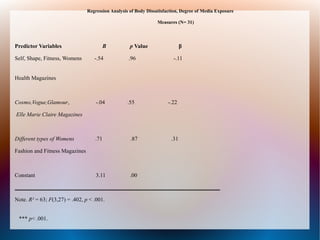
Regression Analysis of Body Dissatisfaction, Degree of Media Exposure
Measures (N= 31)
Predictor Variables B p Value β
Self, Shape, Fitness, Womens -.54 .96 -.11
Health Magazines
Cosmo,Vogue,Glamour, -.04 .55 -.22
Elle Marie Claire Magazines
Different types of Womens .71 .87 .31
Fashion and Fitness Magazines
Constant 3.11 .00
________________________________________________________________________
Note. R² = 63; F(3,27) = .402, p < .001.
*** p< .001.
Discusssion

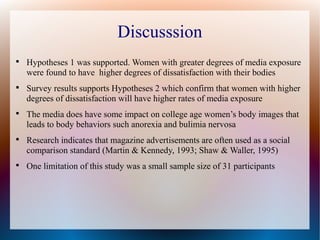
Hypotheses 1 was supported. Women with greater degrees of media exposure
were found to have higher degrees of dissatisfaction with their bodies

Survey results supports Hypotheses 2 which confirm that women with higher
degrees of dissatisfaction will have higher rates of media exposure

The media does have some impact on college age women’s body images that
leads to body behaviors such anorexia and bulimia nervosa

Research indicates that magazine advertisements are often used as a social
comparison standard (Martin & Kennedy, 1993; Shaw & Waller, 1995)

One limitation of this study was a small sample size of 31 participants
Conclusion

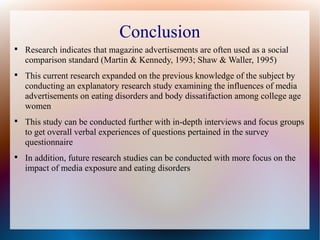
Research indicates that magazine advertisements are often used as a social
comparison standard (Martin & Kennedy, 1993; Shaw & Waller, 1995)

This current research expanded on the previous knowledge of the subject by
conducting an explanatory research study examining the influences of media
advertisements on eating disorders and body dissatifaction among college age
women

This study can be conducted further with in-depth interviews and focus groups
to get overall verbal experiences of questions pertained in the survey
questionnaire

In addition, future research studies can be conducted with more focus on the
impact of media exposure and eating disorders
References
Field, A.E., Cheung, L., Wolf, A.M., Herzog, D., Gortmaker, S. L., & Colditz, G.
A. (1999). Exposure to the mass media and weight concerns among girls.
Pediatrics, 103(3), 660.
Forbes, G. & Frederick, D. (2008). The UCLA body project II: Breast and body
dissatisfaction among African, Asian, European, and Hispanic American
college women. Sex Roles, 58(7/8), 449-457.
Garner, D.M., Garner, M. V., & Van Egeren, L. F. (1992). Body dissatisfaction
adjusted for weight: The body illusion index. International Journal of Eating
Disorders, 12(3), 263-271.
Harper, B., & Tiggemann, M. (2008). The effect of thin ideal media images on
women's self-objectification, mood, and body image. Sex roles, 58(9/10),
649-657.
References
Jung, J., & Forbes, G. (2006). Multi-dimensional assessment of body
dissatisfaction and disordered eating in Korean and US college women: A
comparative study. Sex Roles, 55(1/2), 39-50.
Kilobourne, J. (1994). Still killing us softly: Advertising and the obsession with
thinness. In PoFallon, M. A: Katzman, & S. C. Wooley (Eds.), Feminist
perspectives in eating disorders. New York: Guilford Press.
Levine, M.P., & Smolak, L. (2002). Body image development in adolescence. In
T.F. Cash & T. Pruzinsky (Eds), Body Image. New York: Guilford Press.
Lynch, W.C., Heil, D.P., Wagner, E., & Havens, M.D. (2008). Body
dissatisfaction mediates the association between body mass index and risky
weight control behaviors among white and native americans adolescent girls.
Appetite, 51(1), 210-213.
References
Martin, M. C. & Kennedy, P. F. (1993). Advertising and social comparison:
Consequences for female preadolescents and adolescents. Psychology &
Marketing, 10(6), 513-530. doi: 10.1002/mar4220100605.
Mond, J., Hay, P., Darby, A., Paxton, S., Quirk, F. & Buttner, P., Owen, C., &
Rodgers. (2009). Women with bulimic eating disorders: When do they receive
treatment for an eating problem? Journal of Consulting and Clinical
Psychology, 77(5), 835-844.
Polivy, J., & Herman, C. (2002). Causes of eating disorders. Annual Review of
Psychology, 53(1), 187.
References
Shaw, J., & Waller, G. (1995). The media's impact on body image: Implications
for prevention and treatment. Eating Disorders: The Journal of Treatment
and Prevention, 3(2), 115-123. doi:10.1080/10640269508249154.
Smeesters, D. Mussweiler, T., & Mandel, N. (2010). The effects of thin and
heavy media images on overweight and underweight consumers: Social
comparison processes and behavioral implications. Journal of Consumer
Research, 36(6), 930-949.
Stice, E., Orjada, K., & Tristian, J. (2006). Trial of psychoeducational eating
disturbance intervention for college women: A replication and extension.
International Journal of Eating Disorders, 39(3), 233.
Stice, E., & Shaw, H. E. (1994). Adverse effects of the media portrayed thin-
ideal on women and linkages to bulimic symptomatology. Journal of Social
and Clinical Psychology, 13(3), 288-308.
References
Tiggemann, M., & Mcgill, B. (2004). The role of social comparison in the effect
of magazine advertisements on women's mood and body dissatisfaction.
Journal of Social Clinical Pschology, 23(1), 23-44.

Ysanders Graduate Seminar Presentation Fall 2011

  • 1.
    The Impact ofMedia: Notions of Beauty and Women’s Body Images YoLanda Sanders Texas Woman's University Family Sciences MS, Graduate Student Graduate Seminar Day Fall 2011
  • 2.
    Introduction  Is media exposureaccompanied by mass media and weight concern among girls?  Past research has explored how women conceptualized their bodies related to a media driven image of beauty  The research considered how the responses that emerge from this influence reflected on women’s sense of self worth, insecurities, satisfaction and displeasure related to their bodies that may lead to eating disorders such as anorexia, bulimia, obsessive dieting, and excessive exercising  This research examined the impact of media’s representation of female beauty, as presented in fashion magazines on women’s body images perceptions
  • 3.
    Self-Objectification Theory  According toHarper & Tiggemann (2008), self objectifiction is women's response to media's thin ideal images  Interestingly, the objectification theory developed from studies on media exposure among Western women only. Reportedly, from past studies, fashion magazines are a significant factor in women's body images and self objectification (Harper & Tiggemann, 2008)  Reportedly, from past studies, fashion magazines are a significant factor in women's body images and self objectification (Harper & Tiggemann, 2008)  Lynch, Heil, Wagner and Havens (2008) study concludes that body dissatsifaction is signficantly correlated with BMI, and is also associated with women's self objectification, mood and body image
  • 4.
    Literature Review  Tiggemann andMcgill (2004) maintains that women participants’ brief exposure to media images of females (11 images) led to increased levels of body dissatisfaction and weight anxiety. Many girls in early adolescence rely on magazine and television advertisements for information on weight loss and appearance.  Exposure to media portrayed idealized images, focuses attention on the body, and encourages scrutiny of the acceptability of its shape and size (Kilbourne, 1994; Myers & Biocca, 1992)  Since the ideal is unattainable for the majority of women, it is not surprising that extents to which women internalize societal standards for thinness is a strong predictor of body dissatisfaction, overestimate body size, depression, and disordered eating behaviors (as cited in Levine & Smolak, 2002; Monteath & Mcabe, 1997; Mussell et al., 2000; Polivy & Herman, 2002; Tsiantas & King, 2001)
  • 5.
    Statistics  The question remainswhat is causing these young participants to place constant attention toward their bodies at potential health risks? The research implied 49% participants are impacted by reading media fashion magazines (Field et al., 1999)  Stice, Orjada and Tristan (2006) implied a vast majority of college women in eating disorder prevention programs are psychologically influenced towards negative body image including measures of depression and fat consumption. The related body behavior factors on media influence are prevalent where 47% participants reported the desire of losing weight (Field et al., 1999)  Trampe, Stapel and Siero' s UCLA Body Project II conceptualized the idea that increased sociocultural comparisons and body dissatisfaction caters to young womens body images. They found that 61% of women desired increased breasts size, while 25% were dissatisfied with their breast physical appearance among African, European and Hispanic American college women (Forbes & Frederick, 2007)
  • 6.
    What is BodyDissatisfaction?  Body dissatisfaction is displeasure of physical appearance. The researchers Garner, Garner and Van Egeren (1992) described body dissatisfaction as attitudinal disturbances of body weight  Bearman, Presnell, and Martinez statistics show 50% of young women reported being unhappy with their bodies (as cited in Smeesters, Mussweiler & Mandel, 2009)  An International multidimensional assessment and comparative study was based on the nature of body dissatisfaction. Non-western populations, along with Korean and United States college women, ages 18-24 were included. Body dissatisfaction was found highest among Korean college women(Jung and Forbes, 2006).
  • 7.
     This current projectexpands on previous literature by focusing on how the media influences women's perceptions of their bodies  The purpose of the study was to conduct an explanatory research study examining the influences of media advertisements on behavior modifications such as excessive exercising, dieting, eating disorders, and body dissatisfaction among college age women Purpose of Study
  • 8.
    Hypotheses  Hypotheses I :Increased media exposure will be accompanied by increased dissatisfaction with one’s body image. This hypotheses derives from numerous studies documenting the effects of exposure to media images on disordered eating and body dissatisfaction among American women (Field et al., 1999; Stice & Shaw, 1994).  Hypotheses 2: A high degree of body dissatisfaction will increase the likelihood of maladaptive behaviors, such as eating disorders, excessive dieting and excessive exercising. This hypotheses derives from studies documenting common health problems, disordered eating and obesity among young adult women (Mond, Hay, Darby, Paxton, Quirk, Butner, Owen & Rodgers, 2009).
  • 9.
    Participants  A total of31(N = 31) college women enrolled in an introductory course in Sociologyat the University of Arkansas, Little Rock campus participated in the study for extra credit.  The students ranged in age from 18 to 25  The racial demographics included Hispanic, African American, Caucasian and Native American women
  • 10.
    Procedures  The cross-sectional studydesign used a questionnaire assessing women’s patterns in regards to what is read and how often observed  The students were administered an accidental survey developed by the researcher. Accidental survey means what was available  The survey consisted of self-report questions regarding degree of media exposure, concerns with eating disorders and degree of body dissatisfaction  Responses were measured using a variety of Likert scales
  • 11.
    SECTION III. Pleaseuse the following scale to answer the following questions. 1. Strongly agree 2. Agree 3. Neutral 4. Disagree 5. Strongly disagree 1. My body is sexually appealing. ____ 2. I like my looks just the way they are. ____ 3. Most people would consider me good looking. ____ 4. I like the way I look without my clothes on. ____ 5. I like the way my clothes fit me. ____ 6. I dislike my physique. ____ 7. I am physically unattractive. ____ 8 I am very conscious of even small changes in my weight. ____ 9. I am on a weight loss diet. ____ 10. I have tried to lose weight by fasting or going on crash diets. ____ 11. My thighs rub together when I walk. ____ 12. I have a bulging stomach. ____ 13. I smoke to control my diet. ____
  • 12.
    Variables  Independent 1)degree of mediaexposure 2) body dissatisfaction  Dependent 1) eating disorders (behavioral concerns that leads to eating disorders) 2) excessive dieting (constant dieting habits) 3) excessive exercising (repeated observations of weight, strict aerobic exercise routines)
  • 13.
    Results  The degree ofmedia exposure indicated how often women read Self, Shape, Fitness and Women’s health magazines significantly predicted body dissatisfaction  Women with higher degrees of dissatisfaction will increase maladaptive body behaviors such as eating disorders
  • 14.
    Regression Analysis ofBody Dissatisfaction, Degree of Media Exposure Measures (N= 31) Predictor Variables B p Value β Self, Shape, Fitness, Womens -.54 .96 -.11 Health Magazines Cosmo,Vogue,Glamour, -.04 .55 -.22 Elle Marie Claire Magazines Different types of Womens .71 .87 .31 Fashion and Fitness Magazines Constant 3.11 .00 ________________________________________________________________________ Note. R² = 63; F(3,27) = .402, p < .001. *** p< .001.
  • 15.
    Discusssion  Hypotheses 1 wassupported. Women with greater degrees of media exposure were found to have higher degrees of dissatisfaction with their bodies  Survey results supports Hypotheses 2 which confirm that women with higher degrees of dissatisfaction will have higher rates of media exposure  The media does have some impact on college age women’s body images that leads to body behaviors such anorexia and bulimia nervosa  Research indicates that magazine advertisements are often used as a social comparison standard (Martin & Kennedy, 1993; Shaw & Waller, 1995)  One limitation of this study was a small sample size of 31 participants
  • 16.
    Conclusion  Research indicates thatmagazine advertisements are often used as a social comparison standard (Martin & Kennedy, 1993; Shaw & Waller, 1995)  This current research expanded on the previous knowledge of the subject by conducting an explanatory research study examining the influences of media advertisements on eating disorders and body dissatifaction among college age women  This study can be conducted further with in-depth interviews and focus groups to get overall verbal experiences of questions pertained in the survey questionnaire  In addition, future research studies can be conducted with more focus on the impact of media exposure and eating disorders
  • 17.
    References Field, A.E., Cheung,L., Wolf, A.M., Herzog, D., Gortmaker, S. L., & Colditz, G. A. (1999). Exposure to the mass media and weight concerns among girls. Pediatrics, 103(3), 660. Forbes, G. & Frederick, D. (2008). The UCLA body project II: Breast and body dissatisfaction among African, Asian, European, and Hispanic American college women. Sex Roles, 58(7/8), 449-457. Garner, D.M., Garner, M. V., & Van Egeren, L. F. (1992). Body dissatisfaction adjusted for weight: The body illusion index. International Journal of Eating Disorders, 12(3), 263-271. Harper, B., & Tiggemann, M. (2008). The effect of thin ideal media images on women's self-objectification, mood, and body image. Sex roles, 58(9/10), 649-657.
  • 18.
    References Jung, J., &Forbes, G. (2006). Multi-dimensional assessment of body dissatisfaction and disordered eating in Korean and US college women: A comparative study. Sex Roles, 55(1/2), 39-50. Kilobourne, J. (1994). Still killing us softly: Advertising and the obsession with thinness. In PoFallon, M. A: Katzman, & S. C. Wooley (Eds.), Feminist perspectives in eating disorders. New York: Guilford Press. Levine, M.P., & Smolak, L. (2002). Body image development in adolescence. In T.F. Cash & T. Pruzinsky (Eds), Body Image. New York: Guilford Press. Lynch, W.C., Heil, D.P., Wagner, E., & Havens, M.D. (2008). Body dissatisfaction mediates the association between body mass index and risky weight control behaviors among white and native americans adolescent girls. Appetite, 51(1), 210-213.
  • 19.
    References Martin, M. C.& Kennedy, P. F. (1993). Advertising and social comparison: Consequences for female preadolescents and adolescents. Psychology & Marketing, 10(6), 513-530. doi: 10.1002/mar4220100605. Mond, J., Hay, P., Darby, A., Paxton, S., Quirk, F. & Buttner, P., Owen, C., & Rodgers. (2009). Women with bulimic eating disorders: When do they receive treatment for an eating problem? Journal of Consulting and Clinical Psychology, 77(5), 835-844. Polivy, J., & Herman, C. (2002). Causes of eating disorders. Annual Review of Psychology, 53(1), 187.
  • 20.
    References Shaw, J., &Waller, G. (1995). The media's impact on body image: Implications for prevention and treatment. Eating Disorders: The Journal of Treatment and Prevention, 3(2), 115-123. doi:10.1080/10640269508249154. Smeesters, D. Mussweiler, T., & Mandel, N. (2010). The effects of thin and heavy media images on overweight and underweight consumers: Social comparison processes and behavioral implications. Journal of Consumer Research, 36(6), 930-949. Stice, E., Orjada, K., & Tristian, J. (2006). Trial of psychoeducational eating disturbance intervention for college women: A replication and extension. International Journal of Eating Disorders, 39(3), 233. Stice, E., & Shaw, H. E. (1994). Adverse effects of the media portrayed thin- ideal on women and linkages to bulimic symptomatology. Journal of Social and Clinical Psychology, 13(3), 288-308.
  • 21.
    References Tiggemann, M., &Mcgill, B. (2004). The role of social comparison in the effect of magazine advertisements on women's mood and body dissatisfaction. Journal of Social Clinical Pschology, 23(1), 23-44.