Chapter 13
An Introduction to Cloning and
Recombinant DNA
Clones
• Genetically identical organisms or molecules
derived from a common ancestor
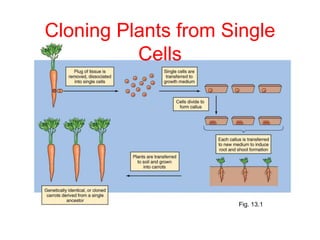
Cloning Plants from Single
Cells
Fig. 13.1
Cloning Animals
• Animals were cloned more than 20
years ago
• Two techniques
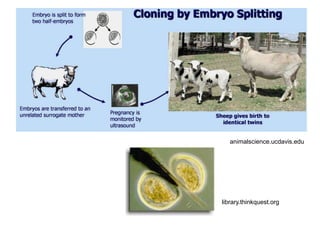
–Embryo splitting
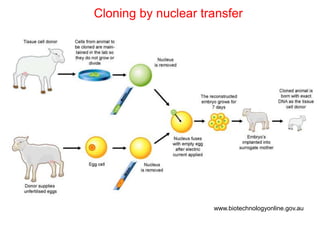
–Nuclear transfer
library.thinkquest.org
animalscience.ucdavis.edu
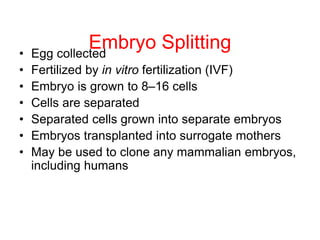
Embryo Splitting
• Egg collected
• Fertilized by in vitro fertilization (IVF)
• Embryo is grown to 8–16 cells
• Cells are separated
• Separated cells grown into separate embryos
• Embryos transplanted into surrogate mothers
• May be used to clone any mammalian embryos,
including humans
www.biotechnologyonline.gov.au
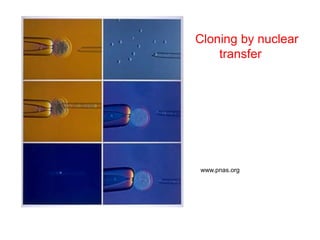
Cloning by nuclear transfer
www.pnas.org
Cloning by nuclear
transfer
Nuclear Transfer
• First done in 1986
• More difficult
• Nucleus is removed from an egg
• Enucleated eggs are fused with other
cells
• Embryos are transplanted into a
surrogate mother
• In 1997, Dolly the sheep was the first
mammalian clone from an adult donor cell
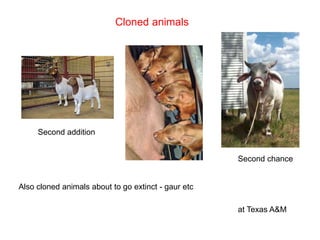
Cloned animals
Second addition
Second chance
at Texas A&M
Also cloned animals about to go extinct - gaur etc
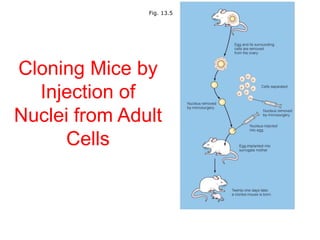
Cloning Mice by
Injection of
Nuclei from Adult
Cells
Fig. 13.5
Problems -
don’t live as long
not carbon copies/identical
develop diseases early
very low success rate - 0.1 - 3%
Dedifferentiation/reprogramming may not be complete
or accurate
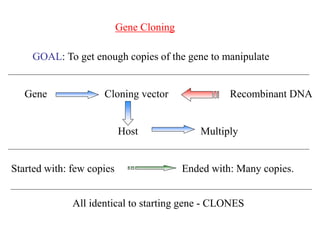
Gene Cloning
All identical to starting gene - CLONES
Gene
Host
Cloning vector Recombinant DNA
Started with: few copies
GOAL: To get enough copies of the gene to manipulate
Multiply
Ended with: Many copies.
Restriction enzymes
Nobel Prize
Werner Arber, Daniel Nathans and Hamilton O. Smith
1978
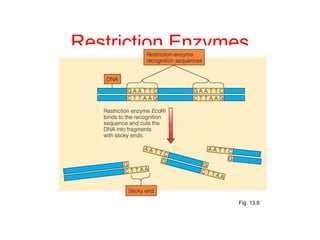
Restriction Enzymes
Fig. 13.6
G
CCTAG
GATCC
G
GATCC
G
G
CCTAG
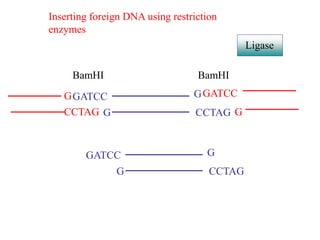
Inserting foreign DNA using restriction
enzymes
GATCC
G
G
CCTAG
BamHI BamHI
Ligase
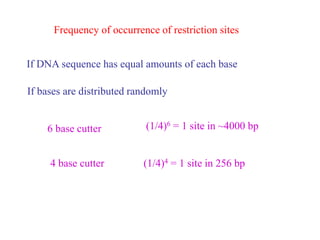
Frequency of occurrence of restriction sites
If DNA sequence has equal amounts of each base
If bases are distributed randomly
6 base cutter (1/4)6 = 1 site in ~4000 bp
4 base cutter (1/4)4 = 1 site in 256 bp
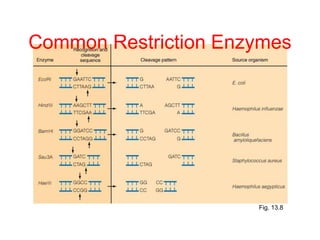
Common Restriction Enzymes
Fig. 13.8
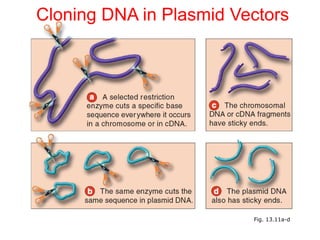
Fig. 13.11a-d
Cloning DNA in Plasmid Vectors
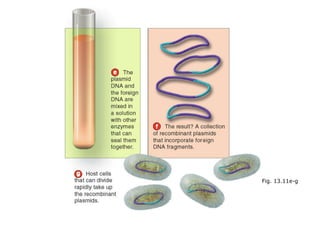
Fig. 13.11e-g
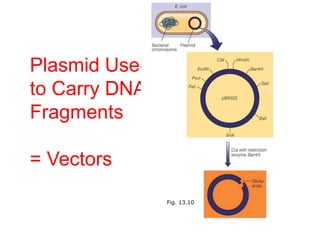
Plasmid Used
to Carry DNA
Fragments
= Vectors
Fig. 13.10
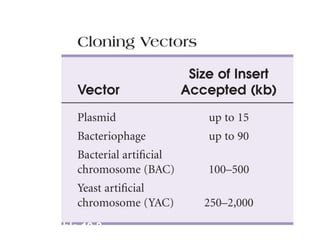
Table 19.2
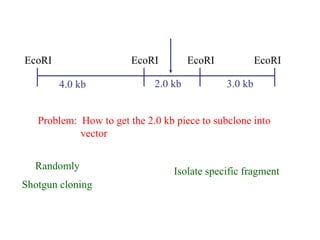
EcoRI EcoRI EcoRI EcoRI
4.0 kb 2.0 kb 3.0 kb
Problem: How to get the 2.0 kb piece to subclone into
vector
Randomly
Isolate specific fragment
Shotgun cloning
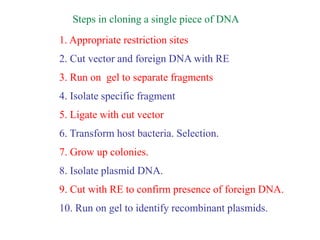
Steps in cloning a single piece of DNA
1. Appropriate restriction sites
2. Cut vector and foreign DNA with RE
3. Run on gel to separate fragments
4. Isolate specific fragment
5. Ligate with cut vector
6. Transform host bacteria. Selection.
7. Grow up colonies.
8. Isolate plasmid DNA.
9. Cut with RE to confirm presence of foreign DNA.
10. Run on gel to identify recombinant plasmids.
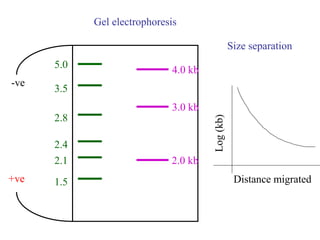
Gel electrophoresis
-ve
+ve
Size separation
4.0 kb
3.0 kb
2.0 kb
5.0
3.5
2.8
2.4
1.5
2.1
Log
(kb)
Distance migrated
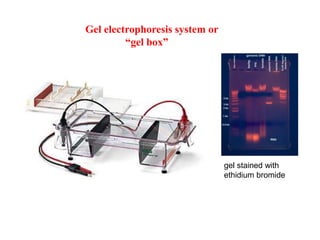
Gel electrophoresis system or
“gel box”
gel stained with
ethidium bromide
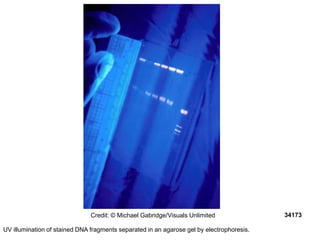
UV illumination of stained DNA fragments separated in an agarose gel by electrophoresis.
Credit: © Michael Gabridge/Visuals Unlimited 34173
Selecting Cells with Vectors
 Vectors carry antibiotic resistance genes
 Growing antibiotic-sensitive cells on media with
antibiotics ensures that all growing cells must
carry the vector
Selecting Cells with Recombinant Vectors
 While inserting the donor DNA, an existing gene
in the vector is inactivated
 OR
 In addition to the Donor gene a marker gene is
added
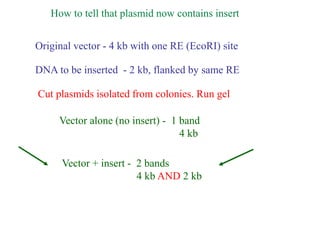
Original vector - 4 kb with one RE (EcoRI) site
DNA to be inserted - 2 kb, flanked by same RE
Cut plasmids isolated from colonies. Run gel
Vector alone (no insert) - 1 band
4 kb
How to tell that plasmid now contains insert
Vector + insert - 2 bands
4 kb AND 2 kb

BMB331 cloning.ppt