IB Business and Management : Unit 1.5  PEST Analysis Lesson 1 Pages 73-76
1. Focus Questions 1. What are the  constraints and opportunities  ( internal factors ) facing a business in the attempt to achieve its aims and objectives? 2. How can these factors facilitate effective decision-making? 3. What are the  external factors  which restrict or aid in the performance of a business? 4.  What is   PEST   and how can we use it to analyze the external factors in more detail?
2. Overview We talked about how internal and external stakeholders can influence an organization. Businesses also face other internal and external factors, which will affect their performance . These factors include :  Internal and External… Opportunities  and Threats .  …
3. Internal Factors The  constraints  and  opportunities : These are within a firm’s own control. Tend to be dominated by the firms rules and culture of a business. Some examples : Finance : Lack sources of finance Can not afford certain kinds of advertising; TV ads. People : Poor working relations Unhappy employees may hinder the performance of a business. Marketing : Your marketing campaigns might be have… inferior products, poor customer service and promotions. Production : Firm may lack the resources  and know-how to achieve better production techniques and stock control. …
4a. External Factors These issues will  restrict or aid  the performance of a business. The company has  no control  of these  external factors . So, why is it important to understand these factors? How can we understand these  uncontrollable  factors better? By using… P E S T What does  P E S T stand for? P olitical, E conomic, S ocial, and T echnological  opportunities  and  threats  of the external environment. These factors, affect all businesses in the economy and are uncontrollable.   …
5a.  P E S T Why use P E S T? First , to ensure that what you are doing is aligned positively with the powerful forces of change that are affecting our world.  Second , helps you avoid taking action that is doomed to failure from the outset, for reasons beyond your control; and Third , it is useful when you start operating in a new country or region.  The use of PEST helps you break free of unconscious assumptions, and helps you quickly adapt to the realities of the new environment . (Taken from  http://www.mindtools.com/pages/article/newTMC_09.htm  ) …
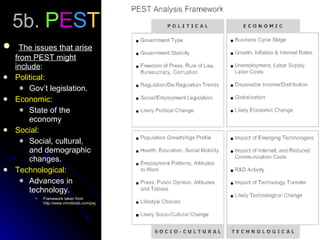
5b.  P E S T The issues that arise from PEST might include : Political : Gov’t legislation. Economic : State of the economy Social : Social, cultural, and demographic changes. Technological : Advances in technology. Framework taken from  http://www.mindtools.com/pages/article/newTMC_09.htm
5c.  P E S T What are the external factors that  harm  a business called? Threats (PEST Analysis) . Can you list some examples? The other factors which  do not harm  a business, are? Opportunities (STEP Analysis) . There are other forms of PEST, such as: PEST LE  Analysis…they include  Legal and Environmental  opportunities and threats. STEEPL E  Analysis, which includes  Ethical  opportunities and threats. …
5d.  P E S T So, how do we carry out a PEST analysis? Well, there are  three basic steps  needed to perform the analysis: 1.  Brainstorm  external factors that may affect your business. Put these under the PEST headings. 2.  Discuss  each factor to decide which ones are most likely to have the greatest impact on your business. 3.  Summarize  the information in a PEST analysis template to help in developing a business strategy. See Box. 1.5a for an example, on pg. 76. This analysis is useful when trying to consider the advantages and disadvantages of a decision . If the opportunities outweigh the threats, then a business is more likely to pursue that option. One key advantage is that the PEST is simple to use. It helps you, as managers,  be thorough and logical in your analysis . It is also a useful  brainstorming and discussion  tool. It  promotes proactive and forward-thinking…much  better than guessing. It helps you  better prepare your business  in dealing with external shocks. And in  devising appropriate organizational strategies .  …
5e.  Activity Get into your business groups. Read the handout carefully. Create a PEST analysis based on the handout. …
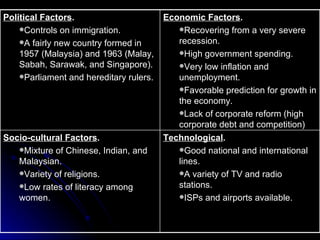
5f.  Activity Answers : Political Factors. Controls on immigration. A fairly new country formed in 1957 (Malaysia) and 1963 (Malay, Sabah, Sarawak, and Singapore). Parliament and hereditary rulers. Economic Factors. Recovering from a very severe recession. High government spending. Very low inflation and unemployment. Favorable prediction for growth in the economy. Lack of corporate reform (high corporate debt and competition) Socio-cultural Factors. Mixture of Chinese, Indian, and Malaysian. Variety of religions. Low rates of literacy among women. Technological. Good national and international lines. A variety of TV and radio stations. ISPs and airports available. …
Technological . Good national and international lines. A variety of TV and radio stations. ISPs and airports available. Socio-cultural Factors . Mixture of Chinese, Indian, and Malaysian. Variety of religions. Low rates of literacy among women. Economic Factors . Recovering from a very severe recession. High government spending. Very low inflation and unemployment. Favorable prediction for growth in the economy. Lack of corporate reform (high corporate debt and competition) Political Factors . Controls on immigration. A fairly new country formed in 1957 (Malaysia) and 1963 (Malay, Sabah, Sarawak, and Singapore). Parliament and hereditary rulers.
IB Business and Management : 1.5  External Opportunities & Threats Lesson 2 Pages 76-90
1. Focus Questions What are the social, technological, economic, environmental, political, legal, and ethical external opportunities and threats? How do they affect decision making in a business? …
2. Social & Cultural The Social and Cultural Factors : 1.  Attitude of society : Will have different issues to deal with, such as: Business ethics, social welfare, women rights, religious or animal rights. 2.  Demographic Changes : Changes in a society can present some opportunities as well as threats to your business. More educated and flexible workforce,  an ageing population, and Changes of attitudes to the role of women. 3.  Multiculturalism : What is the most consumed take out food? Pizza? Hamburgers? Fish & Chips?... As countries become culturally diverse growth in sales of such goods and services will rise. This results in globalization which creates unlimited opportunities both locally and internationally. ( see pg. 77, Box 1.5.1 for discussion ) …
3a. Technological The internet: Affects several departments : Human Resource Management ( recruitment process ) Marketing ( e-commerce ) Finance ( reports published online ) Operations Management ( accessing data ) Why is the internet seen as an  opportunity  for business ? Speed of access to information. Lowers language and cultural barriers. Lowers costs of production. Are there any  threats  for a business using the internet ? Price transparency (you can compare prices on line). Online crime (hackers, banking and credit card fraud). Higher costs of production (maintenance and training costs). …
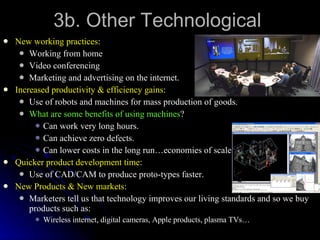
3b. Other Technological New working practices : Working from home Video conferencing Marketing and advertising on the internet. Increased productivity & efficiency gains : Use of robots and machines for mass production of goods. What are some benefits of using machines ? Can work very long hours. Can achieve zero defects. Can lower costs in the long run…economies of scale. Quicker product development time : Use of CAD/CAM to produce proto-types faster. New Products & New markets : Marketers tell us that technology improves our living standards and so we buy products such as: Wireless internet, digital cameras, Apple products, plasma TVs…
3c. Other Technological Job creation: Will be a need to maintain and support the technology. Who will be able to do these types of jobs? Computer programmers, hardware and software technicians, graphic designers, and ICT teachers. …
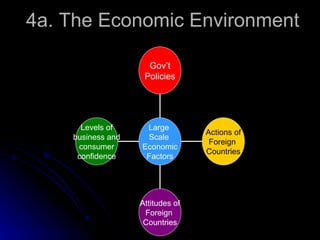
4a. The Economic Environment Levels of business and consumer confidence Attitudes of Foreign  Countries Actions of Foreign  Countries Gov’t Policies Large  Scale  Economic Factors
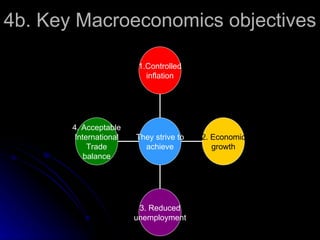
4b. Key Macroeconomics objectives 4. Acceptable International Trade balance 3. Reduced unemployment 2. Economic growth 1.Controlled inflation They strive to achieve
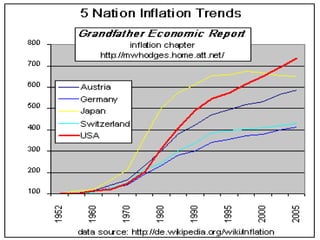
4c. Government Macroeconomic Policies These policies are used to achieve four primary goals which will effect your business activity: 1.  Controlled rate of inflation : What is inflation? The continual rise in price levels in the economy. Why would you want  low and sustainable  inflation? How does it measure economic prosperity? By controlling inflation, can we achieve the other three economic objectives in the long run?  …
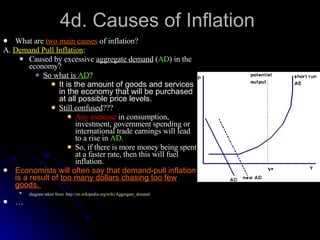
4d. Causes of Inflation What are  two main causes  of inflation? A.  Demand Pull Inflation : Caused by excessive  aggregate demand  ( AD ) in the economy? So what is  AD ? It is the amount of goods and services in the economy that will be purchased at all possible price levels.   Still confused ??? Any increase  in consumption, investment, government spending or international trade earnings will lead to a rise in  AD . So, if there is more money being spent at a faster rate, then this will fuel inflation. Economists will often say that demand-pull inflation is a result of  too many dollars chasing too few goods.   diagram taken from:  http://en.wikipedia.org/wiki/Aggregate_demand   …
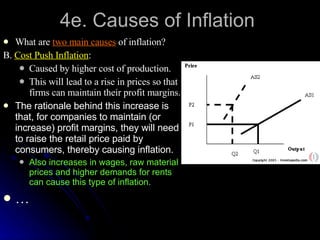
4e. Causes of Inflation What are  two main causes  of inflation? B.  Cost Push Inflation : Caused by higher cost of production. This will lead to a rise in prices so that firms can maintain their profit margins. The rationale behind this increase is that, for companies to maintain (or increase) profit margins, they will need to raise the retail price paid by consumers, thereby causing inflation. Also increases in wages, raw material prices and higher demands for rents can cause this type of inflation.    …
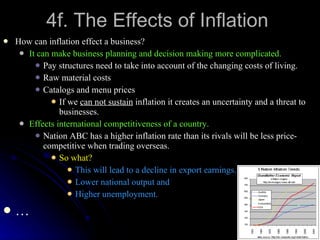
4f. The Effects of Inflation How can inflation effect a business? It can make business planning and decision making more complicated. Pay structures need to take into account of the changing costs of living. Raw material costs Catalogs and menu prices If we  can not sustain  inflation it creates an uncertainty and a threat to businesses. Effects international competitiveness of a country. Nation ABC has a higher inflation rate than its rivals will be less price-competitive when trading overseas. So what? This will lead to a decline in export earnings. Lower national output and Higher unemployment. …
 
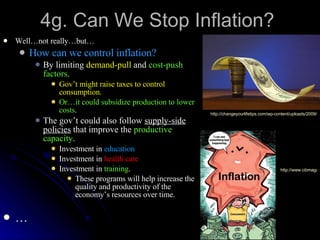
4g. Can We Stop Inflation? Well…not really…but… How can we control inflation? By limiting  demand-pull  and  cost-push factors . Gov’t might raise taxes to control consumption. Or…it could subsidize production to lower costs . The gov’t could also follow  supply-side policies  that improve the  productive capacity . Investment in  education Investment in  health care Investment in  training . These programs will help increase the quality and productivity of the economy’s resources over time.  … http://changeyourlifetips.com/wp-content/uploads/2009/01/so-how-does-a-government-control-inflation.jpg   http://www.cibmagazine.com.cn/W_img/Edit/2007-10/20071011180806477.jpg
5a. Employment What is meant by the  rate of unemployment ? Measures the proportion of a country’s workforce not in employment. Unemployment is caused by the interaction of  aggregate demand  and  aggregate supply  in the economy. For example: If  AD  is high - - - > low  un employment. Why? Increase in demand for labor. If  AS  is high - - - > high employment. Why? Increase in national output / production. … http:// www.hr.wayne.edu/esc/images/employment.jpg   http://www.high-success-salestraining.com/images/employment2lg.jpg
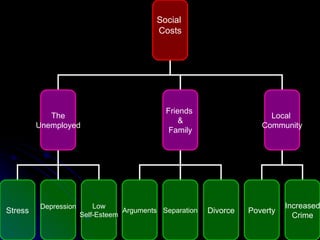
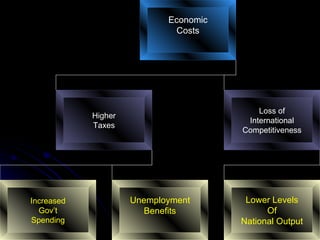
5b. Employment What are some  problems of unemployment  that governments aim to deal with? Social  costs of unemployment. The costs to society. Economic  costs of unemployment. The opportunity costs of unemployment. …
Social  Costs The Unemployed Friends  & Family Local  Community Stress Depression Low Self-Esteem Arguments Separation Divorce Poverty Increased Crime
Economic Costs Higher Taxes Loss of International Competitiveness Increased Gov’t Spending Unemployment Benefits Lower Levels Of National Output
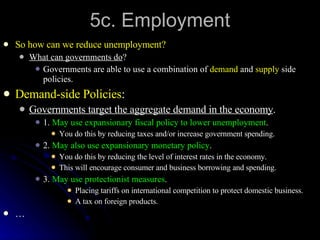
5c. Employment So how can we reduce unemployment? What can governments do ? Governments are able to use a combination of  demand  and  supply  side policies. Demand-side Policies : Governments target the aggregate demand in the economy . 1.  May use expansionary fiscal policy to lower unemployment . You do this by reducing taxes and/or increase government spending. 2.  May also use expansionary monetary policy . You do this by reducing the level of interest rates in the economy. This will encourage consumer and business borrowing and spending. 3.  May use protectionist measures . Placing tariffs on international competition to protect domestic business. A tax on foreign products. …
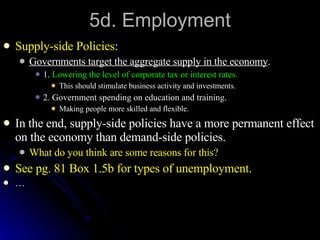
5d. Employment Supply-side Policies : Governments target the aggregate supply in the economy . 1.  Lowering the level of corporate tax or interest rates. This should stimulate business activity and investments. 2. Government spending on education and training. Making people more skilled and flexible. In the end, supply-side policies have a more permanent effect on the economy than demand-side policies. What do you think are some reasons for this? See pg. 81 Box 1.5b for types of unemployment. …
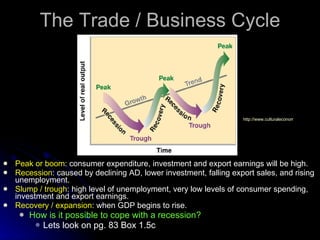
6a. Economic Growth What is economic growth? A country’s increased economic activity. How can this be measured? Measured by the change in total output of the economy per year. A.K.A:  GDP  =  G ross  D omestic  P roduct A high GDP would indicate or suggest that the average person is earning more income and that the economy is more prosperous. See pg. 82, Fig 1.5a The Trade Cycle …
The Trade / Business Cycle Peak or boom : consumer expenditure, investment and export earnings will be high. Recession : caused by declining AD, lower investment, falling export sales, and rising unemployment. Slump / trough : high level of unemployment, very low levels of consumer spending, investment and export earnings. Recovery / expansion : when GDP begins to rise.  How is it possible to cope with a recession?  Lets look on pg. 83 Box 1.5c http://www.culturaleconomics.atfreeweb.com/111%20114%20MBB%20Macro%20Graphics/Macro/Fig%206.1%20Business%20Cycle.jpg
6b. Economic Growth So we learned how to measure economic growth. Is there anything that can contribute to economic growth? 1.  Improved efficiency in the production process . What does that mean or entail? Better use of existing resources. 2.  Enhanced quantity and quality of factors of production . How do you obtain growth in the  quality of factors of production ? $$$  INVESTMENT  $$$ Three key resources of the economy which to invest in : 1. Capital goods ( developing infrastructure ) 2. Education and training ( trained workforce ) 3. Health technology ( workforce, healthy and productive ) …
6c. Economic Growth How do you obtain growth in the  quantity of factors of production ? Well…there are many, many, ways  Discovering new sources of raw materials Changes in the labour force. Three key resources of the economy which to invest in : Changes in demography ( fall in birth rate; size of workforce ) Changes in participation rates ( self-employed or employed ) Changes in net migration ( immigration minus emigration ) Not all countries are able to achieve economic growth; in some cases there are  barriers to economic growth. Lack of infrastructure ( lacks basic electricity, road networks, schools etc ). Lack of technological knowledge. Rapid population growth ( too many mouths to feed ). High foreign debt repayments ( no money to invest in the domestic economy ). …
7a. Balance of Payments What are balance of payments ? A country’s money inflows and outflows. They are made up of two components: 1.  the current account  (export earnings and import expenditure) 2.  the capital account  (flows of money for gov’t reserves, foreign currencies or for investment) The Current account also consists of two parts : A. the visible trade (oil, steel and cars). B. the invisible trade (banking, distribution, and insurance). Why is it better to avoid a deficit on the Current Account in the long run? Well, can you spend more than you earn in the long run? You may be able to if you use credit…but it is not wise to do so. Governments will try to avoid running a deficit in the long run.  They do this by : Increasing Capital Account inflows or Devaluating its exchange rate.  …
7b. Balance of Payments Exchange Rate (FX): What are they and how are they important? It measures the value of one currency in terms of others. Eg. US $1 = 1500 KRW (Korean Won) Higher exchange rate (an appreciation):  = export prices will be higher. This reduces the exporter’s  price competitiveness . Gov’t will try to devalue the exchange rate to give domestic firms a  price advantage . Lower exchange rate (a depreciation):  = import prices will be higher. This will raise the production costs Gov’t will try to correct this imbalance. International trade deals may be postponed until business can benefit from the movement in the exchange rates. Also governments might set up trade barriers to correct the balance of payments. See pg. 85, Box 1.5d. What is protectionism? Any policy used by gov’t to safeguard domestic business from foreign competition. …
8a. Environmental Ops and Threats Is government intervention necessary for business activity? What if businesses do not consider the  external costs of production ? Who is going to deal with this? So, what are the  external costs of production ? A.K.A.  negative externalities Are costs incurred by a third party in a business transaction. Costs borne by society or environment, rather than by the buyer and seller. Such as air pollution, waste, global warming, etc. Overall threats and opportunities : Global warming (increased natural disasters). Public / Social attitudes (CSR, compliance costs). Changes in weather (flooding, drought). Health scares / epidemics (SARS, AIDS, Mad cow disease).
9a.  Political  / Legal / Ethical What does  laissez-faire  mean in a business context? Where the government does not intervene in business activity. Is this always a good idea? Why or why not? What is the argument for this approach? That leaving businesses to their own devices should create healthy competition and efficiency. If gov’t intervenes, their policies could present barriers to business growth. A  laissez-faire  business environment may attract  foreign direct investment . What is the reason for this? Will be easier to conduct business. The reality is… The majority of governments adopt an  interventionist approach  to managing the economy. These policies that control business activity are… Fiscal policy  and  monetary policy .
9b.  Political  / Legal / Ethical Fiscal Policy: Refers to : Government use of taxation:  (see pg. 87, Box 1.5e) Direct : paid from income, wealth or profit and  Indirect : tax paid on trade goods and services. Progressive, Regressive, and Proportional :  Progressive tax : income tax; tax paid increase as the income etc. Regressive tax : tax decreases as income of tax payer rises. Proportional tax : gov’t sales tax; % of tax paid remains the same regardless of income, wealth, or profit levels. Government expenditure: Social security, transport, health care, education, national defense and law and order. Spending on these sectors will also improve the economy. Two forms of fiscal policy : Deflationary : higher tax to slow down high rate of growth. Expansionary : to boost the economy by cutting taxes. …
9c.  Political  / Legal / Ethical Monetary Policy: Used to control the amount of spending and investment in an economy. How can governments do this?  By changing interest rates to affect money supply and exchange rates. What are interests rates? The price of money. The price of borrowing and the return for saving money. If the economy is overheating (growing too fast); this will cause inflation to be too high, then gov’t will increase interest rates. If you increase interest rates, what do you think will happen? Will it be more attractive to borrow money? NO! Why not? Higher costs of interests repayments on loans. Higher interests rates will lower your discretionary income. Discretionary income  = disposable income – all interests bearing loans paid This may lead to a cut back in spending. Will also reduce consumption and investment.  …
9d.  Political  / Legal / Ethical Why do you think businesses are charged different levels of interests? (4 reasons) 1.  Risk : the greater the risk, the greater the chance of failure to repay loan. 2.  Time : the longer the time period, the higher the interest rate. 3.  Administration costs : the higher the cost in lending money, the higher the interest. 4.  Expectations : if gov’t expect the economy to do well, then will announce a higher interest rate. Also, interest rates have a direct impact on exchange rates: An increase in interest rates  =  increase demand for that country’s currency. An increase in exchange rates  =  increased prices of exports, will result in a decrease for demand in exports. Note: Higher exchange rates will hurt the domestic economy. Why? So, is gov’t intervention, to control business activity, counterproductive? Why? Laws  may restrict  business activity. Higher taxes or interest rates  may limit  profit maximization, R & D, and innovation. Regulations  will increase  administration costs on businesses; example: CSR.
9e. Political /  Legal  / Ethical Is gov’t intervention a good thing? Why? Yes, it can protect the public from the negative aspects of business activity. How can gov’t intervention protect the general public? Consumer protection legislation : stop false and misleading product descriptions. Employee protection legislation : safety issues, anti-discrimination. Competition legislation : anti-competitive practices are stopped; monopolies.  Social and environmental protection legislation : consumption of demerit goods (tobacco, alcohol, and illegal drugs) would be higher; laws limit the use.
9f. Political / Legal /  Ethical Is there such a thing as  Business Ethics ? Should business decisions be made based on moral and ethical principles?  Why or why not? So…what would you consider as an ethical firm? Firms which are socially responsible towards their… Stakeholders? Customers? Employees? Local community? Can you give examples of how a firm can be ethical? What are the compliance costs in acting ethically? Can they benefit by being socially responsible? If so, how? They attract and retain good quality workers. They attract new customers and keep existing ones. They create good publicity and public relations. …
IB Business and Management : 1.5  PEST vs. SWOT Lesson 3 Pages 91-93
1. Focus Questions 1. What is SWOT? 2.  How does PEST and SWOT differ and when do you use them? 3. How can PEST assess the external environment and how can this information be used in a business strategy?
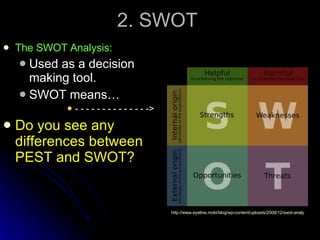
2. SWOT The SWOT Analysis: Used as a decision making tool. SWOT means… - - - - - - - - - - - - - -> Do you see any differences between PEST and SWOT? http://www.eyeline.mobi/blog/wp-content/uploads/2008/12/swot-analysis-image.png
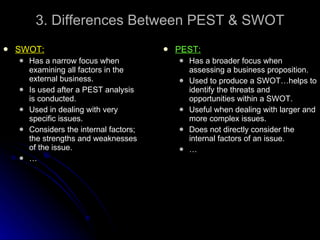
3. Differences Between PEST & SWOT SWOT: Has a narrow focus when examining all factors in the external business. Is used after a PEST analysis is conducted. Used in dealing with very specific issues. Considers the internal factors; the strengths and weaknesses of the issue. … PEST: Has a broader focus when  assessing a business proposition. Used to produce a SWOT…helps to identify the threats and opportunities within a SWOT. Useful when dealing with larger and more complex issues. Does not directly consider the internal factors of an issue. …
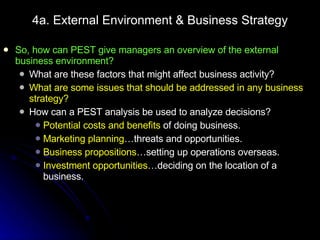
4a. External Environment & Business Strategy So, how can PEST give managers an overview of the external business environment? What are these factors that might affect business activity? What are some issues that should be addressed in any business strategy? How can a PEST analysis be used to analyze decisions? Potential costs and benefits  of doing business. Marketing   planning …threats and opportunities. Business   propositions …setting up operations overseas. Investment   opportunities …deciding on the location of a business.
4b. External Environment & Business Strategy Can you list a range of policies that governments use to achieve their macroeconomic objectives? How will these policies present threats and opportunities for businesses? How will the social, cultural, technological, and environmental factors affect business activity?  Remember :  Different business are affect by different external factors and this depends on factors such as : Size of the business : smaller vs larger firms Ability of management : experienced and skilled managers Price elasticity of demand : products with price inelastic demand have few substitutes…demand will not be affected by external factors…brand loyalty. Degree of diversification : more products you have, the more you are able to handle any changes. Level of gearing : how much a firm relies on external borrowing.
4c. External Environment & Business Strategy From what we have learned thus far,  how will the external factors affect a firm’s international competitiveness? Exchange rate and etc… Remember : internal factors also affect on a firm’s ability to compete overseas.  How so ? The price,  brand awareness,  loyalty,  product design and  quality. …

Bm 1.5 External Environment

  • 1.
    IB Business andManagement : Unit 1.5 PEST Analysis Lesson 1 Pages 73-76
  • 2.
    1. Focus Questions1. What are the constraints and opportunities ( internal factors ) facing a business in the attempt to achieve its aims and objectives? 2. How can these factors facilitate effective decision-making? 3. What are the external factors which restrict or aid in the performance of a business? 4. What is PEST and how can we use it to analyze the external factors in more detail?
  • 3.
    2. Overview Wetalked about how internal and external stakeholders can influence an organization. Businesses also face other internal and external factors, which will affect their performance . These factors include : Internal and External… Opportunities and Threats . …
  • 4.
    3. Internal FactorsThe constraints and opportunities : These are within a firm’s own control. Tend to be dominated by the firms rules and culture of a business. Some examples : Finance : Lack sources of finance Can not afford certain kinds of advertising; TV ads. People : Poor working relations Unhappy employees may hinder the performance of a business. Marketing : Your marketing campaigns might be have… inferior products, poor customer service and promotions. Production : Firm may lack the resources and know-how to achieve better production techniques and stock control. …
  • 5.
    4a. External FactorsThese issues will restrict or aid the performance of a business. The company has no control of these external factors . So, why is it important to understand these factors? How can we understand these uncontrollable factors better? By using… P E S T What does P E S T stand for? P olitical, E conomic, S ocial, and T echnological opportunities and threats of the external environment. These factors, affect all businesses in the economy and are uncontrollable. …
  • 6.
    5a. PE S T Why use P E S T? First , to ensure that what you are doing is aligned positively with the powerful forces of change that are affecting our world. Second , helps you avoid taking action that is doomed to failure from the outset, for reasons beyond your control; and Third , it is useful when you start operating in a new country or region. The use of PEST helps you break free of unconscious assumptions, and helps you quickly adapt to the realities of the new environment . (Taken from http://www.mindtools.com/pages/article/newTMC_09.htm ) …
  • 7.
    5b. PE S T The issues that arise from PEST might include : Political : Gov’t legislation. Economic : State of the economy Social : Social, cultural, and demographic changes. Technological : Advances in technology. Framework taken from http://www.mindtools.com/pages/article/newTMC_09.htm
  • 8.
    5c. PE S T What are the external factors that harm a business called? Threats (PEST Analysis) . Can you list some examples? The other factors which do not harm a business, are? Opportunities (STEP Analysis) . There are other forms of PEST, such as: PEST LE Analysis…they include Legal and Environmental opportunities and threats. STEEPL E Analysis, which includes Ethical opportunities and threats. …
  • 9.
    5d. PE S T So, how do we carry out a PEST analysis? Well, there are three basic steps needed to perform the analysis: 1. Brainstorm external factors that may affect your business. Put these under the PEST headings. 2. Discuss each factor to decide which ones are most likely to have the greatest impact on your business. 3. Summarize the information in a PEST analysis template to help in developing a business strategy. See Box. 1.5a for an example, on pg. 76. This analysis is useful when trying to consider the advantages and disadvantages of a decision . If the opportunities outweigh the threats, then a business is more likely to pursue that option. One key advantage is that the PEST is simple to use. It helps you, as managers, be thorough and logical in your analysis . It is also a useful brainstorming and discussion tool. It promotes proactive and forward-thinking…much better than guessing. It helps you better prepare your business in dealing with external shocks. And in devising appropriate organizational strategies . …
  • 10.
    5e. ActivityGet into your business groups. Read the handout carefully. Create a PEST analysis based on the handout. …
  • 11.
    5f. ActivityAnswers : Political Factors. Controls on immigration. A fairly new country formed in 1957 (Malaysia) and 1963 (Malay, Sabah, Sarawak, and Singapore). Parliament and hereditary rulers. Economic Factors. Recovering from a very severe recession. High government spending. Very low inflation and unemployment. Favorable prediction for growth in the economy. Lack of corporate reform (high corporate debt and competition) Socio-cultural Factors. Mixture of Chinese, Indian, and Malaysian. Variety of religions. Low rates of literacy among women. Technological. Good national and international lines. A variety of TV and radio stations. ISPs and airports available. …
  • 12.
    Technological . Goodnational and international lines. A variety of TV and radio stations. ISPs and airports available. Socio-cultural Factors . Mixture of Chinese, Indian, and Malaysian. Variety of religions. Low rates of literacy among women. Economic Factors . Recovering from a very severe recession. High government spending. Very low inflation and unemployment. Favorable prediction for growth in the economy. Lack of corporate reform (high corporate debt and competition) Political Factors . Controls on immigration. A fairly new country formed in 1957 (Malaysia) and 1963 (Malay, Sabah, Sarawak, and Singapore). Parliament and hereditary rulers.
  • 13.
    IB Business andManagement : 1.5 External Opportunities & Threats Lesson 2 Pages 76-90
  • 14.
    1. Focus QuestionsWhat are the social, technological, economic, environmental, political, legal, and ethical external opportunities and threats? How do they affect decision making in a business? …
  • 15.
    2. Social &Cultural The Social and Cultural Factors : 1. Attitude of society : Will have different issues to deal with, such as: Business ethics, social welfare, women rights, religious or animal rights. 2. Demographic Changes : Changes in a society can present some opportunities as well as threats to your business. More educated and flexible workforce, an ageing population, and Changes of attitudes to the role of women. 3. Multiculturalism : What is the most consumed take out food? Pizza? Hamburgers? Fish & Chips?... As countries become culturally diverse growth in sales of such goods and services will rise. This results in globalization which creates unlimited opportunities both locally and internationally. ( see pg. 77, Box 1.5.1 for discussion ) …
  • 16.
    3a. Technological Theinternet: Affects several departments : Human Resource Management ( recruitment process ) Marketing ( e-commerce ) Finance ( reports published online ) Operations Management ( accessing data ) Why is the internet seen as an opportunity for business ? Speed of access to information. Lowers language and cultural barriers. Lowers costs of production. Are there any threats for a business using the internet ? Price transparency (you can compare prices on line). Online crime (hackers, banking and credit card fraud). Higher costs of production (maintenance and training costs). …
  • 17.
    3b. Other TechnologicalNew working practices : Working from home Video conferencing Marketing and advertising on the internet. Increased productivity & efficiency gains : Use of robots and machines for mass production of goods. What are some benefits of using machines ? Can work very long hours. Can achieve zero defects. Can lower costs in the long run…economies of scale. Quicker product development time : Use of CAD/CAM to produce proto-types faster. New Products & New markets : Marketers tell us that technology improves our living standards and so we buy products such as: Wireless internet, digital cameras, Apple products, plasma TVs…
  • 18.
    3c. Other TechnologicalJob creation: Will be a need to maintain and support the technology. Who will be able to do these types of jobs? Computer programmers, hardware and software technicians, graphic designers, and ICT teachers. …
  • 19.
    4a. The EconomicEnvironment Levels of business and consumer confidence Attitudes of Foreign Countries Actions of Foreign Countries Gov’t Policies Large Scale Economic Factors
  • 20.
    4b. Key Macroeconomicsobjectives 4. Acceptable International Trade balance 3. Reduced unemployment 2. Economic growth 1.Controlled inflation They strive to achieve
  • 21.
    4c. Government MacroeconomicPolicies These policies are used to achieve four primary goals which will effect your business activity: 1. Controlled rate of inflation : What is inflation? The continual rise in price levels in the economy. Why would you want low and sustainable inflation? How does it measure economic prosperity? By controlling inflation, can we achieve the other three economic objectives in the long run? …
  • 22.
    4d. Causes ofInflation What are two main causes of inflation? A. Demand Pull Inflation : Caused by excessive aggregate demand ( AD ) in the economy? So what is AD ? It is the amount of goods and services in the economy that will be purchased at all possible price levels. Still confused ??? Any increase in consumption, investment, government spending or international trade earnings will lead to a rise in AD . So, if there is more money being spent at a faster rate, then this will fuel inflation. Economists will often say that demand-pull inflation is a result of too many dollars chasing too few goods. diagram taken from: http://en.wikipedia.org/wiki/Aggregate_demand …
  • 23.
    4e. Causes ofInflation What are two main causes of inflation? B. Cost Push Inflation : Caused by higher cost of production. This will lead to a rise in prices so that firms can maintain their profit margins. The rationale behind this increase is that, for companies to maintain (or increase) profit margins, they will need to raise the retail price paid by consumers, thereby causing inflation. Also increases in wages, raw material prices and higher demands for rents can cause this type of inflation.  …
  • 24.
    4f. The Effectsof Inflation How can inflation effect a business? It can make business planning and decision making more complicated. Pay structures need to take into account of the changing costs of living. Raw material costs Catalogs and menu prices If we can not sustain inflation it creates an uncertainty and a threat to businesses. Effects international competitiveness of a country. Nation ABC has a higher inflation rate than its rivals will be less price-competitive when trading overseas. So what? This will lead to a decline in export earnings. Lower national output and Higher unemployment. …
  • 25.
  • 26.
    4g. Can WeStop Inflation? Well…not really…but… How can we control inflation? By limiting demand-pull and cost-push factors . Gov’t might raise taxes to control consumption. Or…it could subsidize production to lower costs . The gov’t could also follow supply-side policies that improve the productive capacity . Investment in education Investment in health care Investment in training . These programs will help increase the quality and productivity of the economy’s resources over time. … http://changeyourlifetips.com/wp-content/uploads/2009/01/so-how-does-a-government-control-inflation.jpg http://www.cibmagazine.com.cn/W_img/Edit/2007-10/20071011180806477.jpg
  • 27.
    5a. Employment Whatis meant by the rate of unemployment ? Measures the proportion of a country’s workforce not in employment. Unemployment is caused by the interaction of aggregate demand and aggregate supply in the economy. For example: If AD is high - - - > low un employment. Why? Increase in demand for labor. If AS is high - - - > high employment. Why? Increase in national output / production. … http:// www.hr.wayne.edu/esc/images/employment.jpg http://www.high-success-salestraining.com/images/employment2lg.jpg
  • 28.
    5b. Employment Whatare some problems of unemployment that governments aim to deal with? Social costs of unemployment. The costs to society. Economic costs of unemployment. The opportunity costs of unemployment. …
  • 29.
    Social CostsThe Unemployed Friends & Family Local Community Stress Depression Low Self-Esteem Arguments Separation Divorce Poverty Increased Crime
  • 30.
    Economic Costs HigherTaxes Loss of International Competitiveness Increased Gov’t Spending Unemployment Benefits Lower Levels Of National Output
  • 31.
    5c. Employment Sohow can we reduce unemployment? What can governments do ? Governments are able to use a combination of demand and supply side policies. Demand-side Policies : Governments target the aggregate demand in the economy . 1. May use expansionary fiscal policy to lower unemployment . You do this by reducing taxes and/or increase government spending. 2. May also use expansionary monetary policy . You do this by reducing the level of interest rates in the economy. This will encourage consumer and business borrowing and spending. 3. May use protectionist measures . Placing tariffs on international competition to protect domestic business. A tax on foreign products. …
  • 32.
    5d. Employment Supply-sidePolicies : Governments target the aggregate supply in the economy . 1. Lowering the level of corporate tax or interest rates. This should stimulate business activity and investments. 2. Government spending on education and training. Making people more skilled and flexible. In the end, supply-side policies have a more permanent effect on the economy than demand-side policies. What do you think are some reasons for this? See pg. 81 Box 1.5b for types of unemployment. …
  • 33.
    6a. Economic GrowthWhat is economic growth? A country’s increased economic activity. How can this be measured? Measured by the change in total output of the economy per year. A.K.A: GDP = G ross D omestic P roduct A high GDP would indicate or suggest that the average person is earning more income and that the economy is more prosperous. See pg. 82, Fig 1.5a The Trade Cycle …
  • 34.
    The Trade /Business Cycle Peak or boom : consumer expenditure, investment and export earnings will be high. Recession : caused by declining AD, lower investment, falling export sales, and rising unemployment. Slump / trough : high level of unemployment, very low levels of consumer spending, investment and export earnings. Recovery / expansion : when GDP begins to rise. How is it possible to cope with a recession? Lets look on pg. 83 Box 1.5c http://www.culturaleconomics.atfreeweb.com/111%20114%20MBB%20Macro%20Graphics/Macro/Fig%206.1%20Business%20Cycle.jpg
  • 35.
    6b. Economic GrowthSo we learned how to measure economic growth. Is there anything that can contribute to economic growth? 1. Improved efficiency in the production process . What does that mean or entail? Better use of existing resources. 2. Enhanced quantity and quality of factors of production . How do you obtain growth in the quality of factors of production ? $$$ INVESTMENT $$$ Three key resources of the economy which to invest in : 1. Capital goods ( developing infrastructure ) 2. Education and training ( trained workforce ) 3. Health technology ( workforce, healthy and productive ) …
  • 36.
    6c. Economic GrowthHow do you obtain growth in the quantity of factors of production ? Well…there are many, many, ways  Discovering new sources of raw materials Changes in the labour force. Three key resources of the economy which to invest in : Changes in demography ( fall in birth rate; size of workforce ) Changes in participation rates ( self-employed or employed ) Changes in net migration ( immigration minus emigration ) Not all countries are able to achieve economic growth; in some cases there are barriers to economic growth. Lack of infrastructure ( lacks basic electricity, road networks, schools etc ). Lack of technological knowledge. Rapid population growth ( too many mouths to feed ). High foreign debt repayments ( no money to invest in the domestic economy ). …
  • 37.
    7a. Balance ofPayments What are balance of payments ? A country’s money inflows and outflows. They are made up of two components: 1. the current account (export earnings and import expenditure) 2. the capital account (flows of money for gov’t reserves, foreign currencies or for investment) The Current account also consists of two parts : A. the visible trade (oil, steel and cars). B. the invisible trade (banking, distribution, and insurance). Why is it better to avoid a deficit on the Current Account in the long run? Well, can you spend more than you earn in the long run? You may be able to if you use credit…but it is not wise to do so. Governments will try to avoid running a deficit in the long run. They do this by : Increasing Capital Account inflows or Devaluating its exchange rate. …
  • 38.
    7b. Balance ofPayments Exchange Rate (FX): What are they and how are they important? It measures the value of one currency in terms of others. Eg. US $1 = 1500 KRW (Korean Won) Higher exchange rate (an appreciation): = export prices will be higher. This reduces the exporter’s price competitiveness . Gov’t will try to devalue the exchange rate to give domestic firms a price advantage . Lower exchange rate (a depreciation): = import prices will be higher. This will raise the production costs Gov’t will try to correct this imbalance. International trade deals may be postponed until business can benefit from the movement in the exchange rates. Also governments might set up trade barriers to correct the balance of payments. See pg. 85, Box 1.5d. What is protectionism? Any policy used by gov’t to safeguard domestic business from foreign competition. …
  • 39.
    8a. Environmental Opsand Threats Is government intervention necessary for business activity? What if businesses do not consider the external costs of production ? Who is going to deal with this? So, what are the external costs of production ? A.K.A. negative externalities Are costs incurred by a third party in a business transaction. Costs borne by society or environment, rather than by the buyer and seller. Such as air pollution, waste, global warming, etc. Overall threats and opportunities : Global warming (increased natural disasters). Public / Social attitudes (CSR, compliance costs). Changes in weather (flooding, drought). Health scares / epidemics (SARS, AIDS, Mad cow disease).
  • 40.
    9a. Political / Legal / Ethical What does laissez-faire mean in a business context? Where the government does not intervene in business activity. Is this always a good idea? Why or why not? What is the argument for this approach? That leaving businesses to their own devices should create healthy competition and efficiency. If gov’t intervenes, their policies could present barriers to business growth. A laissez-faire business environment may attract foreign direct investment . What is the reason for this? Will be easier to conduct business. The reality is… The majority of governments adopt an interventionist approach to managing the economy. These policies that control business activity are… Fiscal policy and monetary policy .
  • 41.
    9b. Political / Legal / Ethical Fiscal Policy: Refers to : Government use of taxation: (see pg. 87, Box 1.5e) Direct : paid from income, wealth or profit and Indirect : tax paid on trade goods and services. Progressive, Regressive, and Proportional : Progressive tax : income tax; tax paid increase as the income etc. Regressive tax : tax decreases as income of tax payer rises. Proportional tax : gov’t sales tax; % of tax paid remains the same regardless of income, wealth, or profit levels. Government expenditure: Social security, transport, health care, education, national defense and law and order. Spending on these sectors will also improve the economy. Two forms of fiscal policy : Deflationary : higher tax to slow down high rate of growth. Expansionary : to boost the economy by cutting taxes. …
  • 42.
    9c. Political / Legal / Ethical Monetary Policy: Used to control the amount of spending and investment in an economy. How can governments do this? By changing interest rates to affect money supply and exchange rates. What are interests rates? The price of money. The price of borrowing and the return for saving money. If the economy is overheating (growing too fast); this will cause inflation to be too high, then gov’t will increase interest rates. If you increase interest rates, what do you think will happen? Will it be more attractive to borrow money? NO! Why not? Higher costs of interests repayments on loans. Higher interests rates will lower your discretionary income. Discretionary income = disposable income – all interests bearing loans paid This may lead to a cut back in spending. Will also reduce consumption and investment. …
  • 43.
    9d. Political / Legal / Ethical Why do you think businesses are charged different levels of interests? (4 reasons) 1. Risk : the greater the risk, the greater the chance of failure to repay loan. 2. Time : the longer the time period, the higher the interest rate. 3. Administration costs : the higher the cost in lending money, the higher the interest. 4. Expectations : if gov’t expect the economy to do well, then will announce a higher interest rate. Also, interest rates have a direct impact on exchange rates: An increase in interest rates = increase demand for that country’s currency. An increase in exchange rates = increased prices of exports, will result in a decrease for demand in exports. Note: Higher exchange rates will hurt the domestic economy. Why? So, is gov’t intervention, to control business activity, counterproductive? Why? Laws may restrict business activity. Higher taxes or interest rates may limit profit maximization, R & D, and innovation. Regulations will increase administration costs on businesses; example: CSR.
  • 44.
    9e. Political / Legal / Ethical Is gov’t intervention a good thing? Why? Yes, it can protect the public from the negative aspects of business activity. How can gov’t intervention protect the general public? Consumer protection legislation : stop false and misleading product descriptions. Employee protection legislation : safety issues, anti-discrimination. Competition legislation : anti-competitive practices are stopped; monopolies. Social and environmental protection legislation : consumption of demerit goods (tobacco, alcohol, and illegal drugs) would be higher; laws limit the use.
  • 45.
    9f. Political /Legal / Ethical Is there such a thing as Business Ethics ? Should business decisions be made based on moral and ethical principles? Why or why not? So…what would you consider as an ethical firm? Firms which are socially responsible towards their… Stakeholders? Customers? Employees? Local community? Can you give examples of how a firm can be ethical? What are the compliance costs in acting ethically? Can they benefit by being socially responsible? If so, how? They attract and retain good quality workers. They attract new customers and keep existing ones. They create good publicity and public relations. …
  • 46.
    IB Business andManagement : 1.5 PEST vs. SWOT Lesson 3 Pages 91-93
  • 47.
    1. Focus Questions1. What is SWOT? 2. How does PEST and SWOT differ and when do you use them? 3. How can PEST assess the external environment and how can this information be used in a business strategy?
  • 48.
    2. SWOT TheSWOT Analysis: Used as a decision making tool. SWOT means… - - - - - - - - - - - - - -> Do you see any differences between PEST and SWOT? http://www.eyeline.mobi/blog/wp-content/uploads/2008/12/swot-analysis-image.png
  • 49.
    3. Differences BetweenPEST & SWOT SWOT: Has a narrow focus when examining all factors in the external business. Is used after a PEST analysis is conducted. Used in dealing with very specific issues. Considers the internal factors; the strengths and weaknesses of the issue. … PEST: Has a broader focus when assessing a business proposition. Used to produce a SWOT…helps to identify the threats and opportunities within a SWOT. Useful when dealing with larger and more complex issues. Does not directly consider the internal factors of an issue. …
  • 50.
    4a. External Environment& Business Strategy So, how can PEST give managers an overview of the external business environment? What are these factors that might affect business activity? What are some issues that should be addressed in any business strategy? How can a PEST analysis be used to analyze decisions? Potential costs and benefits of doing business. Marketing planning …threats and opportunities. Business propositions …setting up operations overseas. Investment opportunities …deciding on the location of a business.
  • 51.
    4b. External Environment& Business Strategy Can you list a range of policies that governments use to achieve their macroeconomic objectives? How will these policies present threats and opportunities for businesses? How will the social, cultural, technological, and environmental factors affect business activity? Remember : Different business are affect by different external factors and this depends on factors such as : Size of the business : smaller vs larger firms Ability of management : experienced and skilled managers Price elasticity of demand : products with price inelastic demand have few substitutes…demand will not be affected by external factors…brand loyalty. Degree of diversification : more products you have, the more you are able to handle any changes. Level of gearing : how much a firm relies on external borrowing.
  • 52.
    4c. External Environment& Business Strategy From what we have learned thus far, how will the external factors affect a firm’s international competitiveness? Exchange rate and etc… Remember : internal factors also affect on a firm’s ability to compete overseas. How so ? The price, brand awareness, loyalty, product design and quality. …