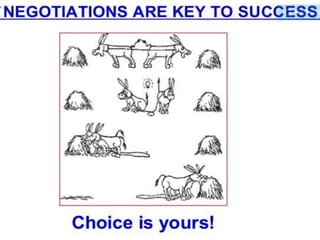
BATNA
BATNA
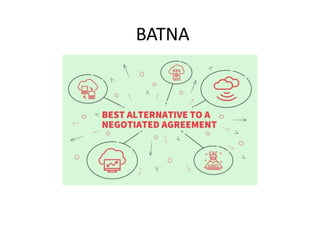
• BATNA is an acronym that stands for Best Alternative
To a Negotiated Agreement.
• It is defined as the most advantageous alternative that
a negotiating party can take if negotiations fail and an
agreement cannot be made. In other words, a party’s
BATNA is what a party’s alternative is if negotiations
are unsuccessful.
• The term BATNA was originally used by Roger Fisher
and William Ury in their 1981 book entitled “Getting to
Yes: Negotiating Without Giving In.”
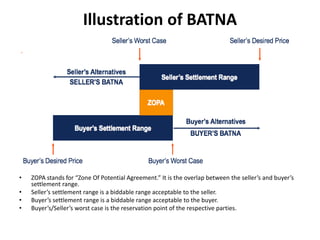
Illustration of BATNA
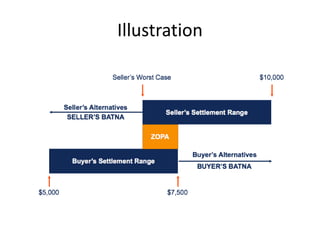
• ZOPA stands for “Zone Of Potential Agreement.” It is the overlap between the seller’s and buyer’s
settlement range.
• Seller’s settlement range is a biddable range acceptable to the seller.
• Buyer’s settlement range is a biddable range acceptable to the buyer.
• Buyer’s/Seller’s worst case is the reservation point of the respective parties.
Importance of BATNA
• BATNA is often used in negotiation tactics and
should always be considered before a negotiation
takes place. It is never wise to enter into a serious
negotiation without knowing your BATNA.
• The value of knowing your best alternative to a
negotiated agreement is that:
– It provides an alternative if negotiations fall through.
– It provides negotiating power.
– It determines your reservation point (the worst price
you are willing to accept).
• If:
• Buyer offers a price that is lower than the
seller’s worst case, then the seller is better off
going with an alternative.
• Seller offers a price that is higher than the
buyer’s worst case, then the buyer is better off
going with an alternative
Example
• Colin needs a car and is negotiating with Tom to
purchase his car.
• Tom offers to sell his car to Colin for $10,000.
• Colin scours through Craigslist and finds a similar
car to which he assigns a dollar value of $7,500.
Colin’s BATNA is $7,500 – if Tom does not offer a
price lower than $7,500, Colin will consider his
best alternative to a negotiated agreement.
• Colin is willing to pay up to $7,500 for the car but
would ideally want to pay $5,000 only. The
relevant information is illustrated below:
Illustration
Explanation
• , if Tom demands a price higher than $7,500,
Colin will take his business elsewhere. In the
example, we are not provided with Tom’s BATNA.
• If we assume that Tom can sell his car to
someone else for $8,000, then $8,000 is Tom’s
BATNA. In such a scenario, an agreement will not
be made, as Tom is only willing to sell for a
minimum of $8,000, while Colin is only willing to
purchase at a maximum of $7,500.
• If Tom’s best alternative to the deal is selling
the car to a dealership, which would offer him
$6,000, then both parties can come to an
agreement because Tom’s reservation point
would be $6,000.
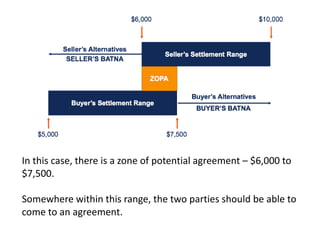
• In the situation described, the diagram would
look as follows:
In this case, there is a zone of potential agreement – $6,000 to
$7,500.
Somewhere within this range, the two parties should be able to
come to an agreement.
Identifying Your BATNA
• As illustrated in the example above, having a
best alternative to a negotiated agreement
before entering into negotiations is important.
• Had Colin not had a BATNA, Tom would have
had more bargaining power. Knowing Colin’s
BATNA is at $7,500, the highest price that Tom
would be able to sell his car to Colin for is
$7,500.
Developing your BATNA
• Here is a process developed by Harvard Law School to
develop the best alternative to a negotiated
agreement:
• List all alternatives to the current negotiation – what
could you do if negotiations fall through?
• Evaluate the value of each alternative – how much is
each alternative worth to me?
• Select the alternative that would provide the highest
value to you (this is your best alternative to a
negotiated agreement).
• After determining your BATNA, calculate the lowest-
valued deal that you’re willing to accept.
BATNA presentation.pptx

BATNA presentation.pptx

  • 1.
  • 2.
    BATNA • BATNA isan acronym that stands for Best Alternative To a Negotiated Agreement. • It is defined as the most advantageous alternative that a negotiating party can take if negotiations fail and an agreement cannot be made. In other words, a party’s BATNA is what a party’s alternative is if negotiations are unsuccessful. • The term BATNA was originally used by Roger Fisher and William Ury in their 1981 book entitled “Getting to Yes: Negotiating Without Giving In.”
  • 3.
    Illustration of BATNA •ZOPA stands for “Zone Of Potential Agreement.” It is the overlap between the seller’s and buyer’s settlement range. • Seller’s settlement range is a biddable range acceptable to the seller. • Buyer’s settlement range is a biddable range acceptable to the buyer. • Buyer’s/Seller’s worst case is the reservation point of the respective parties.
  • 4.
    Importance of BATNA •BATNA is often used in negotiation tactics and should always be considered before a negotiation takes place. It is never wise to enter into a serious negotiation without knowing your BATNA. • The value of knowing your best alternative to a negotiated agreement is that: – It provides an alternative if negotiations fall through. – It provides negotiating power. – It determines your reservation point (the worst price you are willing to accept).
  • 5.
    • If: • Buyeroffers a price that is lower than the seller’s worst case, then the seller is better off going with an alternative. • Seller offers a price that is higher than the buyer’s worst case, then the buyer is better off going with an alternative
  • 6.
    Example • Colin needsa car and is negotiating with Tom to purchase his car. • Tom offers to sell his car to Colin for $10,000. • Colin scours through Craigslist and finds a similar car to which he assigns a dollar value of $7,500. Colin’s BATNA is $7,500 – if Tom does not offer a price lower than $7,500, Colin will consider his best alternative to a negotiated agreement. • Colin is willing to pay up to $7,500 for the car but would ideally want to pay $5,000 only. The relevant information is illustrated below:
  • 7.
  • 8.
    Explanation • , ifTom demands a price higher than $7,500, Colin will take his business elsewhere. In the example, we are not provided with Tom’s BATNA. • If we assume that Tom can sell his car to someone else for $8,000, then $8,000 is Tom’s BATNA. In such a scenario, an agreement will not be made, as Tom is only willing to sell for a minimum of $8,000, while Colin is only willing to purchase at a maximum of $7,500.
  • 9.
    • If Tom’sbest alternative to the deal is selling the car to a dealership, which would offer him $6,000, then both parties can come to an agreement because Tom’s reservation point would be $6,000. • In the situation described, the diagram would look as follows:
  • 10.
    In this case,there is a zone of potential agreement – $6,000 to $7,500. Somewhere within this range, the two parties should be able to come to an agreement.
  • 11.
    Identifying Your BATNA •As illustrated in the example above, having a best alternative to a negotiated agreement before entering into negotiations is important. • Had Colin not had a BATNA, Tom would have had more bargaining power. Knowing Colin’s BATNA is at $7,500, the highest price that Tom would be able to sell his car to Colin for is $7,500.
  • 12.
    Developing your BATNA •Here is a process developed by Harvard Law School to develop the best alternative to a negotiated agreement: • List all alternatives to the current negotiation – what could you do if negotiations fall through? • Evaluate the value of each alternative – how much is each alternative worth to me? • Select the alternative that would provide the highest value to you (this is your best alternative to a negotiated agreement). • After determining your BATNA, calculate the lowest- valued deal that you’re willing to accept.