Corporate Innovation
BWCon Blue Ocean Meetup
Holger Reinhardt
CTO – Haufe Group
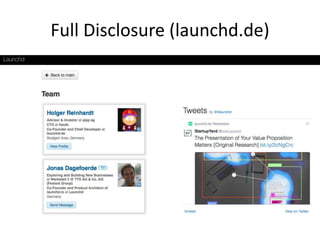
Full Disclosure (launchd.de)
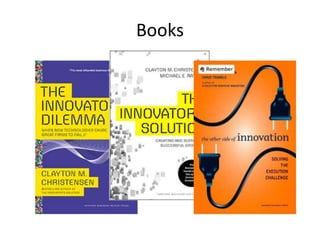
Books
Choices, choices
• Make or Buy
– Organic growth vs acquisition
• Incremental vs disruptive innovation
– Existing product in existing market, or
– Existing product in new market, vs.
– New product in existing market, or
– New product in new market
• Be aware of the “Inventors Dilemma”
The Inventors Dilemma
or Why an MBA might be bad for your business
• “The Inventors Dilemma” (Christensen)
– Intrinsic inhibitors because of the cost structure and value
networks of a company
• “The other side of innovation” (Govindarajan)
– Operational efficiency is fundamentally incompatible with
disruptive innovation
• ‘Well-managed” companies excel at sustaining
innovation but disruptive innovation finds initial niche
outside of established market
• The very purpose of management is to strive for
operational excellence and thereby will resist pursuing
disruptive innovation
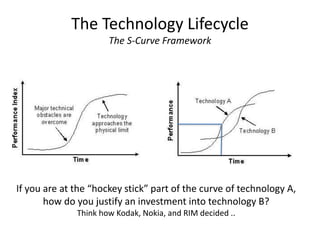
The Technology Lifecycle
The S-Curve Framework
If you are at the “hockey stick” part of the curve of technology A,
how do you justify an investment into technology B?
Think how Kodak, Nokia, and RIM decided ..
Company vs Startup
• Goal of a company
– To make money
• Goal of a startup
– Find a sustainable and scalable business
• What is a startup
– A startup is a temporary organization in search of
a scalable, repeatable, profitable business model
Theory of innovation
• Types of innovation
– Sustaining innovation: breakthrough or incremental
– Disruptive innovation
• Rate of improvement vs rate of absorption
• Relativity of innovation
– Disrupting to some vs sustaining for others
• Value network of a company
– Cost structure, Processes, Suppliers and Channels
– “Within a value network, each firm’s competitive strategy, and particularly its
cost structure and its choices of markets and customers to serve, determines
its perceptions of the economic value of an innovation.”
• Inventors Dilemma
– “Sustaining innovations are so important and attractive, relative to disruptive
ones, that the very best sustaining companies systematically ignore disruptive
threats and opportunities until the game is over. “
Growth through innovation
• Cost structure (again)
– Cost structure determines perception of opportunity
• Growth through sustaining innovation
– Building a better mouse trap
• Growth through disruptive innovation
– Types: New market vs Low-end
– Shaping ideas to disrupt
• Large number of customers not had the money, equipment,
or skill – and went without or paid someone to do it
• Over-served customers happy to pay less for a good enough
product
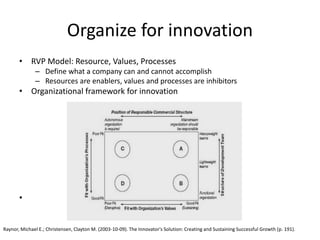
Organize for innovation
• RVP Model: Resource, Values, Processes
– Define what a company can and cannot accomplish
– Resources are enablers, values and processes are inhibitors
• Organizational framework for innovation
•
Raynor, Michael E.; Christensen, Clayton M. (2003-10-09). The Innovator's Solution: Creating and Sustaining Successful Growth (p. 191).
Sources of investment for corporate
Investment
• Importance of cost structure
– determines the type of customers that are and are not
attractive
• Good money vs bad money
– Impatient for growth, Patient for profit
– Patient for growth, Impatient for profit
• Bad money (impatient for growth … )
– Premature scaling
– Wrong channels
• Good money (patient with growth … )
– Discipline through profit
– Survival through profit
Strategy development process
• Types of strategy development process
– Deliberate: conscious and analytical
– Emergent: cumulative effect of day-to-day decisions
• Matching process to innovation type and stage
– Sustaining innovation: deliberate strategy development
– Disruptive innovation: emergent strategy development
• Points of failure
– Implementing deliberate strategy when no strategy can be known
– Not switching to deliberate when viable strategy emerges
• Executive Leverage
– Create cost structure that finds the right customer attractive
– Accelerate emergent strategy development
• Discovery-driven planning (basis of Lean Startup/Customer Development)
– Managing switch from emergent to deliberate strategy and back
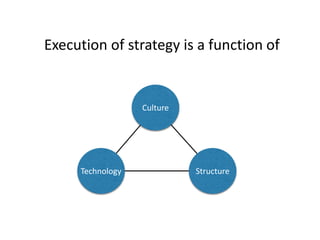
Execution of strategy is a function of
Culture
StructureTechnology
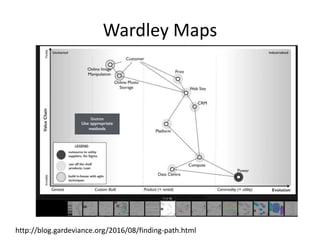
Wardley Maps
http://blog.gardeviance.org/2016/08/finding-path.html
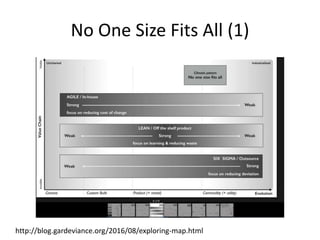
No One Size Fits All (1)
http://blog.gardeviance.org/2016/08/exploring-map.html
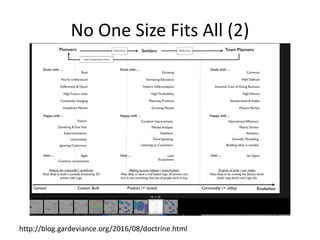
No One Size Fits All (2)
http://blog.gardeviance.org/2016/08/doctrine.html
Organizing New-Product Development
• Manage innovation through
– Existing product line management
– Dedicated product line management
– Ad-hoc Skunkworks projects
– The Google-20% work time approach
– Dedicated in-house incubator teams
– Dragons-Den venture model
• Avoid the ‘better mousetrap’ through cross-
functional teams
• Manage innovation process through stage-gate or
funnel process (at each gate: go, kill, hold, pivot)
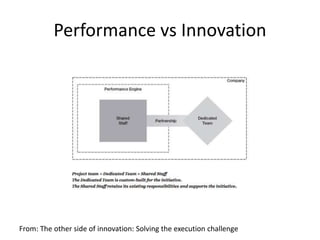
Performance vs Innovation
From: The other side of innovation: Solving the execution challenge
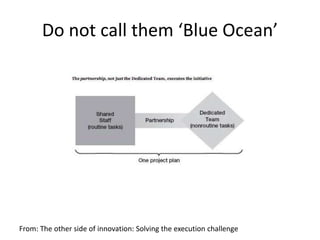
Do not call them ‘Blue Ocean’
From: The other side of innovation: Solving the execution challenge
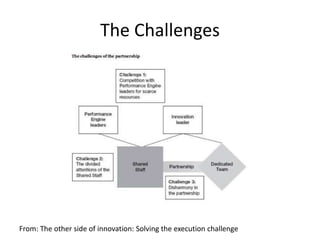
The Challenges
From: The other side of innovation: Solving the execution challenge

Blue Ocean - Corporate Innovation

  • 1.
    Corporate Innovation BWCon BlueOcean Meetup Holger Reinhardt CTO – Haufe Group
  • 3.
  • 4.
  • 5.
    Choices, choices • Makeor Buy – Organic growth vs acquisition • Incremental vs disruptive innovation – Existing product in existing market, or – Existing product in new market, vs. – New product in existing market, or – New product in new market • Be aware of the “Inventors Dilemma”
  • 6.
    The Inventors Dilemma orWhy an MBA might be bad for your business • “The Inventors Dilemma” (Christensen) – Intrinsic inhibitors because of the cost structure and value networks of a company • “The other side of innovation” (Govindarajan) – Operational efficiency is fundamentally incompatible with disruptive innovation • ‘Well-managed” companies excel at sustaining innovation but disruptive innovation finds initial niche outside of established market • The very purpose of management is to strive for operational excellence and thereby will resist pursuing disruptive innovation
  • 7.
    The Technology Lifecycle TheS-Curve Framework If you are at the “hockey stick” part of the curve of technology A, how do you justify an investment into technology B? Think how Kodak, Nokia, and RIM decided ..
  • 8.
    Company vs Startup •Goal of a company – To make money • Goal of a startup – Find a sustainable and scalable business • What is a startup – A startup is a temporary organization in search of a scalable, repeatable, profitable business model
  • 9.
    Theory of innovation •Types of innovation – Sustaining innovation: breakthrough or incremental – Disruptive innovation • Rate of improvement vs rate of absorption • Relativity of innovation – Disrupting to some vs sustaining for others • Value network of a company – Cost structure, Processes, Suppliers and Channels – “Within a value network, each firm’s competitive strategy, and particularly its cost structure and its choices of markets and customers to serve, determines its perceptions of the economic value of an innovation.” • Inventors Dilemma – “Sustaining innovations are so important and attractive, relative to disruptive ones, that the very best sustaining companies systematically ignore disruptive threats and opportunities until the game is over. “
  • 10.
    Growth through innovation •Cost structure (again) – Cost structure determines perception of opportunity • Growth through sustaining innovation – Building a better mouse trap • Growth through disruptive innovation – Types: New market vs Low-end – Shaping ideas to disrupt • Large number of customers not had the money, equipment, or skill – and went without or paid someone to do it • Over-served customers happy to pay less for a good enough product
  • 11.
    Organize for innovation •RVP Model: Resource, Values, Processes – Define what a company can and cannot accomplish – Resources are enablers, values and processes are inhibitors • Organizational framework for innovation • Raynor, Michael E.; Christensen, Clayton M. (2003-10-09). The Innovator's Solution: Creating and Sustaining Successful Growth (p. 191).
  • 12.
    Sources of investmentfor corporate Investment • Importance of cost structure – determines the type of customers that are and are not attractive • Good money vs bad money – Impatient for growth, Patient for profit – Patient for growth, Impatient for profit • Bad money (impatient for growth … ) – Premature scaling – Wrong channels • Good money (patient with growth … ) – Discipline through profit – Survival through profit
  • 13.
    Strategy development process •Types of strategy development process – Deliberate: conscious and analytical – Emergent: cumulative effect of day-to-day decisions • Matching process to innovation type and stage – Sustaining innovation: deliberate strategy development – Disruptive innovation: emergent strategy development • Points of failure – Implementing deliberate strategy when no strategy can be known – Not switching to deliberate when viable strategy emerges • Executive Leverage – Create cost structure that finds the right customer attractive – Accelerate emergent strategy development • Discovery-driven planning (basis of Lean Startup/Customer Development) – Managing switch from emergent to deliberate strategy and back
  • 14.
    Execution of strategyis a function of Culture StructureTechnology
  • 15.
  • 16.
    No One SizeFits All (1) http://blog.gardeviance.org/2016/08/exploring-map.html
  • 17.
    No One SizeFits All (2) http://blog.gardeviance.org/2016/08/doctrine.html
  • 18.
    Organizing New-Product Development •Manage innovation through – Existing product line management – Dedicated product line management – Ad-hoc Skunkworks projects – The Google-20% work time approach – Dedicated in-house incubator teams – Dragons-Den venture model • Avoid the ‘better mousetrap’ through cross- functional teams • Manage innovation process through stage-gate or funnel process (at each gate: go, kill, hold, pivot)
  • 19.
    Performance vs Innovation From:The other side of innovation: Solving the execution challenge
  • 20.
    Do not callthem ‘Blue Ocean’ From: The other side of innovation: Solving the execution challenge
  • 21.
    The Challenges From: Theother side of innovation: Solving the execution challenge

Editor's Notes

  • #10 Sustaining innovation: making better products that can be sold for more money to attractive customers Disruptive innovation: commercialize a simpler, more convenient product that sells for less money and appeals to a new or unattractive customer set
  • #12 Meaning of autonomy: The key dimensions of autonomy relate to processes and values.