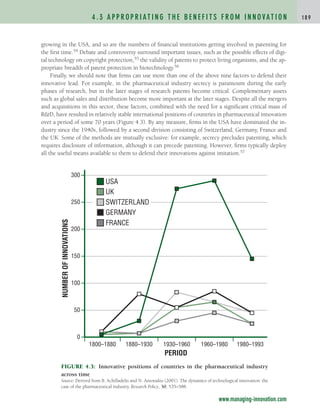
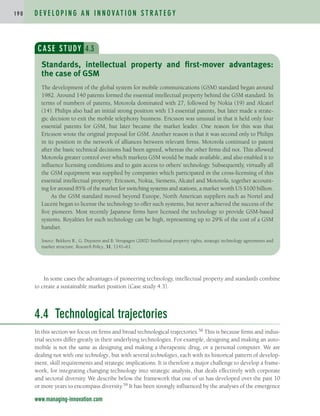
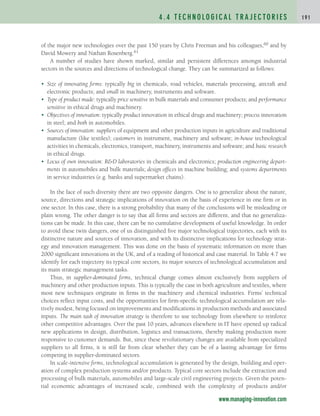
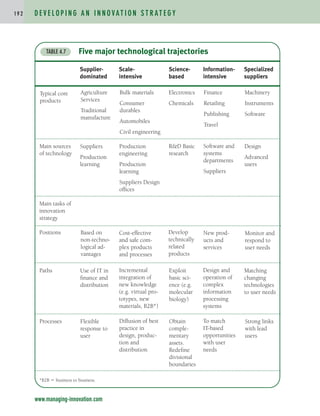
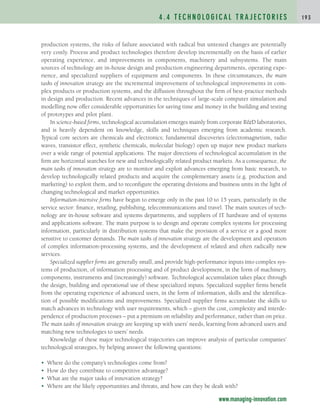
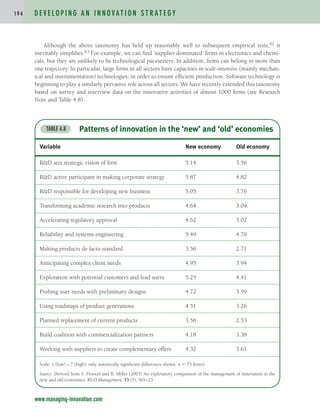
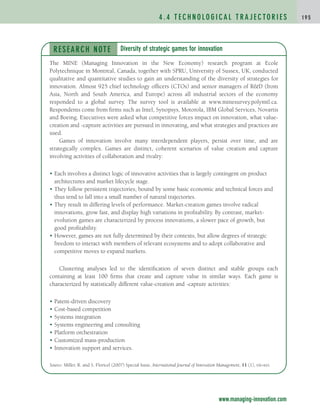
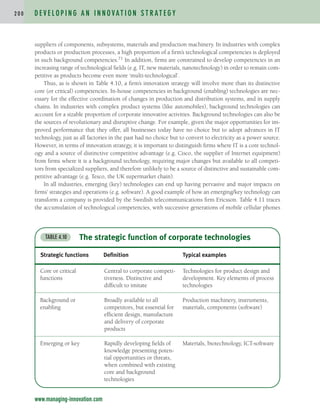
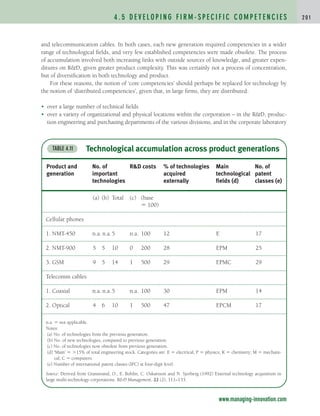
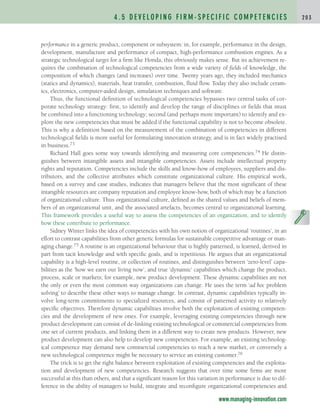
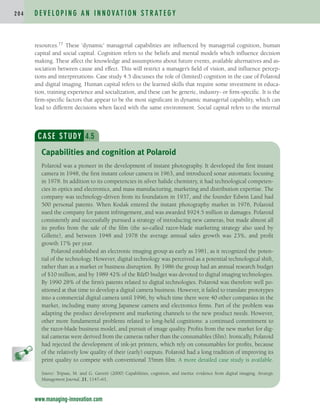
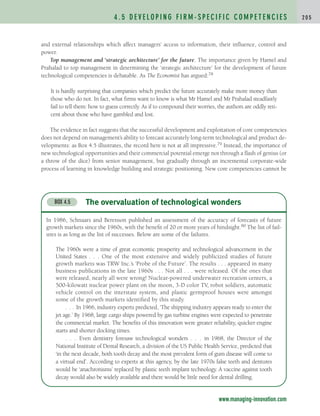
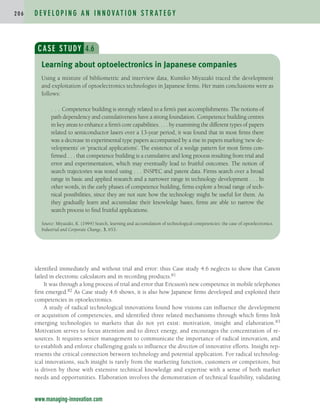
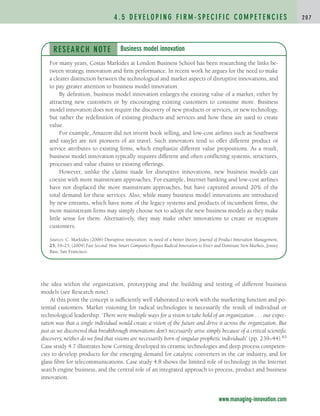
A great deal of business success depends on generating new knowledge and on having the capabilities to
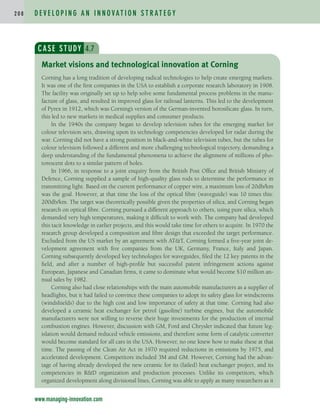
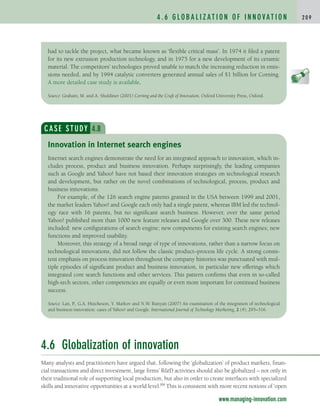
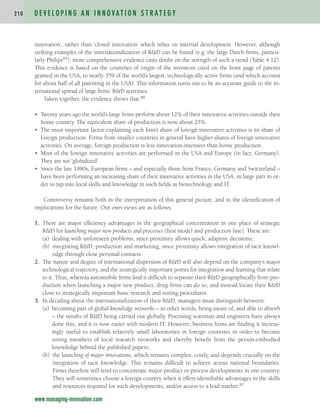
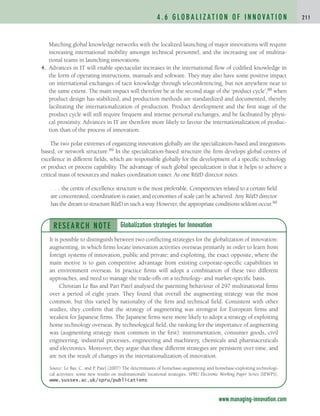
react quickly and intelligently to this new knowledge . . . I believe that strategic thinking is a necessary
but overrated element of business success. If you know how to design great motorcycle engines, I can
teach you all you need to know about strategy in a few days. If you have a Ph.D. in strategy, years of
labor are unlikely to give you the ability to design great new motorcycle engines.
(Richard Rumelt (1996) California Management Review, 38, 110, on the continuing
debate about the causes of Honda’s success in the US motorcycle market)
The above quotation from a distinguished professor of strategy appears on the surface not to be a strong
endorsement of his particular trade. In fact, it offers indirect support for the central propositions of this
chapter:
1. Firm-specific knowledge – including the capacity to exploit it – is an essential feature of competitive
success.
2. An essential feature of corporate strategy should therefore be an innovation strategy, the purpose of
which is deliberately to accumulate such firm-specific knowledge.
3. An innovation strategy must cope with an external environment that is complex and ever-changing,
with considerable uncertainties about present and future developments in technology, competitive
threats and market (and non-market) demands.
4. Internal structures and processes must continuously balance potentially conflicting requirements:
(a) to identify and develop specialized knowledge within technological fields, business functions
and product divisions;
(b) to exploit this knowledge through integration across technological fields, business functions and
product divisions.
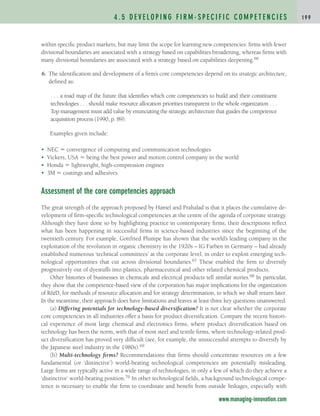
Given complexity, continuous change and consequent uncertainty, we believe that the so-called ra-
tional approach to innovation strategy, still dominant in practice and in the teaching at many business
schools, is less likely to be effective than an incremental approach that stresses continuous adjustment
in the light of new knowledge and learning. We also argue that the approach pioneered by Michael
Porter correctly identifies the nature of the competitive threats and opportunities that emerge from ad-
vances in technology, and rightly stresses the importance of developing and protecting firm-specific
technology in order to enable firms to position themselves against the competition. But it underesti-
mates the power of technology to change the rules of the competitive game by modifying industry
Developing an innovation
strategy*
CHAPTER 4
* The approach we adopt in this chapter is based upon the pioneering work of our former colleague, friend and
co-author, the late Keith Pavitt. The more specific topic of technology strategy is explored in greater detail in
earlier editions of this book, in particular the first (1997) and second (2001).
c04.qxd 2/9/09 4:26 PM Page 164
boundaries, developing new products and shifting barriers to entry. It also overestimates the capacity of
senior management to identify and predict the important changes outside the firm, and to implement
radical changes in competencies and organizational practices within the firm.
In this chapter, we develop what we think is the most useful framework for defining and implement-
ing innovation strategy. We propose that such a framework is the one developed by David Teece and
Gary Pisano. It gives central importance to the dynamic capabilities of firms, and distinguishes three el-
ements of corporate innovation strategy: (i) competitive and national positions; (ii) technological paths;
(iii) organizational and managerial processes. We begin by summarizing the fundamental debate in cor-
porate strategy between ‘rationalist’ and ‘incrementalist’ approaches, and argue that the latter approach
is more realistic, given the inevitable complexities and uncertainties in the innovation process.
4.1 ‘Rationalist’ or ‘incrementalist’ strategies
for innovation?
The long-standing debate between ‘rational’ and ‘incremental’ strategies is of central importance to the mo-
bilization of technology and to the purposes of corporate strategy. We begin by reviewing the main terms
of the debate, and conclude that the supposedly clear distinction between strategies based on ‘choice’ or
on ‘implementation’ breaks down when firms are making decisions in complex and fast-changing compet-
itive environments. Under such circumstances, formal strategies must be seen as part of a wider process of
continuous learning from experience and from others to cope with complexity and change.
Notions of corporate strategy first emerged in the 1960s. A lively debate has continued since then
amongst the various ‘schools’ or theories. Here we discuss the two most influential: the ‘rationalist’ and
the ‘incrementalist’. The main protagonists are Ansoff1 of the rationalist school and Mintzberg2
amongst the incrementalists. A face-to-face debate between the two in the 1990s can be found in the
Strategic Management Journal and an excellent summary of the terms of the debate can be found in
Whittington.3
Rationalist strategy
‘Rationalist’ strategy has been heavily influenced by military experience, where strategy (in principle)
consists of the following steps: (i) describe, understand and analyze the environment; (ii) determine a
course of action in the light of the analysis; (iii) carry out the decided course of action. This is a ‘linear
model’ of rational action: appraise, determine and act. The corporate equivalent is SWOT: the analysis
of corporate strengths and weaknesses in the light of external opportunities and threats. This approach
is intended to help the firm to:
• Be conscious of trends in the competitive environment.
• Prepare for a changing future.
• Ensure that sufficient attention is focused on the longer term, given the pressures to concentrate on
the day to day.
• Ensure coherence in objectives and actions in large, functionally specialized and geographically
dispersed organizations.
4 . 1 ‘ R AT I O N A L I S T ’ O R ‘ I N C R E M E N TA L I S T ’ 1 6 5
www.managing-innovation.com
c04.qxd 2/9/09 4:26 PM Page 165
However, as John Kay has pointed out, the military metaphor can be misleading.4 Corporate objec-
tives are different from military ones: namely, to establish a distinctive competence enabling them to
satisfy customers better than the competition – and not to mobilize sufficient resources to destroy the
enemy (with perhaps the exception of some Internet companies). Excessive concentration on the
‘enemy’ (i.e. corporate competitors) can result in strategies emphasizing large commitments of resources
for the establishment of monopoly power, at the expense of profitable niche markets and of a commit-
ment to satisfying customer needs (see Research Note).
More important, professional experts, including managers, have difficulties in appraising accu-
rately their real situation, essentially for two reasons. First, their external environment is both complex,
D E V E L O P I N G A N I N N O VAT I O N S T R AT E G Y
1 6 6
www.managing-innovation.com
RESEARCH NOTE
Since 2005 the international management consultants Booz Allen Hamilton have conducted a sur-
vey of the spending on and performance of innovation in the world’s 1000 largest firms. The most
recent survey found that there remain significant differences between spending on innovation
across different sectors and regions. For example, the R&D-intensity (R&D spending divided by
sales, expressed as a %) was an average of 13% in the software and healthcare industries, 7% in
electronics, but only 1–2% in more mature sectors. Of the 1000 companies studied, representing
annual R&D expenditure of US $447 billion, 95% of this spending was in the USA, Europe and
Japan.
However, like most studies of innovation and performance (see Chapter 11 for a review),
they find no correlation between R&D spending, growth and financial or market performance.
They argue that it is how the R&D is managed and translated into successful new processes,
products and services which counts more. Overall they identify two factors that are common to
those companies which consistently leverage their R&D spending: strong alignment between
innovation and corporate strategies; and close attention to customer and market needs. This is
not to suggest that there is any single optimum strategy for innovation, and instead they argue
that three distinct clusters of good practice are observable:
• Technology drivers, which focus on scouting and developing new technologies and matching
these to unmet needs, with strong project and risk management capabilities.
• Need seekers, which aim to be first to market, by identifying emerging customer needs, with
strong design and product development capabilities.
• Market readers, which aim to be fast followers, and conduct detailed competitors analysis, with
strong process innovation.
They conclude ‘Is there a best innovation strategy? No . . . Is there a best innovation
strategy for any given company? Yes . . . the key to innovation success has nothing to do with
how much money you spend. It is directly related to the effort expended to align innovation
with strategy and your customers, and to manage the entire process with discipline and
transparency’ (p. 16).
Source: Jaruzelski, B. and K. Dehoff (2008) Booz Allen Hamilton Annual Innovation Survey. Strategy and Business, issue 49.
Innovation strategy in the real world
c04.qxd 2/9/09 4:26 PM Page 166
involving competitors, customers, regulators and so on; and fast-changing, including technical, eco-
nomic, social and political change. It is therefore difficult enough to understand the essential features
of the present, let alone to predict the future (see Box 4.1). Second, managers in large firms disagree
on their firms’ strengths and weaknesses in part because their knowledge of what goes on inside the
firm is imperfect.
4 . 1 ‘ R AT I O N A L I S T ’ O R ‘ I N C R E M E N TA L I S T ’ 1 6 7
‘Strategizing in the real world’
BOX 4.1
‘The war in Vietnam is going well and will succeed.’
(R. MacNamara, 1963)
‘I think there is a world market for about five computers.’
(T. Watson, 1948)
‘Gaiety is the most outstanding feature of the Soviet Union.’
(J. Stalin, 1935)
‘Prediction is very difficult, especially about the future.’
(N. Bohr)
‘I cannot conceive of any vital disaster happening to this vessel.’
(Captain of Titanic, 1912)
The above quotes are from a paper by William Starbuck,5 in which he criticizes formal strategic
planning:
First, formalization undercuts planning’s contributions. Second, nearly all managers hold very in-
accurate beliefs about their firms and market environments. Third, no-one can forecast accurately
over the long term . . . However, planners can make strategic planning more realistic and can use
it to build healthier, more alert and responsive firms. They can make sensible forecasts and use them
to foster alertness; exploit distinctive competencies, entry barriers and proprietary information;
broaden managers’ horizons and help them develop more realistic beliefs; and plan in ways that
make it easier to change strategy later (p. 77).
As a consequence, internal corporate strengths and weaknesses are often difficult to identify before
the benefit of practical experience, especially in new and fast-changing technological fields. For
example:
• In the 1960s, the oil company Gulf defined its distinctive competencies as producing energy, and
so decided to purchase a nuclear energy firm. The venture was unsuccessful, in part because the
strengths of an oil company in finding, extracting, refining and distributing oil-based products, i.e.
geology and chemical-processing technologies, logistics, consumer marketing, were largely irrele-
vant to the design, construction and sale of nuclear reactors, where the key skills are in electro-
mechanical technologies and in selling to relatively few, but often politicized, electrical utilities.6
www.managing-innovation.com
c04.qxd 2/9/09 4:26 PM Page 167
Incrementalist strategy
Given the conditions of uncertainty, ‘incrementalists’ argue that the complete understanding of com-
plexity and change is impossible: our ability both to comprehend the present and to predict the future
is therefore inevitably limited. As a consequence, successful practitioners – engineers, doctors and
politicians, as well as business managers – do not, in general, follow strategies advocated by the ratio-
nalists, but incremental strategies which explicitly recognize that the firm has only very imperfect
knowledge of its environment, of its own strengths and weaknesses, and of the likely rates and directions of
change in the future. It must therefore be ready to adapt its strategy in the light of new information and
understanding, which it must consciously seek to obtain. In such circumstances the most efficient
procedure is to:
1. Make deliberate steps (or changes) towards the stated objective.
2. Measure and evaluate the effects of the steps (changes).
3. Adjust (if necessary) the objective and decide on the next step (change).
This sequence of behaviour goes by many names, such as incrementalism, trial and error, ‘suck it
and see’, muddling through and learning. When undertaken deliberately, and based on strong back-
ground knowledge, it has a more respectable veneer, such as:
D E V E L O P I N G A N I N N O VAT I O N S T R AT E G Y
1 6 8
www.managing-innovation.com
• In the 1960s and 1970s, many firms in the electrical industry bet heavily on the future of
nuclear technology as a revolutionary breakthrough that would provide virtually costless
energy. Nuclear energy failed to fulfil its promise, and firms only recognized later that the
main revolutionary opportunities and threats for them came from the virtually costless
storage and manipulation of information provided by improvements in semiconductor and
related technologies.7
• In the 1980s, analysts and practitioners predicted that the ‘convergence’ of computer and com-
munications technologies through digitalization would lower the barriers to entry of mainframe
computer firms into telecommunications equipment, and vice versa. Many firms tried to diver-
sify into the other market, often through acquisitions or alliances, e.g. IBM bought Rohm, AT&T
bought NCR. Most proved unsuccessful, in part because the software requirements in the
telecommunications and office markets were so different.8
• The 1990s similarly saw commitments in the fast-moving fields of ICT (information and commu-
nication technology) where initial expectations about opportunities and complementarities have
been disappointed. For example, the investments of major media companies in the Internet in
the late 1990s took more than a decade to prove profitable: problems remain in delivering prod-
ucts to consumers and in getting paid for them, and advertising remains ineffective.9 There have
been similar disappointments so far in development of ‘e-entertainment’.10
• The Internet bubble, which began in the late 1990s but had burst by 2000, placed wildly opti-
mistic and unrealistic valuations on new ventures utilizing e-commerce. In particular, most of the
new e-commerce businesses selling to consumers which floated on the US and UK stock ex-
changes between 1998 and 2000 subsequently lost around 90% of their value, or were made
bankrupt. Notorious failures of that period include Boo.com in the UK, which attempted to sell
sports clothing via the Internet, and Pets.com in the USA, which attempted to sell pet food and
accessories.
c04.qxd 2/9/09 4:26 PM Page 168
• Symptom → diagnosis → treatment → diagnosis → adjust treatment → cure (for medical doctors
dealing with patients).
• Design → development → test → adjust design → retest → operate (for engineers making product
and process innovations).
Corporate strategies that do not recognize the complexities of the present, and the uncertainties as-
sociated with change and the future, will certainly be rigid, will probably be wrong, and will poten-
tially be disastrous if they are fully implemented (Case study 4.1). But this is not a reason for rejecting
analysis and rationality in innovation management. On the contrary, under conditions of complexity
and continuous change, it can be argued that ‘incrementalist’ strategies are more rational (that is, more
efficient) than ‘rationalist’ strategies. Nor is it a reason for rejecting all notions of strategic planning.
The original objectives of the ‘rationalists’ for strategic planning – set out above – remain entirely valid.
Corporations, and especially big ones, without any strategies will be ill-equipped to deal with emerg-
ing opportunities and threats: as Pasteur observed ‘. . . chance favours only the prepared mind’.11
4 . 1 ‘ R AT I O N A L I S T ’ O R ‘ I N C R E M E N TA L I S T ’ 1 6 9
www.managing-innovation.com
CASE STUDY 4.1
Jonathan Sapsed’s thought-provoking analysis of corporate strategies of entry into new digital me-
dia12 concludes that the rationalist approach to strategy in emerging industries is prone to failure.
Because of the intrinsic uncertainty in such an area, it is impossible to forecast accurately and pre-
dict the circumstances on which rationalist strategy, e.g. as recommended by Porter, will be based.
Sapsed’s book includes case studies of companies that have followed the classical rational
approach and subsequently found their strategies frustrated.
An example is Pearson, the large media conglomerate, which conducted a SWOT analysis in
response to developments in digital media. The strategizing showed the group’s strong assets in
print publishing and broadcasting, but perceived weaknesses in new media. Having established its
‘gaps’ in capability Pearson then searched for an attractive multimedia firm to fill the gap. It expen-
sively acquired Mindscape, a small Californian firm. The strategy failed with Mindscape being sold
for a loss of £212 million four years later, and Pearson announcing exit from the emerging market
of consumer multimedia.
The strategy failed for various reasons. First, unfamiliarity with the technology and market;
second, a misjudged assessment of Mindscape’s position; and third, a lack of awareness of the mul-
timedia activities already within the group. The formal strategy exercises that preceded action were
prone to misinterpretation and misinformation. The detachment from operations recommended
by rationalist strategy exacerbated the information problems. The emphasis of rational strategy is
not on assessing information arising from operations, but places great credence in detached, logi-
cal thought.
Sapsed argues that whilst formal strategizing is limited in what it can achieve, it may be viewed
as a form of therapy for managers operating under uncertainty. It can enable disciplined thought
on linking technologies to markets, and direct attention to new information and learning. It
focuses minds on products, financial flows and anticipating options in the event of crisis or
growth. Rather than determining future action, it can prepare the firm for unforeseen change.
The limits of rational strategizing
c04.qxd 2/9/09 4:26 PM Page 169
Implications for management
This debate has two sets of implications for managers. The first concerns the practice of corporate strategy,
which should be seen as a form of corporate learning, from analysis and experience, how to cope more
effectively with complexity and change. The implications for the processes of strategy formation are the
following:
• Given uncertainty, explore the implications of a range of possible future trends.
• Ensure broad participation and informal channels of communication.
• Encourage the use of multiple sources of information, debate and scepticism.
• Expect to change strategies in the light of new (and often unexpected) evidence.
The second implication is that successful management practice is never fully reproducible. In a complex
world, neither the most scrupulous practising manager nor the most rigorous management scholar can
be sure of identifying – let alone evaluating – all the necessary ingredients in real examples of success-
ful management practice. In addition, the conditions of any (inevitably imperfect) reproduction of
successful management practice will differ from the original, whether in terms of firm, country, sector,
physical conditions, state of technical knowledge, or organizational skills and cultural norms.
Thus, in conditions of complexity and change – in other words, the conditions for managing inno-
vation – there are no easily applicable recipes for successful management practice. This is one of the rea-
sons why there are continuous swings in management fashion (see Box 4.2). Useful learning from the
experience and analysis of others necessarily requires the following:
1. A critical reading of the evidence underlying any claims to have identified the factors associated with man-
agement success. Compare, for example, the explanations for the success of Honda in penetrating the
US motorcycle market in the 1960s, given (i) by the Boston Consulting Group: exploitation of cost
reductions through manufacturing investment and production learning in deliberately targeted and
specific market segments;13 and (ii) by Richard Pascale: flexibility in product–market strategy in
response to unplanned market signals, high-quality product design, manufacturing investment in re-
sponse to market success.14 The debate has recently been revived, although not resolved, in the
California Management Review.15
2. A careful comparison of the context of successful management practice, with the context of the firm, indus-
try, technology and country in which the practice might be reused. For example, one robust conclusion
from management research and experience is that major ingredients in the successful implemen-
tation of innovation are effective linkages amongst functions within the firm, and with outside
sources of relevant scientific and marketing knowledge. Although very useful to management, this
knowledge has its limits. Conclusions from a drug firm that the key linkages are between univer-
sity research and product development are profoundly misleading for an automobile firm, where
the key linkages are amongst product development, manufacturing and the supply chain. And
even within each of these industries, important linkages may change over time. In the drug indus-
try, the key academic disciplines are shifting from chemistry to include more biology. And in
automobiles, computing and associated skills have become important for the development of
‘virtual prototypes’, and for linkages between product development, manufacturing and the supply
chain.16
D E V E L O P I N G A N I N N O VAT I O N S T R AT E G Y
1 7 0
www.managing-innovation.com
c04.qxd 2/9/09 4:26 PM Page 170
4 . 1 ‘ R AT I O N A L I S T ’ O R ‘ I N C R E M E N TA L I S T ’ 1 7 1
The management tools and techniques described in this book represent only very imperfectly the
complexities and changes of the real world. As such, they can be no more than aids to systematic think-
ing, and to collective learning based on analysis and experience. Especially in conditions of complexity
and change, tacit knowledge of individuals and groups (i.e. know-how that is based on experience, and
that cannot easily be codified and reproduced) is of central importance, whether in the design of auto-
mobiles and drugs, or in the strategic management of innovation.
RESEARCH NOTE
For the past decade INSEAD professors W. Chan Kim and Renée Mauborgne have researched in-
novation strategies, including work on new market spaces and value innovation. Their most re-
cent contribution is the idea of Blue Ocean Strategies.
By definition, Blue Ocean represents all potential markets which currently do not exist and
must be created. In a few cases whole new industries are created, such as those spawned by the
Internet, but in most cases they are created by challenging the boundaries of existing industries
and markets. Therefore both incumbents and new entrants can play a role.
They distinguish Blue Ocean strategies by comparing them to traditional strategic thinking,
which they refer to as Red Ocean strategies:
1. Create uncontested market space, rather than compete in existing market space.
2. Make the competition irrelevant, rather than beat competitors.
3. Create and capture new demand, rather than fight for existing markets and customers.
Blue Ocean innovation strategies
www.managing-innovation.com
Swings in management fashion
BOX 4.2
‘Upsizing. After a decade of telling companies to shrink, management theorists have started to sing
the praises of corporate growth.’
(Feature title from The Economist, 10 February 1996, p. 81)
‘Fire and forget? Having spent the 1990s in the throes of restructuring, reengineering and down-
sizing, American companies are worrying about corporate amnesia.’
(Feature title from The Economist, 20 April 1996, pp. 69–70)
Above are two not untypical examples of swings in management fashion and practice that reflect the
inability of any recipe for good management to reflect the complexities of the real thing, and to put
successful experiences in the past in the context of the function, firm, country, technology, etc. More
recently, a survey of 475 global firms by Bain and Co. showed that the proportion of companies
using management tools associated with business process reengineering, core competencies and total
quality management has been declining since the mid-1990s. But they still remain higher than the
more recently developed tools associated with knowledge management, which have been less success-
ful, especially outside North America (Management fashion: fading fads. The Economist, 22 April
2000, pp. 72–3).
c04.qxd 2/9/09 4:26 PM Page 171
Innovation ‘leadership’ versus ‘followership’
Finally, according to Porter, firms must also decide between two market strategies:17
1. Innovation ‘leadership’ – where firms aim at being first to market, based on technological leadership.
This requires a strong corporate commitment to creativity and risk taking, with close linkages both
to major sources of relevant new knowledge, and to the needs and responses of customers.
2. Innovation ‘followership’ – where firms aim at being late to market, based on imitating (learning)
from the experience of technological leaders. This requires a strong commitment to competitor
analysis and intelligence, to reverse engineering (i.e. testing, evaluating and taking to pieces competi-
tors’ products, in order to understand how they work, how they are made and why they appeal to
customers), and to cost cutting and learning in manufacturing.
However, in practice the distinction between ‘innovator’ and ‘follower’ is much less clear. For exam-
ple, a study of the product strategies of 2273 firms found that market pioneers continue to have high
expenditures on R&D, but that this subsequent R&D is most likely to be aimed at minor, incremental
innovations. A pattern emerges where pioneer firms do not maintain their historical strategy of innova-
tion leadership, but instead focus on leveraging their competencies in minor incremental innovations.
Conversely, late entrant firms appear to pursue one of two very different strategies. The first is based on
competencies other than R&D and new product development – for example, superior distribution or
greater promotion or support. The second, more interesting strategy, is to focus on major new product
development projects in an effort to compete with the pioneer firm.18
However, this example also reveals the essential weaknesses of Porter’s framework for analysis and
action. As Martin Fransman has pointed out, technical personnel in firms like IBM in the 1970s were
well aware of trends in semiconductor technology, and their possible effects on the competitive position
of mainframe producers.19 IBM in fact made at least one major contribution to developments in the rev-
olutionary new technology: RISC microprocessors. Yet, in spite of this knowledge, none of the estab-
lished firms proved capable over the next 20 years of achieving the primary objective of strategy, as
D E V E L O P I N G A N I N N O VAT I O N S T R AT E G Y
1 7 2
www.managing-innovation.com
4. Break the traditional value/cost trade-off: Align the whole system of a company’s activities in
pursuit of both differentiation and low cost.
In many cases a Blue Ocean is created where a company creates value by simultaneously reducing
costs and offering something new or different. In their study of 108 company strategies they found
that only 14% of innovations created new markets, whereas 86% were incremental line extensions.
However, the 14% of Blue Ocean innovations accounted for 38% of revenues and 61% of profits.
The key to creating successful Blue Oceans is to identify and serve uncontested markets, and
therefore benchmarking or imitating competitors is counter-productive. It often involves a
radically different business model, offering a different value proposition at lower cost. It may be
facilitated by technological or other radical innovations, but in most cases this is not the driver.
Sources: W
. Chan Kim and R. Mauborgne (2005) Blue Ocean strategy: from theory to practice. California Management Review,
47 (3), Spring, 105–21; (2005) Blue Ocean Strategy: How to Create Uncontested Market Space and Make the Competition Irrelevant,
Harvard Business School, Boston, MA; (2004) Blue Ocean strategy, Harvard Business Review, 82 (10), October, 76–84.
c04.qxd 2/9/09 4:26 PM Page 172
defined by Porter: ‘. . . to find a position . . . where a company can best defend itself against these com-
petitive forces or can influence them in its favour’.
Like many mainstream industrial economics, Porter’s framework underestimates the power of tech-
nological change to transform industrial structures, and overestimates the power of managers to decide
and implement innovation strategies. Or, to put it another way, it underestimates the importance of tech-
nological trajectories, and of the firm-specific technological and organizational competencies to exploit them.
Large firms in mainframe computers could not control the semiconductor trajectory. Although they had
the necessary technological competencies, their organizational competencies were geared to selling
expensive products in a focused market, rather than a proliferating range of cheap products in an
increasing range of (as yet) unfocused markets.
These shortcomings of Porter’s framework in its treatment of corporate technology and organization
led it to underestimate the constraints on individual firms in choosing their innovation strategies. In
particular:
• Firm size influences the choice between ‘broad front’ and ‘focused’ technological strategies. Large
firms typically have ‘broad front’ strategies whilst small firms are ‘focused’.
• The firm’s established product base and related technological competencies will influence the range of
technological fields and industrial sectors in which it can hope to compete in future. Chemical-based
firms do not diversify into making electronic products, and vice versa. It is very difficult (but not im-
possible, see, for example, the case of Nokia in Box 9.2) for a firm manufacturing traditional textiles
to have an innovation strategy to develop and make computers.20
• The nature of its products and customers will strongly influence its degree of choice between quality and
cost. Compare food products, where there are typically a wide range of qualities and prices, with eth-
ical drugs and passenger aeroplanes where product quality (i.e. safety) is rigidly regulated by govern-
ment legislation (e.g. FAR, JAR) or agencies (e.g. FAA, CAA). Food firms therefore have a relatively
wide range of potential innovation strategies to be chosen from amongst those described by Porter.
The innovation strategies of drug and aircraft firms, on the other hand, inevitably require large-scale
expenditures on product development and rigorous testing.
In addition, technological opportunities are always emerging from advances in knowledge, so that:
• Firms and technologies do not fit tidily into preordained and static industrial structures. In particu-
lar, firms in the chemical and electrical-electronic industries are typically active in a number of
product markets, and also create new ones, like personal computers. Really new innovations (as dis-
tinct from radical or incremental), which involve some discontinuity in the technological or market-
ing base of a firm are actually very common, and often evolve into new businesses and product lines,
such as the Sony Walkman or Canon Laserjet printers.21
• Technological advances can increase opportunities for profitable innovation in so-called mature
sectors. See, for example, the opportunities generated over the past 15 years by applications of IT in
marketing, distribution and coordination in such firms as Benetton and Hotpoint.22 See also the in-
creasing opportunities for technology-based innovation in traditional service activities like banking,
following massive investments in IT equipment and related software competencies.23
• Firms do not become stuck in the middle as Porter predicted. John Kay has shown that firms with
medium costs and medium quality compared to the competition achieve higher returns on investment
4 . 1 ‘ R AT I O N A L I S T ’ O R ‘ I N C R E M E N TA L I S T ’ 1 7 3
www.managing-innovation.com
c04.qxd 2/9/09 4:26 PM Page 173
than those with either low–low or high–high strategies.24 Furthermore, some firms achieve a combi-
nation of high quality and low cost compared to competitors and this reaps high financial returns.
These and related issues of product strategy will be discussed in Chapter 9.
There is also little place in Porter’s framework for the problems of implementing a strategy:
• Organizations which are large and specialized must be capable of learning and changing in response
to new and often unforeseen opportunities and threats. This does not happen automatically, but must
be consciously managed. In particular, the continuous transfer of knowledge and information across
functional and divisional boundaries is essential for successful innovation. Studies confirm that the
explicit management of competencies across different business divisions can help to create radical
innovations, but that such interactions demand attention to leadership roles, team composition and
informal networks.25
• Elements of Porter’s framework have been contradicted as a result of organizational and related tech-
nological changes. The benefits of non-adversarial relations with both suppliers and customers have
become apparent. Instead of bargaining in what appears to be a zero-sum game, cooperative links
with customers and suppliers can increase competitiveness, by improving both the value of innova-
tions to customers, and the efficiency with which they are supplied.26
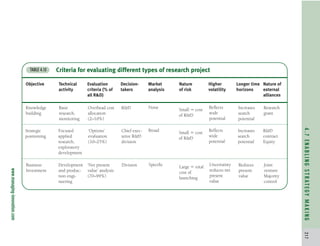
According to a survey of innovation strategies in Europe’s largest firms, just over 35% replied that
the technical knowledge they obtain from their suppliers and customers is very important for their own
innovative activities.27
Christensen and Raynor provide a recent and balanced summary of the relative merits of the rational
versus incremental approaches to strategy:
. . . core competence, as used by many managers, is a dangerously inward-looking notion.
Competitiveness is far more about doing what customers value, than doing what you think
you’re good at . . . the problem with the core competence/not your core competence categoriza-
tion is that what might seem to be a non-core activity today might become an absolutely critical
competence to have mastered in a proprietary way in the future, and vice versa . . . emergent
processes should dominate in circumstances in which the future is hard to read and it is not
clear what the right strategy should be . . . the deliberate strategy process should dominate once
a winning strategy has become clear, because in those circumstances effective execution often
spells the difference between success and failure.28
4.2 The dynamic capabilities of firms
Teece and Pisano29 integrate the various dimensions of innovation strategy identified above into what
they call the ‘dynamic capabilities’ approach to corporate strategy, which underlines the importance of
dynamic change and corporate learning:
This source of competitive advantage, dynamic capabilities, emphasizes two aspects. First, it refers to
the shifting character of the environment; second, it emphasizes the key role of strategic management
D E V E L O P I N G A N I N N O VAT I O N S T R AT E G Y
1 7 4
www.managing-innovation.com
c04.qxd 2/9/09 4:26 PM Page 174
in appropriately adapting, integrating and re-configuring internal and external organizational skills,
resources and functional competencies towards a changing environment (p. 537).
To be strategic, a capability must be honed to a user need (so that there are customers), unique
(so that the products/services can be priced without too much regard for the competition), and dif-
ficult to replicate (so that profits will not be competed away) (p. 539).
We advance the argument that the strategic dimensions of the firm are its managerial and orga-
nizational processes, its present position, and the paths available to it. By managerial processes we refer
to the way things are done in the firm, or what might be referred to as its ‘routines’, or patterns of
current practice and learning. By position, we refer to its current endowment of technology and
intellectual property, as well as its customer base and upstream relations with suppliers. By paths we
refer to the strategic alternatives available to the firm, and the attractiveness of the opportunities
which lie ahead (pp. 537–41, our italics).
Institutions: finance, management and corporate governance
Firms’ innovative behaviours are strongly influenced by the competencies of their managers and the
ways in which their performance is judged and rewarded (and punished). Methods of judgement and
reward vary considerably amongst countries, according to their national systems of corporate gover-
nance: in other words, the systems for exercising and changing corporate ownership and control. In
broad terms, we can distinguish two systems: one practised in the USA and UK; and the other in Japan,
Germany and its neighbours, such as Sweden and Switzerland. In his book Capitalism against Capitalism,
Michel Albert calls the first the ‘Anglo-Saxon’ and the second the ‘Nippon–Rhineland’ variety.30 A lively
debate continues about the essential characteristics and performance of the two systems, in terms of
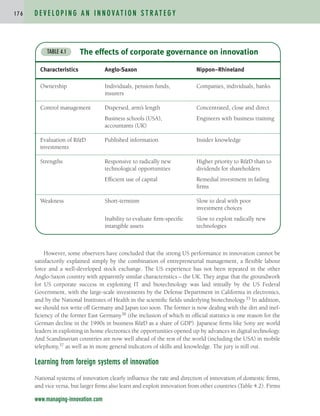
innovation and other performance variables. Table 4.1 is based on a variety of sources, and tries to iden-
tify the main differences that affect innovative performance.
In the UK and the USA, corporate ownership (shareholders) is separated from corporate control
(managers), and the two are mediated through an active stock market. Investors can be persuaded to
hold shares only if there is an expectation of increasing profits and share values. They can shift their
investments relatively easily. On the other hand, in countries with governance structures like those of
Germany or Japan, banks, suppliers and customers are more heavily locked into the firms in which they
invest. Until the 1990s, countries strongly influenced by German and Japanese traditions persisted in
investing heavily in R&D in established firms and technologies, whilst the US system has since been
more effective in generating resources to exploit radically new opportunities in IT and biotechnology.
During the 1980s, the Nippon–Rhineland model seemed to be performing better. Aggregate R&D ex-
penditures were on a healthy upward trend, and so were indicators of aggregate economic performance.
Since then, there have been growing doubts. The aggregate technological and economic indicators have
been performing less well. Japanese firms have proved unable to repeat in telecommunications, software,
microprocessors and computing their technological and competitive successes in consumer electronics.31
German firms have been slow to exploit radically new possibilities in IT and biotechnology,32 and there
have been criticisms of expensive and unrewarding choices in corporate strategy, like the entry of Daimler-
Benz into aerospace.33 At the same time, US firms appear to have learned important lessons, especially from
the Japanese in manufacturing technology, and to have reasserted their eminence in IT and biotechnology.
The 1990s also saw sustained increases in productivity in US industry. According to The Economist in 1995,
in a report entitled ‘Back on top?’, one professor at the Harvard Business School believed that people will
look back at this period as ‘a golden age of entrepreneurial management in the USA’.34
4 . 2 T H E DY N A M I C C A PA B I L I T I E S O F F I R M S 1 7 5
www.managing-innovation.com
c04.qxd 2/9/09 4:26 PM Page 175
However, some observers have concluded that the strong US performance in innovation cannot be
satisfactorily explained simply by the combination of entrepreneurial management, a flexible labour
force and a well-developed stock exchange. The US experience has not been repeated in the other
Anglo-Saxon country with apparently similar characteristics – the UK. They argue that the groundwork
for US corporate success in exploiting IT and biotechnology was laid initially by the US Federal
Government, with the large-scale investments by the Defense Department in California in electronics,
and by the National Institutes of Health in the scientific fields underlying biotechnology.35 In addition,
we should not write off Germany and Japan too soon. The former is now dealing with the dirt and inef-
ficiency of the former East Germany36 (the inclusion of which in official statistics is one reason for the
German decline in the 1990s in business R&D as a share of GDP). Japanese firms like Sony are world
leaders in exploiting in home electronics the opportunities opened up by advances in digital technology.
And Scandinavian countries are now well ahead of the rest of the world (including the USA) in mobile
telephony,37 as well as in more general indicators of skills and knowledge. The jury is still out.
Learning from foreign systems of innovation
National systems of innovation clearly influence the rate and direction of innovation of domestic firms,
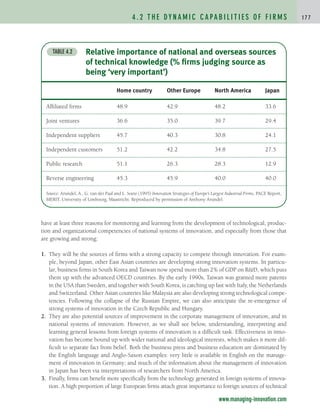
and vice versa, but larger firms also learn and exploit innovation from other countries (Table 4.2). Firms
D E V E L O P I N G A N I N N O VAT I O N S T R AT E G Y
1 7 6
www.managing-innovation.com
The effects of corporate governance on innovation
TABLE 4.1
Characteristics Anglo-Saxon Nippon–Rhineland
Ownership Individuals, pension funds, Companies, individuals, banks
insurers
Control management Dispersed, arm’s length Concentrated, close and direct
Business schools (USA), Engineers with business training
accountants (UK)
Evaluation of R&D Published information Insider knowledge
investments
Strengths Responsive to radically new Higher priority to R&D than to
technological opportunities dividends for shareholders
Efficient use of capital Remedial investment in failing
firms
Weakness Short-termism Slow to deal with poor
investment choices
Inability to evaluate firm-specific Slow to exploit radically new
intangible assets technologies
c04.qxd 2/9/09 4:26 PM Page 176
have at least three reasons for monitoring and learning from the development of technological, produc-
tion and organizational competencies of national systems of innovation, and especially from those that
are growing and strong:
1. They will be the sources of firms with a strong capacity to compete through innovation. For exam-
ple, beyond Japan, other East Asian countries are developing strong innovation systems. In particu-
lar, business firms in South Korea and Taiwan now spend more than 2% of GDP on R&D, which puts
them up with the advanced OECD countries. By the early 1990s, Taiwan was granted more patents
in the USA than Sweden, and together with South Korea, is catching up fast with Italy, the Netherlands
and Switzerland. Other Asian countries like Malaysia are also developing strong technological compe-
tencies. Following the collapse of the Russian Empire, we can also anticipate the re-emergence of
strong systems of innovation in the Czech Republic and Hungary.
2. They are also potential sources of improvement in the corporate management of innovation, and in
national systems of innovation. However, as we shall see below, understanding, interpreting and
learning general lessons from foreign systems of innovation is a difficult task. Effectiveness in inno-
vation has become bound up with wider national and ideological interests, which makes it more dif-
ficult to separate fact from belief. Both the business press and business education are dominated by
the English language and Anglo-Saxon examples: very little is available in English on the manage-
ment of innovation in Germany; and much of the information about the management of innovation
in Japan has been via interpretations of researchers from North America.
3. Finally, firms can benefit more specifically from the technology generated in foreign systems of innova-
tion. A high proportion of large European firms attach great importance to foreign sources of technical
4 . 2 T H E DY N A M I C C A PA B I L I T I E S O F F I R M S 1 7 7
www.managing-innovation.com
Relative importance of national and overseas sources
of technical knowledge (% firms judging source as
being ‘very important’)
TABLE 4.2
Home country Other Europe North America Japan
Affiliated firms 48.9 42.9 48.2 33.6
Joint ventures 36.6 35.0 39.7 29.4
Independent suppliers 45.7 40.3 30.8 24.1
Independent customers 51.2 42.2 34.8 27.5
Public research 51.1 26.3 28.3 12.9
Reverse engineering 45.3 45.9 40.0 40.0
Source: Arundel, A., G. van der Paal and L. Soete (1995) Innovation Strategies of Europe’s Largest Industrial Firms, PACE Report,
MERIT, University of Limbourg, Maastricht. Reproduced by permission of Anthony Arundel.
c04.qxd 2/9/09 4:26 PM Page 177
knowledge, whether obtained through affiliated firms (i.e. direct foreign investment) and joint ven-
tures, links with suppliers and customers, or reverse engineering. In general, they find it is more diffi-
cult to learn from Japan than from North America and elsewhere in Europe, probably because of greater
distances – physical, linguistic and cultural. Perhaps more surprising, European firms find it most dif-
ficult to learn from foreign publicly funded research. This is because effective learning involves more
subtle linkages than straightforward market transactions: for example, the membership of informal pro-
fessional networks. This public knowledge is often seen as a source of potential world innovative
advantage, and we shall see that firms are increasingly active in trying to access foreign sources. In con-
trast, knowledge obtained through market transactions and reverse engineering enables firms to catch
up, and keep up, with competitors. East Asian firms have been very effective over the past 25 years in
making these channels an essential feature of their rapid technological learning (see Case study 4.2).
The slow but significant internationalization of R&D is also a means by which firms can learn from
foreign systems of innovation. There are many reasons why multinational companies choose to locate
R&D outside their home country, including regulatory regime and incentives, lower cost or more
specialist human resources, proximity to lead suppliers or customers, but in many cases a significant
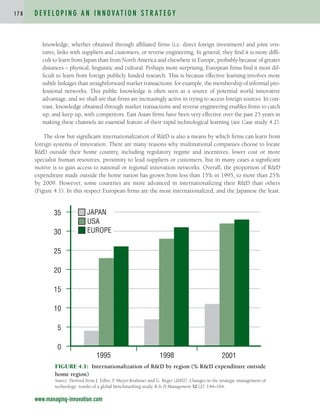
motive is to gain access to national or regional innovation networks. Overall, the proportion of R&D
expenditure made outside the home nation has grown from less than 15% in 1995, to more than 25%
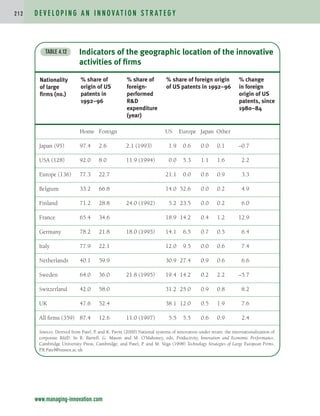
by 2009. However, some countries are more advanced in internationalizing their R&D than others
(Figure 4.1). In this respect European firms are the most internationalized, and the Japanese the least.
D E V E L O P I N G A N I N N O VAT I O N S T R AT E G Y
1 7 8
www.managing-innovation.com
FIGURE 4.1: Internationalization of R&D by region (% R&D expenditure outside
home region)
Source: Derived from J. Edler, F
. Meyer-Krahmer and G. Reger (2002). Changes in the strategic management of
technology: results of a global benchmarking study, R & D Management 32 (2): 149–164.
0
5
10
15
20
25
30
35
1995 1998 2001
JAPAN
USA
EUROPE
c04.qxd 2/9/09 4:26 PM Page 178
4 . 2 T H E DY N A M I C C A PA B I L I T I E S O F F I R M S 1 7 9
CASE STUDY 4.2
The spectacular modernization over the past 25 years of the East Asian ‘dragon’ countries –
Hong Kong, South Korea, Singapore and Taiwan – has led to lively debate about its causes.
Michael Hobday has provided important new insights into how business firms in these coun-
tries succeeded in rapid learning and technological catch up, in spite of underdeveloped do-
mestic systems of science and technology, and a lack of technologically sophisticated domestic
customers.
Government policies provided the favourable general economic climate: export orientation;
basic and vocational education, with strong emphasis on industrial needs; and a stable economy,
with low inflation and high savings. However, of major importance were the strategies and policies
of specific business firms for the effective assimilation of foreign technology.
The main mechanism for catching up was the same in electronics, footwear, bicycles, sewing
machines and automobiles, namely the ‘OEM’ (original equipment manufacture) system. OEM is
a specific form of subcontracting, where firms in catching-up countries produce goods to the ex-
act specification of a foreign trans-national company (TNC) normally based in a richer and tech-
nologically more advanced country. For the TNC, the purpose is to cut costs, and to this end it
offers assistance to the latecomer firms in quality control, choice of equipment, and engineering
and management training.
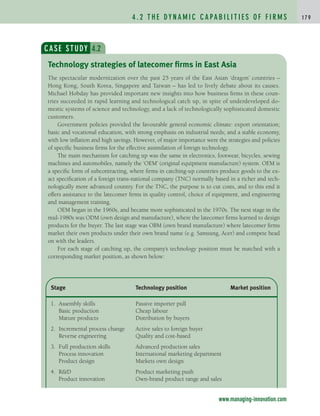
OEM began in the 1960s, and became more sophisticated in the 1970s. The next stage in the
mid-1980s was ODM (own design and manufacture), where the latecomer firms learned to design
products for the buyer. The last stage was OBM (own brand manufacture) where latecomer firms
market their own products under their own brand name (e.g. Samsung, Acer) and compete head
on with the leaders.
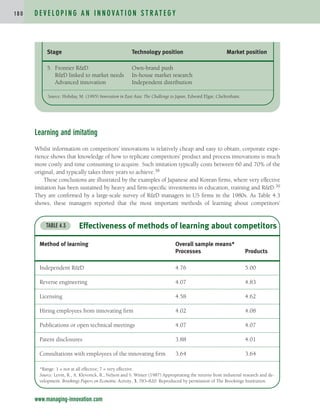
For each stage of catching up, the company’s technology position must be matched with a
corresponding market position, as shown below:
Technology strategies of latecomer firms in East Asia
Stage Technology position Market position
1. Assembly skills Passive importer pull
Basic production Cheap labour
Mature products Distribution by buyers
2. Incremental process change Active sales to foreign buyer
Reverse engineering Quality and cost-based
3. Full production skills Advanced production sales
Process innovation International marketing department
Product design Markets own design
4. R&D Product marketing push
Product innovation Own-brand product range and sales
www.managing-innovation.com
c04.qxd 2/9/09 4:26 PM Page 179
Learning and imitating
Whilst information on competitors’ innovations is relatively cheap and easy to obtain, corporate expe-
rience shows that knowledge of how to replicate competitors’ product and process innovations is much
more costly and time consuming to acquire. Such imitation typically costs between 60 and 70% of the
original, and typically takes three years to achieve.38
These conclusions are illustrated by the examples of Japanese and Korean firms, where very effective
imitation has been sustained by heavy and firm-specific investments in education, training and R&D.39
They are confirmed by a large-scale survey of R&D managers in US firms in the 1980s. As Table 4.3
shows, these managers reported that the most important methods of learning about competitors’
D E V E L O P I N G A N I N N O VAT I O N S T R AT E G Y
1 8 0
www.managing-innovation.com
Stage Technology position Market position
5. Frontier R&D Own-brand push
R&D linked to market needs In-house market research
Advanced innovation Independent distribution
Source: Hobday, M. (1995) Innovation in East Asia: The Challenge to Japan, Edward Elgar, Cheltenham.
Effectiveness of methods of learning about competitors
TABLE 4.3
Method of learning Overall sample means*
Processes Products
Independent R&D 4.76 5.00
Reverse engineering 4.07 4.83
Licensing 4.58 4.62
Hiring employees from innovating firm 4.02 4.08
Publications or open technical meetings 4.07 4.07
Patent disclosures 3.88 4.01
Consultations with employees of the innovating firm 3.64 3.64
*Range: 1 = not at all effective; 7 = very effective.
Source: Levin, R., A. Klevorick, R., Nelson and S. Winter (1987) Appropriating the returns from industrial research and de-
velopment. Brookings Papers on Economic Activity, 3, 783–820. Reproduced by permission of The Brookings Institution.
c04.qxd 2/9/09 4:26 PM Page 180
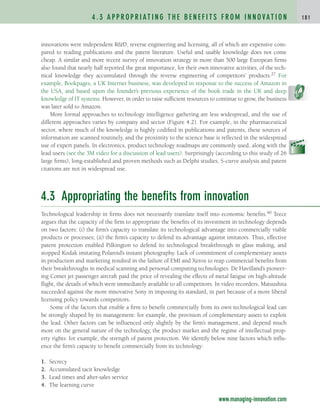
innovations were independent R&D, reverse engineering and licensing, all of which are expensive com-
pared to reading publications and the patent literature. Useful and usable knowledge does not come
cheap. A similar and more recent survey of innovation strategy in more than 500 large European firms
also found that nearly half reported the great importance, for their own innovative activities, of the tech-
nical knowledge they accumulated through the reverse engineering of competitors’ products.27 For
example, Bookpages, a UK Internet business, was developed in response to the success of Amazon in
the USA, and based upon the founder’s previous experience of the book trade in the UK and deep
knowledge of IT systems. However, in order to raise sufficient resources to continue to grow, the business
was later sold to Amazon.
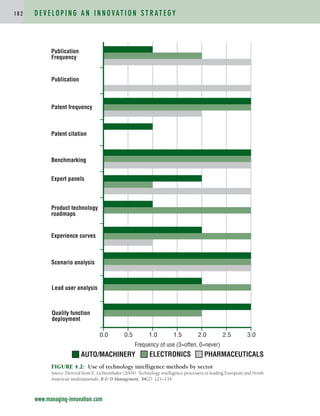
More formal approaches to technology intelligence gathering are less widespread, and the use of
different approaches varies by company and sector (Figure 4.2). For example, in the pharmaceutical
sector, where much of the knowledge is highly codified in publications and patents, these sources of
information are scanned routinely, and the proximity to the science base is reflected in the widespread
use of expert panels. In electronics, product technology roadmaps are commonly used, along with the
lead users (see the 3M video for a discussion of lead users). Surprisingly (according to this study of 26
large firms), long-established and proven methods such as Delphi studies, S-curve analysis and patent
citations are not in widespread use.
4.3 Appropriating the benefits from innovation
Technological leadership in firms does not necessarily translate itself into economic benefits.40 Teece
argues that the capacity of the firm to appropriate the benefits of its investment in technology depends
on two factors: (i) the firm’s capacity to translate its technological advantage into commercially viable
products or processes; (ii) the firm’s capacity to defend its advantage against imitators. Thus, effective
patent protection enabled Pilkington to defend its technological breakthrough in glass making, and
stopped Kodak imitating Polaroid’s instant photography. Lack of commitment of complementary assets
in production and marketing resulted in the failure of EMI and Xerox to reap commercial benefits from
their breakthroughs in medical scanning and personal computing technologies. De Havilland’s pioneer-
ing Comet jet passenger aircraft paid the price of revealing the effects of metal fatigue on high-altitude
flight, the details of which were immediately available to all competitors. In video recorders, Matsushita
succeeded against the more innovative Sony in imposing its standard, in part because of a more liberal
licensing policy towards competitors.
Some of the factors that enable a firm to benefit commercially from its own technological lead can
be strongly shaped by its management: for example, the provision of complementary assets to exploit
the lead. Other factors can be influenced only slightly by the firm’s management, and depend much
more on the general nature of the technology, the product market and the regime of intellectual prop-
erty rights: for example, the strength of patent protection. We identify below nine factors which influ-
ence the firm’s capacity to benefit commercially from its technology:
1. Secrecy
2. Accumulated tacit knowledge
3. Lead times and after-sales service
4. The learning curve
4 . 3 A P P R O P R I AT I N G T H E B E N E F I T S F R O M I N N O VAT I O N 1 8 1
www.managing-innovation.com
c04.qxd 2/9/09 4:26 PM Page 181
D E V E L O P I N G A N I N N O VAT I O N S T R AT E G Y
1 8 2
www.managing-innovation.com
FIGURE 4.2: Use of technology intelligence methods by sector
Source: Derived from E. Lichtenthaler (2004). Technology intelligence processers in leading European and North
American multinationals, R & D Management, 34(2): 121–134.
Publication
Frequency
PHARMACEUTICALS
ELECTRONICS
AUTO/MACHINERY
0.0 0.5 1.0 1.5 2.0 2.5 3.0
Publication
Patent frequency
Patent citation
Benchmarking
Expert panels
Product technology
roadmaps
Experience curves
Scenario analysis
Lead user analysis
Quality function
deployment
Frequency of use (3=often, 0=never)
c04.qxd 2/9/09 4:26 PM Page 182
4 . 3 A P P R O P R I AT I N G T H E B E N E F I T S F R O M I N N O VAT I O N 1 8 3
www.managing-innovation.com
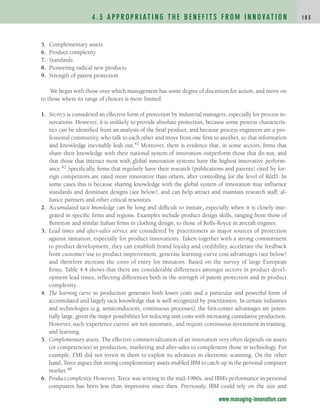
5. Complementary assets
6. Product complexity
7. Standards
8. Pioneering radical new products
9. Strength of patent protection
We begin with those over which management has some degree of discretion for action, and move on
to those where its range of choices is more limited.
1. Secrecy is considered an effective form of protection by industrial managers, especially for process in-
novations. However, it is unlikely to provide absolute protection, because some process characteris-
tics can be identified from an analysis of the final product, and because process engineers are a pro-
fessional community, who talk to each other and move from one firm to another, so that information
and knowledge inevitably leak out.41 Moreover, there is evidence that, in some sectors, firms that
share their knowledge with their national system of innovation outperform those that do not, and
that those that interact most with global innovation systems have the highest innovative perform-
ance.42 Specifically, firms that regularly have their research (publications and patents) cited by for-
eign competitors are rated more innovative than others, after controlling for the level of R&D. In
some cases this is because sharing knowledge with the global system of innovation may influence
standards and dominant designs (see below), and can help attract and maintain research staff, al-
liance partners and other critical resources.
2. Accumulated tacit knowledge can be long and difficult to imitate, especially when it is closely inte-
grated in specific firms and regions. Examples include product design skills, ranging from those of
Benetton and similar Italian firms in clothing design, to those of Rolls-Royce in aircraft engines.
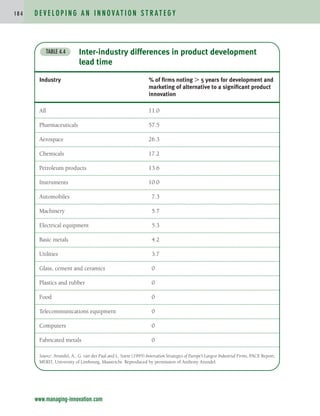
3. Lead times and after-sales service are considered by practitioners as major sources of protection
against imitation, especially for product innovations. Taken together with a strong commitment
to product development, they can establish brand loyalty and credibility, accelerate the feedback
from customer use to product improvement, generate learning-curve cost advantages (see below)
and therefore increase the costs of entry for imitators. Based on the survey of large European
firms, Table 4.4 shows that there are considerable differences amongst sectors in product devel-
opment lead times, reflecting differences both in the strength of patent protection and in product
complexity.
4. The learning curve in production generates both lower costs and a particular and powerful form of
accumulated and largely tacit knowledge that is well recognized by practitioners. In certain industries
and technologies (e.g. semiconductors, continuous processes), the first-comer advantages are poten-
tially large, given the major possibilities for reducing unit costs with increasing cumulative production.
However, such ‘experience curves’ are not automatic, and require continuous investment in training,
and learning.
5. Complementary assets. The effective commercialization of an innovation very often depends on assets
(or competencies) in production, marketing and after-sales to complement those in technology. For
example, EMI did not invest in them to exploit its advances in electronic scanning. On the other
hand, Teece argues that strong complementary assets enabled IBM to catch up in the personal computer
market.40
6. Product complexity. However, Teece was writing in the mid-1980s, and IBM’s performance in personal
computers has been less than impressive since then. Previously, IBM could rely on the size and
c04.qxd 2/9/09 4:26 PM Page 183
D E V E L O P I N G A N I N N O VAT I O N S T R AT E G Y
1 8 4
www.managing-innovation.com
Inter-industry differences in product development
lead time
TABLE 4.4
Industry % of firms noting 
 5 years for development and
marketing of alternative to a significant product
innovation
All 11.0
Pharmaceuticals 57.5
Aerospace 26.3
Chemicals 17.2
Petroleum products 13.6
Instruments 10.0
Automobiles 7.3
Machinery 5.7
Electrical equipment 5.3
Basic metals 4.2
Utilities 3.7
Glass, cement and ceramics 0
Plastics and rubber 0
Food 0
Telecommunications equipment 0
Computers 0
Fabricated metals 0
Source: Arundel, A., G. van der Paal and L. Soete (1995) Innovation Strategies of Europe’s Largest Industrial Firms, PACE Report,
MERIT, University of Limbourg, Maastricht. Reproduced by permission of Anthony Arundel.
c04.qxd 2/9/09 4:26 PM Page 184
complexity of its mainframe computers as an effective barrier against imitation, given the long lead
times required to design and build copy products. With the advent of the microprocessor and stan-
dard software, these technological barriers to imitation disappeared and IBM was faced in the late
1980s with strong competition from IBM ‘clones’, made in the USA and in East Asia. Boeing and
Airbus have faced no such threat to their positions in large civilian aircraft, since the costs and lead
times for imitation remain very high. Product complexity is recognized by managers as an effective
barrier to imitation.
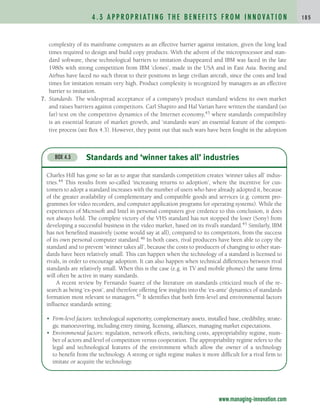
7. Standards. The widespread acceptance of a company’s product standard widens its own market
and raises barriers against competitors. Carl Shapiro and Hal Varian have written the standard (so
far) text on the competitive dynamics of the Internet economy,43 where standards compatibility
is an essential feature of market growth, and ‘standards wars’ an essential feature of the competi-
tive process (see Box 4.3). However, they point out that such wars have been fought in the adoption
4 . 3 A P P R O P R I AT I N G T H E B E N E F I T S F R O M I N N O VAT I O N 1 8 5
Standards and ‘winner takes all’ industries
BOX 4.3
Charles Hill has gone so far as to argue that standards competition creates ‘winner takes all’ indus-
tries.44 This results from so-called ‘increasing returns to adoption’, where the incentive for cus-
tomers to adopt a standard increases with the number of users who have already adopted it, because
of the greater availability of complementary and compatible goods and services (e.g. content pro-
grammes for video recorders, and computer application programs for operating systems). While the
experiences of Microsoft and Intel in personal computers give credence to this conclusion, it does
not always hold. The complete victory of the VHS standard has not stopped the loser (Sony) from
developing a successful business in the video market, based on its rival’s standard.45 Similarly, IBM
has not benefited massively (some would say at all), compared to its competitors, from the success
of its own personal computer standard.46 In both cases, rival producers have been able to copy the
standard and to prevent ‘winner takes all’, because the costs to producers of changing to other stan-
dards have been relatively small. This can happen when the technology of a standard is licensed to
rivals, in order to encourage adoption. It can also happen when technical differences between rival
standards are relatively small. When this is the case (e.g. in TV and mobile phones) the same firms
will often be active in many standards.
A recent review by Fernando Suarez of the literature on standards criticized much of the re-
search as being ‘ex-post’, and therefore offering few insights into the ‘ex-ante’ dynamics of standards
formation most relevant to managers.47 It identifies that both firm-level and environmental factors
influence standards setting:
• Firm-level factors: technological superiority, complementary assets, installed base, credibility, strate-
gic manoeuvering, including entry timing, licensing, alliances, managing market expectations.
• Environmental factors: regulation, network effects, switching costs, appropriability regime, num-
ber of actors and level of competition versus cooperation. The appropriability regime refers to the
legal and technological features of the environment which allow the owner of a technology
to benefit from the technology. A strong or tight regime makes it more difficult for a rival firm to
imitate or acquire the technology.
www.managing-innovation.com
c04.qxd 2/9/09 4:26 PM Page 185
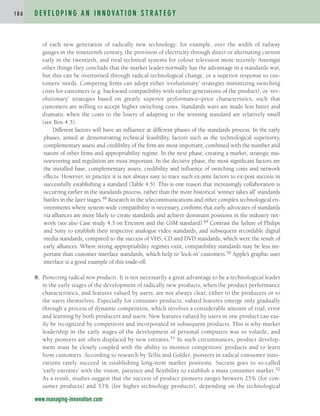
of each new generation of radically new technology: for example, over the width of railway
gauges in the nineteenth century, the provision of electricity through direct or alternating current
early in the twentieth, and rival technical systems for colour television more recently. Amongst
other things they conclude that the market leader normally has the advantage in a standards war,
but this can be overturned through radical technological change, or a superior response to cus-
tomers’ needs. Competing firms can adopt either ‘evolutionary’ strategies minimizing switching
costs for customers (e.g. backward compatibility with earlier generations of the product), or ‘rev-
olutionary’ strategies based on greatly superior performance–price characteristics, such that
customers are willing to accept higher switching costs. Standards wars are made less bitter and
dramatic when the costs to the losers of adapting to the winning standard are relatively small
(see Box 4.5).
Different factors will have an influence at different phases of the standards process. In the early
phases, aimed at demonstrating technical feasibility, factors such as the technological superiority,
complementary assets and credibility of the firm are most important, combined with the number and
nature of other firms and appropriability regime. In the next phase, creating a market, strategic ma-
noeuvering and regulation are most important. In the decisive phase, the most significant factors are
the installed base, complementary assets, credibility and influence of switching costs and network
effects. However, in practice it is not always easy to trace such ex-ante factors to ex-post success in
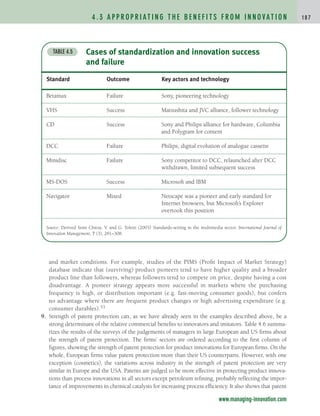
successfully establishing a standard (Table 4.5). This is one reason that increasingly collaboration is
occurring earlier in the standards process, rather than the more historical ‘winner takes all’ standards
battles in the later stages.48 Research in the telecommunications and other complex technological en-
vironments where system-wide compatibility is necessary, confirms that early advocates of standards
via alliances are more likely to create standards and achieve dominant positions in the industry net-
work (see also Case study 4.3 on Ericsson and the GSM standard).49 Contrast the failure of Philips
and Sony to establish their respective analogue video standards, and subsequent recordable digital
media standards, compared to the success of VHS, CD and DVD standards, which were the result of
early alliances. Where strong appropriability regimes exist, compatibility standards may be less im-
portant than customer interface standards, which help to ‘lock-in’ customers.50 Apple’s graphic user
interface is a good example of this trade-off.
8. Pioneering radical new products. It is not necessarily a great advantage to be a technological leader
in the early stages of the development of radically new products, when the product performance
characteristics, and features valued by users, are not always clear, either to the producers or to
the users themselves. Especially for consumer products, valued features emerge only gradually
through a process of dynamic competition, which involves a considerable amount of trial, error
and learning by both producers and users. New features valued by users in one product can eas-
ily be recognized by competitors and incorporated in subsequent products. This is why market
leadership in the early stages of the development of personal computers was so volatile, and
why pioneers are often displaced by new entrants.51 In such circumstances, product develop-
ment must be closely coupled with the ability to monitor competitors’ products and to learn
from customers. According to research by Tellis and Golder, pioneers in radical consumer inno-
vations rarely succeed in establishing long-term market positions. Success goes to so-called
‘early entrants’ with the vision, patience and flexibility to establish a mass consumer market.52
As a result, studies suggest that the success of product pioneers ranges between 25% (for con-
sumer products) and 53% (for higher technology products), depending on the technological
D E V E L O P I N G A N I N N O VAT I O N S T R AT E G Y
1 8 6
www.managing-innovation.com
c04.qxd 2/9/09 4:26 PM Page 186
4 . 3 A P P R O P R I AT I N G T H E B E N E F I T S F R O M I N N O VAT I O N 1 8 7
www.managing-innovation.com
Cases of standardization and innovation success
and failure
TABLE 4.5
Standard Outcome Key actors and technology
Betamax Failure Sony, pioneering technology
VHS Success Matsushita and JVC alliance, follower technology
CD Success Sony and Philips alliance for hardware, Columbia
and Polygram for content
DCC Failure Philips, digital evolution of analogue cassette
Minidisc Failure Sony competitor to DCC, relaunched after DCC
withdrawn, limited subsequent success
MS-DOS Success Microsoft and IBM
Navigator Mixed Netscape was a pioneer and early standard for
Internet browsers, but Microsoft’s Explorer
overtook this position
Source: Derived from Chiesa, V. and G. Toletti (2003) Standards-setting in the multimedia sector. International Journal of
Innovation Management, 7 (3), 281–308.
and market conditions. For example, studies of the PIMS (Profit Impact of Market Strategy)
database indicate that (surviving) product pioneers tend to have higher quality and a broader
product line than followers, whereas followers tend to compete on price, despite having a cost
disadvantage. A pioneer strategy appears more successful in markets where the purchasing
frequency is high, or distribution important (e.g. fast-moving consumer goods), but confers
no advantage where there are frequent product changes or high advertising expenditure (e.g.
consumer durables).53
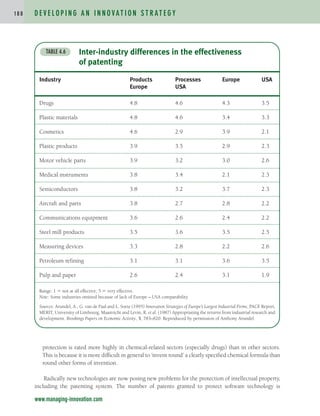
9. Strength of patent protection can, as we have already seen in the examples described above, be a
strong determinant of the relative commercial benefits to innovators and imitators. Table 4.6 summa-
rizes the results of the surveys of the judgements of managers in large European and US firms about
the strength of patent protection. The firms’ sectors are ordered according to the first column of
figures, showing the strength of patent protection for product innovations for European firms. On the
whole, European firms value patent protection more than their US counterparts. However, with one
exception (cosmetics), the variations across industry in the strength of patent protection are very
similar in Europe and the USA. Patents are judged to be more effective in protecting product innova-
tions than process innovations in all sectors except petroleum refining, probably reflecting the impor-
tance of improvements in chemical catalysts for increasing process efficiency. It also shows that patent
c04.qxd 2/9/09 4:26 PM Page 187
protection is rated more highly in chemical-related sectors (especially drugs) than in other sectors.
This is because it is more difficult in general to ‘invent round’ a clearly specified chemical formula than
round other forms of invention.
Radically new technologies are now posing new problems for the protection of intellectual property,
including the patenting system. The number of patents granted to protect software technology is
D E V E L O P I N G A N I N N O VAT I O N S T R AT E G Y
1 8 8
www.managing-innovation.com
Inter-industry differences in the effectiveness
of patenting
TABLE 4.6
Industry Products Processes Europe USA
Europe USA
Drugs 4.8 4.6 4.3 3.5
Plastic materials 4.8 4.6 3.4 3.3
Cosmetics 4.6 2.9 3.9 2.1
Plastic products 3.9 3.5 2.9 2.3
Motor vehicle parts 3.9 3.2 3.0 2.6
Medical instruments 3.8 3.4 2.1 2.3
Semiconductors 3.8 3.2 3.7 2.3
Aircraft and parts 3.8 2.7 2.8 2.2
Communications equipment 3.6 2.6 2.4 2.2
Steel mill products 3.5 3.6 3.5 2.5
Measuring devices 3.3 2.8 2.2 2.6
Petroleum refining 3.1 3.1 3.6 3.5
Pulp and paper 2.6 2.4 3.1 1.9
Range: 1  not at all effective; 5  very effective.
Note: Some industries omitted because of lack of Europe – USA comparability.
Sources: Arundel, A., G. van de Paal and L. Soete (1995) Innovation Strategies of Europe’s Largest Industrial Firms, PACE Report,
MERIT, University of Limbourg, Maastricht and Levin, R. et al. (1987) Appropriating the returns from industrial research and
development. Brookings Papers on Economic Activity, 3, 783–820. Reproduced by permission of Anthony Arundel.
c04.qxd 2/9/09 4:26 PM Page 188
growing in the USA, and so are the numbers of financial institutions getting involved in patenting for
the first time.54 Debate and controversy surround important issues, such as the possible effects of digi-
tal technology on copyright protection,55 the validity of patents to protect living organisms, and the ap-
propriate breadth of patent protection in biotechnology.56
Finally, we should note that firms can use more than one of the above nine factors to defend their
innovative lead. For example, in the pharmaceutical industry secrecy is paramount during the early
phases of research, but in the later stages of research patents become critical. Complementary assets
such as global sales and distribution become more important at the later stages. Despite all the mergers
and acquisitions in this sector, these factors, combined with the need for a significant critical mass of
RD, have resulted in relatively stable international positions of countries in pharmaceutical innovation
over a period of some 70 years (Figure 4.3). By any measure, firms in the USA have dominated the in-
dustry since the 1940s, followed by a second division consisting of Switzerland, Germany, France and
the UK. Some of the methods are mutually exclusive: for example, secrecy precludes patenting, which
requires disclosure of information, although it can precede patenting. However, firms typically deploy
all the useful means available to them to defend their innovations against imitation.57
4 . 3 A P P R O P R I AT I N G T H E B E N E F I T S F R O M I N N O VAT I O N 1 8 9
www.managing-innovation.com
FIGURE 4.3: Innovative positions of countries in the pharmaceutical industry
across time
Source: Derived from B. Achilladelis and N. Antonakis (2001). The dynamics of technological innovation: the
case of the pharmaceutical industry, Research Policy, 30, 535–588.
0
50
100
150
200
250
300
1800–1880 1880–1930 1930–1960 1960–1980 1980–1993
NUMBER
OF
INNOVATIONS
PERIOD
UK
USA
SWITZERLAND
GERMANY
FRANCE
c04.qxd 2/9/09 4:26 PM Page 189
D E V E L O P I N G A N I N N O VAT I O N S T R AT E G Y
1 9 0
www.managing-innovation.com
CASE STUDY 4.3
The development of the global system for mobile communications (GSM) standard began around
1982. Around 140 patents formed the essential intellectual property behind the GSM standard. In
terms of numbers of patents, Motorola dominated with 27, followed by Nokia (19) and Alcatel
(14). Philips also had an initial strong position with 13 essential patents, but later made a strate-
gic decision to exit the mobile telephony business. Ericsson was unusual in that it held only four
essential patents for GSM, but later became the market leader. One reason for this was that
Ericsson wrote the original proposal for GSM. Another reason is that it was second only to Philips
in its position in the network of alliances between relevant firms. Motorola continued to patent
after the basic technical decisions had been agreed, whereas the other firms did not. This allowed
Motorola greater control over which markets GSM would be made available, and also enabled it to
influence licensing conditions and to gain access to others’ technology. Subsequently, virtually all
the GSM equipment was supplied by companies which participated in the cross-licensing of this
essential intellectual property: Ericsson, Nokia, Siemens, Alcatel and Motorola, together account-
ing for around 85% of the market for switching systems and stations, a market worth US $100 billion.
As the GSM standard moved beyond Europe, North American suppliers such as Nortel and
Lucent began to license the technology to offer such systems, but never achieved the success of the
five pioneers. Most recently Japanese firms have licensed the technology to provide GSM-based
systems. Royalties for such technology can be high, representing up to 29% of the cost of a GSM
handset.
Source: Bekkers R., G. Duysters and B. Verspagen (2002) Intellectual property rights, strategic technology agreements and
market structure. Research Policy, 31, 1141–61.
Standards, intellectual property and first-mover advantages:
the case of GSM
In some cases the advantages of pioneering technology, intellectual property and standards combine
to create a sustainable market position (Case study 4.3).
4.4 Technological trajectories
In this section we focus on firms and broad technological trajectories.58 This is because firms and indus-
trial sectors differ greatly in their underlying technologies. For example, designing and making an auto-
mobile is not the same as designing and making a therapeutic drug, or a personal computer. We are
dealing not with one technology, but with several technologies, each with its historical pattern of develop-
ment, skill requirements and strategic implications. It is therefore a major challenge to develop a frame-
work, for integrating changing technology into strategic analysis, that deals effectively with corporate
and sectoral diversity. We describe below the framework that one of us has developed over the past 10
or more years to encompass diversity.59 It has been strongly influenced by the analyses of the emergence
c04.qxd 2/9/09 4:26 PM Page 190
of the major new technologies over the past 150 years by Chris Freeman and his colleagues,60 and by
David Mowery and Nathan Rosenberg.61
A number of studies have shown marked, similar and persistent differences amongst industrial
sectors in the sources and directions of technological change. They can be summarized as follows:
• Size of innovating firms: typically big in chemicals, road vehicles, materials processing, aircraft and
electronic products; and small in machinery, instruments and software.
• Type of product made: typically price sensitive in bulk materials and consumer products; and performance
sensitive in ethical drugs and machinery.
• Objectives of innovation: typically product innovation in ethical drugs and machinery; process innovation
in steel; and both in automobiles.
• Sources of innovation: suppliers of equipment and other production inputs in agriculture and traditional
manufacture (like textiles); customers in instrument, machinery and software; in-house technological
activities in chemicals, electronics, transport, machinery, instruments and software; and basic research
in ethical drugs.
• Locus of own innovation: RD laboratories in chemicals and electronics; production engineering depart-
ments in automobiles and bulk materials; design offices in machine building; and systems departments
in service industries (e.g. banks and supermarket chains).
In the face of such diversity there are two opposite dangers. One is to generalize about the nature,
source, directions and strategic implications of innovation on the basis of experience in one firm or in
one sector. In this case, there is a strong probability that many of the conclusions will be misleading or
plain wrong. The other danger is to say that all firms and sectors are different, and that no generaliza-
tions can be made. In this case, there can be no cumulative development of useful knowledge. In order
to avoid these twin dangers, one of us distinguished five major technological trajectories, each with its
distinctive nature and sources of innovation, and with its distinctive implications for technology strat-
egy and innovation management. This was done on the basis of systematic information on more than
2000 significant innovations in the UK, and of a reading of historical and case material. In Table 4.7 we
identify for each trajectory its typical core sectors, its major sources of technological accumulation and
its main strategic management tasks.
Thus, in supplier-dominated firms, technical change comes almost exclusively from suppliers of
machinery and other production inputs. This is typically the case in both agriculture and textiles, where
most new techniques originate in firms in the machinery and chemical industries. Firms’ technical
choices reflect input costs, and the opportunities for firm-specific technological accumulation are rela-
tively modest, being focused on improvements and modifications in production methods and associated
inputs. The main task of innovation strategy is therefore to use technology from elsewhere to reinforce
other competitive advantages. Over the past 10 years, advances elsewhere in IT have opened up radical
new applications in design, distribution, logistics and transactions, thereby making production more
responsive to customer demands. But, since these revolutionary changes are available from specialized
suppliers to all firms, it is still far from clear whether they can be of a lasting advantage for firms
competing in supplier-dominated sectors.
In scale-intensive firms, technological accumulation is generated by the design, building and oper-
ation of complex production systems and/or products. Typical core sectors include the extraction and
processing of bulk materials, automobiles and large-scale civil engineering projects. Given the poten-
tial economic advantages of increased scale, combined with the complexity of products and/or
4 . 4 T E C H N O L O G I C A L T R A J E C TO R I E S 1 9 1
www.managing-innovation.com
c04.qxd 2/9/09 4:26 PM Page 191
D E V E L O P I N G A N I N N O VAT I O N S T R AT E G Y
1 9 2
www.managing-innovation.com
Five major technological trajectories
TABLE 4.7
Supplier- Scale- Science- Information- Specialized
dominated intensive based intensive suppliers
Typical core
products
Agriculture
Services
Traditional
manufacture
Bulk materials
Consumer
durables
Automobiles
Civil engineering
Electronics
Chemicals
Finance
Retailing
Publishing
Travel
Machinery
Instruments
Software
Main sources
of technology
Suppliers
Production
learning
Production
engineering
Production
learning
Suppliers Design
offices
RD Basic
research
Software and
systems
departments
Suppliers
Design
Advanced
users
Main tasks of
innovation
strategy
Positions Based on
non-techno-
logical ad-
vantages
Cost-effective
and safe com-
plex products
and processes
Develop
technically
related
products
New prod-
ucts and
services
Paths Use of IT in
finance and
distribution
Incremental
integration of
new knowledge
(e.g. virtual pro-
totypes, new
materials, B2B*)
Exploit
basic sci-
ence (e.g.
molecular
biology)
Design and
operation of
complex
information
processing
systems
Matching
changing
technologies
to user needs
Processes Flexible
response to
user
Diffusion of best
practice in
design, produc-
tion and
distribution
Obtain
comple-
mentary
assets.
Redefine
divisional
boundaries
To match
IT-based
opportunities
with user
needs
Strong links
with lead
users
Monitor and
respond to
user needs
*B2B  business to business.
c04.qxd 2/9/09 4:26 PM Page 192
production systems, the risks of failure associated with radical but untested changes are potentially
very costly. Process and product technologies therefore develop incrementally on the basis of earlier
operating experience, and improvements in components, machinery and subsystems. The main
sources of technology are in-house design and production engineering departments, operating expe-
rience, and specialized suppliers of equipment and components. In these circumstances, the main
tasks of innovation strategy are the incremental improvement of technological improvements in com-
plex products or production systems, and the diffusion throughout the firm of best-practice methods
in design and production. Recent advances in the techniques of large-scale computer simulation and
modelling now offer considerable opportunities for saving time and money in the building and testing
of prototypes and pilot plant.
In science-based firms, technological accumulation emerges mainly from corporate RD laboratories,
and is heavily dependent on knowledge, skills and techniques emerging from academic research.
Typical core sectors are chemicals and electronics; fundamental discoveries (electromagnetism, radio
waves, transistor effect, synthetic chemicals, molecular biology) open up major new product markets
over a wide range of potential applications. The major directions of technological accumulation in the
firm are horizontal searches for new and technologically related product markets. As a consequence, the
main tasks of innovation strategy are to monitor and exploit advances emerging from basic research, to
develop technologically related products and acquire the complementary assets (e.g. production and
marketing) to exploit them, and to reconfigure the operating divisions and business units in the light of
changing technological and market opportunities.
Information-intensive firms have begun to emerge only in the past 10 to 15 years, particularly in the
service sector: finance, retailing, publishing, telecommunications and travel. The main sources of tech-
nology are in-house software and systems departments, and suppliers of IT hardware and of systems
and applications software. The main purpose is to design and operate complex systems for processing
information, particularly in distribution systems that make the provision of a service or a good more
sensitive to customer demands. The main tasks of innovation strategy are the development and operation
of complex information-processing systems, and the development of related and often radically new
services.
Specialized supplier firms are generally small, and provide high-performance inputs into complex sys-
tems of production, of information processing and of product development, in the form of machinery,
components, instruments and (increasingly) software. Technological accumulation takes place through
the design, building and operational use of these specialized inputs. Specialized supplier firms benefit
from the operating experience of advanced users, in the form of information, skills and the identifica-
tion of possible modifications and improvements. Specialized supplier firms accumulate the skills to
match advances in technology with user requirements, which – given the cost, complexity and interde-
pendence of production processes – put a premium on reliability and performance, rather than on price.
The main tasks of innovation strategy are keeping up with users’ needs, learning from advanced users and
matching new technologies to users’ needs.
Knowledge of these major technological trajectories can improve analysis of particular companies’
technological strategies, by helping answer the following questions:
• Where do the company’s technologies come from?
• How do they contribute to competitive advantage?
• What are the major tasks of innovation strategy?
• Where are the likely opportunities and threats, and how can they be dealt with?
4 . 4 T E C H N O L O G I C A L T R A J E C TO R I E S 1 9 3
www.managing-innovation.com
c04.qxd 2/9/09 4:26 PM Page 193
Although the above taxonomy has held up reasonably well to subsequent empirical tests,62 it
inevitably simplifies.63 For example, we can find ‘supplier-dominated’ firms in electronics and chemi-
cals, but they are unlikely to be technological pacesetters. In addition, firms can belong in more than
one trajectory. In particular, large firms in all sectors have capacities in scale-intensive (mainly mechan-
ical and instrumentation) technologies, in order to ensure efficient production. Software technology is
beginning to play a similarly pervasive role across all sectors. We have recently extended this taxonomy
based on survey and interview data on the innovative activities of almost 1000 firms (see Research
Note and Table 4.8).
D E V E L O P I N G A N I N N O VAT I O N S T R AT E G Y
1 9 4
www.managing-innovation.com
Patterns of innovation in the ‘new’ and ‘old’ economies
TABLE 4.8
Variable New economy Old economy
RD sets strategic vision of firm 5.14 3.56
RD active participant in making corporate strategy 5.87 4.82
RD responsible for developing new business 5.05 3.76
Transforming academic research into products 4.64 3.09
Accelerating regulatory approval 4.62 3.02
Reliability and systems engineering 5.49 4.79
Making products de facto standard 3.56 2.71
Anticipating complex client needs 4.95 3.94
Exploration with potential customers and lead users 5.25 4.41
Probing user needs with preliminary designs 4.72 3.59
Using roadmaps of product generations 4.51 3.26
Planned replacement of current products 3.56 2.53
Build coalition with commercialization partners 4.18 3.38
Working with suppliers to create complementary offers 4.32 3.61
Scale: 1 (low) – 7 (high); only statistically significant differences shown, n  75 firms).
Source: Derived from S. Floricel and R. Miller (2003) An exploratory comparison of the management of innovation in the
new and old economies. RD Management, 33 (5), 501–25.
c04.qxd 2/9/09 4:26 PM Page 194
4 . 4 T E C H N O L O G I C A L T R A J E C TO R I E S 1 9 5
www.managing-innovation.com
RESEARCH NOTE
The MINE (Managing Innovation in the New Economy) research program at Ecole
Polytechnique in Montreal, Canada, together with SPRU, University of Sussex, UK, conducted
qualitative and quantitative studies to gain an understanding of the diversity of strategies for
innovation. Almost 925 chief technology officers (CTOs) and senior managers of RD (from
Asia, North and South America, and Europe) across all industrial sectors of the economy
responded to a global survey. The survey tool is available at www.minesurvey.polymtl.ca.
Respondents come from firms such as Intel, Synopsys, Motorola, IBM Global Services, Novartis
and Boeing. Executives were asked what competitive forces impact on innovation, what value-
creation and -capture activities are pursued in innovating, and what strategies and practices are
used.
Games of innovation involve many interdependent players, persist over time, and are
strategically complex. Games are distinct, coherent scenarios of value creation and capture
involving activities of collaboration and rivalry:
• Each involves a distinct logic of innovative activities that is largely contingent on product
architectures and market lifecycle stage.
• They follow persistent trajectories, bound by some basic economic and technical forces and
thus tend to fall into a small number of natural trajectories.
• They result in differing levels of performance. Market-creation games involve radical
innovations, grow fast, and display high variations in profitability. By contrast, market-
evolution games are characterized by process innovations, a slower pace of growth, but
good profitability.
• However, games are not fully determined by their contexts, but allow degrees of strategic
freedom to interact with members of relevant ecosystems and to adopt collaborative and
competitive moves to expand markets.
Clustering analyses led to the identification of seven distinct and stable groups each
containing at least 100 firms that create and capture value in similar ways. Each game is
characterized by statistically different value-creation and -capture activities:
• Patent-driven discovery
• Cost-based competition
• Systems integration
• Systems engineering and consulting
• Platform orchestration
• Customized mass-production
• Innovation support and services.
Source: Miller, R. and S. Floricel (2007) Special Issue, International Journal of Innovation Management, 11 (1), vii–xvi.
Diversity of strategic games for innovation
c04.qxd 2/9/09 4:26 PM Page 195
4.5 Developing firm-specific competencies
The ability of firms to track and exploit the technological trajectories described above depends on their
specific technological and organizational competencies, and on the difficulties that competitors have in
imitating them. The notion of firm-specific competencies has become increasingly influential amongst
economists, trying to explain why firms are different, and how they change over time,20 and also
amongst business practitioners and consultants, trying to identify the causes of competitive success. In
the 1990s, management began to shift interest from improvements in short-term operational efficiency
and flexibility (through ‘de-layering’, ‘downsizing’, ‘outsourcing’ and ‘business process reengineering’,
etc.), to a concern that – if taken too far – the ‘lean corporation’ could become the ‘anorexic corpora-
tion’, without any capacities for longer-term change and survival.
Hamel and Prahalad on competencies
The most influential business analysts promoting and developing the notion of ‘core competencies’ have
been Gary Hamel and C. K. Prahalad.64 Their basic ideas can be summarized as follows:
1. The sustainable competitive advantage of firms resides not in their products but in their core compe-
tencies: ‘The real sources of advantage are to be found in management’s ability to consolidate
corporate-wide technologies and production skills into competencies that empower individual
businesses to adapt quickly to changing opportunities’ (p. 81).
2. Core competencies feed into more than one core product, which in turn feed into more than one
business unit. They use the metaphor of the tree:
End products  Leaves, flowers and fruit
Business units  Smaller branches
Core products  Trunk and major limbs
Core competencies  Root systems
Examples of core competencies include Sony in miniaturization, Philips in optical media, 3M in
coatings and adhesives and Canon in the combination of the precision mechanics, fine optics and
microelectronics technologies that underlie all their products (see Case study 4.4). Examples of core
products include Honda in lightweight, high-compression engines and Matsushita in key components
in video cassette recorders.
3. The importance of associated organizational competencies is also recognized: ‘Core competence is
communication, involvement, and a deep commitment to working across organizational boundaries’
(1990, p. 82).
4. Core competencies require focus: ‘Few companies are likely to build world leadership in more than
five or six fundamental competencies. A company that compiles a list of 20 to 30 capabilities has
probably not produced a list of core competencies’ (1990, p. 84).
5. As Table 4.9 shows, the notion of core competencies suggests that large and multidivisional firms
should be viewed not only as a collection of strategic business units (SBUs), but also as bundles of
competencies that do not necessarily fit tidily in one business unit.
D E V E L O P I N G A N I N N O VAT I O N S T R AT E G Y
1 9 6
www.managing-innovation.com
c04.qxd 2/9/09 4:26 PM Page 196
4 . 5 D E V E L O P I N G F I R M - S P E C I F I C C O M P E T E N C I E S 1 9 7
CASE STUDY 4.4
Core competencies at Canon
www.managing-innovation.com
Product Competencies Fine optics Microelectronics
Precision mechanics
Basic camera X X
Compact fashion camera X X
Electronic camera X X
EOS autofocus camera X X X
Video still camera X X X
Laser beam printer X X X
Colour video printer X X
Bubble jet printer X X
Basic fax X X
Laser fax X X
Calculator X
Plain paper copier X X X
Colour copier X X X
Laser copier X X X
Colour laser copier X X X
Still video system X X X
Laser imager X X X
Cell analyzer X X X
Mask aligners X X
Stepper aligners X X
Excimer laser aligners X X X
Source: Prahalad, C. and G. Hamel (1990) The core competencies of the corporation. Harvard Business Review,
May–June, 79–91.
c04.qxd 2/9/09 4:26 PM Page 197
According to Hamel and Prahalad, the concept of the corporation based on core competencies should
not replace the traditional one, but a commitment to it ‘will inevitably influence patterns of diversifica-
tion, skill deployment, resources allocation priorities, and approaches to alliances and outsourcing’
(1990, p. 86). More specifically, the conventional multidivisional structure may facilitate efficient innovation
D E V E L O P I N G A N I N N O VAT I O N S T R AT E G Y
1 9 8
www.managing-innovation.com
According to Christer Oskarsson:65
In the late 1950s . . . the time had come for Canon to apply its precision mechanical and
optical technologies to other areas [than cameras] . . . such as business machines. By 1964
Canon had begun by developing the world’s first 10-key fully electronic calculator . . . fol-
lowed by entry into the coated paper copier market with the development of an electrofax
copier model in 1965, and then into . . . the revolutionary Canon plain paper copier tech-
nology unveiled in 1968 . . . Following these successes of product diversification, Canon’s
product lines were built on a foundation of precision optics, precision engineering and
electronics . . .
The main factors behind . . . increases in the numbers of products, technologies and markets
. . . seem to be the rapid growth of information technology and electronics, technological transi-
tions from analogue to digital technologies, technological fusion of audio and video technologies,
and the technological fusion of electronics and physics to optronics (pp. 24–6).
Two views of corporate structure: strategic business
units and core competencies
TABLE 4.9
Strategic business unit Core competencies
Basis for competition Competitiveness of today’s
products
Inter-firm competition to build com-
petencies
Corporate structure Portfolio of businesses in re-
lated product markets
Portfolio of competencies, core prod-
ucts and business
Status of business unit Autonomy: SBU ‘owns’ all re-
sources other than cash
SBU is a potential reservoir of core
competencies
Resource allocation SBUs are unit of analysis.
Capital allocated to SBUs
SBUs and competencies are unit of
analysis. Top management allocates
capital and talent
Value added of top
management
Optimizing returns through
trade-offs among SBUs
Enunciating strategic architecture, and
building future competencies
c04.qxd 2/9/09 4:26 PM Page 198
within specific product markets, but may limit the scope for learning new competencies: firms with fewer
divisional boundaries are associated with a strategy based on capabilities broadening, whereas firms with
many divisional boundaries are associated with a strategy based on capabilities deepening.66
6. The identification and development of a firm’s core competencies depend on its strategic architecture,
defined as:
. . . a road map of the future that identifies which core competencies to build and their constituent
technologies . . . should make resource allocation priorities transparent to the whole organization . . .
Top management must add value by enunciating the strategic architecture that guides the competence
acquisition process (1990, p. 89).
Examples given include:
• NEC  convergence of computing and communication technologies
• Vickers, USA  being the best power and motion control company in the world
• Honda  lightweight, high-compression engines
• 3M  coatings and adhesives
Assessment of the core competencies approach
The great strength of the approach proposed by Hamel and Prahalad is that it places the cumulative de-
velopment of firm-specific technological competencies at the centre of the agenda of corporate strategy.
Although they have done so by highlighting practice in contemporary firms, their descriptions reflect
what has been happening in successful firms in science-based industries since the beginning of the
twentieth century. For example, Gottfried Plumpe has shown that the world’s leading company in the
exploitation of the revolution in organic chemistry in the 1920s – IG Farben in Germany – had already
established numerous ‘technical committees’ at the corporate level, in order to exploit emerging tech-
nological opportunities that cut across divisional boundaries.67 These enabled the firm to diversify
progressively out of dyestuffs into plastics, pharmaceutical and other related chemical products.
Other histories of businesses in chemicals and electrical products tell similar stories.68 In particular,
they show that the competence-based view of the corporation has major implications for the organization
of RD, for methods of resource allocation and for strategy determination, to which we shall return later.
In the meantime, their approach does have limitations and leaves at least three key questions unanswered.
(a) Differing potentials for technology-based diversification? It is not clear whether the corporate
core competencies in all industries offer a basis for product diversification. Compare the recent histori-
cal experience of most large chemical and electronics firms, where product diversification based on
technology has been the norm, with that of most steel and textile firms, where technology-related prod-
uct diversification has proved very difficult (see, for example, the unsuccessful attempts to diversify by
the Japanese steel industry in the 1980s).69
(b) Multi-technology firms? Recommendations that firms should concentrate resources on a few
fundamental (or ‘distinctive’) world-beating technological competencies are potentially misleading.
Large firms are typically active in a wide range of technologies, in only a few of which do they achieve a
‘distinctive’ world-beating position.70 In other technological fields, a background technological compe-
tence is necessary to enable the firm to coordinate and benefit from outside linkages, especially with
4 . 5 D E V E L O P I N G F I R M - S P E C I F I C C O M P E T E N C I E S 1 9 9
www.managing-innovation.com
c04.qxd 2/9/09 4:26 PM Page 199
suppliers of components, subsystems, materials and production machinery. In industries with complex
products or production processes, a high proportion of a firm’s technological competencies is deployed
in such background competencies.71 In addition, firms are constrained to develop competencies in an
increasing range of technological fields (e.g. IT, new materials, nanotechnology) in order to remain com-
petitive as products become even more ‘multi-technological’.
Thus, as is shown in Table 4.10, a firm’s innovation strategy will involve more than its distinctive
core (or critical) competencies. In-house competencies in background (enabling) technologies are nec-
essary for the effective coordination of changes in production and distribution systems, and in supply
chains. In industries with complex product systems (like automobiles), background technologies can
account for a sizable proportion of corporate innovative activities. Background technologies can also be
the sources of revolutionary and disruptive change. For example, given the major opportunities for im-
proved performance that they offer, all businesses today have no choice but to adopt advances in IT
technology, just as all factories in the past had no choice but to convert to electricity as a power source.
However, in terms of innovation strategy, it is important to distinguish firms where IT is a core technol-
ogy and a source of distinctive competitive advantage (e.g. Cisco, the supplier of Internet equipment)
from firms where it is a background technology, requiring major changes but available to all competi-
tors from specialized suppliers, and therefore unlikely to be a source of distinctive and sustainable com-
petitive advantage (e.g. Tesco, the UK supermarket chain).
In all industries, emerging (key) technologies can end up having pervasive and major impacts on
firms’ strategies and operations (e.g. software). A good example of how an emerging/key technology can
transform a company is provided by the Swedish telecommunications firm Ericsson. Table 4.11 traces
the accumulation of technological competencies, with successive generations of mobile cellular phones
D E V E L O P I N G A N I N N O VAT I O N S T R AT E G Y
2 0 0
www.managing-innovation.com
The strategic function of corporate technologies
TABLE 4.10
Strategic functions Definition Typical examples
Core or critical
functions
Central to corporate competi-
tiveness. Distinctive and
difficult to imitate
Technologies for product design and
development. Key elements of process
technologies
Background or
enabling
Broadly available to all
competitors, but essential for
efficient design, manufacture
and delivery of corporate
products
Production machinery, instruments,
materials, components (software)
Emerging or key Rapidly developing fields of
knowledge presenting poten-
tial opportunities or threats,
when combined with existing
core and background
technologies
Materials, biotechnology, ICT-software
c04.qxd 2/9/09 4:26 PM Page 200
and telecommunication cables. In both cases, each new generation required competencies in a wider
range of technological fields, and very few established competencies were made obsolete. The process
of accumulation involved both increasing links with outside sources of knowledge, and greater expen-
ditures on RD, given greater product complexity. This was certainly not a process of concentration,
but of diversification in both technology and product.
For these reasons, the notion of ‘core competencies’ should perhaps be replaced for technology by
the notion of ‘distributed competencies’, given that, in large firms, they are distributed:
• over a large number of technical fields
• over a variety of organizational and physical locations within the corporation – in the RD, produc-
tion engineering and purchasing departments of the various divisions, and in the corporate laboratory
4 . 5 D E V E L O P I N G F I R M - S P E C I F I C C O M P E T E N C I E S 2 0 1
www.managing-innovation.com
Technological accumulation across product generations
TABLE 4.11
Product and No. of RD costs % of technologies Main No. of
generation important acquired technological patent
technologies externally fields (d) classes (e)
(a) (b) Total (c) (base
 100)
Cellular phones
1. NMT-450 n.a. n.a.5 n.a. 100 12 E 17
2. NMT-900 5 5 10 0 200 28 EPM 25
3. GSM 9 5 14 1 500 29 EPMC 29
Telecomm cables
1. Coaxial n.a. n.a.5 n.a. 100 30 EPM 14
2. Optical 4 6 10 1 500 47 EPCM 17
n.a.  not applicable.
Notes:
(a) No. of technologies from the previous generation.
(b) No. of new technologies, compared to previous generation.
(c) No. of technologies now obsolete from previous generation.
(d) ‘Main’  15% of total engineering stock. Categories are: E  electrical; P  physics; K  chemistry; M  mechani-
cal; C  computers.
(e) Number of international patent classes (IPC) at four-digit level.
Source: Derived from Granstrand, O., E. Bohlin, C. Oskarsson and N. Sjorberg (1992) External technology acquisition in
large multi-technology corporations. RD Management, 22 (2), 111–133.
c04.qxd 2/9/09 4:26 PM Page 201
• amongst different strategic objectives of the corporation, which include not only the establishment of
a distinctive advantage in existing businesses (involving both core and background technologies), but
also the exploration and establishment of new ones (involving emerging technologies).
(c) Core rigidities? As Dorothy Leonard-Barton has pointed out, ‘core competencies’ can also
become ‘core rigidities’ in the firm, when established competencies become too dominant.72 In addition
to sheer habit, this can happen because established competencies are central to today’s products, and
because large numbers of top managers may be trained in them. As a consequence, important new
competencies may be neglected or underestimated (e.g. the threat to mainframes from mini- and micro-
computers by management in mainframe companies). In addition, established innovation strengths may
overshoot the target. In Box 4.4, Leonard-Barton gives a fascinating example from the Japanese automo-
bile industry: how the highly successful ‘heavyweight’ product managers of the 1980s (see Chapter 9)
overdid it in the 1990s. Many examples show that, when ‘core rigidities’ become firmly entrenched,
their removal often requires changes in top management.
Developing and sustaining competencies
The final question about the notion of core competencies is very practical: how can management iden-
tify and develop them?
Definition and measurement. There is no widely accepted definition or method of measurement of
competencies, whether technological or otherwise. One possible measure is the level of functional
D E V E L O P I N G A N I N N O VAT I O N S T R AT E G Y
2 0 2
www.managing-innovation.com
Heavyweight product managers and fat product designs
BOX 4.4
Some of the most admired features . . . identified . . . as conveying a competitive advantage [to
Japanese automobile companies] were: (1) overlapping problem solving among the engineering and
manufacturing functions, leading to shorter model change cycles; (2) small teams with broad task
assignments, leading to high development productivity and shorter lead times; and (3) using a
‘heavyweight’ product manager – a competent individual with extensive project influence . . . who
led a cohesive team with autonomy over product design decisions. By the early 1990s, many of
these features had been emulated . . . by US automobile manufacturers, and the gap between US
and Japanese companies in development lead time and productivity had virtually disappeared.
However . . . there was another reason for the loss of the Japanese competitive edge – ‘fat prod-
uct designs’ . . . an excess in product variety, speed of model change, and unnecessary options . . .
‘overuse’ of the same capability that created competitive advantages in the 1980s has been the
source of the new problem in the 1990s. The formerly ‘lean’ Japanese producers such as Toyota had
overshot their targets of customer satisfaction and overspecified their products, catering to a long
‘laundry list’ of features and carrying their quest for quality to an extreme that could not be cost-
justified when the yen appreciated in 1993 . . . Moreover, the practice of using heavyweight man-
agers to guide important projects led to excessive complexity of parts because these powerful indi-
viduals disliked sharing common parts with other car models.
Source: Leonard-Barton, D. (1995) Wellsprings of Knowledge, Harvard Business School Press, Boston, MA, p. 33.
c04.qxd 2/9/09 4:26 PM Page 202
performance in a generic product, component or subsystem: in, for example, performance in the design,
development, manufacture and performance of compact, high-performance combustion engines. As a
strategic technological target for a firm like Honda, this obviously makes sense. But its achievement re-
quires the combination of technological competencies from a wide variety of fields of knowledge, the
composition of which changes (and increases) over time. Twenty years ago, they included mechanics
(statics and dynamics), materials, heat transfer, combustion, fluid flow. Today they also include ceram-
ics, electronics, computer-aided design, simulation techniques and software.
Thus, the functional definition of technological competencies bypasses two central tasks of cor-
porate technology strategy: first, to identify and develop the range of disciplines or fields that must
be combined into a functioning technology; second (and perhaps more important) to identify and ex-
plore the new competencies that must be added if the functional capability is not to become obsolete.
This is why a definition based on the measurement of the combination of competencies in different
technological fields is more useful for formulating innovation strategy, and is in fact widely practised
in business.73
Richard Hall goes some way towards identifying and measuring core competencies.74 He distin-
guishes between intangible assets and intangible competencies. Assets include intellectual property
rights and reputation. Competencies include the skills and know-how of employees, suppliers and dis-
tributors, and the collective attributes which constitute organizational culture. His empirical work,
based on a survey and case studies, indicates that managers believe that the most significant of these
intangible resources are company reputation and employee know-how, both of which may be a function
of organizational culture. Thus organizational culture, defined as the shared values and beliefs of mem-
bers of an organizational unit, and the associated artefacts, becomes central to organizational learning.
This framework provides a useful way to assess the competencies of an organization, and to identify
how these contribute to performance.
Sidney Winter links the idea of competencies with his own notion of organizational ‘routines’, in an
effort to contrast capabilities from other generic formulas for sustainable competitive advantage or man-
aging change.75 A routine is an organizational behaviour that is highly patterned, is learned, derived in
part from tacit knowledge and with specific goals, and is repetitious. He argues that an organizational
capability is a high-level routine, or collection of routines, and distinguishes between ‘zero-level’ capa-
bilities as the ‘how we earn our living now’, and true ‘dynamic’ capabilities which change the product,
process, scale or markets; for example, new product development. These dynamic capabilities are not
the only or even the most common way organizations can change. He uses the term ‘ad hoc problem
solving’ to describe these other ways to manage change. In contrast, dynamic capabilities typically in-
volve long-term commitments to specialized resources, and consist of patterned activity to relatively
specific objectives. Therefore dynamic capabilities involve both the exploitation of existing competen-
cies and the development of new ones. For example, leveraging existing competencies through new
product development can consist of de-linking existing technological or commercial competencies from
one set of current products, and linking them in a different way to create new products. However, new
product development can also help to develop new competencies. For example, an existing technolog-
ical competence may demand new commercial competencies to reach a new market, or conversely a
new technological competence might be necessary to service an existing customer.76
The trick is to get the right balance between exploitation of existing competencies and the exploita-
tion and development of new competencies. Research suggests that over time some firms are more
successful at this than others, and that a significant reason for this variation in performance is due to dif-
ference in the ability of managers to build, integrate and reconfigure organizational competencies and
4 . 5 D E V E L O P I N G F I R M - S P E C I F I C C O M P E T E N C I E S 2 0 3
www.managing-innovation.com
c04.qxd 2/9/09 4:26 PM Page 203
resources.77 These ‘dynamic’ managerial capabilities are influenced by managerial cognition, human
capital and social capital. Cognition refers to the beliefs and mental models which influence decision
making. These affect the knowledge and assumptions about future events, available alternatives and as-
sociation between cause and effect. This will restrict a manager’s field of vision, and influence percep-
tions and interpretations. Case study 4.5 discusses the role of (limited) cognition in the case of Polaroid
and digital imaging. Human capital refers to the learned skills that require some investment in educa-
tion, training experience and socialization, and these can be generic, industry- or firm-specific. It is the
firm-specific factors that appear to be the most significant in dynamic managerial capability, which can
lead to different decisions when faced with the same environment. Social capital refers to the internal
D E V E L O P I N G A N I N N O VAT I O N S T R AT E G Y
2 0 4
www.managing-innovation.com
CASE STUDY 4.5
Polaroid was a pioneer in the development of instant photography. It developed the first instant
camera in 1948, the first instant colour camera in 1963, and introduced sonar automatic focusing
in 1978. In addition to its competencies in silver halide chemistry, it had technological competen-
cies in optics and electronics, and mass manufacturing, marketing and distribution expertise. The
company was technology-driven from its foundation in 1937, and the founder Edwin Land had
500 personal patents. When Kodak entered the instant photography market in 1976, Polaroid
sued the company for patent infringement, and was awarded $924.5 million in damages. Polaroid
consistently and successfully pursued a strategy of introducing new cameras, but made almost all
its profits from the sale of the film (the so-called razor-blade marketing strategy also used by
Gillette), and between 1948 and 1978 the average annual sales growth was 23%, and profit
growth 17% per year.
Polaroid established an electronic imaging group as early as 1981, as it recognized the poten-
tial of the technology. However, digital technology was perceived as a potential technological shift,
rather than as a market or business disruption. By 1986 the group had an annual research budget
of $10 million, and by 1989 42% of the RD budget was devoted to digital imaging technologies.
By 1990 28% of the firm’s patents related to digital technologies. Polaroid was therefore well po-
sitioned at that time to develop a digital camera business. However, it failed to translate prototypes
into a commercial digital camera until 1996, by which time there were 40 other companies in the
market, including many strong Japanese camera and electronics firms. Part of the problem was
adapting the product development and marketing channels to the new product needs. However,
other more fundamental problems related to long-held cognitions: a continued commitment to
the razor-blade business model, and pursuit of image quality. Profits from the new market for dig-
ital cameras were derived from the cameras rather than the consumables (film). Ironically, Polaroid
had rejected the development of ink-jet printers, which rely on consumables for profits, because
of the relatively low quality of their (early) outputs. Polaroid had a long tradition of improving its
print quality to compete with conventional 35mm film. A more detailed case study is available.
Source: Tripsas, M. and G. Gavetti (2000) Capabilities, cognition, and inertia: evidence from digital imaging. Strategic
Management Journal, 21, 1147–61.
Capabilities and cognition at Polaroid
c04.qxd 2/9/09 4:26 PM Page 204
and external relationships which affect managers’ access to information, their influence, control and
power.
Top management and ‘strategic architecture’ for the future. The importance given by Hamel and
Prahalad to top management in determining the ‘strategic architecture’ for the development of future
technological competencies is debatable. As The Economist has argued:78
It is hardly surprising that companies which predict the future accurately make more money than
those who do not. In fact, what firms want to know is what Mr Hamel and Mr Prahalad steadfastly
fail to tell them: how to guess correctly. As if to compound their worries, the authors are oddly reti-
cent about those who have gambled and lost.
The evidence in fact suggests that the successful development and exploitation of core competencies
does not depend on management’s ability to forecast accurately long-term technological and product de-
velopments: as Box 4.5 illustrates, the record here is not at all impressive.79 Instead, the importance of
new technological opportunities and their commercial potential emerge not through a flash of genius (or
a throw of the dice) from senior management, but gradually through an incremental corporate-wide
process of learning in knowledge building and strategic positioning. New core competencies cannot be
4 . 5 D E V E L O P I N G F I R M - S P E C I F I C C O M P E T E N C I E S 2 0 5
www.managing-innovation.com
The overvaluation of technological wonders
BOX 4.5
In 1986, Schnaars and Berenson published an assessment of the accuracy of forecasts of future
growth markets since the 1960s, with the benefit of 20 or more years of hindsight.80 The list of fail-
ures is as long as the list of successes. Below are some of the failures.
The 1960s were a time of great economic prosperity and technological advancement in the
United States . . . One of the most extensive and widely publicized studies of future
growth markets was TRW Inc.’s ‘Probe of the Future’. The results . . . appeared in many
business publications in the late 1960s . . . Not all . . . were released. Of the ones that
were released, nearly all were wrong! Nuclear-powered underwater recreation centers, a
500-kilowatt nuclear power plant on the moon, 3-D color TV, robot soldiers, automatic
vehicle control on the interstate system, and plastic germproof houses were amongst
some of the growth markets identified by this study.
. . . In 1966, industry experts predicted, ‘The shipping industry appears ready to enter the
jet age.’ By 1968, large cargo ships powered by gas turbine engines were expected to penetrate
the commercial market. The benefits of this innovation were greater reliability, quicker engine
starts and shorter docking times.
. . . Even dentistry foresaw technological wonders . . . in 1968, the Director of the
National Institute of Dental Research, a division of the US Public Health Service, predicted that
‘in the next decade, both tooth decay and the most prevalent form of gum disease will come to
a virtual end’. According to experts at this agency, by the late 1970s false teeth and dentures
would be ‘anachronisms’ replaced by plastic teeth implant technology. A vaccine against tooth
decay would also be widely available and there would be little need for dental drilling.
c04.qxd 2/9/09 4:26 PM Page 205
identified immediately and without trial and error: thus Case study 4.6 neglects to show that Canon
failed in electronic calculators and in recording products.81
It was through a long process of trial and error that Ericsson’s new competence in mobile telephones
first emerged.82 As Case study 4.6 shows, it is also how Japanese firms developed and exploited their
competencies in optoelectronics.
A study of radical technological innovations found how visions can influence the development
or acquisition of competencies, and identified three related mechanisms through which firms link
emerging technologies to markets that do not yet exist: motivation, insight and elaboration.83
Motivation serves to focus attention and to direct energy, and encourages the concentration of re-
sources. It requires senior management to communicate the importance of radical innovation, and
to establish and enforce challenging goals to influence the direction of innovative efforts. Insight rep-
resents the critical connection between technology and potential application. For radical technolog-
ical innovations, such insight is rarely from the marketing function, customers or competitors, but
is driven by those with extensive technical knowledge and expertise with a sense of both market
needs and opportunities. Elaboration involves the demonstration of technical feasibility, validating
D E V E L O P I N G A N I N N O VAT I O N S T R AT E G Y
2 0 6
www.managing-innovation.com
CASE STUDY 4.6
Using a mixture of bibliometric and interview data, Kumiko Miyazaki traced the development
and exploitation of optoelectronics technologies in Japanese firms. Her main conclusions were as
follows:
. . . Competence building is strongly related to a firm’s past accomplishments. The notions of
path dependency and cumulativeness have a strong foundation. Competence building centres
in key areas to enhance a firm’s core capabilities. . . . by examining the different types of papers
related to semiconductor lasers over a 13-year period, it was found that in most firms there
was a decrease in experimental type papers accompanied by a rise in papers marking ‘new de-
velopments’ or ‘practical applications’. The existence of a wedge pattern for most firms con-
firmed . . . that competence building is a cumulative and long process resulting from trial and
error and experimentation, which may eventually lead to fruitful outcomes. The notion of
search trajectories was tested using . . . INSPEC and patent data. Firms search over a broad
range in basic and applied research and a narrower range in technology development . . . In
other words, in the early phases of competence building, firms explore a broad range of tech-
nical possibilities, since they are not sure how the technology might be useful for them. As
they gradually learn and accumulate their knowledge bases, firms are able to narrow the
search process to find fruitful applications.
Source: Miyazaki, K. (1994) Search, learning and accumulation of technological competencies: the case of optoelectronics.
Industrial and Corporate Change, 3, 653.
Learning about optoelectronics in Japanese companies
c04.qxd 2/9/09 4:26 PM Page 206
the idea within the organization, prototyping and the building and testing of different business
models (see Research note).
At this point the concept is sufficiently well elaborated to work with the marketing function and po-
tential customers. Market visioning for radical technologies is necessarily the result of individual or
technological leadership. ‘There were multiple ways for a vision to take hold of an organization . . . our expec-
tation was that a single individual would create a vision of the future and drive it across the organization. But
just as we discovered that breakthrough innovations don’t necessarily arise simply because of a critical scientific
discovery, neither do we find that visions are necessarily born of singular prophetic individuals’ (pp. 239–44).83
Case study 4.7 illustrates how Corning developed its ceramic technologies and deep process competen-
cies to develop products for the emerging demand for catalytic converters in the car industry, and for
glass fibre for telecommunications. Case study 4.8 shows the limited role of technology in the Internet
search engine business, and the central role of an integrated approach to process, product and business
innovation.
4 . 5 D E V E L O P I N G F I R M - S P E C I F I C C O M P E T E N C I E S 2 0 7
www.managing-innovation.com
RESEARCH NOTE
For many years, Costas Markides at London Business School has been researching the links be-
tween strategy, innovation and firm performance. In recent work he argues for the need to make
a clearer distinction between the technological and market aspects of disruptive innovations, and
to pay greater attention to business model innovation.
By definition, business model innovation enlarges the existing value of a market, either by
attracting new customers or by encouraging existing customers to consume more. Business
model innovation does not require the discovery of new products or services, or new technology,
but rather the redefinition of existing products and services and how these are used to create
value.
For example, Amazon did not invent book selling, and low-cost airlines such as Southwest
and easyJet are not pioneers of air travel. Such innovators tend to offer different product or
service attributes to existing firms, which emphasize different value propositions. As a result,
business model innovation typically requires different and often conflicting systems, structures,
processes and value chains to existing offerings.
However, unlike the claims made for disruptive innovations, new business models can
coexist with more mainstream approaches. For example, Internet banking and low-cost airlines
have not displaced the more mainstream approaches, but have captured around 20% of the
total demand for these services. Also, while many business model innovations are introduced
by new entrants, which have none of the legacy systems and products of incumbent firms, the
more mainstream firms may simply choose not to adopt the new business models as they make
little sense for them. Alternatively, they may make other innovations to create or recapture
customers.
Sources: C. Markides (2006) Disruptive innovation: in need of a better theory. Journal of Product Innovation Management,
23, 19–25; (2004) Fast Second: How Smart Companies Bypass Radical Innovation to Enter and Dominate New Markets, Jossey
Bass, San Francisco.
Business model innovation
c04.qxd 2/9/09 4:26 PM Page 207
D E V E L O P I N G A N I N N O VAT I O N S T R AT E G Y
2 0 8
www.managing-innovation.com
CASE STUDY 4.7
Corning has a long tradition of developing radical technologies to help create emerging markets.
It was one of the first companies in the USA to establish a corporate research laboratory in 1908.
The facility was originally set up to help solve some fundamental process problems in the manu-
facture of glass, and resulted in improved glass for railroad lanterns. This led to the development
of Pyrex in 1912, which was Corning’s version of the German-invented borosilicate glass. In turn,
this led to new markets in medical supplies and consumer products.
In the 1940s the company began to develop television tubes for the emerging market for
colour television sets, drawing upon its technology competencies developed for radar during the
war. Corning did not have a strong position in black-and-white television tubes, but the tubes for
colour television followed a different and more challenging technological trajectory, demanding a
deep understanding of the fundamental phenomena to achieve the alignment of millions of pho-
torescent dots to a similar pattern of holes.
In 1966, in response to a joint enquiry from the British Post Office and British Ministry of
Defence, Corning supplied a sample of high-quality glass rods to determine the performance in
transmitting light. Based on the current performance of copper wire, a maximum loss of 20db/km
was the goal. However, at that time the loss of the optical fibre (waveguide) was 10 times this:
200db/km. The target was theoretically possible given the properties of silica, and Corning began
research on optical fibre. Corning pursued a different approach to others, using pure silica, which
demanded very high temperatures, making it difficult to work with. The company had developed
this tacit knowledge in earlier projects, and this would take time for others to acquire. In 1970 the
research group developed a composition and fibre design that exceeded the target performance.
Excluded from the US market by an agreement with ATT, Corning formed a five-year joint de-
velopment agreement with five companies from the UK, Germany, France, Italy and Japan.
Corning subsequently developed key technologies for waveguides, filed the 12 key patents in the
field, and after a number of high-profile but successful patent infringement actions against
European, Japanese and Canadian firms, it came to dominate what would become $10 million an-
nual sales by 1982.
Corning also had close relationships with the main automobile manufacturers as a supplier of
headlights, but it had failed to convince these companies to adopt its safety glass for windscreens
(windshields) due to the high cost and low importance of safety at that time. Corning had also
developed a ceramic heat exchanger for petrol (gasoline) turbine engines, but the automobile
manufacturers were not willing to reverse their huge investments for the production of internal
combustion engines. However, discussion with GM, Ford and Chrysler indicated that future leg-
islation would demand reduced vehicle emissions, and therefore some form of catalytic converter
would become standard for all cars in the USA. However, no one knew how to make these at that
time. The passing of the Clean Air Act in 1970 required reductions in emissions by 1975, and
accelerated development. Competitors included 3M and GM. However, Corning had the advan-
tage of having already developed the new ceramic for its (failed) heat exchanger project, and its
competencies in RD organization and production processes. Unlike its competitors, which
organized development along divisional lines, Corning was able to apply as many researchers as it
Market visions and technological innovation at Corning
c04.qxd 2/9/09 4:26 PM Page 208
4 . 6 G L O B A L I Z AT I O N O F I N N O VAT I O N 2 0 9
www.managing-innovation.com
had to tackle the project, what became known as ‘flexible critical mass’. In 1974 it filed a patent
for its new extrusion production technology, and in 1975 for a new development of its ceramic
material. The competitors’ technologies proved unable to match the increasing reduction in emis-
sions needed, and by 1994 catalytic converters generated annual sales of $1 billion for Corning.
A more detailed case study is available.
Source: Graham, M. and A. Shuldiner (2001) Corning and the Craft of Innovation, Oxford University Press, Oxford.
CASE STUDY 4.8
Internet search engines demonstrate the need for an integrated approach to innovation, which in-
cludes process, product and business innovation. Perhaps surprisingly, the leading companies
such as Google and Yahoo! have not based their innovation strategies on technological research
and development, but rather on the novel combinations of technological, process, product and
business innovations.
For example, of the 126 search engine patents granted in the USA between 1999 and 2001,
the market leaders Yahoo! and Google each only had a single patent, whereas IBM led the technol-
ogy race with 16 patents, but no significant search business. However, over the same period
Yahoo! published more than 1000 new feature releases and Google over 300. These new releases
included: new configurations of search engine; new components for existing search engines; new
functions and improved usability.
Moreover, this strategy of a broad range of type of innovations, rather than a narrow focus on
technological innovations, did not follow the classic product–process life cycle. A strong consis-
tent emphasis on process innovation throughout the company histories was punctuated with mul-
tiple episodes of significant product and business innovation, in particular new offerings which
integrated core search functions and other services. This pattern confirms that even in so-called
high-tech sectors, other competencies are equally or even more important for continued business
success.
Source: Lan, P., G.A. Hutcheson, Y. Markov and N.W. Runyan (2007) An examination of the integration of technological
and business innovation: cases of Yahoo! and Google. International Journal of Technology Marketing, 2 (4), 295–316.
Innovation in Internet search engines
4.6 Globalization of innovation
Many analysts and practitioners have argued that, following the ‘globalization’ of product markets, finan-
cial transactions and direct investment, large firms’ RD activities should also be globalized – not only in
their traditional role of supporting local production, but also in order to create interfaces with specialized
skills and innovative opportunities at a world level.84 This is consistent with more recent notions of ‘open
c04.qxd 2/9/09 4:26 PM Page 209
innovation’, rather than ‘closed innovation’ which relies on internal development. However, although
striking examples of the internationalization of RD can be found (e.g. the large Dutch firms, particu-
larly Philips85), more comprehensive evidence casts doubt on the strength of such a trend (Table 4.12).
This evidence is based on the countries of origin of the inventors cited on the front page of patents
granted in the USA, to nearly 359 of the world’s largest, technologically active firms (and which account
for about half of all patenting in the USA). This information turns out to be an accurate guide to the in-
ternational spread of large firms’ RD activities.
Taken together, the evidence shows that:86
• Twenty years ago the world’s large firms perform about 12% of their innovative activities outside their
home country. The equivalent share of production is now about 25%.
• The most important factor explaining each firm’s share of foreign innovative activities is its share of
foreign production. Firms from smaller countries in general have higher shares of foreign innovative
activities. On average, foreign production is less innovation-intensive than home production.
• Most of the foreign innovative activities are performed in the USA and Europe (in fact, Germany).
They are not ‘globalized’.
• Since the late 1980s, European firms – and especially those from France, Germany and Switzerland –
have been performing an increasing share of their innovative activities in the USA, in large part in or-
der to tap into local skills and knowledge in such fields as biotechnology and IT.
Controversy remains both in the interpretation of this general picture, and in the identification of
implications for the future. Our own views are as follows:
1. There are major efficiency advantages in the geographical concentration in one place of strategic
RD for launching major new products and processes (first model and production line). These are:
(a) dealing with unforeseen problems, since proximity allows quick, adaptive decisions;
(b) integrating RD, production and marketing, since proximity allows integration of tacit knowl-
edge through close personal contacts.
2. The nature and degree of international dispersion of RD will also depend on the company’s major
technological trajectory, and the strategically important points for integration and learning that relate
to it. Thus, whereas automobile firms find it difficult to separate their RD geographically from pro-
duction when launching a major new product, drug firms can do so, and instead locate their RD
close to strategically important basic research and testing procedures.
3. In deciding about the internationalization of their RD, managers must distinguish between:
(a) becoming part of global knowledge networks – in other words, being aware of, and able to absorb
– the results of RD being carried out globally. Practising scientists and engineers have always
done this, and it is now easier with modern IT. However, business firms are finding it increas-
ingly useful to establish relatively small laboratories in foreign countries in order to become
strong members of local research networks and thereby benefit from the person-embodied
knowledge behind the published papers;
(b) the launching of major innovations, which remains complex, costly, and depends crucially on the
integration of tacit knowledge. This remains difficult to achieve across national boundaries.
Firms therefore still tend to concentrate major product or process developments in one country.
They will sometimes choose a foreign country when it offers identifiable advantages in the skills
and resources required for such developments, and/or access to a lead market.87
D E V E L O P I N G A N I N N O VAT I O N S T R AT E G Y
2 1 0
www.managing-innovation.com
c04.qxd 2/9/09 4:26 PM Page 210
Matching global knowledge networks with the localized launching of major innovations will require
increasing international mobility amongst technical personnel, and the increasing use of multina-
tional teams in launching innovations.
4. Advances in IT will enable spectacular increases in the international flow of codified knowledge in
the form of operating instructions, manuals and software. They may also have some positive impact
on international exchanges of tacit knowledge through teleconferencing, but not anywhere near to
the same extent. The main impact will therefore be at the second stage of the ‘product cycle’,88 when
product design has stabilized, and production methods are standardized and documented, thereby
facilitating the internationalization of production. Product development and the first stage of the
product cycle will still require frequent and intense personal exchanges, and be facilitated by physi-
cal proximity. Advances in IT are therefore more likely to favour the internationalization of produc-
tion than of the process of innovation.
The two polar extremes of organizing innovation globally are the specialization-based and integration-
based, or network structure.89 In the specialization-based structure the firm develops global centres of
excellence in different fields, which are responsible globally for the development of a specific technology
or product or process capability. The advantage of such global specialization is that it helps to achieve a
critical mass of resources and makes coordination easier. As one RD director notes:
. . . the centre of excellence structure is the most preferable. Competencies related to a certain field
are concentrated, coordination is easier, and economies of scale can be achieved. Any RD director
has the dream to structure RD in such a way. However, the appropriate conditions seldom occur.90
4 . 6 G L O B A L I Z AT I O N O F I N N O VAT I O N 2 1 1
www.managing-innovation.com
RESEARCH NOTE
It is possible to distinguish between two conflicting strategies for the globalization of innovation:
augmenting, in which firms locate innovation activities overseas primarily in order to learn from
foreign systems of innovation, public and private; and exploiting, the exact opposite, where the
main motive is to gain competitive advantage from existing corporate-specific capabilities in
an environment overseas. In practice firms will adopt a combination of these two different
approaches, and need to manage the trade-offs on a technology- and market-specific basis.
Christian Le Bas and Pari Patel analysed the patenting behaviour of 297 multinational firms
over a period of eight years. They found that overall the augmenting strategy was the most
common, but this varied by nationality of the firm and technical field. Consistent with other
studies, they confirm that the strategy of augmenting was strongest for European firms and
weakest for Japanese firms. The Japanese firms were more likely to adopt a strategy of exploiting
home technology overseas. By technological field, the ranking for the importance of augmenting
was (augmenting strategy most common in the first): instrumentation, consumer goods, civil
engineering, industrial processes, engineering and machinery, chemicals and pharmaceuticals
and electronics. Moreover, they argue that these different strategies are persistent over time, and
are not the result of changes in the internationalization of innovation.
Source: Le Bas, C. and P. Patel (2007) The determinants of homebase-augmenting and homebase-exploiting technologi-
cal activities: some new results on multinationals’ locational strategies. SPRU Electronic Working Paper Series (SEWPS),
www.sussex.ac.uk/spru/publications.
Globalization strategies for Innovation
c04.qxd 2/9/09 4:26 PM Page 211
D E V E L O P I N G A N I N N O VAT I O N S T R AT E G Y
2 1 2
www.managing-innovation.com
Indicators of the geographic location of the innovative
activities of firms
TABLE 4.12
Nationality
of large
firms (no.)
Home Foreign US Europe Japan Other
Japan (95) 97.4 2.6 2.1 (1993) 1.9 0.6 0.0 0.1 –0.7
USA (128) 92.0 8.0 11.9 (1994) 0.0 5.3 1.1 1.6 2.2
Europe (136) 77.3 22.7 21.1 0.0 0.6 0.9 3.3
Belgium 33.2 66.8 14.0 52.6 0.0 0.2 4.9
Finland 71.2 28.8 24.0 (1992) 5.2 23.5 0.0 0.2 6.0
France 65.4 34.6 18.9 14.2 0.4 1.2 12.9
Germany 78.2 21.8 18.0 (1995) 14.1 6.5 0.7 0.5 6.4
Italy 77.9 22.1 12.0 9.5 0.0 0.6 7.4
Netherlands 40.1 59.9 30.9 27.4 0.9 0.6 6.6
Sweden 64.0 36.0 21.8 (1995) 19.4 14.2 0.2 2.2 –5.7
Switzerland 42.0 58.0 31.2 25.0 0.9 0.8 8.2
UK 47.6 52.4 38.1 12.0 0.5 1.9 7.6
All firms (359) 87.4 12.6 11.0 (1997) 5.5 5.5 0.6 0.9 2.4
Sources: Derived from Patel, P. and K. Pavitt (2000) National systems of innovation under strain: the internationalization of
corporate RD. In R. Barrell, G. Mason and M. O’Mahoney, eds, Productivity, Innovation and Economic Performance,
Cambridge University Press, Cambridge; and Patel, P. and M. Vega (1998) Technology Strategies of Large European Firms,
P.R.Patel@sussex.ac.uk
% share of
origin of US
patents in
1992–96
% share of
foreign-
performed
RD
expenditure
(year)
% share of foreign origin
of US patents in 1992–96
% change
in foreign
origin of US
patents, since
1980–84
c04.qxd 2/9/09 4:26 PM Page 212
In addition, it may allow location close to a global innovation cluster. The main disadvantages of
global specialization are the potential isolation of the centre of excellence from global needs, and the
subsequent transfer of technologies to subsidiaries worldwide. In contrast, in the integration-based
structure different units around the world each contribute to the development of technology projects.
The advantage of this approach is that it draws upon a more diverse range of capabilities and interna-
tional perspectives. In addition, it can encourage competition amongst different units. However, the in-
tegrated approach suffers from very high costs of coordination, and commonly suffers from duplication
of efforts and inefficient use of scarce resources. In practice, hybrids of these two extreme structures are
common, often as a result of practical compromises and trade-offs necessary to accommodate history,
acquisitions and politics. For example, specialization by centre of excellence may include contributions
from other units, and integrated structures may include the contribution of specialized units. The main
factors influencing the decision where to locate RD globally are, in order of importance:90
1. The availability of critical competencies for the project.
2. The international credibility (within the organization) of the RD manager responsible for the
project.
3. The importance of external sources of technical and market knowledge, e.g. sources of technology,
suppliers and customers.
4. The importance and costs of internal transactions, e.g. between engineering and production.
5. Cost and disruption of relocating key personnel to the chosen site.
4 . 6 G L O B A L I Z AT I O N O F I N N O VAT I O N 2 1 3
Location of global innovation
Large companies swing between ‘distributed RD’ where researchers are based in small business
units (SBU), and centralized RD. The reason for this is that there are merits in both approaches.
Centralized RD improves recruitment and development of world-class specialists, whereas
distributed RD improves researchers’ understanding of business strategy. Anyone working in
centralized RD must make the most of the advantages and work to overcome the disadvantages.
The biggest challenge for centralized RD is connectivity with the SBU.
In Sharp Laboratories of Europe we have found that the probability of success of our projects
is the probability of technical success multiplied by the probability of commercial success.
Technical success is fundamentally easier to manage because so many of the parameters are
within our control. It is easy for us to increase the effort, bring in outside expertise or try
different routes. Commercial success is much harder for us to manage and we have learnt that
the quality of relationships is fundamental to success. There are well-understood motivational
and cultural differences between RD and other company functions such as manufacturing or
marketing. Manufacturing is measured by quality, yield, availability, low inventory and low cost.
Parameters all disrupted by the introduction of new products. Marketing is seeking to provide
customers with exactly what they want, but those goals may not be technically achievable.
Researchers are measured by the strength of the technology and are always looking for a better
solution.
VIEWS FROM THE FRONT LINE
www.managing-innovation.com
c04.qxd 2/9/09 4:26 PM Page 213
4.7 Enabling strategy making
Scanning and searching the environment identifies a wide range of potential targets for innovation and
effectively answers the question, ‘What could we do?’ But even the best-resourced organization will
need to balance this with some difficult choices about which options it will explore – and which it will
leave aside. This process should not simply be about responding to what competitors do or what cus-
tomers ask for in the marketplace. Nor should it simply be a case of following the latest technological
fashion. Successful innovation strategy requires understanding the key parameters of the competitive
game (markets, competitors, external forces, etc.) and also the role which technological knowledge can
play as a resource in this game. How can it be accumulated and shared, how can it be deployed in new
products/services and processes, how can complementary knowledge be acquired or brought to bear,
etc.? Such questions are as much about the management of the learning process within the firm as
about investments or acquisitions – and building effective routines for supporting this process is criti-
cal to success.
Building a strategic framework to guide selection of possible innovation projects is not easy. In a
complex and uncertain world it is a nonsense to think that we can make detailed plans ahead of the
game and then follow them through in systematic fashion. Life – and certainly organizational life – isn’t
like that; as John Lennon said, it’s what happens when you’re busy making other plans!
Equally organizations cannot afford to innovate at random – they need some kind of framework which
articulates how they think innovation can help them survive and grow, and they need to be able to allocate
scarce resources to a portfolio of innovation projects based on this view. It should be flexible enough to
help monitor and adapt projects over time as ideas move towards more concrete innovations – and rigid
enough to justify continuation or termination as uncertainties and risky guesswork become replaced by
actual knowledge.
Although developing such a framework is complex we can identify a number of key routines which or-
ganizations use to create and deploy such frameworks. These help provide answers to three key questions:
• Strategic analysis – what, realistically, could we do?
• Strategic choice – what are we going to do (and in choosing to commit our resources to that, what
will we leave out)?
• Strategic monitoring – over time reviewing to check is this still what we want to do?
D E V E L O P I N G A N I N N O VAT I O N S T R AT E G Y
2 1 4
www.managing-innovation.com
Inability to bridge these different motivations and cultures is a major barrier to delivering
innovation in products. Engaging in short-term RD projects is the most useful way to build a
bridge between a centralized RD centre and SBU. It creates understanding on both sides and in
our experience is a vital precursor to a major technology transfer. There is risk associated with it
that vital long-term RD resource will be diverted into fire-fighting activities and this needs to be
managed. It is our experience that managing commercial risk through strong relationships is vital
to project success.
Source: Dr Stephen Bold FREng, Managing Director, Sharp Laboratories of Europe Ltd, www.sle.sharp.co.uk.
c04.qxd 2/9/09 8:26 PM Page 214
Routines to help strategic analysis
Research has repeatedly shown that organizations which simply innovate on impulse are poor per-
formers. For example, a number of studies cite firms that have adopted expensive and complex inno-
vations to upgrade their processes but which have failed to obtain competitive advantage from
process innovation.91 By contrast, those which understand the overall business, including their tech-
nological competence and their desired development trajectory are more likely to succeed. In similar
fashion, studies of product/service innovation regularly point to lack of strategic underpinning as a
key problem.92 For this reason many organizations take time – often off-site and away from the day-
to-day pressures of their ‘normal’ operations – to reflect and develop a shared strategic framework for
innovation.
The underlying question this framework has to answer is about balancing fit with business strategy
– does the innovation we are considering help us reach the strategic goals we have set ourselves (for
growth, market share, profit margin, etc.)? – with the underlying competencies – do we know enough
about this to pull it off (or if not do we have a clear idea of how we would get hold of and integrate such
knowledge)? Much can be gained through taking a systematic approach to answering these questions –
a typical approach might be to carry out some form of competitive analysis which looks at the position-
ing of the organization in terms of its environment and the key forces acting upon competition. Within
this picture questions can then be asked about how a proposed innovation might help shift the compet-
itive positioning favourably – by lowering or raising entry barriers, by introducing substitutes to rewrite
the rules of the game, etc. A wide range of tools is available to help this process. For example, the 4Ps
framework introduced in Chapter 2 can be used to review the potential for innovation.
Many structured methodologies exist to help organizations work through these questions and these
are often used to help smaller and less experienced players build management capability. Examples in-
clude the SWORD approach to help SMEs find and develop appropriate new product opportunities or
the ‘Making IT Pay’ framework offered by the UK DTI to help firms make strategic process innovation
decisions.93 Increasing emphasis is being placed on the role of intermediaries – innovation consultants
and advisors – who can provide a degree of assistance in thinking through innovation strategy – and a
number of regional and national government support programmes include this element. Examples in-
clude the IRAP programme (developed in Canada but widely used by other countries such as Thailand),
the European Union’s MINT programme, the TEKES counselling scheme in Finland, the Manufacturing
Advisory Service in the UK (modelled in part on the US Manufacturing Extension Service in the USA)
and the AMT programme in Ireland.94
In carrying out such a systematic analysis it is important to build on multiple perspectives. Reviews
can take an ‘outside-in’ approach, using tools for competitor and market analysis, or they can adopt an
‘inside-out’ model, looking for ways of deploying competencies. They can build on explorations of the
future such as the scenarios described earlier in this chapter, and they can make use of techniques like
‘technology road-mapping’ to help identify courses of action which will deliver broad strategic objec-
tives.95 But in the process of carrying out such reviews it is critical to remember that strategy is not an
exact science so much as a process of building shared perspectives and developing a framework within
which risky decisions can be located.
It is also important not to neglect the need to communicate and share this strategic analysis. Unless
people within the organization understand and commit to the analysis it will be hard for them to use it
to frame their actions. The issue of strategy deployment – communicating and enabling people to use the
4 . 7 E N A B L I N G S T R AT E G Y M A K I N G 2 1 5
www.managing-innovation.com
c04.qxd 2/9/09 8:17 PM Page 215
framework – is essential if the organization is to avoid the risk of having ‘know-how’ but not ‘know-why’
in its innovation process. Deployment of this kind comes to the fore in the case of focused incremental
improvement activities common to implementations of the ‘lean’ philosophy or of kaizen. In principle it
is possible to mobilize most of the people in an organization to contribute their ideas and creativity to-
wards continuous improvement, but in practice this often fails. A key issue is the presence – or absence
– of some strategic focus within which they can locate their multiple small-scale innovation activities.
This requires two key enablers – the creation of a clear and coherent strategy for the business and the
deployment of it through a cascade process which builds understanding and ownership of the goals and
sub-goals.
This is a characteristic feature of many Japanese kaizen systems and may help explain why there is
such a strong ‘track record’ of strategic gains through continuous improvement. In such plants overall
business strategy is broken down into focused three-year mid-term plans (MTPs); typically the plan is
given a slogan or motto to help identify it. This forms the basis of banners and other illustrations, but
its real effect is to provide a backdrop against which efforts over the next three years can be focused. The
MTP is specified not just in vague terms but with specific and measurable objectives – often described
as pillars. These are, in turn, decomposed into manageable projects which have clear targets and meas-
urable achievement milestones, and it is to these that workplace innovation activities are systematically
applied.
Policy deployment of this kind requires suitable tools and techniques and examples include hoshin
(participative) planning, how–why charts, ‘bowling charts’ and briefing groups. Chapter 9 picks up this
theme in more detail.
Portfolio management approaches
There are a variety of approaches which have developed to deal with the question of what is broadly
termed ‘portfolio management’. These range from simple judgements about risk and reward to complex
quantitative tools based on probability theory.96 But the underlying purpose is the same – to provide a
coherent basis on which to judge which projects should be undertaken, and to ensure a good balance
across the portfolio of risk and potential reward. Failure to make such judgements can lead to a number
of problem issues, as Table 4.13 indicates.
In general we can identify three approaches to this problem of building a strategic portfolio – bene-
fit measurement techniques, economic models and portfolio models. Benefit measurement approaches
are usually based on relatively simple subjective judgements – for example, checklists which ask
whether certain criteria are met or not. More advanced versions attempt some kind of scoring or weight-
ing so that projects can be compared in terms of their overall attractiveness. The main weakness here is
that they consider each project in relative isolation.
Economic models attempt to put some financial or other quantitative data into the equation –
for example, by calculating a payback time or discounted cash flow arising from the project. Once
again these suffer from only treating single projects rather than reviewing a bundle, and they are
also heavily dependent on the availability of good financial data – not always the case at the outset
of a risky project. The third group – portfolio methods – tries to deal with the issue of reviewing
across a set of projects and looks for balance. Chapter 8 discusses portfolio methods and tools in
more detail.
D E V E L O P I N G A N I N N O VAT I O N S T R AT E G Y
2 1 6
www.managing-innovation.com
c04.qxd 2/9/09 4:26 PM Page 216
www.managing-innovation.com
Criteria for evaluating different types of research project
TABLE 4.13
Objective Technical Evaluation Decision- Market Nature Higher Longer time Nature of
activity criteria (% of takers analysis of risk volatility horizons external
all RD) alliances
Knowledge
building
Basic
research,
monitoring
Overhead cost
allocation
(2–10%)
RD None Small ⫽ cost
of RD
Reflects
wide
potential
Increases
search
potential
Research
grant
Strategic
positioning
Focused
applied
research,
exploratory
development
‘Options’
evaluation
(10–25%)
Chief exec-
utive RD
division
Broad Small ⫽ cost
of RD
Reflects
wide
potential
Increases
search
potential
RD
contract
Equity
Business
Investment
Development
and produc-
tion engi-
neering
‘Net present
value’ analysis
(70–99%)
Division Specific Large ⫽ total
cost of
launching
Uncertainty
reduces net
present
value
Reduces
present
value
Joint
venture
Majority
control
4
.
7
E
N
A
B
L
I
N
G
S
T
R
A
T
E
G
Y
M
A
K
I
N
G
2
1
7
c04.qxd
2/9/09
8:10
PM
Page
217
D E V E L O P I N G A N I N N O VAT I O N S T R AT E G Y
2 1 8
RESEARCH NOTE
We examined how strategy develops and evolves over time, and how different tools and
processes are used in practice. Unlike most studies, which rely on surveys or interviews after the
event, in this study we collected data from two case study companies by direct observation over
many months, in real time. The data we generated included:
(a) 1392 digital photographs – the photographs we had taken of activities in the two settings in-
cluded pictures taken during project and client meetings, interactions with visual materials,
individual working and office conversations.
(b) Field notebooks – the notebooks had been used by each researcher to keep a diary of their
time in the field, jotting down observations alongside the date and time, and at times relin-
quishing control to engineers and designers who took the notebooks and drew directly into
them.
(c) 34 hours of audio material – taped during the project meetings attended as part of the obser-
vational work and follow-up interviews. This was also transcribed.
(d) Digital and physical files – additional documentation relating to the new product development
project was archived in both digital and hard-copy formats.
The more useful practices we observed included:
• Business strategy charts and roadmaps: These timeline charts are generated in PowerPoint,
and used by the general managers to disseminate corporate strategy, showing gross margin and
the competitive roadmap. They were used in a meeting called by the general manager and
attended by everybody in the division. Copies were then published on the server.
• Technology development roadmap: This is a sector-level roadmap for silicon implant
technology; which also shows RD and product release schedules. It shows the lifetime of
product models, with quarterly figures for spending on RD and continuous improvement.
A printed version sits on the desk of the assistant to the product manager. A PowerPoint
version was published on the server.
• Financial forecast spreadsheets: These are used to manage cost reduction and projections
of revenue flow; the charts have a time dimension. For example, versions of cost reduction
spreadsheets, generated by senior management, are used in a frozen way in cross-function
team meetings between representatives of the engineering and procurement departments to
negotiate and coordinate around delivery of targets and responsibilities for cost.
• Strategic project timelines: These are timelines showing the goals of the project; the differ-
ent streams of business and relationships with clients that relate to it. The general manager
used a whiteboard to sketch the first version, which was then converted over a number of
weeks into a proliferation of more formalized and detailed versions.
• Gantt charts: These are timelines for scheduling activities. As the project progressed, ver-
sions of this timeline were widely used by the project team to keep present understanding of
the activities involved in achieving production against a tight deadline. An example is posted
up on the office wall of the assistant to the product manager. Hard copies and PowerPoint
versions were used in cross-function product development team meetings.
Strategy making in practice
www.managing-innovation.com
c04.qxd 2/9/09 4:26 PM Page 218
Summary and further reading
In formulating and executing their innovation strategies, organizations cannot ignore the national
systems of innovation and international value chains in which they are embedded. Through their strong
influences on demand and competitive conditions, the provision of human resources, and forms of
corporate governance, national systems of innovation both open opportunities and impose constraints
on what firms can do.
However, although firms’ strategies are influenced by their own national systems of innovation, and
their position in international value chains, they are not determined by them. Learning (i.e. assimilating
knowledge) from competitors and external sources of innovation is essential for developing capabilities,
but does require costly investments in RD, training and skills development in order to develop the
necessary absorptive capacity. This depends in part on what management itself does, by way of invest-
ing in complementary assets in production, marketing, service and support, and its position in local and
international systems of innovation. It also depends on a variety of factors that make it more or less
difficult to appropriate the benefits from innovation, such as intellectual property and international
trading regimes, and over which management can sometimes have very little influence.
There are a number of texts which describe and compare different systems of national innovation
policy, including National Innovation Systems (Oxford University Press, 1993), edited by Richard Nelson;
National Systems of Innovation (Pinter, 1992), edited by B.-A. Lundvall; and Systems of Innovation:
Technologies, Institutions and Organisations (Pinter, 1997), edited by Charles Edquist. The former is
stronger on US policy, the other two on European, but all have an emphasis on public policy rather than
corporate strategy. Michael Porter’s The Competitive Advantage of Nations (Macmillan, 1990) provides a
useful framework in which to examine the direct impact on corporate behaviour of innovation systems.
At the other extreme, David Landes’ Wealth and Poverty of Nations (Little Brown, 1998) takes a broad
(and stimulating) historical and cultural perspective. The best overview is provided by the anthology of
Chris Freeman’s work in Systems of Innovation (Edward Elgar, 2008).
Comprehensive and balanced reviews of the arguments and evidence for product leadership versus
follower positions are provided by G.J. Tellis and P.N. Golder: Will and Vision: How Latecomers Grow to
Dominate Markets (McGraw-Hill, 2002) and Fast Second: How Smart Companies Bypass Radical Innovation
to Enter and Dominate New Markets (Jossey Bass, 2004) by Costas Markides. More relevant to firms from
emerging economies, and our favourite text on the subject, is Naushad Forbes and David Wield’s From
Followers to Leaders: Managing Technology and Innovation (Routledge, 2002), which includes numerous
case examples. For recent reviews of the core competence and dynamic capability perspectives see
David Teece’s Essays in Technology Management and Policy: Selected Papers (World Scientific Press, 2004)
S U M M A RY A N D F U RT H E R R E A D I N G 2 1 9
• Progress charts: These are timelines for progress towards phase exit (and hence, revenue
generation) shown in a standardized format with ‘smileys’ used to represent the project man-
ager’s assessment of risks. It is used by the quality manager for generic product development
process, in a fortnightly cross-function meeting to review progress across the entire portfolio
of new product development activity.
Source: Whyte, J., B. Ewenstein, M. Hales and J. Tidd (2008) How to visualize knowledge in project-based work. Long
Range Planning, 41(1), 74–92. Reproduced by permission of Elsevier.
www.managing-innovation.com
c04.qxd 2/9/09 4:27 PM Page 219
and Connie Helfat’s Dynamic Capabilities: Understanding Strategic Change in Organizations (Blackwell,
2006). Davenport, Leibold and Voelpel provide an recent edited compilation of leading strategy writers
in Strategic Management in the Innovation Economy (2nd edition, Wiley, 2006), and the review edited by
Robert Galavan, John Murray and Costas Markides, Strategy, Innovation and Change (Oxford University
Press, 2008), is excellent. On the more specific issue of technology strategy Vittorio Chiesa’s RD
Strategy and Organization (Imperial College Press, 2001) is a good place to start. The renewed interest in
business model innovation, that is how value is created and captured, is discussed in Strategic Market
Creation: A New Perspective on Marketing and Innovation Management, a review of research at Copenhagen
Business School and Bocconi University, edited by Karin Tollin and Antonella Carù (Wiley, 2008).
Web links
Here are the full details of the resources available on the website flagged throughout the text:
Case studies:
Polaroid
Corning
Interactive exercises:
4Ps analysis
Tools:
Identifying innovative capabilities
Video podcast:
3M: Identifying lead users
Audio podcast:
Simon Murdoch: Bookpages
References
1. Ansoff, I. (1965) The firm of the future. Harvard Business Review, Sept–Oct, 162–178.
2. Mintzberg, H. (1987) Crafting strategy., Harvard Business Review, July–August, 66–75. See also the
interview with Mintzberg in The Academy of Management Executive (2000) 14 (3), 31–42.
3. Whittington, R. (1994) What is Strategy and Does it Matter? Routledge, London.
4. Kay, J. (1993) Foundations of Corporate Success: How Business Strategies Add Value, Oxford University
Press, Oxford.
5. Starbuck, W.H. (1992) Strategizing in the real world. International Journal of Technology
Management, special publication on ‘Technological Foundations of Strategic Management’. 8 (1/2),
77–85.
6. Howard, N. (1983) A novel approach to nuclear fusion. Dun’s Business Month, 123, 72, 76.
D E V E L O P I N G A N I N N O VAT I O N S T R AT E G Y
2 2 0
www.managing-innovation.com
c04.qxd 2/9/09 4:27 PM Page 220
7. Berton, L. (1974) Nuclear energy stocks, set to explode. Financial World, 141 (16 Jan), 8–11;
Freeman, C. (1984) Prometheus unbound. Futures, 16, 495–507.
8. Duysters, G. (1995) The Evolution of Complex Industrial Systems: The Dynamics of Major IT
Sectors, MERIT, University of Maastricht, Maastricht; The Economist (1996) Fatal attraction: why
ATT was led astray by the lure of computers. Management Brief, 23 March; Von Tunzelmann, N.
(1999) Technological accumulation and corporate change in the electronics industry. In A.
Gambardella and F
. Malerba (eds), The Organization of Scientific and Technological Research in Europe,
Cambridge University Press, Cambridge.
9. The Economist (2000) The failure of new media. 19 August, 59–60.
10. The Economist (2000) A survey of e-entertainment. 7 October.
11. Pasteur, L. (1854) Address given on the inauguration of the Faculty of Science, University of Lille,
7 December. Reproduced in Oxford Dictionary of Quotations, Oxford University Press, Oxford.
12. Sapsed, J. (2001) Restricted Vision: Strategizing Under Uncertainty, Imperial College Press, London.
13. Boston Consulting Group (1975) Strategy Alternatives for the British Motorcycle Industry, HMSO,
London.
14. Pascale, R. (1984) Perspectives on strategy: the real story behind Honda’s success. California
Management Review, 26, 47–72.
15. Mintzberg, H., R.T. Pascale, M. Goold, and R.P. Rumelt (1996) The ‘Honda effect’ revisited.
California Management Review, 38 (4), 78–117.
16. Lee, G. (1995) Virtual prototyping on personal computers. Mechanical Engineering, 117 (July),
70–3.
17. Porter, M. (1980) Competitive Strategy, Free Press, New York.
18. Robinson, W. and Chiang, J. (2002) Product development strategies for established market pio-
neers, early followers, and late entrants. Strategic Management Journal, 23, 855–66.
19. Fransman, M. (1994) Information, knowledge, vision and theories of the firm. Industrial and
Corporate Change, 3, 713–57.
20. Patel, P. and K. Pavitt (1998) The wide (and increasing) spread of technological competencies in
the world’s largest firms: a challenge to conventional wisdom. In A. Chandler, P. Hagstrom and O.
Solvell (eds), The Dynamic Firm, Oxford University Press, Oxford.
21. Garcia, R. and R. Calantone (2002) A critical look at technological innovation typology and inno-
vativeness terminology: a literature review. Journal of Product Innovation Management, 19, 110–32.
22. Baden-Fuller, C. and J. Stopford (1994) Rejuvenating the Mature Business: The Competitive
Challenge, Harvard Business School Press, Boston, MA; Belussi, F
. (1989) Benetton – a case study
of corporate strategy for innovation in traditional sectors. In M. Dodgson (ed.), Technology Strategy
and the Firm: Management and Public Policy (pp. 116–33), Longman, London.
23. Barras, R. (1990) Interactive innovation in financial and business services: the vanguard of the
service revolution. Research Policy, 19, 215–38.
24. Kay, J. (1996) Oh Professor Porter, whatever did you do? Financial Times, 10 May, 17.
25. Tidd, J. (1995) The development of novel products through intra- and inter-organizational net-
works: the case of home automation. Journal of Product Innovation Management, 12 (4), 307–22;
McDermott, C. and G. O’Connor (2002) Managing radical innovation: an overview of emergent
strategy issues. Journal of Product Innovation Management, 19, 424–38.
26. Lamming, R. (1993) Beyond Partnership, Prentice-Hall, Hemel Hempstead.
27. Arundel, A., G. van de Paal and L. Soete (1995) Innovation Strategies of Europe’s Largest Industrial
Firms, PACE Report, MERIT, University of Limbourg, Maastricht.
R E F E R E N C E S 2 2 1
www.managing-innovation.com
c04.qxd 2/9/09 4:27 PM Page 221
28. Christensen, C. and M. Raynor (2003) The Innovator’s Solution: Creating and Sustaining Successful
Growth, Harvard Business School Press, Boston, MA.
29. Teece, D. and G. Pisano (1994) The dynamic capabilities of firms: an introduction. Industrial and
Corporate Change, 3, 537–56.
30. Albert, M. (1992) Capitalism against Capitalism, Whurr, London.
31. Fransman, M. (1995) Japan’s Computer and Communications Industry, Oxford University Press, Oxford.
32. Albach, H. (1996) Global competitive strategies for scienceware products. In G. Koopmann and H.
Scharrer (eds), The Economics of High Technology Competition and Cooperation in Global Markets (pp.
203–17), Nomos, Baden-Baden.
33. The Economist (1995) Dismantling Daimler-Benz. 18 November, 99–100.
34. The Economist (1995) Back on top. A survey of American business. 16 September.
35. Gordon, P. (1996) Industrial districts and the globalization of innovation: regions and networks in
the new economic space. In X. Vence-Deza and J. Metcalfe (eds), Wealth from Diversity (pp. 103–34),
Kluwer, Dordrecht; Computer Science and Telecommunications Board (1999) Funding a
Revolution: Government Support for Computing Research, National Research Council, Washington, DC.
36. Harding, R. and W. Paterson (eds) (2000) The Future of the German Economy: An End to the Miracle?
Manchester University Press, Manchester.
37. The Economist (1999) The world in your pocket: a survey of telecommunications, 9 October.
38. Levin, R., A. Klevoric, R. Nelson, and S. Winter (1987) Appropriating the returns from indus-
trial research and development. Brookings Papers on Economic Activity, 3, 783–820; Mansfield, E.,
M. Schwartz and S. Wagner (1981) Imitation costs and patents: an empirical study. Economic
Journal, 91, 907–18.
39. Kim, L. (1993) National system of industrial innovation: dynamics of capability building in Korea
and Odagiri, H. and A. Goto (1993) The Japanese system of innovation: past, present and future. In
R. Nelson (ed.), National Innovation Systems (pp. 357–83, 76–114), Oxford University Press, Oxford.
40. Teece, D. (1986) Profiting from technological innovation: implications for integration, collabora-
tion, licensing and public policy. Research Policy, 15, 285–305.
41. Von Hippel, E. (1987) Cooperation between rivals: informal know-how training. Research Policy,
16, 291–302.
42. Spencer, J. (2003) Firms’ knowledge-sharing strategies in the global innovation system: empirical
evidence from the flat panel display industry. Strategic Management Journal, 24, 217–33.
43. Shapiro, C. and H. Varian (1998) Information Rules: A Strategic Guide to the Network Economy,
Harvard Business School Press, Boston, MA.
44. Hill, C. (1997) Establishing a standard: competitive strategy and technological standards in winner-
take-all industries. Academy of Management Executive, 11, 7–25.
45. Rosenbloom, R. and M. Cusumano (1987) Technological pioneering and competitive advantage:
the birth of the VCR industry. California Management Review, 24, 51–76.
46. Chesbrough, H. and D. Teece (1996) When is virtual virtuous? Organizing for innovation.
Harvard Business Review, Jan–Feb, 65–73.
47. Suarez, F
. (2004) Battles for technological dominance: an integrative framework. Research Policy,
33, 271–86.
48. Chiesa, V., R. Manzini, and G. Toletti (2002) Standards-setting processes: evidence from two case
studies. RD Management, 32 (5), 431–50.
49. Soh, P. and E. Roberts (2003) Networks of innovators: a longitudinal perspective. Research Policy,
32, 1569–88.
D E V E L O P I N G A N I N N O VAT I O N S T R AT E G Y
2 2 2
www.managing-innovation.com
c04.qxd 2/9/09 4:27 PM Page 222
50. Sahay, A. and D. Riley (2003) The role of resource access, market conditions, and the nature of in-
novation in the pursuit of standards in the new product development process. Journal of Product
Innovation Management, 20, 338–55.
51. Steffens, J. (1994) Newgames: Strategic Competition in the PC Revolution, Pergamon Press, Oxford.
52. Tellis, G. and P. Golder (1996) First to market, first to fail? Real causes of enduring market lead-
ership. Sloan Management Review, Winter, 65–75; Tellis, G. and P. Golder (2002) Will and Vision:
How Latecomers Grow to Dominate Markets, McGraw-Hill, New York.
53. Lambkin, M. (1992) Pioneering new markets. A comparison of market share winners and losers.
International Journal of Research on Marketing, 5–22; Robinson, W. (2002) Product development
strategies for established market pioneers, early followers and late entrants. Strategic Management
Journal, 23, 855–66.
54. The Economist (2000) The knowledge monopolies: patent wars. 8 April, 95–9; (1996) A dose of
patent medicine. 10 February, 93–4.
55. The Economist (1999) Digital rights and wrongs. 17 July, 99–100.
56. Mazzolini, R. and R. Nelson (1998) The benefits and costs of strong patent protection: a contri-
bution to the current debate. Research Policy, 26, 405.
57. Bertin, G. and S. Wyatt (1988) Multinationals and Industrial Property: The Control of the World’s
Technology, Harvester-Wheatsheaf, Hemel Hempstead.
58. Dosi, G. (1982) Technological paradigms and technological trajectories. Research Policy, 11,
147–62.
59. Pavitt, K. (1984) Sectoral patterns of technical change: towards a taxonomy and a theory. Research
Policy, 13, 343–73; Pavitt, K. (1990) What we know about the strategic management of technol-
ogy. California Management Review, 32, 17–26.
60. Freeman, C., J. Clark and L. Soete (1982) Unemployment and Technical Innovation: A Study of Long
Waves and Economic Development, Frances Pinter, London.
61. Mowery, D. and N. Rosenberg (1989) Technology and the Pursuit of Economic Growth, Cambridge
University Press, Cambridge.
62. Arundel, A., G. van de Paal and L. Soete (1995) Innovation Strategies of Europe’s Largest Industrial
Firms, PACE Report, MERIT, University of Limbourg, Maastricht; Cesaretto, S. and S. Mangano
(1992) Technological profiles and economic performance in the Italian manufacturing sector.
Economics of Innovation and New Technology, 2, 237–56.
63. Coombs, R. and A. Richards (1991) Technologies, products and firms’ strategies. Technology
Analysis and Strategic Management, 3, 77–86, 157–75.
64. Prahalad, C. and G. Hamel (1990) The core competencies of the corporation. Harvard Business
Review, May–June, 79–91; Prahalad, C. and Hamel, G. (1994) Competing for the Future, Harvard
Business School Press, Cambridge, MA.
65. Oskarsson, C. (1993) Technology Diversification: The Phenomenon, its Causes and Effects, Department
of Industrial Management and Economics, Chalmers University, Gothenburg.
66. Argyres, N. (1996) Capabilities, technological diversification and divisionalization. Strategic
Management Journal, 17, 395–410.
67. Plumpe, G. (1995) Innovation and the structure of IG Farben. In F
. Caron, P. Erker and W. Fischer
(eds), Innovations in the European Economy between the Wars, De Gruyter, Berlin.
68. Graham, M. (1986) RCA and the Videodisc: The Business of Research, Cambridge University Press,
Cambridge; Hounshell, D. and J. Smith (1988) Science and Corporate Strategy: Du Pont RD,
1902–1980, Cambridge University Press, New York; Reader, W. (1975) Imperial Chemical Industries,
R E F E R E N C E S 2 2 3
www.managing-innovation.com
c04.qxd 2/9/09 4:27 PM Page 223
a History, Oxford University Press, Oxford; Reich, L. (1985) The Making of American Industrial
Research: Science and Business at GE and Bell, Cambridge University, Cambridge. For a discussion of
the implications for innovation strategy of these and related studies, see Pavitt, K. and W.
Steinmueller (2001) Technology in corporate strategy: change, continuity and the information rev-
olution. In A. Pettigrew, H. Thomas and R. Whittington (eds), Handbook of Strategy and
Management, Sage, London.
69. The Economist (1989) Japan’s smokestack fire-sale. 19 August, 63–4.
70. Granstrand, O., P. Patel and K. Pavitt (1997) Multi-technology corporations: why they have ‘dis-
tributed’ rather than ‘distinctive core’ competencies. California Management Review, 39, 8–25; Patel,
P. and K. Pavitt (1998) The wide (and increasing) spread of technological competencies in the
world’s largest firms: a challenge to conventional wisdom. In A. Chandler, P. Hagstrom and O.
Solvell (eds), The Dynamic Firm, Oxford University Press, Oxford.
71. Prencipe, A. (1997) Technological competencies and product’s evolutionary dynamics: a case study
from the aero-engine industry. Research Policy, 25, 1261.
72. Leonard-Barton, D. (1995) Wellsprings of Knowledge, Harvard Business School Press, Boston, MA.
73. Capon, N. and R. Glazer (1987) Marketing and technology: a strategic coalignment. Journal of
Marketing, 51, 1–14.
74. Hall, R. (2006) What are competencies. In J. Tidd (ed), From Knowledge Management to Strategic
Competence, Second Edition, Imperial College Press, London; (1994) A framework for identifying
the intangible sources of sustainable competitive advantage. In G. Hamel and A. Heene (eds),
Competence-Based Competition (pp. 149–69), John Wiley  Sons, Ltd, Chichester.
75. Winter, S.G. (2003) Understanding dynamic capabilities. Strategic Management Journal, 24, 991–5
76. Danneels, E. (2002) The dynamic effects of product innovation and firm competencies. Strategic
Management Journal, 23, 1095–21.
77. Adner, R. and Helfat, C. (2003) Corporate effects and dynamic managerial capabilities. Strategic
Management Journal, 1011–25.
78. The Economist (1994) The vision thing. 3 September, 77.
79. For more detail, see Schnaars, S. (1989) Megamistakes: Forecasting and the Myth of Rapid
Technological Change, Free Press, New York.
80. Schnaars, S. and C. Berenson (1986) Growth market forecasting revisited: a look back at a look
forward. California Management Review, 28, 71–88.
81. Sandoz, P. (1997) Canon, Penguin, London.
82. Granstrand, O., E. Bohlin, C. Oskarsson, and N. Sjoberg (1992) External technology acquisition
in large multi-technology corporations. RD Management, 22 (2), 111–33.
83. O’Connor, G. and R. Veryzer (2001) The nature of market visioning for the technology-based rad-
ical innovation. Journal of Product Innovation Management, 18, 231–46.
84. Ohmae, K. (1990) The Borderless World: Power and Strategy in the Interlinked Economy, Collins,
London; Friedman, T. (2006) The World is Flat: The Globalized World in the 21st Century, Penguin,
London.
85. Ghoshal, S. and C. Bartlett (1987) Innovation processes in multinational corporations. Strategic
Management Journal, 8, 425–39.
86. Cantwell, J. and J. Molero (2003) Multinational Enterprises, Innovative Systems and Systems of
Innovation, Edward Elgar, Cheltenham; Cantwell, J. (1992) The internationalisation of technologi-
cal activity and its implications for competitiveness. In O. Granstrand, L. Hakanson and S.
Sjolander (eds), Technology Management and International Business, John Wiley  Sons, Ltd,
D E V E L O P I N G A N I N N O VAT I O N S T R AT E G Y
2 2 4
www.managing-innovation.com
c04.qxd 2/9/09 4:27 PM Page 224
Chichester; Patel, P. (1996) Are large firms internationalising the generation of technology? Some
new evidence. IEEE Transactions on Engineering Management, 43, 41–47; Ariffin, L. and M. Bell
(1999) Firms, politics and political economy: patterns of subsidiary–parent linkages and technolog-
ical capability-building in electronics TNC subsidiaries in Malaysia. In K. Jomo, G. Felker and R.
Rasiah (eds), Industrial Technology Development in Malaysia: Industry and Firm Studies, Routledge,
London; Hu, Y-S. (1995) The international transferability of competitive advantage. California
Management Review, 37, 73–88; Senker, J. (1995) Tacit knowledge and models of innovation.
Industrial and Corporate Change, 4, 425–47; Senker, J., P. Benoit-Joly and M. Reinhard (1996)
Overseas Biotechnology Research by Europe’s Chemical-Pharmaceuticals Multinationals: Rationale and
Implications, STEEP Discussion Paper No. 33, Science Policy Research Unit, University of Sussex,
Brighton; Niosi, J. (1999) The internationalization of industrial RD. Research Policy, 29, 107.
87. Gerybadze, A. and G. Reger (1999) Globalisation of RD: recent changes in the management of
innovation in transnational corporations. Research Policy, 28, 251–74.
88. Vernon, R. (1966) International investment and international trade in the product cycle. Quarterly
Journal of Economics, 80, 190–207.
89. Chiesa, V. (2001) RD Strategy and Organization, Imperial College Press, London.
90. Chiesa, V. (2000) Global RD project management and organization: a taxonomy. Journal of
Product Innovation Management, 17, 341–59.
91. Ettlie, J. (1988) Taking Charge of Manufacturing, Jossey-Bass, San Francisco; Bessant, J. (1991)
Managing Advanced Manufacturing Technology: The Challenge of the Fifth Wave, NCC-Blackwell,
Oxford.
92. Griffin, A., M.D. Rosenau, G.A. Castellion, and N.F
. Anschuetz (1996) The PDMA Handbook of
New Product Development, John Wiley  Sons, Inc., New York; Ernst, H. (2002) Success factors of
new product development: a review of the empirical literature. International Journal of Management
Reviews, 4 (1), 1–40.
93. Carson, J. (1989) Innovation: A Battleplan for the 1990s, Gower, Aldershot. Bessant, J. (1997)
Developing technology capability through manufacturing strategy. International Journal of Technology
Management, 14 (2/3/4), 177–95; DTI (1998) Making IT Fit: Guide to Developing Strategic
Manufacturing, UK Department of Trade and Industry, London.
94. Mills, J., K. Platts, A. Neely, A. Richards, and M. Bourne (2002) Creating a Winning Business
Formula, Cambridge University Press, Cambridge; Mills, J., K. Platts, M. Bourne, and A. Richards
(2002) Competing through Competencies, Cambridge University Press, Cambridge.
95. Crawford, M. and C. Di Benedetto (1999) New Products Management, McGraw-Hill/Irwin, New
York; Floyd, C. (1997) Managing Technology for Corporate Success, Gower, Aldershot.
96. Cooper, R. (1988) The new product process: a decision guide for management. Journal of Marketing
Management, 3 (3), 238–55.
R E F E R E N C E S 2 2 5
www.managing-innovation.com
c04.qxd 2/9/09 4:27 PM Page 225

4. Chapter 4 Developing an Innovation Strategy.pdf

  • 1.
    A great dealof business success depends on generating new knowledge and on having the capabilities to react quickly and intelligently to this new knowledge . . . I believe that strategic thinking is a necessary but overrated element of business success. If you know how to design great motorcycle engines, I can teach you all you need to know about strategy in a few days. If you have a Ph.D. in strategy, years of labor are unlikely to give you the ability to design great new motorcycle engines. (Richard Rumelt (1996) California Management Review, 38, 110, on the continuing debate about the causes of Honda’s success in the US motorcycle market) The above quotation from a distinguished professor of strategy appears on the surface not to be a strong endorsement of his particular trade. In fact, it offers indirect support for the central propositions of this chapter: 1. Firm-specific knowledge – including the capacity to exploit it – is an essential feature of competitive success. 2. An essential feature of corporate strategy should therefore be an innovation strategy, the purpose of which is deliberately to accumulate such firm-specific knowledge. 3. An innovation strategy must cope with an external environment that is complex and ever-changing, with considerable uncertainties about present and future developments in technology, competitive threats and market (and non-market) demands. 4. Internal structures and processes must continuously balance potentially conflicting requirements: (a) to identify and develop specialized knowledge within technological fields, business functions and product divisions; (b) to exploit this knowledge through integration across technological fields, business functions and product divisions. Given complexity, continuous change and consequent uncertainty, we believe that the so-called ra- tional approach to innovation strategy, still dominant in practice and in the teaching at many business schools, is less likely to be effective than an incremental approach that stresses continuous adjustment in the light of new knowledge and learning. We also argue that the approach pioneered by Michael Porter correctly identifies the nature of the competitive threats and opportunities that emerge from ad- vances in technology, and rightly stresses the importance of developing and protecting firm-specific technology in order to enable firms to position themselves against the competition. But it underesti- mates the power of technology to change the rules of the competitive game by modifying industry Developing an innovation strategy* CHAPTER 4 * The approach we adopt in this chapter is based upon the pioneering work of our former colleague, friend and co-author, the late Keith Pavitt. The more specific topic of technology strategy is explored in greater detail in earlier editions of this book, in particular the first (1997) and second (2001). c04.qxd 2/9/09 4:26 PM Page 164
  • 2.
    boundaries, developing newproducts and shifting barriers to entry. It also overestimates the capacity of senior management to identify and predict the important changes outside the firm, and to implement radical changes in competencies and organizational practices within the firm. In this chapter, we develop what we think is the most useful framework for defining and implement- ing innovation strategy. We propose that such a framework is the one developed by David Teece and Gary Pisano. It gives central importance to the dynamic capabilities of firms, and distinguishes three el- ements of corporate innovation strategy: (i) competitive and national positions; (ii) technological paths; (iii) organizational and managerial processes. We begin by summarizing the fundamental debate in cor- porate strategy between ‘rationalist’ and ‘incrementalist’ approaches, and argue that the latter approach is more realistic, given the inevitable complexities and uncertainties in the innovation process. 4.1 ‘Rationalist’ or ‘incrementalist’ strategies for innovation? The long-standing debate between ‘rational’ and ‘incremental’ strategies is of central importance to the mo- bilization of technology and to the purposes of corporate strategy. We begin by reviewing the main terms of the debate, and conclude that the supposedly clear distinction between strategies based on ‘choice’ or on ‘implementation’ breaks down when firms are making decisions in complex and fast-changing compet- itive environments. Under such circumstances, formal strategies must be seen as part of a wider process of continuous learning from experience and from others to cope with complexity and change. Notions of corporate strategy first emerged in the 1960s. A lively debate has continued since then amongst the various ‘schools’ or theories. Here we discuss the two most influential: the ‘rationalist’ and the ‘incrementalist’. The main protagonists are Ansoff1 of the rationalist school and Mintzberg2 amongst the incrementalists. A face-to-face debate between the two in the 1990s can be found in the Strategic Management Journal and an excellent summary of the terms of the debate can be found in Whittington.3 Rationalist strategy ‘Rationalist’ strategy has been heavily influenced by military experience, where strategy (in principle) consists of the following steps: (i) describe, understand and analyze the environment; (ii) determine a course of action in the light of the analysis; (iii) carry out the decided course of action. This is a ‘linear model’ of rational action: appraise, determine and act. The corporate equivalent is SWOT: the analysis of corporate strengths and weaknesses in the light of external opportunities and threats. This approach is intended to help the firm to: • Be conscious of trends in the competitive environment. • Prepare for a changing future. • Ensure that sufficient attention is focused on the longer term, given the pressures to concentrate on the day to day. • Ensure coherence in objectives and actions in large, functionally specialized and geographically dispersed organizations. 4 . 1 ‘ R AT I O N A L I S T ’ O R ‘ I N C R E M E N TA L I S T ’ 1 6 5 www.managing-innovation.com c04.qxd 2/9/09 4:26 PM Page 165
  • 3.
    However, as JohnKay has pointed out, the military metaphor can be misleading.4 Corporate objec- tives are different from military ones: namely, to establish a distinctive competence enabling them to satisfy customers better than the competition – and not to mobilize sufficient resources to destroy the enemy (with perhaps the exception of some Internet companies). Excessive concentration on the ‘enemy’ (i.e. corporate competitors) can result in strategies emphasizing large commitments of resources for the establishment of monopoly power, at the expense of profitable niche markets and of a commit- ment to satisfying customer needs (see Research Note). More important, professional experts, including managers, have difficulties in appraising accu- rately their real situation, essentially for two reasons. First, their external environment is both complex, D E V E L O P I N G A N I N N O VAT I O N S T R AT E G Y 1 6 6 www.managing-innovation.com RESEARCH NOTE Since 2005 the international management consultants Booz Allen Hamilton have conducted a sur- vey of the spending on and performance of innovation in the world’s 1000 largest firms. The most recent survey found that there remain significant differences between spending on innovation across different sectors and regions. For example, the R&D-intensity (R&D spending divided by sales, expressed as a %) was an average of 13% in the software and healthcare industries, 7% in electronics, but only 1–2% in more mature sectors. Of the 1000 companies studied, representing annual R&D expenditure of US $447 billion, 95% of this spending was in the USA, Europe and Japan. However, like most studies of innovation and performance (see Chapter 11 for a review), they find no correlation between R&D spending, growth and financial or market performance. They argue that it is how the R&D is managed and translated into successful new processes, products and services which counts more. Overall they identify two factors that are common to those companies which consistently leverage their R&D spending: strong alignment between innovation and corporate strategies; and close attention to customer and market needs. This is not to suggest that there is any single optimum strategy for innovation, and instead they argue that three distinct clusters of good practice are observable: • Technology drivers, which focus on scouting and developing new technologies and matching these to unmet needs, with strong project and risk management capabilities. • Need seekers, which aim to be first to market, by identifying emerging customer needs, with strong design and product development capabilities. • Market readers, which aim to be fast followers, and conduct detailed competitors analysis, with strong process innovation. They conclude ‘Is there a best innovation strategy? No . . . Is there a best innovation strategy for any given company? Yes . . . the key to innovation success has nothing to do with how much money you spend. It is directly related to the effort expended to align innovation with strategy and your customers, and to manage the entire process with discipline and transparency’ (p. 16). Source: Jaruzelski, B. and K. Dehoff (2008) Booz Allen Hamilton Annual Innovation Survey. Strategy and Business, issue 49. Innovation strategy in the real world c04.qxd 2/9/09 4:26 PM Page 166
  • 4.
    involving competitors, customers,regulators and so on; and fast-changing, including technical, eco- nomic, social and political change. It is therefore difficult enough to understand the essential features of the present, let alone to predict the future (see Box 4.1). Second, managers in large firms disagree on their firms’ strengths and weaknesses in part because their knowledge of what goes on inside the firm is imperfect. 4 . 1 ‘ R AT I O N A L I S T ’ O R ‘ I N C R E M E N TA L I S T ’ 1 6 7 ‘Strategizing in the real world’ BOX 4.1 ‘The war in Vietnam is going well and will succeed.’ (R. MacNamara, 1963) ‘I think there is a world market for about five computers.’ (T. Watson, 1948) ‘Gaiety is the most outstanding feature of the Soviet Union.’ (J. Stalin, 1935) ‘Prediction is very difficult, especially about the future.’ (N. Bohr) ‘I cannot conceive of any vital disaster happening to this vessel.’ (Captain of Titanic, 1912) The above quotes are from a paper by William Starbuck,5 in which he criticizes formal strategic planning: First, formalization undercuts planning’s contributions. Second, nearly all managers hold very in- accurate beliefs about their firms and market environments. Third, no-one can forecast accurately over the long term . . . However, planners can make strategic planning more realistic and can use it to build healthier, more alert and responsive firms. They can make sensible forecasts and use them to foster alertness; exploit distinctive competencies, entry barriers and proprietary information; broaden managers’ horizons and help them develop more realistic beliefs; and plan in ways that make it easier to change strategy later (p. 77). As a consequence, internal corporate strengths and weaknesses are often difficult to identify before the benefit of practical experience, especially in new and fast-changing technological fields. For example: • In the 1960s, the oil company Gulf defined its distinctive competencies as producing energy, and so decided to purchase a nuclear energy firm. The venture was unsuccessful, in part because the strengths of an oil company in finding, extracting, refining and distributing oil-based products, i.e. geology and chemical-processing technologies, logistics, consumer marketing, were largely irrele- vant to the design, construction and sale of nuclear reactors, where the key skills are in electro- mechanical technologies and in selling to relatively few, but often politicized, electrical utilities.6 www.managing-innovation.com c04.qxd 2/9/09 4:26 PM Page 167
  • 5.
    Incrementalist strategy Given theconditions of uncertainty, ‘incrementalists’ argue that the complete understanding of com- plexity and change is impossible: our ability both to comprehend the present and to predict the future is therefore inevitably limited. As a consequence, successful practitioners – engineers, doctors and politicians, as well as business managers – do not, in general, follow strategies advocated by the ratio- nalists, but incremental strategies which explicitly recognize that the firm has only very imperfect knowledge of its environment, of its own strengths and weaknesses, and of the likely rates and directions of change in the future. It must therefore be ready to adapt its strategy in the light of new information and understanding, which it must consciously seek to obtain. In such circumstances the most efficient procedure is to: 1. Make deliberate steps (or changes) towards the stated objective. 2. Measure and evaluate the effects of the steps (changes). 3. Adjust (if necessary) the objective and decide on the next step (change). This sequence of behaviour goes by many names, such as incrementalism, trial and error, ‘suck it and see’, muddling through and learning. When undertaken deliberately, and based on strong back- ground knowledge, it has a more respectable veneer, such as: D E V E L O P I N G A N I N N O VAT I O N S T R AT E G Y 1 6 8 www.managing-innovation.com • In the 1960s and 1970s, many firms in the electrical industry bet heavily on the future of nuclear technology as a revolutionary breakthrough that would provide virtually costless energy. Nuclear energy failed to fulfil its promise, and firms only recognized later that the main revolutionary opportunities and threats for them came from the virtually costless storage and manipulation of information provided by improvements in semiconductor and related technologies.7 • In the 1980s, analysts and practitioners predicted that the ‘convergence’ of computer and com- munications technologies through digitalization would lower the barriers to entry of mainframe computer firms into telecommunications equipment, and vice versa. Many firms tried to diver- sify into the other market, often through acquisitions or alliances, e.g. IBM bought Rohm, AT&T bought NCR. Most proved unsuccessful, in part because the software requirements in the telecommunications and office markets were so different.8 • The 1990s similarly saw commitments in the fast-moving fields of ICT (information and commu- nication technology) where initial expectations about opportunities and complementarities have been disappointed. For example, the investments of major media companies in the Internet in the late 1990s took more than a decade to prove profitable: problems remain in delivering prod- ucts to consumers and in getting paid for them, and advertising remains ineffective.9 There have been similar disappointments so far in development of ‘e-entertainment’.10 • The Internet bubble, which began in the late 1990s but had burst by 2000, placed wildly opti- mistic and unrealistic valuations on new ventures utilizing e-commerce. In particular, most of the new e-commerce businesses selling to consumers which floated on the US and UK stock ex- changes between 1998 and 2000 subsequently lost around 90% of their value, or were made bankrupt. Notorious failures of that period include Boo.com in the UK, which attempted to sell sports clothing via the Internet, and Pets.com in the USA, which attempted to sell pet food and accessories. c04.qxd 2/9/09 4:26 PM Page 168
  • 6.
    • Symptom →diagnosis → treatment → diagnosis → adjust treatment → cure (for medical doctors dealing with patients). • Design → development → test → adjust design → retest → operate (for engineers making product and process innovations). Corporate strategies that do not recognize the complexities of the present, and the uncertainties as- sociated with change and the future, will certainly be rigid, will probably be wrong, and will poten- tially be disastrous if they are fully implemented (Case study 4.1). But this is not a reason for rejecting analysis and rationality in innovation management. On the contrary, under conditions of complexity and continuous change, it can be argued that ‘incrementalist’ strategies are more rational (that is, more efficient) than ‘rationalist’ strategies. Nor is it a reason for rejecting all notions of strategic planning. The original objectives of the ‘rationalists’ for strategic planning – set out above – remain entirely valid. Corporations, and especially big ones, without any strategies will be ill-equipped to deal with emerg- ing opportunities and threats: as Pasteur observed ‘. . . chance favours only the prepared mind’.11 4 . 1 ‘ R AT I O N A L I S T ’ O R ‘ I N C R E M E N TA L I S T ’ 1 6 9 www.managing-innovation.com CASE STUDY 4.1 Jonathan Sapsed’s thought-provoking analysis of corporate strategies of entry into new digital me- dia12 concludes that the rationalist approach to strategy in emerging industries is prone to failure. Because of the intrinsic uncertainty in such an area, it is impossible to forecast accurately and pre- dict the circumstances on which rationalist strategy, e.g. as recommended by Porter, will be based. Sapsed’s book includes case studies of companies that have followed the classical rational approach and subsequently found their strategies frustrated. An example is Pearson, the large media conglomerate, which conducted a SWOT analysis in response to developments in digital media. The strategizing showed the group’s strong assets in print publishing and broadcasting, but perceived weaknesses in new media. Having established its ‘gaps’ in capability Pearson then searched for an attractive multimedia firm to fill the gap. It expen- sively acquired Mindscape, a small Californian firm. The strategy failed with Mindscape being sold for a loss of £212 million four years later, and Pearson announcing exit from the emerging market of consumer multimedia. The strategy failed for various reasons. First, unfamiliarity with the technology and market; second, a misjudged assessment of Mindscape’s position; and third, a lack of awareness of the mul- timedia activities already within the group. The formal strategy exercises that preceded action were prone to misinterpretation and misinformation. The detachment from operations recommended by rationalist strategy exacerbated the information problems. The emphasis of rational strategy is not on assessing information arising from operations, but places great credence in detached, logi- cal thought. Sapsed argues that whilst formal strategizing is limited in what it can achieve, it may be viewed as a form of therapy for managers operating under uncertainty. It can enable disciplined thought on linking technologies to markets, and direct attention to new information and learning. It focuses minds on products, financial flows and anticipating options in the event of crisis or growth. Rather than determining future action, it can prepare the firm for unforeseen change. The limits of rational strategizing c04.qxd 2/9/09 4:26 PM Page 169
  • 7.
    Implications for management Thisdebate has two sets of implications for managers. The first concerns the practice of corporate strategy, which should be seen as a form of corporate learning, from analysis and experience, how to cope more effectively with complexity and change. The implications for the processes of strategy formation are the following: • Given uncertainty, explore the implications of a range of possible future trends. • Ensure broad participation and informal channels of communication. • Encourage the use of multiple sources of information, debate and scepticism. • Expect to change strategies in the light of new (and often unexpected) evidence. The second implication is that successful management practice is never fully reproducible. In a complex world, neither the most scrupulous practising manager nor the most rigorous management scholar can be sure of identifying – let alone evaluating – all the necessary ingredients in real examples of success- ful management practice. In addition, the conditions of any (inevitably imperfect) reproduction of successful management practice will differ from the original, whether in terms of firm, country, sector, physical conditions, state of technical knowledge, or organizational skills and cultural norms. Thus, in conditions of complexity and change – in other words, the conditions for managing inno- vation – there are no easily applicable recipes for successful management practice. This is one of the rea- sons why there are continuous swings in management fashion (see Box 4.2). Useful learning from the experience and analysis of others necessarily requires the following: 1. A critical reading of the evidence underlying any claims to have identified the factors associated with man- agement success. Compare, for example, the explanations for the success of Honda in penetrating the US motorcycle market in the 1960s, given (i) by the Boston Consulting Group: exploitation of cost reductions through manufacturing investment and production learning in deliberately targeted and specific market segments;13 and (ii) by Richard Pascale: flexibility in product–market strategy in response to unplanned market signals, high-quality product design, manufacturing investment in re- sponse to market success.14 The debate has recently been revived, although not resolved, in the California Management Review.15 2. A careful comparison of the context of successful management practice, with the context of the firm, indus- try, technology and country in which the practice might be reused. For example, one robust conclusion from management research and experience is that major ingredients in the successful implemen- tation of innovation are effective linkages amongst functions within the firm, and with outside sources of relevant scientific and marketing knowledge. Although very useful to management, this knowledge has its limits. Conclusions from a drug firm that the key linkages are between univer- sity research and product development are profoundly misleading for an automobile firm, where the key linkages are amongst product development, manufacturing and the supply chain. And even within each of these industries, important linkages may change over time. In the drug indus- try, the key academic disciplines are shifting from chemistry to include more biology. And in automobiles, computing and associated skills have become important for the development of ‘virtual prototypes’, and for linkages between product development, manufacturing and the supply chain.16 D E V E L O P I N G A N I N N O VAT I O N S T R AT E G Y 1 7 0 www.managing-innovation.com c04.qxd 2/9/09 4:26 PM Page 170
  • 8.
    4 . 1‘ R AT I O N A L I S T ’ O R ‘ I N C R E M E N TA L I S T ’ 1 7 1 The management tools and techniques described in this book represent only very imperfectly the complexities and changes of the real world. As such, they can be no more than aids to systematic think- ing, and to collective learning based on analysis and experience. Especially in conditions of complexity and change, tacit knowledge of individuals and groups (i.e. know-how that is based on experience, and that cannot easily be codified and reproduced) is of central importance, whether in the design of auto- mobiles and drugs, or in the strategic management of innovation. RESEARCH NOTE For the past decade INSEAD professors W. Chan Kim and Renée Mauborgne have researched in- novation strategies, including work on new market spaces and value innovation. Their most re- cent contribution is the idea of Blue Ocean Strategies. By definition, Blue Ocean represents all potential markets which currently do not exist and must be created. In a few cases whole new industries are created, such as those spawned by the Internet, but in most cases they are created by challenging the boundaries of existing industries and markets. Therefore both incumbents and new entrants can play a role. They distinguish Blue Ocean strategies by comparing them to traditional strategic thinking, which they refer to as Red Ocean strategies: 1. Create uncontested market space, rather than compete in existing market space. 2. Make the competition irrelevant, rather than beat competitors. 3. Create and capture new demand, rather than fight for existing markets and customers. Blue Ocean innovation strategies www.managing-innovation.com Swings in management fashion BOX 4.2 ‘Upsizing. After a decade of telling companies to shrink, management theorists have started to sing the praises of corporate growth.’ (Feature title from The Economist, 10 February 1996, p. 81) ‘Fire and forget? Having spent the 1990s in the throes of restructuring, reengineering and down- sizing, American companies are worrying about corporate amnesia.’ (Feature title from The Economist, 20 April 1996, pp. 69–70) Above are two not untypical examples of swings in management fashion and practice that reflect the inability of any recipe for good management to reflect the complexities of the real thing, and to put successful experiences in the past in the context of the function, firm, country, technology, etc. More recently, a survey of 475 global firms by Bain and Co. showed that the proportion of companies using management tools associated with business process reengineering, core competencies and total quality management has been declining since the mid-1990s. But they still remain higher than the more recently developed tools associated with knowledge management, which have been less success- ful, especially outside North America (Management fashion: fading fads. The Economist, 22 April 2000, pp. 72–3). c04.qxd 2/9/09 4:26 PM Page 171
  • 9.
    Innovation ‘leadership’ versus‘followership’ Finally, according to Porter, firms must also decide between two market strategies:17 1. Innovation ‘leadership’ – where firms aim at being first to market, based on technological leadership. This requires a strong corporate commitment to creativity and risk taking, with close linkages both to major sources of relevant new knowledge, and to the needs and responses of customers. 2. Innovation ‘followership’ – where firms aim at being late to market, based on imitating (learning) from the experience of technological leaders. This requires a strong commitment to competitor analysis and intelligence, to reverse engineering (i.e. testing, evaluating and taking to pieces competi- tors’ products, in order to understand how they work, how they are made and why they appeal to customers), and to cost cutting and learning in manufacturing. However, in practice the distinction between ‘innovator’ and ‘follower’ is much less clear. For exam- ple, a study of the product strategies of 2273 firms found that market pioneers continue to have high expenditures on R&D, but that this subsequent R&D is most likely to be aimed at minor, incremental innovations. A pattern emerges where pioneer firms do not maintain their historical strategy of innova- tion leadership, but instead focus on leveraging their competencies in minor incremental innovations. Conversely, late entrant firms appear to pursue one of two very different strategies. The first is based on competencies other than R&D and new product development – for example, superior distribution or greater promotion or support. The second, more interesting strategy, is to focus on major new product development projects in an effort to compete with the pioneer firm.18 However, this example also reveals the essential weaknesses of Porter’s framework for analysis and action. As Martin Fransman has pointed out, technical personnel in firms like IBM in the 1970s were well aware of trends in semiconductor technology, and their possible effects on the competitive position of mainframe producers.19 IBM in fact made at least one major contribution to developments in the rev- olutionary new technology: RISC microprocessors. Yet, in spite of this knowledge, none of the estab- lished firms proved capable over the next 20 years of achieving the primary objective of strategy, as D E V E L O P I N G A N I N N O VAT I O N S T R AT E G Y 1 7 2 www.managing-innovation.com 4. Break the traditional value/cost trade-off: Align the whole system of a company’s activities in pursuit of both differentiation and low cost. In many cases a Blue Ocean is created where a company creates value by simultaneously reducing costs and offering something new or different. In their study of 108 company strategies they found that only 14% of innovations created new markets, whereas 86% were incremental line extensions. However, the 14% of Blue Ocean innovations accounted for 38% of revenues and 61% of profits. The key to creating successful Blue Oceans is to identify and serve uncontested markets, and therefore benchmarking or imitating competitors is counter-productive. It often involves a radically different business model, offering a different value proposition at lower cost. It may be facilitated by technological or other radical innovations, but in most cases this is not the driver. Sources: W . Chan Kim and R. Mauborgne (2005) Blue Ocean strategy: from theory to practice. California Management Review, 47 (3), Spring, 105–21; (2005) Blue Ocean Strategy: How to Create Uncontested Market Space and Make the Competition Irrelevant, Harvard Business School, Boston, MA; (2004) Blue Ocean strategy, Harvard Business Review, 82 (10), October, 76–84. c04.qxd 2/9/09 4:26 PM Page 172
  • 10.
    defined by Porter:‘. . . to find a position . . . where a company can best defend itself against these com- petitive forces or can influence them in its favour’. Like many mainstream industrial economics, Porter’s framework underestimates the power of tech- nological change to transform industrial structures, and overestimates the power of managers to decide and implement innovation strategies. Or, to put it another way, it underestimates the importance of tech- nological trajectories, and of the firm-specific technological and organizational competencies to exploit them. Large firms in mainframe computers could not control the semiconductor trajectory. Although they had the necessary technological competencies, their organizational competencies were geared to selling expensive products in a focused market, rather than a proliferating range of cheap products in an increasing range of (as yet) unfocused markets. These shortcomings of Porter’s framework in its treatment of corporate technology and organization led it to underestimate the constraints on individual firms in choosing their innovation strategies. In particular: • Firm size influences the choice between ‘broad front’ and ‘focused’ technological strategies. Large firms typically have ‘broad front’ strategies whilst small firms are ‘focused’. • The firm’s established product base and related technological competencies will influence the range of technological fields and industrial sectors in which it can hope to compete in future. Chemical-based firms do not diversify into making electronic products, and vice versa. It is very difficult (but not im- possible, see, for example, the case of Nokia in Box 9.2) for a firm manufacturing traditional textiles to have an innovation strategy to develop and make computers.20 • The nature of its products and customers will strongly influence its degree of choice between quality and cost. Compare food products, where there are typically a wide range of qualities and prices, with eth- ical drugs and passenger aeroplanes where product quality (i.e. safety) is rigidly regulated by govern- ment legislation (e.g. FAR, JAR) or agencies (e.g. FAA, CAA). Food firms therefore have a relatively wide range of potential innovation strategies to be chosen from amongst those described by Porter. The innovation strategies of drug and aircraft firms, on the other hand, inevitably require large-scale expenditures on product development and rigorous testing. In addition, technological opportunities are always emerging from advances in knowledge, so that: • Firms and technologies do not fit tidily into preordained and static industrial structures. In particu- lar, firms in the chemical and electrical-electronic industries are typically active in a number of product markets, and also create new ones, like personal computers. Really new innovations (as dis- tinct from radical or incremental), which involve some discontinuity in the technological or market- ing base of a firm are actually very common, and often evolve into new businesses and product lines, such as the Sony Walkman or Canon Laserjet printers.21 • Technological advances can increase opportunities for profitable innovation in so-called mature sectors. See, for example, the opportunities generated over the past 15 years by applications of IT in marketing, distribution and coordination in such firms as Benetton and Hotpoint.22 See also the in- creasing opportunities for technology-based innovation in traditional service activities like banking, following massive investments in IT equipment and related software competencies.23 • Firms do not become stuck in the middle as Porter predicted. John Kay has shown that firms with medium costs and medium quality compared to the competition achieve higher returns on investment 4 . 1 ‘ R AT I O N A L I S T ’ O R ‘ I N C R E M E N TA L I S T ’ 1 7 3 www.managing-innovation.com c04.qxd 2/9/09 4:26 PM Page 173
  • 11.
    than those witheither low–low or high–high strategies.24 Furthermore, some firms achieve a combi- nation of high quality and low cost compared to competitors and this reaps high financial returns. These and related issues of product strategy will be discussed in Chapter 9. There is also little place in Porter’s framework for the problems of implementing a strategy: • Organizations which are large and specialized must be capable of learning and changing in response to new and often unforeseen opportunities and threats. This does not happen automatically, but must be consciously managed. In particular, the continuous transfer of knowledge and information across functional and divisional boundaries is essential for successful innovation. Studies confirm that the explicit management of competencies across different business divisions can help to create radical innovations, but that such interactions demand attention to leadership roles, team composition and informal networks.25 • Elements of Porter’s framework have been contradicted as a result of organizational and related tech- nological changes. The benefits of non-adversarial relations with both suppliers and customers have become apparent. Instead of bargaining in what appears to be a zero-sum game, cooperative links with customers and suppliers can increase competitiveness, by improving both the value of innova- tions to customers, and the efficiency with which they are supplied.26 According to a survey of innovation strategies in Europe’s largest firms, just over 35% replied that the technical knowledge they obtain from their suppliers and customers is very important for their own innovative activities.27 Christensen and Raynor provide a recent and balanced summary of the relative merits of the rational versus incremental approaches to strategy: . . . core competence, as used by many managers, is a dangerously inward-looking notion. Competitiveness is far more about doing what customers value, than doing what you think you’re good at . . . the problem with the core competence/not your core competence categoriza- tion is that what might seem to be a non-core activity today might become an absolutely critical competence to have mastered in a proprietary way in the future, and vice versa . . . emergent processes should dominate in circumstances in which the future is hard to read and it is not clear what the right strategy should be . . . the deliberate strategy process should dominate once a winning strategy has become clear, because in those circumstances effective execution often spells the difference between success and failure.28 4.2 The dynamic capabilities of firms Teece and Pisano29 integrate the various dimensions of innovation strategy identified above into what they call the ‘dynamic capabilities’ approach to corporate strategy, which underlines the importance of dynamic change and corporate learning: This source of competitive advantage, dynamic capabilities, emphasizes two aspects. First, it refers to the shifting character of the environment; second, it emphasizes the key role of strategic management D E V E L O P I N G A N I N N O VAT I O N S T R AT E G Y 1 7 4 www.managing-innovation.com c04.qxd 2/9/09 4:26 PM Page 174
  • 12.
    in appropriately adapting,integrating and re-configuring internal and external organizational skills, resources and functional competencies towards a changing environment (p. 537). To be strategic, a capability must be honed to a user need (so that there are customers), unique (so that the products/services can be priced without too much regard for the competition), and dif- ficult to replicate (so that profits will not be competed away) (p. 539). We advance the argument that the strategic dimensions of the firm are its managerial and orga- nizational processes, its present position, and the paths available to it. By managerial processes we refer to the way things are done in the firm, or what might be referred to as its ‘routines’, or patterns of current practice and learning. By position, we refer to its current endowment of technology and intellectual property, as well as its customer base and upstream relations with suppliers. By paths we refer to the strategic alternatives available to the firm, and the attractiveness of the opportunities which lie ahead (pp. 537–41, our italics). Institutions: finance, management and corporate governance Firms’ innovative behaviours are strongly influenced by the competencies of their managers and the ways in which their performance is judged and rewarded (and punished). Methods of judgement and reward vary considerably amongst countries, according to their national systems of corporate gover- nance: in other words, the systems for exercising and changing corporate ownership and control. In broad terms, we can distinguish two systems: one practised in the USA and UK; and the other in Japan, Germany and its neighbours, such as Sweden and Switzerland. In his book Capitalism against Capitalism, Michel Albert calls the first the ‘Anglo-Saxon’ and the second the ‘Nippon–Rhineland’ variety.30 A lively debate continues about the essential characteristics and performance of the two systems, in terms of innovation and other performance variables. Table 4.1 is based on a variety of sources, and tries to iden- tify the main differences that affect innovative performance. In the UK and the USA, corporate ownership (shareholders) is separated from corporate control (managers), and the two are mediated through an active stock market. Investors can be persuaded to hold shares only if there is an expectation of increasing profits and share values. They can shift their investments relatively easily. On the other hand, in countries with governance structures like those of Germany or Japan, banks, suppliers and customers are more heavily locked into the firms in which they invest. Until the 1990s, countries strongly influenced by German and Japanese traditions persisted in investing heavily in R&D in established firms and technologies, whilst the US system has since been more effective in generating resources to exploit radically new opportunities in IT and biotechnology. During the 1980s, the Nippon–Rhineland model seemed to be performing better. Aggregate R&D ex- penditures were on a healthy upward trend, and so were indicators of aggregate economic performance. Since then, there have been growing doubts. The aggregate technological and economic indicators have been performing less well. Japanese firms have proved unable to repeat in telecommunications, software, microprocessors and computing their technological and competitive successes in consumer electronics.31 German firms have been slow to exploit radically new possibilities in IT and biotechnology,32 and there have been criticisms of expensive and unrewarding choices in corporate strategy, like the entry of Daimler- Benz into aerospace.33 At the same time, US firms appear to have learned important lessons, especially from the Japanese in manufacturing technology, and to have reasserted their eminence in IT and biotechnology. The 1990s also saw sustained increases in productivity in US industry. According to The Economist in 1995, in a report entitled ‘Back on top?’, one professor at the Harvard Business School believed that people will look back at this period as ‘a golden age of entrepreneurial management in the USA’.34 4 . 2 T H E DY N A M I C C A PA B I L I T I E S O F F I R M S 1 7 5 www.managing-innovation.com c04.qxd 2/9/09 4:26 PM Page 175
  • 13.
    However, some observershave concluded that the strong US performance in innovation cannot be satisfactorily explained simply by the combination of entrepreneurial management, a flexible labour force and a well-developed stock exchange. The US experience has not been repeated in the other Anglo-Saxon country with apparently similar characteristics – the UK. They argue that the groundwork for US corporate success in exploiting IT and biotechnology was laid initially by the US Federal Government, with the large-scale investments by the Defense Department in California in electronics, and by the National Institutes of Health in the scientific fields underlying biotechnology.35 In addition, we should not write off Germany and Japan too soon. The former is now dealing with the dirt and inef- ficiency of the former East Germany36 (the inclusion of which in official statistics is one reason for the German decline in the 1990s in business R&D as a share of GDP). Japanese firms like Sony are world leaders in exploiting in home electronics the opportunities opened up by advances in digital technology. And Scandinavian countries are now well ahead of the rest of the world (including the USA) in mobile telephony,37 as well as in more general indicators of skills and knowledge. The jury is still out. Learning from foreign systems of innovation National systems of innovation clearly influence the rate and direction of innovation of domestic firms, and vice versa, but larger firms also learn and exploit innovation from other countries (Table 4.2). Firms D E V E L O P I N G A N I N N O VAT I O N S T R AT E G Y 1 7 6 www.managing-innovation.com The effects of corporate governance on innovation TABLE 4.1 Characteristics Anglo-Saxon Nippon–Rhineland Ownership Individuals, pension funds, Companies, individuals, banks insurers Control management Dispersed, arm’s length Concentrated, close and direct Business schools (USA), Engineers with business training accountants (UK) Evaluation of R&D Published information Insider knowledge investments Strengths Responsive to radically new Higher priority to R&D than to technological opportunities dividends for shareholders Efficient use of capital Remedial investment in failing firms Weakness Short-termism Slow to deal with poor investment choices Inability to evaluate firm-specific Slow to exploit radically new intangible assets technologies c04.qxd 2/9/09 4:26 PM Page 176
  • 14.
    have at leastthree reasons for monitoring and learning from the development of technological, produc- tion and organizational competencies of national systems of innovation, and especially from those that are growing and strong: 1. They will be the sources of firms with a strong capacity to compete through innovation. For exam- ple, beyond Japan, other East Asian countries are developing strong innovation systems. In particu- lar, business firms in South Korea and Taiwan now spend more than 2% of GDP on R&D, which puts them up with the advanced OECD countries. By the early 1990s, Taiwan was granted more patents in the USA than Sweden, and together with South Korea, is catching up fast with Italy, the Netherlands and Switzerland. Other Asian countries like Malaysia are also developing strong technological compe- tencies. Following the collapse of the Russian Empire, we can also anticipate the re-emergence of strong systems of innovation in the Czech Republic and Hungary. 2. They are also potential sources of improvement in the corporate management of innovation, and in national systems of innovation. However, as we shall see below, understanding, interpreting and learning general lessons from foreign systems of innovation is a difficult task. Effectiveness in inno- vation has become bound up with wider national and ideological interests, which makes it more dif- ficult to separate fact from belief. Both the business press and business education are dominated by the English language and Anglo-Saxon examples: very little is available in English on the manage- ment of innovation in Germany; and much of the information about the management of innovation in Japan has been via interpretations of researchers from North America. 3. Finally, firms can benefit more specifically from the technology generated in foreign systems of innova- tion. A high proportion of large European firms attach great importance to foreign sources of technical 4 . 2 T H E DY N A M I C C A PA B I L I T I E S O F F I R M S 1 7 7 www.managing-innovation.com Relative importance of national and overseas sources of technical knowledge (% firms judging source as being ‘very important’) TABLE 4.2 Home country Other Europe North America Japan Affiliated firms 48.9 42.9 48.2 33.6 Joint ventures 36.6 35.0 39.7 29.4 Independent suppliers 45.7 40.3 30.8 24.1 Independent customers 51.2 42.2 34.8 27.5 Public research 51.1 26.3 28.3 12.9 Reverse engineering 45.3 45.9 40.0 40.0 Source: Arundel, A., G. van der Paal and L. Soete (1995) Innovation Strategies of Europe’s Largest Industrial Firms, PACE Report, MERIT, University of Limbourg, Maastricht. Reproduced by permission of Anthony Arundel. c04.qxd 2/9/09 4:26 PM Page 177
  • 15.
    knowledge, whether obtainedthrough affiliated firms (i.e. direct foreign investment) and joint ven- tures, links with suppliers and customers, or reverse engineering. In general, they find it is more diffi- cult to learn from Japan than from North America and elsewhere in Europe, probably because of greater distances – physical, linguistic and cultural. Perhaps more surprising, European firms find it most dif- ficult to learn from foreign publicly funded research. This is because effective learning involves more subtle linkages than straightforward market transactions: for example, the membership of informal pro- fessional networks. This public knowledge is often seen as a source of potential world innovative advantage, and we shall see that firms are increasingly active in trying to access foreign sources. In con- trast, knowledge obtained through market transactions and reverse engineering enables firms to catch up, and keep up, with competitors. East Asian firms have been very effective over the past 25 years in making these channels an essential feature of their rapid technological learning (see Case study 4.2). The slow but significant internationalization of R&D is also a means by which firms can learn from foreign systems of innovation. There are many reasons why multinational companies choose to locate R&D outside their home country, including regulatory regime and incentives, lower cost or more specialist human resources, proximity to lead suppliers or customers, but in many cases a significant motive is to gain access to national or regional innovation networks. Overall, the proportion of R&D expenditure made outside the home nation has grown from less than 15% in 1995, to more than 25% by 2009. However, some countries are more advanced in internationalizing their R&D than others (Figure 4.1). In this respect European firms are the most internationalized, and the Japanese the least. D E V E L O P I N G A N I N N O VAT I O N S T R AT E G Y 1 7 8 www.managing-innovation.com FIGURE 4.1: Internationalization of R&D by region (% R&D expenditure outside home region) Source: Derived from J. Edler, F . Meyer-Krahmer and G. Reger (2002). Changes in the strategic management of technology: results of a global benchmarking study, R & D Management 32 (2): 149–164. 0 5 10 15 20 25 30 35 1995 1998 2001 JAPAN USA EUROPE c04.qxd 2/9/09 4:26 PM Page 178
  • 16.
    4 . 2T H E DY N A M I C C A PA B I L I T I E S O F F I R M S 1 7 9 CASE STUDY 4.2 The spectacular modernization over the past 25 years of the East Asian ‘dragon’ countries – Hong Kong, South Korea, Singapore and Taiwan – has led to lively debate about its causes. Michael Hobday has provided important new insights into how business firms in these coun- tries succeeded in rapid learning and technological catch up, in spite of underdeveloped do- mestic systems of science and technology, and a lack of technologically sophisticated domestic customers. Government policies provided the favourable general economic climate: export orientation; basic and vocational education, with strong emphasis on industrial needs; and a stable economy, with low inflation and high savings. However, of major importance were the strategies and policies of specific business firms for the effective assimilation of foreign technology. The main mechanism for catching up was the same in electronics, footwear, bicycles, sewing machines and automobiles, namely the ‘OEM’ (original equipment manufacture) system. OEM is a specific form of subcontracting, where firms in catching-up countries produce goods to the ex- act specification of a foreign trans-national company (TNC) normally based in a richer and tech- nologically more advanced country. For the TNC, the purpose is to cut costs, and to this end it offers assistance to the latecomer firms in quality control, choice of equipment, and engineering and management training. OEM began in the 1960s, and became more sophisticated in the 1970s. The next stage in the mid-1980s was ODM (own design and manufacture), where the latecomer firms learned to design products for the buyer. The last stage was OBM (own brand manufacture) where latecomer firms market their own products under their own brand name (e.g. Samsung, Acer) and compete head on with the leaders. For each stage of catching up, the company’s technology position must be matched with a corresponding market position, as shown below: Technology strategies of latecomer firms in East Asia Stage Technology position Market position 1. Assembly skills Passive importer pull Basic production Cheap labour Mature products Distribution by buyers 2. Incremental process change Active sales to foreign buyer Reverse engineering Quality and cost-based 3. Full production skills Advanced production sales Process innovation International marketing department Product design Markets own design 4. R&D Product marketing push Product innovation Own-brand product range and sales www.managing-innovation.com c04.qxd 2/9/09 4:26 PM Page 179
  • 17.
    Learning and imitating Whilstinformation on competitors’ innovations is relatively cheap and easy to obtain, corporate expe- rience shows that knowledge of how to replicate competitors’ product and process innovations is much more costly and time consuming to acquire. Such imitation typically costs between 60 and 70% of the original, and typically takes three years to achieve.38 These conclusions are illustrated by the examples of Japanese and Korean firms, where very effective imitation has been sustained by heavy and firm-specific investments in education, training and R&D.39 They are confirmed by a large-scale survey of R&D managers in US firms in the 1980s. As Table 4.3 shows, these managers reported that the most important methods of learning about competitors’ D E V E L O P I N G A N I N N O VAT I O N S T R AT E G Y 1 8 0 www.managing-innovation.com Stage Technology position Market position 5. Frontier R&D Own-brand push R&D linked to market needs In-house market research Advanced innovation Independent distribution Source: Hobday, M. (1995) Innovation in East Asia: The Challenge to Japan, Edward Elgar, Cheltenham. Effectiveness of methods of learning about competitors TABLE 4.3 Method of learning Overall sample means* Processes Products Independent R&D 4.76 5.00 Reverse engineering 4.07 4.83 Licensing 4.58 4.62 Hiring employees from innovating firm 4.02 4.08 Publications or open technical meetings 4.07 4.07 Patent disclosures 3.88 4.01 Consultations with employees of the innovating firm 3.64 3.64 *Range: 1 = not at all effective; 7 = very effective. Source: Levin, R., A. Klevorick, R., Nelson and S. Winter (1987) Appropriating the returns from industrial research and de- velopment. Brookings Papers on Economic Activity, 3, 783–820. Reproduced by permission of The Brookings Institution. c04.qxd 2/9/09 4:26 PM Page 180
  • 18.
    innovations were independentR&D, reverse engineering and licensing, all of which are expensive com- pared to reading publications and the patent literature. Useful and usable knowledge does not come cheap. A similar and more recent survey of innovation strategy in more than 500 large European firms also found that nearly half reported the great importance, for their own innovative activities, of the tech- nical knowledge they accumulated through the reverse engineering of competitors’ products.27 For example, Bookpages, a UK Internet business, was developed in response to the success of Amazon in the USA, and based upon the founder’s previous experience of the book trade in the UK and deep knowledge of IT systems. However, in order to raise sufficient resources to continue to grow, the business was later sold to Amazon. More formal approaches to technology intelligence gathering are less widespread, and the use of different approaches varies by company and sector (Figure 4.2). For example, in the pharmaceutical sector, where much of the knowledge is highly codified in publications and patents, these sources of information are scanned routinely, and the proximity to the science base is reflected in the widespread use of expert panels. In electronics, product technology roadmaps are commonly used, along with the lead users (see the 3M video for a discussion of lead users). Surprisingly (according to this study of 26 large firms), long-established and proven methods such as Delphi studies, S-curve analysis and patent citations are not in widespread use. 4.3 Appropriating the benefits from innovation Technological leadership in firms does not necessarily translate itself into economic benefits.40 Teece argues that the capacity of the firm to appropriate the benefits of its investment in technology depends on two factors: (i) the firm’s capacity to translate its technological advantage into commercially viable products or processes; (ii) the firm’s capacity to defend its advantage against imitators. Thus, effective patent protection enabled Pilkington to defend its technological breakthrough in glass making, and stopped Kodak imitating Polaroid’s instant photography. Lack of commitment of complementary assets in production and marketing resulted in the failure of EMI and Xerox to reap commercial benefits from their breakthroughs in medical scanning and personal computing technologies. De Havilland’s pioneer- ing Comet jet passenger aircraft paid the price of revealing the effects of metal fatigue on high-altitude flight, the details of which were immediately available to all competitors. In video recorders, Matsushita succeeded against the more innovative Sony in imposing its standard, in part because of a more liberal licensing policy towards competitors. Some of the factors that enable a firm to benefit commercially from its own technological lead can be strongly shaped by its management: for example, the provision of complementary assets to exploit the lead. Other factors can be influenced only slightly by the firm’s management, and depend much more on the general nature of the technology, the product market and the regime of intellectual prop- erty rights: for example, the strength of patent protection. We identify below nine factors which influ- ence the firm’s capacity to benefit commercially from its technology: 1. Secrecy 2. Accumulated tacit knowledge 3. Lead times and after-sales service 4. The learning curve 4 . 3 A P P R O P R I AT I N G T H E B E N E F I T S F R O M I N N O VAT I O N 1 8 1 www.managing-innovation.com c04.qxd 2/9/09 4:26 PM Page 181
  • 19.
    D E VE L O P I N G A N I N N O VAT I O N S T R AT E G Y 1 8 2 www.managing-innovation.com FIGURE 4.2: Use of technology intelligence methods by sector Source: Derived from E. Lichtenthaler (2004). Technology intelligence processers in leading European and North American multinationals, R & D Management, 34(2): 121–134. Publication Frequency PHARMACEUTICALS ELECTRONICS AUTO/MACHINERY 0.0 0.5 1.0 1.5 2.0 2.5 3.0 Publication Patent frequency Patent citation Benchmarking Expert panels Product technology roadmaps Experience curves Scenario analysis Lead user analysis Quality function deployment Frequency of use (3=often, 0=never) c04.qxd 2/9/09 4:26 PM Page 182
  • 20.
    4 . 3A P P R O P R I AT I N G T H E B E N E F I T S F R O M I N N O VAT I O N 1 8 3 www.managing-innovation.com 5. Complementary assets 6. Product complexity 7. Standards 8. Pioneering radical new products 9. Strength of patent protection We begin with those over which management has some degree of discretion for action, and move on to those where its range of choices is more limited. 1. Secrecy is considered an effective form of protection by industrial managers, especially for process in- novations. However, it is unlikely to provide absolute protection, because some process characteris- tics can be identified from an analysis of the final product, and because process engineers are a pro- fessional community, who talk to each other and move from one firm to another, so that information and knowledge inevitably leak out.41 Moreover, there is evidence that, in some sectors, firms that share their knowledge with their national system of innovation outperform those that do not, and that those that interact most with global innovation systems have the highest innovative perform- ance.42 Specifically, firms that regularly have their research (publications and patents) cited by for- eign competitors are rated more innovative than others, after controlling for the level of R&D. In some cases this is because sharing knowledge with the global system of innovation may influence standards and dominant designs (see below), and can help attract and maintain research staff, al- liance partners and other critical resources. 2. Accumulated tacit knowledge can be long and difficult to imitate, especially when it is closely inte- grated in specific firms and regions. Examples include product design skills, ranging from those of Benetton and similar Italian firms in clothing design, to those of Rolls-Royce in aircraft engines. 3. Lead times and after-sales service are considered by practitioners as major sources of protection against imitation, especially for product innovations. Taken together with a strong commitment to product development, they can establish brand loyalty and credibility, accelerate the feedback from customer use to product improvement, generate learning-curve cost advantages (see below) and therefore increase the costs of entry for imitators. Based on the survey of large European firms, Table 4.4 shows that there are considerable differences amongst sectors in product devel- opment lead times, reflecting differences both in the strength of patent protection and in product complexity. 4. The learning curve in production generates both lower costs and a particular and powerful form of accumulated and largely tacit knowledge that is well recognized by practitioners. In certain industries and technologies (e.g. semiconductors, continuous processes), the first-comer advantages are poten- tially large, given the major possibilities for reducing unit costs with increasing cumulative production. However, such ‘experience curves’ are not automatic, and require continuous investment in training, and learning. 5. Complementary assets. The effective commercialization of an innovation very often depends on assets (or competencies) in production, marketing and after-sales to complement those in technology. For example, EMI did not invest in them to exploit its advances in electronic scanning. On the other hand, Teece argues that strong complementary assets enabled IBM to catch up in the personal computer market.40 6. Product complexity. However, Teece was writing in the mid-1980s, and IBM’s performance in personal computers has been less than impressive since then. Previously, IBM could rely on the size and c04.qxd 2/9/09 4:26 PM Page 183
  • 21.
    D E VE L O P I N G A N I N N O VAT I O N S T R AT E G Y 1 8 4 www.managing-innovation.com Inter-industry differences in product development lead time TABLE 4.4 Industry % of firms noting 5 years for development and marketing of alternative to a significant product innovation All 11.0 Pharmaceuticals 57.5 Aerospace 26.3 Chemicals 17.2 Petroleum products 13.6 Instruments 10.0 Automobiles 7.3 Machinery 5.7 Electrical equipment 5.3 Basic metals 4.2 Utilities 3.7 Glass, cement and ceramics 0 Plastics and rubber 0 Food 0 Telecommunications equipment 0 Computers 0 Fabricated metals 0 Source: Arundel, A., G. van der Paal and L. Soete (1995) Innovation Strategies of Europe’s Largest Industrial Firms, PACE Report, MERIT, University of Limbourg, Maastricht. Reproduced by permission of Anthony Arundel. c04.qxd 2/9/09 4:26 PM Page 184
  • 22.
    complexity of itsmainframe computers as an effective barrier against imitation, given the long lead times required to design and build copy products. With the advent of the microprocessor and stan- dard software, these technological barriers to imitation disappeared and IBM was faced in the late 1980s with strong competition from IBM ‘clones’, made in the USA and in East Asia. Boeing and Airbus have faced no such threat to their positions in large civilian aircraft, since the costs and lead times for imitation remain very high. Product complexity is recognized by managers as an effective barrier to imitation. 7. Standards. The widespread acceptance of a company’s product standard widens its own market and raises barriers against competitors. Carl Shapiro and Hal Varian have written the standard (so far) text on the competitive dynamics of the Internet economy,43 where standards compatibility is an essential feature of market growth, and ‘standards wars’ an essential feature of the competi- tive process (see Box 4.3). However, they point out that such wars have been fought in the adoption 4 . 3 A P P R O P R I AT I N G T H E B E N E F I T S F R O M I N N O VAT I O N 1 8 5 Standards and ‘winner takes all’ industries BOX 4.3 Charles Hill has gone so far as to argue that standards competition creates ‘winner takes all’ indus- tries.44 This results from so-called ‘increasing returns to adoption’, where the incentive for cus- tomers to adopt a standard increases with the number of users who have already adopted it, because of the greater availability of complementary and compatible goods and services (e.g. content pro- grammes for video recorders, and computer application programs for operating systems). While the experiences of Microsoft and Intel in personal computers give credence to this conclusion, it does not always hold. The complete victory of the VHS standard has not stopped the loser (Sony) from developing a successful business in the video market, based on its rival’s standard.45 Similarly, IBM has not benefited massively (some would say at all), compared to its competitors, from the success of its own personal computer standard.46 In both cases, rival producers have been able to copy the standard and to prevent ‘winner takes all’, because the costs to producers of changing to other stan- dards have been relatively small. This can happen when the technology of a standard is licensed to rivals, in order to encourage adoption. It can also happen when technical differences between rival standards are relatively small. When this is the case (e.g. in TV and mobile phones) the same firms will often be active in many standards. A recent review by Fernando Suarez of the literature on standards criticized much of the re- search as being ‘ex-post’, and therefore offering few insights into the ‘ex-ante’ dynamics of standards formation most relevant to managers.47 It identifies that both firm-level and environmental factors influence standards setting: • Firm-level factors: technological superiority, complementary assets, installed base, credibility, strate- gic manoeuvering, including entry timing, licensing, alliances, managing market expectations. • Environmental factors: regulation, network effects, switching costs, appropriability regime, num- ber of actors and level of competition versus cooperation. The appropriability regime refers to the legal and technological features of the environment which allow the owner of a technology to benefit from the technology. A strong or tight regime makes it more difficult for a rival firm to imitate or acquire the technology. www.managing-innovation.com c04.qxd 2/9/09 4:26 PM Page 185
  • 23.
    of each newgeneration of radically new technology: for example, over the width of railway gauges in the nineteenth century, the provision of electricity through direct or alternating current early in the twentieth, and rival technical systems for colour television more recently. Amongst other things they conclude that the market leader normally has the advantage in a standards war, but this can be overturned through radical technological change, or a superior response to cus- tomers’ needs. Competing firms can adopt either ‘evolutionary’ strategies minimizing switching costs for customers (e.g. backward compatibility with earlier generations of the product), or ‘rev- olutionary’ strategies based on greatly superior performance–price characteristics, such that customers are willing to accept higher switching costs. Standards wars are made less bitter and dramatic when the costs to the losers of adapting to the winning standard are relatively small (see Box 4.5). Different factors will have an influence at different phases of the standards process. In the early phases, aimed at demonstrating technical feasibility, factors such as the technological superiority, complementary assets and credibility of the firm are most important, combined with the number and nature of other firms and appropriability regime. In the next phase, creating a market, strategic ma- noeuvering and regulation are most important. In the decisive phase, the most significant factors are the installed base, complementary assets, credibility and influence of switching costs and network effects. However, in practice it is not always easy to trace such ex-ante factors to ex-post success in successfully establishing a standard (Table 4.5). This is one reason that increasingly collaboration is occurring earlier in the standards process, rather than the more historical ‘winner takes all’ standards battles in the later stages.48 Research in the telecommunications and other complex technological en- vironments where system-wide compatibility is necessary, confirms that early advocates of standards via alliances are more likely to create standards and achieve dominant positions in the industry net- work (see also Case study 4.3 on Ericsson and the GSM standard).49 Contrast the failure of Philips and Sony to establish their respective analogue video standards, and subsequent recordable digital media standards, compared to the success of VHS, CD and DVD standards, which were the result of early alliances. Where strong appropriability regimes exist, compatibility standards may be less im- portant than customer interface standards, which help to ‘lock-in’ customers.50 Apple’s graphic user interface is a good example of this trade-off. 8. Pioneering radical new products. It is not necessarily a great advantage to be a technological leader in the early stages of the development of radically new products, when the product performance characteristics, and features valued by users, are not always clear, either to the producers or to the users themselves. Especially for consumer products, valued features emerge only gradually through a process of dynamic competition, which involves a considerable amount of trial, error and learning by both producers and users. New features valued by users in one product can eas- ily be recognized by competitors and incorporated in subsequent products. This is why market leadership in the early stages of the development of personal computers was so volatile, and why pioneers are often displaced by new entrants.51 In such circumstances, product develop- ment must be closely coupled with the ability to monitor competitors’ products and to learn from customers. According to research by Tellis and Golder, pioneers in radical consumer inno- vations rarely succeed in establishing long-term market positions. Success goes to so-called ‘early entrants’ with the vision, patience and flexibility to establish a mass consumer market.52 As a result, studies suggest that the success of product pioneers ranges between 25% (for con- sumer products) and 53% (for higher technology products), depending on the technological D E V E L O P I N G A N I N N O VAT I O N S T R AT E G Y 1 8 6 www.managing-innovation.com c04.qxd 2/9/09 4:26 PM Page 186
  • 24.
    4 . 3A P P R O P R I AT I N G T H E B E N E F I T S F R O M I N N O VAT I O N 1 8 7 www.managing-innovation.com Cases of standardization and innovation success and failure TABLE 4.5 Standard Outcome Key actors and technology Betamax Failure Sony, pioneering technology VHS Success Matsushita and JVC alliance, follower technology CD Success Sony and Philips alliance for hardware, Columbia and Polygram for content DCC Failure Philips, digital evolution of analogue cassette Minidisc Failure Sony competitor to DCC, relaunched after DCC withdrawn, limited subsequent success MS-DOS Success Microsoft and IBM Navigator Mixed Netscape was a pioneer and early standard for Internet browsers, but Microsoft’s Explorer overtook this position Source: Derived from Chiesa, V. and G. Toletti (2003) Standards-setting in the multimedia sector. International Journal of Innovation Management, 7 (3), 281–308. and market conditions. For example, studies of the PIMS (Profit Impact of Market Strategy) database indicate that (surviving) product pioneers tend to have higher quality and a broader product line than followers, whereas followers tend to compete on price, despite having a cost disadvantage. A pioneer strategy appears more successful in markets where the purchasing frequency is high, or distribution important (e.g. fast-moving consumer goods), but confers no advantage where there are frequent product changes or high advertising expenditure (e.g. consumer durables).53 9. Strength of patent protection can, as we have already seen in the examples described above, be a strong determinant of the relative commercial benefits to innovators and imitators. Table 4.6 summa- rizes the results of the surveys of the judgements of managers in large European and US firms about the strength of patent protection. The firms’ sectors are ordered according to the first column of figures, showing the strength of patent protection for product innovations for European firms. On the whole, European firms value patent protection more than their US counterparts. However, with one exception (cosmetics), the variations across industry in the strength of patent protection are very similar in Europe and the USA. Patents are judged to be more effective in protecting product innova- tions than process innovations in all sectors except petroleum refining, probably reflecting the impor- tance of improvements in chemical catalysts for increasing process efficiency. It also shows that patent c04.qxd 2/9/09 4:26 PM Page 187
  • 25.
    protection is ratedmore highly in chemical-related sectors (especially drugs) than in other sectors. This is because it is more difficult in general to ‘invent round’ a clearly specified chemical formula than round other forms of invention. Radically new technologies are now posing new problems for the protection of intellectual property, including the patenting system. The number of patents granted to protect software technology is D E V E L O P I N G A N I N N O VAT I O N S T R AT E G Y 1 8 8 www.managing-innovation.com Inter-industry differences in the effectiveness of patenting TABLE 4.6 Industry Products Processes Europe USA Europe USA Drugs 4.8 4.6 4.3 3.5 Plastic materials 4.8 4.6 3.4 3.3 Cosmetics 4.6 2.9 3.9 2.1 Plastic products 3.9 3.5 2.9 2.3 Motor vehicle parts 3.9 3.2 3.0 2.6 Medical instruments 3.8 3.4 2.1 2.3 Semiconductors 3.8 3.2 3.7 2.3 Aircraft and parts 3.8 2.7 2.8 2.2 Communications equipment 3.6 2.6 2.4 2.2 Steel mill products 3.5 3.6 3.5 2.5 Measuring devices 3.3 2.8 2.2 2.6 Petroleum refining 3.1 3.1 3.6 3.5 Pulp and paper 2.6 2.4 3.1 1.9 Range: 1 not at all effective; 5 very effective. Note: Some industries omitted because of lack of Europe – USA comparability. Sources: Arundel, A., G. van de Paal and L. Soete (1995) Innovation Strategies of Europe’s Largest Industrial Firms, PACE Report, MERIT, University of Limbourg, Maastricht and Levin, R. et al. (1987) Appropriating the returns from industrial research and development. Brookings Papers on Economic Activity, 3, 783–820. Reproduced by permission of Anthony Arundel. c04.qxd 2/9/09 4:26 PM Page 188
  • 26.
    growing in theUSA, and so are the numbers of financial institutions getting involved in patenting for the first time.54 Debate and controversy surround important issues, such as the possible effects of digi- tal technology on copyright protection,55 the validity of patents to protect living organisms, and the ap- propriate breadth of patent protection in biotechnology.56 Finally, we should note that firms can use more than one of the above nine factors to defend their innovative lead. For example, in the pharmaceutical industry secrecy is paramount during the early phases of research, but in the later stages of research patents become critical. Complementary assets such as global sales and distribution become more important at the later stages. Despite all the mergers and acquisitions in this sector, these factors, combined with the need for a significant critical mass of RD, have resulted in relatively stable international positions of countries in pharmaceutical innovation over a period of some 70 years (Figure 4.3). By any measure, firms in the USA have dominated the in- dustry since the 1940s, followed by a second division consisting of Switzerland, Germany, France and the UK. Some of the methods are mutually exclusive: for example, secrecy precludes patenting, which requires disclosure of information, although it can precede patenting. However, firms typically deploy all the useful means available to them to defend their innovations against imitation.57 4 . 3 A P P R O P R I AT I N G T H E B E N E F I T S F R O M I N N O VAT I O N 1 8 9 www.managing-innovation.com FIGURE 4.3: Innovative positions of countries in the pharmaceutical industry across time Source: Derived from B. Achilladelis and N. Antonakis (2001). The dynamics of technological innovation: the case of the pharmaceutical industry, Research Policy, 30, 535–588. 0 50 100 150 200 250 300 1800–1880 1880–1930 1930–1960 1960–1980 1980–1993 NUMBER OF INNOVATIONS PERIOD UK USA SWITZERLAND GERMANY FRANCE c04.qxd 2/9/09 4:26 PM Page 189
  • 27.
    D E VE L O P I N G A N I N N O VAT I O N S T R AT E G Y 1 9 0 www.managing-innovation.com CASE STUDY 4.3 The development of the global system for mobile communications (GSM) standard began around 1982. Around 140 patents formed the essential intellectual property behind the GSM standard. In terms of numbers of patents, Motorola dominated with 27, followed by Nokia (19) and Alcatel (14). Philips also had an initial strong position with 13 essential patents, but later made a strate- gic decision to exit the mobile telephony business. Ericsson was unusual in that it held only four essential patents for GSM, but later became the market leader. One reason for this was that Ericsson wrote the original proposal for GSM. Another reason is that it was second only to Philips in its position in the network of alliances between relevant firms. Motorola continued to patent after the basic technical decisions had been agreed, whereas the other firms did not. This allowed Motorola greater control over which markets GSM would be made available, and also enabled it to influence licensing conditions and to gain access to others’ technology. Subsequently, virtually all the GSM equipment was supplied by companies which participated in the cross-licensing of this essential intellectual property: Ericsson, Nokia, Siemens, Alcatel and Motorola, together account- ing for around 85% of the market for switching systems and stations, a market worth US $100 billion. As the GSM standard moved beyond Europe, North American suppliers such as Nortel and Lucent began to license the technology to offer such systems, but never achieved the success of the five pioneers. Most recently Japanese firms have licensed the technology to provide GSM-based systems. Royalties for such technology can be high, representing up to 29% of the cost of a GSM handset. Source: Bekkers R., G. Duysters and B. Verspagen (2002) Intellectual property rights, strategic technology agreements and market structure. Research Policy, 31, 1141–61. Standards, intellectual property and first-mover advantages: the case of GSM In some cases the advantages of pioneering technology, intellectual property and standards combine to create a sustainable market position (Case study 4.3). 4.4 Technological trajectories In this section we focus on firms and broad technological trajectories.58 This is because firms and indus- trial sectors differ greatly in their underlying technologies. For example, designing and making an auto- mobile is not the same as designing and making a therapeutic drug, or a personal computer. We are dealing not with one technology, but with several technologies, each with its historical pattern of develop- ment, skill requirements and strategic implications. It is therefore a major challenge to develop a frame- work, for integrating changing technology into strategic analysis, that deals effectively with corporate and sectoral diversity. We describe below the framework that one of us has developed over the past 10 or more years to encompass diversity.59 It has been strongly influenced by the analyses of the emergence c04.qxd 2/9/09 4:26 PM Page 190
  • 28.
    of the majornew technologies over the past 150 years by Chris Freeman and his colleagues,60 and by David Mowery and Nathan Rosenberg.61 A number of studies have shown marked, similar and persistent differences amongst industrial sectors in the sources and directions of technological change. They can be summarized as follows: • Size of innovating firms: typically big in chemicals, road vehicles, materials processing, aircraft and electronic products; and small in machinery, instruments and software. • Type of product made: typically price sensitive in bulk materials and consumer products; and performance sensitive in ethical drugs and machinery. • Objectives of innovation: typically product innovation in ethical drugs and machinery; process innovation in steel; and both in automobiles. • Sources of innovation: suppliers of equipment and other production inputs in agriculture and traditional manufacture (like textiles); customers in instrument, machinery and software; in-house technological activities in chemicals, electronics, transport, machinery, instruments and software; and basic research in ethical drugs. • Locus of own innovation: RD laboratories in chemicals and electronics; production engineering depart- ments in automobiles and bulk materials; design offices in machine building; and systems departments in service industries (e.g. banks and supermarket chains). In the face of such diversity there are two opposite dangers. One is to generalize about the nature, source, directions and strategic implications of innovation on the basis of experience in one firm or in one sector. In this case, there is a strong probability that many of the conclusions will be misleading or plain wrong. The other danger is to say that all firms and sectors are different, and that no generaliza- tions can be made. In this case, there can be no cumulative development of useful knowledge. In order to avoid these twin dangers, one of us distinguished five major technological trajectories, each with its distinctive nature and sources of innovation, and with its distinctive implications for technology strat- egy and innovation management. This was done on the basis of systematic information on more than 2000 significant innovations in the UK, and of a reading of historical and case material. In Table 4.7 we identify for each trajectory its typical core sectors, its major sources of technological accumulation and its main strategic management tasks. Thus, in supplier-dominated firms, technical change comes almost exclusively from suppliers of machinery and other production inputs. This is typically the case in both agriculture and textiles, where most new techniques originate in firms in the machinery and chemical industries. Firms’ technical choices reflect input costs, and the opportunities for firm-specific technological accumulation are rela- tively modest, being focused on improvements and modifications in production methods and associated inputs. The main task of innovation strategy is therefore to use technology from elsewhere to reinforce other competitive advantages. Over the past 10 years, advances elsewhere in IT have opened up radical new applications in design, distribution, logistics and transactions, thereby making production more responsive to customer demands. But, since these revolutionary changes are available from specialized suppliers to all firms, it is still far from clear whether they can be of a lasting advantage for firms competing in supplier-dominated sectors. In scale-intensive firms, technological accumulation is generated by the design, building and oper- ation of complex production systems and/or products. Typical core sectors include the extraction and processing of bulk materials, automobiles and large-scale civil engineering projects. Given the poten- tial economic advantages of increased scale, combined with the complexity of products and/or 4 . 4 T E C H N O L O G I C A L T R A J E C TO R I E S 1 9 1 www.managing-innovation.com c04.qxd 2/9/09 4:26 PM Page 191
  • 29.
    D E VE L O P I N G A N I N N O VAT I O N S T R AT E G Y 1 9 2 www.managing-innovation.com Five major technological trajectories TABLE 4.7 Supplier- Scale- Science- Information- Specialized dominated intensive based intensive suppliers Typical core products Agriculture Services Traditional manufacture Bulk materials Consumer durables Automobiles Civil engineering Electronics Chemicals Finance Retailing Publishing Travel Machinery Instruments Software Main sources of technology Suppliers Production learning Production engineering Production learning Suppliers Design offices RD Basic research Software and systems departments Suppliers Design Advanced users Main tasks of innovation strategy Positions Based on non-techno- logical ad- vantages Cost-effective and safe com- plex products and processes Develop technically related products New prod- ucts and services Paths Use of IT in finance and distribution Incremental integration of new knowledge (e.g. virtual pro- totypes, new materials, B2B*) Exploit basic sci- ence (e.g. molecular biology) Design and operation of complex information processing systems Matching changing technologies to user needs Processes Flexible response to user Diffusion of best practice in design, produc- tion and distribution Obtain comple- mentary assets. Redefine divisional boundaries To match IT-based opportunities with user needs Strong links with lead users Monitor and respond to user needs *B2B business to business. c04.qxd 2/9/09 4:26 PM Page 192
  • 30.
    production systems, therisks of failure associated with radical but untested changes are potentially very costly. Process and product technologies therefore develop incrementally on the basis of earlier operating experience, and improvements in components, machinery and subsystems. The main sources of technology are in-house design and production engineering departments, operating expe- rience, and specialized suppliers of equipment and components. In these circumstances, the main tasks of innovation strategy are the incremental improvement of technological improvements in com- plex products or production systems, and the diffusion throughout the firm of best-practice methods in design and production. Recent advances in the techniques of large-scale computer simulation and modelling now offer considerable opportunities for saving time and money in the building and testing of prototypes and pilot plant. In science-based firms, technological accumulation emerges mainly from corporate RD laboratories, and is heavily dependent on knowledge, skills and techniques emerging from academic research. Typical core sectors are chemicals and electronics; fundamental discoveries (electromagnetism, radio waves, transistor effect, synthetic chemicals, molecular biology) open up major new product markets over a wide range of potential applications. The major directions of technological accumulation in the firm are horizontal searches for new and technologically related product markets. As a consequence, the main tasks of innovation strategy are to monitor and exploit advances emerging from basic research, to develop technologically related products and acquire the complementary assets (e.g. production and marketing) to exploit them, and to reconfigure the operating divisions and business units in the light of changing technological and market opportunities. Information-intensive firms have begun to emerge only in the past 10 to 15 years, particularly in the service sector: finance, retailing, publishing, telecommunications and travel. The main sources of tech- nology are in-house software and systems departments, and suppliers of IT hardware and of systems and applications software. The main purpose is to design and operate complex systems for processing information, particularly in distribution systems that make the provision of a service or a good more sensitive to customer demands. The main tasks of innovation strategy are the development and operation of complex information-processing systems, and the development of related and often radically new services. Specialized supplier firms are generally small, and provide high-performance inputs into complex sys- tems of production, of information processing and of product development, in the form of machinery, components, instruments and (increasingly) software. Technological accumulation takes place through the design, building and operational use of these specialized inputs. Specialized supplier firms benefit from the operating experience of advanced users, in the form of information, skills and the identifica- tion of possible modifications and improvements. Specialized supplier firms accumulate the skills to match advances in technology with user requirements, which – given the cost, complexity and interde- pendence of production processes – put a premium on reliability and performance, rather than on price. The main tasks of innovation strategy are keeping up with users’ needs, learning from advanced users and matching new technologies to users’ needs. Knowledge of these major technological trajectories can improve analysis of particular companies’ technological strategies, by helping answer the following questions: • Where do the company’s technologies come from? • How do they contribute to competitive advantage? • What are the major tasks of innovation strategy? • Where are the likely opportunities and threats, and how can they be dealt with? 4 . 4 T E C H N O L O G I C A L T R A J E C TO R I E S 1 9 3 www.managing-innovation.com c04.qxd 2/9/09 4:26 PM Page 193
  • 31.
    Although the abovetaxonomy has held up reasonably well to subsequent empirical tests,62 it inevitably simplifies.63 For example, we can find ‘supplier-dominated’ firms in electronics and chemi- cals, but they are unlikely to be technological pacesetters. In addition, firms can belong in more than one trajectory. In particular, large firms in all sectors have capacities in scale-intensive (mainly mechan- ical and instrumentation) technologies, in order to ensure efficient production. Software technology is beginning to play a similarly pervasive role across all sectors. We have recently extended this taxonomy based on survey and interview data on the innovative activities of almost 1000 firms (see Research Note and Table 4.8). D E V E L O P I N G A N I N N O VAT I O N S T R AT E G Y 1 9 4 www.managing-innovation.com Patterns of innovation in the ‘new’ and ‘old’ economies TABLE 4.8 Variable New economy Old economy RD sets strategic vision of firm 5.14 3.56 RD active participant in making corporate strategy 5.87 4.82 RD responsible for developing new business 5.05 3.76 Transforming academic research into products 4.64 3.09 Accelerating regulatory approval 4.62 3.02 Reliability and systems engineering 5.49 4.79 Making products de facto standard 3.56 2.71 Anticipating complex client needs 4.95 3.94 Exploration with potential customers and lead users 5.25 4.41 Probing user needs with preliminary designs 4.72 3.59 Using roadmaps of product generations 4.51 3.26 Planned replacement of current products 3.56 2.53 Build coalition with commercialization partners 4.18 3.38 Working with suppliers to create complementary offers 4.32 3.61 Scale: 1 (low) – 7 (high); only statistically significant differences shown, n 75 firms). Source: Derived from S. Floricel and R. Miller (2003) An exploratory comparison of the management of innovation in the new and old economies. RD Management, 33 (5), 501–25. c04.qxd 2/9/09 4:26 PM Page 194
  • 32.
    4 . 4T E C H N O L O G I C A L T R A J E C TO R I E S 1 9 5 www.managing-innovation.com RESEARCH NOTE The MINE (Managing Innovation in the New Economy) research program at Ecole Polytechnique in Montreal, Canada, together with SPRU, University of Sussex, UK, conducted qualitative and quantitative studies to gain an understanding of the diversity of strategies for innovation. Almost 925 chief technology officers (CTOs) and senior managers of RD (from Asia, North and South America, and Europe) across all industrial sectors of the economy responded to a global survey. The survey tool is available at www.minesurvey.polymtl.ca. Respondents come from firms such as Intel, Synopsys, Motorola, IBM Global Services, Novartis and Boeing. Executives were asked what competitive forces impact on innovation, what value- creation and -capture activities are pursued in innovating, and what strategies and practices are used. Games of innovation involve many interdependent players, persist over time, and are strategically complex. Games are distinct, coherent scenarios of value creation and capture involving activities of collaboration and rivalry: • Each involves a distinct logic of innovative activities that is largely contingent on product architectures and market lifecycle stage. • They follow persistent trajectories, bound by some basic economic and technical forces and thus tend to fall into a small number of natural trajectories. • They result in differing levels of performance. Market-creation games involve radical innovations, grow fast, and display high variations in profitability. By contrast, market- evolution games are characterized by process innovations, a slower pace of growth, but good profitability. • However, games are not fully determined by their contexts, but allow degrees of strategic freedom to interact with members of relevant ecosystems and to adopt collaborative and competitive moves to expand markets. Clustering analyses led to the identification of seven distinct and stable groups each containing at least 100 firms that create and capture value in similar ways. Each game is characterized by statistically different value-creation and -capture activities: • Patent-driven discovery • Cost-based competition • Systems integration • Systems engineering and consulting • Platform orchestration • Customized mass-production • Innovation support and services. Source: Miller, R. and S. Floricel (2007) Special Issue, International Journal of Innovation Management, 11 (1), vii–xvi. Diversity of strategic games for innovation c04.qxd 2/9/09 4:26 PM Page 195
  • 33.
    4.5 Developing firm-specificcompetencies The ability of firms to track and exploit the technological trajectories described above depends on their specific technological and organizational competencies, and on the difficulties that competitors have in imitating them. The notion of firm-specific competencies has become increasingly influential amongst economists, trying to explain why firms are different, and how they change over time,20 and also amongst business practitioners and consultants, trying to identify the causes of competitive success. In the 1990s, management began to shift interest from improvements in short-term operational efficiency and flexibility (through ‘de-layering’, ‘downsizing’, ‘outsourcing’ and ‘business process reengineering’, etc.), to a concern that – if taken too far – the ‘lean corporation’ could become the ‘anorexic corpora- tion’, without any capacities for longer-term change and survival. Hamel and Prahalad on competencies The most influential business analysts promoting and developing the notion of ‘core competencies’ have been Gary Hamel and C. K. Prahalad.64 Their basic ideas can be summarized as follows: 1. The sustainable competitive advantage of firms resides not in their products but in their core compe- tencies: ‘The real sources of advantage are to be found in management’s ability to consolidate corporate-wide technologies and production skills into competencies that empower individual businesses to adapt quickly to changing opportunities’ (p. 81). 2. Core competencies feed into more than one core product, which in turn feed into more than one business unit. They use the metaphor of the tree: End products Leaves, flowers and fruit Business units Smaller branches Core products Trunk and major limbs Core competencies Root systems Examples of core competencies include Sony in miniaturization, Philips in optical media, 3M in coatings and adhesives and Canon in the combination of the precision mechanics, fine optics and microelectronics technologies that underlie all their products (see Case study 4.4). Examples of core products include Honda in lightweight, high-compression engines and Matsushita in key components in video cassette recorders. 3. The importance of associated organizational competencies is also recognized: ‘Core competence is communication, involvement, and a deep commitment to working across organizational boundaries’ (1990, p. 82). 4. Core competencies require focus: ‘Few companies are likely to build world leadership in more than five or six fundamental competencies. A company that compiles a list of 20 to 30 capabilities has probably not produced a list of core competencies’ (1990, p. 84). 5. As Table 4.9 shows, the notion of core competencies suggests that large and multidivisional firms should be viewed not only as a collection of strategic business units (SBUs), but also as bundles of competencies that do not necessarily fit tidily in one business unit. D E V E L O P I N G A N I N N O VAT I O N S T R AT E G Y 1 9 6 www.managing-innovation.com c04.qxd 2/9/09 4:26 PM Page 196
  • 34.
    4 . 5D E V E L O P I N G F I R M - S P E C I F I C C O M P E T E N C I E S 1 9 7 CASE STUDY 4.4 Core competencies at Canon www.managing-innovation.com Product Competencies Fine optics Microelectronics Precision mechanics Basic camera X X Compact fashion camera X X Electronic camera X X EOS autofocus camera X X X Video still camera X X X Laser beam printer X X X Colour video printer X X Bubble jet printer X X Basic fax X X Laser fax X X Calculator X Plain paper copier X X X Colour copier X X X Laser copier X X X Colour laser copier X X X Still video system X X X Laser imager X X X Cell analyzer X X X Mask aligners X X Stepper aligners X X Excimer laser aligners X X X Source: Prahalad, C. and G. Hamel (1990) The core competencies of the corporation. Harvard Business Review, May–June, 79–91. c04.qxd 2/9/09 4:26 PM Page 197
  • 35.
    According to Hameland Prahalad, the concept of the corporation based on core competencies should not replace the traditional one, but a commitment to it ‘will inevitably influence patterns of diversifica- tion, skill deployment, resources allocation priorities, and approaches to alliances and outsourcing’ (1990, p. 86). More specifically, the conventional multidivisional structure may facilitate efficient innovation D E V E L O P I N G A N I N N O VAT I O N S T R AT E G Y 1 9 8 www.managing-innovation.com According to Christer Oskarsson:65 In the late 1950s . . . the time had come for Canon to apply its precision mechanical and optical technologies to other areas [than cameras] . . . such as business machines. By 1964 Canon had begun by developing the world’s first 10-key fully electronic calculator . . . fol- lowed by entry into the coated paper copier market with the development of an electrofax copier model in 1965, and then into . . . the revolutionary Canon plain paper copier tech- nology unveiled in 1968 . . . Following these successes of product diversification, Canon’s product lines were built on a foundation of precision optics, precision engineering and electronics . . . The main factors behind . . . increases in the numbers of products, technologies and markets . . . seem to be the rapid growth of information technology and electronics, technological transi- tions from analogue to digital technologies, technological fusion of audio and video technologies, and the technological fusion of electronics and physics to optronics (pp. 24–6). Two views of corporate structure: strategic business units and core competencies TABLE 4.9 Strategic business unit Core competencies Basis for competition Competitiveness of today’s products Inter-firm competition to build com- petencies Corporate structure Portfolio of businesses in re- lated product markets Portfolio of competencies, core prod- ucts and business Status of business unit Autonomy: SBU ‘owns’ all re- sources other than cash SBU is a potential reservoir of core competencies Resource allocation SBUs are unit of analysis. Capital allocated to SBUs SBUs and competencies are unit of analysis. Top management allocates capital and talent Value added of top management Optimizing returns through trade-offs among SBUs Enunciating strategic architecture, and building future competencies c04.qxd 2/9/09 4:26 PM Page 198
  • 36.
    within specific productmarkets, but may limit the scope for learning new competencies: firms with fewer divisional boundaries are associated with a strategy based on capabilities broadening, whereas firms with many divisional boundaries are associated with a strategy based on capabilities deepening.66 6. The identification and development of a firm’s core competencies depend on its strategic architecture, defined as: . . . a road map of the future that identifies which core competencies to build and their constituent technologies . . . should make resource allocation priorities transparent to the whole organization . . . Top management must add value by enunciating the strategic architecture that guides the competence acquisition process (1990, p. 89). Examples given include: • NEC convergence of computing and communication technologies • Vickers, USA being the best power and motion control company in the world • Honda lightweight, high-compression engines • 3M coatings and adhesives Assessment of the core competencies approach The great strength of the approach proposed by Hamel and Prahalad is that it places the cumulative de- velopment of firm-specific technological competencies at the centre of the agenda of corporate strategy. Although they have done so by highlighting practice in contemporary firms, their descriptions reflect what has been happening in successful firms in science-based industries since the beginning of the twentieth century. For example, Gottfried Plumpe has shown that the world’s leading company in the exploitation of the revolution in organic chemistry in the 1920s – IG Farben in Germany – had already established numerous ‘technical committees’ at the corporate level, in order to exploit emerging tech- nological opportunities that cut across divisional boundaries.67 These enabled the firm to diversify progressively out of dyestuffs into plastics, pharmaceutical and other related chemical products. Other histories of businesses in chemicals and electrical products tell similar stories.68 In particular, they show that the competence-based view of the corporation has major implications for the organization of RD, for methods of resource allocation and for strategy determination, to which we shall return later. In the meantime, their approach does have limitations and leaves at least three key questions unanswered. (a) Differing potentials for technology-based diversification? It is not clear whether the corporate core competencies in all industries offer a basis for product diversification. Compare the recent histori- cal experience of most large chemical and electronics firms, where product diversification based on technology has been the norm, with that of most steel and textile firms, where technology-related prod- uct diversification has proved very difficult (see, for example, the unsuccessful attempts to diversify by the Japanese steel industry in the 1980s).69 (b) Multi-technology firms? Recommendations that firms should concentrate resources on a few fundamental (or ‘distinctive’) world-beating technological competencies are potentially misleading. Large firms are typically active in a wide range of technologies, in only a few of which do they achieve a ‘distinctive’ world-beating position.70 In other technological fields, a background technological compe- tence is necessary to enable the firm to coordinate and benefit from outside linkages, especially with 4 . 5 D E V E L O P I N G F I R M - S P E C I F I C C O M P E T E N C I E S 1 9 9 www.managing-innovation.com c04.qxd 2/9/09 4:26 PM Page 199
  • 37.
    suppliers of components,subsystems, materials and production machinery. In industries with complex products or production processes, a high proportion of a firm’s technological competencies is deployed in such background competencies.71 In addition, firms are constrained to develop competencies in an increasing range of technological fields (e.g. IT, new materials, nanotechnology) in order to remain com- petitive as products become even more ‘multi-technological’. Thus, as is shown in Table 4.10, a firm’s innovation strategy will involve more than its distinctive core (or critical) competencies. In-house competencies in background (enabling) technologies are nec- essary for the effective coordination of changes in production and distribution systems, and in supply chains. In industries with complex product systems (like automobiles), background technologies can account for a sizable proportion of corporate innovative activities. Background technologies can also be the sources of revolutionary and disruptive change. For example, given the major opportunities for im- proved performance that they offer, all businesses today have no choice but to adopt advances in IT technology, just as all factories in the past had no choice but to convert to electricity as a power source. However, in terms of innovation strategy, it is important to distinguish firms where IT is a core technol- ogy and a source of distinctive competitive advantage (e.g. Cisco, the supplier of Internet equipment) from firms where it is a background technology, requiring major changes but available to all competi- tors from specialized suppliers, and therefore unlikely to be a source of distinctive and sustainable com- petitive advantage (e.g. Tesco, the UK supermarket chain). In all industries, emerging (key) technologies can end up having pervasive and major impacts on firms’ strategies and operations (e.g. software). A good example of how an emerging/key technology can transform a company is provided by the Swedish telecommunications firm Ericsson. Table 4.11 traces the accumulation of technological competencies, with successive generations of mobile cellular phones D E V E L O P I N G A N I N N O VAT I O N S T R AT E G Y 2 0 0 www.managing-innovation.com The strategic function of corporate technologies TABLE 4.10 Strategic functions Definition Typical examples Core or critical functions Central to corporate competi- tiveness. Distinctive and difficult to imitate Technologies for product design and development. Key elements of process technologies Background or enabling Broadly available to all competitors, but essential for efficient design, manufacture and delivery of corporate products Production machinery, instruments, materials, components (software) Emerging or key Rapidly developing fields of knowledge presenting poten- tial opportunities or threats, when combined with existing core and background technologies Materials, biotechnology, ICT-software c04.qxd 2/9/09 4:26 PM Page 200
  • 38.
    and telecommunication cables.In both cases, each new generation required competencies in a wider range of technological fields, and very few established competencies were made obsolete. The process of accumulation involved both increasing links with outside sources of knowledge, and greater expen- ditures on RD, given greater product complexity. This was certainly not a process of concentration, but of diversification in both technology and product. For these reasons, the notion of ‘core competencies’ should perhaps be replaced for technology by the notion of ‘distributed competencies’, given that, in large firms, they are distributed: • over a large number of technical fields • over a variety of organizational and physical locations within the corporation – in the RD, produc- tion engineering and purchasing departments of the various divisions, and in the corporate laboratory 4 . 5 D E V E L O P I N G F I R M - S P E C I F I C C O M P E T E N C I E S 2 0 1 www.managing-innovation.com Technological accumulation across product generations TABLE 4.11 Product and No. of RD costs % of technologies Main No. of generation important acquired technological patent technologies externally fields (d) classes (e) (a) (b) Total (c) (base 100) Cellular phones 1. NMT-450 n.a. n.a.5 n.a. 100 12 E 17 2. NMT-900 5 5 10 0 200 28 EPM 25 3. GSM 9 5 14 1 500 29 EPMC 29 Telecomm cables 1. Coaxial n.a. n.a.5 n.a. 100 30 EPM 14 2. Optical 4 6 10 1 500 47 EPCM 17 n.a. not applicable. Notes: (a) No. of technologies from the previous generation. (b) No. of new technologies, compared to previous generation. (c) No. of technologies now obsolete from previous generation. (d) ‘Main’ 15% of total engineering stock. Categories are: E electrical; P physics; K chemistry; M mechani- cal; C computers. (e) Number of international patent classes (IPC) at four-digit level. Source: Derived from Granstrand, O., E. Bohlin, C. Oskarsson and N. Sjorberg (1992) External technology acquisition in large multi-technology corporations. RD Management, 22 (2), 111–133. c04.qxd 2/9/09 4:26 PM Page 201
  • 39.
    • amongst differentstrategic objectives of the corporation, which include not only the establishment of a distinctive advantage in existing businesses (involving both core and background technologies), but also the exploration and establishment of new ones (involving emerging technologies). (c) Core rigidities? As Dorothy Leonard-Barton has pointed out, ‘core competencies’ can also become ‘core rigidities’ in the firm, when established competencies become too dominant.72 In addition to sheer habit, this can happen because established competencies are central to today’s products, and because large numbers of top managers may be trained in them. As a consequence, important new competencies may be neglected or underestimated (e.g. the threat to mainframes from mini- and micro- computers by management in mainframe companies). In addition, established innovation strengths may overshoot the target. In Box 4.4, Leonard-Barton gives a fascinating example from the Japanese automo- bile industry: how the highly successful ‘heavyweight’ product managers of the 1980s (see Chapter 9) overdid it in the 1990s. Many examples show that, when ‘core rigidities’ become firmly entrenched, their removal often requires changes in top management. Developing and sustaining competencies The final question about the notion of core competencies is very practical: how can management iden- tify and develop them? Definition and measurement. There is no widely accepted definition or method of measurement of competencies, whether technological or otherwise. One possible measure is the level of functional D E V E L O P I N G A N I N N O VAT I O N S T R AT E G Y 2 0 2 www.managing-innovation.com Heavyweight product managers and fat product designs BOX 4.4 Some of the most admired features . . . identified . . . as conveying a competitive advantage [to Japanese automobile companies] were: (1) overlapping problem solving among the engineering and manufacturing functions, leading to shorter model change cycles; (2) small teams with broad task assignments, leading to high development productivity and shorter lead times; and (3) using a ‘heavyweight’ product manager – a competent individual with extensive project influence . . . who led a cohesive team with autonomy over product design decisions. By the early 1990s, many of these features had been emulated . . . by US automobile manufacturers, and the gap between US and Japanese companies in development lead time and productivity had virtually disappeared. However . . . there was another reason for the loss of the Japanese competitive edge – ‘fat prod- uct designs’ . . . an excess in product variety, speed of model change, and unnecessary options . . . ‘overuse’ of the same capability that created competitive advantages in the 1980s has been the source of the new problem in the 1990s. The formerly ‘lean’ Japanese producers such as Toyota had overshot their targets of customer satisfaction and overspecified their products, catering to a long ‘laundry list’ of features and carrying their quest for quality to an extreme that could not be cost- justified when the yen appreciated in 1993 . . . Moreover, the practice of using heavyweight man- agers to guide important projects led to excessive complexity of parts because these powerful indi- viduals disliked sharing common parts with other car models. Source: Leonard-Barton, D. (1995) Wellsprings of Knowledge, Harvard Business School Press, Boston, MA, p. 33. c04.qxd 2/9/09 4:26 PM Page 202
  • 40.
    performance in ageneric product, component or subsystem: in, for example, performance in the design, development, manufacture and performance of compact, high-performance combustion engines. As a strategic technological target for a firm like Honda, this obviously makes sense. But its achievement re- quires the combination of technological competencies from a wide variety of fields of knowledge, the composition of which changes (and increases) over time. Twenty years ago, they included mechanics (statics and dynamics), materials, heat transfer, combustion, fluid flow. Today they also include ceram- ics, electronics, computer-aided design, simulation techniques and software. Thus, the functional definition of technological competencies bypasses two central tasks of cor- porate technology strategy: first, to identify and develop the range of disciplines or fields that must be combined into a functioning technology; second (and perhaps more important) to identify and ex- plore the new competencies that must be added if the functional capability is not to become obsolete. This is why a definition based on the measurement of the combination of competencies in different technological fields is more useful for formulating innovation strategy, and is in fact widely practised in business.73 Richard Hall goes some way towards identifying and measuring core competencies.74 He distin- guishes between intangible assets and intangible competencies. Assets include intellectual property rights and reputation. Competencies include the skills and know-how of employees, suppliers and dis- tributors, and the collective attributes which constitute organizational culture. His empirical work, based on a survey and case studies, indicates that managers believe that the most significant of these intangible resources are company reputation and employee know-how, both of which may be a function of organizational culture. Thus organizational culture, defined as the shared values and beliefs of mem- bers of an organizational unit, and the associated artefacts, becomes central to organizational learning. This framework provides a useful way to assess the competencies of an organization, and to identify how these contribute to performance. Sidney Winter links the idea of competencies with his own notion of organizational ‘routines’, in an effort to contrast capabilities from other generic formulas for sustainable competitive advantage or man- aging change.75 A routine is an organizational behaviour that is highly patterned, is learned, derived in part from tacit knowledge and with specific goals, and is repetitious. He argues that an organizational capability is a high-level routine, or collection of routines, and distinguishes between ‘zero-level’ capa- bilities as the ‘how we earn our living now’, and true ‘dynamic’ capabilities which change the product, process, scale or markets; for example, new product development. These dynamic capabilities are not the only or even the most common way organizations can change. He uses the term ‘ad hoc problem solving’ to describe these other ways to manage change. In contrast, dynamic capabilities typically in- volve long-term commitments to specialized resources, and consist of patterned activity to relatively specific objectives. Therefore dynamic capabilities involve both the exploitation of existing competen- cies and the development of new ones. For example, leveraging existing competencies through new product development can consist of de-linking existing technological or commercial competencies from one set of current products, and linking them in a different way to create new products. However, new product development can also help to develop new competencies. For example, an existing technolog- ical competence may demand new commercial competencies to reach a new market, or conversely a new technological competence might be necessary to service an existing customer.76 The trick is to get the right balance between exploitation of existing competencies and the exploita- tion and development of new competencies. Research suggests that over time some firms are more successful at this than others, and that a significant reason for this variation in performance is due to dif- ference in the ability of managers to build, integrate and reconfigure organizational competencies and 4 . 5 D E V E L O P I N G F I R M - S P E C I F I C C O M P E T E N C I E S 2 0 3 www.managing-innovation.com c04.qxd 2/9/09 4:26 PM Page 203
  • 41.
    resources.77 These ‘dynamic’managerial capabilities are influenced by managerial cognition, human capital and social capital. Cognition refers to the beliefs and mental models which influence decision making. These affect the knowledge and assumptions about future events, available alternatives and as- sociation between cause and effect. This will restrict a manager’s field of vision, and influence percep- tions and interpretations. Case study 4.5 discusses the role of (limited) cognition in the case of Polaroid and digital imaging. Human capital refers to the learned skills that require some investment in educa- tion, training experience and socialization, and these can be generic, industry- or firm-specific. It is the firm-specific factors that appear to be the most significant in dynamic managerial capability, which can lead to different decisions when faced with the same environment. Social capital refers to the internal D E V E L O P I N G A N I N N O VAT I O N S T R AT E G Y 2 0 4 www.managing-innovation.com CASE STUDY 4.5 Polaroid was a pioneer in the development of instant photography. It developed the first instant camera in 1948, the first instant colour camera in 1963, and introduced sonar automatic focusing in 1978. In addition to its competencies in silver halide chemistry, it had technological competen- cies in optics and electronics, and mass manufacturing, marketing and distribution expertise. The company was technology-driven from its foundation in 1937, and the founder Edwin Land had 500 personal patents. When Kodak entered the instant photography market in 1976, Polaroid sued the company for patent infringement, and was awarded $924.5 million in damages. Polaroid consistently and successfully pursued a strategy of introducing new cameras, but made almost all its profits from the sale of the film (the so-called razor-blade marketing strategy also used by Gillette), and between 1948 and 1978 the average annual sales growth was 23%, and profit growth 17% per year. Polaroid established an electronic imaging group as early as 1981, as it recognized the poten- tial of the technology. However, digital technology was perceived as a potential technological shift, rather than as a market or business disruption. By 1986 the group had an annual research budget of $10 million, and by 1989 42% of the RD budget was devoted to digital imaging technologies. By 1990 28% of the firm’s patents related to digital technologies. Polaroid was therefore well po- sitioned at that time to develop a digital camera business. However, it failed to translate prototypes into a commercial digital camera until 1996, by which time there were 40 other companies in the market, including many strong Japanese camera and electronics firms. Part of the problem was adapting the product development and marketing channels to the new product needs. However, other more fundamental problems related to long-held cognitions: a continued commitment to the razor-blade business model, and pursuit of image quality. Profits from the new market for dig- ital cameras were derived from the cameras rather than the consumables (film). Ironically, Polaroid had rejected the development of ink-jet printers, which rely on consumables for profits, because of the relatively low quality of their (early) outputs. Polaroid had a long tradition of improving its print quality to compete with conventional 35mm film. A more detailed case study is available. Source: Tripsas, M. and G. Gavetti (2000) Capabilities, cognition, and inertia: evidence from digital imaging. Strategic Management Journal, 21, 1147–61. Capabilities and cognition at Polaroid c04.qxd 2/9/09 4:26 PM Page 204
  • 42.
    and external relationshipswhich affect managers’ access to information, their influence, control and power. Top management and ‘strategic architecture’ for the future. The importance given by Hamel and Prahalad to top management in determining the ‘strategic architecture’ for the development of future technological competencies is debatable. As The Economist has argued:78 It is hardly surprising that companies which predict the future accurately make more money than those who do not. In fact, what firms want to know is what Mr Hamel and Mr Prahalad steadfastly fail to tell them: how to guess correctly. As if to compound their worries, the authors are oddly reti- cent about those who have gambled and lost. The evidence in fact suggests that the successful development and exploitation of core competencies does not depend on management’s ability to forecast accurately long-term technological and product de- velopments: as Box 4.5 illustrates, the record here is not at all impressive.79 Instead, the importance of new technological opportunities and their commercial potential emerge not through a flash of genius (or a throw of the dice) from senior management, but gradually through an incremental corporate-wide process of learning in knowledge building and strategic positioning. New core competencies cannot be 4 . 5 D E V E L O P I N G F I R M - S P E C I F I C C O M P E T E N C I E S 2 0 5 www.managing-innovation.com The overvaluation of technological wonders BOX 4.5 In 1986, Schnaars and Berenson published an assessment of the accuracy of forecasts of future growth markets since the 1960s, with the benefit of 20 or more years of hindsight.80 The list of fail- ures is as long as the list of successes. Below are some of the failures. The 1960s were a time of great economic prosperity and technological advancement in the United States . . . One of the most extensive and widely publicized studies of future growth markets was TRW Inc.’s ‘Probe of the Future’. The results . . . appeared in many business publications in the late 1960s . . . Not all . . . were released. Of the ones that were released, nearly all were wrong! Nuclear-powered underwater recreation centers, a 500-kilowatt nuclear power plant on the moon, 3-D color TV, robot soldiers, automatic vehicle control on the interstate system, and plastic germproof houses were amongst some of the growth markets identified by this study. . . . In 1966, industry experts predicted, ‘The shipping industry appears ready to enter the jet age.’ By 1968, large cargo ships powered by gas turbine engines were expected to penetrate the commercial market. The benefits of this innovation were greater reliability, quicker engine starts and shorter docking times. . . . Even dentistry foresaw technological wonders . . . in 1968, the Director of the National Institute of Dental Research, a division of the US Public Health Service, predicted that ‘in the next decade, both tooth decay and the most prevalent form of gum disease will come to a virtual end’. According to experts at this agency, by the late 1970s false teeth and dentures would be ‘anachronisms’ replaced by plastic teeth implant technology. A vaccine against tooth decay would also be widely available and there would be little need for dental drilling. c04.qxd 2/9/09 4:26 PM Page 205
  • 43.
    identified immediately andwithout trial and error: thus Case study 4.6 neglects to show that Canon failed in electronic calculators and in recording products.81 It was through a long process of trial and error that Ericsson’s new competence in mobile telephones first emerged.82 As Case study 4.6 shows, it is also how Japanese firms developed and exploited their competencies in optoelectronics. A study of radical technological innovations found how visions can influence the development or acquisition of competencies, and identified three related mechanisms through which firms link emerging technologies to markets that do not yet exist: motivation, insight and elaboration.83 Motivation serves to focus attention and to direct energy, and encourages the concentration of re- sources. It requires senior management to communicate the importance of radical innovation, and to establish and enforce challenging goals to influence the direction of innovative efforts. Insight rep- resents the critical connection between technology and potential application. For radical technolog- ical innovations, such insight is rarely from the marketing function, customers or competitors, but is driven by those with extensive technical knowledge and expertise with a sense of both market needs and opportunities. Elaboration involves the demonstration of technical feasibility, validating D E V E L O P I N G A N I N N O VAT I O N S T R AT E G Y 2 0 6 www.managing-innovation.com CASE STUDY 4.6 Using a mixture of bibliometric and interview data, Kumiko Miyazaki traced the development and exploitation of optoelectronics technologies in Japanese firms. Her main conclusions were as follows: . . . Competence building is strongly related to a firm’s past accomplishments. The notions of path dependency and cumulativeness have a strong foundation. Competence building centres in key areas to enhance a firm’s core capabilities. . . . by examining the different types of papers related to semiconductor lasers over a 13-year period, it was found that in most firms there was a decrease in experimental type papers accompanied by a rise in papers marking ‘new de- velopments’ or ‘practical applications’. The existence of a wedge pattern for most firms con- firmed . . . that competence building is a cumulative and long process resulting from trial and error and experimentation, which may eventually lead to fruitful outcomes. The notion of search trajectories was tested using . . . INSPEC and patent data. Firms search over a broad range in basic and applied research and a narrower range in technology development . . . In other words, in the early phases of competence building, firms explore a broad range of tech- nical possibilities, since they are not sure how the technology might be useful for them. As they gradually learn and accumulate their knowledge bases, firms are able to narrow the search process to find fruitful applications. Source: Miyazaki, K. (1994) Search, learning and accumulation of technological competencies: the case of optoelectronics. Industrial and Corporate Change, 3, 653. Learning about optoelectronics in Japanese companies c04.qxd 2/9/09 4:26 PM Page 206
  • 44.
    the idea withinthe organization, prototyping and the building and testing of different business models (see Research note). At this point the concept is sufficiently well elaborated to work with the marketing function and po- tential customers. Market visioning for radical technologies is necessarily the result of individual or technological leadership. ‘There were multiple ways for a vision to take hold of an organization . . . our expec- tation was that a single individual would create a vision of the future and drive it across the organization. But just as we discovered that breakthrough innovations don’t necessarily arise simply because of a critical scientific discovery, neither do we find that visions are necessarily born of singular prophetic individuals’ (pp. 239–44).83 Case study 4.7 illustrates how Corning developed its ceramic technologies and deep process competen- cies to develop products for the emerging demand for catalytic converters in the car industry, and for glass fibre for telecommunications. Case study 4.8 shows the limited role of technology in the Internet search engine business, and the central role of an integrated approach to process, product and business innovation. 4 . 5 D E V E L O P I N G F I R M - S P E C I F I C C O M P E T E N C I E S 2 0 7 www.managing-innovation.com RESEARCH NOTE For many years, Costas Markides at London Business School has been researching the links be- tween strategy, innovation and firm performance. In recent work he argues for the need to make a clearer distinction between the technological and market aspects of disruptive innovations, and to pay greater attention to business model innovation. By definition, business model innovation enlarges the existing value of a market, either by attracting new customers or by encouraging existing customers to consume more. Business model innovation does not require the discovery of new products or services, or new technology, but rather the redefinition of existing products and services and how these are used to create value. For example, Amazon did not invent book selling, and low-cost airlines such as Southwest and easyJet are not pioneers of air travel. Such innovators tend to offer different product or service attributes to existing firms, which emphasize different value propositions. As a result, business model innovation typically requires different and often conflicting systems, structures, processes and value chains to existing offerings. However, unlike the claims made for disruptive innovations, new business models can coexist with more mainstream approaches. For example, Internet banking and low-cost airlines have not displaced the more mainstream approaches, but have captured around 20% of the total demand for these services. Also, while many business model innovations are introduced by new entrants, which have none of the legacy systems and products of incumbent firms, the more mainstream firms may simply choose not to adopt the new business models as they make little sense for them. Alternatively, they may make other innovations to create or recapture customers. Sources: C. Markides (2006) Disruptive innovation: in need of a better theory. Journal of Product Innovation Management, 23, 19–25; (2004) Fast Second: How Smart Companies Bypass Radical Innovation to Enter and Dominate New Markets, Jossey Bass, San Francisco. Business model innovation c04.qxd 2/9/09 4:26 PM Page 207
  • 45.
    D E VE L O P I N G A N I N N O VAT I O N S T R AT E G Y 2 0 8 www.managing-innovation.com CASE STUDY 4.7 Corning has a long tradition of developing radical technologies to help create emerging markets. It was one of the first companies in the USA to establish a corporate research laboratory in 1908. The facility was originally set up to help solve some fundamental process problems in the manu- facture of glass, and resulted in improved glass for railroad lanterns. This led to the development of Pyrex in 1912, which was Corning’s version of the German-invented borosilicate glass. In turn, this led to new markets in medical supplies and consumer products. In the 1940s the company began to develop television tubes for the emerging market for colour television sets, drawing upon its technology competencies developed for radar during the war. Corning did not have a strong position in black-and-white television tubes, but the tubes for colour television followed a different and more challenging technological trajectory, demanding a deep understanding of the fundamental phenomena to achieve the alignment of millions of pho- torescent dots to a similar pattern of holes. In 1966, in response to a joint enquiry from the British Post Office and British Ministry of Defence, Corning supplied a sample of high-quality glass rods to determine the performance in transmitting light. Based on the current performance of copper wire, a maximum loss of 20db/km was the goal. However, at that time the loss of the optical fibre (waveguide) was 10 times this: 200db/km. The target was theoretically possible given the properties of silica, and Corning began research on optical fibre. Corning pursued a different approach to others, using pure silica, which demanded very high temperatures, making it difficult to work with. The company had developed this tacit knowledge in earlier projects, and this would take time for others to acquire. In 1970 the research group developed a composition and fibre design that exceeded the target performance. Excluded from the US market by an agreement with ATT, Corning formed a five-year joint de- velopment agreement with five companies from the UK, Germany, France, Italy and Japan. Corning subsequently developed key technologies for waveguides, filed the 12 key patents in the field, and after a number of high-profile but successful patent infringement actions against European, Japanese and Canadian firms, it came to dominate what would become $10 million an- nual sales by 1982. Corning also had close relationships with the main automobile manufacturers as a supplier of headlights, but it had failed to convince these companies to adopt its safety glass for windscreens (windshields) due to the high cost and low importance of safety at that time. Corning had also developed a ceramic heat exchanger for petrol (gasoline) turbine engines, but the automobile manufacturers were not willing to reverse their huge investments for the production of internal combustion engines. However, discussion with GM, Ford and Chrysler indicated that future leg- islation would demand reduced vehicle emissions, and therefore some form of catalytic converter would become standard for all cars in the USA. However, no one knew how to make these at that time. The passing of the Clean Air Act in 1970 required reductions in emissions by 1975, and accelerated development. Competitors included 3M and GM. However, Corning had the advan- tage of having already developed the new ceramic for its (failed) heat exchanger project, and its competencies in RD organization and production processes. Unlike its competitors, which organized development along divisional lines, Corning was able to apply as many researchers as it Market visions and technological innovation at Corning c04.qxd 2/9/09 4:26 PM Page 208
  • 46.
    4 . 6G L O B A L I Z AT I O N O F I N N O VAT I O N 2 0 9 www.managing-innovation.com had to tackle the project, what became known as ‘flexible critical mass’. In 1974 it filed a patent for its new extrusion production technology, and in 1975 for a new development of its ceramic material. The competitors’ technologies proved unable to match the increasing reduction in emis- sions needed, and by 1994 catalytic converters generated annual sales of $1 billion for Corning. A more detailed case study is available. Source: Graham, M. and A. Shuldiner (2001) Corning and the Craft of Innovation, Oxford University Press, Oxford. CASE STUDY 4.8 Internet search engines demonstrate the need for an integrated approach to innovation, which in- cludes process, product and business innovation. Perhaps surprisingly, the leading companies such as Google and Yahoo! have not based their innovation strategies on technological research and development, but rather on the novel combinations of technological, process, product and business innovations. For example, of the 126 search engine patents granted in the USA between 1999 and 2001, the market leaders Yahoo! and Google each only had a single patent, whereas IBM led the technol- ogy race with 16 patents, but no significant search business. However, over the same period Yahoo! published more than 1000 new feature releases and Google over 300. These new releases included: new configurations of search engine; new components for existing search engines; new functions and improved usability. Moreover, this strategy of a broad range of type of innovations, rather than a narrow focus on technological innovations, did not follow the classic product–process life cycle. A strong consis- tent emphasis on process innovation throughout the company histories was punctuated with mul- tiple episodes of significant product and business innovation, in particular new offerings which integrated core search functions and other services. This pattern confirms that even in so-called high-tech sectors, other competencies are equally or even more important for continued business success. Source: Lan, P., G.A. Hutcheson, Y. Markov and N.W. Runyan (2007) An examination of the integration of technological and business innovation: cases of Yahoo! and Google. International Journal of Technology Marketing, 2 (4), 295–316. Innovation in Internet search engines 4.6 Globalization of innovation Many analysts and practitioners have argued that, following the ‘globalization’ of product markets, finan- cial transactions and direct investment, large firms’ RD activities should also be globalized – not only in their traditional role of supporting local production, but also in order to create interfaces with specialized skills and innovative opportunities at a world level.84 This is consistent with more recent notions of ‘open c04.qxd 2/9/09 4:26 PM Page 209
  • 47.
    innovation’, rather than‘closed innovation’ which relies on internal development. However, although striking examples of the internationalization of RD can be found (e.g. the large Dutch firms, particu- larly Philips85), more comprehensive evidence casts doubt on the strength of such a trend (Table 4.12). This evidence is based on the countries of origin of the inventors cited on the front page of patents granted in the USA, to nearly 359 of the world’s largest, technologically active firms (and which account for about half of all patenting in the USA). This information turns out to be an accurate guide to the in- ternational spread of large firms’ RD activities. Taken together, the evidence shows that:86 • Twenty years ago the world’s large firms perform about 12% of their innovative activities outside their home country. The equivalent share of production is now about 25%. • The most important factor explaining each firm’s share of foreign innovative activities is its share of foreign production. Firms from smaller countries in general have higher shares of foreign innovative activities. On average, foreign production is less innovation-intensive than home production. • Most of the foreign innovative activities are performed in the USA and Europe (in fact, Germany). They are not ‘globalized’. • Since the late 1980s, European firms – and especially those from France, Germany and Switzerland – have been performing an increasing share of their innovative activities in the USA, in large part in or- der to tap into local skills and knowledge in such fields as biotechnology and IT. Controversy remains both in the interpretation of this general picture, and in the identification of implications for the future. Our own views are as follows: 1. There are major efficiency advantages in the geographical concentration in one place of strategic RD for launching major new products and processes (first model and production line). These are: (a) dealing with unforeseen problems, since proximity allows quick, adaptive decisions; (b) integrating RD, production and marketing, since proximity allows integration of tacit knowl- edge through close personal contacts. 2. The nature and degree of international dispersion of RD will also depend on the company’s major technological trajectory, and the strategically important points for integration and learning that relate to it. Thus, whereas automobile firms find it difficult to separate their RD geographically from pro- duction when launching a major new product, drug firms can do so, and instead locate their RD close to strategically important basic research and testing procedures. 3. In deciding about the internationalization of their RD, managers must distinguish between: (a) becoming part of global knowledge networks – in other words, being aware of, and able to absorb – the results of RD being carried out globally. Practising scientists and engineers have always done this, and it is now easier with modern IT. However, business firms are finding it increas- ingly useful to establish relatively small laboratories in foreign countries in order to become strong members of local research networks and thereby benefit from the person-embodied knowledge behind the published papers; (b) the launching of major innovations, which remains complex, costly, and depends crucially on the integration of tacit knowledge. This remains difficult to achieve across national boundaries. Firms therefore still tend to concentrate major product or process developments in one country. They will sometimes choose a foreign country when it offers identifiable advantages in the skills and resources required for such developments, and/or access to a lead market.87 D E V E L O P I N G A N I N N O VAT I O N S T R AT E G Y 2 1 0 www.managing-innovation.com c04.qxd 2/9/09 4:26 PM Page 210
  • 48.
    Matching global knowledgenetworks with the localized launching of major innovations will require increasing international mobility amongst technical personnel, and the increasing use of multina- tional teams in launching innovations. 4. Advances in IT will enable spectacular increases in the international flow of codified knowledge in the form of operating instructions, manuals and software. They may also have some positive impact on international exchanges of tacit knowledge through teleconferencing, but not anywhere near to the same extent. The main impact will therefore be at the second stage of the ‘product cycle’,88 when product design has stabilized, and production methods are standardized and documented, thereby facilitating the internationalization of production. Product development and the first stage of the product cycle will still require frequent and intense personal exchanges, and be facilitated by physi- cal proximity. Advances in IT are therefore more likely to favour the internationalization of produc- tion than of the process of innovation. The two polar extremes of organizing innovation globally are the specialization-based and integration- based, or network structure.89 In the specialization-based structure the firm develops global centres of excellence in different fields, which are responsible globally for the development of a specific technology or product or process capability. The advantage of such global specialization is that it helps to achieve a critical mass of resources and makes coordination easier. As one RD director notes: . . . the centre of excellence structure is the most preferable. Competencies related to a certain field are concentrated, coordination is easier, and economies of scale can be achieved. Any RD director has the dream to structure RD in such a way. However, the appropriate conditions seldom occur.90 4 . 6 G L O B A L I Z AT I O N O F I N N O VAT I O N 2 1 1 www.managing-innovation.com RESEARCH NOTE It is possible to distinguish between two conflicting strategies for the globalization of innovation: augmenting, in which firms locate innovation activities overseas primarily in order to learn from foreign systems of innovation, public and private; and exploiting, the exact opposite, where the main motive is to gain competitive advantage from existing corporate-specific capabilities in an environment overseas. In practice firms will adopt a combination of these two different approaches, and need to manage the trade-offs on a technology- and market-specific basis. Christian Le Bas and Pari Patel analysed the patenting behaviour of 297 multinational firms over a period of eight years. They found that overall the augmenting strategy was the most common, but this varied by nationality of the firm and technical field. Consistent with other studies, they confirm that the strategy of augmenting was strongest for European firms and weakest for Japanese firms. The Japanese firms were more likely to adopt a strategy of exploiting home technology overseas. By technological field, the ranking for the importance of augmenting was (augmenting strategy most common in the first): instrumentation, consumer goods, civil engineering, industrial processes, engineering and machinery, chemicals and pharmaceuticals and electronics. Moreover, they argue that these different strategies are persistent over time, and are not the result of changes in the internationalization of innovation. Source: Le Bas, C. and P. Patel (2007) The determinants of homebase-augmenting and homebase-exploiting technologi- cal activities: some new results on multinationals’ locational strategies. SPRU Electronic Working Paper Series (SEWPS), www.sussex.ac.uk/spru/publications. Globalization strategies for Innovation c04.qxd 2/9/09 4:26 PM Page 211
  • 49.
    D E VE L O P I N G A N I N N O VAT I O N S T R AT E G Y 2 1 2 www.managing-innovation.com Indicators of the geographic location of the innovative activities of firms TABLE 4.12 Nationality of large firms (no.) Home Foreign US Europe Japan Other Japan (95) 97.4 2.6 2.1 (1993) 1.9 0.6 0.0 0.1 –0.7 USA (128) 92.0 8.0 11.9 (1994) 0.0 5.3 1.1 1.6 2.2 Europe (136) 77.3 22.7 21.1 0.0 0.6 0.9 3.3 Belgium 33.2 66.8 14.0 52.6 0.0 0.2 4.9 Finland 71.2 28.8 24.0 (1992) 5.2 23.5 0.0 0.2 6.0 France 65.4 34.6 18.9 14.2 0.4 1.2 12.9 Germany 78.2 21.8 18.0 (1995) 14.1 6.5 0.7 0.5 6.4 Italy 77.9 22.1 12.0 9.5 0.0 0.6 7.4 Netherlands 40.1 59.9 30.9 27.4 0.9 0.6 6.6 Sweden 64.0 36.0 21.8 (1995) 19.4 14.2 0.2 2.2 –5.7 Switzerland 42.0 58.0 31.2 25.0 0.9 0.8 8.2 UK 47.6 52.4 38.1 12.0 0.5 1.9 7.6 All firms (359) 87.4 12.6 11.0 (1997) 5.5 5.5 0.6 0.9 2.4 Sources: Derived from Patel, P. and K. Pavitt (2000) National systems of innovation under strain: the internationalization of corporate RD. In R. Barrell, G. Mason and M. O’Mahoney, eds, Productivity, Innovation and Economic Performance, Cambridge University Press, Cambridge; and Patel, P. and M. Vega (1998) Technology Strategies of Large European Firms, P.R.Patel@sussex.ac.uk % share of origin of US patents in 1992–96 % share of foreign- performed RD expenditure (year) % share of foreign origin of US patents in 1992–96 % change in foreign origin of US patents, since 1980–84 c04.qxd 2/9/09 4:26 PM Page 212
  • 50.
    In addition, itmay allow location close to a global innovation cluster. The main disadvantages of global specialization are the potential isolation of the centre of excellence from global needs, and the subsequent transfer of technologies to subsidiaries worldwide. In contrast, in the integration-based structure different units around the world each contribute to the development of technology projects. The advantage of this approach is that it draws upon a more diverse range of capabilities and interna- tional perspectives. In addition, it can encourage competition amongst different units. However, the in- tegrated approach suffers from very high costs of coordination, and commonly suffers from duplication of efforts and inefficient use of scarce resources. In practice, hybrids of these two extreme structures are common, often as a result of practical compromises and trade-offs necessary to accommodate history, acquisitions and politics. For example, specialization by centre of excellence may include contributions from other units, and integrated structures may include the contribution of specialized units. The main factors influencing the decision where to locate RD globally are, in order of importance:90 1. The availability of critical competencies for the project. 2. The international credibility (within the organization) of the RD manager responsible for the project. 3. The importance of external sources of technical and market knowledge, e.g. sources of technology, suppliers and customers. 4. The importance and costs of internal transactions, e.g. between engineering and production. 5. Cost and disruption of relocating key personnel to the chosen site. 4 . 6 G L O B A L I Z AT I O N O F I N N O VAT I O N 2 1 3 Location of global innovation Large companies swing between ‘distributed RD’ where researchers are based in small business units (SBU), and centralized RD. The reason for this is that there are merits in both approaches. Centralized RD improves recruitment and development of world-class specialists, whereas distributed RD improves researchers’ understanding of business strategy. Anyone working in centralized RD must make the most of the advantages and work to overcome the disadvantages. The biggest challenge for centralized RD is connectivity with the SBU. In Sharp Laboratories of Europe we have found that the probability of success of our projects is the probability of technical success multiplied by the probability of commercial success. Technical success is fundamentally easier to manage because so many of the parameters are within our control. It is easy for us to increase the effort, bring in outside expertise or try different routes. Commercial success is much harder for us to manage and we have learnt that the quality of relationships is fundamental to success. There are well-understood motivational and cultural differences between RD and other company functions such as manufacturing or marketing. Manufacturing is measured by quality, yield, availability, low inventory and low cost. Parameters all disrupted by the introduction of new products. Marketing is seeking to provide customers with exactly what they want, but those goals may not be technically achievable. Researchers are measured by the strength of the technology and are always looking for a better solution. VIEWS FROM THE FRONT LINE www.managing-innovation.com c04.qxd 2/9/09 4:26 PM Page 213
  • 51.
    4.7 Enabling strategymaking Scanning and searching the environment identifies a wide range of potential targets for innovation and effectively answers the question, ‘What could we do?’ But even the best-resourced organization will need to balance this with some difficult choices about which options it will explore – and which it will leave aside. This process should not simply be about responding to what competitors do or what cus- tomers ask for in the marketplace. Nor should it simply be a case of following the latest technological fashion. Successful innovation strategy requires understanding the key parameters of the competitive game (markets, competitors, external forces, etc.) and also the role which technological knowledge can play as a resource in this game. How can it be accumulated and shared, how can it be deployed in new products/services and processes, how can complementary knowledge be acquired or brought to bear, etc.? Such questions are as much about the management of the learning process within the firm as about investments or acquisitions – and building effective routines for supporting this process is criti- cal to success. Building a strategic framework to guide selection of possible innovation projects is not easy. In a complex and uncertain world it is a nonsense to think that we can make detailed plans ahead of the game and then follow them through in systematic fashion. Life – and certainly organizational life – isn’t like that; as John Lennon said, it’s what happens when you’re busy making other plans! Equally organizations cannot afford to innovate at random – they need some kind of framework which articulates how they think innovation can help them survive and grow, and they need to be able to allocate scarce resources to a portfolio of innovation projects based on this view. It should be flexible enough to help monitor and adapt projects over time as ideas move towards more concrete innovations – and rigid enough to justify continuation or termination as uncertainties and risky guesswork become replaced by actual knowledge. Although developing such a framework is complex we can identify a number of key routines which or- ganizations use to create and deploy such frameworks. These help provide answers to three key questions: • Strategic analysis – what, realistically, could we do? • Strategic choice – what are we going to do (and in choosing to commit our resources to that, what will we leave out)? • Strategic monitoring – over time reviewing to check is this still what we want to do? D E V E L O P I N G A N I N N O VAT I O N S T R AT E G Y 2 1 4 www.managing-innovation.com Inability to bridge these different motivations and cultures is a major barrier to delivering innovation in products. Engaging in short-term RD projects is the most useful way to build a bridge between a centralized RD centre and SBU. It creates understanding on both sides and in our experience is a vital precursor to a major technology transfer. There is risk associated with it that vital long-term RD resource will be diverted into fire-fighting activities and this needs to be managed. It is our experience that managing commercial risk through strong relationships is vital to project success. Source: Dr Stephen Bold FREng, Managing Director, Sharp Laboratories of Europe Ltd, www.sle.sharp.co.uk. c04.qxd 2/9/09 8:26 PM Page 214
  • 52.
    Routines to helpstrategic analysis Research has repeatedly shown that organizations which simply innovate on impulse are poor per- formers. For example, a number of studies cite firms that have adopted expensive and complex inno- vations to upgrade their processes but which have failed to obtain competitive advantage from process innovation.91 By contrast, those which understand the overall business, including their tech- nological competence and their desired development trajectory are more likely to succeed. In similar fashion, studies of product/service innovation regularly point to lack of strategic underpinning as a key problem.92 For this reason many organizations take time – often off-site and away from the day- to-day pressures of their ‘normal’ operations – to reflect and develop a shared strategic framework for innovation. The underlying question this framework has to answer is about balancing fit with business strategy – does the innovation we are considering help us reach the strategic goals we have set ourselves (for growth, market share, profit margin, etc.)? – with the underlying competencies – do we know enough about this to pull it off (or if not do we have a clear idea of how we would get hold of and integrate such knowledge)? Much can be gained through taking a systematic approach to answering these questions – a typical approach might be to carry out some form of competitive analysis which looks at the position- ing of the organization in terms of its environment and the key forces acting upon competition. Within this picture questions can then be asked about how a proposed innovation might help shift the compet- itive positioning favourably – by lowering or raising entry barriers, by introducing substitutes to rewrite the rules of the game, etc. A wide range of tools is available to help this process. For example, the 4Ps framework introduced in Chapter 2 can be used to review the potential for innovation. Many structured methodologies exist to help organizations work through these questions and these are often used to help smaller and less experienced players build management capability. Examples in- clude the SWORD approach to help SMEs find and develop appropriate new product opportunities or the ‘Making IT Pay’ framework offered by the UK DTI to help firms make strategic process innovation decisions.93 Increasing emphasis is being placed on the role of intermediaries – innovation consultants and advisors – who can provide a degree of assistance in thinking through innovation strategy – and a number of regional and national government support programmes include this element. Examples in- clude the IRAP programme (developed in Canada but widely used by other countries such as Thailand), the European Union’s MINT programme, the TEKES counselling scheme in Finland, the Manufacturing Advisory Service in the UK (modelled in part on the US Manufacturing Extension Service in the USA) and the AMT programme in Ireland.94 In carrying out such a systematic analysis it is important to build on multiple perspectives. Reviews can take an ‘outside-in’ approach, using tools for competitor and market analysis, or they can adopt an ‘inside-out’ model, looking for ways of deploying competencies. They can build on explorations of the future such as the scenarios described earlier in this chapter, and they can make use of techniques like ‘technology road-mapping’ to help identify courses of action which will deliver broad strategic objec- tives.95 But in the process of carrying out such reviews it is critical to remember that strategy is not an exact science so much as a process of building shared perspectives and developing a framework within which risky decisions can be located. It is also important not to neglect the need to communicate and share this strategic analysis. Unless people within the organization understand and commit to the analysis it will be hard for them to use it to frame their actions. The issue of strategy deployment – communicating and enabling people to use the 4 . 7 E N A B L I N G S T R AT E G Y M A K I N G 2 1 5 www.managing-innovation.com c04.qxd 2/9/09 8:17 PM Page 215
  • 53.
    framework – isessential if the organization is to avoid the risk of having ‘know-how’ but not ‘know-why’ in its innovation process. Deployment of this kind comes to the fore in the case of focused incremental improvement activities common to implementations of the ‘lean’ philosophy or of kaizen. In principle it is possible to mobilize most of the people in an organization to contribute their ideas and creativity to- wards continuous improvement, but in practice this often fails. A key issue is the presence – or absence – of some strategic focus within which they can locate their multiple small-scale innovation activities. This requires two key enablers – the creation of a clear and coherent strategy for the business and the deployment of it through a cascade process which builds understanding and ownership of the goals and sub-goals. This is a characteristic feature of many Japanese kaizen systems and may help explain why there is such a strong ‘track record’ of strategic gains through continuous improvement. In such plants overall business strategy is broken down into focused three-year mid-term plans (MTPs); typically the plan is given a slogan or motto to help identify it. This forms the basis of banners and other illustrations, but its real effect is to provide a backdrop against which efforts over the next three years can be focused. The MTP is specified not just in vague terms but with specific and measurable objectives – often described as pillars. These are, in turn, decomposed into manageable projects which have clear targets and meas- urable achievement milestones, and it is to these that workplace innovation activities are systematically applied. Policy deployment of this kind requires suitable tools and techniques and examples include hoshin (participative) planning, how–why charts, ‘bowling charts’ and briefing groups. Chapter 9 picks up this theme in more detail. Portfolio management approaches There are a variety of approaches which have developed to deal with the question of what is broadly termed ‘portfolio management’. These range from simple judgements about risk and reward to complex quantitative tools based on probability theory.96 But the underlying purpose is the same – to provide a coherent basis on which to judge which projects should be undertaken, and to ensure a good balance across the portfolio of risk and potential reward. Failure to make such judgements can lead to a number of problem issues, as Table 4.13 indicates. In general we can identify three approaches to this problem of building a strategic portfolio – bene- fit measurement techniques, economic models and portfolio models. Benefit measurement approaches are usually based on relatively simple subjective judgements – for example, checklists which ask whether certain criteria are met or not. More advanced versions attempt some kind of scoring or weight- ing so that projects can be compared in terms of their overall attractiveness. The main weakness here is that they consider each project in relative isolation. Economic models attempt to put some financial or other quantitative data into the equation – for example, by calculating a payback time or discounted cash flow arising from the project. Once again these suffer from only treating single projects rather than reviewing a bundle, and they are also heavily dependent on the availability of good financial data – not always the case at the outset of a risky project. The third group – portfolio methods – tries to deal with the issue of reviewing across a set of projects and looks for balance. Chapter 8 discusses portfolio methods and tools in more detail. D E V E L O P I N G A N I N N O VAT I O N S T R AT E G Y 2 1 6 www.managing-innovation.com c04.qxd 2/9/09 4:26 PM Page 216
  • 54.
    www.managing-innovation.com Criteria for evaluatingdifferent types of research project TABLE 4.13 Objective Technical Evaluation Decision- Market Nature Higher Longer time Nature of activity criteria (% of takers analysis of risk volatility horizons external all RD) alliances Knowledge building Basic research, monitoring Overhead cost allocation (2–10%) RD None Small ⫽ cost of RD Reflects wide potential Increases search potential Research grant Strategic positioning Focused applied research, exploratory development ‘Options’ evaluation (10–25%) Chief exec- utive RD division Broad Small ⫽ cost of RD Reflects wide potential Increases search potential RD contract Equity Business Investment Development and produc- tion engi- neering ‘Net present value’ analysis (70–99%) Division Specific Large ⫽ total cost of launching Uncertainty reduces net present value Reduces present value Joint venture Majority control 4 . 7 E N A B L I N G S T R A T E G Y M A K I N G 2 1 7 c04.qxd 2/9/09 8:10 PM Page 217
  • 55.
    D E VE L O P I N G A N I N N O VAT I O N S T R AT E G Y 2 1 8 RESEARCH NOTE We examined how strategy develops and evolves over time, and how different tools and processes are used in practice. Unlike most studies, which rely on surveys or interviews after the event, in this study we collected data from two case study companies by direct observation over many months, in real time. The data we generated included: (a) 1392 digital photographs – the photographs we had taken of activities in the two settings in- cluded pictures taken during project and client meetings, interactions with visual materials, individual working and office conversations. (b) Field notebooks – the notebooks had been used by each researcher to keep a diary of their time in the field, jotting down observations alongside the date and time, and at times relin- quishing control to engineers and designers who took the notebooks and drew directly into them. (c) 34 hours of audio material – taped during the project meetings attended as part of the obser- vational work and follow-up interviews. This was also transcribed. (d) Digital and physical files – additional documentation relating to the new product development project was archived in both digital and hard-copy formats. The more useful practices we observed included: • Business strategy charts and roadmaps: These timeline charts are generated in PowerPoint, and used by the general managers to disseminate corporate strategy, showing gross margin and the competitive roadmap. They were used in a meeting called by the general manager and attended by everybody in the division. Copies were then published on the server. • Technology development roadmap: This is a sector-level roadmap for silicon implant technology; which also shows RD and product release schedules. It shows the lifetime of product models, with quarterly figures for spending on RD and continuous improvement. A printed version sits on the desk of the assistant to the product manager. A PowerPoint version was published on the server. • Financial forecast spreadsheets: These are used to manage cost reduction and projections of revenue flow; the charts have a time dimension. For example, versions of cost reduction spreadsheets, generated by senior management, are used in a frozen way in cross-function team meetings between representatives of the engineering and procurement departments to negotiate and coordinate around delivery of targets and responsibilities for cost. • Strategic project timelines: These are timelines showing the goals of the project; the differ- ent streams of business and relationships with clients that relate to it. The general manager used a whiteboard to sketch the first version, which was then converted over a number of weeks into a proliferation of more formalized and detailed versions. • Gantt charts: These are timelines for scheduling activities. As the project progressed, ver- sions of this timeline were widely used by the project team to keep present understanding of the activities involved in achieving production against a tight deadline. An example is posted up on the office wall of the assistant to the product manager. Hard copies and PowerPoint versions were used in cross-function product development team meetings. Strategy making in practice www.managing-innovation.com c04.qxd 2/9/09 4:26 PM Page 218
  • 56.
    Summary and furtherreading In formulating and executing their innovation strategies, organizations cannot ignore the national systems of innovation and international value chains in which they are embedded. Through their strong influences on demand and competitive conditions, the provision of human resources, and forms of corporate governance, national systems of innovation both open opportunities and impose constraints on what firms can do. However, although firms’ strategies are influenced by their own national systems of innovation, and their position in international value chains, they are not determined by them. Learning (i.e. assimilating knowledge) from competitors and external sources of innovation is essential for developing capabilities, but does require costly investments in RD, training and skills development in order to develop the necessary absorptive capacity. This depends in part on what management itself does, by way of invest- ing in complementary assets in production, marketing, service and support, and its position in local and international systems of innovation. It also depends on a variety of factors that make it more or less difficult to appropriate the benefits from innovation, such as intellectual property and international trading regimes, and over which management can sometimes have very little influence. There are a number of texts which describe and compare different systems of national innovation policy, including National Innovation Systems (Oxford University Press, 1993), edited by Richard Nelson; National Systems of Innovation (Pinter, 1992), edited by B.-A. Lundvall; and Systems of Innovation: Technologies, Institutions and Organisations (Pinter, 1997), edited by Charles Edquist. The former is stronger on US policy, the other two on European, but all have an emphasis on public policy rather than corporate strategy. Michael Porter’s The Competitive Advantage of Nations (Macmillan, 1990) provides a useful framework in which to examine the direct impact on corporate behaviour of innovation systems. At the other extreme, David Landes’ Wealth and Poverty of Nations (Little Brown, 1998) takes a broad (and stimulating) historical and cultural perspective. The best overview is provided by the anthology of Chris Freeman’s work in Systems of Innovation (Edward Elgar, 2008). Comprehensive and balanced reviews of the arguments and evidence for product leadership versus follower positions are provided by G.J. Tellis and P.N. Golder: Will and Vision: How Latecomers Grow to Dominate Markets (McGraw-Hill, 2002) and Fast Second: How Smart Companies Bypass Radical Innovation to Enter and Dominate New Markets (Jossey Bass, 2004) by Costas Markides. More relevant to firms from emerging economies, and our favourite text on the subject, is Naushad Forbes and David Wield’s From Followers to Leaders: Managing Technology and Innovation (Routledge, 2002), which includes numerous case examples. For recent reviews of the core competence and dynamic capability perspectives see David Teece’s Essays in Technology Management and Policy: Selected Papers (World Scientific Press, 2004) S U M M A RY A N D F U RT H E R R E A D I N G 2 1 9 • Progress charts: These are timelines for progress towards phase exit (and hence, revenue generation) shown in a standardized format with ‘smileys’ used to represent the project man- ager’s assessment of risks. It is used by the quality manager for generic product development process, in a fortnightly cross-function meeting to review progress across the entire portfolio of new product development activity. Source: Whyte, J., B. Ewenstein, M. Hales and J. Tidd (2008) How to visualize knowledge in project-based work. Long Range Planning, 41(1), 74–92. Reproduced by permission of Elsevier. www.managing-innovation.com c04.qxd 2/9/09 4:27 PM Page 219
  • 57.
    and Connie Helfat’sDynamic Capabilities: Understanding Strategic Change in Organizations (Blackwell, 2006). Davenport, Leibold and Voelpel provide an recent edited compilation of leading strategy writers in Strategic Management in the Innovation Economy (2nd edition, Wiley, 2006), and the review edited by Robert Galavan, John Murray and Costas Markides, Strategy, Innovation and Change (Oxford University Press, 2008), is excellent. On the more specific issue of technology strategy Vittorio Chiesa’s RD Strategy and Organization (Imperial College Press, 2001) is a good place to start. The renewed interest in business model innovation, that is how value is created and captured, is discussed in Strategic Market Creation: A New Perspective on Marketing and Innovation Management, a review of research at Copenhagen Business School and Bocconi University, edited by Karin Tollin and Antonella Carù (Wiley, 2008). Web links Here are the full details of the resources available on the website flagged throughout the text: Case studies: Polaroid Corning Interactive exercises: 4Ps analysis Tools: Identifying innovative capabilities Video podcast: 3M: Identifying lead users Audio podcast: Simon Murdoch: Bookpages References 1. Ansoff, I. (1965) The firm of the future. Harvard Business Review, Sept–Oct, 162–178. 2. Mintzberg, H. (1987) Crafting strategy., Harvard Business Review, July–August, 66–75. See also the interview with Mintzberg in The Academy of Management Executive (2000) 14 (3), 31–42. 3. Whittington, R. (1994) What is Strategy and Does it Matter? Routledge, London. 4. Kay, J. (1993) Foundations of Corporate Success: How Business Strategies Add Value, Oxford University Press, Oxford. 5. Starbuck, W.H. (1992) Strategizing in the real world. International Journal of Technology Management, special publication on ‘Technological Foundations of Strategic Management’. 8 (1/2), 77–85. 6. Howard, N. (1983) A novel approach to nuclear fusion. Dun’s Business Month, 123, 72, 76. D E V E L O P I N G A N I N N O VAT I O N S T R AT E G Y 2 2 0 www.managing-innovation.com c04.qxd 2/9/09 4:27 PM Page 220
  • 58.
    7. Berton, L.(1974) Nuclear energy stocks, set to explode. Financial World, 141 (16 Jan), 8–11; Freeman, C. (1984) Prometheus unbound. Futures, 16, 495–507. 8. Duysters, G. (1995) The Evolution of Complex Industrial Systems: The Dynamics of Major IT Sectors, MERIT, University of Maastricht, Maastricht; The Economist (1996) Fatal attraction: why ATT was led astray by the lure of computers. Management Brief, 23 March; Von Tunzelmann, N. (1999) Technological accumulation and corporate change in the electronics industry. In A. Gambardella and F . Malerba (eds), The Organization of Scientific and Technological Research in Europe, Cambridge University Press, Cambridge. 9. The Economist (2000) The failure of new media. 19 August, 59–60. 10. The Economist (2000) A survey of e-entertainment. 7 October. 11. Pasteur, L. (1854) Address given on the inauguration of the Faculty of Science, University of Lille, 7 December. Reproduced in Oxford Dictionary of Quotations, Oxford University Press, Oxford. 12. Sapsed, J. (2001) Restricted Vision: Strategizing Under Uncertainty, Imperial College Press, London. 13. Boston Consulting Group (1975) Strategy Alternatives for the British Motorcycle Industry, HMSO, London. 14. Pascale, R. (1984) Perspectives on strategy: the real story behind Honda’s success. California Management Review, 26, 47–72. 15. Mintzberg, H., R.T. Pascale, M. Goold, and R.P. Rumelt (1996) The ‘Honda effect’ revisited. California Management Review, 38 (4), 78–117. 16. Lee, G. (1995) Virtual prototyping on personal computers. Mechanical Engineering, 117 (July), 70–3. 17. Porter, M. (1980) Competitive Strategy, Free Press, New York. 18. Robinson, W. and Chiang, J. (2002) Product development strategies for established market pio- neers, early followers, and late entrants. Strategic Management Journal, 23, 855–66. 19. Fransman, M. (1994) Information, knowledge, vision and theories of the firm. Industrial and Corporate Change, 3, 713–57. 20. Patel, P. and K. Pavitt (1998) The wide (and increasing) spread of technological competencies in the world’s largest firms: a challenge to conventional wisdom. In A. Chandler, P. Hagstrom and O. Solvell (eds), The Dynamic Firm, Oxford University Press, Oxford. 21. Garcia, R. and R. Calantone (2002) A critical look at technological innovation typology and inno- vativeness terminology: a literature review. Journal of Product Innovation Management, 19, 110–32. 22. Baden-Fuller, C. and J. Stopford (1994) Rejuvenating the Mature Business: The Competitive Challenge, Harvard Business School Press, Boston, MA; Belussi, F . (1989) Benetton – a case study of corporate strategy for innovation in traditional sectors. In M. Dodgson (ed.), Technology Strategy and the Firm: Management and Public Policy (pp. 116–33), Longman, London. 23. Barras, R. (1990) Interactive innovation in financial and business services: the vanguard of the service revolution. Research Policy, 19, 215–38. 24. Kay, J. (1996) Oh Professor Porter, whatever did you do? Financial Times, 10 May, 17. 25. Tidd, J. (1995) The development of novel products through intra- and inter-organizational net- works: the case of home automation. Journal of Product Innovation Management, 12 (4), 307–22; McDermott, C. and G. O’Connor (2002) Managing radical innovation: an overview of emergent strategy issues. Journal of Product Innovation Management, 19, 424–38. 26. Lamming, R. (1993) Beyond Partnership, Prentice-Hall, Hemel Hempstead. 27. Arundel, A., G. van de Paal and L. Soete (1995) Innovation Strategies of Europe’s Largest Industrial Firms, PACE Report, MERIT, University of Limbourg, Maastricht. R E F E R E N C E S 2 2 1 www.managing-innovation.com c04.qxd 2/9/09 4:27 PM Page 221
  • 59.
    28. Christensen, C.and M. Raynor (2003) The Innovator’s Solution: Creating and Sustaining Successful Growth, Harvard Business School Press, Boston, MA. 29. Teece, D. and G. Pisano (1994) The dynamic capabilities of firms: an introduction. Industrial and Corporate Change, 3, 537–56. 30. Albert, M. (1992) Capitalism against Capitalism, Whurr, London. 31. Fransman, M. (1995) Japan’s Computer and Communications Industry, Oxford University Press, Oxford. 32. Albach, H. (1996) Global competitive strategies for scienceware products. In G. Koopmann and H. Scharrer (eds), The Economics of High Technology Competition and Cooperation in Global Markets (pp. 203–17), Nomos, Baden-Baden. 33. The Economist (1995) Dismantling Daimler-Benz. 18 November, 99–100. 34. The Economist (1995) Back on top. A survey of American business. 16 September. 35. Gordon, P. (1996) Industrial districts and the globalization of innovation: regions and networks in the new economic space. In X. Vence-Deza and J. Metcalfe (eds), Wealth from Diversity (pp. 103–34), Kluwer, Dordrecht; Computer Science and Telecommunications Board (1999) Funding a Revolution: Government Support for Computing Research, National Research Council, Washington, DC. 36. Harding, R. and W. Paterson (eds) (2000) The Future of the German Economy: An End to the Miracle? Manchester University Press, Manchester. 37. The Economist (1999) The world in your pocket: a survey of telecommunications, 9 October. 38. Levin, R., A. Klevoric, R. Nelson, and S. Winter (1987) Appropriating the returns from indus- trial research and development. Brookings Papers on Economic Activity, 3, 783–820; Mansfield, E., M. Schwartz and S. Wagner (1981) Imitation costs and patents: an empirical study. Economic Journal, 91, 907–18. 39. Kim, L. (1993) National system of industrial innovation: dynamics of capability building in Korea and Odagiri, H. and A. Goto (1993) The Japanese system of innovation: past, present and future. In R. Nelson (ed.), National Innovation Systems (pp. 357–83, 76–114), Oxford University Press, Oxford. 40. Teece, D. (1986) Profiting from technological innovation: implications for integration, collabora- tion, licensing and public policy. Research Policy, 15, 285–305. 41. Von Hippel, E. (1987) Cooperation between rivals: informal know-how training. Research Policy, 16, 291–302. 42. Spencer, J. (2003) Firms’ knowledge-sharing strategies in the global innovation system: empirical evidence from the flat panel display industry. Strategic Management Journal, 24, 217–33. 43. Shapiro, C. and H. Varian (1998) Information Rules: A Strategic Guide to the Network Economy, Harvard Business School Press, Boston, MA. 44. Hill, C. (1997) Establishing a standard: competitive strategy and technological standards in winner- take-all industries. Academy of Management Executive, 11, 7–25. 45. Rosenbloom, R. and M. Cusumano (1987) Technological pioneering and competitive advantage: the birth of the VCR industry. California Management Review, 24, 51–76. 46. Chesbrough, H. and D. Teece (1996) When is virtual virtuous? Organizing for innovation. Harvard Business Review, Jan–Feb, 65–73. 47. Suarez, F . (2004) Battles for technological dominance: an integrative framework. Research Policy, 33, 271–86. 48. Chiesa, V., R. Manzini, and G. Toletti (2002) Standards-setting processes: evidence from two case studies. RD Management, 32 (5), 431–50. 49. Soh, P. and E. Roberts (2003) Networks of innovators: a longitudinal perspective. Research Policy, 32, 1569–88. D E V E L O P I N G A N I N N O VAT I O N S T R AT E G Y 2 2 2 www.managing-innovation.com c04.qxd 2/9/09 4:27 PM Page 222
  • 60.
    50. Sahay, A.and D. Riley (2003) The role of resource access, market conditions, and the nature of in- novation in the pursuit of standards in the new product development process. Journal of Product Innovation Management, 20, 338–55. 51. Steffens, J. (1994) Newgames: Strategic Competition in the PC Revolution, Pergamon Press, Oxford. 52. Tellis, G. and P. Golder (1996) First to market, first to fail? Real causes of enduring market lead- ership. Sloan Management Review, Winter, 65–75; Tellis, G. and P. Golder (2002) Will and Vision: How Latecomers Grow to Dominate Markets, McGraw-Hill, New York. 53. Lambkin, M. (1992) Pioneering new markets. A comparison of market share winners and losers. International Journal of Research on Marketing, 5–22; Robinson, W. (2002) Product development strategies for established market pioneers, early followers and late entrants. Strategic Management Journal, 23, 855–66. 54. The Economist (2000) The knowledge monopolies: patent wars. 8 April, 95–9; (1996) A dose of patent medicine. 10 February, 93–4. 55. The Economist (1999) Digital rights and wrongs. 17 July, 99–100. 56. Mazzolini, R. and R. Nelson (1998) The benefits and costs of strong patent protection: a contri- bution to the current debate. Research Policy, 26, 405. 57. Bertin, G. and S. Wyatt (1988) Multinationals and Industrial Property: The Control of the World’s Technology, Harvester-Wheatsheaf, Hemel Hempstead. 58. Dosi, G. (1982) Technological paradigms and technological trajectories. Research Policy, 11, 147–62. 59. Pavitt, K. (1984) Sectoral patterns of technical change: towards a taxonomy and a theory. Research Policy, 13, 343–73; Pavitt, K. (1990) What we know about the strategic management of technol- ogy. California Management Review, 32, 17–26. 60. Freeman, C., J. Clark and L. Soete (1982) Unemployment and Technical Innovation: A Study of Long Waves and Economic Development, Frances Pinter, London. 61. Mowery, D. and N. Rosenberg (1989) Technology and the Pursuit of Economic Growth, Cambridge University Press, Cambridge. 62. Arundel, A., G. van de Paal and L. Soete (1995) Innovation Strategies of Europe’s Largest Industrial Firms, PACE Report, MERIT, University of Limbourg, Maastricht; Cesaretto, S. and S. Mangano (1992) Technological profiles and economic performance in the Italian manufacturing sector. Economics of Innovation and New Technology, 2, 237–56. 63. Coombs, R. and A. Richards (1991) Technologies, products and firms’ strategies. Technology Analysis and Strategic Management, 3, 77–86, 157–75. 64. Prahalad, C. and G. Hamel (1990) The core competencies of the corporation. Harvard Business Review, May–June, 79–91; Prahalad, C. and Hamel, G. (1994) Competing for the Future, Harvard Business School Press, Cambridge, MA. 65. Oskarsson, C. (1993) Technology Diversification: The Phenomenon, its Causes and Effects, Department of Industrial Management and Economics, Chalmers University, Gothenburg. 66. Argyres, N. (1996) Capabilities, technological diversification and divisionalization. Strategic Management Journal, 17, 395–410. 67. Plumpe, G. (1995) Innovation and the structure of IG Farben. In F . Caron, P. Erker and W. Fischer (eds), Innovations in the European Economy between the Wars, De Gruyter, Berlin. 68. Graham, M. (1986) RCA and the Videodisc: The Business of Research, Cambridge University Press, Cambridge; Hounshell, D. and J. Smith (1988) Science and Corporate Strategy: Du Pont RD, 1902–1980, Cambridge University Press, New York; Reader, W. (1975) Imperial Chemical Industries, R E F E R E N C E S 2 2 3 www.managing-innovation.com c04.qxd 2/9/09 4:27 PM Page 223
  • 61.
    a History, OxfordUniversity Press, Oxford; Reich, L. (1985) The Making of American Industrial Research: Science and Business at GE and Bell, Cambridge University, Cambridge. For a discussion of the implications for innovation strategy of these and related studies, see Pavitt, K. and W. Steinmueller (2001) Technology in corporate strategy: change, continuity and the information rev- olution. In A. Pettigrew, H. Thomas and R. Whittington (eds), Handbook of Strategy and Management, Sage, London. 69. The Economist (1989) Japan’s smokestack fire-sale. 19 August, 63–4. 70. Granstrand, O., P. Patel and K. Pavitt (1997) Multi-technology corporations: why they have ‘dis- tributed’ rather than ‘distinctive core’ competencies. California Management Review, 39, 8–25; Patel, P. and K. Pavitt (1998) The wide (and increasing) spread of technological competencies in the world’s largest firms: a challenge to conventional wisdom. In A. Chandler, P. Hagstrom and O. Solvell (eds), The Dynamic Firm, Oxford University Press, Oxford. 71. Prencipe, A. (1997) Technological competencies and product’s evolutionary dynamics: a case study from the aero-engine industry. Research Policy, 25, 1261. 72. Leonard-Barton, D. (1995) Wellsprings of Knowledge, Harvard Business School Press, Boston, MA. 73. Capon, N. and R. Glazer (1987) Marketing and technology: a strategic coalignment. Journal of Marketing, 51, 1–14. 74. Hall, R. (2006) What are competencies. In J. Tidd (ed), From Knowledge Management to Strategic Competence, Second Edition, Imperial College Press, London; (1994) A framework for identifying the intangible sources of sustainable competitive advantage. In G. Hamel and A. Heene (eds), Competence-Based Competition (pp. 149–69), John Wiley Sons, Ltd, Chichester. 75. Winter, S.G. (2003) Understanding dynamic capabilities. Strategic Management Journal, 24, 991–5 76. Danneels, E. (2002) The dynamic effects of product innovation and firm competencies. Strategic Management Journal, 23, 1095–21. 77. Adner, R. and Helfat, C. (2003) Corporate effects and dynamic managerial capabilities. Strategic Management Journal, 1011–25. 78. The Economist (1994) The vision thing. 3 September, 77. 79. For more detail, see Schnaars, S. (1989) Megamistakes: Forecasting and the Myth of Rapid Technological Change, Free Press, New York. 80. Schnaars, S. and C. Berenson (1986) Growth market forecasting revisited: a look back at a look forward. California Management Review, 28, 71–88. 81. Sandoz, P. (1997) Canon, Penguin, London. 82. Granstrand, O., E. Bohlin, C. Oskarsson, and N. Sjoberg (1992) External technology acquisition in large multi-technology corporations. RD Management, 22 (2), 111–33. 83. O’Connor, G. and R. Veryzer (2001) The nature of market visioning for the technology-based rad- ical innovation. Journal of Product Innovation Management, 18, 231–46. 84. Ohmae, K. (1990) The Borderless World: Power and Strategy in the Interlinked Economy, Collins, London; Friedman, T. (2006) The World is Flat: The Globalized World in the 21st Century, Penguin, London. 85. Ghoshal, S. and C. Bartlett (1987) Innovation processes in multinational corporations. Strategic Management Journal, 8, 425–39. 86. Cantwell, J. and J. Molero (2003) Multinational Enterprises, Innovative Systems and Systems of Innovation, Edward Elgar, Cheltenham; Cantwell, J. (1992) The internationalisation of technologi- cal activity and its implications for competitiveness. In O. Granstrand, L. Hakanson and S. Sjolander (eds), Technology Management and International Business, John Wiley Sons, Ltd, D E V E L O P I N G A N I N N O VAT I O N S T R AT E G Y 2 2 4 www.managing-innovation.com c04.qxd 2/9/09 4:27 PM Page 224
  • 62.
    Chichester; Patel, P.(1996) Are large firms internationalising the generation of technology? Some new evidence. IEEE Transactions on Engineering Management, 43, 41–47; Ariffin, L. and M. Bell (1999) Firms, politics and political economy: patterns of subsidiary–parent linkages and technolog- ical capability-building in electronics TNC subsidiaries in Malaysia. In K. Jomo, G. Felker and R. Rasiah (eds), Industrial Technology Development in Malaysia: Industry and Firm Studies, Routledge, London; Hu, Y-S. (1995) The international transferability of competitive advantage. California Management Review, 37, 73–88; Senker, J. (1995) Tacit knowledge and models of innovation. Industrial and Corporate Change, 4, 425–47; Senker, J., P. Benoit-Joly and M. Reinhard (1996) Overseas Biotechnology Research by Europe’s Chemical-Pharmaceuticals Multinationals: Rationale and Implications, STEEP Discussion Paper No. 33, Science Policy Research Unit, University of Sussex, Brighton; Niosi, J. (1999) The internationalization of industrial RD. Research Policy, 29, 107. 87. Gerybadze, A. and G. Reger (1999) Globalisation of RD: recent changes in the management of innovation in transnational corporations. Research Policy, 28, 251–74. 88. Vernon, R. (1966) International investment and international trade in the product cycle. Quarterly Journal of Economics, 80, 190–207. 89. Chiesa, V. (2001) RD Strategy and Organization, Imperial College Press, London. 90. Chiesa, V. (2000) Global RD project management and organization: a taxonomy. Journal of Product Innovation Management, 17, 341–59. 91. Ettlie, J. (1988) Taking Charge of Manufacturing, Jossey-Bass, San Francisco; Bessant, J. (1991) Managing Advanced Manufacturing Technology: The Challenge of the Fifth Wave, NCC-Blackwell, Oxford. 92. Griffin, A., M.D. Rosenau, G.A. Castellion, and N.F . Anschuetz (1996) The PDMA Handbook of New Product Development, John Wiley Sons, Inc., New York; Ernst, H. (2002) Success factors of new product development: a review of the empirical literature. International Journal of Management Reviews, 4 (1), 1–40. 93. Carson, J. (1989) Innovation: A Battleplan for the 1990s, Gower, Aldershot. Bessant, J. (1997) Developing technology capability through manufacturing strategy. International Journal of Technology Management, 14 (2/3/4), 177–95; DTI (1998) Making IT Fit: Guide to Developing Strategic Manufacturing, UK Department of Trade and Industry, London. 94. Mills, J., K. Platts, A. Neely, A. Richards, and M. Bourne (2002) Creating a Winning Business Formula, Cambridge University Press, Cambridge; Mills, J., K. Platts, M. Bourne, and A. Richards (2002) Competing through Competencies, Cambridge University Press, Cambridge. 95. Crawford, M. and C. Di Benedetto (1999) New Products Management, McGraw-Hill/Irwin, New York; Floyd, C. (1997) Managing Technology for Corporate Success, Gower, Aldershot. 96. Cooper, R. (1988) The new product process: a decision guide for management. Journal of Marketing Management, 3 (3), 238–55. R E F E R E N C E S 2 2 5 www.managing-innovation.com c04.qxd 2/9/09 4:27 PM Page 225