PCDT
A COMPARITIVE AUDIT OF A
NEW PROCEDURE IN MICU
2013 - 2015
What is “Tracheostomy”
 The word “tracheotomy” is derived from the Latin
“trachea” and “tomein” (to make an opening).
 Tracheostomy is an operative procedure that creates a
surgical airway in the cervical trachea .
 Traditionally surgical or open has been the choice, off
late percutaneous or PCDT is used more often.
History
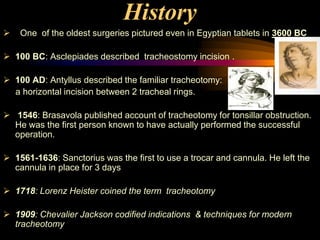
 One of the oldest surgeries pictured even in Egyptian tablets in 3600 BC
 100 BC: Asclepiades described tracheostomy incision .
 100 AD: Antyllus described the familiar tracheotomy:
a horizontal incision between 2 tracheal rings.
 1546: Brasavola published account of tracheotomy for tonsillar obstruction.
He was the first person known to have actually performed the successful
operation.
 1561-1636: Sanctorius was the first to use a trocar and cannula. He left the
cannula in place for 3 days
 1718: Lorenz Heister coined the term tracheotomy
 1909: Chevalier Jackson codified indications & techniques for modern
tracheotomy
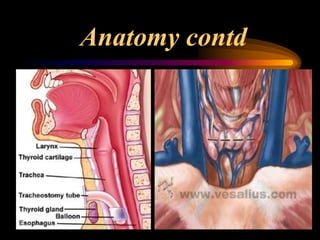
Anatomy
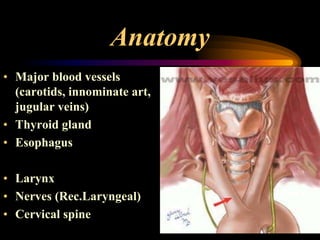
• Major blood vessels
(carotids, innominate art,
jugular veins)
• Thyroid gland
• Esophagus
• Larynx
• Nerves (Rec.Laryngeal)
• Cervical spine
Anatomy contd
Tracheotomy Indications
To bypass obstruction
- Tumors (of oropharynx, larynx, upper trachea)
- Infections (epiglottitis,diphteria, etc)
- Bilateral Vocal Cord Paralysis
- Trauma (maxillofacial fractures,severe bleeding, airway
obstruction,laryngeal injuries.)
- Edema (tongue, laryngopharynx)
- Intubation failure
- Foreign body obstruction
- Subglottic or tracheal stenosis
Tracheotomy Indications
• Need for prolonged ventilatory support
• Neuromuscular diseases paralyzing or weakening chest
muscles & diaphragm.
• Cervical sp cord injuries +/- respiratory muscle paralysis.
• Aspirations related to CNS, muscular or sensory impairement
• To reduce anatomic dead space and increase the chance for
mechanical ventilation withdrawal
• Better ease of nursing care & Pulmonary toileting.
• To improve the patient`s comfort & quality of life (easier
toileting,ability to speak & eat increase the mobility)
Advantages
• Less irritation of nose, mouth and throat.
• Mouth care is much easier to perform thus indirectly
preventing VAP.
• The patient is able to cough up mucus as the airway
distance is shorter.
• Lesser amount of sedation so early withdrawal from
ventilation and decreased risk of VAP.
• Ability to speak and if the patient can swallow,he can
eat and drink
Disadvantages
• Procedure related complications - primarily
bleeding.
• Pneumothorax , pneumomediastinum,injuries to
other structures.
• A scar will remain visible on the neck –very
minimal or not seen in PCDT.
• Delayed complications – tracheal
stenosis,tracheal stricture and tracheo-
esophageal fistula.
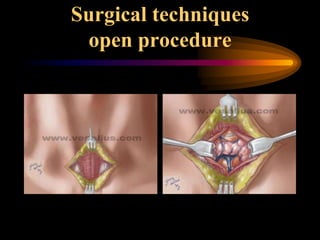
Surgical techniques
open procedure
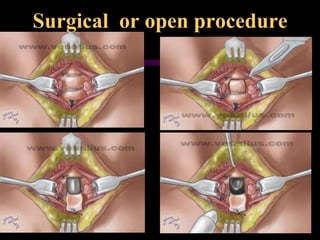
Surgical or open procedure
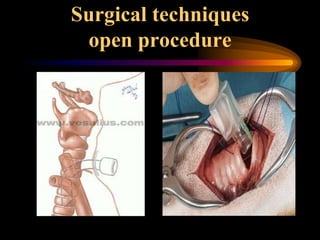
Surgical techniques
open procedure
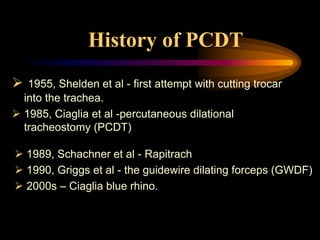
History of PCDT
 1955, Shelden et al - first attempt with cutting trocar
into the trachea.
 1985, Ciaglia et al -percutaneous dilational
tracheostomy (PCDT)
 1989, Schachner et al - Rapitrach
 1990, Griggs et al - the guidewire dilating forceps (GWDF)
 2000s – Ciaglia blue rhino.
Percutaneous approach
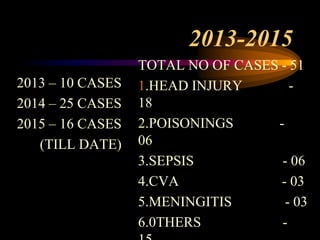
2013-2015
2013 – 10 CASES
2014 – 25 CASES
2015 – 16 CASES
(TILL DATE)
TOTAL NO OF CASES - 51
1.HEAD INJURY -
18
2.POISONINGS -
06
3.SEPSIS - 06
4.CVA - 03
5.MENINGITIS - 03
6.0THERS -
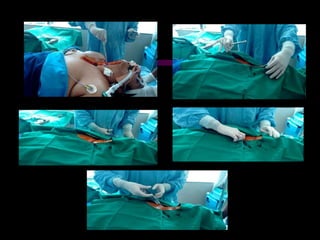
THE PROCEDURE….
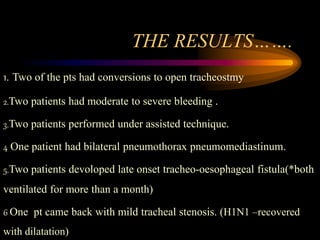
THE RESULTS…….
1. Two of the pts had conversions to open tracheostmy
2.Two patients had moderate to severe bleeding .
3.Two patients performed under assisted technique.
4 One patient had bilateral pneumothorax pneumomediastinum.
5.Two patients devoloped late onset tracheo-oesophageal fistula(*both
ventilated for more than a month)
6 One pt came back with mild tracheal stenosis. (H1N1 –recovered
with dilatation)
Complications –Immediate.
• Apnea due to transient loss of ventilatory support must .
• False root / false passage.
• Bleeding
• Pneumothorax or pneumomediastinum
• Damage to the vocal cords (direct)
• Injury to adjacent structures: recurrent laryngeal nerves,
the great vessels, and the esophagus.
• Post-obstructive pulmonary edema
• Hypotension
• Arrhythmia
Complications - Early
• Early bleeding: This is usually the result of increased blood
pressure as the patient emerges from anesthesia and begins
to cough.
• Plugging with mucus
• Tracheitis
• Cellulitis or local infection.
• Tube displacement
• Subcutaneous emphysema
• Atelectasis
Complications - Late
• Bleeding - tracheoinnominate fistula
• Tracheo- and laryngomalacia
• Stenosis
• Tracheoesophageal fistula
• Tracheocutaneous fistula
• Granulation
• Scarring
• Failure to decannulate
CONCLUSIONS
1. PCDT – a safe and effective method in trained hands
2. Cost effective requires less assistants,less time(3-5min avg )
3. Early /immediate complications are known but self limiting
(primarily bleeding)
4. Late complications comparable with surgical method, incidence
is LESS.
5. Overall a safe method. Use of USG and bronchoscopy to be
encouraged when available.
THAT’S FAIRY TALE…….
THANK YOU

Pcdt

  • 1.
    PCDT A COMPARITIVE AUDITOF A NEW PROCEDURE IN MICU 2013 - 2015
  • 2.
    What is “Tracheostomy” The word “tracheotomy” is derived from the Latin “trachea” and “tomein” (to make an opening).  Tracheostomy is an operative procedure that creates a surgical airway in the cervical trachea .  Traditionally surgical or open has been the choice, off late percutaneous or PCDT is used more often.
  • 3.
    History  One ofthe oldest surgeries pictured even in Egyptian tablets in 3600 BC  100 BC: Asclepiades described tracheostomy incision .  100 AD: Antyllus described the familiar tracheotomy: a horizontal incision between 2 tracheal rings.  1546: Brasavola published account of tracheotomy for tonsillar obstruction. He was the first person known to have actually performed the successful operation.  1561-1636: Sanctorius was the first to use a trocar and cannula. He left the cannula in place for 3 days  1718: Lorenz Heister coined the term tracheotomy  1909: Chevalier Jackson codified indications & techniques for modern tracheotomy
  • 4.
    Anatomy • Major bloodvessels (carotids, innominate art, jugular veins) • Thyroid gland • Esophagus • Larynx • Nerves (Rec.Laryngeal) • Cervical spine
  • 5.
  • 6.
    Tracheotomy Indications To bypassobstruction - Tumors (of oropharynx, larynx, upper trachea) - Infections (epiglottitis,diphteria, etc) - Bilateral Vocal Cord Paralysis - Trauma (maxillofacial fractures,severe bleeding, airway obstruction,laryngeal injuries.) - Edema (tongue, laryngopharynx) - Intubation failure - Foreign body obstruction - Subglottic or tracheal stenosis
  • 7.
    Tracheotomy Indications • Needfor prolonged ventilatory support • Neuromuscular diseases paralyzing or weakening chest muscles & diaphragm. • Cervical sp cord injuries +/- respiratory muscle paralysis. • Aspirations related to CNS, muscular or sensory impairement • To reduce anatomic dead space and increase the chance for mechanical ventilation withdrawal • Better ease of nursing care & Pulmonary toileting. • To improve the patient`s comfort & quality of life (easier toileting,ability to speak & eat increase the mobility)
  • 8.
    Advantages • Less irritationof nose, mouth and throat. • Mouth care is much easier to perform thus indirectly preventing VAP. • The patient is able to cough up mucus as the airway distance is shorter. • Lesser amount of sedation so early withdrawal from ventilation and decreased risk of VAP. • Ability to speak and if the patient can swallow,he can eat and drink
  • 9.
    Disadvantages • Procedure relatedcomplications - primarily bleeding. • Pneumothorax , pneumomediastinum,injuries to other structures. • A scar will remain visible on the neck –very minimal or not seen in PCDT. • Delayed complications – tracheal stenosis,tracheal stricture and tracheo- esophageal fistula.
  • 10.
  • 11.
  • 12.
  • 13.
    History of PCDT 1955, Shelden et al - first attempt with cutting trocar into the trachea.  1985, Ciaglia et al -percutaneous dilational tracheostomy (PCDT)  1989, Schachner et al - Rapitrach  1990, Griggs et al - the guidewire dilating forceps (GWDF)  2000s – Ciaglia blue rhino.
  • 14.
  • 15.
    2013-2015 2013 – 10CASES 2014 – 25 CASES 2015 – 16 CASES (TILL DATE) TOTAL NO OF CASES - 51 1.HEAD INJURY - 18 2.POISONINGS - 06 3.SEPSIS - 06 4.CVA - 03 5.MENINGITIS - 03 6.0THERS -
  • 17.
  • 20.
    THE RESULTS……. 1. Twoof the pts had conversions to open tracheostmy 2.Two patients had moderate to severe bleeding . 3.Two patients performed under assisted technique. 4 One patient had bilateral pneumothorax pneumomediastinum. 5.Two patients devoloped late onset tracheo-oesophageal fistula(*both ventilated for more than a month) 6 One pt came back with mild tracheal stenosis. (H1N1 –recovered with dilatation)
  • 21.
    Complications –Immediate. • Apneadue to transient loss of ventilatory support must . • False root / false passage. • Bleeding • Pneumothorax or pneumomediastinum • Damage to the vocal cords (direct) • Injury to adjacent structures: recurrent laryngeal nerves, the great vessels, and the esophagus. • Post-obstructive pulmonary edema • Hypotension • Arrhythmia
  • 22.
    Complications - Early •Early bleeding: This is usually the result of increased blood pressure as the patient emerges from anesthesia and begins to cough. • Plugging with mucus • Tracheitis • Cellulitis or local infection. • Tube displacement • Subcutaneous emphysema • Atelectasis
  • 23.
    Complications - Late •Bleeding - tracheoinnominate fistula • Tracheo- and laryngomalacia • Stenosis • Tracheoesophageal fistula • Tracheocutaneous fistula • Granulation • Scarring • Failure to decannulate
  • 25.
    CONCLUSIONS 1. PCDT –a safe and effective method in trained hands 2. Cost effective requires less assistants,less time(3-5min avg ) 3. Early /immediate complications are known but self limiting (primarily bleeding) 4. Late complications comparable with surgical method, incidence is LESS. 5. Overall a safe method. Use of USG and bronchoscopy to be encouraged when available.
  • 27.