Mujtaba Ashraf 16/09/2015 1
Prepared by: Dr-Abdikadir Daahir Jaama
Topic: Blood Group
Tel: +252634992499
Coutry: Somalia
E-mail: Halaasi143@outlook.com
Introduction
Blood group systems
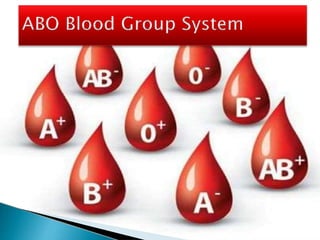
 ABO blood group system
Rh blood group system
Mujtaba Ashraf 16/09/2015 2
Blood transfusion
Mujtaba Ashraf 16/09/2015 3
Introduction
 Precautions
„Adverse effect Of Blood Transfusion
Exchange Transfusion
 A blood group also called a BloodType
 Classification of blood is based on the presence or
absence of inherited antigenic substances on the surface
of red blood cells (RBCs)
 These antigens may be proteins,
carbohydrates, glycoproteins, or glycolipids, depending
on the blood group system.
Mujtaba Ashraf 16/09/2015 4
16/09Mujtaba Ashraf
The ABO blood group system is the most
important blood type system (or blood group
system) in human blood transfusion.
ABO blood types are also present in some
other animals
for example rodents and apes such as
chimpanzees, bonobos and gorillas.
Mujtaba Ashraf 16/09/2015 6
Determination of ABO blood groups depends
upon the immunological reaction between
antigen and antibody.
Antigens are also called agglutinogens
because of their capacity to cause
agglutination of RBCs.
Mujtaba Ashraf 16/09/2015 7
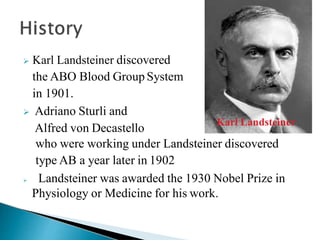
 Karl Landsteiner discovered
the ABO Blood Group System
in 1901.
 Adriano Sturli and
Alfred von Decastello
who were working under Landsteiner discovered
type AB a year later in 1902
 Landsteiner was awarded the 1930 Nobel Prize in
Physiology or Medicine for his work.
Karl Landsteiner
Mujtaba Ashraf 16/09/2015 8
Janský is credited with the first classification of blood
into the four types (A, B, AB, O) in 1907, which remains in
use today.
Reuben Ottenberg successfully transfused blood between
two people at Mount Sinai Hospital in New York. He was
the first person to record pre-transfusion testing for blood
compatibility in a clinical setting.
Later in 1954 he was the first to be awarded with Karl
Landsteiner Award
Mujtaba Ashraf 16/09/2015 9
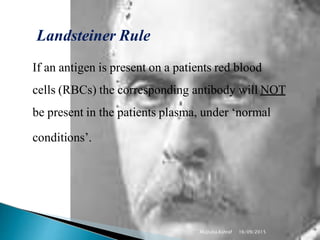
Landsteiner Rule
Mujtaba Ashraf 16/09/2015 10
If an antigen is present on a patients red blood
cells (RBCs) the corresponding antibody will NOT
be present in the patients plasma, under ‘normal
conditions’.
ABO BASICS
Mujtaba Ashraf 16/09/2015 11
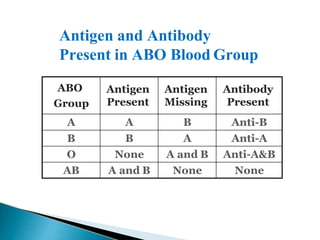
Based on the presence or absence of antigen Aand
antigen B, blood is divided into four groups:
‘A, B, AB and ‘O’group.
Blood having antigen A belongs to ‘A’group.This
blood has β-antibody in the serum.
Blood with antigen B and α-antibody belongs to ‘B’
group.
If both the antigens are present, blood group is called
‘AB’ group and serum of this group does notcontain
any antibody.
If both antigens are absent, the blood group is called
‘O’ group and both α and β antibodies are present in
the serum.
Mujtaba Ashraf 16/09/2015 12
ABO
Group
Antigen
Present
Antigen
Missing
Antibody
Present
A A B Anti-B
B B A Anti-A
O None A and B Anti-A&B
AB A and B None None
Mujtaba Ashraf 16/09/2015 13
Antigen and Antibody
Present in ABO Blood Group
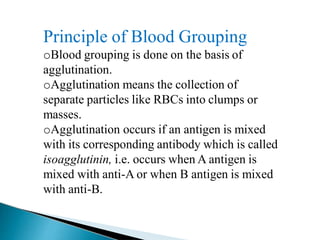
Principle of Blood Grouping
Mujtaba Ashraf 16/09/2015 14
oBlood grouping is done on the basis of
agglutination.
oAgglutination means the collection of
separate particles like RBCs into clumps or
masses.
oAgglutination occurs if an antigen is mixed
with its corresponding antibody which is called
isoagglutinin, i.e. occurs when A antigen is
mixed with anti-A or when B antigen is mixed
with anti-B.
IMPORTANCE OFABO GROUPS
IN BLOOD TRANSFUSION
During blood transfusion, only compatible blood must
be used.
The one who gives blood is called the ‘donor’ andthe
one who receives the blood is called ‘recipient’.
While transfusing the blood, antigen of the donor and
the antibody of the recipient are considered.
Mujtaba Ashraf 16/09/2015 15
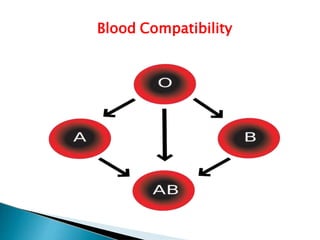
The antibody of the donor and antigen of the
recipient are ignored mostly.
Thus, RBC of ‘O’ group has no antigen and so
agglutination does not occur with any other group
of blood. So, ‘O’ group blood can be given to any
blood group persons and the people with this blood
group are called ‘universal donors’.
Mujtaba Ashraf 16/09/2015 16
Plasma of AB group blood has no antibody. This does
not cause agglutination of RBC from any other group
of blood.
People with AB group can receive blood from any
blood group persons. So, people with this blood
group are called ‘universal recipients’.
Mujtaba Ashraf 16/09/2015 17
In mismatched transfusion,
the transfusion reactions occur between
donor’s RBC and recipient’s plasma.
So, if the donor’s plasma contains
agglutinins against recipient’s RBC,
agglutination does not occur because
these antibodies are diluted in the
recipient’s blood.
Mujtaba Ashraf 16/09/2015 18
Blood Compatibility
Mujtaba Ashraf 16/09/2015 19
TRANSFUSION REACTIONS
DUE TO ABO INCOMPATIBILITY
Transfusion reactions are the adverse reactions in the
body, which occur due to transfusion error that
involves transfusion of incompatible (mismatched)
blood.
The reactions may be mild causing only fever and
hives (skin disorder characterized by itching) or may
be severe leading to renal failure, shock and death.
Mujtaba Ashraf 16/09/2015 20
Mujtaba Ashraf 16/09/2015 21
The Rh blood group system is one of thirty-
five current human blood group systems.
It is the most important blood group system
afterABO.
Rh blood group system consists of 50 defined
blood-group antigens, among them there are six
common types of Rh antigens.
Each of which is called an Rh factor.
These types are designated C,D, E, c, d, and e.
Mujtaba Ashraf 16/09/2015 22
The type D antigen is widely prevalent in the
population and considerably more antigenic than
the other Rh antigens.
Anyone who has this type of antigen is said to be
Rh positive, whereas a person who does not have
type D antigen is said to be Rh negative.
Mujtaba Ashraf 16/09/2015 23
This antigen was discovered by Karl
Landsteiner and Alexander Wiener in 1940.
It was first discovered in Rhesus macaque and
hence the name 'Rh factor’.
Mujtaba Ashraf 16/09/2015 24
Erythroblastosis Fetalis (“Hemolytic Disease of the Newborn”)
Erythroblastosis fetalis is a disease of the fetus and
newborn child characterized by agglutination and
phagocytosis of the fetus’s red blood cells.
In most instances of erythroblastosis fetalis, the
mother is Rh negative and the father Rh positive.
The baby has inherited the Rh-positive antigen from the
father, and the mother develops anti-Rh agglutinins
from exposure to the fetus’s Rh antigen.
In turn, the mother’s agglutinins diffuse through the
placenta into the fetus and cause red blood cell
agglutination.
Mujtaba Ashraf 16/09/2015 25
Symptoms and signs in the fetus:
Enlarged liver spleen, or heart
Mujtaba Ashraf 16/09/2015 26
fluid buildup in the fetus' abdomen seen via
ultrasound.
Symptoms and signs in the newborn:
•Anemia that creates the newborn's pallor
(pale appearance).
•Jaundice or yellow discoloration of the
newborn's skin, sclera or mucous
membrane.
•Enlargement of the newborn's liver and
spleen.
•Severe edema of the entire body.
•Dyspnea or difficulty breathing.
Mujtaba Ashraf 16/09/2015 27
Mujtaba Ashraf 16/09/2015 28
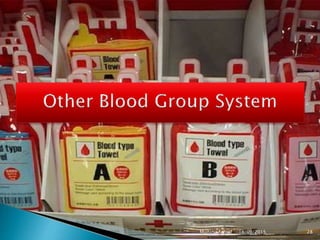
Thirty-five major blood group systems were
recognized by the International Society of Blood
Transfusion (ISBT) in October 2012.
In addition to the ABO antigens and Rhesus
antigens, many other antigens are expressed on
the red blood cell surface membrane.
Mujtaba Ashraf 16/09/2015 29
An individual can be AB Rh D positive, and at
the same time M and N positive (MNS system),
K positive (Kell system), and Lea or
Leb positive (Lewis system). Many of the blood
group systems were named after the patients in
whom the corresponding antibodies were
initially encountered.
Mujtaba Ashraf 16/09/2015 30
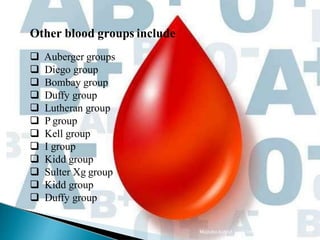
Other blood groups include
Mujtaba Ashraf 16/09/2015 31
 Auberger groups
 Diego group
 Bombay group
 Duffy group
 Lutheran group
 P group
 Kell group
 I group
 Kidd group
 Sulter Xg group
 Kidd group
 Duffy group
Mujtaba Ashraf 16/09/2015 32
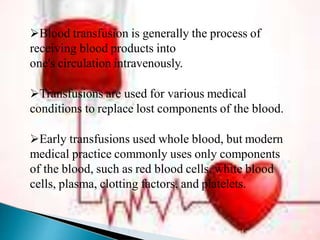
Blood transfusion is generally the process of
receiving blood products into
one's circulation intravenously.
Transfusions are used for various medical
conditions to replace lost components of the blood.
Early transfusions used whole blood, but modern
medical practice commonly uses only components
of the blood, such as red blood cells, white blood
cells, plasma, clotting factors, and platelets.
Mujtaba Ashraf 16/09/2015 33
Blood transfusion is the process of transferring
blood or blood components from one person (the
donor) into the bloodstream of another person (the
recipient).
Richard Lower pioneered the first blood
transfusion from animal to human in 1665 at
the Royal Society.
In 1840 Dr. Blundell, performed the first
successful whole blood transfusion to
treat haemophilia.
Mujtaba Ashraf 16/09/2015 34
•Before a blood transfusion is given, there are many steps
taken to ensure quality of the blood products,
compatibility, and safety to the recipient.
•Blood transfusions typically use sources of blood: one's
own (autologous transfusion), or someone else's
(allogeneic or homologous transfusion).
•The latter is much more common than the former.
•Using another's blood must first start with donation of
blood.
•Blood is most commonly donated as whole
blood intravenously and collecting it with
an anticoagulant.
Mujtaba Ashraf 16/09/2015 35
Processing and Testing of Blood
Mujtaba Ashraf 16/09/2015 36
Donated blood is usually subjected to processing
after it is collected, to make it suitable for use in
specific patient populations.
Collected blood is then separated into blood
components by centrifugation:
red blood cells, plasma, platelets, albumin protein,
clotting factor
concentrates, cryoprecipitate, fibrinogen concentrate
and immunoglobulins (antibodies)
All donated blood is tested for infections
like HIVs, Hepatitis B, Hepatitis C, Syphilis
All donated blood is also tested for ABO
and Rh groups, along with the presence of
any red blood cell antibodies.
Pathogen Reduction treatment done.
Mujtaba Ashraf 16/09/2015 37
CONDITIONS WHEN BLOOD TRANSFUSION
IS NECESSARY
Mujtaba Ashraf 16/09/2015 38
Anemia
Hemorrhage
Trauma
Burns
Surgery
PRECAUTIONS TO BE TAKEN BEFORE
THE TRANSFUSION OF BLOOD
Mujtaba Ashraf 16/09/2015 39
 Donor must be healthy, without any diseases like:
a. Sexually transmitted diseases such as syphilis
b. Diseases caused by virus like hepatitis, AIDS,
etc.
 Only compatible blood must be transfused
 Both matching and cross-matching must be done
 Rh compatibility must be confirmed.
PRECAUTIONS TO BE TAKEN WHILE
TRANSFUSING BLOOD
Mujtaba Ashraf 16/09/2015 40
 Apparatus for transfusion must be sterile
 Temperature of blood to be transfused must be
same as the body temperature
Transfusion of blood must be slow. The sudden
rapid infusion of blood into the body increases the
load on the heart, resulting in many complications.
Adverse effect of Blood transfusion
Transfusions of blood products are associated with
several complications, many of which can be grouped as
immunological or infectious such as:
Mujtaba Ashraf 16/09/2015 41
Acute hemolytic reaction
Delayed hemolytic reaction
Allergic reaction
Post-transfusion purpura
Transfusion associated acute lung injury
HIV
Hepatitis C
EXCHANGE TRANSFUSION
- is the procedure which involves
removal of patient’s blood completely and
replacement
with fresh blood or plasma of the donor.
Also known as replacement transfusion.
It is an important in life-saving procedure carried
out in conditions such as
severe jaundice, sickle cell anemia, erythroblastosis
fetalis, etc.
Mujtaba Ashraf 16/09/2015 42
References
Mujtaba Ashraf 16/09/2015 43
•Guyton-Physiology-11th edition
•Essentials of Medical Physiology, 6th Edition By K
Sembulingam
Mujtaba Ashraf 16/09/2015 44

Bloodgroup2

  • 1.
    Mujtaba Ashraf 16/09/20151 Prepared by: Dr-Abdikadir Daahir Jaama Topic: Blood Group Tel: +252634992499 Coutry: Somalia E-mail: Halaasi143@outlook.com
  • 2.
    Introduction Blood group systems ABO blood group system Rh blood group system Mujtaba Ashraf 16/09/2015 2
  • 3.
    Blood transfusion Mujtaba Ashraf16/09/2015 3 Introduction  Precautions „Adverse effect Of Blood Transfusion Exchange Transfusion
  • 4.
     A bloodgroup also called a BloodType  Classification of blood is based on the presence or absence of inherited antigenic substances on the surface of red blood cells (RBCs)  These antigens may be proteins, carbohydrates, glycoproteins, or glycolipids, depending on the blood group system. Mujtaba Ashraf 16/09/2015 4
  • 5.
  • 6.
    The ABO bloodgroup system is the most important blood type system (or blood group system) in human blood transfusion. ABO blood types are also present in some other animals for example rodents and apes such as chimpanzees, bonobos and gorillas. Mujtaba Ashraf 16/09/2015 6
  • 7.
    Determination of ABOblood groups depends upon the immunological reaction between antigen and antibody. Antigens are also called agglutinogens because of their capacity to cause agglutination of RBCs. Mujtaba Ashraf 16/09/2015 7
  • 8.
     Karl Landsteinerdiscovered the ABO Blood Group System in 1901.  Adriano Sturli and Alfred von Decastello who were working under Landsteiner discovered type AB a year later in 1902  Landsteiner was awarded the 1930 Nobel Prize in Physiology or Medicine for his work. Karl Landsteiner Mujtaba Ashraf 16/09/2015 8
  • 9.
    Janský is creditedwith the first classification of blood into the four types (A, B, AB, O) in 1907, which remains in use today. Reuben Ottenberg successfully transfused blood between two people at Mount Sinai Hospital in New York. He was the first person to record pre-transfusion testing for blood compatibility in a clinical setting. Later in 1954 he was the first to be awarded with Karl Landsteiner Award Mujtaba Ashraf 16/09/2015 9
  • 10.
    Landsteiner Rule Mujtaba Ashraf16/09/2015 10 If an antigen is present on a patients red blood cells (RBCs) the corresponding antibody will NOT be present in the patients plasma, under ‘normal conditions’.
  • 11.
    ABO BASICS Mujtaba Ashraf16/09/2015 11 Based on the presence or absence of antigen Aand antigen B, blood is divided into four groups: ‘A, B, AB and ‘O’group. Blood having antigen A belongs to ‘A’group.This blood has β-antibody in the serum.
  • 12.
    Blood with antigenB and α-antibody belongs to ‘B’ group. If both the antigens are present, blood group is called ‘AB’ group and serum of this group does notcontain any antibody. If both antigens are absent, the blood group is called ‘O’ group and both α and β antibodies are present in the serum. Mujtaba Ashraf 16/09/2015 12
  • 13.
    ABO Group Antigen Present Antigen Missing Antibody Present A A BAnti-B B B A Anti-A O None A and B Anti-A&B AB A and B None None Mujtaba Ashraf 16/09/2015 13 Antigen and Antibody Present in ABO Blood Group
  • 14.
    Principle of BloodGrouping Mujtaba Ashraf 16/09/2015 14 oBlood grouping is done on the basis of agglutination. oAgglutination means the collection of separate particles like RBCs into clumps or masses. oAgglutination occurs if an antigen is mixed with its corresponding antibody which is called isoagglutinin, i.e. occurs when A antigen is mixed with anti-A or when B antigen is mixed with anti-B.
  • 15.
    IMPORTANCE OFABO GROUPS INBLOOD TRANSFUSION During blood transfusion, only compatible blood must be used. The one who gives blood is called the ‘donor’ andthe one who receives the blood is called ‘recipient’. While transfusing the blood, antigen of the donor and the antibody of the recipient are considered. Mujtaba Ashraf 16/09/2015 15
  • 16.
    The antibody ofthe donor and antigen of the recipient are ignored mostly. Thus, RBC of ‘O’ group has no antigen and so agglutination does not occur with any other group of blood. So, ‘O’ group blood can be given to any blood group persons and the people with this blood group are called ‘universal donors’. Mujtaba Ashraf 16/09/2015 16
  • 17.
    Plasma of ABgroup blood has no antibody. This does not cause agglutination of RBC from any other group of blood. People with AB group can receive blood from any blood group persons. So, people with this blood group are called ‘universal recipients’. Mujtaba Ashraf 16/09/2015 17
  • 18.
    In mismatched transfusion, thetransfusion reactions occur between donor’s RBC and recipient’s plasma. So, if the donor’s plasma contains agglutinins against recipient’s RBC, agglutination does not occur because these antibodies are diluted in the recipient’s blood. Mujtaba Ashraf 16/09/2015 18
  • 19.
  • 20.
    TRANSFUSION REACTIONS DUE TOABO INCOMPATIBILITY Transfusion reactions are the adverse reactions in the body, which occur due to transfusion error that involves transfusion of incompatible (mismatched) blood. The reactions may be mild causing only fever and hives (skin disorder characterized by itching) or may be severe leading to renal failure, shock and death. Mujtaba Ashraf 16/09/2015 20
  • 21.
  • 22.
    The Rh bloodgroup system is one of thirty- five current human blood group systems. It is the most important blood group system afterABO. Rh blood group system consists of 50 defined blood-group antigens, among them there are six common types of Rh antigens. Each of which is called an Rh factor. These types are designated C,D, E, c, d, and e. Mujtaba Ashraf 16/09/2015 22
  • 23.
    The type Dantigen is widely prevalent in the population and considerably more antigenic than the other Rh antigens. Anyone who has this type of antigen is said to be Rh positive, whereas a person who does not have type D antigen is said to be Rh negative. Mujtaba Ashraf 16/09/2015 23
  • 24.
    This antigen wasdiscovered by Karl Landsteiner and Alexander Wiener in 1940. It was first discovered in Rhesus macaque and hence the name 'Rh factor’. Mujtaba Ashraf 16/09/2015 24
  • 25.
    Erythroblastosis Fetalis (“HemolyticDisease of the Newborn”) Erythroblastosis fetalis is a disease of the fetus and newborn child characterized by agglutination and phagocytosis of the fetus’s red blood cells. In most instances of erythroblastosis fetalis, the mother is Rh negative and the father Rh positive. The baby has inherited the Rh-positive antigen from the father, and the mother develops anti-Rh agglutinins from exposure to the fetus’s Rh antigen. In turn, the mother’s agglutinins diffuse through the placenta into the fetus and cause red blood cell agglutination. Mujtaba Ashraf 16/09/2015 25
  • 26.
    Symptoms and signsin the fetus: Enlarged liver spleen, or heart Mujtaba Ashraf 16/09/2015 26 fluid buildup in the fetus' abdomen seen via ultrasound.
  • 27.
    Symptoms and signsin the newborn: •Anemia that creates the newborn's pallor (pale appearance). •Jaundice or yellow discoloration of the newborn's skin, sclera or mucous membrane. •Enlargement of the newborn's liver and spleen. •Severe edema of the entire body. •Dyspnea or difficulty breathing. Mujtaba Ashraf 16/09/2015 27
  • 28.
  • 29.
    Thirty-five major bloodgroup systems were recognized by the International Society of Blood Transfusion (ISBT) in October 2012. In addition to the ABO antigens and Rhesus antigens, many other antigens are expressed on the red blood cell surface membrane. Mujtaba Ashraf 16/09/2015 29
  • 30.
    An individual canbe AB Rh D positive, and at the same time M and N positive (MNS system), K positive (Kell system), and Lea or Leb positive (Lewis system). Many of the blood group systems were named after the patients in whom the corresponding antibodies were initially encountered. Mujtaba Ashraf 16/09/2015 30
  • 31.
    Other blood groupsinclude Mujtaba Ashraf 16/09/2015 31  Auberger groups  Diego group  Bombay group  Duffy group  Lutheran group  P group  Kell group  I group  Kidd group  Sulter Xg group  Kidd group  Duffy group
  • 32.
  • 33.
    Blood transfusion isgenerally the process of receiving blood products into one's circulation intravenously. Transfusions are used for various medical conditions to replace lost components of the blood. Early transfusions used whole blood, but modern medical practice commonly uses only components of the blood, such as red blood cells, white blood cells, plasma, clotting factors, and platelets. Mujtaba Ashraf 16/09/2015 33
  • 34.
    Blood transfusion isthe process of transferring blood or blood components from one person (the donor) into the bloodstream of another person (the recipient). Richard Lower pioneered the first blood transfusion from animal to human in 1665 at the Royal Society. In 1840 Dr. Blundell, performed the first successful whole blood transfusion to treat haemophilia. Mujtaba Ashraf 16/09/2015 34
  • 35.
    •Before a bloodtransfusion is given, there are many steps taken to ensure quality of the blood products, compatibility, and safety to the recipient. •Blood transfusions typically use sources of blood: one's own (autologous transfusion), or someone else's (allogeneic or homologous transfusion). •The latter is much more common than the former. •Using another's blood must first start with donation of blood. •Blood is most commonly donated as whole blood intravenously and collecting it with an anticoagulant. Mujtaba Ashraf 16/09/2015 35
  • 36.
    Processing and Testingof Blood Mujtaba Ashraf 16/09/2015 36 Donated blood is usually subjected to processing after it is collected, to make it suitable for use in specific patient populations. Collected blood is then separated into blood components by centrifugation: red blood cells, plasma, platelets, albumin protein, clotting factor concentrates, cryoprecipitate, fibrinogen concentrate and immunoglobulins (antibodies)
  • 37.
    All donated bloodis tested for infections like HIVs, Hepatitis B, Hepatitis C, Syphilis All donated blood is also tested for ABO and Rh groups, along with the presence of any red blood cell antibodies. Pathogen Reduction treatment done. Mujtaba Ashraf 16/09/2015 37
  • 38.
    CONDITIONS WHEN BLOODTRANSFUSION IS NECESSARY Mujtaba Ashraf 16/09/2015 38 Anemia Hemorrhage Trauma Burns Surgery
  • 39.
    PRECAUTIONS TO BETAKEN BEFORE THE TRANSFUSION OF BLOOD Mujtaba Ashraf 16/09/2015 39  Donor must be healthy, without any diseases like: a. Sexually transmitted diseases such as syphilis b. Diseases caused by virus like hepatitis, AIDS, etc.  Only compatible blood must be transfused  Both matching and cross-matching must be done  Rh compatibility must be confirmed.
  • 40.
    PRECAUTIONS TO BETAKEN WHILE TRANSFUSING BLOOD Mujtaba Ashraf 16/09/2015 40  Apparatus for transfusion must be sterile  Temperature of blood to be transfused must be same as the body temperature Transfusion of blood must be slow. The sudden rapid infusion of blood into the body increases the load on the heart, resulting in many complications.
  • 41.
    Adverse effect ofBlood transfusion Transfusions of blood products are associated with several complications, many of which can be grouped as immunological or infectious such as: Mujtaba Ashraf 16/09/2015 41 Acute hemolytic reaction Delayed hemolytic reaction Allergic reaction Post-transfusion purpura Transfusion associated acute lung injury HIV Hepatitis C
  • 42.
    EXCHANGE TRANSFUSION - isthe procedure which involves removal of patient’s blood completely and replacement with fresh blood or plasma of the donor. Also known as replacement transfusion. It is an important in life-saving procedure carried out in conditions such as severe jaundice, sickle cell anemia, erythroblastosis fetalis, etc. Mujtaba Ashraf 16/09/2015 42
  • 43.
    References Mujtaba Ashraf 16/09/201543 •Guyton-Physiology-11th edition •Essentials of Medical Physiology, 6th Edition By K Sembulingam
  • 44.