Welcome to Journal
Club Presentation
Presented by,
Dnyanshree V. Tijare
Guide: Dr. Manoj Aswar
M. Pharm second year (Dept. of Pharmacology)
Rajarshi Shahu College of Pharmacy, Buldhana
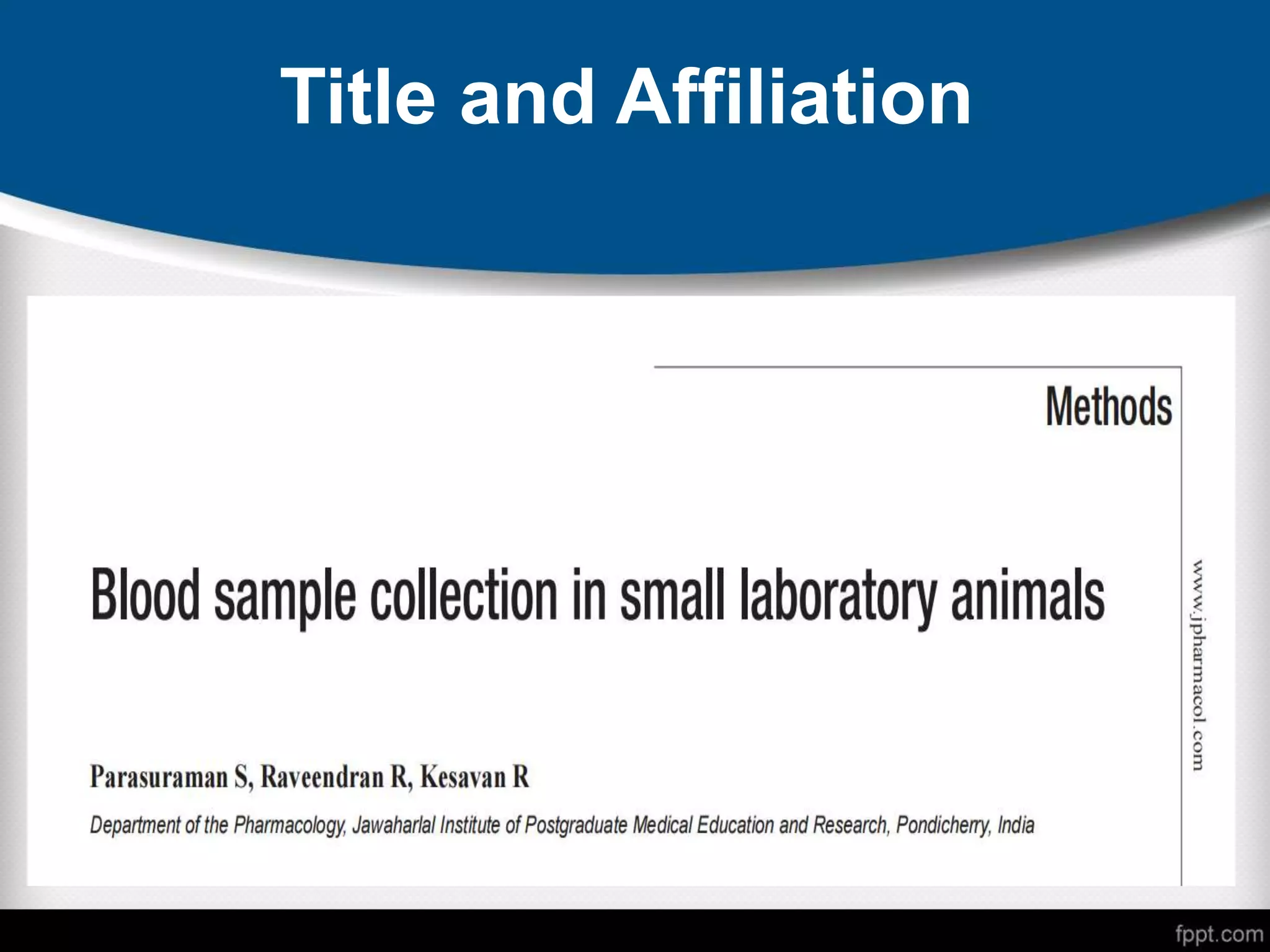
Title and Affiliation
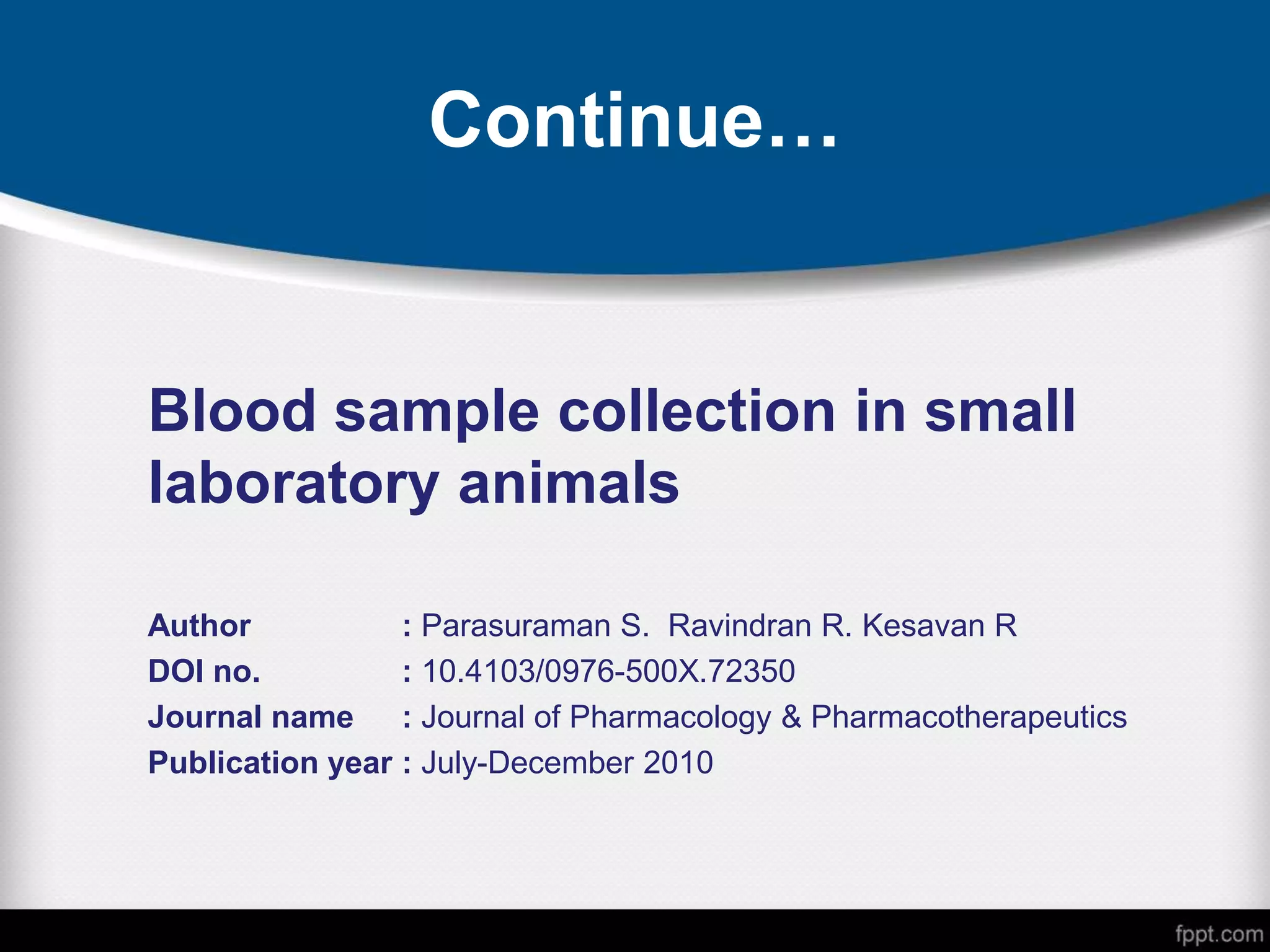
Continue…
Blood sample collection in small
laboratory animals
Author : Parasuraman S. Ravindran R. Kesavan R
DOI no. : 10.4103/0976-500X.72350
Journal name : Journal of Pharmacology & Pharmacotherapeutics
Publication year : July-December 2010
Content
General principles of blood collection method
Common anaesthetic agents required for lab animals
General methods for blood collection
Discussion & References
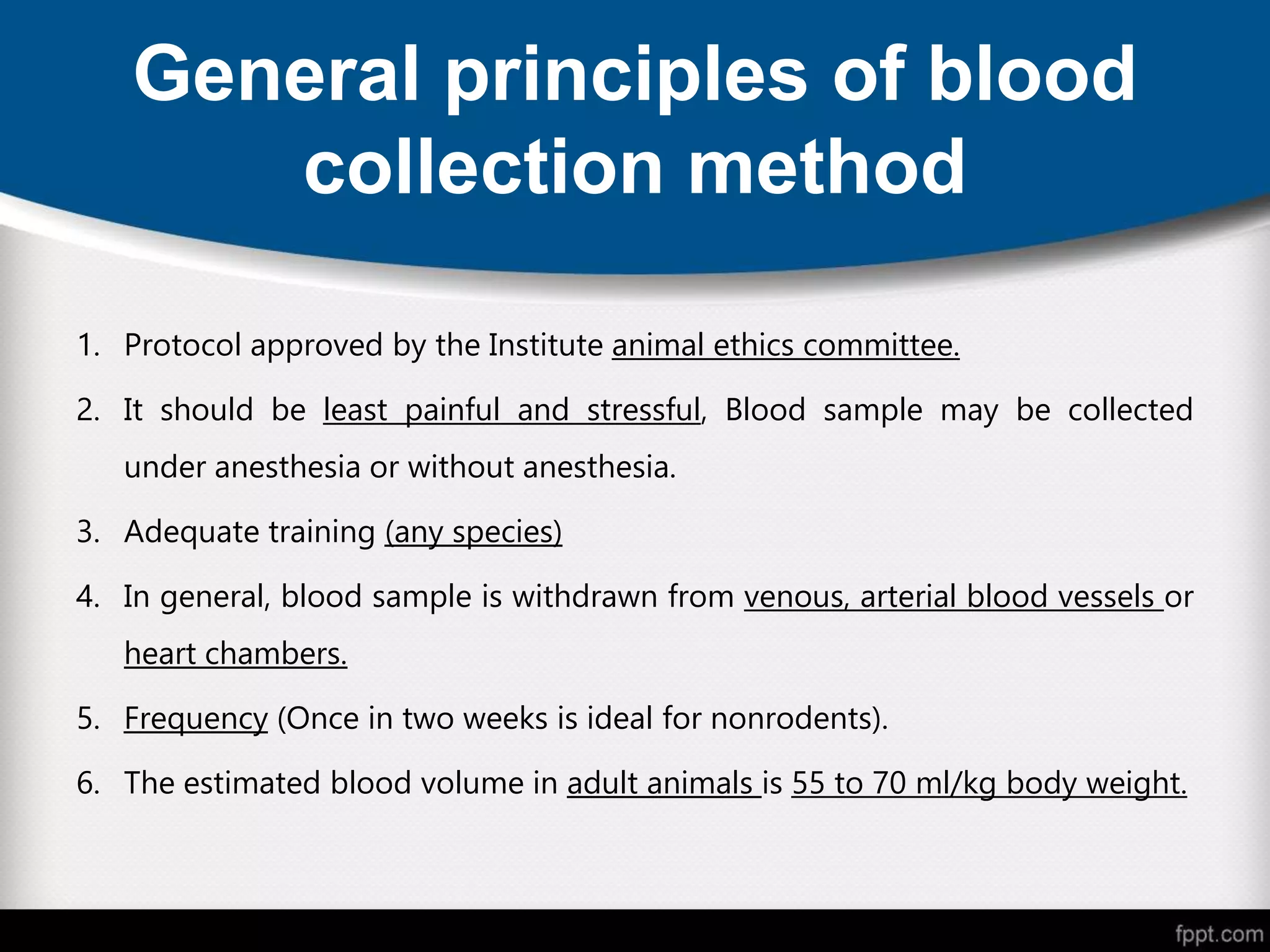
General principles of blood
collection method
1. Protocol approved by the Institute animal ethics committee.
2. It should be least painful and stressful, Blood sample may be collected
under anesthesia or without anesthesia.
3. Adequate training (any species)
4. In general, blood sample is withdrawn from venous, arterial blood vessels or
heart chambers.
5. Frequency (Once in two weeks is ideal for nonrodents).
6. The estimated blood volume in adult animals is 55 to 70 ml/kg body weight.
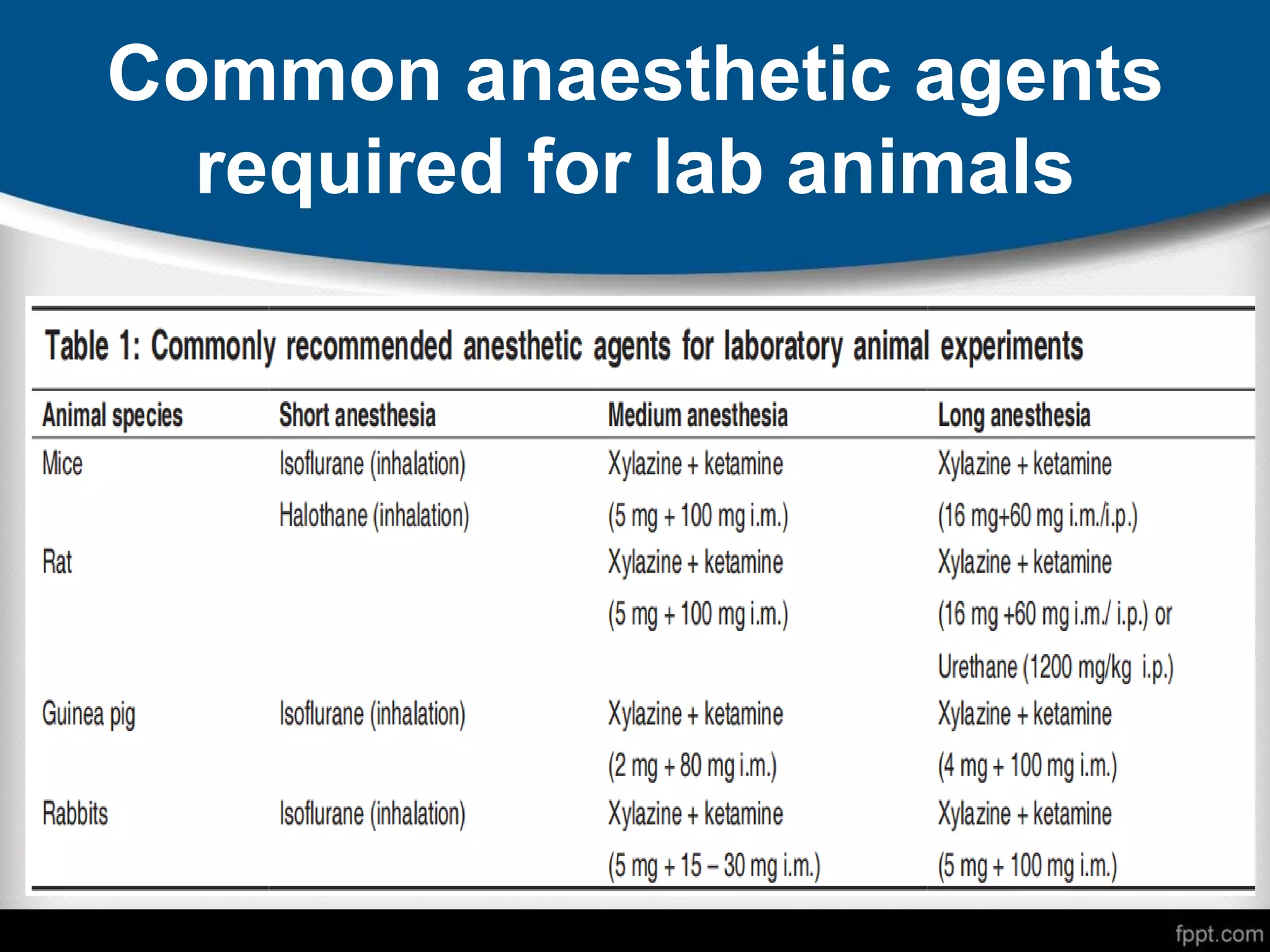
Common anaesthetic agents
required for lab animals
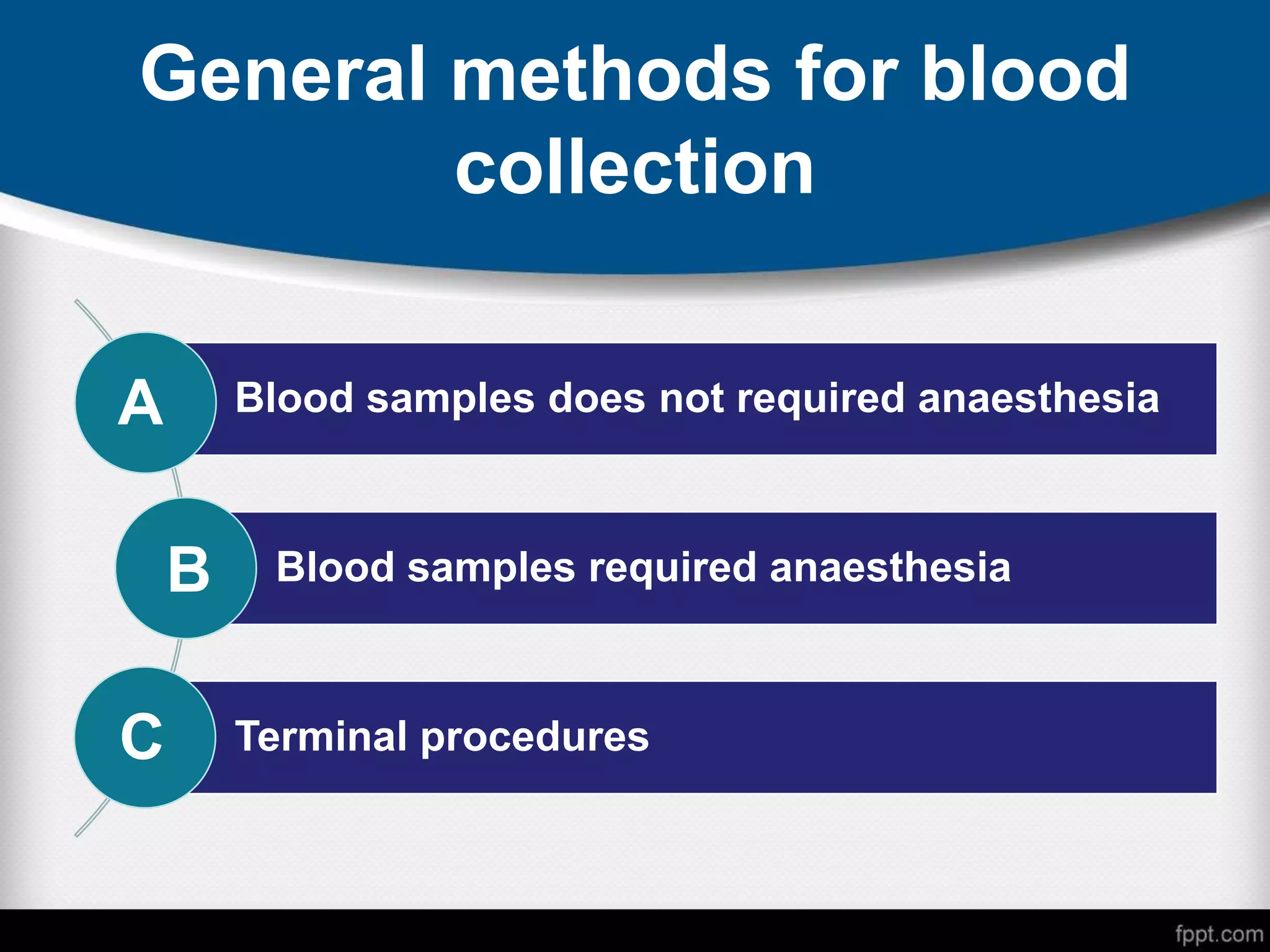
General methods for blood
collection
Blood samples does not required anaesthesia
Blood samples required anaesthesia
Terminal procedures
A
B
C
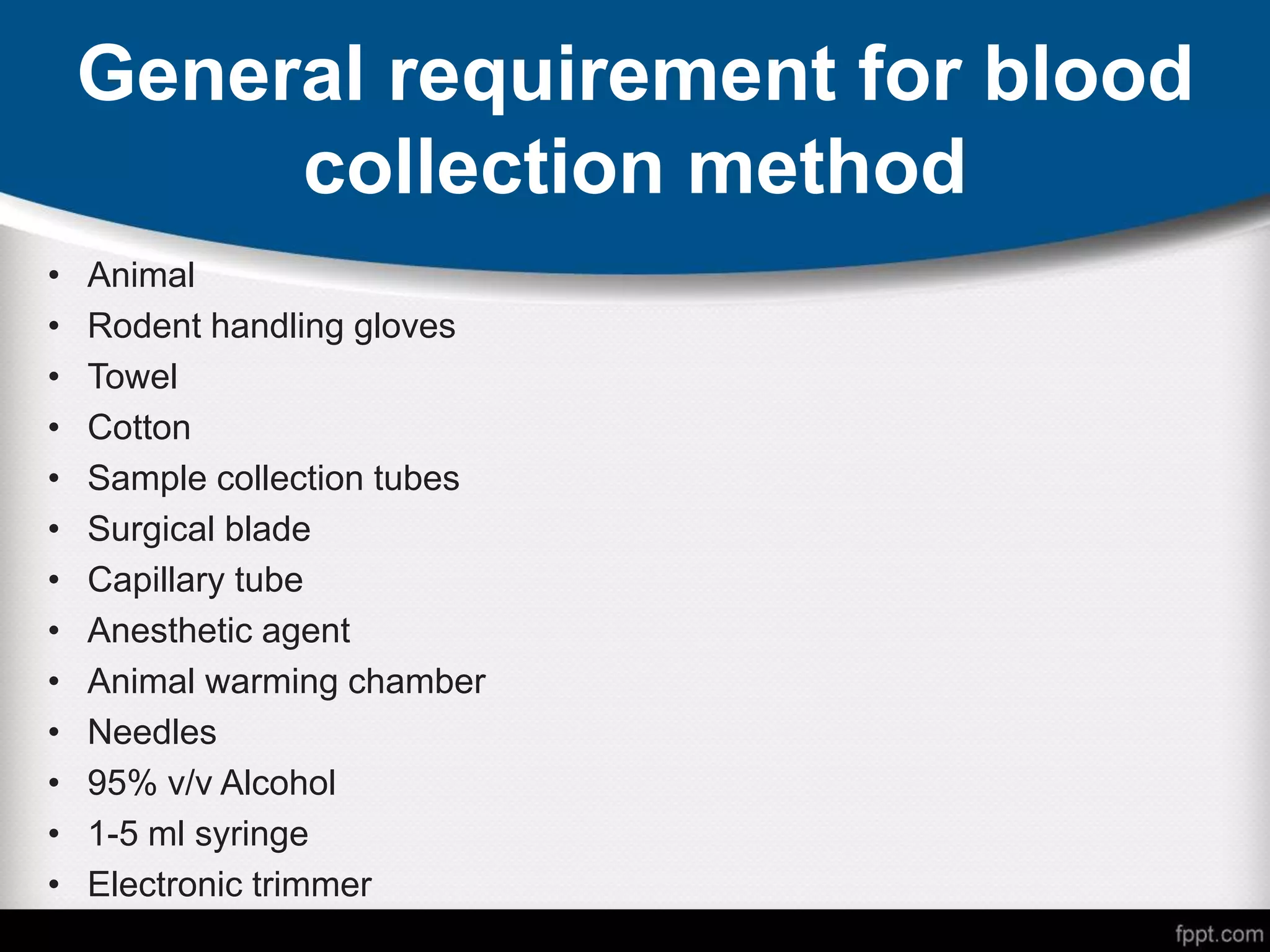
General requirement for blood
collection method
• Animal
• Rodent handling gloves
• Towel
• Cotton
• Sample collection tubes
• Surgical blade
• Capillary tube
• Anesthetic agent
• Animal warming chamber
• Needles
• 95% v/v Alcohol
• 1-5 ml syringe
• Electronic trimmer
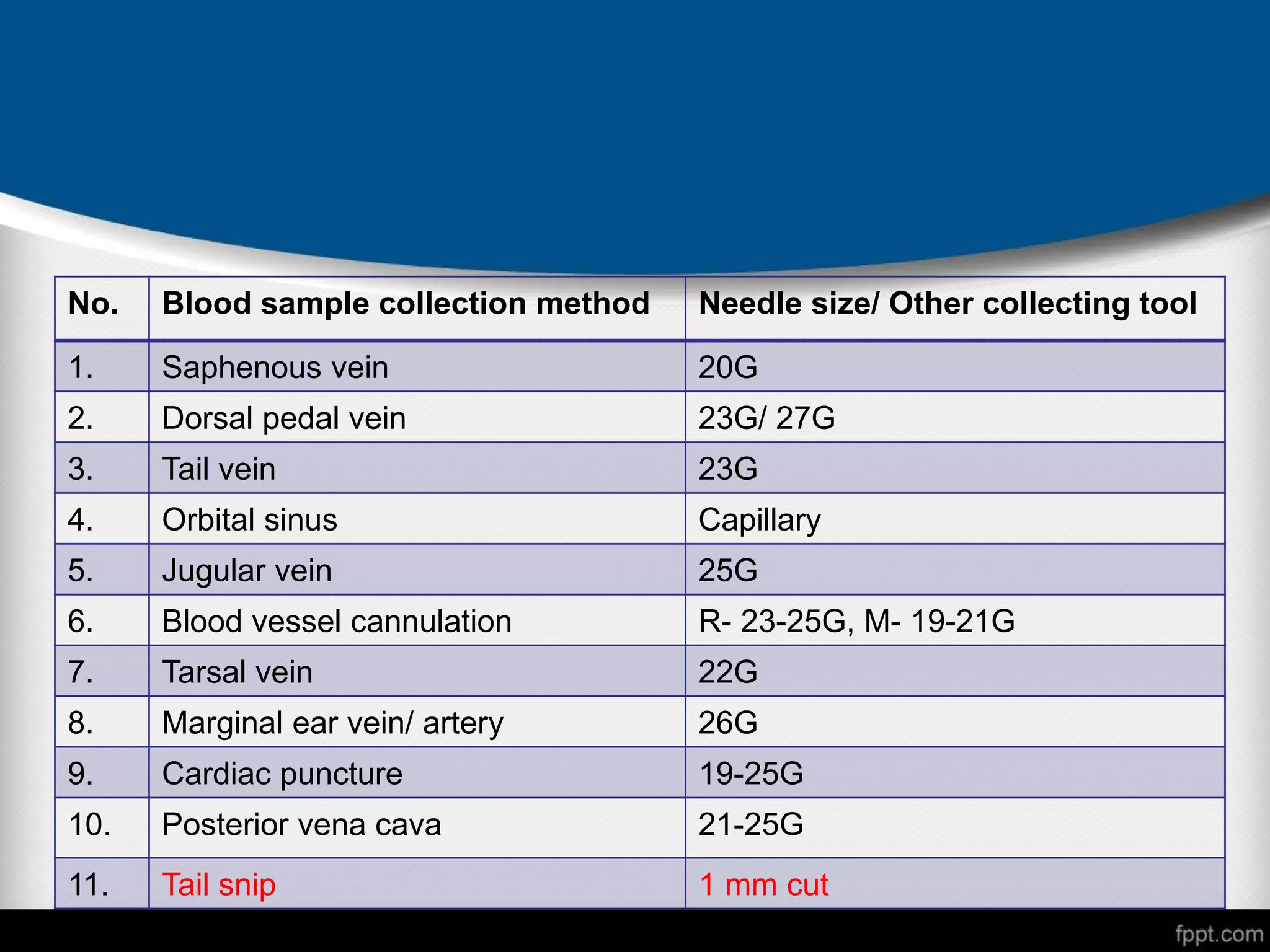
No. Blood sample collection method Needle size/ Other collecting tool
1. Saphenous vein 20G
2. Dorsal pedal vein 23G/ 27G
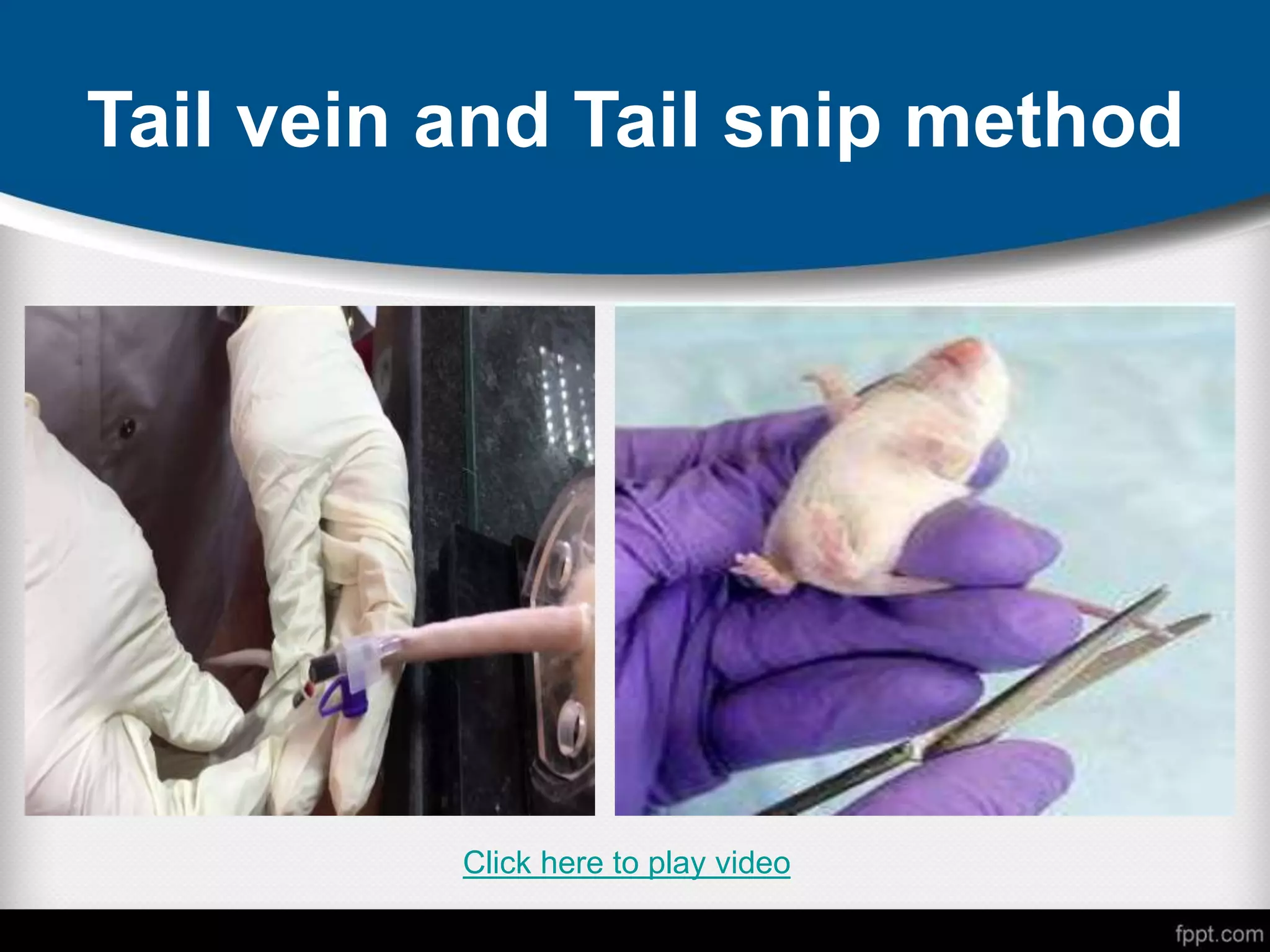
3. Tail vein 23G
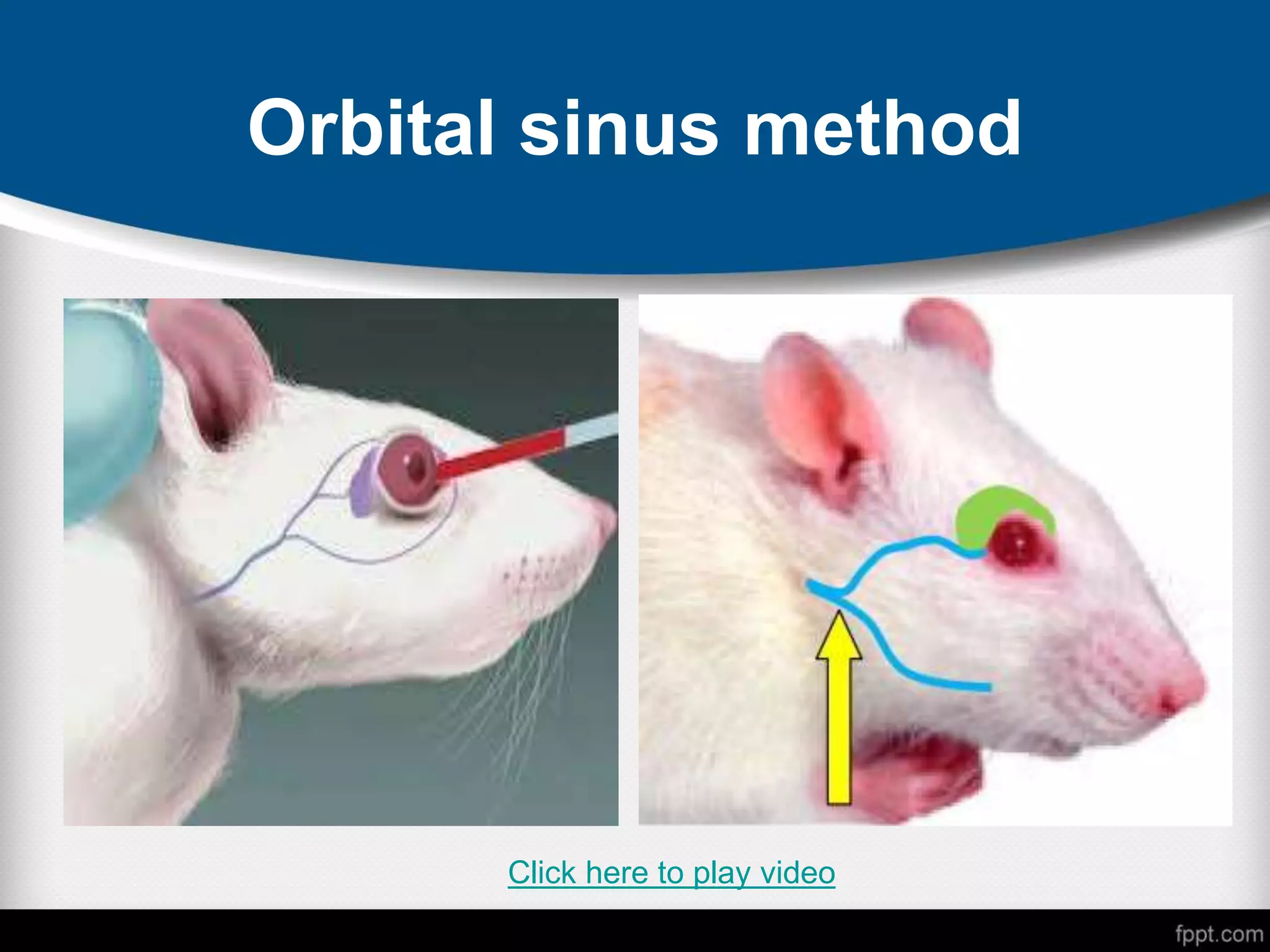
4. Orbital sinus Capillary
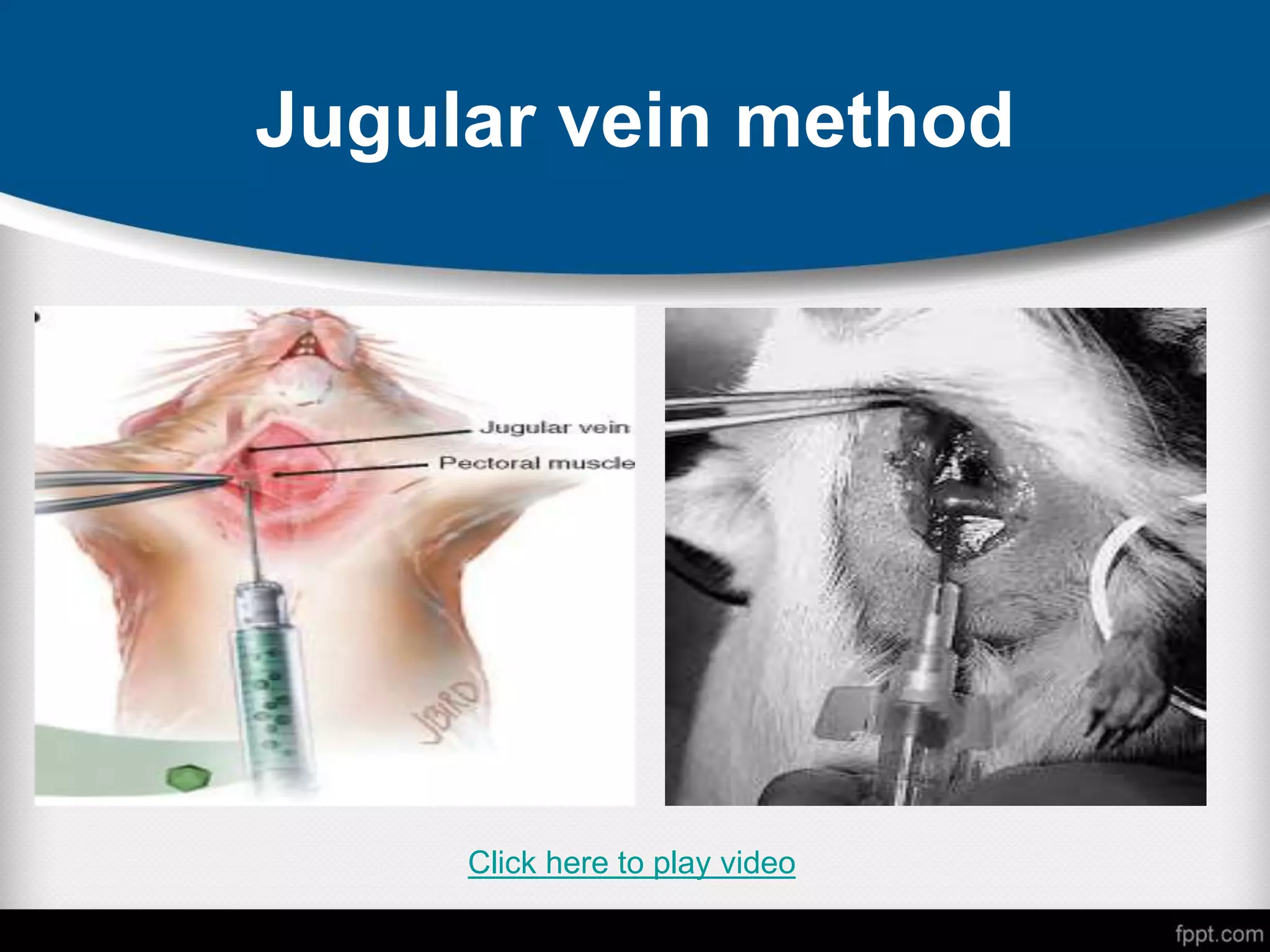
5. Jugular vein 25G
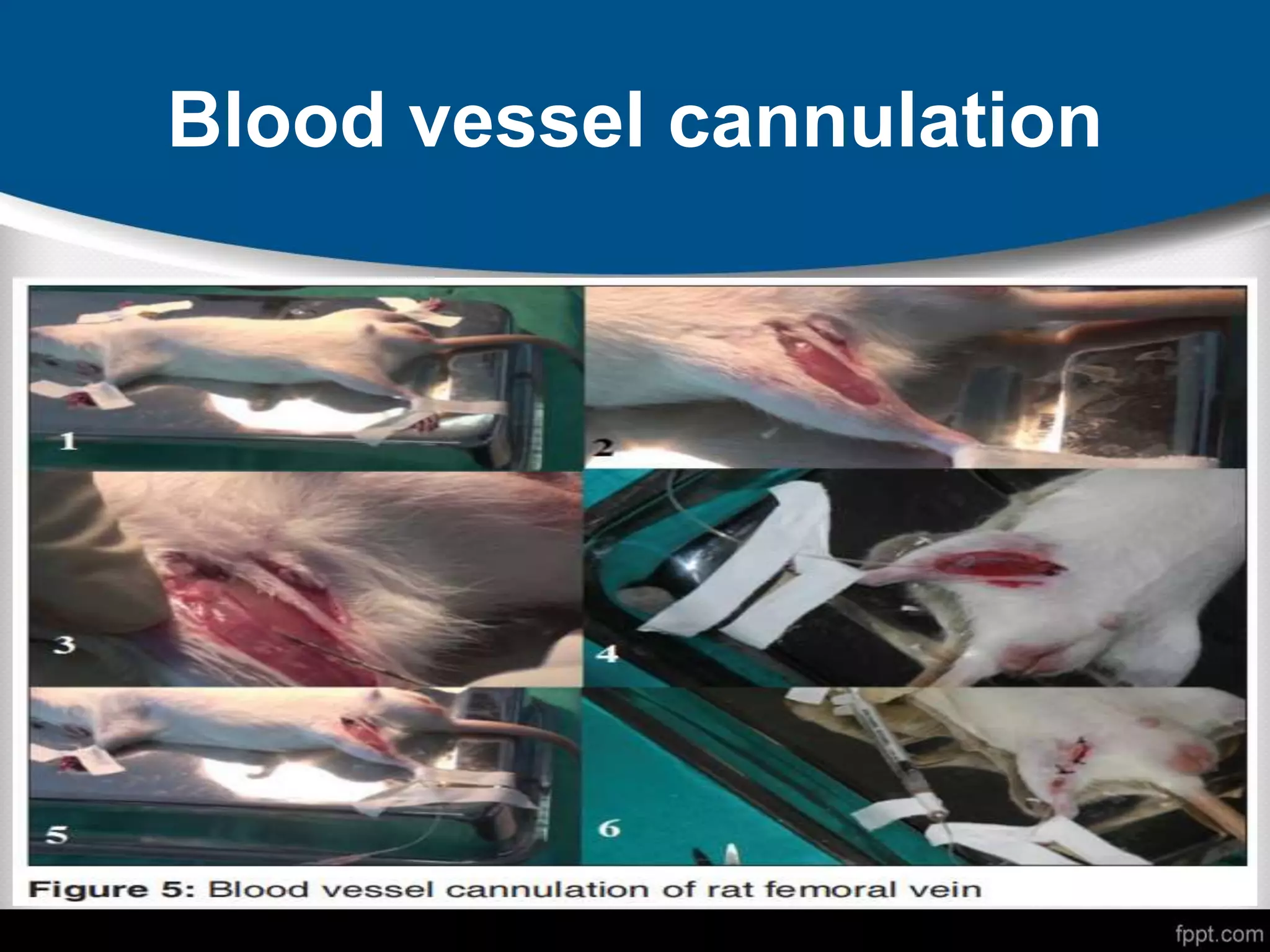
6. Blood vessel cannulation R- 23-25G, M- 19-21G
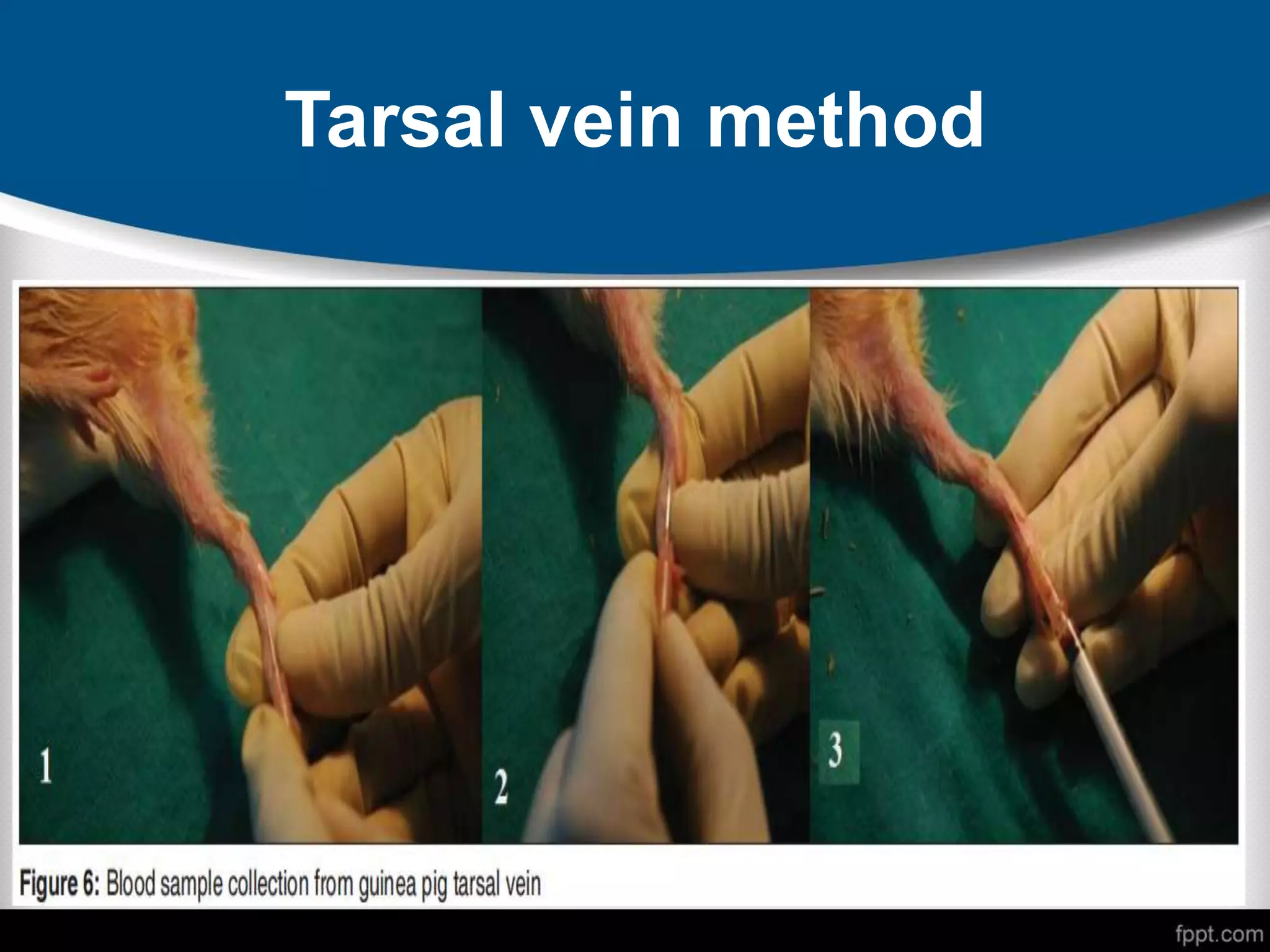
7. Tarsal vein 22G
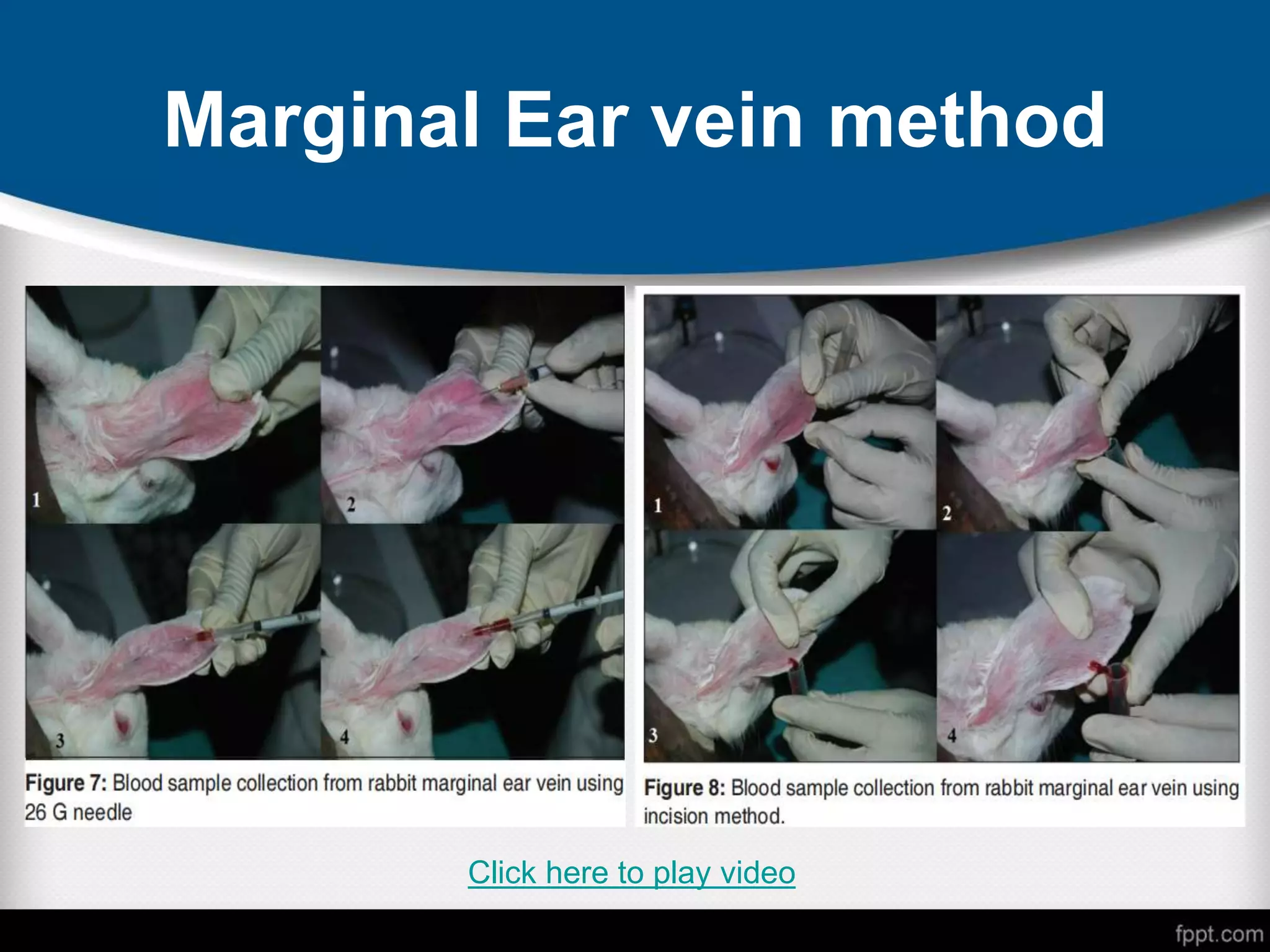
8. Marginal ear vein/ artery 26G
9. Cardiac puncture 19-25G
10. Posterior vena cava 21-25G
11. Tail snip 1 mm cut
Blood sample collection
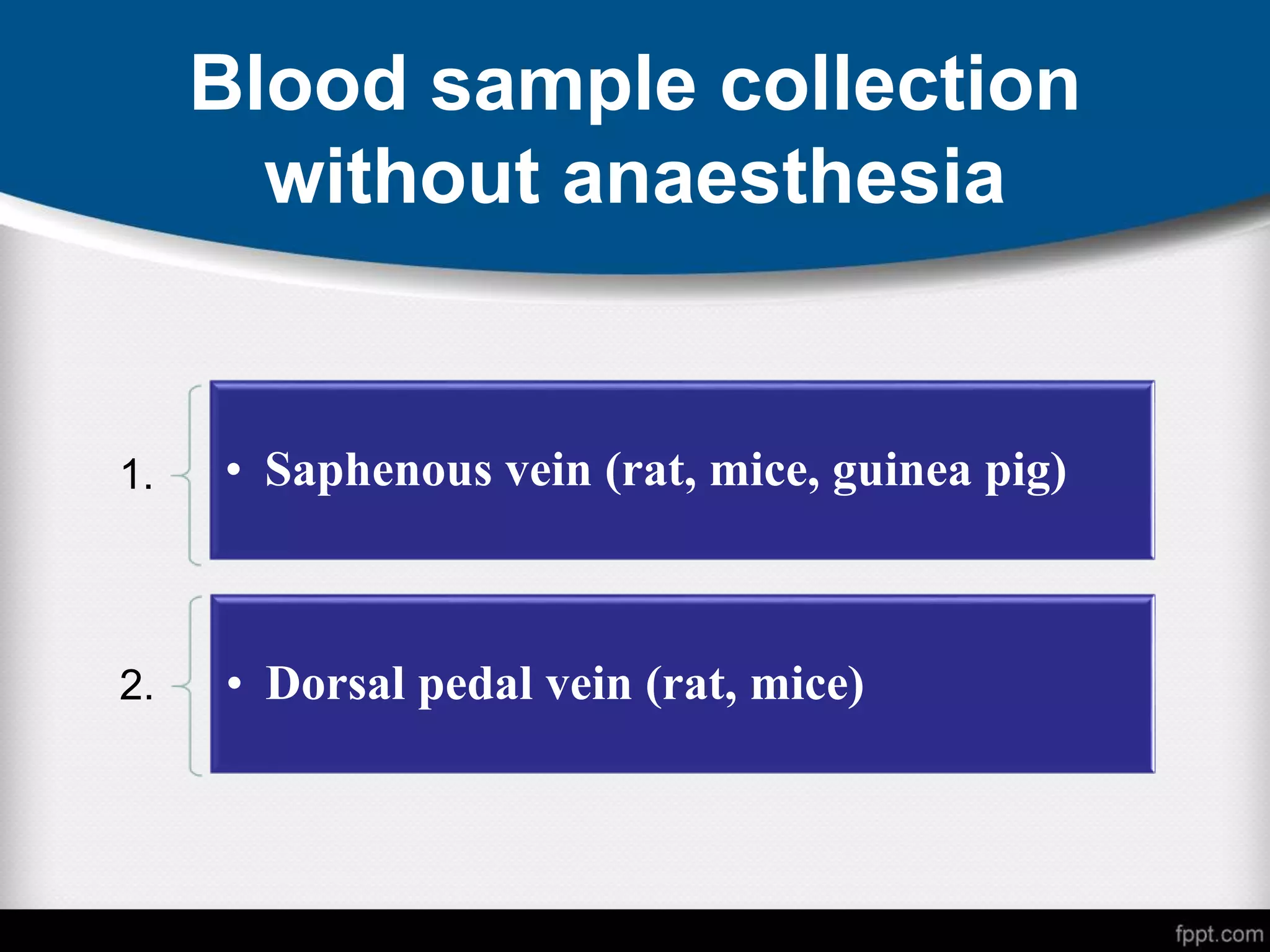
without anaesthesia
1. • Saphenous vein (rat, mice, guinea pig)
2. • Dorsal pedal vein (rat, mice)
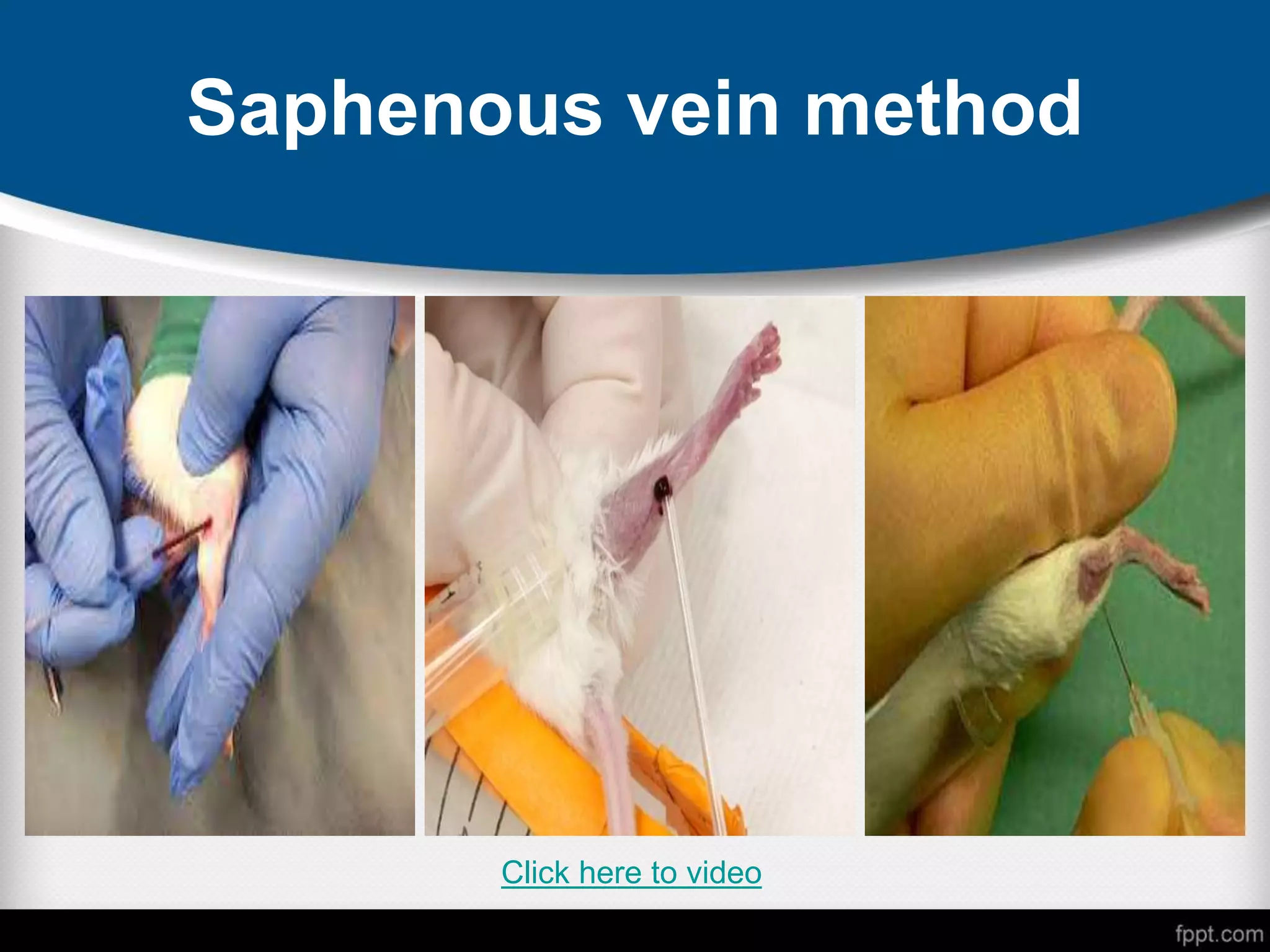
Saphenous vein method
Click here to video
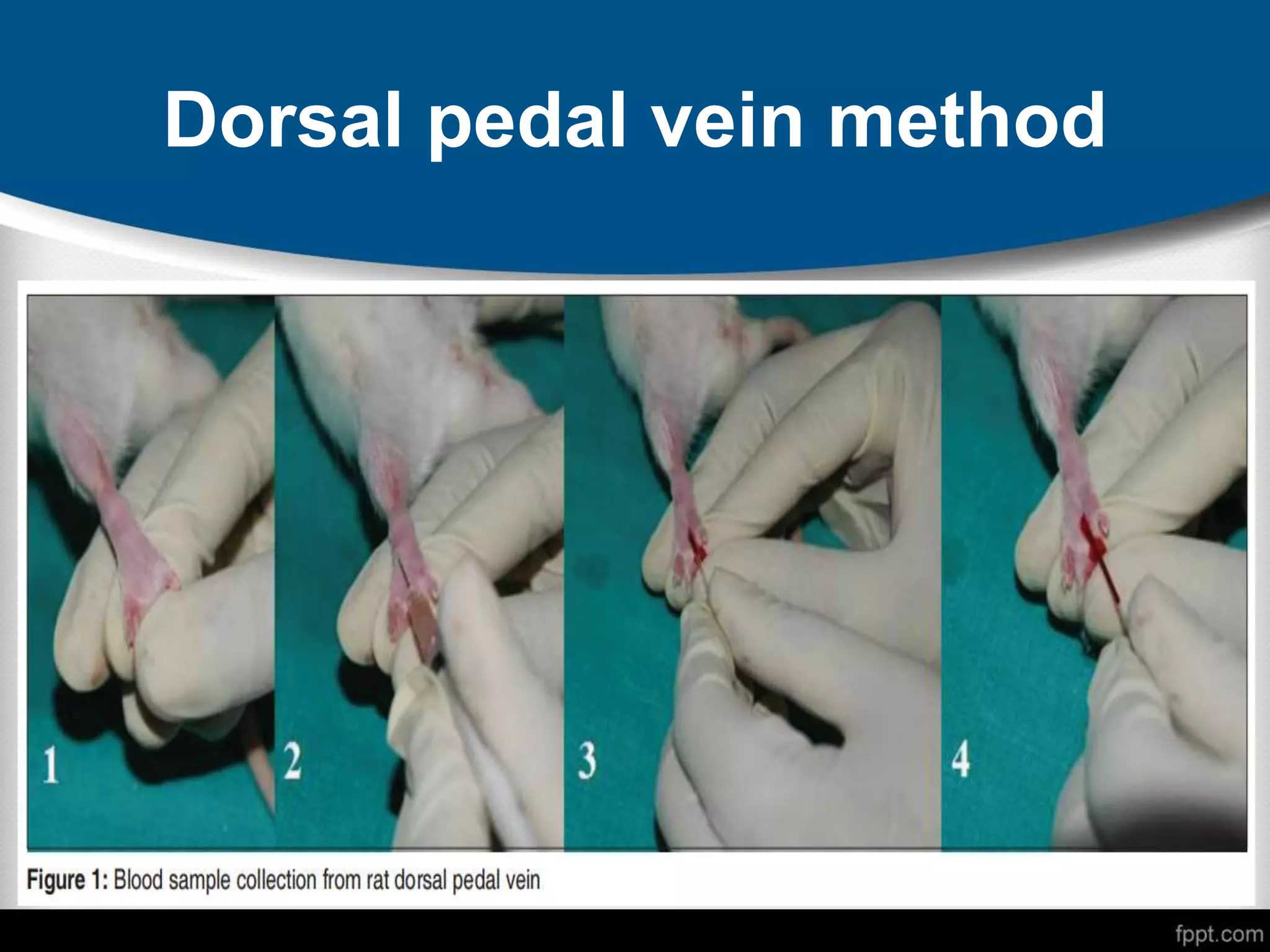
Dorsal pedal vein method
Blood sample collection with
anaesthesia
Tail vein & Tail snip
Orbital sinus
Jugular vein
Blood vessel cannulation
Tarsal vein
Marginal ear vein/ artery
Tail vein and Tail snip method
Click here to play video
Orbital sinus method
Click here to play video
Jugular vein method
Click here to play video
Blood vessel cannulation
Tarsal vein method
Marginal Ear vein method
Click here to play video
Terminal procedures
Posterior
vena cava
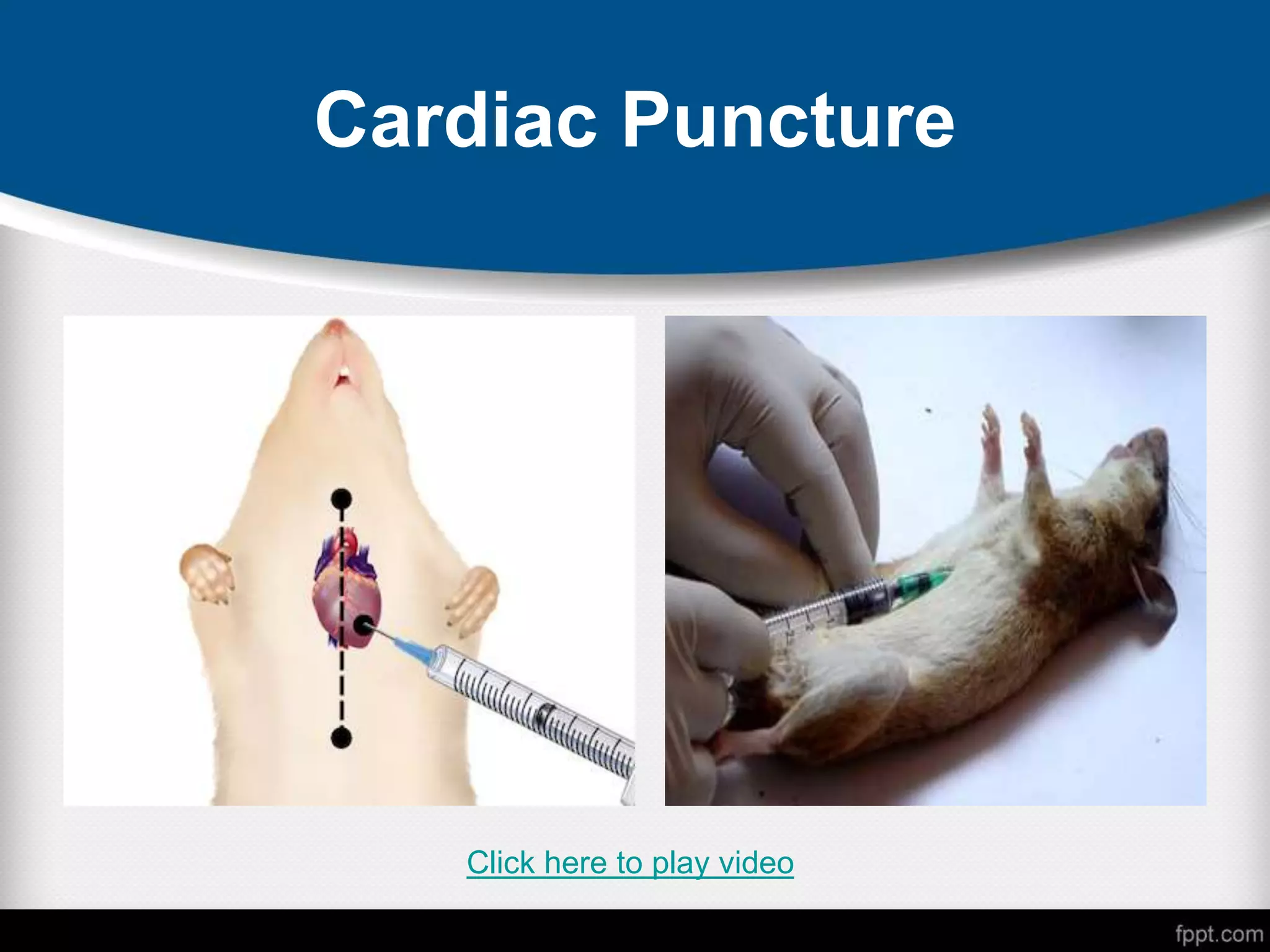
Cardiac
puncture
1
2
Cardiac Puncture
Click here to play video
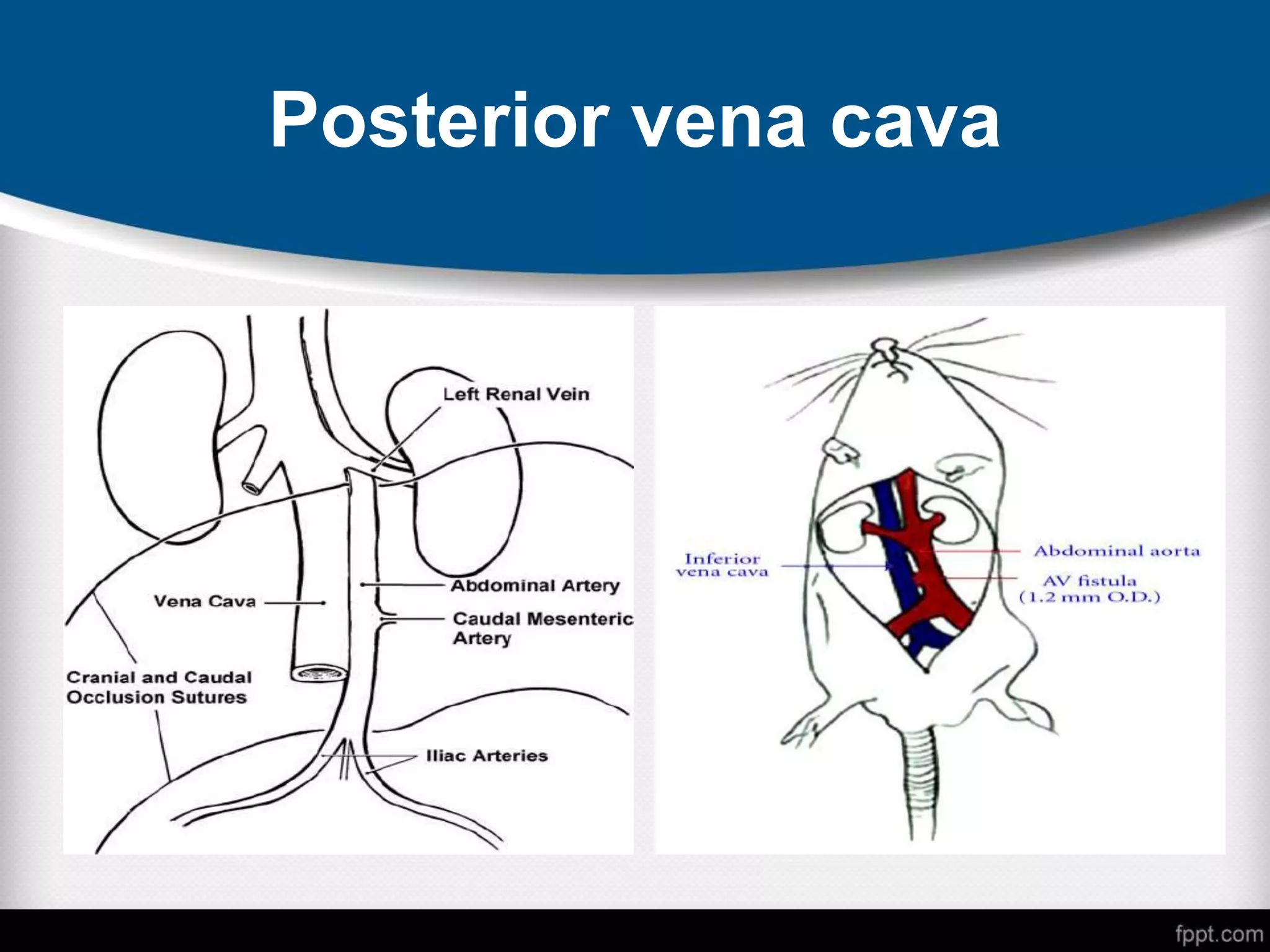
Posterior vena cava
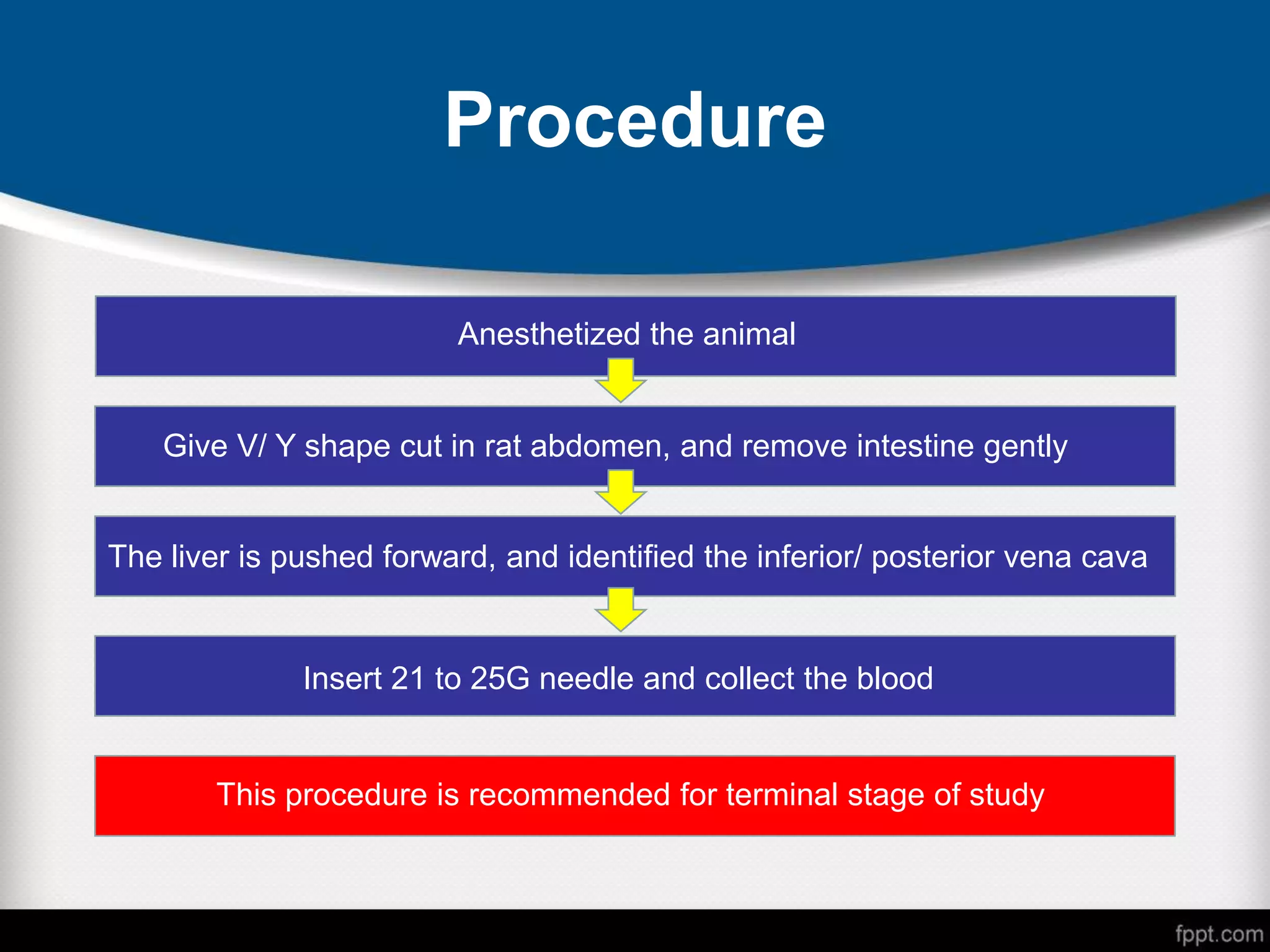
Procedure
This procedure is recommended for terminal stage of study
Give V/ Y shape cut in rat abdomen, and remove intestine gently
Anesthetized the animal
The liver is pushed forward, and identified the inferior/ posterior vena cava
Insert 21 to 25G needle and collect the blood
Fluid Replacement
Lactated Ringer’s Solution (LRS) is the recommended
balanced crystalloid solution for fluid replacement.
Alternatively, 0.9% sterile isotonic saline may be used. For
adult mice, 1.0 ml of warmed LRS or isotonic saline can be
given by IP or SC administration. For adult rats, administer
5 -10 ml warmed LRS or 0.9% saline (½ of the total volume
via IP and ½ via SC routes).
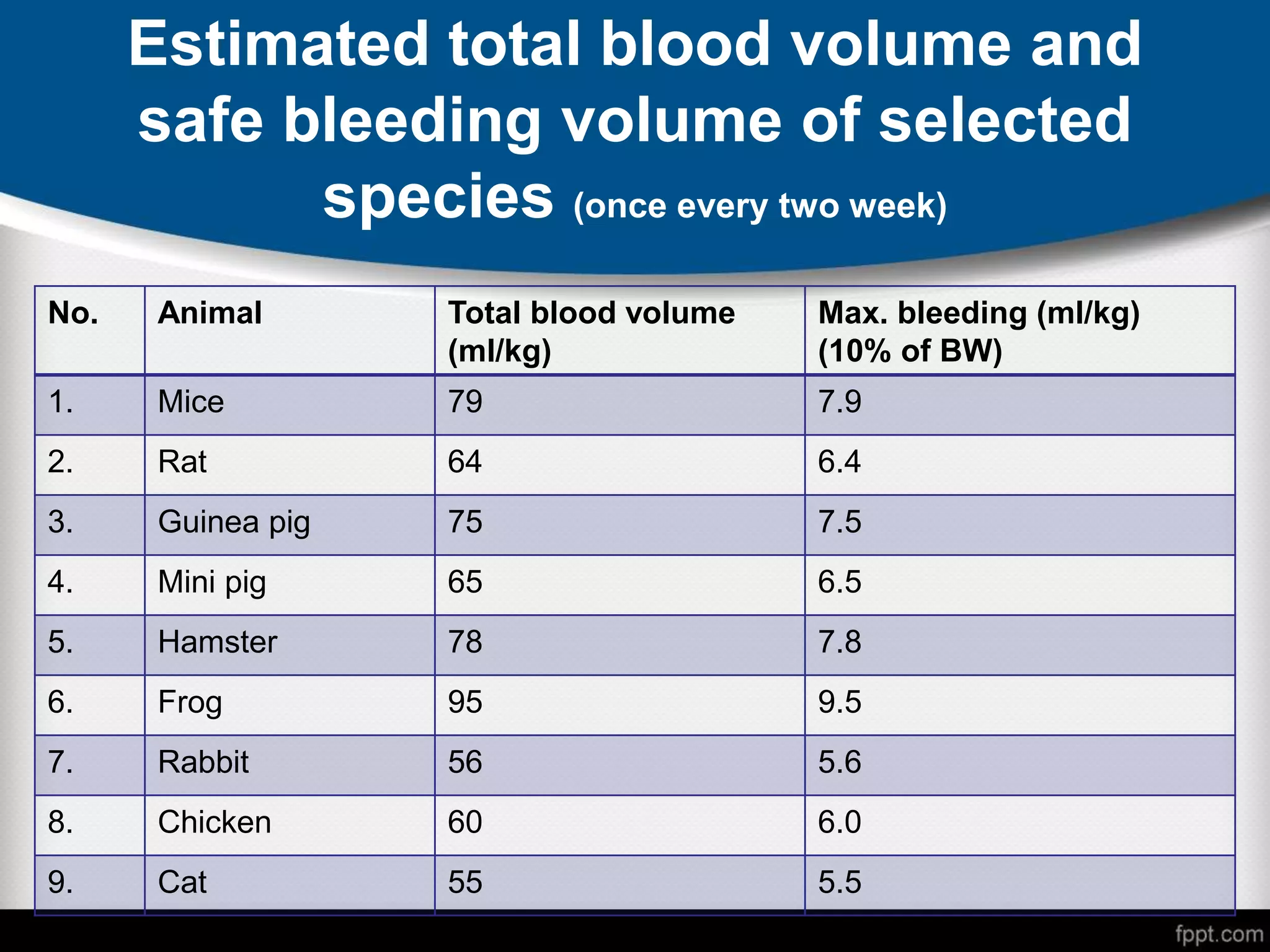
Estimated total blood volume and
safe bleeding volume of selected
species (once every two week)
No. Animal Total blood volume
(ml/kg)
Max. bleeding (ml/kg)
(10% of BW)
1. Mice 79 7.9
2. Rat 64 6.4
3. Guinea pig 75 7.5
4. Mini pig 65 6.5
5. Hamster 78 7.8
6. Frog 95 9.5
7. Rabbit 56 5.6
8. Chicken 60 6.0
9. Cat 55 5.5
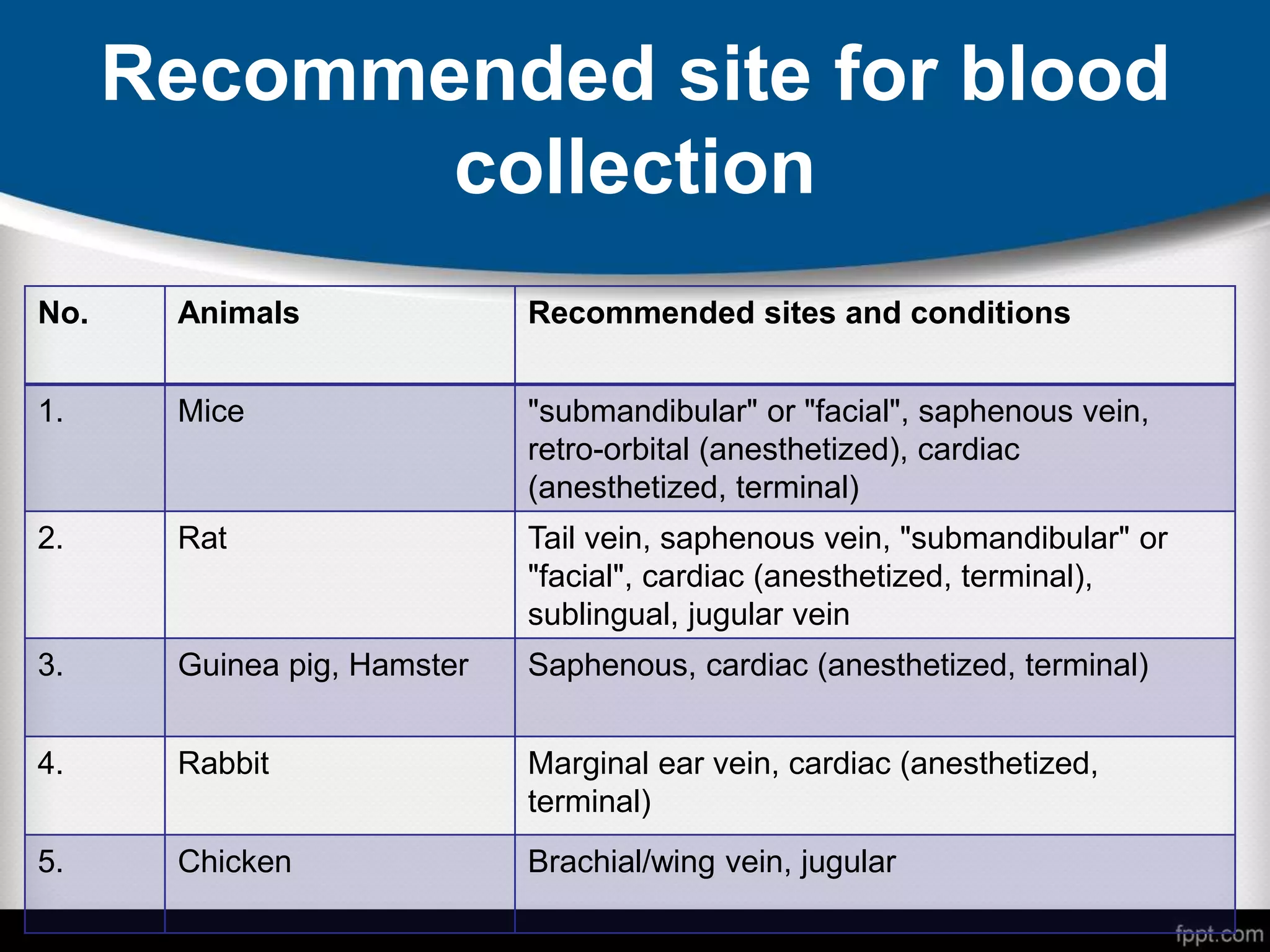
Recommended site for blood
collection
No. Animals Recommended sites and conditions
1. Mice "submandibular" or "facial", saphenous vein,
retro-orbital (anesthetized), cardiac
(anesthetized, terminal)
2. Rat Tail vein, saphenous vein, "submandibular" or
"facial", cardiac (anesthetized, terminal),
sublingual, jugular vein
3. Guinea pig, Hamster Saphenous, cardiac (anesthetized, terminal)
4. Rabbit Marginal ear vein, cardiac (anesthetized,
terminal)
5. Chicken Brachial/wing vein, jugular
References
• Hoff J, Rlagt LV. Methods of blood collection in the mouse. Lab
animals 2000;29:47-53.
• Blood sampling online. 2009; [12 screens]. Available
from:http://www.nc3rs.org.uk/bloodsamplingmicrosite/page.asp?id=3
13[Last cited on 2010 Fe24].
• Guidelines for Survival Bleeding of Mice and Rats. NIH-ARAC
Guidelines [online]. 2005 Jan 12. Available from
http://oacu.od.nih.gov/ARAC/Bleeding.pdf [accessed on 2010 Mar
09].
• McGuill MW, Rowan AN. Biological Effects of Blood Loss:
Implications for Sampling Volumes and Techniques. ILAR J 1989. p.
31
Continue…
• Procedure for rabbit blood collection [online]. Available from:http://
www.research.uky.edu/ori/univet/resources/sop/Procedure_rabbit_bl
ood_ collection.pdf [Last cited on 2010 Feb 23].
• CPCSEA guidelines for laboratory animal facility. Indian J
Pharmacol 2003;35:257-74.
• Vogel HG, editor. Drug discovery and evaluation: Pharmacological
assays. 2nd ed. Berlin: Springer; 2002.
• Anaesthesia and Analgesia in Laboratory Animals at UCSF [online].
Available from :http://www.iacuc.ucsf.edu/Index.asp[Last cited on
2010 Feb 24]. and Availabl
from:http://www.iacuc.ucsf.edu/Proc/awRatFrm.asp. [Last cited on
2010 Feb 24].
Thank You

Blood Sample Collection Method.ppt

  • 1.
    Welcome to Journal ClubPresentation Presented by, Dnyanshree V. Tijare Guide: Dr. Manoj Aswar M. Pharm second year (Dept. of Pharmacology) Rajarshi Shahu College of Pharmacy, Buldhana
  • 2.
  • 3.
    Continue… Blood sample collectionin small laboratory animals Author : Parasuraman S. Ravindran R. Kesavan R DOI no. : 10.4103/0976-500X.72350 Journal name : Journal of Pharmacology & Pharmacotherapeutics Publication year : July-December 2010
  • 4.
    Content General principles ofblood collection method Common anaesthetic agents required for lab animals General methods for blood collection Discussion & References
  • 5.
    General principles ofblood collection method 1. Protocol approved by the Institute animal ethics committee. 2. It should be least painful and stressful, Blood sample may be collected under anesthesia or without anesthesia. 3. Adequate training (any species) 4. In general, blood sample is withdrawn from venous, arterial blood vessels or heart chambers. 5. Frequency (Once in two weeks is ideal for nonrodents). 6. The estimated blood volume in adult animals is 55 to 70 ml/kg body weight.
  • 6.
  • 7.
    General methods forblood collection Blood samples does not required anaesthesia Blood samples required anaesthesia Terminal procedures A B C
  • 8.
    General requirement forblood collection method • Animal • Rodent handling gloves • Towel • Cotton • Sample collection tubes • Surgical blade • Capillary tube • Anesthetic agent • Animal warming chamber • Needles • 95% v/v Alcohol • 1-5 ml syringe • Electronic trimmer
  • 9.
    No. Blood samplecollection method Needle size/ Other collecting tool 1. Saphenous vein 20G 2. Dorsal pedal vein 23G/ 27G 3. Tail vein 23G 4. Orbital sinus Capillary 5. Jugular vein 25G 6. Blood vessel cannulation R- 23-25G, M- 19-21G 7. Tarsal vein 22G 8. Marginal ear vein/ artery 26G 9. Cardiac puncture 19-25G 10. Posterior vena cava 21-25G 11. Tail snip 1 mm cut
  • 10.
    Blood sample collection withoutanaesthesia 1. • Saphenous vein (rat, mice, guinea pig) 2. • Dorsal pedal vein (rat, mice)
  • 11.
  • 12.
  • 13.
    Blood sample collectionwith anaesthesia Tail vein & Tail snip Orbital sinus Jugular vein Blood vessel cannulation Tarsal vein Marginal ear vein/ artery
  • 14.
    Tail vein andTail snip method Click here to play video
  • 15.
    Orbital sinus method Clickhere to play video
  • 16.
    Jugular vein method Clickhere to play video
  • 17.
  • 18.
  • 20.
    Marginal Ear veinmethod Click here to play video
  • 21.
  • 22.
  • 23.
  • 24.
    Procedure This procedure isrecommended for terminal stage of study Give V/ Y shape cut in rat abdomen, and remove intestine gently Anesthetized the animal The liver is pushed forward, and identified the inferior/ posterior vena cava Insert 21 to 25G needle and collect the blood
  • 25.
    Fluid Replacement Lactated Ringer’sSolution (LRS) is the recommended balanced crystalloid solution for fluid replacement. Alternatively, 0.9% sterile isotonic saline may be used. For adult mice, 1.0 ml of warmed LRS or isotonic saline can be given by IP or SC administration. For adult rats, administer 5 -10 ml warmed LRS or 0.9% saline (½ of the total volume via IP and ½ via SC routes).
  • 26.
    Estimated total bloodvolume and safe bleeding volume of selected species (once every two week) No. Animal Total blood volume (ml/kg) Max. bleeding (ml/kg) (10% of BW) 1. Mice 79 7.9 2. Rat 64 6.4 3. Guinea pig 75 7.5 4. Mini pig 65 6.5 5. Hamster 78 7.8 6. Frog 95 9.5 7. Rabbit 56 5.6 8. Chicken 60 6.0 9. Cat 55 5.5
  • 27.
    Recommended site forblood collection No. Animals Recommended sites and conditions 1. Mice "submandibular" or "facial", saphenous vein, retro-orbital (anesthetized), cardiac (anesthetized, terminal) 2. Rat Tail vein, saphenous vein, "submandibular" or "facial", cardiac (anesthetized, terminal), sublingual, jugular vein 3. Guinea pig, Hamster Saphenous, cardiac (anesthetized, terminal) 4. Rabbit Marginal ear vein, cardiac (anesthetized, terminal) 5. Chicken Brachial/wing vein, jugular
  • 28.
    References • Hoff J,Rlagt LV. Methods of blood collection in the mouse. Lab animals 2000;29:47-53. • Blood sampling online. 2009; [12 screens]. Available from:http://www.nc3rs.org.uk/bloodsamplingmicrosite/page.asp?id=3 13[Last cited on 2010 Fe24]. • Guidelines for Survival Bleeding of Mice and Rats. NIH-ARAC Guidelines [online]. 2005 Jan 12. Available from http://oacu.od.nih.gov/ARAC/Bleeding.pdf [accessed on 2010 Mar 09]. • McGuill MW, Rowan AN. Biological Effects of Blood Loss: Implications for Sampling Volumes and Techniques. ILAR J 1989. p. 31
  • 29.
    Continue… • Procedure forrabbit blood collection [online]. Available from:http:// www.research.uky.edu/ori/univet/resources/sop/Procedure_rabbit_bl ood_ collection.pdf [Last cited on 2010 Feb 23]. • CPCSEA guidelines for laboratory animal facility. Indian J Pharmacol 2003;35:257-74. • Vogel HG, editor. Drug discovery and evaluation: Pharmacological assays. 2nd ed. Berlin: Springer; 2002. • Anaesthesia and Analgesia in Laboratory Animals at UCSF [online]. Available from :http://www.iacuc.ucsf.edu/Index.asp[Last cited on 2010 Feb 24]. and Availabl from:http://www.iacuc.ucsf.edu/Proc/awRatFrm.asp. [Last cited on 2010 Feb 24].
  • 30.