BLOOD GROUPING AND
CROSS MATCHING
BLOOD GROUPING
BASIS
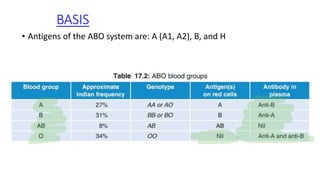
• Antigens of the ABO system are: A (A1, A2), B, and H
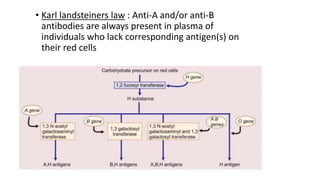
• Karl landsteiners law : Anti-A and/or anti-B
antibodies are always present in plasma of
individuals who lack corresponding antigen(s) on
their red cells
 Bombay Blood group – Lacks H, A & B antigens; Rare; Discovered by- Dr.
Y.M Bhende.
• Some persons do not inherit the H gene (genotype hh) and thus cannot
synthesise H substance.
• They inherit the A or B gene but cannot express it.
• Bombay phenotype or Bombay blood group (Oh).
• Their red cells type as group O; however, unlike group O individuals, Oh
persons have no H antigen on their red cells and their plasma contains
strong anti-H in addition to anti-A and anti-B.
• Therefore, Bombay group persons should be transfused only with Oh
blood.
Antigens secreted by different ABO blood groups are:
• • Group A: A, H
• • Group B: B, H
• • Group AB: A, B, H
• • Group O: H
OTHER BLOOD GROUPING SYSTEMS
• Lewis system
• P system
• KELL system
• Duffy system
• Kidd system
• Lutheran system
• MNS system
• Diego system
• Yt system
• Colton system
Different methods
• Traditional methods -Slide/tile method
Tube method
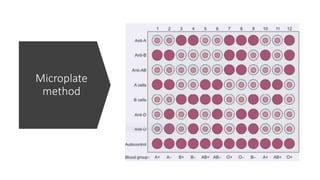
Microplate method
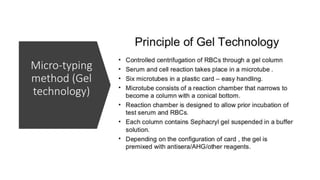
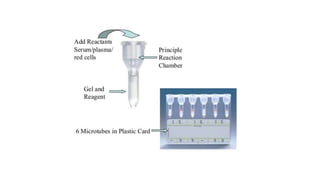
Newer methods- Micro-typing method (Gel technology)
Glass microbeads technology
Erythrocytes magnetized technology
Forward and reverse typing
• The process of identifying an individual’s blood group involving
testing of red cells with known anti sera (Forward typing ) and plasma
with known group red cells (reverse typing )
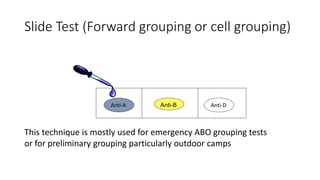
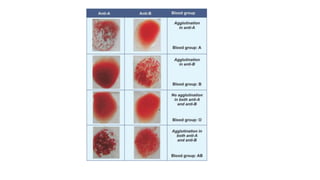
Anti-D
Slide Test (Forward grouping or cell grouping)
Anti-B
Anti-A
This technique is mostly used for emergency ABO grouping tests
or for preliminary grouping particularly outdoor camps
• Method:
• 1. Divide a clean and dry glass slide into two sections with a glass
marking pencil. Label the sections as anti-A and anti-B
• 2. Place one drop of anti-A and one drop of anti-B antiserum in the
center of the corresponding section of the slide.
• 3. Add one drop of blood sample to be tested to each drop of
antiserum.
• 4. Mix antiserum and blood by using a separate stick for each section.
• 5. By tilting the slide from side to side, observe for agglutination after
exactly two minutes.
• Result:
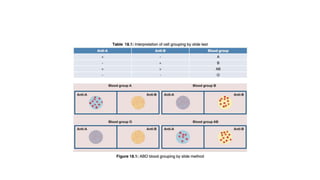
• Positive (+): small clumps of red cells are seen floating in a clear liquid.
Negative (-): Uniform suspension of red cells.
• Disadvantages
Less sensitive than tube test
Drying up of the reaction mixture can cause aggregation of cells,
giving false positive results
Weaker reactions are difficult to interpret
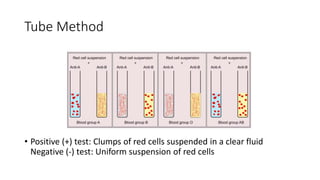
Tube Method
• Positive (+) test: Clumps of red cells suspended in a clear fluid
Negative (-) test: Uniform suspension of red cells
• Advantages
Allows for fairly long incubation without drying up of the tube
contents
Centrifugation involved enhances the reaction allowing weaker
antigens and antibodies to be detected
Simplicity of grading
Requires smaller volume of reagents
Microplate
method
Micro-typing
method (Gel
technology)
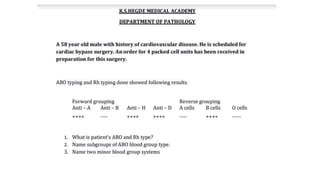
Answer
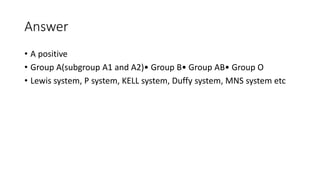
• A positive
• Group A(subgroup A1 and A2)• Group B• Group AB• Group O
• Lewis system, P system, KELL system, Duffy system, MNS system etc
Answers
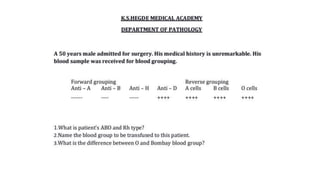
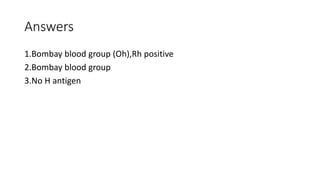
1.Bombay blood group (Oh),Rh positive
2.Bombay blood group
3.No H antigen
Answers
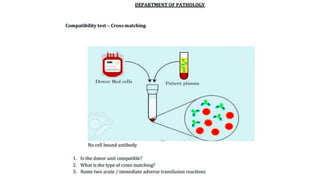
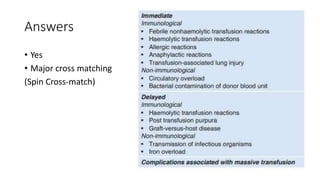
• Yes
• Major cross matching
(Spin Cross-match)
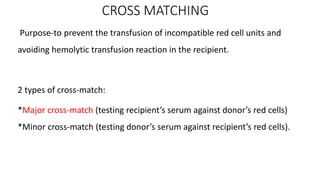
CROSS MATCHING
Purpose-to prevent the transfusion of incompatible red cell units and
avoiding hemolytic transfusion reaction in the recipient.
2 types of cross-match:
*Major cross-match (testing recipient’s serum against donor’s red cells)
*Minor cross-match (testing donor’s serum against recipient’s red cells).
Answers
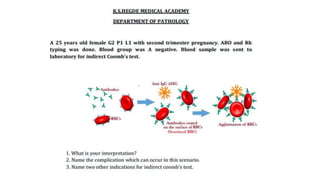
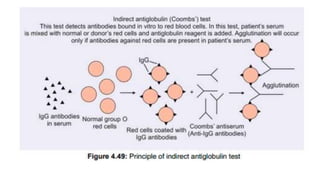
1.Indirect comb’s test positive.
There are incomplete antibodies present in the patient’s serum directed
against red cell antigens.(anti-D antibodies)
2.Complication: Hemolytic disease of newborn.
3. Indications:
• Cross matching
• Hemolytic disease of newborn.

Blood Grouping

  • 1.
  • 2.
  • 3.
    BASIS • Antigens ofthe ABO system are: A (A1, A2), B, and H
  • 4.
    • Karl landsteinerslaw : Anti-A and/or anti-B antibodies are always present in plasma of individuals who lack corresponding antigen(s) on their red cells
  • 5.
     Bombay Bloodgroup – Lacks H, A & B antigens; Rare; Discovered by- Dr. Y.M Bhende. • Some persons do not inherit the H gene (genotype hh) and thus cannot synthesise H substance. • They inherit the A or B gene but cannot express it. • Bombay phenotype or Bombay blood group (Oh). • Their red cells type as group O; however, unlike group O individuals, Oh persons have no H antigen on their red cells and their plasma contains strong anti-H in addition to anti-A and anti-B. • Therefore, Bombay group persons should be transfused only with Oh blood.
  • 6.
    Antigens secreted bydifferent ABO blood groups are: • • Group A: A, H • • Group B: B, H • • Group AB: A, B, H • • Group O: H
  • 7.
    OTHER BLOOD GROUPINGSYSTEMS • Lewis system • P system • KELL system • Duffy system • Kidd system • Lutheran system • MNS system • Diego system • Yt system • Colton system
  • 8.
    Different methods • Traditionalmethods -Slide/tile method Tube method Microplate method Newer methods- Micro-typing method (Gel technology) Glass microbeads technology Erythrocytes magnetized technology
  • 9.
    Forward and reversetyping • The process of identifying an individual’s blood group involving testing of red cells with known anti sera (Forward typing ) and plasma with known group red cells (reverse typing )
  • 10.
    Anti-D Slide Test (Forwardgrouping or cell grouping) Anti-B Anti-A This technique is mostly used for emergency ABO grouping tests or for preliminary grouping particularly outdoor camps
  • 11.
    • Method: • 1.Divide a clean and dry glass slide into two sections with a glass marking pencil. Label the sections as anti-A and anti-B • 2. Place one drop of anti-A and one drop of anti-B antiserum in the center of the corresponding section of the slide. • 3. Add one drop of blood sample to be tested to each drop of antiserum. • 4. Mix antiserum and blood by using a separate stick for each section. • 5. By tilting the slide from side to side, observe for agglutination after exactly two minutes. • Result: • Positive (+): small clumps of red cells are seen floating in a clear liquid. Negative (-): Uniform suspension of red cells.
  • 12.
    • Disadvantages Less sensitivethan tube test Drying up of the reaction mixture can cause aggregation of cells, giving false positive results Weaker reactions are difficult to interpret
  • 16.
    Tube Method • Positive(+) test: Clumps of red cells suspended in a clear fluid Negative (-) test: Uniform suspension of red cells
  • 17.
    • Advantages Allows forfairly long incubation without drying up of the tube contents Centrifugation involved enhances the reaction allowing weaker antigens and antibodies to be detected Simplicity of grading Requires smaller volume of reagents
  • 18.
  • 19.
  • 22.
    Answer • A positive •Group A(subgroup A1 and A2)• Group B• Group AB• Group O • Lewis system, P system, KELL system, Duffy system, MNS system etc
  • 24.
    Answers 1.Bombay blood group(Oh),Rh positive 2.Bombay blood group 3.No H antigen
  • 26.
    Answers • Yes • Majorcross matching (Spin Cross-match)
  • 27.
    CROSS MATCHING Purpose-to preventthe transfusion of incompatible red cell units and avoiding hemolytic transfusion reaction in the recipient. 2 types of cross-match: *Major cross-match (testing recipient’s serum against donor’s red cells) *Minor cross-match (testing donor’s serum against recipient’s red cells).
  • 31.
    Answers 1.Indirect comb’s testpositive. There are incomplete antibodies present in the patient’s serum directed against red cell antigens.(anti-D antibodies) 2.Complication: Hemolytic disease of newborn. 3. Indications: • Cross matching • Hemolytic disease of newborn.

Editor's Notes

  • #5 based on presence or absence of A / B antigens on red cells antibodies are always present in plasma of individuals who lack corresponding antigen