ORGANIZATIONAL STRUCTURE AND
DESIGN
Organizational Design Approaches – managers
have to make choices regarding how to group
employees together to perform their assigned
job. The five common approaches that assist
managers in determining departmental groupings
are functional, divisional, matrix, team, and
networking (Houghton Mifflin Harcourt, 2016).
Organizational design deals with constructing
and changing organizational structure to achieve
organizational goals (Mueller, 2014).
FUNCTIONAL STRUCTURE
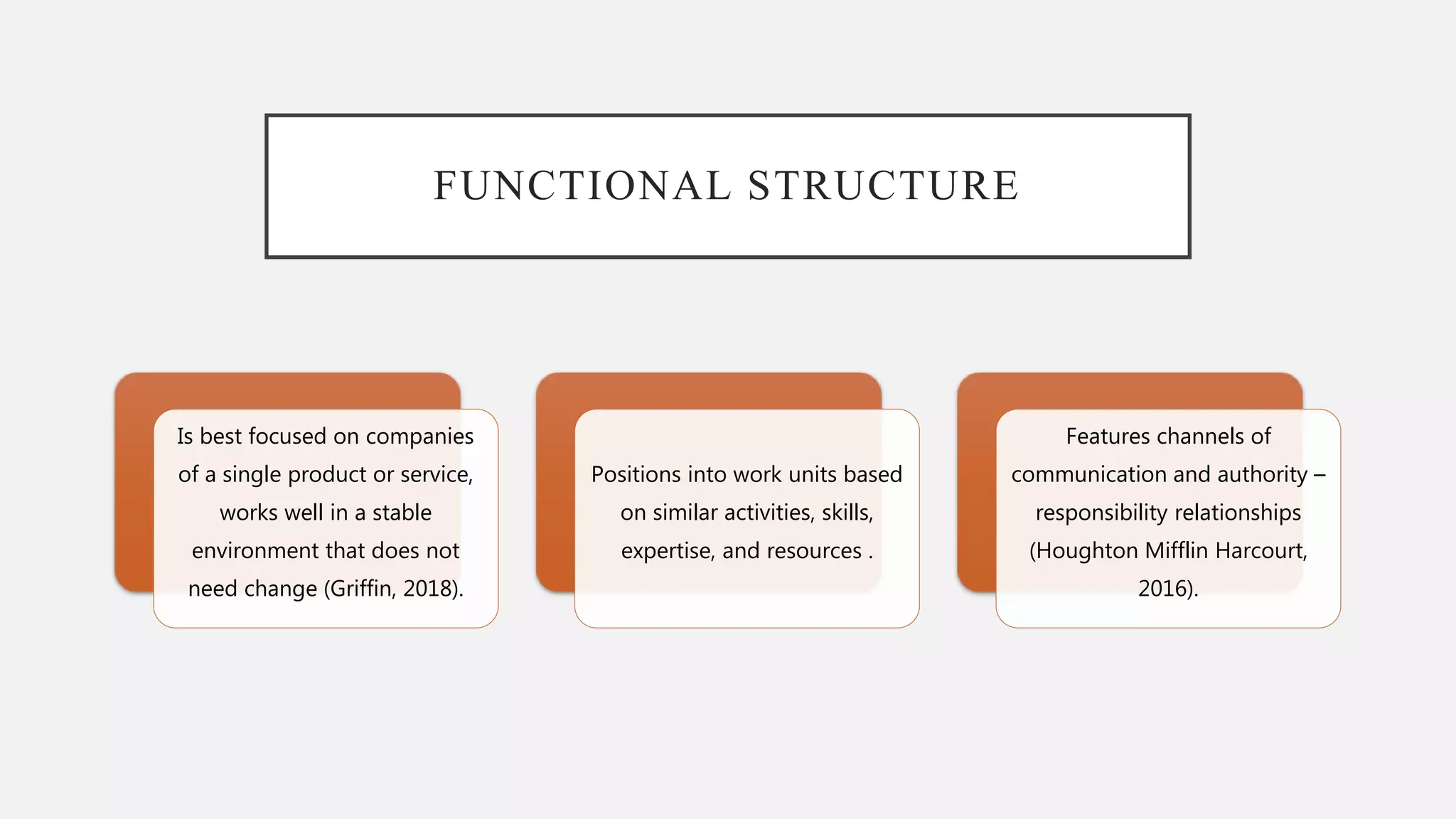
Is best focused on companies
of a single product or service,
works well in a stable
environment that does not
need change (Griffin, 2018).
Positions into work units based
on similar activities, skills,
expertise, and resources .
Features channels of
communication and authority –
responsibility relationships
(Houghton Mifflin Harcourt,
2016).
DIVISIONAL STRUCTURE
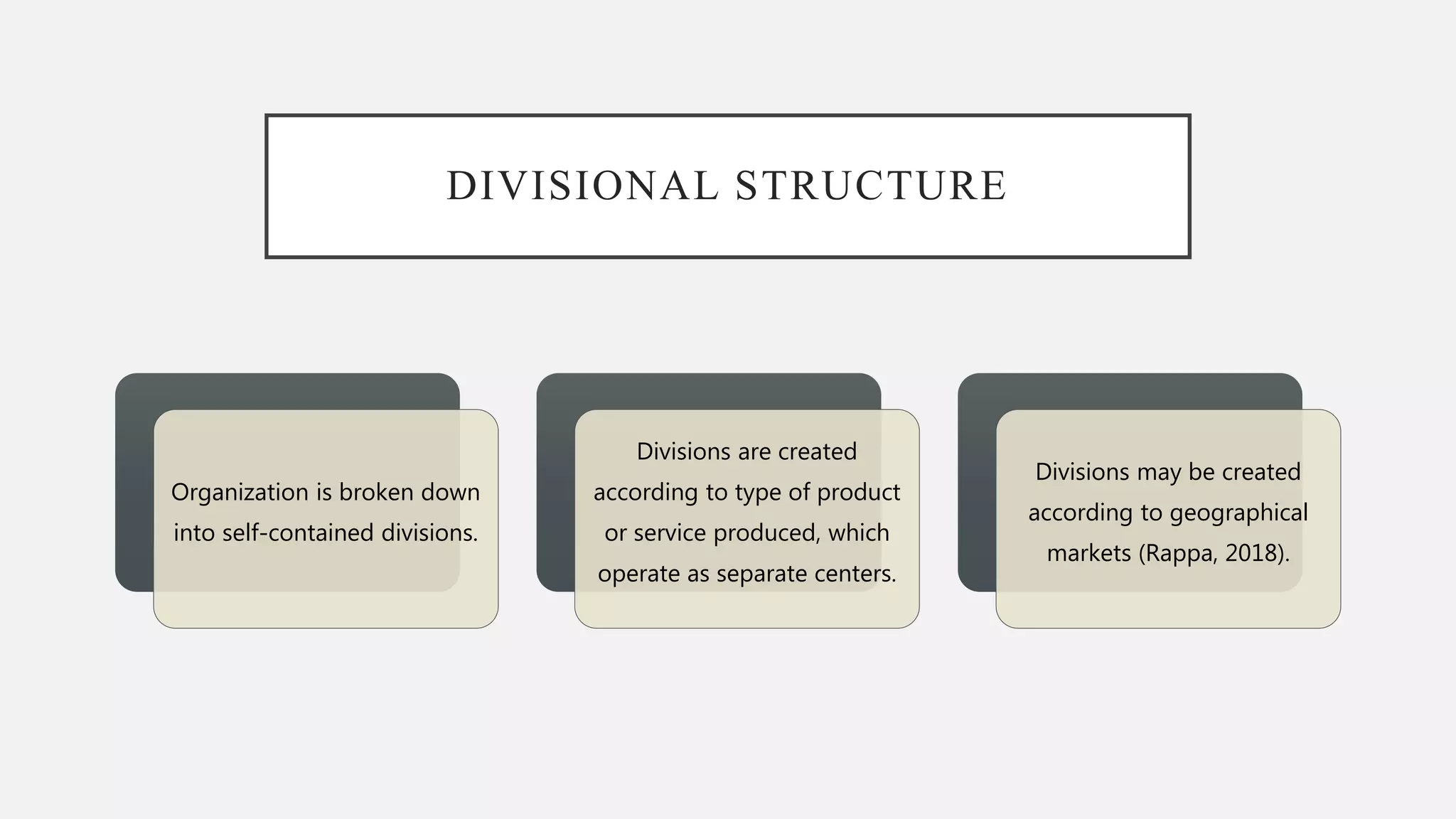
Organization is broken down
into self-contained divisions.
Divisions are created
according to type of product
or service produced, which
operate as separate centers.
Divisions may be created
according to geographical
markets (Rappa, 2018).
MATRIX STRUCTURE
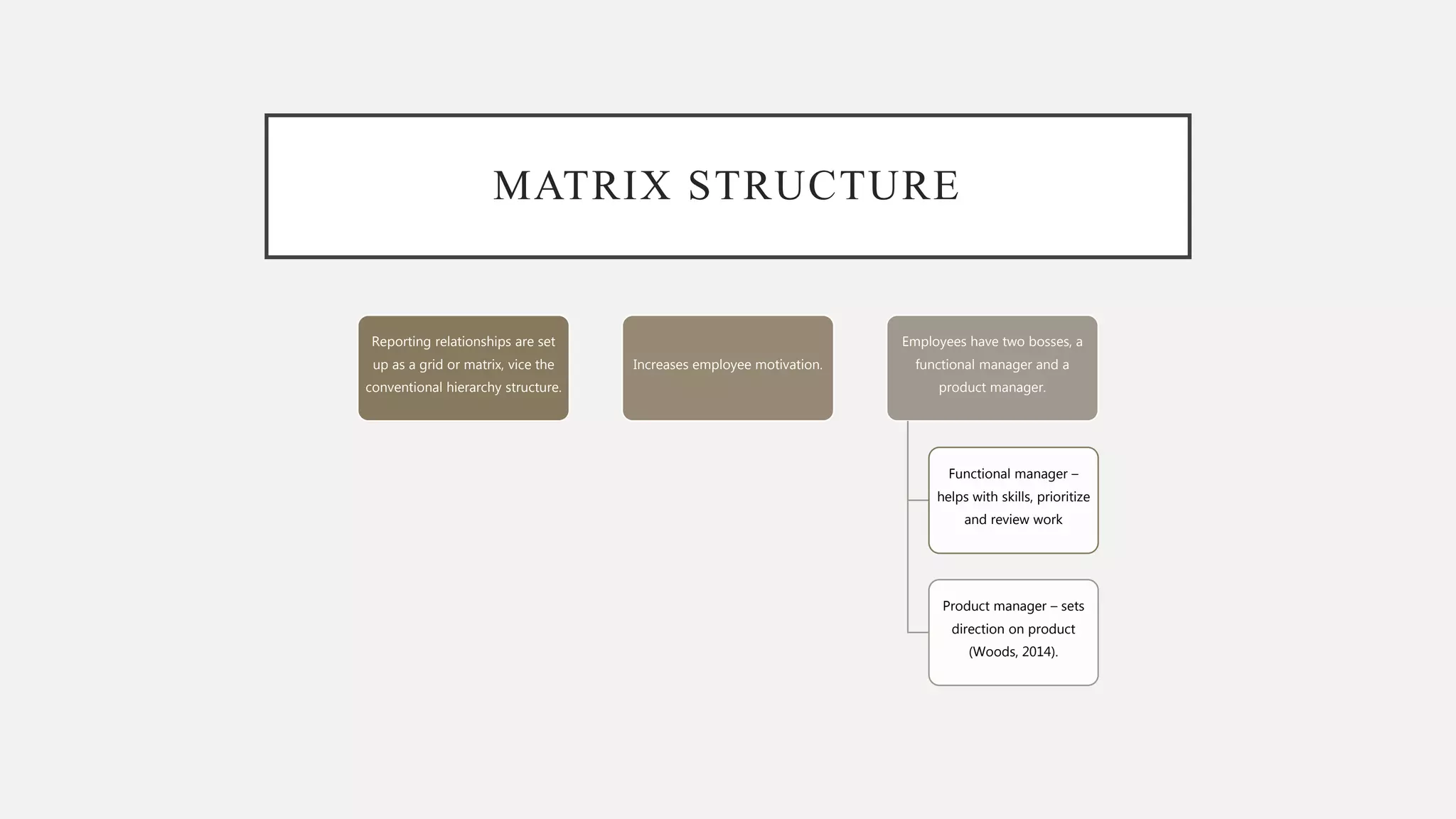
Reporting relationships are set
up as a grid or matrix, vice the
conventional hierarchy structure.
Increases employee motivation.
Employees have two bosses, a
functional manager and a
product manager.
Functional manager –
helps with skills, prioritize
and review work
Product manager – sets
direction on product
(Woods, 2014).
TEAM STRUCTURE
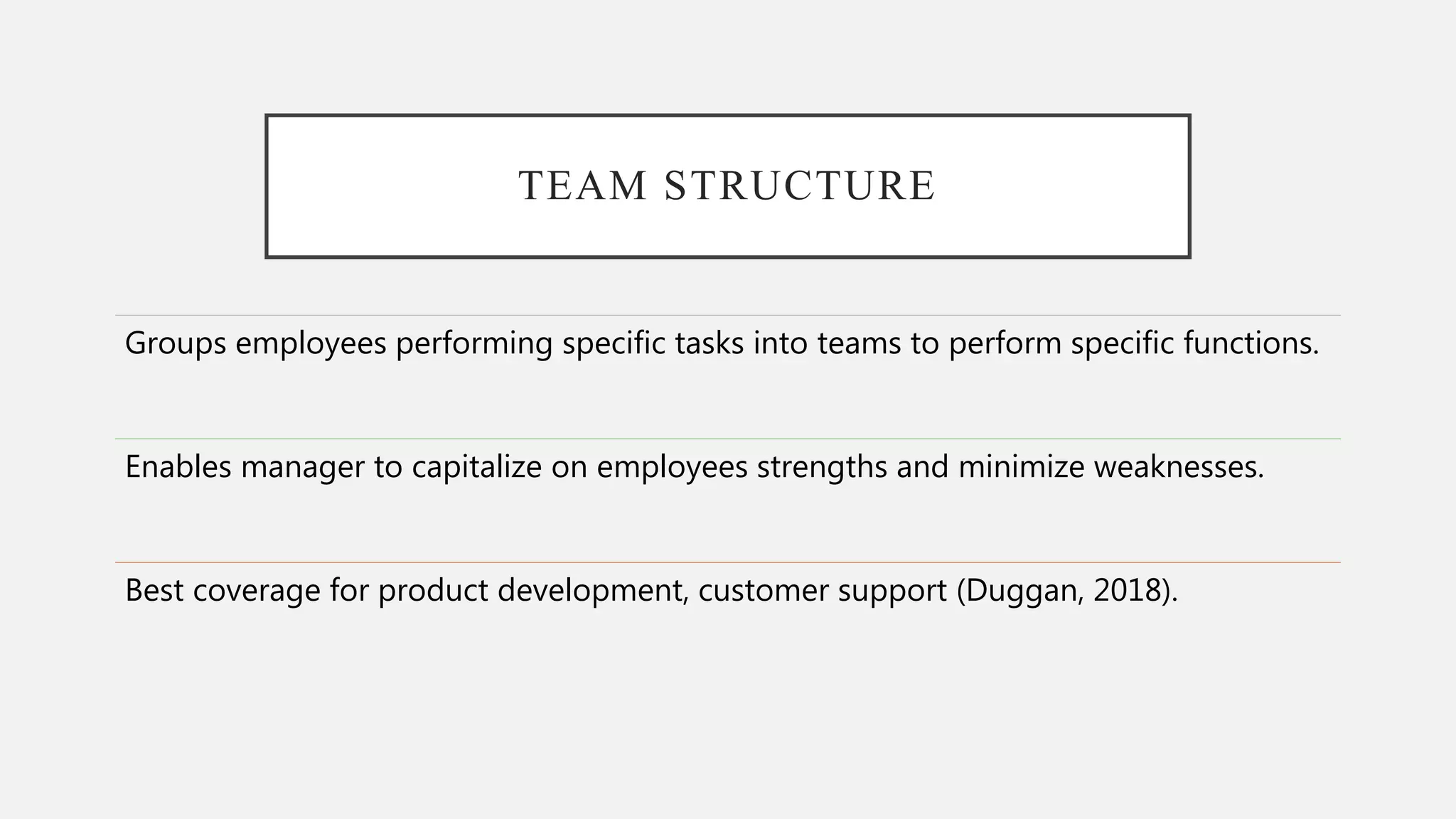
Groups employees performing specific tasks into teams to perform specific functions.
Enables manager to capitalize on employees strengths and minimize weaknesses.
Best coverage for product development, customer support (Duggan, 2018).
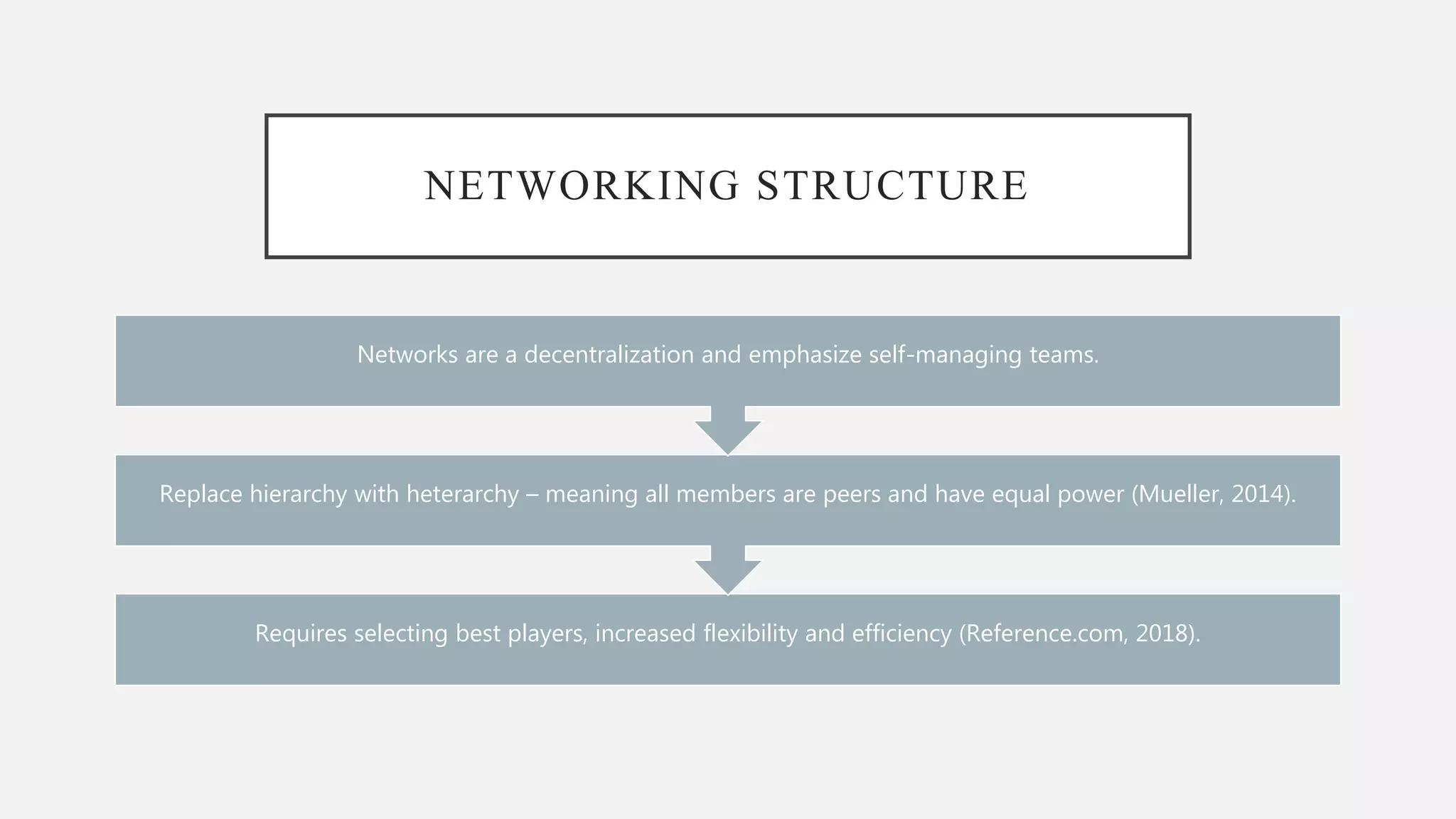
NETWORKING STRUCTURE
Requires selecting best players, increased flexibility and efficiency (Reference.com, 2018).
Replace hierarchy with heterarchy – meaning all members are peers and have equal power (Mueller, 2014).
Networks are a decentralization and emphasize self-managing teams.
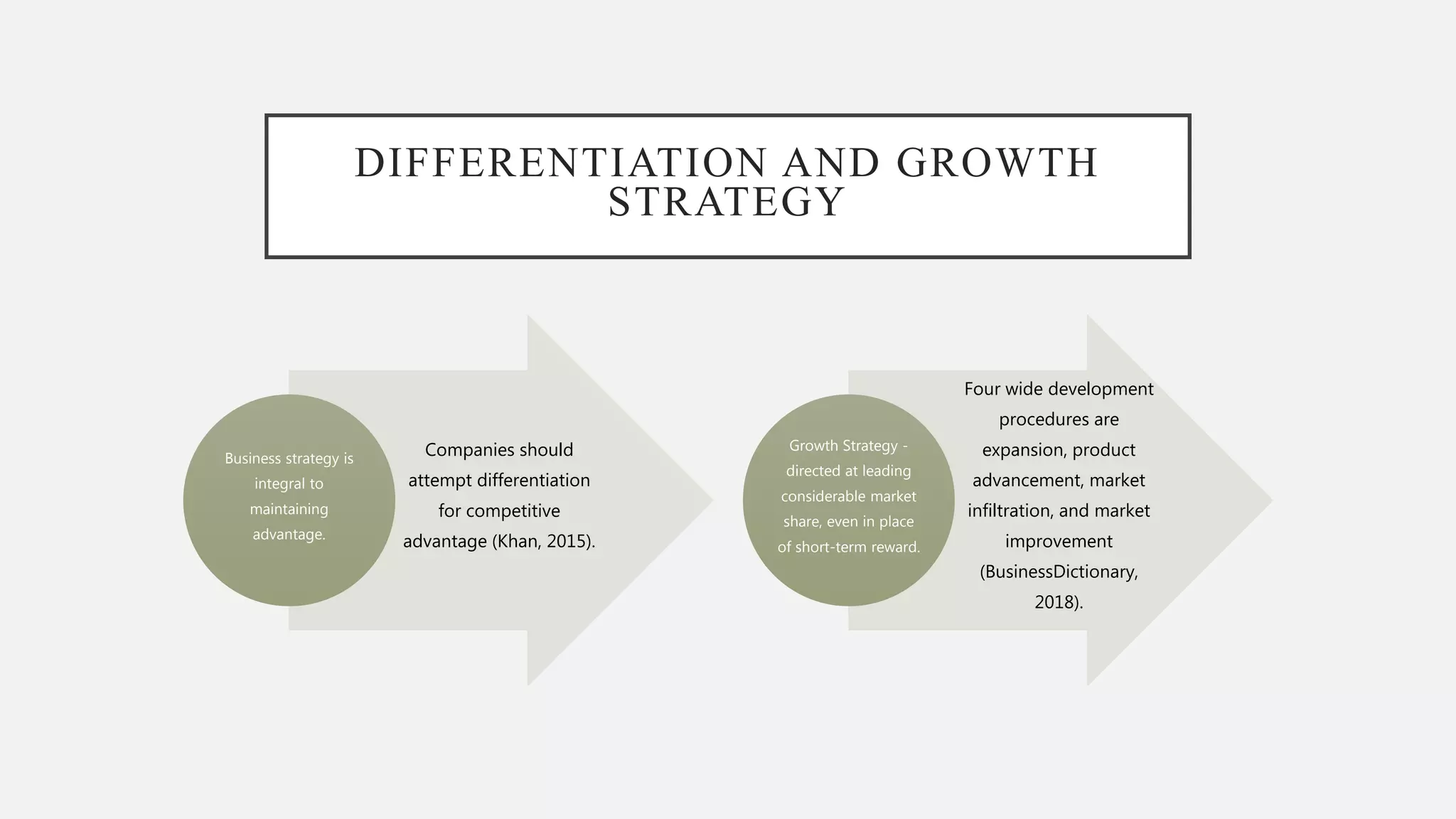
DIFFERENTIATION AND GROWTH
STRATEGY
Companies should
attempt differentiation
for competitive
advantage (Khan, 2015).
Business strategy is
integral to
maintaining
advantage.
Four wide development
procedures are
expansion, product
advancement, market
infiltration, and market
improvement
(BusinessDictionary,
2018).
Growth Strategy -
directed at leading
considerable market
share, even in place
of short-term reward.
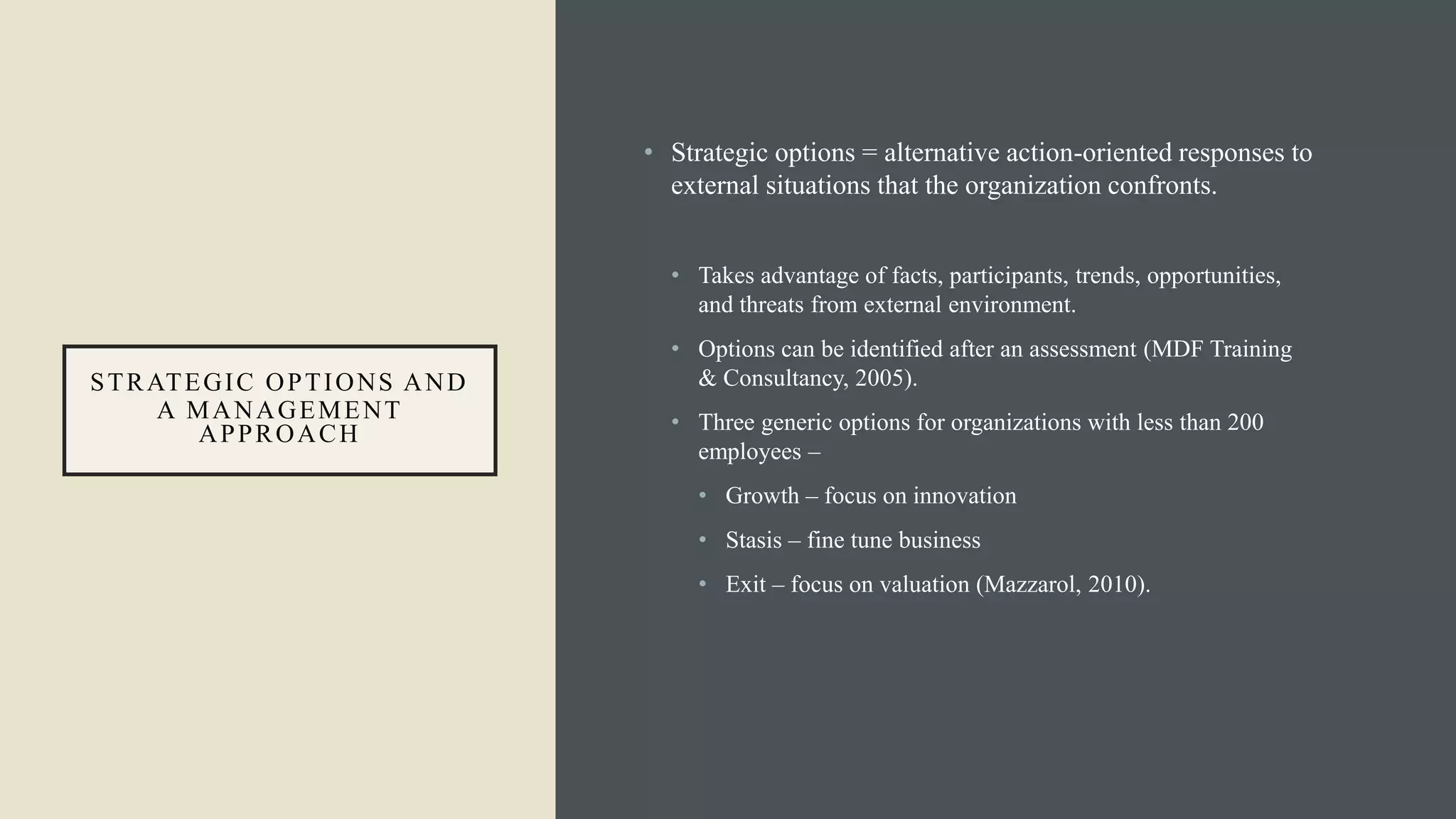
STRATEGIC OPTIONS AND
A MANAGEMENT
APPROACH
• Strategic options = alternative action-oriented responses to
external situations that the organization confronts.
• Takes advantage of facts, participants, trends, opportunities,
and threats from external environment.
• Options can be identified after an assessment (MDF Training
& Consultancy, 2005).
• Three generic options for organizations with less than 200
employees –
• Growth – focus on innovation
• Stasis – fine tune business
• Exit – focus on valuation (Mazzarol, 2010).
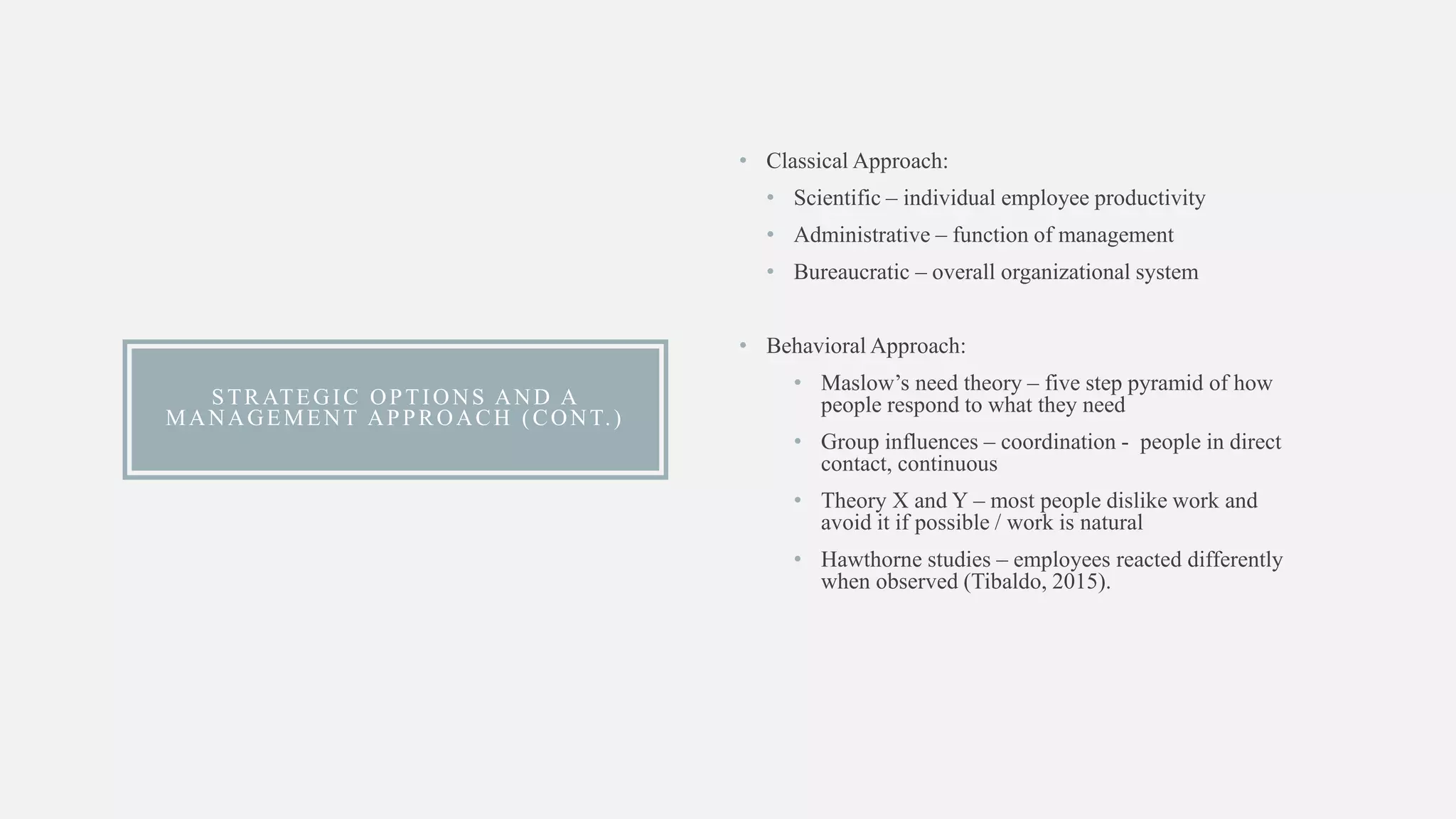
STRATEGIC OPTIONS AND A
MANAGEMENT APPROACH (CONT.)
• Classical Approach:
• Scientific – individual employee productivity
• Administrative – function of management
• Bureaucratic – overall organizational system
• Behavioral Approach:
• Maslow’s need theory – five step pyramid of how
people respond to what they need
• Group influences – coordination - people in direct
contact, continuous
• Theory X and Y – most people dislike work and
avoid it if possible / work is natural
• Hawthorne studies – employees reacted differently
when observed (Tibaldo, 2015).
STRATEGIC
OPTIONS AND A
MANAGEMENT
APPROACH
(CONT.)
• Modern Approach:
• Theory Z – employees have interest in good
work relationships, encouraged in management
decisions, long-term assets
• Total Quality Management – improving product
quality, customer satisfaction
• Management by objectives – everyone agrees to
objectives and understands what needs to happen
to accomplish goal (Tibaldo, 2015).
EMPLOYEE
SATISFACTION
AND
RETENTION
• Employee retention is a challenge of
organizations.
• Employees are most important asset (Anitha
& Begum, 2016).
• Variation in cultural values have a significant
effect on employee termination.
• Employee job performance and retention
varies with organizational cultural values
(Sheridan, 2017).
EMPLOYEE SATISFACTION AND
RETENTION (CONT.)
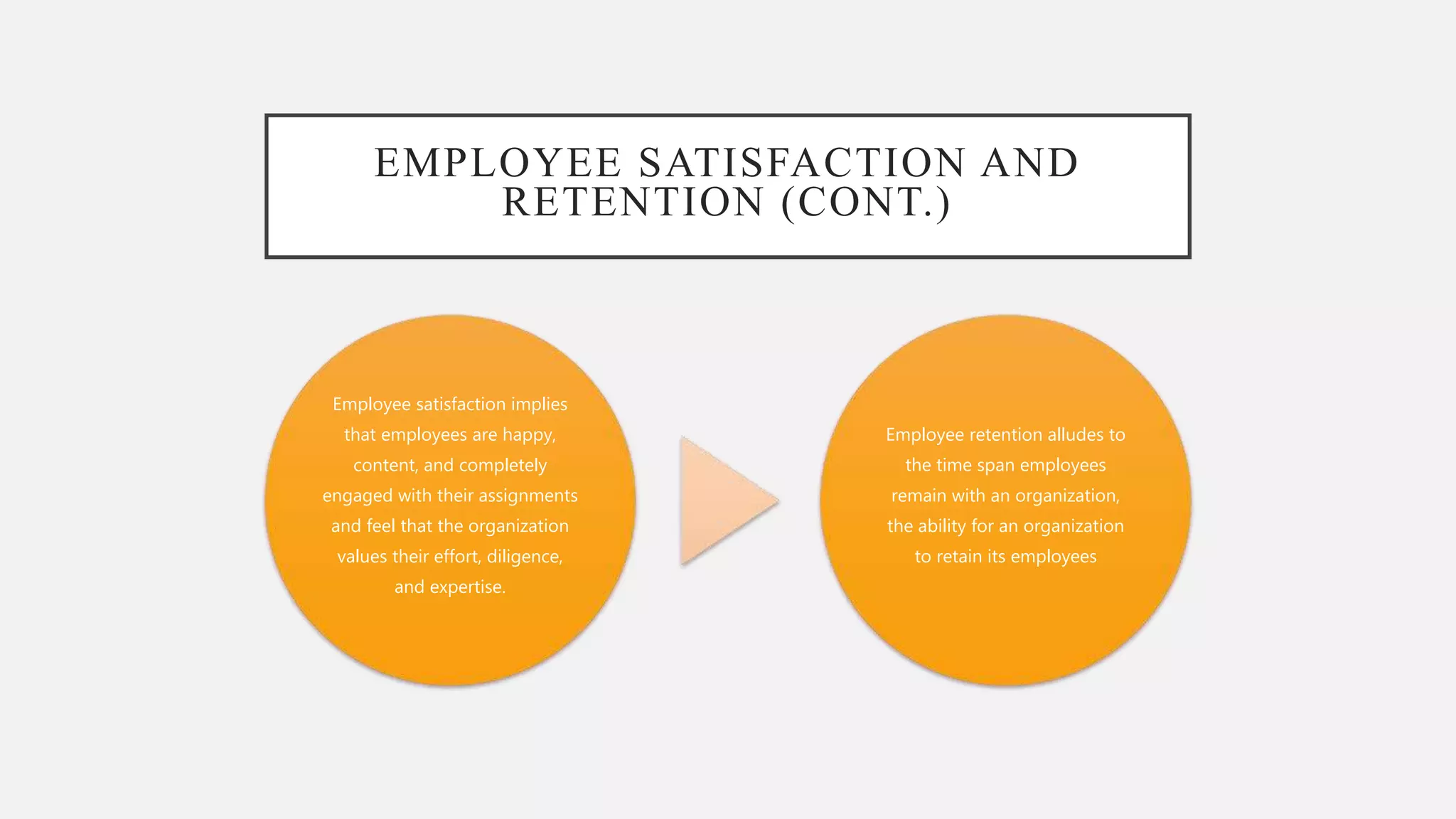
Employee satisfaction implies
that employees are happy,
content, and completely
engaged with their assignments
and feel that the organization
values their effort, diligence,
and expertise.
Employee retention alludes to
the time span employees
remain with an organization,
the ability for an organization
to retain its employees
REFERENCES
Anitha, J., & Begum, F. N. (2016). Role of organisational culture
and employee commitment in employee retention. ASBM
Journal of Management, 9(1), 17-28. Retrieved from
https://libraryresources.columbiasouthern.edu/login?url=http://s
earch.proquest.com.libraryresources.columbiasouthern.edu/docv
iew/1768170510?accountid=33337
BusinessDictionary. (2018). Growth strategy. Retrieved from
http://www.businessdictionary.com/definition/growth-
strategy.html
Duggan, T. (2018). The advantages of team-based structure.
Retrieved from http://smallbusiness.chron.com/advantages-
teambased-structure-55624.html
Griffin, D. (2018). Functional organizational structure advantages.
Retrieved from http://smallbusiness.chron.com/functional-
organizational-structure-advantages-3721.html
Houghton Mifflin Harcourt. (2016). Five approaches to
organizational design. Retrieved from
https://www.cliffsnotes.com/study-guides/principles-of-
management/organizational-design-and-structure/five-
approaches-to-organizational-design
REFERENCES
(CONT.)
Khan, M. M. S. (2015). The longevity of large enterprises: A study
of the factors that sustain enterprises over an extended period of
time. The Journal of Developing Areas, 49(5), 41-52. Retrieved
from
https://libraryresources.columbiasouthern.edu/login?url=http://s
earch.proquest.com.libraryresources.columbiasouthern.edu/docv
iew/1707487550?accountid=33337
Mazzarol, T. (2010). What are your strategic options? Retrieved
from https://cemi.com.au/node/92
MDF Training & Consultancy. (2005). Strategic options. Retrieved
from
https://www.sportanddev.org/sites/default/files/downloads/strate
gic_options.pdf
Mueller, J. R. (2014). Alternative organizational design and its
impact on the future of work. Journal of Strategic Innovation
and Sustainability, 9(1), 48-58. Retrieved from
https://libraryresources.columbiasouthern.edu/login?url=http://s
earch.proquest.com.libraryresources.columbiasouthern.edu/docv
iew/1535386881?accountid=33337
REFERENCES
(CONT.)
Rappa, F. (2018). The advantages of divisional structure in
organizations. Retrieved from
http://smallbusiness.chron.com/advantages-divisional-structure-
organizations-26170.html
Reference.com. (2018). What is a network organizational structure?
Retrieved from https://www.reference.com/business-
finance/network-organizational-structure-491fa130f3a473d2#
Sheridan, J. E. (2017). Organizational culture and employee
retention [Abstract]. Academy of Management, 35(5). Abstract
retrieved from https://journals.aom.org/doi/abs/10.5465/256539
Tibaldo, J. (2015). Management approaches. Retrieved from
https://www.slideshare.net/janettie/management-approaches
Woods, C. (2014). Matrix Organizational Structure: Advantages,
Disadvantages & Examples. Retrieved from
https://study.com/academy/lesson/matrix-organizational-
structure-advantages-disadvantages-examples.html

Organizational Structure and Design

  • 1.
    ORGANIZATIONAL STRUCTURE AND DESIGN OrganizationalDesign Approaches – managers have to make choices regarding how to group employees together to perform their assigned job. The five common approaches that assist managers in determining departmental groupings are functional, divisional, matrix, team, and networking (Houghton Mifflin Harcourt, 2016). Organizational design deals with constructing and changing organizational structure to achieve organizational goals (Mueller, 2014).
  • 2.
    FUNCTIONAL STRUCTURE Is bestfocused on companies of a single product or service, works well in a stable environment that does not need change (Griffin, 2018). Positions into work units based on similar activities, skills, expertise, and resources . Features channels of communication and authority – responsibility relationships (Houghton Mifflin Harcourt, 2016).
  • 3.
    DIVISIONAL STRUCTURE Organization isbroken down into self-contained divisions. Divisions are created according to type of product or service produced, which operate as separate centers. Divisions may be created according to geographical markets (Rappa, 2018).
  • 4.
    MATRIX STRUCTURE Reporting relationshipsare set up as a grid or matrix, vice the conventional hierarchy structure. Increases employee motivation. Employees have two bosses, a functional manager and a product manager. Functional manager – helps with skills, prioritize and review work Product manager – sets direction on product (Woods, 2014).
  • 5.
    TEAM STRUCTURE Groups employeesperforming specific tasks into teams to perform specific functions. Enables manager to capitalize on employees strengths and minimize weaknesses. Best coverage for product development, customer support (Duggan, 2018).
  • 6.
    NETWORKING STRUCTURE Requires selectingbest players, increased flexibility and efficiency (Reference.com, 2018). Replace hierarchy with heterarchy – meaning all members are peers and have equal power (Mueller, 2014). Networks are a decentralization and emphasize self-managing teams.
  • 7.
    DIFFERENTIATION AND GROWTH STRATEGY Companiesshould attempt differentiation for competitive advantage (Khan, 2015). Business strategy is integral to maintaining advantage. Four wide development procedures are expansion, product advancement, market infiltration, and market improvement (BusinessDictionary, 2018). Growth Strategy - directed at leading considerable market share, even in place of short-term reward.
  • 8.
    STRATEGIC OPTIONS AND AMANAGEMENT APPROACH • Strategic options = alternative action-oriented responses to external situations that the organization confronts. • Takes advantage of facts, participants, trends, opportunities, and threats from external environment. • Options can be identified after an assessment (MDF Training & Consultancy, 2005). • Three generic options for organizations with less than 200 employees – • Growth – focus on innovation • Stasis – fine tune business • Exit – focus on valuation (Mazzarol, 2010).
  • 9.
    STRATEGIC OPTIONS ANDA MANAGEMENT APPROACH (CONT.) • Classical Approach: • Scientific – individual employee productivity • Administrative – function of management • Bureaucratic – overall organizational system • Behavioral Approach: • Maslow’s need theory – five step pyramid of how people respond to what they need • Group influences – coordination - people in direct contact, continuous • Theory X and Y – most people dislike work and avoid it if possible / work is natural • Hawthorne studies – employees reacted differently when observed (Tibaldo, 2015).
  • 10.
    STRATEGIC OPTIONS AND A MANAGEMENT APPROACH (CONT.) •Modern Approach: • Theory Z – employees have interest in good work relationships, encouraged in management decisions, long-term assets • Total Quality Management – improving product quality, customer satisfaction • Management by objectives – everyone agrees to objectives and understands what needs to happen to accomplish goal (Tibaldo, 2015).
  • 11.
    EMPLOYEE SATISFACTION AND RETENTION • Employee retentionis a challenge of organizations. • Employees are most important asset (Anitha & Begum, 2016). • Variation in cultural values have a significant effect on employee termination. • Employee job performance and retention varies with organizational cultural values (Sheridan, 2017).
  • 12.
    EMPLOYEE SATISFACTION AND RETENTION(CONT.) Employee satisfaction implies that employees are happy, content, and completely engaged with their assignments and feel that the organization values their effort, diligence, and expertise. Employee retention alludes to the time span employees remain with an organization, the ability for an organization to retain its employees
  • 13.
    REFERENCES Anitha, J., &Begum, F. N. (2016). Role of organisational culture and employee commitment in employee retention. ASBM Journal of Management, 9(1), 17-28. Retrieved from https://libraryresources.columbiasouthern.edu/login?url=http://s earch.proquest.com.libraryresources.columbiasouthern.edu/docv iew/1768170510?accountid=33337 BusinessDictionary. (2018). Growth strategy. Retrieved from http://www.businessdictionary.com/definition/growth- strategy.html Duggan, T. (2018). The advantages of team-based structure. Retrieved from http://smallbusiness.chron.com/advantages- teambased-structure-55624.html Griffin, D. (2018). Functional organizational structure advantages. Retrieved from http://smallbusiness.chron.com/functional- organizational-structure-advantages-3721.html Houghton Mifflin Harcourt. (2016). Five approaches to organizational design. Retrieved from https://www.cliffsnotes.com/study-guides/principles-of- management/organizational-design-and-structure/five- approaches-to-organizational-design
  • 14.
    REFERENCES (CONT.) Khan, M. M.S. (2015). The longevity of large enterprises: A study of the factors that sustain enterprises over an extended period of time. The Journal of Developing Areas, 49(5), 41-52. Retrieved from https://libraryresources.columbiasouthern.edu/login?url=http://s earch.proquest.com.libraryresources.columbiasouthern.edu/docv iew/1707487550?accountid=33337 Mazzarol, T. (2010). What are your strategic options? Retrieved from https://cemi.com.au/node/92 MDF Training & Consultancy. (2005). Strategic options. Retrieved from https://www.sportanddev.org/sites/default/files/downloads/strate gic_options.pdf Mueller, J. R. (2014). Alternative organizational design and its impact on the future of work. Journal of Strategic Innovation and Sustainability, 9(1), 48-58. Retrieved from https://libraryresources.columbiasouthern.edu/login?url=http://s earch.proquest.com.libraryresources.columbiasouthern.edu/docv iew/1535386881?accountid=33337
  • 15.
    REFERENCES (CONT.) Rappa, F. (2018).The advantages of divisional structure in organizations. Retrieved from http://smallbusiness.chron.com/advantages-divisional-structure- organizations-26170.html Reference.com. (2018). What is a network organizational structure? Retrieved from https://www.reference.com/business- finance/network-organizational-structure-491fa130f3a473d2# Sheridan, J. E. (2017). Organizational culture and employee retention [Abstract]. Academy of Management, 35(5). Abstract retrieved from https://journals.aom.org/doi/abs/10.5465/256539 Tibaldo, J. (2015). Management approaches. Retrieved from https://www.slideshare.net/janettie/management-approaches Woods, C. (2014). Matrix Organizational Structure: Advantages, Disadvantages & Examples. Retrieved from https://study.com/academy/lesson/matrix-organizational- structure-advantages-disadvantages-examples.html

Editor's Notes

  • #2 These five basic structures are then modified based on organizational needs and combine various elements of organic and mechanistic structures.
  • #3 Functional structure is the most common. Usually has divisions based on functional areas within the business.
  • #4 Divisional has become the second most popular structure. Key functions such as finance and personnel are typically at the company’s central headquarters. Performance is also easier to monitor.
  • #5 The matrix structure consolidates functional specialization with the focal point of divisional structure. This structure utilizes lasting cross‐functional groups to incorporate practical aptitude with a divisional core interest.
  • #6 The expectation is to separate functional barriers among departments and create a compelling relationship for tackling continuous issues.
  • #7 This approach gives adaptability and decreases overhead in light of the fact that the extent of staff and tasks can be diminished.
  • #8 For organizations to support long haul development, managers should comprehend what separates it from the opposition.
  • #9 Management is about getting things done. It incorporates different functions that accomplish a task and gets employees to work together to complete those tasks.
  • #10 It is important to acknowledge human behavior in shaping management style. Just because a person is a manager does not mean that he knows how to handle people accordingly.
  • #11 Modern management changes the way leaders manage today’s organizations.
  • #12 Organizational culture plays a big part in employee satisfaction and retention. Managers should engage in good working relationships. That leads to improved employee satisfaction. Higher job satisfaction leads to higher retention.
  • #13 Organizational culture plays a big part in employee satisfaction and retention. Managers should engage in good working relationships which leads to improved employee satisfaction. Higher job satisfaction leads to higher retention.