URINARY BIOMARKERS IN
BLADDER CANCER
1
URINARY BIOMARKERS
developed as an adjunct to standard diagnostic modalities for bladder
cancer diagnosis and monitoring
• Noninvasive testing with improved sensitivity over urine cytology has
been proposed as a desirable alternative to cystoscopy which costly
and uncomfortable
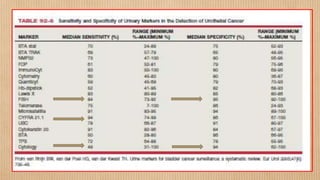
• Many urine-based markers are being used in clinical practice, but
none of them have shown better specificity than urine cytology, but
have shown definitely a better sensitivity than urine cytology.
2
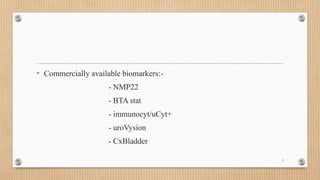
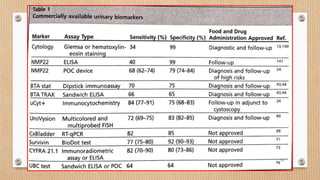
• Commercially available biomarkers:-
- NMP22
- BTA stat
- immunocyt/uCyt+
- uroVysion
- CxBladder
3
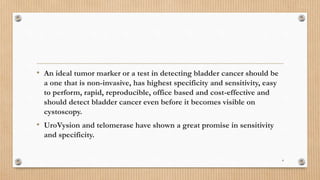
• An ideal tumor marker or a test in detecting bladder cancer should be
a one that is non-invasive, has highest specificity and sensitivity, easy
to perform, rapid, reproducible, office based and cost-effective and
should detect bladder cancer even before it becomes visible on
cystoscopy.
• UroVysion and telomerase have shown a great promise in sensitivity
and specificity.
4
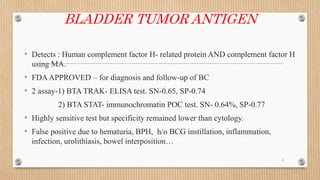
BLADDER TUMOR ANTIGEN
• Detects : Human complement factor H- related protein AND complement factor H
using MA.
• FDAAPPROVED – for diagnosis and follow-up of BC
• 2 assay-1) BTA TRAK- ELISA test. SN-0.65, SP-0.74
2) BTA STAT- immunochromatin POC test. SN- 0.64%, SP-0.77
• Highly sensitive test but specificity remained lower than cytology.
• False positive due to hematuria, BPH, h/o BCG instillation, inflammation,
infection, urolithiasis, bowel interposition…
5
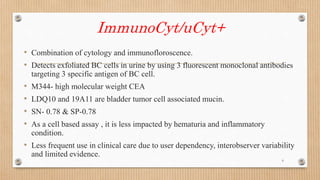
ImmunoCyt/uCyt+
• Combination of cytology and immunofloroscence.
• Detects exfoliated BC cells in urine by using 3 fluorescent monoclonal antibodies
targeting 3 specific antigen of BC cell.
• M344- high molecular weight CEA
• LDQ10 and 19A11 are bladder tumor cell associated mucin.
• SN- 0.78 & SP-0.78
• As a cell based assay , it is less impacted by hematuria and inflammatory
condition.
• Less frequent use in clinical care due to user dependency, interobserver variability
and limited evidence.
6
7
NMP 22
• Important role in structural framework of nucleus.
• Involved in mitosis by enabling correct distribution of chromatin to daughter
cell.
• 20 times more prevalent in malignant urothelial cells compared with normal
cells
• 2 assay- 1) NMP22 BC test kit-ELISA test
2) NMP22 bladder check test – immunochromatin assay i,e
point of care ( POC) test.
8
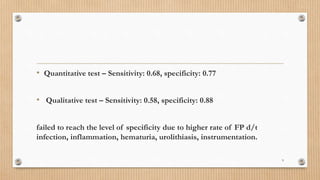
• Quantitative test – Sensitivity: 0.68, specificity: 0.77
• Qualitative test – Sensitivity: 0.58, specificity: 0.88
failed to reach the level of specificity due to higher rate of FP d/t
infection, inflammation, hematuria, urolithiasis, instrumentation.
9
uroVysion
• FISH assay.
• Identifies fluorescently labelled DNA probes that bind to intranuclear
chromosomes
• Detects aneuploidy of chromosomes 3,7,17 and heterozygous loss of
9P21 locus in exfoliated urothelial cells
10
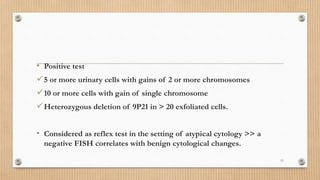
• Positive test
5 or more urinary cells with gains of 2 or more chromosomes
10 or more cells with gain of single chromosome
Heterozygous deletion of 9P21 in > 20 exfoliated cells.
• Considered as reflex test in the setting of atypical cytology >> a
negative FISH correlates with benign cytological changes.
11
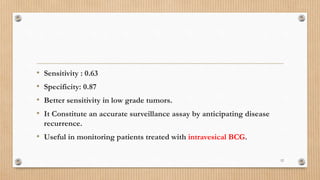
• Sensitivity : 0.63
• Specificity: 0.87
• Better sensitivity in low grade tumors.
• It Constitute an accurate surveillance assay by anticipating disease
recurrence.
• Useful in monitoring patients treated with intravesical BCG.
12
CxBladder
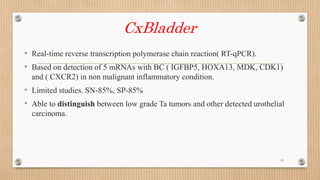
• Real-time reverse transcription polymerase chain reaction( RT-qPCR).
• Based on detection of 5 mRNAs with BC ( IGFBP5, HOXA13, MDK, CDK1)
and ( CXCR2) in non malignant inflammatory condition.
• Limited studies. SN-85%, SP-85%
• Able to distinguish between low grade Ta tumors and other detected urothelial
carcinoma.
13
14
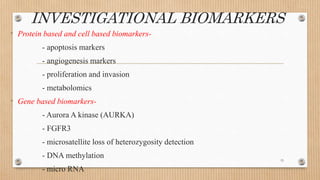
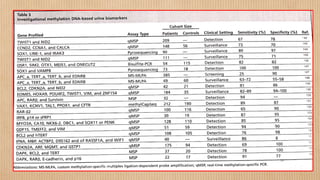
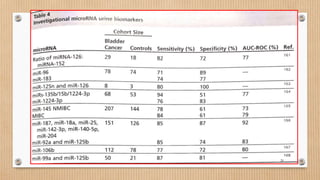
INVESTIGATIONAL BIOMARKERS
• Protein based and cell based biomarkers-
- apoptosis markers
- angiogenesis markers
- proliferation and invasion
- metabolomics
• Gene based biomarkers-
- Aurora A kinase (AURKA)
- FGFR3
- microsatellite loss of heterozygosity detection
- DNA methylation
- micro RNA
15
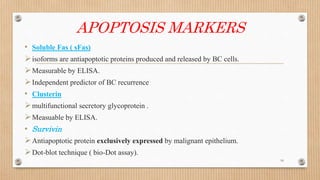
APOPTOSIS MARKERS
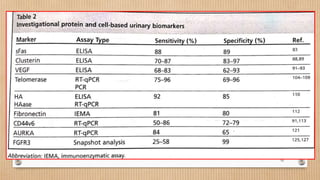
• Soluble Fas ( sFas)
isoforms are antiapoptotic proteins produced and released by BC cells.
Measurable by ELISA.
Independent predictor of BC recurrence
• Clusterin
multifunctional secretory glycoprotein .
Measuable by ELISA.
• Survivin
Antiapoptotic protein exclusively expressed by malignant epithelium.
Dot-blot technique ( bio-Dot assay).
16
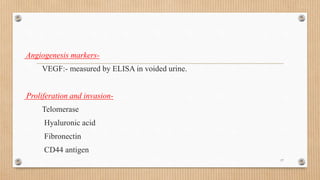
Angiogenesis markers-
VEGF:- measured by ELISA in voided urine.
Proliferation and invasion-
Telomerase
Hyaluronic acid
Fibronectin
CD44 antigen
17
18
19
20
Key points for urinary biomarkers
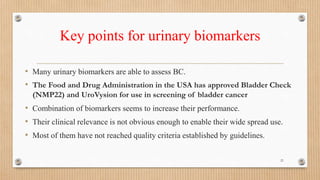
• Many urinary biomarkers are able to assess BC.
• The Food and Drug Administration in the USA has approved Bladder Check
(NMP22) and UroVysion for use in screening of bladder cancer
• Combination of biomarkers seems to increase their performance.
• Their clinical relevance is not obvious enough to enable their wide spread use.
• Most of them have not reached quality criteria established by guidelines.
21
CURRENT PRACTICE
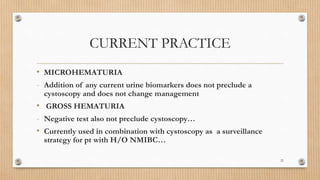
• MICROHEMATURIA
- Addition of any current urine biomarkers does not preclude a
cystoscopy and does not change management
• GROSS HEMATURIA
- Negative test also not preclude cystoscopy…
• Currently used in combination with cystoscopy as a surveillance
strategy for pt with H/O NMIBC…
22
• There are certain situations where the marker is positive but
no tumor is found on white light cystoscopy.
• This phenomenon has been observed in UroVysion FISH test
more predominantly and to moderate extent in cytology and to
lesser extent in BTA test and NMP22
• a positive UroVysion FISH test even in the absence of
confirmatory cystoscopical or cytological findings could
predict disease recurrence in 35-63% of patients within the
next 6-10 months.
• If blue light cystoscopy was used in these situations of
positive marker, ONE CAN DETECT A CANCER
• this phenomenon of anticipatory positive test should be
taken as an advantage, both in screening and surveillance.
23
THANK YOU
24

BLADDER- CARCINOMA- URINARY BIOMARKERS PPT final-1.pptx

  • 1.
  • 2.
    URINARY BIOMARKERS developed asan adjunct to standard diagnostic modalities for bladder cancer diagnosis and monitoring • Noninvasive testing with improved sensitivity over urine cytology has been proposed as a desirable alternative to cystoscopy which costly and uncomfortable • Many urine-based markers are being used in clinical practice, but none of them have shown better specificity than urine cytology, but have shown definitely a better sensitivity than urine cytology. 2
  • 3.
    • Commercially availablebiomarkers:- - NMP22 - BTA stat - immunocyt/uCyt+ - uroVysion - CxBladder 3
  • 4.
    • An idealtumor marker or a test in detecting bladder cancer should be a one that is non-invasive, has highest specificity and sensitivity, easy to perform, rapid, reproducible, office based and cost-effective and should detect bladder cancer even before it becomes visible on cystoscopy. • UroVysion and telomerase have shown a great promise in sensitivity and specificity. 4
  • 5.
    BLADDER TUMOR ANTIGEN •Detects : Human complement factor H- related protein AND complement factor H using MA. • FDAAPPROVED – for diagnosis and follow-up of BC • 2 assay-1) BTA TRAK- ELISA test. SN-0.65, SP-0.74 2) BTA STAT- immunochromatin POC test. SN- 0.64%, SP-0.77 • Highly sensitive test but specificity remained lower than cytology. • False positive due to hematuria, BPH, h/o BCG instillation, inflammation, infection, urolithiasis, bowel interposition… 5
  • 6.
    ImmunoCyt/uCyt+ • Combination ofcytology and immunofloroscence. • Detects exfoliated BC cells in urine by using 3 fluorescent monoclonal antibodies targeting 3 specific antigen of BC cell. • M344- high molecular weight CEA • LDQ10 and 19A11 are bladder tumor cell associated mucin. • SN- 0.78 & SP-0.78 • As a cell based assay , it is less impacted by hematuria and inflammatory condition. • Less frequent use in clinical care due to user dependency, interobserver variability and limited evidence. 6
  • 7.
  • 8.
    NMP 22 • Importantrole in structural framework of nucleus. • Involved in mitosis by enabling correct distribution of chromatin to daughter cell. • 20 times more prevalent in malignant urothelial cells compared with normal cells • 2 assay- 1) NMP22 BC test kit-ELISA test 2) NMP22 bladder check test – immunochromatin assay i,e point of care ( POC) test. 8
  • 9.
    • Quantitative test– Sensitivity: 0.68, specificity: 0.77 • Qualitative test – Sensitivity: 0.58, specificity: 0.88 failed to reach the level of specificity due to higher rate of FP d/t infection, inflammation, hematuria, urolithiasis, instrumentation. 9
  • 10.
    uroVysion • FISH assay. •Identifies fluorescently labelled DNA probes that bind to intranuclear chromosomes • Detects aneuploidy of chromosomes 3,7,17 and heterozygous loss of 9P21 locus in exfoliated urothelial cells 10
  • 11.
    • Positive test 5or more urinary cells with gains of 2 or more chromosomes 10 or more cells with gain of single chromosome Heterozygous deletion of 9P21 in > 20 exfoliated cells. • Considered as reflex test in the setting of atypical cytology >> a negative FISH correlates with benign cytological changes. 11
  • 12.
    • Sensitivity :0.63 • Specificity: 0.87 • Better sensitivity in low grade tumors. • It Constitute an accurate surveillance assay by anticipating disease recurrence. • Useful in monitoring patients treated with intravesical BCG. 12
  • 13.
    CxBladder • Real-time reversetranscription polymerase chain reaction( RT-qPCR). • Based on detection of 5 mRNAs with BC ( IGFBP5, HOXA13, MDK, CDK1) and ( CXCR2) in non malignant inflammatory condition. • Limited studies. SN-85%, SP-85% • Able to distinguish between low grade Ta tumors and other detected urothelial carcinoma. 13
  • 14.
  • 15.
    INVESTIGATIONAL BIOMARKERS • Proteinbased and cell based biomarkers- - apoptosis markers - angiogenesis markers - proliferation and invasion - metabolomics • Gene based biomarkers- - Aurora A kinase (AURKA) - FGFR3 - microsatellite loss of heterozygosity detection - DNA methylation - micro RNA 15
  • 16.
    APOPTOSIS MARKERS • SolubleFas ( sFas) isoforms are antiapoptotic proteins produced and released by BC cells. Measurable by ELISA. Independent predictor of BC recurrence • Clusterin multifunctional secretory glycoprotein . Measuable by ELISA. • Survivin Antiapoptotic protein exclusively expressed by malignant epithelium. Dot-blot technique ( bio-Dot assay). 16
  • 17.
    Angiogenesis markers- VEGF:- measuredby ELISA in voided urine. Proliferation and invasion- Telomerase Hyaluronic acid Fibronectin CD44 antigen 17
  • 18.
  • 19.
  • 20.
  • 21.
    Key points forurinary biomarkers • Many urinary biomarkers are able to assess BC. • The Food and Drug Administration in the USA has approved Bladder Check (NMP22) and UroVysion for use in screening of bladder cancer • Combination of biomarkers seems to increase their performance. • Their clinical relevance is not obvious enough to enable their wide spread use. • Most of them have not reached quality criteria established by guidelines. 21
  • 22.
    CURRENT PRACTICE • MICROHEMATURIA -Addition of any current urine biomarkers does not preclude a cystoscopy and does not change management • GROSS HEMATURIA - Negative test also not preclude cystoscopy… • Currently used in combination with cystoscopy as a surveillance strategy for pt with H/O NMIBC… 22
  • 23.
    • There arecertain situations where the marker is positive but no tumor is found on white light cystoscopy. • This phenomenon has been observed in UroVysion FISH test more predominantly and to moderate extent in cytology and to lesser extent in BTA test and NMP22 • a positive UroVysion FISH test even in the absence of confirmatory cystoscopical or cytological findings could predict disease recurrence in 35-63% of patients within the next 6-10 months. • If blue light cystoscopy was used in these situations of positive marker, ONE CAN DETECT A CANCER • this phenomenon of anticipatory positive test should be taken as an advantage, both in screening and surveillance. 23
  • 24.

Editor's Notes

  • #4 These are most widely available biomarkers that have relevance in current and future clinical practice
  • #6 2 basement membrane antigens - This high FP of Both BTA assay could be related to the cross reactivity with RBC because complement factor H is present in high concentration in serum
  • #9 Both assayes are FDA approved for use in BC survellance
  • #23 1-b/c negative test is a/w approx. 10% probability of having cancer - B/C none of the currently available biomarkers have reached the necessary threshold for the diagnosis of BC