NEWER TUMOR MARKERS
DR. BINA M. GADHIYA
ASSISTANT PROFESSOR
DEPT OF BIOCHEMISTRY
GMC AURANGABAD
 TUMOR MARKER is a substance produced by a tumor or
by the host in response to a tumor which is used to
differentiate a tumor from normal tissue or to detect
the presence of a tumor based on measurements in
blood or secretions.
 They are found in cells, tissues or body fluids.
 Measured qualitatively or quantitatively by chemical
immunological or molecular biological methods.
 They are biochemical or immunologic counterparts of
differentiation states of tumor.
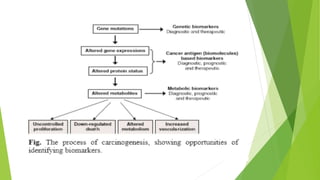
 Cancer a multigene disease (cluster of diseases)which
arises as a result of mutational & epigenetic changes
coupled with activation of complex signaling networks.
 It involves alteration of three main classes of genes –
1)ProtoOncogenes 2)Tumor suppressor genes 3) DNA
repair genes.
 This contribute to development of cancer genotype &
phenotype.
 This alterations resist the natural & inherent death
mechanisms embedded in cells(apoptosis) coupled with
dysregulation of cell proliferation events.
Cancer
 These genetic alterations include gene rearrangements,
point mutations & gene amplifications leading to
disturbances in molecular pathways regulating cell
growth, survival & metastasis.
 When these changes manifest in mazority of patients
with specific type of tumour this can be used as tumour
markers ( Biomarkers ) .
 Can also be used for detection & developing targeted
therapies besides predicting responses to treatment.
 This new tumor markers include a broad range of
biochemical entities such as:
1. nucleic acids
2. proteins
3. sugars
4. lipids
5. small metabolites
6. cytogenetic & cytokinetic parameters
7. whole tumor cells
8. cancer stem cells
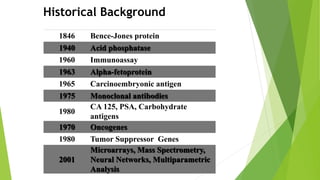
Historical Background
1846 Bence-Jones protein
1940 Acid phosphatase
1960 Immunoassay
1963 Alpha-fetoprotein
1965 Carcinoembryonic antigen
1975 Monoclonal antibodies
1980
CA 125, PSA, Carbohydrate
antigens
1970 Oncogenes
1980 Tumor Suppressor Genes
2001
Microarrays, Mass Spectrometry,
Neural Networks, Multiparametric
Analysis
 Highly specific i.e. detectable in only one tumor,
not detectable in benign disease and healthy
subjects
 Highly sensitive i.e. detectable when only a few
cancer cells are present
 specific to a particular organ
 Correlate with the tumour stage or tumour mass
 correlate with the prognosis
 have a reliable prediction value
 But ideal tumour marker doesn’t exists
Ideal Tumour Marker should be….
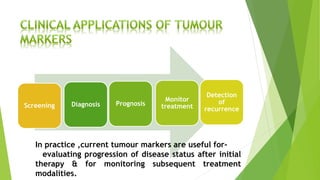
Diagnosis Prognosis
Monitor
treatment
Detection
of
recurrence
Screening
In practice ,current tumour markers are useful for-
evaluating progression of disease status after initial
therapy & for monitoring subsequent treatment
modalities.
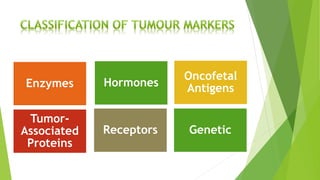
Hormones
Oncofetal
AntigensEnzymes
Tumor-
Associated
Proteins
Receptors Genetic
ENZYMES AS TUMOR MARKERS
 ALCOHOL DEHYRDROGENESE & ALDOLASE : LIVER
CANCER
 ALKALINE PHOSPHATASE :BONE, LIVER LEUKEMIA
 PROSTATIC ACID PHOSOHATASE :PROSTATE
 NEURON SPECIFIC ENOLASE : SMALL CELL LUNG CANCER,
NEUROBLASTOMA,MELANOMA
 LACTATE DEHYDROGENES : LYMPHOMA , LEUKEMIA
PROSTATE SPECIFIC ANTIGEN :
 Only marker used to screen for a common type of
cancer –prostate cancer.
 PSA is a single chain glycoprotein specific for prostatic
tissue.
 Gene encoding PSA has been sequenced & located on
chromosome 19.
 PSA is a serine protease of the kallikrein family.(KLK3).
 Sandwich immunoassays are used to measure PSA.
UROKINASE PLASMINOGEN ACTIVATOR
SYSTEM
 Contains 1) UROKINASE PLASMINOGEN ACTIVATOR (uPA) A serine
protease
2) uPA membrane bound receptor (uPAR)
3) uPA inhibitors ,PAI-1 & PAI-2
 Cathepsins B & L activates uPA ,which interacts with its receptor
,uPAR & converts plasminogen to plasmin .
 Plasmin degrades extracellular matrix (ECM) components & activates
MMPs which further degrade the ECM & activate & release growth
factors FGF & transforming growth factor –beta.
 uPA IS the prognostic marker in breast cancer. ALSO in ovarian ,renal
cervical & other cancers.
 It is measured by ELISA & commercially available kits for detection of
uPA & & PAI in tumor tissue.
CATHEPSINS
 Are lysosomal proteases.
 Cathepsin B , D & L have role in tumor development & progression.
 Expression & localization of CB & CD is altered in tumor tissue.
 Increased expression is seen in –breast,gastric ,lung, prostate
cancer & melanomas.
 Altered localization is seen in –colon ,thyroid cancers ,-gliomas
,breast epithelial tumors .
 They are involved in tissue invasion through ECM degradation &
growth promotion by various growth factors –fibroblast growth
factor ,Insulin like growth factor-1,Epidermal growth factor .
 Increased expression ECM proteases is seen in stromal cells at the
border between tumor cells & normal tissue .
 Detection of CB & other growth factors in stromal cells & tumor
tissue may have prognostic value.CB is detected by ELISA.
 RIA is used to detect cytoplasmic CD in tumor tissue. It can be
measured by western blot , immunohistochemistry & by activity.
MATRIX METALLO PROTEINASES
 Zinc dependent endopeptidases capable of degrading components
of ECM.
 Involved in tissue remodeling & wound repair
 Also associated with tumor growth ,invasion & metastasis.
 Increased expression of MMP-2 & MMP-9 is associated with
accelerated tumor progression in oral carcinoma ,lung
adenocarcinoma ,papillary thyroid carcinoma .
 MMP-7 correlates with tumor aggressiveness in esophageal
carcinoma.
 Expression of MMP-1 is associated with lymph node metastasis in
cervical cancer & peritoneal metastasis in gastric cancer.
 MMP inhibition may be therapeutic strategy for cancer.
 MMPs are detected in tissue sections by immunohistochemistry
using specific antibodies & in tissue extracts & serum by
immunoassay.
ISOCITRATE DEHYDROGENASE 1
 IDH1 can be used as a plasma biomarker for the
diagnosis of NSCLCs, particularly lung adenocarcinoma,
with relatively high sensitivity and specificity.
( Clin Cancer Res; 19(18); 5136–45. ©2013 AACR.)
HORMONES AS TUMOR MARKERS
 ACTH :CUSHING’S SYNDROME,LUNG CANCER
 ADH :LUNG , ADRENAL CORTEX,PANCREATIC
 BOMBESIN :LUNG
 CALCITONIN :MEDULLARY CA THYROID
 VASOACTIVE INTESTINAL PEPTIDE
:PHEOCHROMOCYTOMA, NEUROBLASTOMA
 HUMAN CHOROINIC GONADOTROPIN
:CHORIOCARCINOMA, EMBRYONAL
ONCOFETAL ANTIGENS
 AFP : HEPATOCELLULAR ,GERM CELL TUMOR,
 CARCINOFETAl FERRITIN : LIVER
 CEA : COLORECTAL, GASTROINTESTINAL, LUNG,
BREAST ,PANCREATIC
 SQUAMOUS CELL ANTIGEN : CERVICAL, LUNG, SKIN,
HEAD & NECK
 TENNESSEE ANTIGEN : COLON, GASTROINTESTINAL,
BLADDER
 CYTOKERATINS : 1)TISSUE POLYPEPTIDE ANTIGEN :
BREAST, COLORECTAL, OVARIAN, BLADDER 2)TISSUE
POLYPEPTIDE SPECIFIC ANTIGEN 3) CYTOKERATIN 19
FRAGMENTS (CYFRA-21-1) -a prognostic marker for non
small cell lung cancer.
Proteins as tumor markers
 BETA 2 MACROGLOBULIN : MULTIPLE MYELOMA, CML,
WALDENSTROM’S MACROGLOBULINEMIA
 C-PEPTIDE : INSULINOMA
 FERRITIN : LIVER, LUNG, BREAST, LEUKEMIA
 IMMUNOGLOBULINS : MULTIPLE MYELOMA, LYMPHOMAS
 MELANOMA ASSOCIATED ANTIGEN : MELANOMA
 DES-GAMMA-CARBOXY PROTHROMBIN :
HEPATOCELLULAR
 SOLUBLE MESOTHELIN RELATED PEPTIDES :
MESOTHELIOMA, OVARIAN
TUMOR ASSOCIATED TRYPSIN
INHIBITOR(TATI)
 Acute phase reactant & induced under strong
inflammatory conditions
 Increased in gastrointestinal & urologic cancers .
 Useful marker for pancreatic cancer .
 TATI in serum or urine is measured by
radioimmunoassay.
 NUCLEAR MATRIX PROTEIN -22 : BLADDER CANCER
 S-100 PROTEINS - MELANOMA
 AUTOANTIBODIES TO TUMOR ANTIGENS
 MARKERS OF ANGIOGENESIS : VASCULAR ENDOTHELIAL
GROWTH FACTOR (VEGF) , SOLUBLE Tie 2 RECEPTOR
corelate with development of metastasis.
 THYROGLOBULIN : THYROID CANCER
 CHROMOGRANINS : NEUROENDOCRINE TUMORS
HEAT SHOCK PROTEINS
 BREAST, ENDOMETRIAL CANCER, OSTEOSARCOMA
 Physiopathological features of tumor micro
environment (low glucose, oxygen) stimulate HSP
induction.
 HSP 27 EXPRESSION is associated with poor prognosis in
gastric ,liver ,prostate carcinoma & osteosarcoma. Also
associated with poor response to chemotherapy in
leukemia patients.
 HSP 70 is correlated with poor prognosis in breast,
endometrial, uterine ,cervical & bladder carcinoma.
 Implication of HSP in tumor progression & response to
therapy has led to its successful targeting in therapy by
use of HSP in anticancer vaccines exploiting their ability
MMP 13 –MATRIX METALLOPROTEIN 13
 POTENTIALLY NEW TUMOR MARKER FOR BREAST
DIAGNOSIS.
 Gene expression using microarray technology was
studied in breast cancer patients .MMP 13 WAS 100%
over expressed confirmed to be a secreted protein by
western blot analysis of the culture medium .
(HE4) HUMAN EPIDIDYMIS PROTEIN 4
 Marker for ovarian cancer .
 Gene for HE4 has been discovered using microarrays to
be overexpressed in epididymal tissue & later in ovarian
cancer tissue.
 The algorithm termed RISK OF MALIGNANCY INDEX
(ROMI) incorporating HE4 & CA 125 was accurate in
classifying a high percentage of women with epithelial
ovarian cancer.
 It is measured by enzyme immunoassay .
Ova1 1ST IVDMIA PROTEOMIC
DIAGNOSTIC FOR OVARIAN CANCER.
 Qualitative serum test that conbines results of 5 immunoassays into a
single numeric score.
 5 markers are –CA 125, PREALBUMIN , Apo A1 , Transferrin & Beta 2
macroglobulin
 Indicated in women who over age 18 & present with adnexal mass for
which surgery is planned & yet not referred to oncologist .
 OVA1 score is calculated using OvaCalc software.
 Expected value for probability of malignancy -
 in premenopausal women-1)HIGH –OVA 1≥ 5.0 2) LOW OVA1 < 5.0
 In postmenopausal women -1)HIGH –OVA 1≥ 4.4 2) LOW OVA1 < 4.4
CARBOHYDRATE MARKERS or MUCIN
TUMOR MARKERS
 CA-125 : OVARIAN, ENDOMETRIAL
 CA-15-3 : BREAST, OVARIAN
 CA-549 : BREAST, OVARIAN
 CA-27.29 : BREAST
 MUCIN-LIKE CARCINOMA ASSOCIATED ANTIGEN (MCA) :
BREAST , OVARIAN
 DU-PAN-2 : PANCREATIC
BLOOD GROUP ANTIGEN RELATED
MARKERS
 CA 72-4 : NEWER TEST FOR OVARIAN, PANCREATIC &
STOMACH CANCER . Studies of this marker are still in
progress.
 CA 19-9 : PANCREATIC, GASTROINTESTINAL, HEPATIC
.best for pancreatic cancer.
 CA 19-5 : PANCREATIC, GASTROINTESTINAL , OVARIAN
 CA 50 : PANCREATIC, GASTROINTESTINAL, COLON
 CA 242 : PANCREATIC, GASTROINTESTINAL
RECEPTORS & OTHER TUMOR MARKERS
 ESTROGEN & PROGESTERONE RECEPTORS : INDICATORS
OF HORMONAL THERAPY IN BREAST CANCER.
 ANDROGEN RECEPTORS : PROSTATE CANCER.
 HEPATOCYTE GROWTH FACTOR RECEPTOR (c-MET) :
COLORECTAL , HEPATOCELLULAR, BREAST, PROSTATE,
CERVICAL CANCER.
 EPIDERMAL GROWTH FACTOR RECEPTORS : OVER
EXPRESSION HAS STRONG PROGNOSTIC VALUE.
 CATECHOLAMINE METABOLITES - VMA, HVA
,METANEPHRINES :NEUROBLASTOMA ,
PHEOCHROMOCYTOMA
 HYDROXYPROLINE : BONE METASTASIS ( BREAST ),
MULTIPLE MYELOMA
 LIPID ASSOCIATED SAILIC ACID : GASTROINTESTINAL
,LUNG ,RHEUMATOID
 POLYAMINES
 LYSOPHOSPHATIDIC ACID : A POTENTIAL BIOMARKER FOR
OVARIAN & OTHER GYNEACOLOGICAL CANCERS.
Genetic markers
 Deviations from diploid chromosome to hypo & hyper-
diploidy as well as aneuploidy are noted in malignant
tumors.
 Sister chromatid exchanges & translocations give rise to
structural aberrations are scored using various banding
techniques. Philadelphia chromosome is associated with
CML due to translocation between chromosomes 9 &
22.
 Double minutes & homogenously stained regions
indicative of gene amplifications are often observed in
malignant cells that can serve as markers.
 Somatic mutations are promising biomarkers for cancer
risk as they can capture genetic events associated with
malignant transformations.
 Enhanced cell proliferation ,most important hallmark of
cancer can be assessed by flow cytometric analysis of
DNA Content ,which is automated, objective & rapid
allowing large number of cells to be measured.
 Identification of S phase cells & analysis of number of
antigenic determinants of proliferation (PCNA, Ki67,
NOR, etc ) are studied by molecular cell biology
techniques which can be used as complementary
markers.
 Proteins encoded by mini chromosome maintenance
genes (MCM) are also proposed as useful markers of
proliferation ; with high levels of gene expression
indicating poor prognosis.
 Gene deletions can be discovered by PCR using
microsatellite probes to various chromosomes & sites .
 Random chromosomal abnormalities are associated with
clinical cancer.
 Mutations & loss of heterozygosity within several proto-
oncogenes can lead to microsatellite instability .
Detection of this MSI in pathological tissue samples &
comparison with normal tissue represents a valuable
tool for early detection , at pre neoplastic stage.
 Establishment of biomarkers require a comprehensive
understanding of molecular mechanisms & cellular
processes underlying the initiation of cancer, especially
focusing on how small changes in only a few regulatory
genes or proteins can disrupt a variety of cellular
functions.
 In the post genomic era , with the availability of
complete human genome sequence & recent
technological advancement such as high throughput
DNA sequencing , microarrays & mass spectrometry, the
plethora of potentially informative cancer biomarkers
has expanded dramatically.
Oncogenes
 Oncogenes are derived from proto-oncogenes that may
be activated by dominant mutations ,insertions ,
deletions, translocations , or inversions.
 Most oncogenes code for proteins needed for
proliferation , & their activation leads to cell division.
 Most oncogenes are associated with hematologic
malignancies ,such as leukemia & to a lesser extent
solid tumors .
 More than 40 proto oncogenes are recognized but only
few are useful as tumor markers.
RAS GENES
 PROTEINS Coded by ras genes are located in inner face of cellular
membranes.
 They bind to GDP/GTP & function as molecular switches that regulate
mitogenic signals from growth factor to nucleus by signal transduction
pathways .
 This are activated in association with protein tyrosine kinase receptors
 Mutated N RAS is critical step in carcinogenesis & is found in
Neuroblastoma & Acute myeloid leukemia
 Single point mutation in K RAS AT 12th position leads to change of amino
acid from glycine to valine in p21 protein & is most frequently found in
cancer & correlates with poor prognosis .
 Mutations of ras oncogenes have been detected in DNA in stool of
symptomatic & asymptomatic patients of colorectal cancer, suggesting a
novel ,noninvasive paradigm for population screening.
 ASCO in 2009 has formalized that diagnosis of metastatic colorectal cancer
with wild type KRAS tumors are likely to benefit from monoclonal antibody
treatments targeting the EGFR pathways such as CETUXIMAB &
PANITUMUMAB.
C- myc gene
 Binds to DNA & is involved in transcription regulation.
 Gene product p62 is located in nucleus of transformed
cells.
 Translocation results in activation of this gene & is
associated with poor prognosis. Increased expression is
seen in T & B cell lymphoma ,sarcoma .
 Over expression of p62 is also seen in70 to 100% of
primary breast cancers & can be detected with
immunohistochemistry.
Her-2/neu (ERBB2)-
 This gene codes for EGF family of tyrosine kinase
receptors which are involved in cell proliferation ,
differentiation & survival.
 Amplification of this gene is found in Breast, Ovarian &
gastrointestinal tumors.
 HERCEPTIN treatment is administered only to those
breast cancer patients who have Her-2/neu
amplification.
 Immunohistochemistry is used to detect increased
expression of this protein.
 FISH is used for detection of HER-2/neu gene
amplification.
BCL-2 GENE
 BCL-2 oncogene codes for a protein which inhibits
apoptosis, especially lymphoma & leukemia cells.
 Activation of this BCL-2 gene is due to 14:18
translocation resulting in formation of BCL-2 protein.
 Overexpression of BCL-2 gene is associated with
development of resistance to cytotoxic cancer
chemotherapy .
BCR-ABL FUSION GENE
 A balanced translocation between chromosomes 9 & 22
creating BCR- ABL fusion gene ( Philadelphia
chromosome )seen in 90% of CML patients.
 Protein derived from this fusion is active tyrosine
kinase that activates several signaling pathways, leading
to uncontrolled growth , inhibition of apoptosis &
neoplastic transformation.
 Detection of BCR-ABL gene by RT-PCR is useful in
diagnosing CML & monitoring residual disease in
patients who have undergone bone marrow
transplantation.
 Several strategies target the BCR-ABL gene by
oligonucleotides or the BCR-ABL kinase domain by
tyrosine kinase inhibitor ST1571 (GLEEVEC OR IMATINIB
MESYLATE )
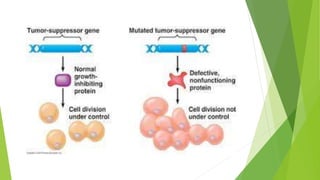
Tumor suppressor genes
 This genes are isolated from many solid tumors .
 The oncogenicity of tumor suppressor genes is derived from loss
of genes . Deletion or monosomy leads to loss of tumor
suppressor genes
 P53 Gene activates molecular processes that delay the cell cycle
progression of proliferating cells & stimulate DNA repair process.
 Mutant p53 gene is useful biomarker for predicting prognosis &
patients response to therapy.
 Gene replacement therapies targeting p53 aims at restoration of
p53 function in cancer cells by introduction of exogenous p53.
 APC gene is deactivated in many tumors (oesaphageal
adenocarcinoma & squamous cell carcinoma.) hypermethylated
APC gene in the blood is associated with poor survival.
 Mutations in BRCA 1 & BRCA 2 gene have an inherited
predisposition to develop breast & ovarian cancer.
 In colon cancer ,deletion or reduced expression of DCC
gene correlates with increasing stage & poor prognosis.
 PTEN mutation or loss of expression is associated with
more advanced stage & is a poor prognostic indicator in
various cancers, including breast, cervical,
hepatocellular & endometrial.
Epigenetic markers
 Epigenetic modifications occur directly through DNA
methylation of genes or indirectly by methylation
,acetylation or phosphorylation of histones & other
proteins around which DNA is wound to form chromatin.
 Activity of DNA methyl transferases are altered in tumor
cells & are associated with developmental
abnormalities.
 Genomic hypo methylation leads to genomic instability
& stronger gene expression .
 Local promoter CpG island hypermethylation induces
functional silencing of tumor suppressor genes.
 Hypermethylation of p16 promoter in the circulating
serum DNA correlate well with recurrent colorectal
cancer.
 Aberrant methylation of p16Ink4 & MGMT promoters
can be detected in DNA from the sputum of patients
with squamous cell carcinoma nearly 3 years before
clinical diagnosis.
 Alterations in methylation patterns of group of genes in
sputum samples may be an effective & non invasive
approach for identifying smokers at risk of developing
lung cancer.
 The development of therapeutics that reverse
epigenetic alterations in cancer cells along with
prognostic & diagnostic assays on gene methylation
patterns are promising new avenues for future
improvements in patient care.
Cells as Biomarkers
Circulating Tumor Cells [CTCs] :
 They provide early and reliable indication of disease
progression and survival of patients on systemic therapy
for metastatic breast cancer as early as 3-4 weeks after
initiation of therapy.
 Superior to standard tumor markers in predicting
prognosis.
 Can be used as an early predictor of treatment efficacy
and extremely in sparing patients from futile therapy.
 Can be detected by immunocytometry.
T-regulatory cells [CD4+,CD25+,Foxp3] :
 These are important in inducing and maintaining
peripheral self-tolerance and thus preventing immune
pathologies.
 Increased T regulatory activity is associated with poor
response to tumor antigens and contribute to immune
dysfunction resulting in tumor growth.
 T-regulatory cells may serve as surrogate immune
marker of cancer progression and perhaps prognosis.
 It is also useful as a predictor of response to therapies.
 CD 90 IS A DIAGNOSTIC MARKER TO DIFFERENTIATE
BETWEEN MALIGNANT PLEURAL MESOTHELIOMA & LUNG
CARCINOMA WITH IMMUNO HISTOCHEMISTRY .
Cancer Stem Cells [CSC] :
 Subpopulation of cancer cells which resemble the
developmental hierarchy of the normal tissue from which
the tumor arose.
 Evidence for existence of CSC initially came from studies of
AML.
 CSC are now demonstrated in many solid tumors including
glioblastoma, medulloblastoma, breast cancer, melanoma
and prostate cancer.
 CSC are resistant to chemotherapy and radiation therapy.
Eradication is the critical determinant in achieving cure.
 Identifying and characterizing CSC for every possible tumor
is of paramount importance and will likely lead to new
therapeutic avenues.
Viral Biomarkers
Hepatocellular cancer –
 HBV promotes carcinogenesis through genetic instability
generated by its common integration in host DNA .
 These markers include :
1. Analysis of viral DNA or proteins or antibodies produced
against the viral proteins.
2.HBsAG
3.HBeSG
4.anti-HBV core-antigen.
5.anti-HBeAG, anti-HbsAG.
Cervical Cancer :
 Persistent infection of high-risk type of human papilloma
virus.
 HPV-viral load in biopsy specimen.
 Antibodies against HPV-E6 and E7 serves as markers of an
invasive HPV associated malignancy.
 2 new HPV Vaccines “Gardasil” and “Cervarix” are highly
immunogenic and effective in preventing infections with high
risk-HPV types 16 & 18.
 EBV has been directly implicated in pathogenesis of Burkitt’s
lymphoma, NHL, nasopharyngeal carcinoma.
 Detection of quantification of plasma EBV-DNA serves as a
useful molecular marker for diagnosis monitoring and
prediction of relapse in patients with nasopharyngeal
carcinoma and Hodgkin’s lymphoma.
(PCA 3) PROSTATE CANCER ANTIGEN 3
GENE
 It is a new gene based test carried out on urine sample .
 PCA 3 is highly specific to prostate cancer & not
increased in benign enlargement or inflammation of
prostate.
 This testing holds potential in men with elevated PSA
levels but no cancer on initial biopsy.
 PCA 3 urine test will decide whether a new biopsy is
needed.
Mitochondrial Markers
 Mutations in mitochondrial DNA particularly in D-loop
region have found in many cancers .
 Mutated mt DNA has been detected in body fluids of
cancer patients & is much more abundant than mutated
nuclear p53 DNA.
Metabolic Biomarkers
 Bio-energetic index of cell has been suggested for
classification and prognosis of cancer, besides
predicting the response to therapy.
 Positron emission tomography allows non invasive and
quantitative analysis of various biologic process.
 It uses a glucose analogue [2-deoxy-D-glucose] labelled
with positron emitter Fluorine 18.
 FDG that is partially metabolized and trapped as its
phosphate [2-DG-6-P] in the tumor tissue, thus,
localizing the tumor
 Extent of increase in glucose utilization measured by
FDG-PET has been co-related with degree of malignancy
in some tumors.
 Glycolytic inhibitors like 2-deoxy-D-glucose are
selectively cytotoxic to tumor cells sensitizing it to
ionizing radiations. 2-DG has the potential to enhance
the efficacy of chemotherapy.
 Clinical trials in patients with malignant brain tumors
using a hypo fraction radio-therapy protocol combined
with 2DG have been very encouraging.
 Studying cancer through metabolomics could reveal
new biomarkers for cancer that could be useful for its
future prognosis ,diagnosis & therapy.
Therapeutic Biomarkers
 Targeted therapies display greater selectivity for tumor cells.
Eg : Small molecule drugs that inhibit the activity of tyrosine
kinases [ Eg : Imatinib and Erlotinib targeting ABL & EGFR].
 Antibody bevacizumab targets a growth factor that stimulates
tumor blood vessel growth.
Telomerase
 One of the best markers for human cancer associated with
only malignant tumors.
 Telomerase enzyme ensures the maintenance of telomere and
thereby protecting the cell from degradation and cell death.
 In cancer cells telomerase shuttling system is impaired.
 The TRAP (telomeric repeat amplification protocol) assay is
used for detection of telomerase activity.
 It has been a target for anti-cancer therapeutics that turn off
telomerase and there by inhibit tumor growth.
 Currently two clinical trials : one using a vaccine [GRNVAC1]
and the other a lapidated drug [GRN163L] are under way to
evaluate the efficacy of telomerase inhibitors.
Histone deacetylases [HDACs]
 HDACs are associated with oncogenesis by regulating the
expression of certain tumor suppressor genes leading to
excessive proliferation and tumorogenesis.
 They have recently been the attractive targets for cancer
therapeutics.
 HDAC inhibitors are currently under clinical investigation
in a number of hematological malignancies and solid
tumors.
Mammalian target of rapamycin
 Evolutionarily conserved serine threonine protein kinase that
belongs to PIKK (phosphoinositide 3 kinase (PI3K) –related kinase
) family .
 Plays an important role regulating cell growth & proliferation .
 Upon activation mTOR increases phosphorylation levels of its
downstreams targets that include P70S6K & 4EBP1, which leads
to increased levels of translation , ribosome biogenesis &
reorganization of actin cytoskeleton & inhibition of autophagy .
 A no. of m TOR inhibitors have potent anti-proliferative
properties which make them useful for cancer chemotherapy
particularly of advanced solid tumors showing higher levels of
expressions of phosphorylated S6.
PIN1
 Peptidyl-Prolyl-Isomerase [PPIase], PIN1 regulates post
phosphorylation event which is in the form Cis and Trans
isomerization of phosphoserine/threonine – proline peptide
bonds at selective sides.
 Over expression of PIN1 has been reported in human breast
cancer cell lines and tissues, and its expression closely
correlates with the level of cyclin D1 in tumors.
 PIN1 opens a new target for the development of specific
therapeutics as phosphorylated p53 is known substrates of
PIN1.
 Inhibition of PIN1 induces mitotic arrest and apoptosis in
tumor cell lines
 Recent studies with PIN1 inhibitor Juglone delays the growth
of various tumor cell lines.
Proteomics analysis of saliva
 Non invasive method for identifying biomarkers for human
cancers
 4 proteins in saliva have been found to be useful markers of oral
cancers with 90% sensitivity & 83% specificity for oral squamous
cell carcinoma .
 Calcium binding protein MRP 14
 CD 59 –overexpressed on tumor cells that enables them to
escape from complement dependent & antibody mediated
immune responses.
 Profilin 1 a protein involved in several signaling pathways
,secreted in tumor microenvironments during the early
progressive stage of tumorogenesis.
 Catalase, a member of antioxidative system is involved in
carcinogenesis & tumor progression .
ADIPONECTIN & LEPTIN – IN BREAST
CANCER
 Adiponectin & leptin are involved.
 Studies show that leptin m RNA expression is higher than
adiponectin m RNA expression in cancer cells.
 Adiponectin inhibits proliferation of cancer cells. Leptin
stimulates growth of cancer cells.
 Adiponectin inhibits leptin induced cell proliferation.
ADHESION MOLECULES & METASTASIS
 Cell adhesion molecules, including Integrins, Selectins &
Cadherins regulate many steps of metastatic process.
 Increased serum levels of E selectin, Inter cellular adhesion
molecule (ICAM) & Vascular adhesion molecule (VCAM)
indicate late stage of Breast cancer or the occurrence of
metastasis & hence a poor prognosis.
Stress & cancer
 Under normal circumstances trigerring ATF 3 gene in
stressfull conditions protects the body from harm by causing
normal cells to commit suicide .
 Cancer cells are able to switch on ATF 3 GENE in immune
cells & causes malfunction of immune cells & allows cancer
cells to escape from the tumor & spread to other parts of
the body.
MICROARRAY BASED MARKERS
 Amplichip p450 – Roche diagnostics
 Oncotype Dx - Genomic health inc.
 Mammaprint - Agendia inc.
 Tissue of origin test – Pathwork diagnostics .
 Bioplat-a software for human cancer biomarker discovery
 Micro array based analytes will revolutionize the future of
cancer therapy by providing biomarkers on their genetic
makeup.
 THE PRECLINICAL STRATEGY OF CANCER BIOMARKER
DISCOVERY ARE SENSITIVE & SPECIFIC ENOUGH
-FOR EARLY CANCER DETECTION
-FOR MONITORING DISEASE PROGRESSION &
-FOR PROPER TREATMENT SELECTION,
PAVING THE WAY TO INDIVIDUALIZED CANCER TREATMENT.
 NEW ERA IN CLINICAL ONCOLOGY WILL BE GUIDED BY
MOLECULAR ATTRIBUTES OF INDIVIDUAL PATIENTS THAT WILL
ALSO ANSWER ABOUT BIOLOGIC BEHAVIOR OF TUMORS .
Thank You
REFERENCES-
 Cancer Biomarkers – Current Perspectives. [Indian J Med Res 132, August
2010, pp 129-149.
 Teitz Textbook of clinical chemistry and molecular diagnostics.
 MMP13 is potentially a new tumor marker for breast cancer diagnostic.
[PubMed – indexed for MEDLINE]
 BioPlat- a software for human cancer biomarker discovery.[Bioinformatics.
02/2014]
 Involvement of adiponectin and leptin in breast cancer: clinical and in vitro
studies.[ENDOCR RELAT CANCER, 2009 December;16(4): 1197-210]
 Detecting cancer through markers (Dr. Mohini Bhargava- Express Healthcare)
 Cancer biomarker discovery : current status & future perspectives.
( International journal of Radiation Biology ).
 Stress fuels cancer spread by triggering master gene :ATF 3.

Newer Tumour Markers

  • 1.
    NEWER TUMOR MARKERS DR.BINA M. GADHIYA ASSISTANT PROFESSOR DEPT OF BIOCHEMISTRY GMC AURANGABAD
  • 2.
     TUMOR MARKERis a substance produced by a tumor or by the host in response to a tumor which is used to differentiate a tumor from normal tissue or to detect the presence of a tumor based on measurements in blood or secretions.  They are found in cells, tissues or body fluids.  Measured qualitatively or quantitatively by chemical immunological or molecular biological methods.  They are biochemical or immunologic counterparts of differentiation states of tumor.
  • 3.
     Cancer amultigene disease (cluster of diseases)which arises as a result of mutational & epigenetic changes coupled with activation of complex signaling networks.  It involves alteration of three main classes of genes – 1)ProtoOncogenes 2)Tumor suppressor genes 3) DNA repair genes.  This contribute to development of cancer genotype & phenotype.  This alterations resist the natural & inherent death mechanisms embedded in cells(apoptosis) coupled with dysregulation of cell proliferation events. Cancer
  • 4.
     These geneticalterations include gene rearrangements, point mutations & gene amplifications leading to disturbances in molecular pathways regulating cell growth, survival & metastasis.  When these changes manifest in mazority of patients with specific type of tumour this can be used as tumour markers ( Biomarkers ) .  Can also be used for detection & developing targeted therapies besides predicting responses to treatment.
  • 5.
     This newtumor markers include a broad range of biochemical entities such as: 1. nucleic acids 2. proteins 3. sugars 4. lipids 5. small metabolites 6. cytogenetic & cytokinetic parameters 7. whole tumor cells 8. cancer stem cells
  • 7.
    Historical Background 1846 Bence-Jonesprotein 1940 Acid phosphatase 1960 Immunoassay 1963 Alpha-fetoprotein 1965 Carcinoembryonic antigen 1975 Monoclonal antibodies 1980 CA 125, PSA, Carbohydrate antigens 1970 Oncogenes 1980 Tumor Suppressor Genes 2001 Microarrays, Mass Spectrometry, Neural Networks, Multiparametric Analysis
  • 8.
     Highly specifici.e. detectable in only one tumor, not detectable in benign disease and healthy subjects  Highly sensitive i.e. detectable when only a few cancer cells are present  specific to a particular organ  Correlate with the tumour stage or tumour mass  correlate with the prognosis  have a reliable prediction value  But ideal tumour marker doesn’t exists Ideal Tumour Marker should be….
  • 9.
    Diagnosis Prognosis Monitor treatment Detection of recurrence Screening In practice,current tumour markers are useful for- evaluating progression of disease status after initial therapy & for monitoring subsequent treatment modalities.
  • 10.
  • 11.
    ENZYMES AS TUMORMARKERS  ALCOHOL DEHYRDROGENESE & ALDOLASE : LIVER CANCER  ALKALINE PHOSPHATASE :BONE, LIVER LEUKEMIA  PROSTATIC ACID PHOSOHATASE :PROSTATE  NEURON SPECIFIC ENOLASE : SMALL CELL LUNG CANCER, NEUROBLASTOMA,MELANOMA  LACTATE DEHYDROGENES : LYMPHOMA , LEUKEMIA
  • 12.
    PROSTATE SPECIFIC ANTIGEN:  Only marker used to screen for a common type of cancer –prostate cancer.  PSA is a single chain glycoprotein specific for prostatic tissue.  Gene encoding PSA has been sequenced & located on chromosome 19.  PSA is a serine protease of the kallikrein family.(KLK3).  Sandwich immunoassays are used to measure PSA.
  • 13.
    UROKINASE PLASMINOGEN ACTIVATOR SYSTEM Contains 1) UROKINASE PLASMINOGEN ACTIVATOR (uPA) A serine protease 2) uPA membrane bound receptor (uPAR) 3) uPA inhibitors ,PAI-1 & PAI-2  Cathepsins B & L activates uPA ,which interacts with its receptor ,uPAR & converts plasminogen to plasmin .  Plasmin degrades extracellular matrix (ECM) components & activates MMPs which further degrade the ECM & activate & release growth factors FGF & transforming growth factor –beta.  uPA IS the prognostic marker in breast cancer. ALSO in ovarian ,renal cervical & other cancers.  It is measured by ELISA & commercially available kits for detection of uPA & & PAI in tumor tissue.
  • 14.
    CATHEPSINS  Are lysosomalproteases.  Cathepsin B , D & L have role in tumor development & progression.  Expression & localization of CB & CD is altered in tumor tissue.  Increased expression is seen in –breast,gastric ,lung, prostate cancer & melanomas.  Altered localization is seen in –colon ,thyroid cancers ,-gliomas ,breast epithelial tumors .  They are involved in tissue invasion through ECM degradation & growth promotion by various growth factors –fibroblast growth factor ,Insulin like growth factor-1,Epidermal growth factor .  Increased expression ECM proteases is seen in stromal cells at the border between tumor cells & normal tissue .  Detection of CB & other growth factors in stromal cells & tumor tissue may have prognostic value.CB is detected by ELISA.  RIA is used to detect cytoplasmic CD in tumor tissue. It can be measured by western blot , immunohistochemistry & by activity.
  • 15.
    MATRIX METALLO PROTEINASES Zinc dependent endopeptidases capable of degrading components of ECM.  Involved in tissue remodeling & wound repair  Also associated with tumor growth ,invasion & metastasis.  Increased expression of MMP-2 & MMP-9 is associated with accelerated tumor progression in oral carcinoma ,lung adenocarcinoma ,papillary thyroid carcinoma .  MMP-7 correlates with tumor aggressiveness in esophageal carcinoma.  Expression of MMP-1 is associated with lymph node metastasis in cervical cancer & peritoneal metastasis in gastric cancer.  MMP inhibition may be therapeutic strategy for cancer.  MMPs are detected in tissue sections by immunohistochemistry using specific antibodies & in tissue extracts & serum by immunoassay.
  • 16.
    ISOCITRATE DEHYDROGENASE 1 IDH1 can be used as a plasma biomarker for the diagnosis of NSCLCs, particularly lung adenocarcinoma, with relatively high sensitivity and specificity. ( Clin Cancer Res; 19(18); 5136–45. ©2013 AACR.)
  • 17.
    HORMONES AS TUMORMARKERS  ACTH :CUSHING’S SYNDROME,LUNG CANCER  ADH :LUNG , ADRENAL CORTEX,PANCREATIC  BOMBESIN :LUNG  CALCITONIN :MEDULLARY CA THYROID  VASOACTIVE INTESTINAL PEPTIDE :PHEOCHROMOCYTOMA, NEUROBLASTOMA  HUMAN CHOROINIC GONADOTROPIN :CHORIOCARCINOMA, EMBRYONAL
  • 18.
    ONCOFETAL ANTIGENS  AFP: HEPATOCELLULAR ,GERM CELL TUMOR,  CARCINOFETAl FERRITIN : LIVER  CEA : COLORECTAL, GASTROINTESTINAL, LUNG, BREAST ,PANCREATIC  SQUAMOUS CELL ANTIGEN : CERVICAL, LUNG, SKIN, HEAD & NECK  TENNESSEE ANTIGEN : COLON, GASTROINTESTINAL, BLADDER  CYTOKERATINS : 1)TISSUE POLYPEPTIDE ANTIGEN : BREAST, COLORECTAL, OVARIAN, BLADDER 2)TISSUE POLYPEPTIDE SPECIFIC ANTIGEN 3) CYTOKERATIN 19 FRAGMENTS (CYFRA-21-1) -a prognostic marker for non small cell lung cancer.
  • 19.
    Proteins as tumormarkers  BETA 2 MACROGLOBULIN : MULTIPLE MYELOMA, CML, WALDENSTROM’S MACROGLOBULINEMIA  C-PEPTIDE : INSULINOMA  FERRITIN : LIVER, LUNG, BREAST, LEUKEMIA  IMMUNOGLOBULINS : MULTIPLE MYELOMA, LYMPHOMAS  MELANOMA ASSOCIATED ANTIGEN : MELANOMA  DES-GAMMA-CARBOXY PROTHROMBIN : HEPATOCELLULAR  SOLUBLE MESOTHELIN RELATED PEPTIDES : MESOTHELIOMA, OVARIAN
  • 20.
    TUMOR ASSOCIATED TRYPSIN INHIBITOR(TATI) Acute phase reactant & induced under strong inflammatory conditions  Increased in gastrointestinal & urologic cancers .  Useful marker for pancreatic cancer .  TATI in serum or urine is measured by radioimmunoassay.
  • 21.
     NUCLEAR MATRIXPROTEIN -22 : BLADDER CANCER  S-100 PROTEINS - MELANOMA  AUTOANTIBODIES TO TUMOR ANTIGENS  MARKERS OF ANGIOGENESIS : VASCULAR ENDOTHELIAL GROWTH FACTOR (VEGF) , SOLUBLE Tie 2 RECEPTOR corelate with development of metastasis.  THYROGLOBULIN : THYROID CANCER  CHROMOGRANINS : NEUROENDOCRINE TUMORS
  • 22.
    HEAT SHOCK PROTEINS BREAST, ENDOMETRIAL CANCER, OSTEOSARCOMA  Physiopathological features of tumor micro environment (low glucose, oxygen) stimulate HSP induction.  HSP 27 EXPRESSION is associated with poor prognosis in gastric ,liver ,prostate carcinoma & osteosarcoma. Also associated with poor response to chemotherapy in leukemia patients.  HSP 70 is correlated with poor prognosis in breast, endometrial, uterine ,cervical & bladder carcinoma.  Implication of HSP in tumor progression & response to therapy has led to its successful targeting in therapy by use of HSP in anticancer vaccines exploiting their ability
  • 23.
    MMP 13 –MATRIXMETALLOPROTEIN 13  POTENTIALLY NEW TUMOR MARKER FOR BREAST DIAGNOSIS.  Gene expression using microarray technology was studied in breast cancer patients .MMP 13 WAS 100% over expressed confirmed to be a secreted protein by western blot analysis of the culture medium .
  • 24.
    (HE4) HUMAN EPIDIDYMISPROTEIN 4  Marker for ovarian cancer .  Gene for HE4 has been discovered using microarrays to be overexpressed in epididymal tissue & later in ovarian cancer tissue.  The algorithm termed RISK OF MALIGNANCY INDEX (ROMI) incorporating HE4 & CA 125 was accurate in classifying a high percentage of women with epithelial ovarian cancer.  It is measured by enzyme immunoassay .
  • 25.
    Ova1 1ST IVDMIAPROTEOMIC DIAGNOSTIC FOR OVARIAN CANCER.  Qualitative serum test that conbines results of 5 immunoassays into a single numeric score.  5 markers are –CA 125, PREALBUMIN , Apo A1 , Transferrin & Beta 2 macroglobulin  Indicated in women who over age 18 & present with adnexal mass for which surgery is planned & yet not referred to oncologist .  OVA1 score is calculated using OvaCalc software.  Expected value for probability of malignancy -  in premenopausal women-1)HIGH –OVA 1≥ 5.0 2) LOW OVA1 < 5.0  In postmenopausal women -1)HIGH –OVA 1≥ 4.4 2) LOW OVA1 < 4.4
  • 26.
    CARBOHYDRATE MARKERS orMUCIN TUMOR MARKERS  CA-125 : OVARIAN, ENDOMETRIAL  CA-15-3 : BREAST, OVARIAN  CA-549 : BREAST, OVARIAN  CA-27.29 : BREAST  MUCIN-LIKE CARCINOMA ASSOCIATED ANTIGEN (MCA) : BREAST , OVARIAN  DU-PAN-2 : PANCREATIC
  • 27.
    BLOOD GROUP ANTIGENRELATED MARKERS  CA 72-4 : NEWER TEST FOR OVARIAN, PANCREATIC & STOMACH CANCER . Studies of this marker are still in progress.  CA 19-9 : PANCREATIC, GASTROINTESTINAL, HEPATIC .best for pancreatic cancer.  CA 19-5 : PANCREATIC, GASTROINTESTINAL , OVARIAN  CA 50 : PANCREATIC, GASTROINTESTINAL, COLON  CA 242 : PANCREATIC, GASTROINTESTINAL
  • 28.
    RECEPTORS & OTHERTUMOR MARKERS  ESTROGEN & PROGESTERONE RECEPTORS : INDICATORS OF HORMONAL THERAPY IN BREAST CANCER.  ANDROGEN RECEPTORS : PROSTATE CANCER.  HEPATOCYTE GROWTH FACTOR RECEPTOR (c-MET) : COLORECTAL , HEPATOCELLULAR, BREAST, PROSTATE, CERVICAL CANCER.  EPIDERMAL GROWTH FACTOR RECEPTORS : OVER EXPRESSION HAS STRONG PROGNOSTIC VALUE.
  • 29.
     CATECHOLAMINE METABOLITES- VMA, HVA ,METANEPHRINES :NEUROBLASTOMA , PHEOCHROMOCYTOMA  HYDROXYPROLINE : BONE METASTASIS ( BREAST ), MULTIPLE MYELOMA  LIPID ASSOCIATED SAILIC ACID : GASTROINTESTINAL ,LUNG ,RHEUMATOID  POLYAMINES  LYSOPHOSPHATIDIC ACID : A POTENTIAL BIOMARKER FOR OVARIAN & OTHER GYNEACOLOGICAL CANCERS.
  • 30.
    Genetic markers  Deviationsfrom diploid chromosome to hypo & hyper- diploidy as well as aneuploidy are noted in malignant tumors.  Sister chromatid exchanges & translocations give rise to structural aberrations are scored using various banding techniques. Philadelphia chromosome is associated with CML due to translocation between chromosomes 9 & 22.  Double minutes & homogenously stained regions indicative of gene amplifications are often observed in malignant cells that can serve as markers.  Somatic mutations are promising biomarkers for cancer risk as they can capture genetic events associated with malignant transformations.
  • 31.
     Enhanced cellproliferation ,most important hallmark of cancer can be assessed by flow cytometric analysis of DNA Content ,which is automated, objective & rapid allowing large number of cells to be measured.  Identification of S phase cells & analysis of number of antigenic determinants of proliferation (PCNA, Ki67, NOR, etc ) are studied by molecular cell biology techniques which can be used as complementary markers.  Proteins encoded by mini chromosome maintenance genes (MCM) are also proposed as useful markers of proliferation ; with high levels of gene expression indicating poor prognosis.
  • 32.
     Gene deletionscan be discovered by PCR using microsatellite probes to various chromosomes & sites .  Random chromosomal abnormalities are associated with clinical cancer.  Mutations & loss of heterozygosity within several proto- oncogenes can lead to microsatellite instability . Detection of this MSI in pathological tissue samples & comparison with normal tissue represents a valuable tool for early detection , at pre neoplastic stage.
  • 33.
     Establishment ofbiomarkers require a comprehensive understanding of molecular mechanisms & cellular processes underlying the initiation of cancer, especially focusing on how small changes in only a few regulatory genes or proteins can disrupt a variety of cellular functions.  In the post genomic era , with the availability of complete human genome sequence & recent technological advancement such as high throughput DNA sequencing , microarrays & mass spectrometry, the plethora of potentially informative cancer biomarkers has expanded dramatically.
  • 34.
    Oncogenes  Oncogenes arederived from proto-oncogenes that may be activated by dominant mutations ,insertions , deletions, translocations , or inversions.  Most oncogenes code for proteins needed for proliferation , & their activation leads to cell division.  Most oncogenes are associated with hematologic malignancies ,such as leukemia & to a lesser extent solid tumors .  More than 40 proto oncogenes are recognized but only few are useful as tumor markers.
  • 35.
    RAS GENES  PROTEINSCoded by ras genes are located in inner face of cellular membranes.  They bind to GDP/GTP & function as molecular switches that regulate mitogenic signals from growth factor to nucleus by signal transduction pathways .  This are activated in association with protein tyrosine kinase receptors  Mutated N RAS is critical step in carcinogenesis & is found in Neuroblastoma & Acute myeloid leukemia  Single point mutation in K RAS AT 12th position leads to change of amino acid from glycine to valine in p21 protein & is most frequently found in cancer & correlates with poor prognosis .  Mutations of ras oncogenes have been detected in DNA in stool of symptomatic & asymptomatic patients of colorectal cancer, suggesting a novel ,noninvasive paradigm for population screening.  ASCO in 2009 has formalized that diagnosis of metastatic colorectal cancer with wild type KRAS tumors are likely to benefit from monoclonal antibody treatments targeting the EGFR pathways such as CETUXIMAB & PANITUMUMAB.
  • 36.
    C- myc gene Binds to DNA & is involved in transcription regulation.  Gene product p62 is located in nucleus of transformed cells.  Translocation results in activation of this gene & is associated with poor prognosis. Increased expression is seen in T & B cell lymphoma ,sarcoma .  Over expression of p62 is also seen in70 to 100% of primary breast cancers & can be detected with immunohistochemistry.
  • 37.
    Her-2/neu (ERBB2)-  Thisgene codes for EGF family of tyrosine kinase receptors which are involved in cell proliferation , differentiation & survival.  Amplification of this gene is found in Breast, Ovarian & gastrointestinal tumors.  HERCEPTIN treatment is administered only to those breast cancer patients who have Her-2/neu amplification.  Immunohistochemistry is used to detect increased expression of this protein.  FISH is used for detection of HER-2/neu gene amplification.
  • 38.
    BCL-2 GENE  BCL-2oncogene codes for a protein which inhibits apoptosis, especially lymphoma & leukemia cells.  Activation of this BCL-2 gene is due to 14:18 translocation resulting in formation of BCL-2 protein.  Overexpression of BCL-2 gene is associated with development of resistance to cytotoxic cancer chemotherapy .
  • 39.
    BCR-ABL FUSION GENE A balanced translocation between chromosomes 9 & 22 creating BCR- ABL fusion gene ( Philadelphia chromosome )seen in 90% of CML patients.  Protein derived from this fusion is active tyrosine kinase that activates several signaling pathways, leading to uncontrolled growth , inhibition of apoptosis & neoplastic transformation.  Detection of BCR-ABL gene by RT-PCR is useful in diagnosing CML & monitoring residual disease in patients who have undergone bone marrow transplantation.  Several strategies target the BCR-ABL gene by oligonucleotides or the BCR-ABL kinase domain by tyrosine kinase inhibitor ST1571 (GLEEVEC OR IMATINIB MESYLATE )
  • 40.
    Tumor suppressor genes This genes are isolated from many solid tumors .  The oncogenicity of tumor suppressor genes is derived from loss of genes . Deletion or monosomy leads to loss of tumor suppressor genes  P53 Gene activates molecular processes that delay the cell cycle progression of proliferating cells & stimulate DNA repair process.  Mutant p53 gene is useful biomarker for predicting prognosis & patients response to therapy.  Gene replacement therapies targeting p53 aims at restoration of p53 function in cancer cells by introduction of exogenous p53.  APC gene is deactivated in many tumors (oesaphageal adenocarcinoma & squamous cell carcinoma.) hypermethylated APC gene in the blood is associated with poor survival.
  • 41.
     Mutations inBRCA 1 & BRCA 2 gene have an inherited predisposition to develop breast & ovarian cancer.  In colon cancer ,deletion or reduced expression of DCC gene correlates with increasing stage & poor prognosis.  PTEN mutation or loss of expression is associated with more advanced stage & is a poor prognostic indicator in various cancers, including breast, cervical, hepatocellular & endometrial.
  • 43.
    Epigenetic markers  Epigeneticmodifications occur directly through DNA methylation of genes or indirectly by methylation ,acetylation or phosphorylation of histones & other proteins around which DNA is wound to form chromatin.  Activity of DNA methyl transferases are altered in tumor cells & are associated with developmental abnormalities.  Genomic hypo methylation leads to genomic instability & stronger gene expression .  Local promoter CpG island hypermethylation induces functional silencing of tumor suppressor genes.  Hypermethylation of p16 promoter in the circulating serum DNA correlate well with recurrent colorectal cancer.
  • 44.
     Aberrant methylationof p16Ink4 & MGMT promoters can be detected in DNA from the sputum of patients with squamous cell carcinoma nearly 3 years before clinical diagnosis.  Alterations in methylation patterns of group of genes in sputum samples may be an effective & non invasive approach for identifying smokers at risk of developing lung cancer.  The development of therapeutics that reverse epigenetic alterations in cancer cells along with prognostic & diagnostic assays on gene methylation patterns are promising new avenues for future improvements in patient care.
  • 45.
    Cells as Biomarkers CirculatingTumor Cells [CTCs] :  They provide early and reliable indication of disease progression and survival of patients on systemic therapy for metastatic breast cancer as early as 3-4 weeks after initiation of therapy.  Superior to standard tumor markers in predicting prognosis.  Can be used as an early predictor of treatment efficacy and extremely in sparing patients from futile therapy.  Can be detected by immunocytometry.
  • 46.
    T-regulatory cells [CD4+,CD25+,Foxp3]:  These are important in inducing and maintaining peripheral self-tolerance and thus preventing immune pathologies.  Increased T regulatory activity is associated with poor response to tumor antigens and contribute to immune dysfunction resulting in tumor growth.  T-regulatory cells may serve as surrogate immune marker of cancer progression and perhaps prognosis.  It is also useful as a predictor of response to therapies.  CD 90 IS A DIAGNOSTIC MARKER TO DIFFERENTIATE BETWEEN MALIGNANT PLEURAL MESOTHELIOMA & LUNG CARCINOMA WITH IMMUNO HISTOCHEMISTRY .
  • 47.
    Cancer Stem Cells[CSC] :  Subpopulation of cancer cells which resemble the developmental hierarchy of the normal tissue from which the tumor arose.  Evidence for existence of CSC initially came from studies of AML.  CSC are now demonstrated in many solid tumors including glioblastoma, medulloblastoma, breast cancer, melanoma and prostate cancer.  CSC are resistant to chemotherapy and radiation therapy. Eradication is the critical determinant in achieving cure.  Identifying and characterizing CSC for every possible tumor is of paramount importance and will likely lead to new therapeutic avenues.
  • 48.
    Viral Biomarkers Hepatocellular cancer–  HBV promotes carcinogenesis through genetic instability generated by its common integration in host DNA .  These markers include : 1. Analysis of viral DNA or proteins or antibodies produced against the viral proteins. 2.HBsAG 3.HBeSG 4.anti-HBV core-antigen. 5.anti-HBeAG, anti-HbsAG.
  • 49.
    Cervical Cancer : Persistent infection of high-risk type of human papilloma virus.  HPV-viral load in biopsy specimen.  Antibodies against HPV-E6 and E7 serves as markers of an invasive HPV associated malignancy.  2 new HPV Vaccines “Gardasil” and “Cervarix” are highly immunogenic and effective in preventing infections with high risk-HPV types 16 & 18.  EBV has been directly implicated in pathogenesis of Burkitt’s lymphoma, NHL, nasopharyngeal carcinoma.  Detection of quantification of plasma EBV-DNA serves as a useful molecular marker for diagnosis monitoring and prediction of relapse in patients with nasopharyngeal carcinoma and Hodgkin’s lymphoma.
  • 50.
    (PCA 3) PROSTATECANCER ANTIGEN 3 GENE  It is a new gene based test carried out on urine sample .  PCA 3 is highly specific to prostate cancer & not increased in benign enlargement or inflammation of prostate.  This testing holds potential in men with elevated PSA levels but no cancer on initial biopsy.  PCA 3 urine test will decide whether a new biopsy is needed.
  • 51.
    Mitochondrial Markers  Mutationsin mitochondrial DNA particularly in D-loop region have found in many cancers .  Mutated mt DNA has been detected in body fluids of cancer patients & is much more abundant than mutated nuclear p53 DNA.
  • 52.
    Metabolic Biomarkers  Bio-energeticindex of cell has been suggested for classification and prognosis of cancer, besides predicting the response to therapy.  Positron emission tomography allows non invasive and quantitative analysis of various biologic process.  It uses a glucose analogue [2-deoxy-D-glucose] labelled with positron emitter Fluorine 18.  FDG that is partially metabolized and trapped as its phosphate [2-DG-6-P] in the tumor tissue, thus, localizing the tumor
  • 53.
     Extent ofincrease in glucose utilization measured by FDG-PET has been co-related with degree of malignancy in some tumors.  Glycolytic inhibitors like 2-deoxy-D-glucose are selectively cytotoxic to tumor cells sensitizing it to ionizing radiations. 2-DG has the potential to enhance the efficacy of chemotherapy.  Clinical trials in patients with malignant brain tumors using a hypo fraction radio-therapy protocol combined with 2DG have been very encouraging.  Studying cancer through metabolomics could reveal new biomarkers for cancer that could be useful for its future prognosis ,diagnosis & therapy.
  • 54.
    Therapeutic Biomarkers  Targetedtherapies display greater selectivity for tumor cells. Eg : Small molecule drugs that inhibit the activity of tyrosine kinases [ Eg : Imatinib and Erlotinib targeting ABL & EGFR].  Antibody bevacizumab targets a growth factor that stimulates tumor blood vessel growth.
  • 55.
    Telomerase  One ofthe best markers for human cancer associated with only malignant tumors.  Telomerase enzyme ensures the maintenance of telomere and thereby protecting the cell from degradation and cell death.  In cancer cells telomerase shuttling system is impaired.  The TRAP (telomeric repeat amplification protocol) assay is used for detection of telomerase activity.  It has been a target for anti-cancer therapeutics that turn off telomerase and there by inhibit tumor growth.  Currently two clinical trials : one using a vaccine [GRNVAC1] and the other a lapidated drug [GRN163L] are under way to evaluate the efficacy of telomerase inhibitors.
  • 56.
    Histone deacetylases [HDACs] HDACs are associated with oncogenesis by regulating the expression of certain tumor suppressor genes leading to excessive proliferation and tumorogenesis.  They have recently been the attractive targets for cancer therapeutics.  HDAC inhibitors are currently under clinical investigation in a number of hematological malignancies and solid tumors.
  • 57.
    Mammalian target ofrapamycin  Evolutionarily conserved serine threonine protein kinase that belongs to PIKK (phosphoinositide 3 kinase (PI3K) –related kinase ) family .  Plays an important role regulating cell growth & proliferation .  Upon activation mTOR increases phosphorylation levels of its downstreams targets that include P70S6K & 4EBP1, which leads to increased levels of translation , ribosome biogenesis & reorganization of actin cytoskeleton & inhibition of autophagy .  A no. of m TOR inhibitors have potent anti-proliferative properties which make them useful for cancer chemotherapy particularly of advanced solid tumors showing higher levels of expressions of phosphorylated S6.
  • 58.
    PIN1  Peptidyl-Prolyl-Isomerase [PPIase],PIN1 regulates post phosphorylation event which is in the form Cis and Trans isomerization of phosphoserine/threonine – proline peptide bonds at selective sides.  Over expression of PIN1 has been reported in human breast cancer cell lines and tissues, and its expression closely correlates with the level of cyclin D1 in tumors.  PIN1 opens a new target for the development of specific therapeutics as phosphorylated p53 is known substrates of PIN1.  Inhibition of PIN1 induces mitotic arrest and apoptosis in tumor cell lines  Recent studies with PIN1 inhibitor Juglone delays the growth of various tumor cell lines.
  • 59.
    Proteomics analysis ofsaliva  Non invasive method for identifying biomarkers for human cancers  4 proteins in saliva have been found to be useful markers of oral cancers with 90% sensitivity & 83% specificity for oral squamous cell carcinoma .  Calcium binding protein MRP 14  CD 59 –overexpressed on tumor cells that enables them to escape from complement dependent & antibody mediated immune responses.  Profilin 1 a protein involved in several signaling pathways ,secreted in tumor microenvironments during the early progressive stage of tumorogenesis.  Catalase, a member of antioxidative system is involved in carcinogenesis & tumor progression .
  • 60.
    ADIPONECTIN & LEPTIN– IN BREAST CANCER  Adiponectin & leptin are involved.  Studies show that leptin m RNA expression is higher than adiponectin m RNA expression in cancer cells.  Adiponectin inhibits proliferation of cancer cells. Leptin stimulates growth of cancer cells.  Adiponectin inhibits leptin induced cell proliferation.
  • 61.
    ADHESION MOLECULES &METASTASIS  Cell adhesion molecules, including Integrins, Selectins & Cadherins regulate many steps of metastatic process.  Increased serum levels of E selectin, Inter cellular adhesion molecule (ICAM) & Vascular adhesion molecule (VCAM) indicate late stage of Breast cancer or the occurrence of metastasis & hence a poor prognosis.
  • 62.
    Stress & cancer Under normal circumstances trigerring ATF 3 gene in stressfull conditions protects the body from harm by causing normal cells to commit suicide .  Cancer cells are able to switch on ATF 3 GENE in immune cells & causes malfunction of immune cells & allows cancer cells to escape from the tumor & spread to other parts of the body.
  • 63.
    MICROARRAY BASED MARKERS Amplichip p450 – Roche diagnostics  Oncotype Dx - Genomic health inc.  Mammaprint - Agendia inc.  Tissue of origin test – Pathwork diagnostics .  Bioplat-a software for human cancer biomarker discovery  Micro array based analytes will revolutionize the future of cancer therapy by providing biomarkers on their genetic makeup.
  • 64.
     THE PRECLINICALSTRATEGY OF CANCER BIOMARKER DISCOVERY ARE SENSITIVE & SPECIFIC ENOUGH -FOR EARLY CANCER DETECTION -FOR MONITORING DISEASE PROGRESSION & -FOR PROPER TREATMENT SELECTION, PAVING THE WAY TO INDIVIDUALIZED CANCER TREATMENT.  NEW ERA IN CLINICAL ONCOLOGY WILL BE GUIDED BY MOLECULAR ATTRIBUTES OF INDIVIDUAL PATIENTS THAT WILL ALSO ANSWER ABOUT BIOLOGIC BEHAVIOR OF TUMORS .
  • 65.
  • 66.
    REFERENCES-  Cancer Biomarkers– Current Perspectives. [Indian J Med Res 132, August 2010, pp 129-149.  Teitz Textbook of clinical chemistry and molecular diagnostics.  MMP13 is potentially a new tumor marker for breast cancer diagnostic. [PubMed – indexed for MEDLINE]  BioPlat- a software for human cancer biomarker discovery.[Bioinformatics. 02/2014]  Involvement of adiponectin and leptin in breast cancer: clinical and in vitro studies.[ENDOCR RELAT CANCER, 2009 December;16(4): 1197-210]  Detecting cancer through markers (Dr. Mohini Bhargava- Express Healthcare)  Cancer biomarker discovery : current status & future perspectives. ( International journal of Radiation Biology ).  Stress fuels cancer spread by triggering master gene :ATF 3.