BASICS IN BLADDER TUMOR
Dr LAKSHMI KANDHAN
EPIDEMIOLOGY
• Bladder cancer (BC) is the seventh most commonly diagnosed cancer in the
male population worldwide, while it drops to tenth when both genders are
considered.
• Recurrence and routine surveillance/treatment make bladder cancer
most expensive malignancy to treat from diagnosis to death.
• M:F = 3:1 (survival better in men).
• Peak incidence ages 60-70 years.
• Majority (~93%) are urothelial cancer (transitional cell carcinoma).
RISK FACTORS
• GENETICS
N-acetyltransferase 2 (NAT2) and a deletion of glutathione S-transferase μ (GSTM1).
Both of these genes are associated with the ability to metabolize aromatic amines.
Lynch syndrome.
• SMOKING
Tobacco is the main known cause of bladder cancer and accounts for 30% to 40% of all
urothelial carcinoma.
• BODY MASS INDEX
The mechanism of excess weight contributing to cancer risk includes insulin
resistance, chronic hyperinsulinemia, increased bioavailability of steroid hormones,
and localized inflammation.
RISK FACTORS
• OCCUPATIONAL RISK
Occupational exposures account for between 5% and 10% of all bladder
cancer.
Tobacco, dye, and rubber workers, hairdressers, painters, and leather
workers.
• SCHISTOSOMIASIS
S. haematobium is the one linked to squamous cell bladder cancer.
S. haematobium live in the venules of the human urinary bladder, where
they lay eggs, producing irritation and tissue fibrosis.
RISK FACTORS
• RADIATION
• DRUGS – Pioglitazone, Cyclophosphamide
• MEDICAL CONDITIONS –
o Neurogenic bladder and spinal cord injuries with long term catheters.
o Bladder calculi , Urinary outflow obstruction.
o Recurrent UTI.
SIGNS AND SYMPTOMS
• Gross haematuria most common
• Most commonly intermittent
• Gross 68-97%
• Microhaematuria- 11%
• Irritative voiding symptoms (especially in absence of UTI)
IMAGING
• CT urogram – Detect papillary tumour in the urinary tract
• IV urography – Alternate for CT Urogram
• Ultrasound - Moderate sensitivity to a wide range of abnormalities in
the upper- and lower urinary tract. It cannot rule out all potential
causes of haematuria.
CYSTOSCOPY
• Gold standard
• All adult patients with gross haematuria and 35 years and older with
microscopic haematuria
• White light cystoscopy
• Blue light cystoscopy
WHITE LIGHT CYSTOSCOPY
• White light cystoscopy (WLC) is the cornerstone detection method for
NMIBC, and transurethral resection of bladder tumour (TURBT) is the gold
standard treatment procedure performed during WLC.
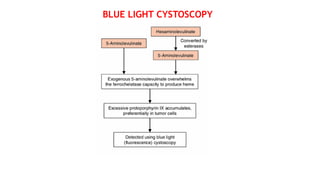
BLUE LIGHT CYSTOSCOPY
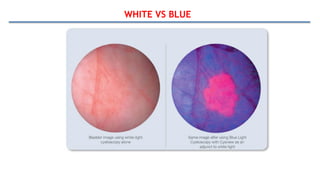
WHITE VS BLUE
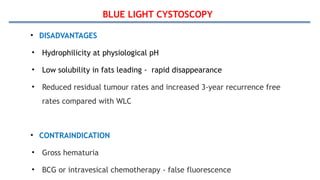
BLUE LIGHT CYSTOSCOPY
• DISADVANTAGES
• Hydrophilicity at physiological pH
• Low solubility in fats leading - rapid disappearance
• Reduced residual tumour rates and increased 3-year recurrence free
rates compared with WLC
• CONTRAINDICATION
• Gross hematuria
• BCG or intravesical chemotherapy - false fluorescence
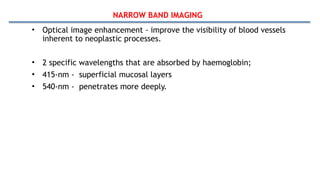
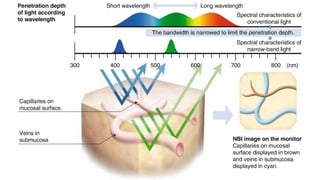
NARROW BAND IMAGING
• Optical image enhancement - improve the visibility of blood vessels
inherent to neoplastic processes.
• 2 specific wavelengths that are absorbed by haemoglobin;
• 415-nm - superficial mucosal layers
• 540-nm - penetrates more deeply.
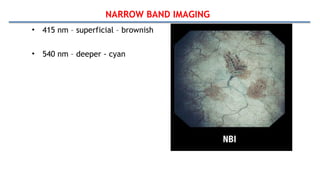
NARROW BAND IMAGING
• 415 nm – superficial – brownish
• 540 nm – deeper - cyan
OPTICAL COHERENCE TOMOGRAPHY
• Real-time imaging technology using near-infrared light (890–1300 nm)
to provide cross-sectional images of biologic tissues.
• Early experience suggests more than 90% sensitivity, specificity.
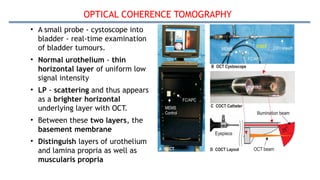
OPTICAL COHERENCE TOMOGRAPHY
• A small probe - cystoscope into
bladder - real-time examination
of bladder tumours.
• Normal urothelium - thin
horizontal layer of uniform low
signal intensity
• LP - scattering and thus appears
as a brighter horizontal
underlying layer with OCT.
• Between these two layers, the
basement membrane
• Distinguish layers of urothelium
and lamina propria as well as
muscularis propria
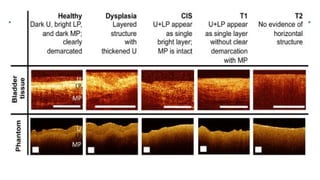
OPTICAL COHERENCE TOMOGRAPHY
• BC - irregular, thickened layer of heterogeneous signal intensity in
OCT images.
• The visualization of CIS – difficult.
• CIS and inflammation - heterogeneous signal intensity of the
unbroadened urothelium, causing a reduced contrast with the
untouched LP
• NMIBC - sensitivity of 75–90% and a specificity of 89% with OCT
CONFOCAL LASER ENDOMICROSCOPY
• CLE - confocal microscopy - high-resolution cellular and subcellular
imaging.
• Micro-architectural and cellular level to distinguish between normal
urothelium, benign inflammatory lesions, and low vs high-grade tumours
• A 488 nm low-power laser scans a tissue section of interest below the
surface.
• Using fluorescein - intravenously or topically.
• CLE images are acquired as video sequences at a rate of 12 frames per
second via direct contact of the probe with tissues of interest.
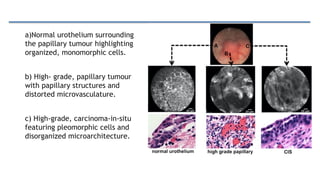
a)Normal urothelium surrounding
the papillary tumour highlighting
organized, monomorphic cells.
b) High- grade, papillary tumour
with papillary structures and
distorted microvasculature.
c) High-grade, carcinoma-in-situ
featuring pleomorphic cells and
disorganized microarchitecture.
URINE CYTOLOGY
• It has high sensitivity in HG and G3 tumours (84%), but low sensitivity in LG/G1
tumours (16%).
• The sensitivity in CIS detection is 28–100% .
• Cytology is useful, particularly as an adjunct to cystoscopy, in patients with HG/G3
tumours.
• Positive voided urinary cytology can indicate an urothelial carcinoma anywhere in
the urinary tract; negative cytology, however, does not exclude its presence.
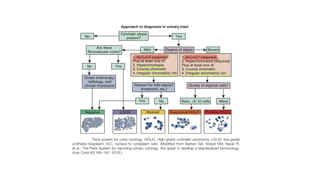
The Paris System published in 2016 redefined urinary cytology diagnostic categories as
follows:
• No adequate diagnosis possible (No diagnosis);
• Negative for urothelial carcinoma (Negative);
• Atypical urothelial cells (Atypia);
• Suspicious for HG urothelial carcinoma (Suspicious);
• High-grade/G3 urothelial carcinoma (Malignant).
The principle of the system and its terminology underlines the role of urinary cytology
in detection of G3 and HG tumours.
URINARY MOLECULAR MARKERS
• UroVysion assay(FISH)
• Nuclear Matrix Protein (NMP)22
• Fibroblast Growth Factor
• Receptor (FGFR)3/Telomerase Reverse Transcriptase (TERT)
• Microsatellite analysis
BLADDER TUMOR ANTIGEN
• BTA assay detects two basement membrane antigens – Human complement factor H
related protein and complement factor H using monoclonal antibodies.
• Two forms of BTA test :
1) BTA STAT test
2) BTA TRAK test
IMMUNOCYT
• Cell based adjunct to urine cytology.
• Fluorescent labelled antibodies are directed against three antigens
expressed by exfoliated urothelial cells - Glycosylated form of CEA and two
mucins.
• Operator dependent , interobserver variability.
CxBladder
• Cell based urine assay that comprises five m RNA fragments.
• Currently available urinary biomarkers miss many patients with bladder
cancer and yield false positives in others.
• Biomarkers are currently used in combination with cystoscopy as a
surveillance strategy for patients with a known history of NMIBC.
PATHOLOGY
• Epithelial Metaplasia.
• Papilloma and Inverted Papilloma.
• Nephrogenic adenoma.
• Leucoplakia.
• Cystitis Cystica and Glandularis.
• Precursor malignant lesions.
• Malignant lesions.
EPITHELIAL METAPLASIA
• Focal area of transformed urothelium, with otherwise normal nuclear and
cellular morphology.
• Located on the trigone.
• Biopsy is unnecessary.
• No treatment required.
PAPILLOMA & INVERTED PAPILLOMA
• Papilloma is characterised by benign proliferative growth of delicate stalks
lined by normal appearing urothelium.
• An inverted papilloma is a benign proliferative lesion that is associated with
chronic inflammation or bladder outlet obstruction and can be located
throughout the bladder but most commonly on the trigone, accounting for
less than 1% of all bladder tumors.
• Painless gross hematuria.
• Lack of cytologic atypia.
NEPHROGENIC ADENOMA
• Rare tumor caused by chronic irritation of the urothelium and can arise from
trauma, prior surgery, renal transplantation, intravesical chemotherapy,
stones, catheters, and infection.
• Composed of glandular appearing tubules similar to renal tubules that
involve mucosa and submucosa of the bladder.
• Cystoscopically, it may appear like a papillary neoplasm and may be hard to
distinguish from more aggressive bladder neoplasms.
• Lesions may cause dysuria, hematuria, prompting cystoscopic investigation.
• Recurrence does occur but is uncommon and can be safely managed with
repeat resection.
LEUKOPLAKIA
• White, flaky plaques floating in the bladder.
• Frequent, recurrent infections with urinary urgency and frequency.
• Bladder mucosa is chronically inflamed, displaying diffuse squamous
metaplasia of keratinizing type leukoplakia.
• More recently a connection between leukoplakia as an independent risk
factor for bladder cancer has been disproven.
• Staack et al. (2006) performed cytogenic studies of bladder leukoplakia in
77 cases using DNA analysis for tumor suppressor gene TP52 and found no
evidence to suggest that this condition was premalignant; therefore
cystoscopy, biopsy, and further treatment were unnecessary.
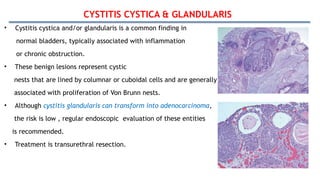
CYSTITIS CYSTICA & GLANDULARIS
• Cystitis cystica and/or glandularis is a common finding in
normal bladders, typically associated with inflammation
or chronic obstruction.
• These benign lesions represent cystic
nests that are lined by columnar or cuboidal cells and are generally
associated with proliferation of Von Brunn nests.
• Although cystitis glandularis can transform into adenocarcinoma,
the risk is low , regular endoscopic evaluation of these entities
is recommended.
• Treatment is transurethral resection.
PRECURSOR MALIGNANT LESIONS
• The 2004 World Health Organization classification system for urothelial
neoplasia classifies pre-malignant lesions as
1. Urothelial hyperplasia (flat and papillary)
2. Reactive atypia
3. Urothelial atypia of unknown significance (AUS)
4. Urothelial dysplasia
5. Low-grade intraurothelial neoplasia
MALIGNANT LESIONS
• Urothelial carcinoma is the most common malignancy of the urinary tract
and is the second most common cause of death among all genitourinary
tumors.
• Non–muscle-invasive bladder cancer, comprising low- and high-grade
noninvasive papillary neoplasms, CIS, and urothelial carcinoma with
invasion into the lamina propria (T1) , make up approximately 70% of all
bladder urothelial carcinoma.
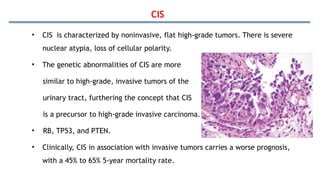
CIS
• CIS is characterized by noninvasive, flat high-grade tumors. There is severe
nuclear atypia, loss of cellular polarity.
• The genetic abnormalities of CIS are more
similar to high-grade, invasive tumors of the
urinary tract, furthering the concept that CIS
is a precursor to high-grade invasive carcinoma.
• RB, TP53, and PTEN.
• Clinically, CIS in association with invasive tumors carries a worse prognosis,
with a 45% to 65% 5-year mortality rate.
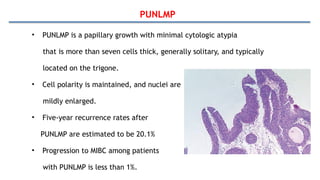
PUNLMP
• PUNLMP is a papillary growth with minimal cytologic atypia
that is more than seven cells thick, generally solitary, and typically
located on the trigone.
• Cell polarity is maintained, and nuclei are
mildly enlarged.
• Five-year recurrence rates after
PUNLMP are estimated to be 20.1%
• Progression to MIBC among patients
with PUNLMP is less than 1%.
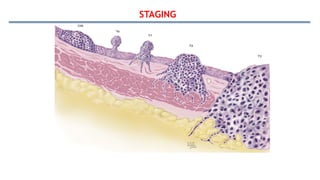
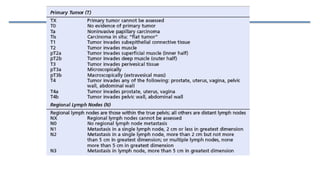
STAGING
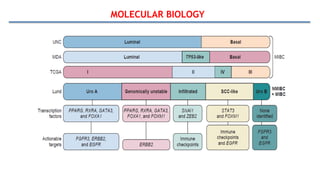
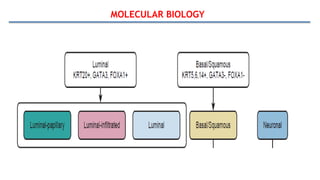
MOLECULAR BIOLOGY
MOLECULAR BIOLOGY
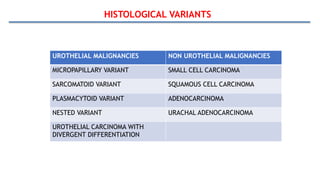
HISTOLOGICAL VARIANTS
UROTHELIAL MALIGNANCIES NON UROTHELIAL MALIGNANCIES
MICROPAPILLARY VARIANT SMALL CELL CARCINOMA
SARCOMATOID VARIANT SQUAMOUS CELL CARCINOMA
PLASMACYTOID VARIANT ADENOCARCINOMA
NESTED VARIANT URACHAL ADENOCARCINOMA
UROTHELIAL CARCINOMA WITH
DIVERGENT DIFFERENTIATION
SMALL CELL CARCINOMA
• Small cell carcinoma is a rare, poorly differentiated neuroendocrine
neoplasm that primarily arises in the lung but can occur in extrapulmonary
sites, including the prostate and bladder.
• Although patients typically are seen with hematuria, there have been
reports of paraneoplastic syndromes associated with small cell carcinoma
including hypercalcemia, Cushing syndrome, and sensory neuropathy.
• Clinically aggressive and chemosensitive.
SQUAMOUS CELL CARCINOMA
• Chronic infection with S. haematobium or other bacteria leads to SCC of the
bladder.
• The central factor contributing to the development of SCC is chronic inflammation
of the urinary tract.
• Historically patients with spinal cord injury requiring chronic catheterization had
an incidence of SCC of 2.3%; however, this incidence rate has declined to 0.39%
because of the trend toward intermittent self-catheterization.
• Radical cystectomy is the mainstay treatment for SCC, and there is no clear
consensus regarding the use of neoadjuvant chemotherapy before surgery.
ADENOCARCINOMA
• Adenocarcinoma may be a primary cancer arising from the bladder
urothelium with a pure glandular phenotype, or may be a secondary cancer
from a distant metastasis, or more commonly from direct extension from
the colon, prostate, endometrium, or cervix.
• Although the urachus is not an anatomic component of the urinary bladder,
urachal adenocarcinomas share similar pathologic and clinical features to
bladder adenocarcinoma.
• Risk factors for adenocarcinoma are a history of bladder exstrophy,
schistosomiasis, and chronic irritation or obstruction.
URACHAL ADENOCARCINOMA
• Urachal adenocarcinoma is a rare cancer, accounting for approximately
one-third of all bladder adenocarcinomas, that arises from
the allantoic remnant that connects the bladder to the umbilical cord
during embryogenesis.
• Although urachal remnants are typically lined by urothelial cells, urachal
cancer is almost always adenocarcinoma in origin.
URACHAL ADENOCARCINOMA
• The 2016 WHO classification introduced criteria for the
diagnosis of urachal adenocarcinoma :
1. Tumor should be located in the bladder dome or
anterior abdominal wall, with the epicenter of the tumor occurring in
the bladder wall.
2. Tumor could not have widespread cystitis cystica,
and there should be a thorough investigation for a secondary source
for the adenocarcinoma.
• The standard treatment for urachal adenocarcinoma is en bloc resection of
the bladder dome, urachal ligament and umbilicus.
THANK YOU

BLADDER TUMOR introduction and management

  • 1.
    BASICS IN BLADDERTUMOR Dr LAKSHMI KANDHAN
  • 2.
    EPIDEMIOLOGY • Bladder cancer(BC) is the seventh most commonly diagnosed cancer in the male population worldwide, while it drops to tenth when both genders are considered. • Recurrence and routine surveillance/treatment make bladder cancer most expensive malignancy to treat from diagnosis to death. • M:F = 3:1 (survival better in men). • Peak incidence ages 60-70 years. • Majority (~93%) are urothelial cancer (transitional cell carcinoma).
  • 3.
    RISK FACTORS • GENETICS N-acetyltransferase2 (NAT2) and a deletion of glutathione S-transferase μ (GSTM1). Both of these genes are associated with the ability to metabolize aromatic amines. Lynch syndrome. • SMOKING Tobacco is the main known cause of bladder cancer and accounts for 30% to 40% of all urothelial carcinoma. • BODY MASS INDEX The mechanism of excess weight contributing to cancer risk includes insulin resistance, chronic hyperinsulinemia, increased bioavailability of steroid hormones, and localized inflammation.
  • 4.
    RISK FACTORS • OCCUPATIONALRISK Occupational exposures account for between 5% and 10% of all bladder cancer. Tobacco, dye, and rubber workers, hairdressers, painters, and leather workers. • SCHISTOSOMIASIS S. haematobium is the one linked to squamous cell bladder cancer. S. haematobium live in the venules of the human urinary bladder, where they lay eggs, producing irritation and tissue fibrosis.
  • 5.
    RISK FACTORS • RADIATION •DRUGS – Pioglitazone, Cyclophosphamide • MEDICAL CONDITIONS – o Neurogenic bladder and spinal cord injuries with long term catheters. o Bladder calculi , Urinary outflow obstruction. o Recurrent UTI.
  • 6.
    SIGNS AND SYMPTOMS •Gross haematuria most common • Most commonly intermittent • Gross 68-97% • Microhaematuria- 11% • Irritative voiding symptoms (especially in absence of UTI)
  • 7.
    IMAGING • CT urogram– Detect papillary tumour in the urinary tract • IV urography – Alternate for CT Urogram • Ultrasound - Moderate sensitivity to a wide range of abnormalities in the upper- and lower urinary tract. It cannot rule out all potential causes of haematuria.
  • 8.
    CYSTOSCOPY • Gold standard •All adult patients with gross haematuria and 35 years and older with microscopic haematuria • White light cystoscopy • Blue light cystoscopy
  • 9.
    WHITE LIGHT CYSTOSCOPY •White light cystoscopy (WLC) is the cornerstone detection method for NMIBC, and transurethral resection of bladder tumour (TURBT) is the gold standard treatment procedure performed during WLC.
  • 10.
  • 11.
  • 12.
    BLUE LIGHT CYSTOSCOPY •DISADVANTAGES • Hydrophilicity at physiological pH • Low solubility in fats leading - rapid disappearance • Reduced residual tumour rates and increased 3-year recurrence free rates compared with WLC • CONTRAINDICATION • Gross hematuria • BCG or intravesical chemotherapy - false fluorescence
  • 13.
    NARROW BAND IMAGING •Optical image enhancement - improve the visibility of blood vessels inherent to neoplastic processes. • 2 specific wavelengths that are absorbed by haemoglobin; • 415-nm - superficial mucosal layers • 540-nm - penetrates more deeply.
  • 15.
    NARROW BAND IMAGING •415 nm – superficial – brownish • 540 nm – deeper - cyan
  • 16.
    OPTICAL COHERENCE TOMOGRAPHY •Real-time imaging technology using near-infrared light (890–1300 nm) to provide cross-sectional images of biologic tissues. • Early experience suggests more than 90% sensitivity, specificity.
  • 17.
    OPTICAL COHERENCE TOMOGRAPHY •A small probe - cystoscope into bladder - real-time examination of bladder tumours. • Normal urothelium - thin horizontal layer of uniform low signal intensity • LP - scattering and thus appears as a brighter horizontal underlying layer with OCT. • Between these two layers, the basement membrane • Distinguish layers of urothelium and lamina propria as well as muscularis propria
  • 19.
    OPTICAL COHERENCE TOMOGRAPHY •BC - irregular, thickened layer of heterogeneous signal intensity in OCT images. • The visualization of CIS – difficult. • CIS and inflammation - heterogeneous signal intensity of the unbroadened urothelium, causing a reduced contrast with the untouched LP • NMIBC - sensitivity of 75–90% and a specificity of 89% with OCT
  • 20.
    CONFOCAL LASER ENDOMICROSCOPY •CLE - confocal microscopy - high-resolution cellular and subcellular imaging. • Micro-architectural and cellular level to distinguish between normal urothelium, benign inflammatory lesions, and low vs high-grade tumours • A 488 nm low-power laser scans a tissue section of interest below the surface. • Using fluorescein - intravenously or topically. • CLE images are acquired as video sequences at a rate of 12 frames per second via direct contact of the probe with tissues of interest.
  • 21.
    a)Normal urothelium surrounding thepapillary tumour highlighting organized, monomorphic cells. b) High- grade, papillary tumour with papillary structures and distorted microvasculature. c) High-grade, carcinoma-in-situ featuring pleomorphic cells and disorganized microarchitecture.
  • 22.
    URINE CYTOLOGY • Ithas high sensitivity in HG and G3 tumours (84%), but low sensitivity in LG/G1 tumours (16%). • The sensitivity in CIS detection is 28–100% . • Cytology is useful, particularly as an adjunct to cystoscopy, in patients with HG/G3 tumours. • Positive voided urinary cytology can indicate an urothelial carcinoma anywhere in the urinary tract; negative cytology, however, does not exclude its presence.
  • 23.
    The Paris Systempublished in 2016 redefined urinary cytology diagnostic categories as follows: • No adequate diagnosis possible (No diagnosis); • Negative for urothelial carcinoma (Negative); • Atypical urothelial cells (Atypia); • Suspicious for HG urothelial carcinoma (Suspicious); • High-grade/G3 urothelial carcinoma (Malignant). The principle of the system and its terminology underlines the role of urinary cytology in detection of G3 and HG tumours.
  • 25.
    URINARY MOLECULAR MARKERS •UroVysion assay(FISH) • Nuclear Matrix Protein (NMP)22 • Fibroblast Growth Factor • Receptor (FGFR)3/Telomerase Reverse Transcriptase (TERT) • Microsatellite analysis
  • 26.
    BLADDER TUMOR ANTIGEN •BTA assay detects two basement membrane antigens – Human complement factor H related protein and complement factor H using monoclonal antibodies. • Two forms of BTA test : 1) BTA STAT test 2) BTA TRAK test
  • 27.
    IMMUNOCYT • Cell basedadjunct to urine cytology. • Fluorescent labelled antibodies are directed against three antigens expressed by exfoliated urothelial cells - Glycosylated form of CEA and two mucins. • Operator dependent , interobserver variability.
  • 28.
    CxBladder • Cell basedurine assay that comprises five m RNA fragments. • Currently available urinary biomarkers miss many patients with bladder cancer and yield false positives in others. • Biomarkers are currently used in combination with cystoscopy as a surveillance strategy for patients with a known history of NMIBC.
  • 29.
    PATHOLOGY • Epithelial Metaplasia. •Papilloma and Inverted Papilloma. • Nephrogenic adenoma. • Leucoplakia. • Cystitis Cystica and Glandularis. • Precursor malignant lesions. • Malignant lesions.
  • 30.
    EPITHELIAL METAPLASIA • Focalarea of transformed urothelium, with otherwise normal nuclear and cellular morphology. • Located on the trigone. • Biopsy is unnecessary. • No treatment required.
  • 31.
    PAPILLOMA & INVERTEDPAPILLOMA • Papilloma is characterised by benign proliferative growth of delicate stalks lined by normal appearing urothelium. • An inverted papilloma is a benign proliferative lesion that is associated with chronic inflammation or bladder outlet obstruction and can be located throughout the bladder but most commonly on the trigone, accounting for less than 1% of all bladder tumors. • Painless gross hematuria. • Lack of cytologic atypia.
  • 32.
    NEPHROGENIC ADENOMA • Raretumor caused by chronic irritation of the urothelium and can arise from trauma, prior surgery, renal transplantation, intravesical chemotherapy, stones, catheters, and infection. • Composed of glandular appearing tubules similar to renal tubules that involve mucosa and submucosa of the bladder. • Cystoscopically, it may appear like a papillary neoplasm and may be hard to distinguish from more aggressive bladder neoplasms. • Lesions may cause dysuria, hematuria, prompting cystoscopic investigation. • Recurrence does occur but is uncommon and can be safely managed with repeat resection.
  • 33.
    LEUKOPLAKIA • White, flakyplaques floating in the bladder. • Frequent, recurrent infections with urinary urgency and frequency. • Bladder mucosa is chronically inflamed, displaying diffuse squamous metaplasia of keratinizing type leukoplakia. • More recently a connection between leukoplakia as an independent risk factor for bladder cancer has been disproven. • Staack et al. (2006) performed cytogenic studies of bladder leukoplakia in 77 cases using DNA analysis for tumor suppressor gene TP52 and found no evidence to suggest that this condition was premalignant; therefore cystoscopy, biopsy, and further treatment were unnecessary.
  • 34.
    CYSTITIS CYSTICA &GLANDULARIS • Cystitis cystica and/or glandularis is a common finding in normal bladders, typically associated with inflammation or chronic obstruction. • These benign lesions represent cystic nests that are lined by columnar or cuboidal cells and are generally associated with proliferation of Von Brunn nests. • Although cystitis glandularis can transform into adenocarcinoma, the risk is low , regular endoscopic evaluation of these entities is recommended. • Treatment is transurethral resection.
  • 35.
    PRECURSOR MALIGNANT LESIONS •The 2004 World Health Organization classification system for urothelial neoplasia classifies pre-malignant lesions as 1. Urothelial hyperplasia (flat and papillary) 2. Reactive atypia 3. Urothelial atypia of unknown significance (AUS) 4. Urothelial dysplasia 5. Low-grade intraurothelial neoplasia
  • 36.
    MALIGNANT LESIONS • Urothelialcarcinoma is the most common malignancy of the urinary tract and is the second most common cause of death among all genitourinary tumors. • Non–muscle-invasive bladder cancer, comprising low- and high-grade noninvasive papillary neoplasms, CIS, and urothelial carcinoma with invasion into the lamina propria (T1) , make up approximately 70% of all bladder urothelial carcinoma.
  • 37.
    CIS • CIS ischaracterized by noninvasive, flat high-grade tumors. There is severe nuclear atypia, loss of cellular polarity. • The genetic abnormalities of CIS are more similar to high-grade, invasive tumors of the urinary tract, furthering the concept that CIS is a precursor to high-grade invasive carcinoma. • RB, TP53, and PTEN. • Clinically, CIS in association with invasive tumors carries a worse prognosis, with a 45% to 65% 5-year mortality rate.
  • 38.
    PUNLMP • PUNLMP isa papillary growth with minimal cytologic atypia that is more than seven cells thick, generally solitary, and typically located on the trigone. • Cell polarity is maintained, and nuclei are mildly enlarged. • Five-year recurrence rates after PUNLMP are estimated to be 20.1% • Progression to MIBC among patients with PUNLMP is less than 1%.
  • 39.
  • 41.
  • 42.
  • 43.
    HISTOLOGICAL VARIANTS UROTHELIAL MALIGNANCIESNON UROTHELIAL MALIGNANCIES MICROPAPILLARY VARIANT SMALL CELL CARCINOMA SARCOMATOID VARIANT SQUAMOUS CELL CARCINOMA PLASMACYTOID VARIANT ADENOCARCINOMA NESTED VARIANT URACHAL ADENOCARCINOMA UROTHELIAL CARCINOMA WITH DIVERGENT DIFFERENTIATION
  • 44.
    SMALL CELL CARCINOMA •Small cell carcinoma is a rare, poorly differentiated neuroendocrine neoplasm that primarily arises in the lung but can occur in extrapulmonary sites, including the prostate and bladder. • Although patients typically are seen with hematuria, there have been reports of paraneoplastic syndromes associated with small cell carcinoma including hypercalcemia, Cushing syndrome, and sensory neuropathy. • Clinically aggressive and chemosensitive.
  • 45.
    SQUAMOUS CELL CARCINOMA •Chronic infection with S. haematobium or other bacteria leads to SCC of the bladder. • The central factor contributing to the development of SCC is chronic inflammation of the urinary tract. • Historically patients with spinal cord injury requiring chronic catheterization had an incidence of SCC of 2.3%; however, this incidence rate has declined to 0.39% because of the trend toward intermittent self-catheterization. • Radical cystectomy is the mainstay treatment for SCC, and there is no clear consensus regarding the use of neoadjuvant chemotherapy before surgery.
  • 46.
    ADENOCARCINOMA • Adenocarcinoma maybe a primary cancer arising from the bladder urothelium with a pure glandular phenotype, or may be a secondary cancer from a distant metastasis, or more commonly from direct extension from the colon, prostate, endometrium, or cervix. • Although the urachus is not an anatomic component of the urinary bladder, urachal adenocarcinomas share similar pathologic and clinical features to bladder adenocarcinoma. • Risk factors for adenocarcinoma are a history of bladder exstrophy, schistosomiasis, and chronic irritation or obstruction.
  • 47.
    URACHAL ADENOCARCINOMA • Urachaladenocarcinoma is a rare cancer, accounting for approximately one-third of all bladder adenocarcinomas, that arises from the allantoic remnant that connects the bladder to the umbilical cord during embryogenesis. • Although urachal remnants are typically lined by urothelial cells, urachal cancer is almost always adenocarcinoma in origin.
  • 48.
    URACHAL ADENOCARCINOMA • The2016 WHO classification introduced criteria for the diagnosis of urachal adenocarcinoma : 1. Tumor should be located in the bladder dome or anterior abdominal wall, with the epicenter of the tumor occurring in the bladder wall. 2. Tumor could not have widespread cystitis cystica, and there should be a thorough investigation for a secondary source for the adenocarcinoma. • The standard treatment for urachal adenocarcinoma is en bloc resection of the bladder dome, urachal ligament and umbilicus.
  • 49.