SUBMITTED BY COURSE TEACHER
ROSHAN SARMILA. A Dr. S. PARTHASARATHY
ID. No. 2016021038 Asst. Prof., (Plant Pathology)
COLLEGE OF AGRICULTURAL TECHNOLOGY
Affiliated to Tamil Nadu Agricultural University, Coimbatore
Kullapuram, Via Vaigai dam, Theni-625 562
CASTOR SEEDLING BLIGHT
SIGNIFICANCE
• Castor oil plant (Ricinus communis L.,
Euphorbiaceae) - Nonedible oilseed crop of arid
and semi arid regions of India.
• Originates from tropical Africa.
• Seeds contain Ricin – extremely toxic protein.
• Oil has industrial and medicinal uses such as
nylon, fibre, jet engine lubricants, dyes, soaps,
oinments, paints, varnishes.
In world,
India is largest producer – 55-60 % TGP
Area - 12.33 lakh ha
Production - 19.64 lakh t
Productivity - 1592 kg / ha
In India,
Gujarat is largest producer – 14.93 lakh t
DISEASE
• Seedling blight – Phytophthora nicotianae (=P.
parasitica) (Dastur) water house.
• Common disease in India.
• First reported from Pusa, Bihar ( 1909) in
moderate to severe form.
• Seedling mortality – 30- 40%
• Favoured by ill drained and prolonged rainy
season( end of june to september).
Also reported in UP in 1948 and Hydrebad in
1947.
DISTRIBUTION:
UP, AP, Telangana, Karnataka, Bihar, Gujarat.
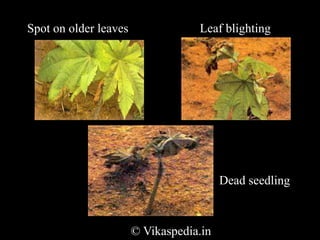
Spot on older leaves Leaf blighting
Dead seedling
© Vikaspedia.in
SYMPTOMS:
 Leaves -Circular, dull green patch on both
surface.
 Spreads and leaf to rot and hanging down.
 Stem - Cause withering and death of seedling due
to destruction of growing point or by the collapse
of stem.
 Initailly on young leaves and spread petiole, stem
causing black discolouration and severe
defoliation.
Spot on older leaf:
 Leaf spots turn yellow and then brown concentric
zones of lighter and darker colour formed.
 Affected leaves shed prematurely.
 Moist – very fine whitish haze is found on under
surface of the leaf spot.
 Direct attack of stem is not very common if it
means damage is less due to the presence of
cuticularised epidermis in older leaves resist
penetration.
PATHOGEN:
 Non septate, inter and intra cellular hyalin
mycelium.
 Sporogiophores emerge through the stomata on
the lower surface singly or in groups.
 A single colourless ovoid or roundish
sporangium is borne at the tip of sporongiophores.
 A ripe sporangium liberates zoospores when put
in water. Which varies from 5 to 45 in each
sporangium.
 Fungus also produces oospore and
chlamydospores.
 It also produces infection on the leaf of sesamum,
this might serve as a collatral or alternative host of
the fungus.
 Aesexual spore: Zoospore.
 Sexual spore: Oospore.
Zoospore
©Forestryimages.org
LIFECYCLE
© researchgate.net
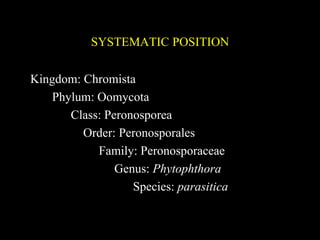
SYSTEMATIC POSITION
Kingdom: Chromista
Phylum: Oomycota
Class: Peronosporea
Order: Peronosporales
Family: Peronosporaceae
Genus: Phytophthora
Species: parasitica
FAVOURABLE CONDITION:
• Continuous rainy weather.
• Low temperature (20-25◦C).
• Low lying and ill drained soils.
MODE OF SPREAD:
Primary source :
Pathogen remains in soil as chlamydospores and
oospores.
Fungus also survive on host like potato, tomato,
brinjal, sesamum.
Secondary source:
Wind borne sporangia.
MANAGEMENT:
 Ill drained, damp, low lying localities should be
avoided for sowing castor.
 Seed dressing with 4g Trichoderma viride
formulation and 3g Metalaxyl (Phenyl amide
compound) per kg of seed.
 Soil drenching with Copper oxychloride (Blue
copper) @ 3g/lit or Metalaxyl 2g/lit.
SUBMITTED BY COURSE TEACHER
ROSHAN SARMILA. A Dr. S. PARTHASARATHY
ID. No. 2016021038 Asst. Prof., (Plant Pathology)
COLLEGE OF AGRICULTURAL TECHNOLOGY
Affiliated to Tamil Nadu Agricultural University, Coimbatore
Kullapuram, Via Vaigai dam, Theni-625 562
CASTOR RUST
CASTOR RUST
© bowerbird.org.au
CASTOR RUST
Melompsora ricini
 It has been recorded on castor oil plant, in Africa,
Asia and southern Europe.
 M. ricini known only on its uredinial and telial
states.
 In Australia, M. ricini was first collected (BRIP
25782) in Brisbane in Auguest, 1999.
 Within weeks the rust was found in perth.
 Yield loss 89.9%, affects rearing of eri silkworm.
SIGNIFICANCE
 Controlling the rust with hyperparasites has been
attempted but not found to be economic
importance.
 It is suggested that at the first sign of infection,
diseased leaves should be destroyed.
SYMPTOMS
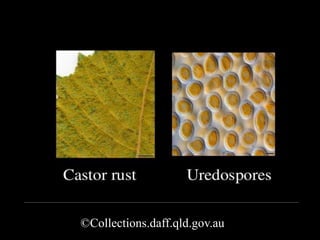
 Minute, orange-yellow coloured, raised pustules
appear with powdery masses on the lower surface
of the leaves and the corresponding upper surface
of the leaves are yellow.
 Often the pustules are grouped in concentric rings
and coalesce together to for drying of leaves.
 Pale leaf spots eventually develop into spore
producing structures called pustules.
 Some cases there may be dozen of pustules on a
single leaf.
 Severely affected often turn yellow and fall
prematurely.
 Heavy infection often reduces the vigour of the
plant. In extreme cases (e.g. with antirrhinum rust)
the plant can be killed.
PATHOGEN
 The hyphae collect beneath the epidermis of the
leaf and form a minute cushion.
 The urdeospores arise beneath the epidermis on
the tips of branched hyphae.
 Stout club-shaped paraphyses are also formed in
the sorus.
 At maturity the epidermis ruptures releasing
clouds of spores.
 The uredospores are round or eliptic, warty and
orange in colour and measure 25-29 × 19-25µ.
 They germinates by germ tube which comes out
from the pores and infects fresh leaves of castor.
 Melompsora ricini is pathogenic to Euphorbia
obtusifolia, E.ipecacuanha, E.geniculata and
E.marginata besides 24 strains and varieties of
R.communis.
©Collections.daff.qld.gov.au
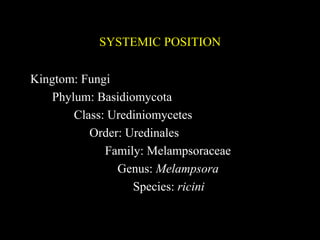
SYSTEMIC POSITION
Kingtom: Fungi
Phylum: Basidiomycota
Class: Urediniomycetes
Order: Uredinales
Family: Melampsoraceae
Genus: Melampsora
Species: ricini
Spreads:
1. Chiefly by urediospores, and sometimes by wind.
Distribution:
1. The disease occurs in Bombay, Deccan districts,
Coimbatore and Nagpur.
2. It usually appears in Bombay between November
and February on castor sown in June.
Favourable condition
Common in India – Nov-Feb-Annual crops.
Geographical distribution:
Africa (Algeria, Congo, Egypt, Ethiopia, Kenya,
Libya, Malawi, Morocco, Mozambique, Rhodesia,
Sudan, Tanzania, Uganda); Asia (Ceylon, Cyprus,
India); Europe (Italy, Lusitania, Portugal).
(From the literature and Herb. IMI)
HOSTS
On Ricinus communis; also by inoculation on
1. Euphorphia geniculata,
2. E. ipecacuanha,
3. E. marginata,
4. E. obtusifolia.
MANAGEMENT
• Rogue out the self sown castor crops and other
weed hosts.
• Spraying the crop with fine sulphur powder @20-
30 kg /ha.
• Spray Mancozeb (Indofil M-45) at 2kg/ha or
Propioconazole (Tilt) 1 lit/ ha.
REFERENCE
• Das.P.C., 2018. Plant Disease. Kalyani Publishers,
Ludhiana.
• Rangaswami.G., Mahadevan.A., 2016. Disease of
Crop Plants in India. (Fourth edition). PHI
learning private limited Delhi.
• Agritech.tnau.ac.in/crop-protection/crop-prot-
crop%20disease-oilseeds-castor.html

CASTOR SEEDLING BLIGHT ,CASTOR RUST

  • 1.
    SUBMITTED BY COURSETEACHER ROSHAN SARMILA. A Dr. S. PARTHASARATHY ID. No. 2016021038 Asst. Prof., (Plant Pathology) COLLEGE OF AGRICULTURAL TECHNOLOGY Affiliated to Tamil Nadu Agricultural University, Coimbatore Kullapuram, Via Vaigai dam, Theni-625 562 CASTOR SEEDLING BLIGHT
  • 2.
    SIGNIFICANCE • Castor oilplant (Ricinus communis L., Euphorbiaceae) - Nonedible oilseed crop of arid and semi arid regions of India. • Originates from tropical Africa. • Seeds contain Ricin – extremely toxic protein. • Oil has industrial and medicinal uses such as nylon, fibre, jet engine lubricants, dyes, soaps, oinments, paints, varnishes.
  • 3.
    In world, India islargest producer – 55-60 % TGP Area - 12.33 lakh ha Production - 19.64 lakh t Productivity - 1592 kg / ha In India, Gujarat is largest producer – 14.93 lakh t
  • 4.
    DISEASE • Seedling blight– Phytophthora nicotianae (=P. parasitica) (Dastur) water house. • Common disease in India. • First reported from Pusa, Bihar ( 1909) in moderate to severe form. • Seedling mortality – 30- 40% • Favoured by ill drained and prolonged rainy season( end of june to september).
  • 5.
    Also reported inUP in 1948 and Hydrebad in 1947. DISTRIBUTION: UP, AP, Telangana, Karnataka, Bihar, Gujarat.
  • 6.
    Spot on olderleaves Leaf blighting Dead seedling © Vikaspedia.in
  • 7.
    SYMPTOMS:  Leaves -Circular,dull green patch on both surface.  Spreads and leaf to rot and hanging down.  Stem - Cause withering and death of seedling due to destruction of growing point or by the collapse of stem.  Initailly on young leaves and spread petiole, stem causing black discolouration and severe defoliation.
  • 8.
    Spot on olderleaf:  Leaf spots turn yellow and then brown concentric zones of lighter and darker colour formed.  Affected leaves shed prematurely.  Moist – very fine whitish haze is found on under surface of the leaf spot.  Direct attack of stem is not very common if it means damage is less due to the presence of cuticularised epidermis in older leaves resist penetration.
  • 9.
    PATHOGEN:  Non septate,inter and intra cellular hyalin mycelium.  Sporogiophores emerge through the stomata on the lower surface singly or in groups.  A single colourless ovoid or roundish sporangium is borne at the tip of sporongiophores.
  • 10.
     A ripesporangium liberates zoospores when put in water. Which varies from 5 to 45 in each sporangium.  Fungus also produces oospore and chlamydospores.  It also produces infection on the leaf of sesamum, this might serve as a collatral or alternative host of the fungus.  Aesexual spore: Zoospore.  Sexual spore: Oospore.
  • 11.
  • 12.
  • 13.
    SYSTEMATIC POSITION Kingdom: Chromista Phylum:Oomycota Class: Peronosporea Order: Peronosporales Family: Peronosporaceae Genus: Phytophthora Species: parasitica
  • 14.
    FAVOURABLE CONDITION: • Continuousrainy weather. • Low temperature (20-25◦C). • Low lying and ill drained soils. MODE OF SPREAD: Primary source : Pathogen remains in soil as chlamydospores and oospores. Fungus also survive on host like potato, tomato, brinjal, sesamum. Secondary source: Wind borne sporangia.
  • 15.
    MANAGEMENT:  Ill drained,damp, low lying localities should be avoided for sowing castor.  Seed dressing with 4g Trichoderma viride formulation and 3g Metalaxyl (Phenyl amide compound) per kg of seed.  Soil drenching with Copper oxychloride (Blue copper) @ 3g/lit or Metalaxyl 2g/lit.
  • 16.
    SUBMITTED BY COURSETEACHER ROSHAN SARMILA. A Dr. S. PARTHASARATHY ID. No. 2016021038 Asst. Prof., (Plant Pathology) COLLEGE OF AGRICULTURAL TECHNOLOGY Affiliated to Tamil Nadu Agricultural University, Coimbatore Kullapuram, Via Vaigai dam, Theni-625 562 CASTOR RUST
  • 17.
  • 18.
    CASTOR RUST Melompsora ricini It has been recorded on castor oil plant, in Africa, Asia and southern Europe.  M. ricini known only on its uredinial and telial states.  In Australia, M. ricini was first collected (BRIP 25782) in Brisbane in Auguest, 1999.  Within weeks the rust was found in perth.  Yield loss 89.9%, affects rearing of eri silkworm.
  • 19.
    SIGNIFICANCE  Controlling therust with hyperparasites has been attempted but not found to be economic importance.  It is suggested that at the first sign of infection, diseased leaves should be destroyed.
  • 20.
    SYMPTOMS  Minute, orange-yellowcoloured, raised pustules appear with powdery masses on the lower surface of the leaves and the corresponding upper surface of the leaves are yellow.  Often the pustules are grouped in concentric rings and coalesce together to for drying of leaves.  Pale leaf spots eventually develop into spore producing structures called pustules.
  • 21.
     Some casesthere may be dozen of pustules on a single leaf.  Severely affected often turn yellow and fall prematurely.  Heavy infection often reduces the vigour of the plant. In extreme cases (e.g. with antirrhinum rust) the plant can be killed.
  • 22.
    PATHOGEN  The hyphaecollect beneath the epidermis of the leaf and form a minute cushion.  The urdeospores arise beneath the epidermis on the tips of branched hyphae.  Stout club-shaped paraphyses are also formed in the sorus.
  • 23.
     At maturitythe epidermis ruptures releasing clouds of spores.  The uredospores are round or eliptic, warty and orange in colour and measure 25-29 × 19-25µ.  They germinates by germ tube which comes out from the pores and infects fresh leaves of castor.  Melompsora ricini is pathogenic to Euphorbia obtusifolia, E.ipecacuanha, E.geniculata and E.marginata besides 24 strains and varieties of R.communis.
  • 24.
  • 25.
    SYSTEMIC POSITION Kingtom: Fungi Phylum:Basidiomycota Class: Urediniomycetes Order: Uredinales Family: Melampsoraceae Genus: Melampsora Species: ricini
  • 26.
    Spreads: 1. Chiefly byurediospores, and sometimes by wind. Distribution: 1. The disease occurs in Bombay, Deccan districts, Coimbatore and Nagpur. 2. It usually appears in Bombay between November and February on castor sown in June.
  • 27.
    Favourable condition Common inIndia – Nov-Feb-Annual crops. Geographical distribution: Africa (Algeria, Congo, Egypt, Ethiopia, Kenya, Libya, Malawi, Morocco, Mozambique, Rhodesia, Sudan, Tanzania, Uganda); Asia (Ceylon, Cyprus, India); Europe (Italy, Lusitania, Portugal). (From the literature and Herb. IMI)
  • 28.
    HOSTS On Ricinus communis;also by inoculation on 1. Euphorphia geniculata, 2. E. ipecacuanha, 3. E. marginata, 4. E. obtusifolia.
  • 29.
    MANAGEMENT • Rogue outthe self sown castor crops and other weed hosts. • Spraying the crop with fine sulphur powder @20- 30 kg /ha. • Spray Mancozeb (Indofil M-45) at 2kg/ha or Propioconazole (Tilt) 1 lit/ ha.
  • 30.
    REFERENCE • Das.P.C., 2018.Plant Disease. Kalyani Publishers, Ludhiana. • Rangaswami.G., Mahadevan.A., 2016. Disease of Crop Plants in India. (Fourth edition). PHI learning private limited Delhi. • Agritech.tnau.ac.in/crop-protection/crop-prot- crop%20disease-oilseeds-castor.html