PRESENTATION ON
       COLORS


 NIKITA HAKELS
 HASHAM-UL-HAQ
 QAZI MOHAMMAD SAAD
IBHRAHIM
CONTENTS
Introduction to Color
             Theory
With colors you can set a mood, attract
attention, or make a statement. You can use
color to energize, or to cool down. By
selecting the right color scheme, you can
create an ambiance of elegance, warmth or
tranquility, or you can convey an image of
playful youthfulness. Color can be your most
powerful design element if you learn to use
it effectively.
 
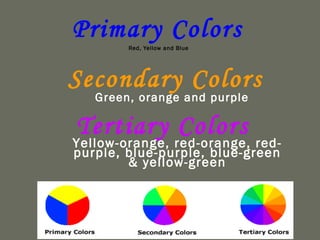
Primary Colors
        Red, Yellow and Blue


Secondary Colors
   Green, orange and purple

Tertiary Colors
Yellow-orange, red-orange, red-
purple, blue-purple, blue-green
        & yellow-green
Primary Colors
• In traditional color theory
(used in paint and pigments),
primary colors are the 3
pigment colors that can not be
mixed or formed by any
combination of other colors.
Secondary Colors
These are the colors
formed by mixing the
primary colors
Tertiary Colors
• These are the colors formed
by mixing a primary and a
secondary color. That's why
the hue is a two word name,
such as blue-green, red-violet,
and yellow-orange.
Color Scheme
    A color scheme is a planned
    combination of colors.

    Color concepts which will help
    you understand color schemes
    include warm colors, cool colors,
    complementary colors and
    adjacent colors.

    There are types of color
    schemes Complementary, Split
    Complementary,  Analogous,
    Triadic, Monochromatic
Triadic Color Scheme
Analogous Color
    Scheme
Split Complementary Color
         Scheme
Complementary color
      Scheme
TRIADIC COLOR SCHEME
 Three hues equally positioned on a color wheel

  ANALOGOUS COLOR SCHEME
 Those colors located adjacent to each other on a
                  color wheel.

SPLIT COMPLEMENTARY COLOR
          SCHEME
  One hue plus two others equally spaced from
                 its complement
     COMPLEMENTARY COLOR
   Those colors across from each other on a
                 SCHEME
                 color wheel.
PSYCHOLOGICAL ASPECT
       OF COLORS
What is Color Psychology
           ?
 It is the study of color as a factor
 in human behavior. This includes very
 diverse studies, ranging from
 quantifying individual
 color Preference to investigating
 the relationship between shirt color
 and match outcome in English
 football
Color Psychology as Therapy
Several ancient cultures, including the Egyptians and Chinese, practiced
chromotherapy, or using colors to heal. Chromotherapy is sometimes
referred to as light therapy or colourology and is still used today as a
holistic or alternative treatment.
In this treatment:
Red was used to stimulate the body and mind and to increase circulation.
Yellow was thought to stimulate the nerves and purify the body.
Orange was used to heal the lungs and to increase energy levels.
Blue was believed to soothe illnesses and treat pain.
Indigo shades were thought to alleviate skin problems.
 
                                     
Use of color to create
         ambiance
• Color has long been used to create feelings of
coziness or spaciousness.

• Colors have an effect on people's moods and
emotions.

• Color can affect our reactions to people. The
effect is subtle but very real; color sways
perception, judgment and behavior.
Light, color, and
            surroundings
• Light and color can influence how people 
perceive the area around them. Different light 
sources affect how the colors of walls and other 
objects are seen.

• Lighter colors may appear to be more orange or 
"brownish" and darker colors may appear even 
darker.

• Light and color can influence how people 
perceive the area around them..
EMOTIONAL ASPECT AND
CULTURAL DIVERSITY OF
       COLORS
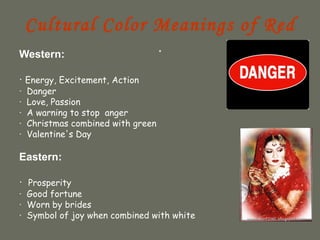
Cultural Color Meanings of Red
Western:
                                    .
· Energy, Excitement, Action
·   Danger
·   Love, Passion
·   A warning to stop anger
·   Christmas combined with green
·   Valentine's Day

Eastern:

·  Prosperity
· Good fortune
· Worn by brides
· Symbol of joy when combined with white
Cultural Color Meanings of Green
 Western:

 · Lucky color in most western cultures
 ·   Spring, New Birth, Regeneration
 ·   Nature and Environmental Awareness
 ·   Color for 'go' at traffic lights
 ·   Saint Patrick's Day
 ·   Christmas combined with red
 ·   Jealousy
 ·   Greed

 Eastern:

 · New life, regeneration and hope fertility
Cultural Color Meanings of
           Pink
Western:

• Caring and Nurturing
• Love and Romance
• Feminine


Eastern:

· Feminine
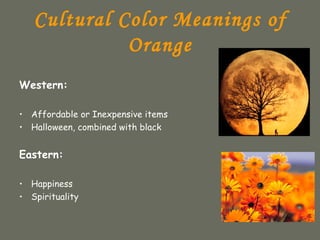
Cultural Color Meanings of
             Orange
Western:

• Affordable or Inexpensive items
• Halloween, combined with black


Eastern:

• Happiness
• Spirituality
Cultural Color Meanings of
          Yellow
Western:
•   Happiness, Joy
•   Hope
•   Cowardice
•   Caution, warning of hazards and hazardous substances


Eastern:

• Sacred
• Imperial
Cultural Color Meanings
            of Blue  
Generally the safest color to use world wide

Western:

•   Trust and authority
•   Conservative, Corporate
•   Peace and Calm
•   Depression, Sadness
•   "something blue" Bridal tradition
•   Masculine color
•   Baby boys

Eastern:

• Immortality
Cultural Color Meanings of
              Purple
Western:

•   Royalty
•   Spirituality
•   Wealth and Fame
•   High ranking positions of authority
•   Military Honor (Purple Heart)

Eastern:

• Wealth
Cultural Color Meanings of
              White
Western:

•   Brides and Weddings
•   Angels
•   Hospitals, Doctors
•   Peace - the white dove
•   Purity and Cleanliness

Eastern:
• Death, mourning and funerals
• Sadness
Cultural Color Meanings of
             Black
Western:

• Power, Control, Intimidation
• Funerals, death, mourning
• Rebellion


Eastern:

• Wealth, Health and Prosperity
THANK
 YOU

black

  • 1.
    PRESENTATION ON COLORS NIKITA HAKELS HASHAM-UL-HAQ QAZI MOHAMMAD SAAD IBHRAHIM
  • 2.
  • 4.
    Introduction to Color Theory With colors you can set a mood, attract attention, or make a statement. You can use color to energize, or to cool down. By selecting the right color scheme, you can create an ambiance of elegance, warmth or tranquility, or you can convey an image of playful youthfulness. Color can be your most powerful design element if you learn to use it effectively.  
  • 5.
    Primary Colors Red, Yellow and Blue Secondary Colors Green, orange and purple Tertiary Colors Yellow-orange, red-orange, red- purple, blue-purple, blue-green & yellow-green
  • 6.
    Primary Colors • Intraditional color theory (used in paint and pigments), primary colors are the 3 pigment colors that can not be mixed or formed by any combination of other colors.
  • 7.
    Secondary Colors These arethe colors formed by mixing the primary colors
  • 8.
    Tertiary Colors • Theseare the colors formed by mixing a primary and a secondary color. That's why the hue is a two word name, such as blue-green, red-violet, and yellow-orange.
  • 10.
    Color Scheme A color scheme is a planned combination of colors. Color concepts which will help you understand color schemes include warm colors, cool colors, complementary colors and adjacent colors. There are types of color schemes Complementary, Split Complementary,  Analogous, Triadic, Monochromatic
  • 11.
  • 12.
  • 13.
  • 14.
  • 15.
    TRIADIC COLOR SCHEME  Threehues equally positioned on a color wheel ANALOGOUS COLOR SCHEME  Those colors located adjacent to each other on a color wheel. SPLIT COMPLEMENTARY COLOR SCHEME   One hue plus two others equally spaced from its complement   COMPLEMENTARY COLOR   Those colors across from each other on a SCHEME color wheel.
  • 16.
  • 17.
    What is ColorPsychology ? It is the study of color as a factor in human behavior. This includes very diverse studies, ranging from quantifying individual color Preference to investigating the relationship between shirt color and match outcome in English football
  • 18.
    Color Psychology asTherapy Several ancient cultures, including the Egyptians and Chinese, practiced chromotherapy, or using colors to heal. Chromotherapy is sometimes referred to as light therapy or colourology and is still used today as a holistic or alternative treatment. In this treatment: Red was used to stimulate the body and mind and to increase circulation. Yellow was thought to stimulate the nerves and purify the body. Orange was used to heal the lungs and to increase energy levels. Blue was believed to soothe illnesses and treat pain. Indigo shades were thought to alleviate skin problems.    
  • 20.
    Use of colorto create ambiance • Color has long been used to create feelings of coziness or spaciousness. • Colors have an effect on people's moods and emotions. • Color can affect our reactions to people. The effect is subtle but very real; color sways perception, judgment and behavior.
  • 21.
    Light, color, and surroundings • Light and color can influence how people  perceive the area around them. Different light  sources affect how the colors of walls and other  objects are seen. • Lighter colors may appear to be more orange or  "brownish" and darker colors may appear even  darker. • Light and color can influence how people  perceive the area around them..
  • 22.
    EMOTIONAL ASPECT AND CULTURALDIVERSITY OF COLORS
  • 24.
    Cultural Color Meaningsof Red Western: . · Energy, Excitement, Action · Danger · Love, Passion · A warning to stop anger · Christmas combined with green · Valentine's Day Eastern: ·  Prosperity · Good fortune · Worn by brides · Symbol of joy when combined with white
  • 25.
    Cultural Color Meaningsof Green Western: · Lucky color in most western cultures · Spring, New Birth, Regeneration · Nature and Environmental Awareness · Color for 'go' at traffic lights · Saint Patrick's Day · Christmas combined with red · Jealousy · Greed Eastern: · New life, regeneration and hope fertility
  • 26.
    Cultural Color Meaningsof Pink Western: • Caring and Nurturing • Love and Romance • Feminine Eastern: · Feminine
  • 27.
    Cultural Color Meaningsof Orange Western: • Affordable or Inexpensive items • Halloween, combined with black Eastern: • Happiness • Spirituality
  • 28.
    Cultural Color Meaningsof Yellow Western: • Happiness, Joy • Hope • Cowardice • Caution, warning of hazards and hazardous substances Eastern: • Sacred • Imperial
  • 29.
    Cultural Color Meanings of Blue   Generally the safest color to use world wide Western: • Trust and authority • Conservative, Corporate • Peace and Calm • Depression, Sadness • "something blue" Bridal tradition • Masculine color • Baby boys Eastern: • Immortality
  • 30.
    Cultural Color Meaningsof Purple Western: • Royalty • Spirituality • Wealth and Fame • High ranking positions of authority • Military Honor (Purple Heart) Eastern: • Wealth
  • 31.
    Cultural Color Meaningsof White Western: • Brides and Weddings • Angels • Hospitals, Doctors • Peace - the white dove • Purity and Cleanliness Eastern: • Death, mourning and funerals • Sadness
  • 32.
    Cultural Color Meaningsof Black Western: • Power, Control, Intimidation • Funerals, death, mourning • Rebellion Eastern: • Wealth, Health and Prosperity
  • 33.